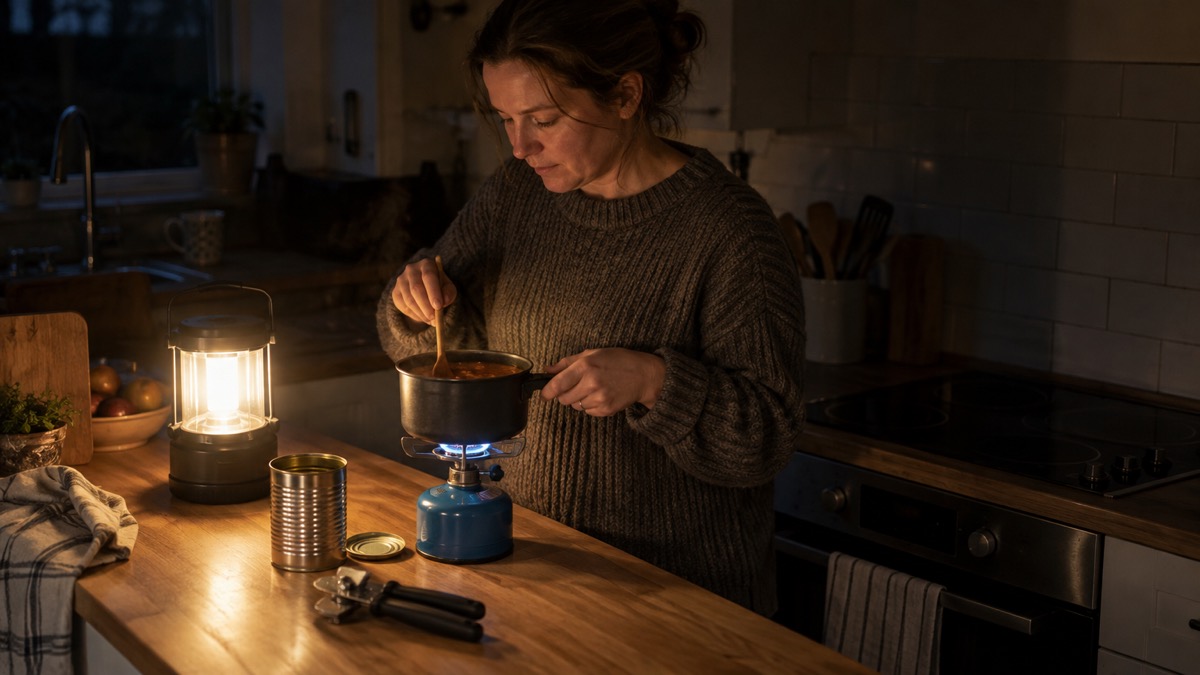
When the power goes off, the food in your fridge and freezer is on a clock. Food Standards Agency guidance is that a power outage of less than 4 hours is unlikely to affect the safety of food in chilled or frozen storage, so most short cuts change nothing about what you eat1. Beyond that, the rules are simple: keep the fridge and freezer doors shut, eat the chilled food first, and fall back on tinned, bottled and dried food from the cupboard, which stays safe at room temperature throughout1.
The order to use food in, set out in official guidance, is: first foods that need refrigeration, then defrosted frozen food that does not need cooking, then room-temperature perishable food such as bread, and finally room-temperature tinned, bottled and dried food1. Food Standards Scotland gives the same order, adding that chilled foods go off quickest, so use them up before anything else2. If the cut lasts longer, throw away food from a fridge if the electricity has been off for more than 4 hours, and food from a freezer if it has been off for more than 24 hours3.
Most households can eat well through a cut with nothing more than a stocked cupboard and a little planning. This page sets out what to eat and when, how to keep fridge and freezer food safe, what to store in advance, and how to heat food safely if you have a camping stove, along with the fire and carbon monoxide rules that come with it.
What to eat first: the order to use your food in
Work down through your kitchen in the order food spoils. Chilled foods go off quickest, so use them up first: milk, cheese, cooked dishes, ready meals, anything labelled with a use-by or keep-refrigerated label2. Next comes frozen food that has defrosted and can be eaten without cooking, then room-temperature perishable food such as bread, and last of all the tinned, bottled and dried food that will still be safe days later1.
This order does two things at once. It gets the most perishable food eaten while it is still safe, and it cuts waste, which Food Standards Scotland states as the aim of the sequence2. Food that is normally stored at ambient temperature will continue to be safe to eat during a cut, and some foods such as tinned foods are safe to eat without heating through, so save those for after the perishable food is finished1.
A practical first meal in a cut is therefore a cold one assembled from the fridge: bread, cheese, butter, cold cooked meat, fruit and vegetables, and anything already cooked that only needed reheating. NHS inform notes that fridge storage covers cooked dishes and foods labelled with a use by or keep refrigerated label, including dairy produce such as milk, cheese and butter, raw and cooked meat, eggs, fresh fruit and vegetables, and ready meals6. Most of that can be eaten cold or at room temperature without any risk, provided the 4-hour rule has not passed.
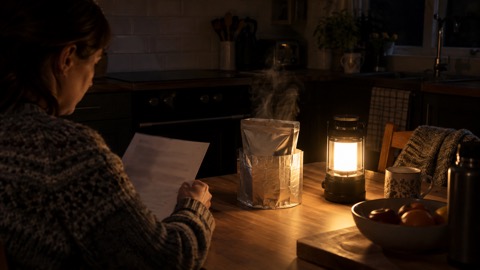
If you have advance notice of a cut, for example from storm warnings, use it. Official tips include filling a flask with hot water and making up a hot water bottle while the power is still on7. A filled food flask can hold a hot meal or hot water for drinks through the first hours of a cut, which takes the pressure off the cold food entirely.
Fridge and freezer food during a power cut
The single most useful thing you can do when the power goes off is nothing: keep the fridge and freezer doors closed. Public Health Wales advises that during a power cut in bad weather you should not open your freezer, and that if the food has defrosted by the time the power is back on you should throw it away4. Wigan Council gives the same advice for the fridge, telling households to protect the food by keeping the fridge or freezer door closed to protect the temperature8. Every opening lets cold air escape and shortens the time the food stays safe.
The time limits come from official guidance on what to do after the power returns. Throw away food from a fridge if the electricity has been off for more than 4 hours, and food from a freezer if it has been off for more than 24 hours3. A power outage is when the electrical power goes out unexpectedly, and it can cause food spoilage, so it is worth checking chilled and frozen food carefully even after a short cut1.
| Storage | How long food stays safe | What to do |
|---|---|---|
| Fridge | Up to 4 hours with the door kept closed3 | Throw away food if the power has been off more than 4 hours3 |
| Freezer | Up to 24 hours with the door kept closed3 | Throw away food if the power has been off more than 24 hours3 |
| Cupboard | Unaffected by the power cut | Safe to eat throughout; tinned food needs no heating1 |
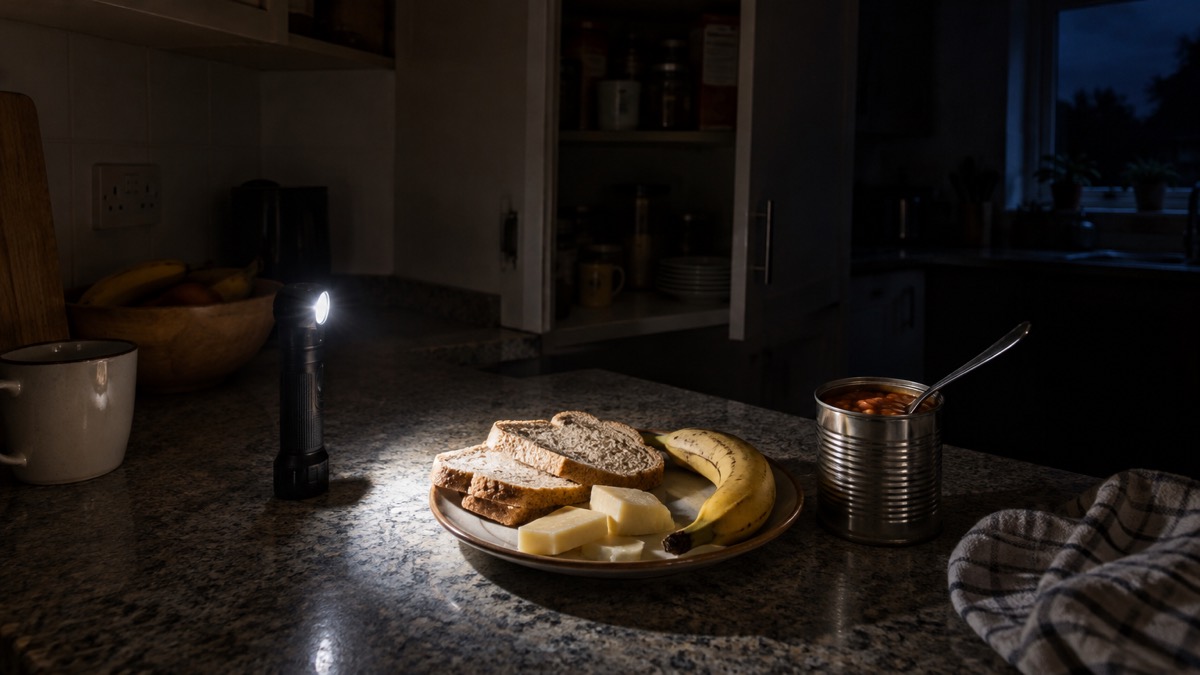
Two further rules cover the middle ground. Northumberland Council guidance for businesses affected by power cuts states that defrosted food should be safe if treated as chilled food, refrigerated and used up within a couple of days, and that if frozen food has risen above 8ºC for more than four hours it should be thrown away9. In a cut you cannot refrigerate anything, so treat defrosted food as food to eat now, in the first sitting or two, not food to keep. If you are unsure whether frozen food rose above 8ºC for more than four hours, the safe answer is to throw it away9.
While the power is off, also turn off big appliances, especially cookers and electric fires, until the power is back on, as Public Health Wales advises, so nothing comes back on unattended when the supply returns4. If you want to know the moment the power returns, leave a light switched on in one room7.
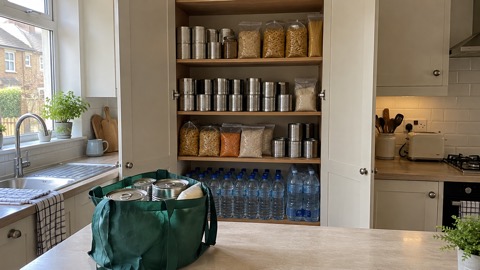
Stocking cupboard food for a few days
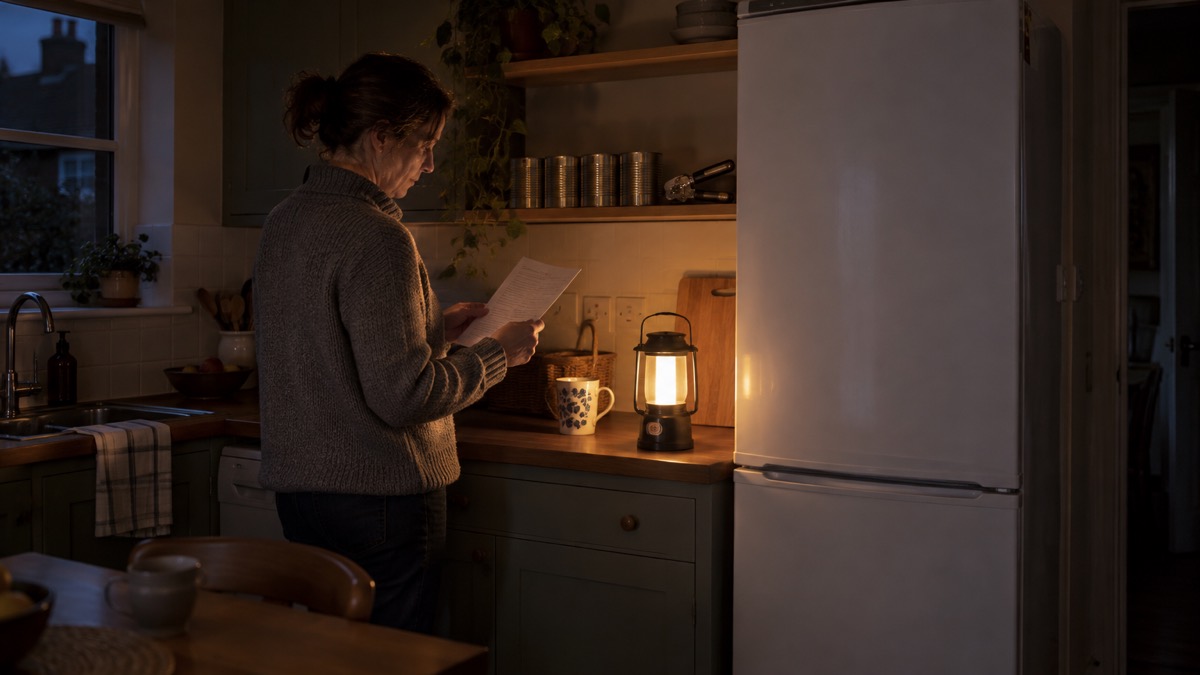
The reason to plan meals without power in advance is that you may not be able to buy anything once a cut starts. A power outage can close retail businesses, grocery stores, petrol stations, cash machines and banks, and disrupt communications, water and transportation10. Wiltshire and Swindon Prepared put the question plainly: think about how much food you have in your fridge or cupboard and ask yourself whether you could last a day or two without going to the shops10.
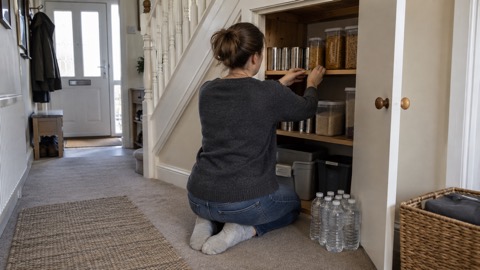
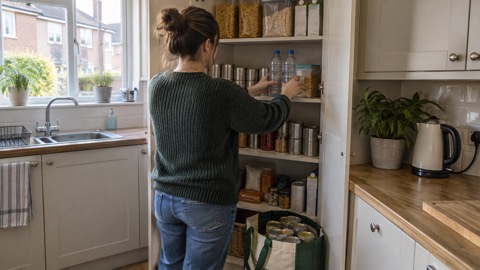
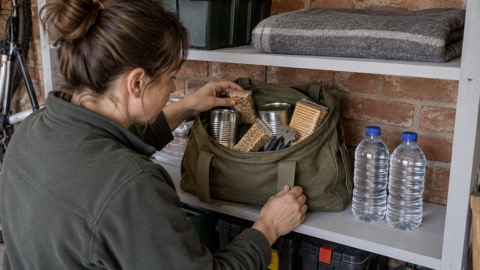
Official advice across the UK is consistent on how much to hold. Argyll and Bute Council, in its winter weather guidance, tells households to keep at least three days' supply of food, bottled water and other essentials, including medicines, and tinned and dry foods which store safely without need for electricity5. The UK government's Prepare campaign gives the same figure: non-perishable food for 3 days, food with a long shelf life that does not need refrigeration or cooking, for example tinned meat, fish or vegetables, dried fruit and nuts11. The best approach, it adds, is to buy food you would usually eat, so the store is food your household actually likes and knows how to serve11.
What to choose when building that store:
- Foods that require no refrigeration, preparation or cooking, and little or no water, as Bradford Council's flood pack advises; pick items that are compact and lightweight12
- Long-lasting cupboard essentials such as tinned vegetables, beans, pulses, soup and pasta, as the NHS in Norfolk and Suffolk recommends13
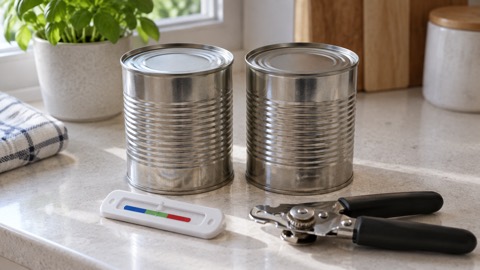
- Ready-to-eat tinned meat, fruit or vegetables, with a tin opener, as Greater Manchester resilience guidance sets out; include ready-made baby formula and pet food if your household needs them14
- A good stock of tinned or long-life food before heavy snow, as Lancaster City Council advises, because you may not be able to reach a supplier for a number of days15
- Tinned and frozen food in cold weather, as the City of London Corporation suggests, so you do not have to go out when it is too cold16
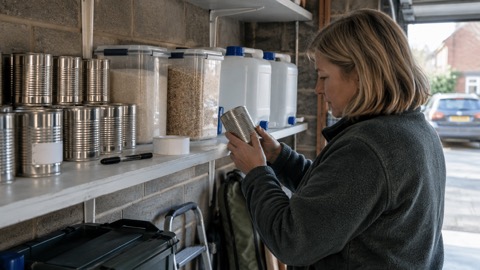
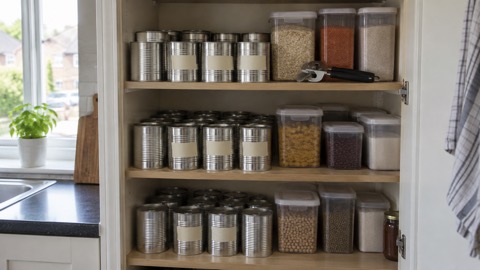
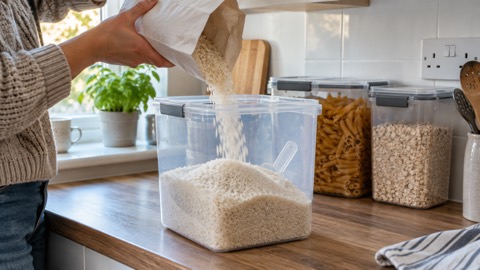
Keep cupboard and pantry food in sealed bags or containers, which Food Standards Scotland says helps keep food fresh and stops anything falling into the food by accident17. If you cannot cook without electricity, make sure you have food that is ready to eat, as Cornwall Council's storm advice puts it18, and make sure there is something available to eat that does not require electricity or heat preparation19.
For more on building the store, see how much emergency food to store per person, what to keep in an emergency store cupboard and the emergency store cupboard checklist.
Cans, grains and dried food: what keeps and what it gives you
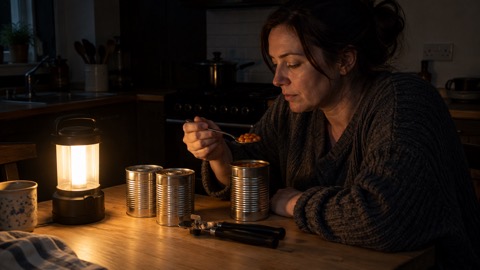
The backbone of meals without power is food that sits happily at room temperature for months or years. Best-before dates appear on a wide range of foods, including frozen, dried and tinned foods such as canned tomatoes, bread and cereal, as Food Standards Scotland explains20. Tinned food is safe to eat without heating through, which makes it the natural fallback once the fridge food is finished1.
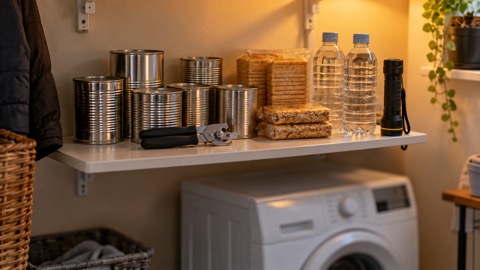
A store built around tins, jars and dry packets gives you real meals, not just snacks. Tinned vegetables, beans, pulses, soup and pasta are the specific examples the NHS gives for long-lasting cupboard essentials13. Tinned meat, fish, fruit and vegetables need no cooking at all11. Dried fruit and nuts keep well and need nothing added11. Dry staples such as rice, pasta, oats and pulses store for long periods, though most need hot water to become a meal, which is where a camping stove or a flask of hot water made in advance comes in.
How each type of store food behaves in a cut:
| Type | Needs cooking? | Keeps at room temperature | Notes |
|---|---|---|---|
| Tinned meat, fish, vegetables, fruit | No1 | Yes, long shelf life11 | Eat straight from the tin; keep a tin opener14 |
| Tinned soup, beans, pulses | Warming helps but tinned food is safe unheated1 | Yes13 | Can be eaten cold if needed |
| Bread and cereal | No | Short term; these are the perishable end of ambient food1 | Use after chilled food, before tins1 |
| Dried fruit and nuts | No | Yes11 | Compact and lightweight12 |
| Rice, pasta, oats, pulses | Yes, hot water | Yes | Needs a stove or pre-filled flask |
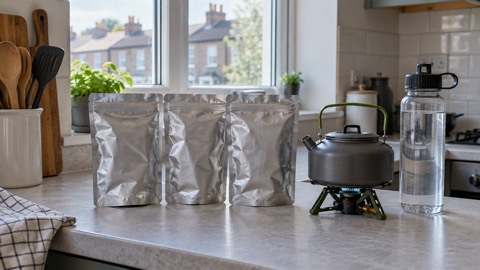
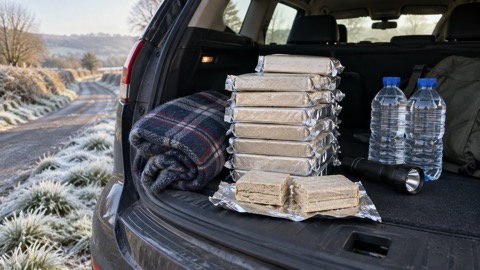
Freeze-dried meals and long-life ration packs take this further, needing only hot water or nothing at all. Canned goods, grains and freeze-dried food can all be considered emergency food, and they can keep families nourished for a longer period even with blackouts11. See freeze-dried meals, self-heating meals and flameless ration heaters and emergency ration packs for more on those.
Whatever you store, rotate it. Emergency food can simply be the everyday food families buy and store in their refrigerators and pantries, including vegetables, fruits and perishables, which can sustain a family for a good number of days11. Our page on rotating your store covers the habit, and shelf life, use by and best before dates explained covers what the dates on the packets actually mean.
Camping stoves and gas cartridges: using them safely
If you want hot food or hot drinks during a longer cut, a camping stove, barbecue or bottled gas stove can cook food and heat water for food preparation and cleaning, Food Standards Scotland confirms, but you must check the manufacturer's instructions for safe use2. The UK government's food safety guidance says the same: check the manufacturer's instructions for safe use of these appliances, as most are designed for outdoor use only1.
That last point is the one that matters most. Devon and Somerset Fire and Rescue Service is blunt about it:
"Never use a camping stove, portable barbecue, lit charcoal or generator in an enclosed space, as they are designed for outdoor use only and can produce poisonous carbon monoxide."
London Fire Brigade goes further still: it is never safe to use any type of outdoor cooking equipment like a BBQ or camping stove indoors, because doing so poses a serious risk of fire and deadly carbon monoxide poisoning22. Carbon monoxide has no smell and no taste, and a kitchen with the door open is still an enclosed space. If you use a camping stove, use it outdoors, well away from the house.
The safe routine, drawn from fire service guidance:
- Take the stove outdoors, away from the house, tent and anything flammable. nidirect's fire safety advice is to always cook outside and well away from your tent24.
- Check the manufacturer's instructions before use, as most stoves are designed for outdoor use only1.
- Never change gas cartridges indoors or near ignition sources23.
- Turn the gas off when the stove is not in use, as nidirect advises for caravans and mobile homes24.
- Cook food until it is steaming hot and cooked all the way through. Cooking with these appliances can take longer than your usual ways of cooking, so take extra care that food is steaming hot and cooked through1.
- Never leave cooking unattended, and never leave cooking on when you are not in the house25.
One more cooking rule from NHS inform: never cook food over flames, because the outside will burn while the inside stays raw and unsafe to eat6. Let flames die down to embers on any barbecue, and on a stove use the pan, not the flame, to do the cooking.
Note also that your usual cooker may not be entirely dead in a cut. Electric and induction cookers will not work during a power cut, but gas cookers may continue to function, according to the government's food safety guidance1. If you have a gas hob, check whether the ignition works or whether you can light it safely by the maker's method before assuming you need the camping stove. For a fuller treatment of heating and cooking off-grid, see heating and cooking without mains power or gas.
Where fuel and flames must never go
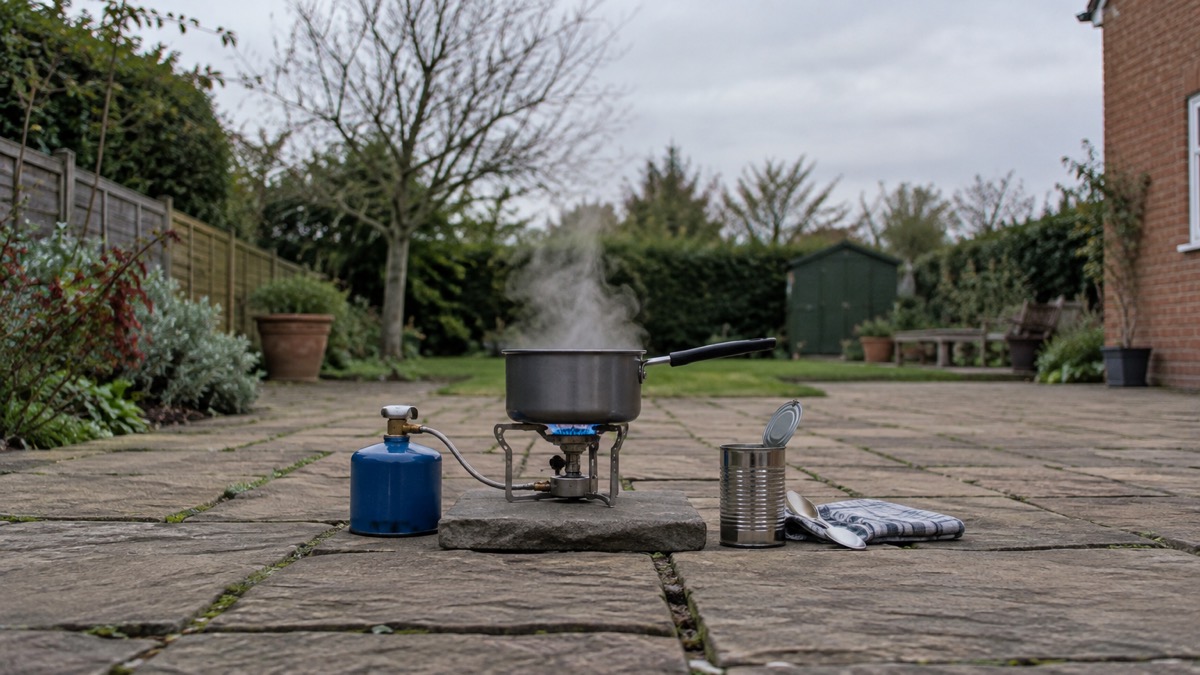
The rules above cover stoves, but the same principles govern every fuel and flame you might reach for during a cut. Barbecue lighting is the clearest case. Manchester Fire and Rescue Service instructs: to start your barbecue only use barbecue lighter fuel or firelighters, never petrol, paraffin or other flammable liquids, and once your barbecue is lit, never add more liquid fuel26. The same guidance adds: never use petrol or paraffin to revive your barbecue, and use only recognised lighters or starter fuel on cold coals in moderation26.
Beyond fuel, the fire service's general home fire safety rules apply with extra force when you are cooking by torchlight. Devon and Somerset Fire and Rescue Service's top ways to reduce fire risk at home include never leaving cooking on when you are not in the house, and never leaving a device charging unattended25. During a cut, when routines are disrupted and lighting is poor, both are easy to get wrong: a stove left to warm food while you check on a neighbour, or a power bank left charging under a blanket once the power returns.
The full list of things that must never happen:
- Never use a camping stove, barbecue, lit charcoal or generator in an enclosed space21
- Never use any outdoor cooking equipment indoors22
- Never use barbecues or camping stoves inside, as Belfast City Council's flooding advice also states27
- Never use petrol, paraffin or other flammable liquids to start or revive a barbecue26
- Never change gas cartridges indoors or near ignition sources23
- Never leave cooking on when you are not in the house25
- Never leave a device charging unattended25
- Never cook food over flames6
Light while you eat: torches first, candles with care
Eating a meal in a power cut means lighting it too, and the official preference is clear. nidirect's advice for strong winds and heavy rain is to preferably use a torch, oil or gas lamp as a source of light rather than candles28. A torch or head torch leaves your hands free, lights the plate rather than the ceiling, and carries no flame near food, paper or curtains.
Candles are still part of official preparedness lists: nidirect's strong winds weather warning advice says to keep a supply of candles29, and the same guidance repeats the preference for torches, oil or gas lamps over them28. If you do use candles, treat them as the fallback, keep them away from anything that can burn, and never leave them unattended. Our emergency lighting page covers torches, lanterns and candles in full.
A wind-up or battery-powered lantern is the middle ground worth having: it lights a whole table, needs no batteries to be fresh, and poses no fire risk at all. Even though candles are an option, they involve fire hazards, so keep torches and lanterns where you can find them in the dark26.
Getting help and news during a long cut
Report the power cut as soon as you know about it. Call 105, a free service in Scotland, England and Wales that puts you through to your local network operator23. You can also report a power cut and track updates on the Power Cut 105 website, and if you cannot report it online, call 105 for free14. Ofgem confirms the routes: report it directly to your local network operator using their website, or call 105 for free31. Anglesey Council's advice is simply to report any power cuts immediately by calling 10530.
For news during the cut, use radio. Ready Scotland advises that if the power is out you should use a battery-powered or wind-up radio, try both digital and FM stations, and that you can also use a car radio, though in severe weather it might be safer to stay indoors32. Llangattock community council's adverse weather advice is to keep a wind-up, battery or solar radio ready so you can listen to local radio updates33. In West Yorkshire, the local risk register names specific stations to tune into if a major power outage occurs: BBC Radio 2, BBC Radio 4 or BBC Radio Leeds34.
For phone calls, keep an analogue phone that can be connected in your house, as West Yorkshire Prepared advises, because it will still work if a power cut impacts the mobile network7. Anglesey Council gives the same advice: it is worth having an analogue phone as this does not run off the main electricity supply30. Keep a mobile phone charged, keep a power bank or solar charger ready, and write down important phone numbers7.
Practical steps for a longer cut, from official guidance:
- If it is a localised power cut, stay with friends or relatives until your power is back on7
- Leave a light on so you know when your power comes back on7
- Switch off appliances that could pose a hazard7
- Check on vulnerable neighbours or family7
- Notify a friend or neighbour if you are anxious, and keep blankets and thick jumpers available8
If you or someone in your household depends on electricity for medical equipment or needs extra support, see extra help in an emergency. Households that need it can also ask their energy supplier about the Priority Services Register, and our power cuts page covers the wider picture, including what causes cuts and what help exists.
What causes power cuts, and why the cause matters
Electricity loss can be caused by a number of things, such as severe weather, accidental damage or malicious attack, which damage the distribution network34. Power cuts often happen with no warning, which is why the food advice is built around what is already in your kitchen rather than what you can go out and buy21. A power outage is simply when the electrical power goes out unexpectedly10.
The cause matters to your food planning in one way: severe weather cuts tend to be longer and can stop you reaching the shops even after the power returns, which is why councils advise a good stock of tinned or long-life food before snow15 and tinned and frozen food in cold weather16. It also matters if you are wondering about compensation: Ofgem states you will not be paid for blackouts caused by a national power shortage, damage to electrical equipment or appliances, or a low supply after a power cut31. That page is about money, not meals, but it is a fair reminder not to count on anything except your own cupboard.
For households that need emergency food help rather than just planning, see getting emergency food help, and for babies and special diets in a cut, see babies, young children and medical diets in an emergency and how to make up baby formula in a power cut.
Sources (34)
- Food safety in a power cut: advice for consumers, UK Government, 2023-07-26
- Power cuts: food safety advice, Food Standards Scotland
- What to do after a flood, UK Government
- Weather and health advice, Public Health Wales
- Winter weather: be prepared, Argyll and Bute Council
- Preparing and cooking food safely, NHS inform, 2025-02-21
- Power cuts: advice for households, West Yorkshire Prepared
- Power cuts: advice for residents, Wigan Council
- Information about specific safety concerns, Northumberland Council
- What is a national power outage, Wiltshire and Swindon Prepared
- Get prepared for emergencies, UK Government Prepare campaign, 2026-10-21
- Create a flood pack, Bradford Council
- Stay warm and nourished, NHS Norfolk and Waveney Integrated Care Board
- Loss of essential services: prepare yourself, Greater Manchester Combined Authority
- Be prepared for severe weather, Lancaster City Council
- Advice on coping in the cold weather, City of London Corporation, 2025-08-15
- Food storage advice, Food Standards Scotland
- Storm preparation advice, Cornwall Council
- 12 tips to prepare for a power cut, Horsted Keynes Parish Council
- Use by and best before dates, Food Standards Scotland
- Power cuts: safety advice, Devon and Somerset Fire and Rescue Service, 2023-11-30
- Cooking safety in the home, London Fire Brigade
- Power cuts, Scottish Fire and Rescue Service
- Fire and summer safety advice, nidirect, 2026-07-03
- Top ways to reduce your risk of having a fire at home, Devon and Somerset Fire and Rescue Service
- Barbecue safety, Manchester Fire and Rescue Service
- Flooding advice, Belfast City Council
- Strong winds and heavy rain warning: information and advice, nidirect, 2026-01-27
- Strong winds weather warning: information and advice, nidirect
- Winter ready, Isle of Anglesey County Council
- Check if you can get payment for a power cut, Ofgem
- Emergency plan, Ready Scotland, 2026-03-24
- Adverse weather events, Llangattock Community Council
- Community Risk Register, West Yorkshire Prepared, 2025
 Long-Term Storage Kit Checklist
 Store Cupboard Checklist
 30-Day Household Checklist
 How Much Emergency Food to Store
 What to Store in an Emergency
 Starting a Store Cupboard
 Shelf Life and Date Labels
 Rotating Your Food Store
 Long-Term Storage Conditions
 Self-Heating Meals
 Tinned Food Guide
 Rice, Pasta and Pulses Storage
 Freeze-Dried Meals
 Emergency Ration Packs
 Emergency Ration Bars