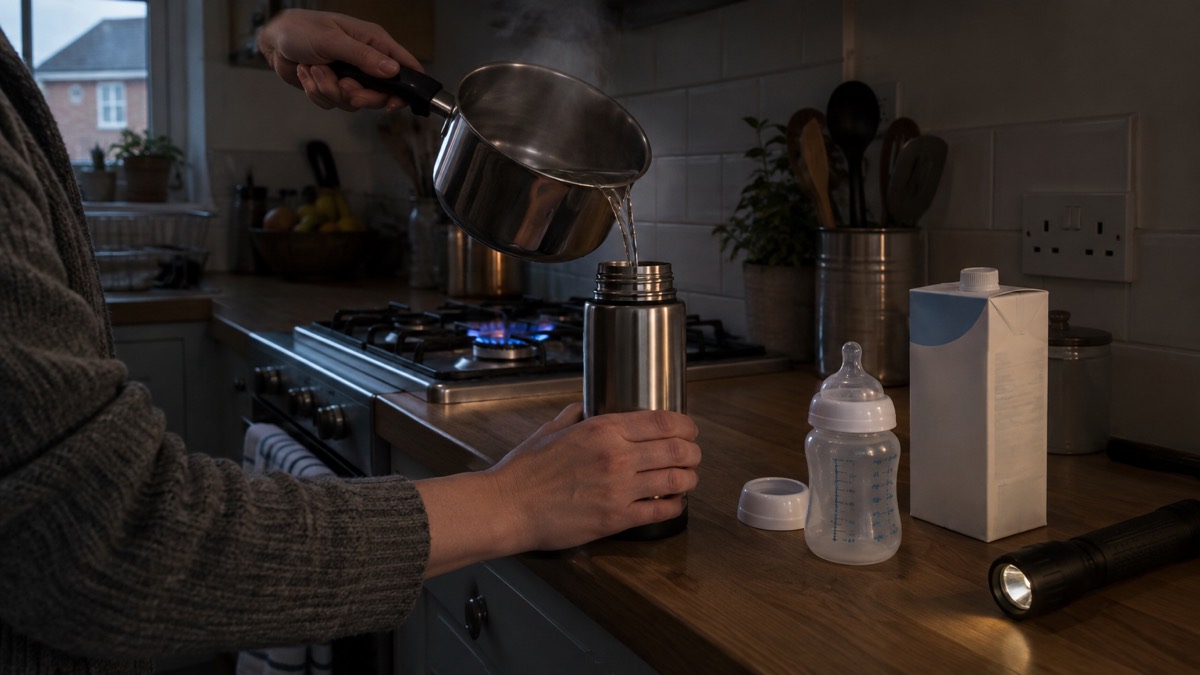
If the power goes and you cannot boil water, the safest thing to feed a formula-fed baby is ready-to-use, or ready-to-feed, formula. Official guidance is consistent on this: if you are not able to boil water to prepare baby formula safely, try to use ready-to-use baby formula1. The same advice appears in the government's power cut guidance, which says that if you have no tap water, using ready-made or ready-to-feed formula is the safest option2.
The reason is that powdered formula is not sterile and should only be prepared using freshly boiled water3. Without power, you may not be able to boil water or sterilise bottles, which is exactly why ready-made formula is recommended for emergencies4. Keeping a supply in the cupboard, plus a flask of hot water prepared before a planned cut, covers most of what a household with a baby needs.
This page sets out what to keep in, how to make up a feed when the kettle will not work, how to sterilise bottles without power, and what to do when the electricity comes back on. It is written for England, with notes where the arrangements differ in Scotland, Wales and Northern Ireland.
Use ready-to-use formula if you cannot boil water
The first decision in a power cut is simple: can you boil water safely? If you can, you can make up powdered formula as normal. If you cannot, use ready-to-use formula. The government's emergency kit checklist puts it plainly: ready-made or "ready-to-feed" formula is best, as you may not be able to boil water to make up powdered formula safely7. The Be Ready checklist repeats the same wording8.
Ready-to-use formula comes in cartons or bottles that need no water and no mixing. That makes it the one infant feed that works when the kettle, the steriliser and the tap are all out of action. It is also the option recommended when your water supply is interrupted or contaminated, because you are not relying on the safety of what comes out of the tap2.
If you have no ready-to-use formula and cannot boil water, there is a fallback, but it is a last resort. Official flood guidance says that if boiling is not possible and ready-to-feed liquid formula is not available, bottled water (table, spring or mineral) can be used without boiling, but the prepared feed should then be used immediately9. The same instruction appears in Northern Ireland guidance: use unboiled bottled water to make a baby feed, but you must give the feed to the baby immediately10.
The Breastfeeding Network, an independent source, adds an important caution: making up formula with cooled previously boiled water or clean room temperature water should only be done if there is no other option and for the shortest time possible11. Treat any unboiled-water feed as a stopgap, not a routine.
Why formula needs boiled water
Powdered infant formula is not a sterile product. Official guidance states that powdered formula is not sterile and should only be prepared using freshly boiled water3. That is the whole reason a power cut matters so much for a formula-fed baby: the safety step depends on boiling.
The Food Standards Scotland guidance is direct: you need to boil water to prepare infant formula safely, and if you can't boil water, use ready-to-use infant formula12. If you use a baby formula preparation machine, make sure the water is at least 70C10. That figure is the temperature the water must reach, not a target for the feed itself.
There is a second reason boiling matters: sterilising the bottles and teats. The Breastfeeding Network lists the options as microwave or steam sterilisation (if you have power), cold water sterilisation or boiling water sterilisation11. Two of those three work without electricity, which is why a flask of boiled water and a cold water sterilising tablet or liquid are worth keeping in.
Where the water itself is suspect, the advice tightens further. After a flood, the preferred option is to use bowser or bottled water, brought to a rolling boil and cooled, and unboiled water should not be used13. Do not use tap water with an odour or discolouration to prepare baby formula; use bottled water that has been boiled and cooled, or ready-made formula milk6.
Keep a supply of ready-to-use formula in case the power goes
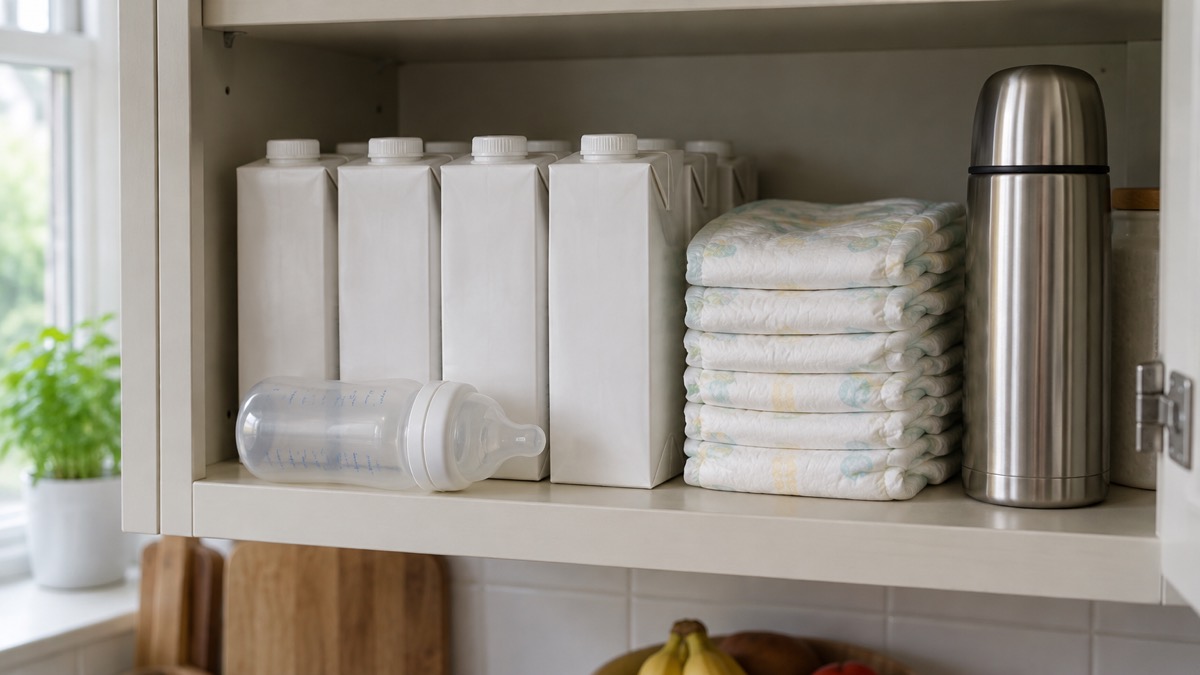
The single most useful preparation is a store of ready-to-use formula. Official guidance for households with a baby says to make sure you have a supply of pre-prepared formula baby milk, if used12. The same instruction appears in severe weather advice for Northern Ireland14. The government's power cut guidance says your emergency store should include ready-made baby formula2.
How much to keep is a household decision, but the principle is to have enough that a cut of a day or more does not send you out in bad weather. Which? recommends including ready-to-feed baby formula in an emergency food stockpile if you have a baby or young child8. The Scottish Government's Ready Scotland emergency kit guidance lists baby supplies such as nappies and ready-made infant formula15.
A practical baby store might include:
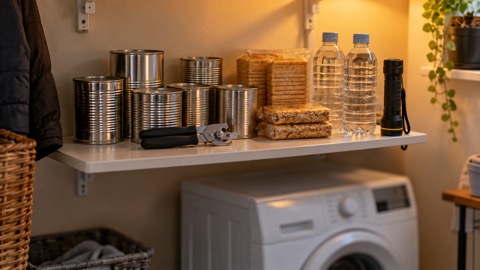
- Ready-to-use formula cartons or bottles, enough for several days2
- Nappies and wipes15
- A flask for hot water16
- Bottled water for sterilising and cleaning11
- Cold water sterilising tablets or liquid11
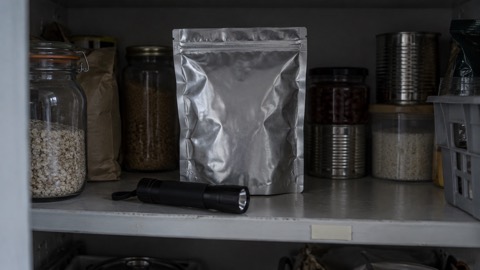
- A torch and spare batteries for night feeds
Store the formula somewhere cool and dry, and check dates regularly. Rotate it the same way you would any other emergency food: use the oldest first and replace what you use. For more on building a store that keeps, see What to Keep in an Emergency Store Cupboard and Rotating Your Store: First In, First Out.
A flask of hot water: getting it ready before a power cut
A vacuum flask of boiled water is the quiet hero of a power cut with a baby. Official guidance for households with a baby says to prepare a flask of hot water to heat bottles and baby food14. Northern Powergrid's advice is to use a vacuum flask to store hot water16. If you know a planned cut is coming, boil water in advance and keep it in a flask17.
The flask does two jobs. First, it gives you hot water for sterilising bottles by the boiling water method, which needs no electricity11. Second, it lets you warm a feed without a kettle. The NHS advises against heating formula in a microwave and suggests a bottle warmer or a jug of hot water instead18. A flask and a jug do that job when the socket is dead.
If you have a gas hob that still works, or a camping stove, you can boil water during the cut. Food Standards Scotland says you can cook food and heat water using a camping stove, barbecue or bottled gas stove, checking the manufacturer's instructions for safe use12. Wiltshire and Swindon's gas outage guidance suggests boiling water outside on a camping stove and keeping it in a flask19.
Making up a feed when the power is off
Work through the options in order. First, ready-to-use formula, straight from the carton. Second, if you have boiled water in a flask that is still hot enough, powdered formula made up as normal. Third, if neither is possible, unboiled bottled water as a last resort, with the feed given immediately9.
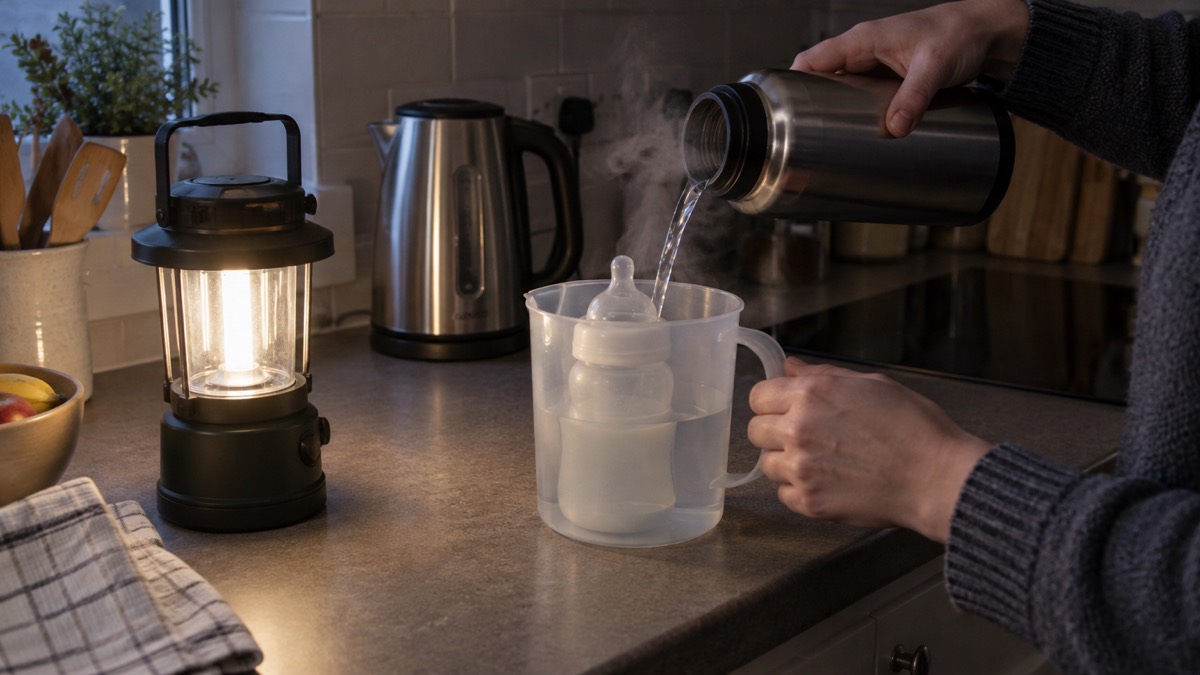
Cooling a feed without a fridge is the next problem. Stand the bottle in a jug or bowl of cold water. Do not use a microwave: the NHS says to avoid heating up bottles of formula in a microwave and to use a bottle warmer or jug of hot water instead18. Make up only what you need, so there is less to cool and less to store.
Storing opened cartons is a matter for the carton's own instructions. In a power cut, keep the refrigerator and freezer doors closed to protect the cold air20. If a carton has been out of the fridge longer than its label allows, do not use it. When in doubt, throw it out.
Sterilising without power comes down to the methods that do not need a socket. Cold water sterilisation uses a tablet or liquid in water, and any bottled water you use for sterilising does not have to be safe for formula preparation, because your baby will not be drinking it, so the levels of sodium or sulphate do not matter11. Boiling water sterilisation needs hot water, which is where the flask earns its place. If your water supply is cut off, use alcohol-based hand sanitiser for cleaning your hands before touching food or feeding equipment14.
What to do when the power comes back on
When the electricity returns, the first job is safety, the second is the fridge. Switch off appliances that could pose a hazard, and leave a light on so you know when power is back21. Turn off big appliances, especially cookers and electric fires, until the power is back on22. Do not open your freezer, and if food has defrosted by the time the power is back on, throw it away22.
For the baby's equipment, this is the moment to run the steriliser, boil a fresh kettle and restock the flask. Check any formula that was in the fridge during the cut. If you are unsure whether it stayed cold enough, do not use it.
Restock what you used. Replace the ready-to-use cartons, check dates, and refill the flask. A power cut is a useful reminder to top up the baby store before the next one.
If the cut was localised and you have somewhere to go, official guidance suggests staying with friends or relatives until your power is back on21. For a household with a baby, that can be the simplest option of all.
Where to get help
You do not have to manage alone. Keep baby supplies such as nappies and ready-made infant formula in your emergency kit so you are not dependent on shops in the first hours15. Beyond that, there is support.
- Your energy supplier's Priority Services Register. If anyone in the home is vulnerable, including a baby, ask to be added. Suppliers use it to plan support during cuts.
- Your local council. Councils publish emergency planning advice and can point you to local support.
- Food banks and the Healthy Start scheme. For eligible families, the Healthy Start scheme helps with the cost of milk and vitamins. See The Healthy Start Scheme: Who Qualifies and What It Gives.
- Neighbours and relatives. Check on each other. Official advice is to check on vulnerable neighbours or family21.
For more on feeding babies and young children through disruption, see Babies, Young Children and Medical Diets in an Emergency. For the wider picture on power cuts, see Power Cuts: A Household Guide.
Sources (22)
- Loss of essential services, Greater Manchester Combined Authority, 2026-10-29
- Power cuts, Prepare campaign (UK Government), 2026-10-21
- Power cuts, Be Ready campaign (UK Government), 2026-10-21
- Water supply interruptions or outages, Prepare campaign (UK Government), 2026-10-12
- Strong winds and heavy rain warning - information and advice | nidirect, nidirect (Northern Ireland government)
- How to recover from flooding, UK Government, 2023-12-19
- Be Ready Checklist, Be Ready campaign (UK Government), 2026
- Emergency kit packing list, Which?, 2026-09-30
- Flooding, Runnymede Borough Council, 2026-10-26
- Keeping children safe during a flood, nidirect (Northern Ireland Government), 2025-12-09
- Feeding your baby in an emergency situation, The Breastfeeding Network, 2026-10-13
- Power cuts, Food Standards Scotland, 2026-10-25
- Staying safe in a flood, Herefordshire Council, 2026-10-29
- Strong winds weather warning information and advice, nidirect (Northern Ireland Government), 2026-01-27
- Emergency kit, Ready Scotland (Scottish Government), 2026-10-22
- Be prepared, Northern Powergrid, 2026-10-26
- Tips to prepare for a power cut, Electricity North West, 2026-10-26
- Baby and toddler safety, NHS, 2026-02-19
- What you might need in a gas outage, Wiltshire and Swindon Prepared, 2026-10-25
- How do I keep food safe, NIE Networks, 2026-10-25
- Power cuts, West Yorkshire Prepared, 2026-10-29
- Weather and health, Public Health Wales, 2026-07-16
 Long-Term Storage Kit Checklist
 Store Cupboard Checklist
 30-Day Household Checklist
 Refreezing Defrosted Meat
 Leftovers in the Fridge
 Reducing Botulism Risk
 Sterilising Jars
 Spotting Spoiled Preserved Food
 Boiling Water in Glass Jars
 Mylar Bag Food Shelf Life
 Mylar Bag Sizes
 Are Mylar Bags Food Safe
 Oxygen Absorber Activation
 Silica Gel With Stored Food
 Freeze-Dried Meal Shelf Life