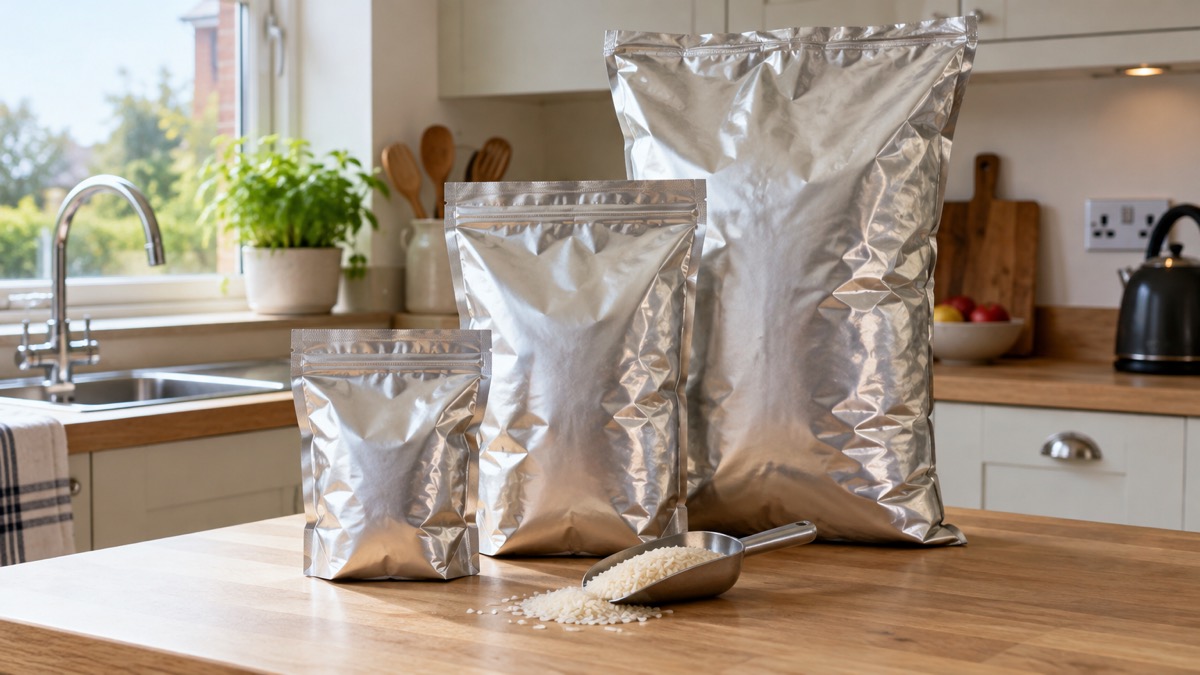
Mylar bags are sold in a handful of standard sizes, and the right one depends on how much rice, pasta or beans you are putting in and whether you want to reopen the bag. For bulk, the 48cm x 74cm bag is listed for large amounts of rice, flour, beans and legumes, and one buyer reports filling it with 10kg of rice with room to spare1.
The second decision is the closure. Zip-lock bags can be pressed shut and reopened, and most are also heat sealable, so you can seal them properly for the long term2. Whichever you choose, check the listing says food grade, and label every bag with its contents and the date1.
Small amounts: bags for a few kilos or a single jar's worth
If you are putting up a kilo or two of rice, a bag of pasta or a jar's worth of beans, a small bag does the job without leaving a lot of air inside. It is food grade and safe for food storage, and comes in pack sizes of 1, 10, 50, 100, 500 and 1,200, so you can buy a single bag to try before committing to a box5.
For very small quantities there are smaller bags again. Those suit the seasoning end of a store cupboard rather than the rice and pasta itself.
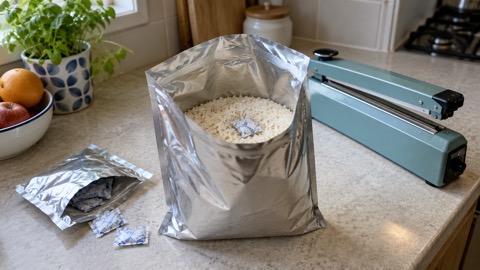
A step up, the 20cm x 30cm heavy duty bag is listed for medium amounts of dry foodstuffs, particularly heavy, bulky or irregular shaped foods, including rice, pasta, noodles, beans, pulses, seeds and dehydrated meat and vegetables6. It is food grade, and the distributor lists it as ideal for use with 300cc oxygen absorbers and 30g silica gel desiccants6. That makes it a sensible first bag for a household building a store a few kilos at a time.
Medium amounts: the bags sold for bulky rice, pasta and beans
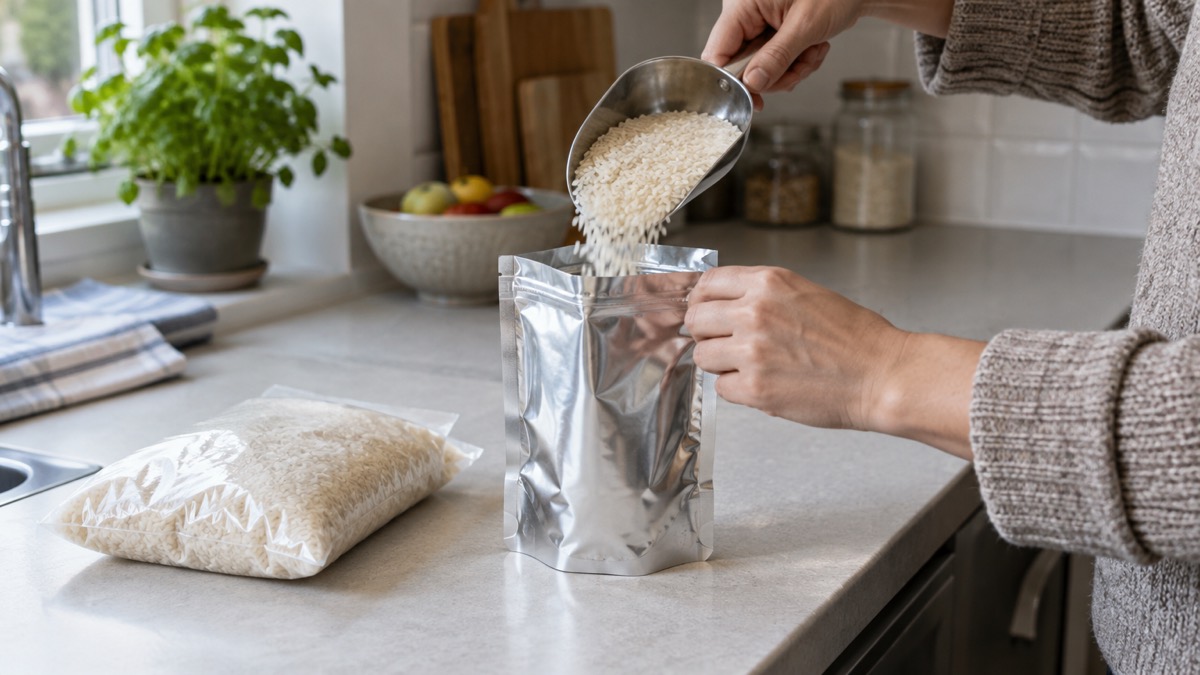
Once you are storing several kilos at a time, the medium heavy duty bags are the ones the distributor lists for the job. Both are food grade and both protect against oxygen, heat, pests, light and moisture7.
One buyer reports using it for 3kg bags of pasta, describing it as easy to handle and seal with a nicely sized oxygen absorber9. That is a useful guide to what a bag of this size holds in practice: a few kilos of a bulky dry food, sealed in one go.
| Bag size | What the distributor lists it for | Absorber listed with it |
|---|---|---|
| 20cm x 30cm heavy duty | Medium amounts, heavy, bulky or irregular foods6 | 300cc absorbers and 30g desiccants6 |
| 48cm x 74cm | Large amounts: cereals, grains, pasta, rice, flour, noodles, beans, legumes1 | 2000cc absorbers and 100g desiccants1 |
If you are not sure how much you will store, buy a small pack first and see how far it goes.
Large amounts: 48cm x 74cm bags for bulk rice, grains and beans
For a bulk store, the 48cm x 74cm bag is the size the distributor lists for large amounts of dry foods, including cereals and grains, pasta, rice, flour, noodles, beans and legumes, in fact any dry foodstuff1. It is food grade and protects against oxygen, heat, pests, light and moisture1. A heavy duty version of the same size is listed for the same foods4.
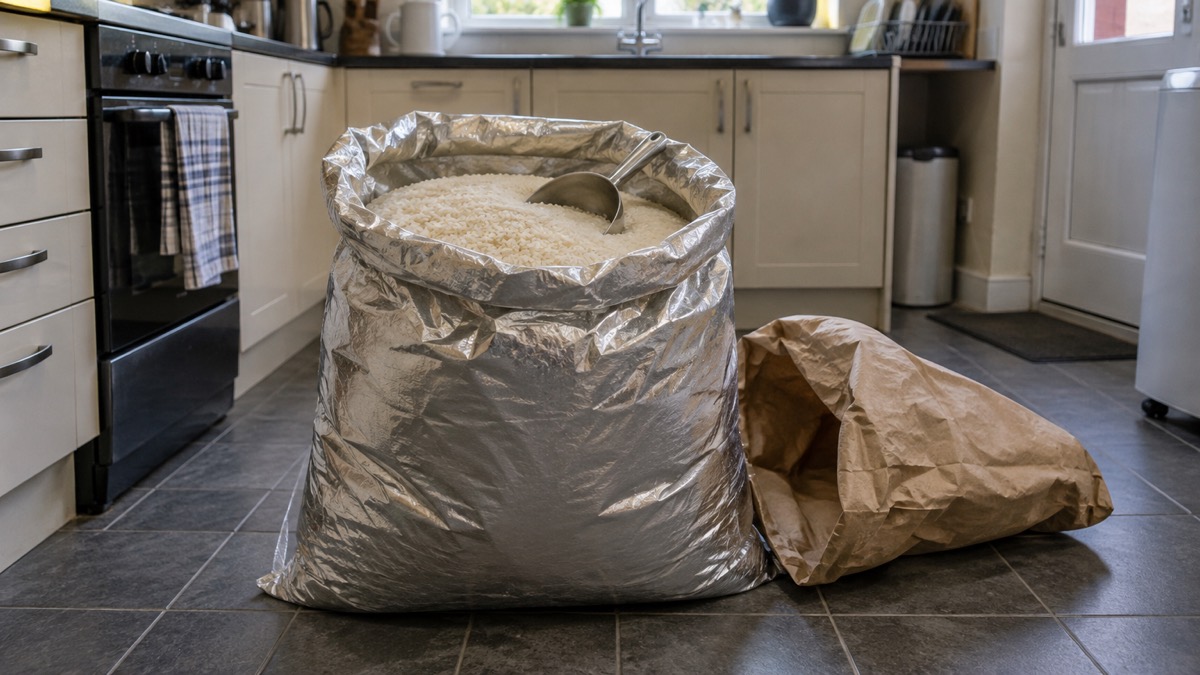
These bags are genuinely large. One buyer reports that they are massive, that they wanted them to fill 10kg of rice and that there was plenty of space for probably more1. Treat that as a report from a customer rather than a stated capacity: the listing does not give a weight, so fill a bag and judge for yourself rather than assuming a figure.
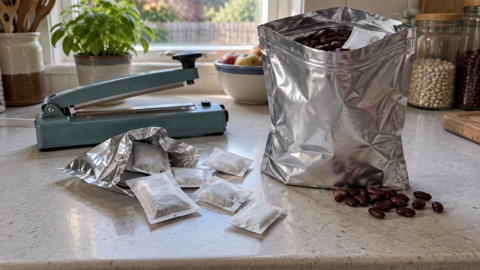
The standard 48cm x 74cm bag is listed as ideal for use with 2000cc oxygen absorbers and 100g silica gel desiccants, and the heavy duty version has one 2000cc oxygen absorber recommended for it1. The distributor also sells a bundle of 10 OxyFree 2,000cc oxygen absorbers with 10 of the 48cm x 74cm bags, which suits setting up a bulk store in one go1. Pack sizes are 10, 50, 100 and 350 for the standard bag and 10, 50, 100 and 250 for the heavy duty1.
A bag this size is also sold for things other than food: the heavy duty version is listed for storage of large paper and canvas items such as paintings, prints and lithographs, and for clothes storage4. If you buy a pack and find you have spares, they will keep other bulky items dry too.
Ziplock or heat-sealed: which bag suits your store
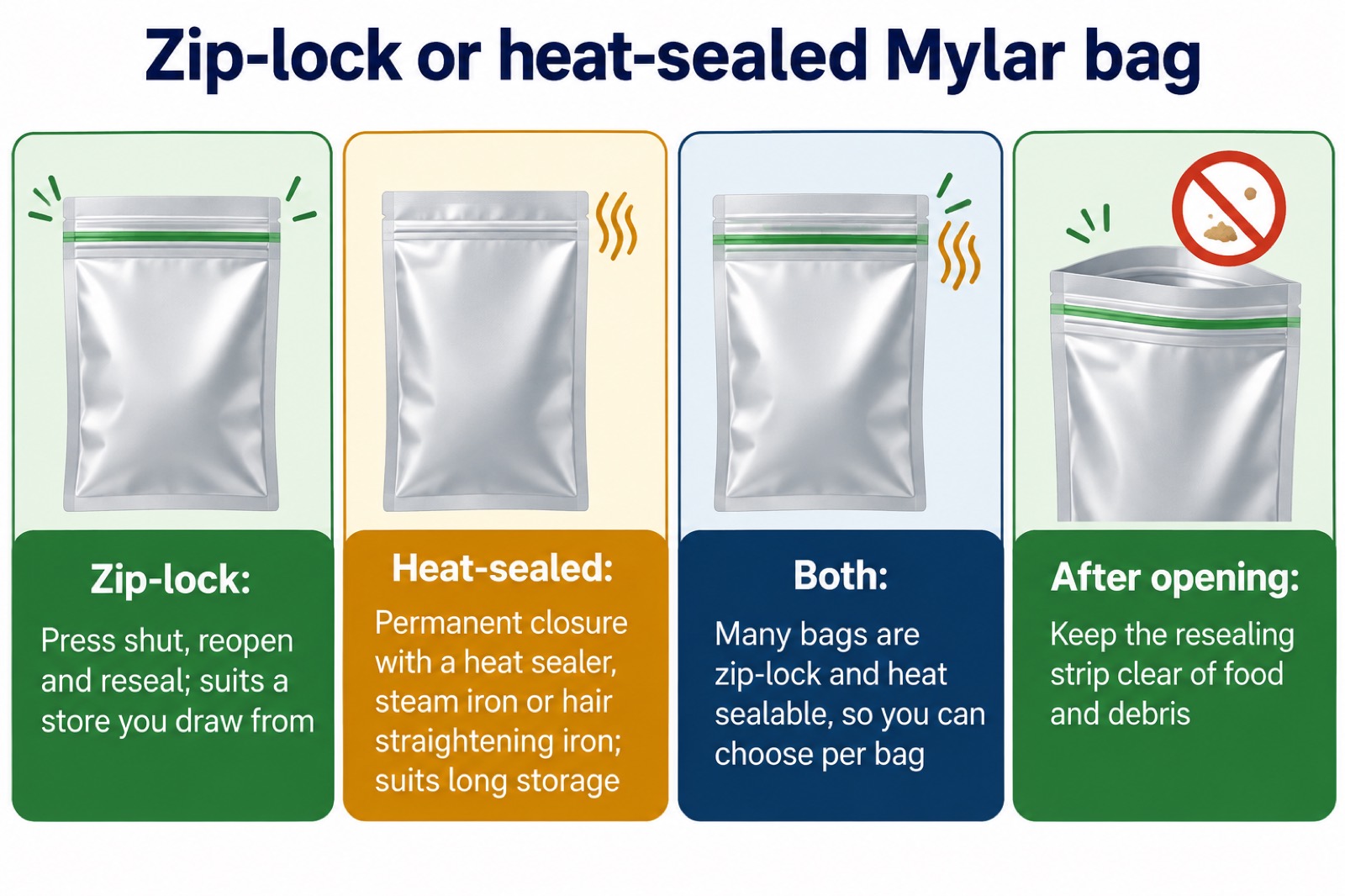
The choice between a zip-lock bag and a heat-sealed one comes down to how often you open it. A zip-lock bag can be pressed shut, opened and resealed, which suits a working store you draw from week by week. A heat-sealed bag gives a more permanent closure, which suits food you intend to leave untouched for a long time.
Many bags offer both. Both are food grade2.
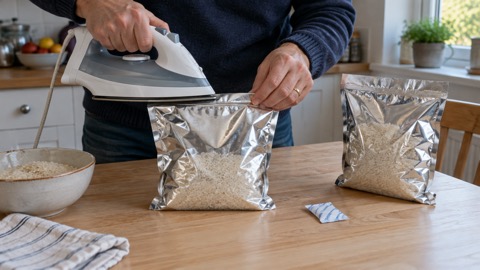
For a long-term seal, guidance for UK households describes sealing Mylar bags with a steam iron with the steam off, or a hair straightening iron, then labelling each bag with its contents and date3. The same guidance suggests placing the sealed bags inside 5 gallon plastic buckets so that they do not become punctured3.
If you reuse a zip-lock bag after opening part of the contents, keep the resealing strip clear of any food or debris so it seals properly11. That one habit is what keeps a reopened bag airtight.
Stand-up bags and other shapes
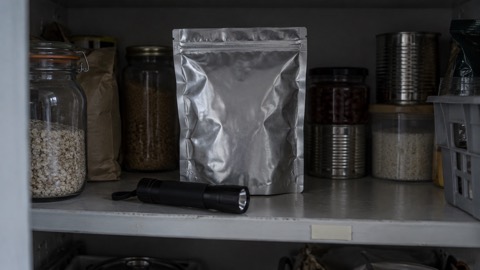
Not every bag is a flat pouch. Stand-up Mylar pouches have a zip-lock and a heat sealable closure and stand upright on the shelf, which makes them easy to fill and easy to read once labelled12.
Stand-up bags suit a shelf you open often, where you want to see what is inside and take a portion out. Flat bags suit packing tightly into a bucket or box, where standing upright is not the point. Neither is better in the abstract; they answer different questions about how you will use the store.
Matching the bag to the food and sealing it properly
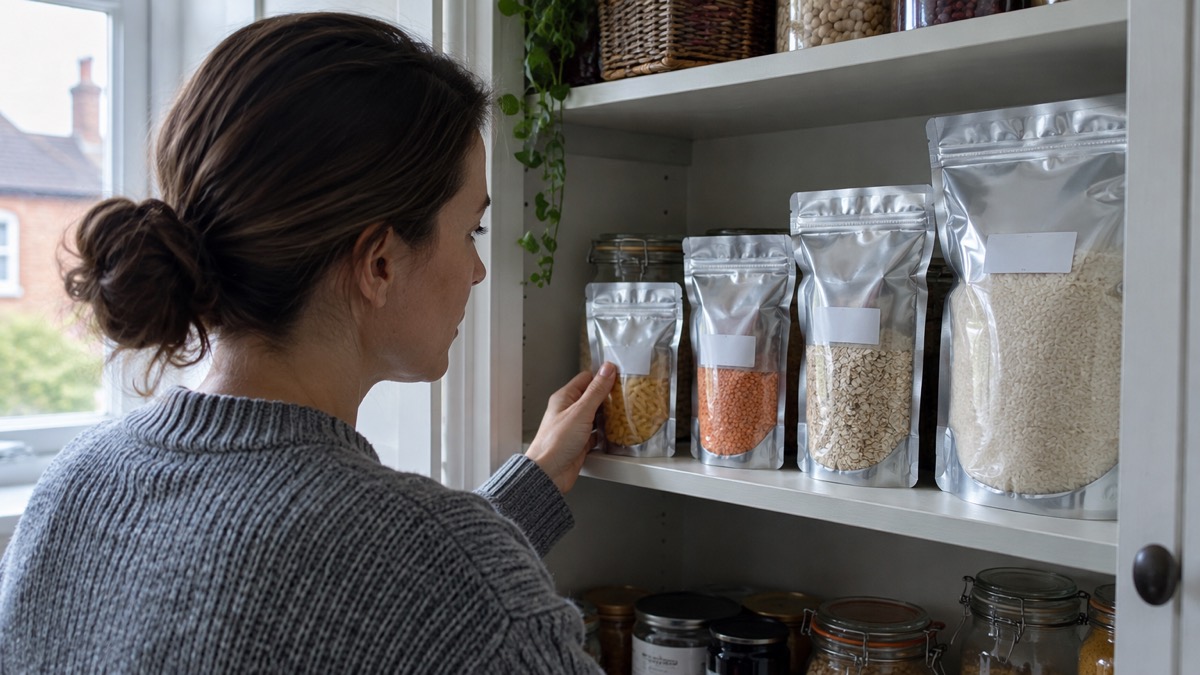
The bag size should follow the food. Rice, pasta and beans are bulky and irregular, which is why the medium heavy duty bags are listed for exactly those foods6. Dehydrated meat and vegetables appear on the medium bags and the small zip-lock bag6.
These are a different tool from a sealed Mylar bag: good for the cupboard you use, less suited to a sealed long-term store.
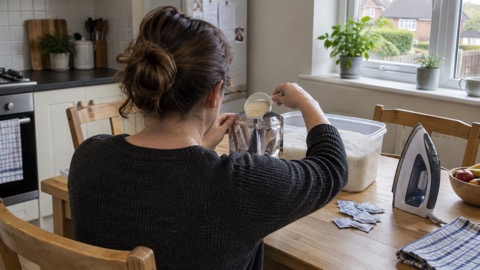
Whichever bag you choose, the routine is the same: fill it, add the absorber the listing recommends, seal it, and label it with the contents and the date3. For more on the bags themselves, see Mylar bags and oxygen absorbers for dry stores, and for how long food keeps once sealed, how long food lasts in Mylar bags with oxygen absorbers.
Sources (12)
- Large Mylar Bag 48cm x 74cm, Mylar Shop, 2026-10-12
- Mylar Ziplock Bag 24cm x 34cm, Mylar Shop, 2026-09-14
- The No-BS Guide to Urban Prepping in the UK, Preppers Only, 2024-06
- Large Heavy Duty Mylar Bag 48cm x 74cm, Mylar Shop, 2026-10-12
- Mylar Ziplock Bag 20cm x 25cm, Mylar Shop, 2026-10-01
- Heavy Duty Mylar Bag 20cm x 30cm, Mylar Shop, 2026-10-21
- Heavy Duty Mylar Bag 25cm x 35cm, Mylar Shop, 2026-10-18
- Heavy Duty Mylar Bag 35cm x 50cm, Mylar Shop, 2026-09-14
- 35cm x 50cm HD Mylar Bag Oxygen Absorber Bundle, Mylar Shop, 2025-10-07
- Mylar Ziplock Heavy Duty Bag 25cm x 40cm, Mylar Shop, 2026-10-24
- Mylar Standup Ziplock Bag 12cm x 20cm, Mylar Shop, 2026-09-14
- Mylar Standup Ziplock Bag 25cm x 35cm, Mylar Shop, 2026-09-14
 Long-Term Storage Kit Checklist
 Store Cupboard Checklist
 30-Day Household Checklist
 Baby Formula in a Power Cut
 Refreezing Defrosted Meat
 Leftovers in the Fridge
 Reducing Botulism Risk
 Sterilising Jars
 Spotting Spoiled Preserved Food
 Boiling Water in Glass Jars
 Mylar Bag Food Shelf Life
 Are Mylar Bags Food Safe
 Oxygen Absorber Activation
 Silica Gel With Stored Food
 Freeze-Dried Meal Shelf Life