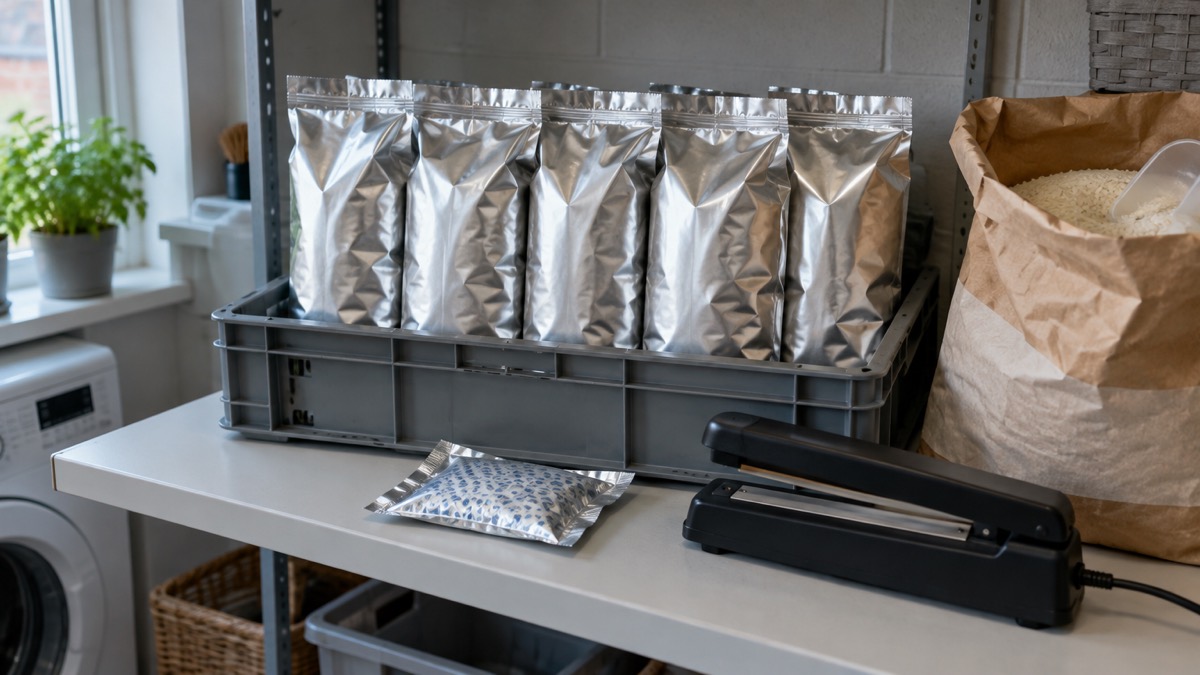
Mylar bags are foil laminate bags that, once heat-sealed, cut dry food off from everything that spoils it: oxygen, heat, pests, light and moisture1. Sealed with an oxygen absorber inside, dry foods such as rice, pasta, flour, beans and oats can last for decades, and the sellers of the bags state that inorganic items like paper and plastic keep even longer1. That makes them the standard method for building a long-term dry store in a UK home, alongside tins and jars.
The system has three parts that work together. The bag itself is the barrier. The oxygen absorber, a small sachet that scavenges the oxygen left inside the sealed bag, does the work of making the interior air-free; for a large 48cm x 74cm bag the recommendation is one 2,000cc absorber2. The silica gel desiccant handles the remaining moisture: silica gel absorbs up to 40% of its own weight in water vapour3. Get all three right, and only genuinely dry food inside, and a bag of rice sealed this year can outlast most of the other things in your cupboard.
This page covers what the bags protect against, which foods suit them and which must never go in, how to choose between ziplock, stand-up and heavy-duty heat-seal bags, how to fill and seal them, and how to store the finished bags. For how long specific foods keep, see how long food lasts in Mylar bags with oxygen absorbers.
What a sealed Mylar bag keeps out
What a sealed Mylar bag keeps out is the five things that ruin long-term stores: oxygen, heat, pests, light and moisture4. Each of those does a different kind of damage, and the bag deals with them in different ways.
Oxygen is the one the bag cannot finish on its own, which is why the oxygen absorber is used alongside it. Light and oxygen together drive the rancidity of fats and the staling of grains; block the light with foil and remove the oxygen with the absorber, and those reactions largely stop. Pests are kept out physically: weevils and pantry moths cannot chew through the laminate, so a sealed bag protects grain that would otherwise be lost to insects in a paper sack. Moisture is dealt with by the silica desiccant placed inside the bag. Heat, finally, is a storage-condition problem rather than a packaging one: the bag insulates, but you still choose where to put it, and official guidance is to keep stores in a dry place where the temperature is fairly cool6.
The payoff is length of life. The distributor states that foods sealed in Mylar bags with oxygen absorbers can last for decades, and that inorganic products like paper and plastic last even longer1. That claim is about dry foods in properly sealed bags kept in good conditions, and it is the reason a household building a store of rice, pasta or flour for emergencies uses this method rather than leaving sacks on a shelf. How long each food actually keeps depends on its own fat and moisture content, which is covered in how long food lasts in Mylar bags and in our guide to shelf life and date labels.
Which foods belong in Mylar bags, and which must never go in
The foods the sellers list for these bags are all dry: cereals and grains, pasta, rice, flour, noodles, beans and legumes, described as "in fact any dry foodstuff"7. Heavy-duty bags are recommended for medium amounts of dry foodstuffs, particularly heavy, bulky or irregular shaped foods, including rice, pasta, noodles, beans, pulses, seeds and dehydrated meat and vegetables5. Smaller ziplock bags suit small amounts of dry foodstuffs, including rice and pasta, cereals, oats and grains, nuts and pulses, and dehydrated meat and vegetables8.
The limit on that list is the word dry, and it is a safety limit, not a preference.
The reason is that removing oxygen preserves dry food but creates the exact conditions some bacteria want. In a dry bag of rice there is too little moisture for anything to grow. In a moist or oily food sealed the same way, low oxygen plus moisture is the environment in which Clostridium botulinum can produce its toxin, and you cannot see, smell or taste it. The same principle sits behind official advice on home preservation: do not eat preserved food if containers are bulging or leaking, if food shows mould or spoilage, or if you are unsure it was preserved safely10. A puffed or bulging sealed bag should be treated the same way as a swollen tin: throw the food away.
Everyday food hygiene still applies around the store. Food Standards Scotland advises keeping cupboard and pantry food in sealed bags or containers to keep it fresh and stop anything falling into the food by accident11. The Food Standards Agency makes the general point that chilling, freezing and defrosting food properly helps stop harmful bacteria from growing12, and NHS Inform similarly advises proper preparation and cooking13. None of those wet-route risks apply to a dry bag, but they frame why the dry-foods-only rule is absolute.
Bag sizes: matching the bag to the job
Bags come in a range of sizes, and the right one depends on how much food you are storing and how heavy or awkward it is. The sizes below are the ones the UK distributor sells for food use, with their stated capacities and suitable foods.
| Bag | Internal size | Stated capacity | Best suited to |
|---|---|---|---|
| Mylar Ziplock Bag 20cm x 25cm | small | small amounts of dry food | rice and pasta in small quantities, cereals, oats, nuts, dehydrated meat and vegetables8 |
| Heavy Duty Mylar Bag 25cm x 35cm | medium | medium amounts | heavy, bulky or irregular shaped foods: rice, pasta, beans, pulses, seeds, dehydrated meat and vegetables5 |
| Heavy Duty Mylar Bag 35cm x 50cm | medium-large | 7 to 8kg, depending on the brand, with a couple of inches left at the top for sealing | same medium-duty range of dry foods1 |
| Large Mylar Bag 48cm x 74cm | 45.5cm x 72cm internal | around 10kg of rice with space for more, in one buyer's experience | large amounts of dry foods: cereals, grains, pasta, rice, flour, noodles, beans, legumes7 |
| Large Heavy Duty Mylar Bag 48cm x 74cm | large | large amounts | the same dry foods, in the thicker foil2 |
Two practical points follow from the table. First, the large bags are genuinely large: one buyer reported filling 10kg of rice with "plenty of space for probably more"7, which is more than many households want to open at once. Once a bag is cut open the seal is gone, so a household of two may be better served by several medium bags than one giant one. Second, the heavy-duty versions exist because some foods are hard on the foil: the 25cm x 35cm heavy-duty bag is recommended specifically for heavy, bulky or irregular shaped foods5, and spaghetti or linguine laid sideways in a 35cm x 50cm bag is the seller's own example of an awkward shape1. For help matching a bag to a specific food, see what size Mylar bag you need for rice, pasta and beans.
Pack sizes also differ: the Large Mylar Bag 48cm x 74cm comes in packs of 10, 50, 100 and 3507, and the Large Heavy Duty version in packs of 10, 50, 100 and 2502. Buy for the number of bags you will actually fill in one session, because oxygen absorbers are best used promptly once opened, as explained in how quickly oxygen absorbers work once opened.
Ziplock, stand-up or heavy-duty heat-seal: three ways to close a bag
There are three broad styles of food-grade Mylar bag, and they suit three different habits of use.
Ziplock bags close with a press-seal like a heavy-duty freezer bag, so you can open and reopen them. The 20cm x 25cm ziplock is sold for storage of small amounts of dry foodstuffs, including rice and pasta, cereals, oats and grains, nuts and pulses, and dehydrated meat and vegetables8. Because they reopen, they suit food you dip into regularly rather than food you are committing to decades of storage. They are also sold for protecting paperwork, photographs, CDs and clothing8, which is a fair warning that not every Mylar bag on a shelf is meant for food: check the food-grade marking, covered in are Mylar bags food grade and safe for food.
Stand-up ziplock pouches have a folded base so they sit upright on a shelf. The 25cm x 35cm stand-up pouch is described as ideal for storage and display of protein and other powders, supplements, herbs, spices and liquids5. The mention of liquids is the seller's own listing, and it is about convenience packaging, not long-term oxygen-free storage; the botulism warning above still rules out wet food in a sealed bag with an absorber.
Heavy-duty heat-seal bags are the ones for a long-term store. They have no zip at all: you heat-seal them closed, and they stay closed until you cut them open. The heavy-duty 25cm x 35cm and the large heavy-duty 48cm x 74cm are the workhorses5, with the heavier foil for heavy, bulky or irregular contents. A heat-sealed bag is a one-way decision, which is exactly what you want for food meant to sit undisturbed for years.
The choice between them is really a choice between two ways of storing food: the open-and-close bag for the working cupboard, and the sealed bag for the deep store. Many households use both, keeping a ziplock bag of rice in the kitchen and sealed heavy-duty bags in reserve. Glass jars are a third option for dry food, compared with bags in Mylar bags or glass jars for dry food.
Oxygen absorbers: one 2,000cc sachet for a large bag
The oxygen absorber is the small sachet that does the preserving. Once sealed inside the bag it chemically binds the oxygen in the trapped air, leaving an environment in which the reactions that spoil dry food largely stop. The absorber is sized in cubic centimetres of oxygen it can absorb, and the size must match the bag.
The distributor's recommendations are straightforward. For the Large Heavy Duty Mylar Bag 48cm x 74cm: "We recomend using one 2000cc oxygen absorbers with this bag"2. The 2,000cc absorbers are described as the perfect size for the larger Mylar bags generally7, and the large bags are listed as ideal for use with 2000cc oxygen absorbers and 100g silica gel desiccants7. At the other end of the range, 300cc oxygen absorbers are the perfect size for medium Mylar bags5, 100cc absorbers suit smaller Mylar bags, and 20cc absorbers suit the smallest bags and pouches1.
| Bag size | Absorber size |
|---|---|
| Smallest bags and pouches | 20cc1 |
| Smaller bags | 100cc1 |
| Medium bags, e.g. 25cm x 35cm | 300cc5 |
| Large bags, e.g. 35cm x 50cm and 48cm x 74cm | 2,000cc1 |
Bundles are sold that pair the two correctly: a large bag bundle contains 10 OxyFree 2,000cc oxygen absorbers and 10 of the 48cm x 74cm bags7, a medium heavy-duty bundle contains 2 x 20 OxyFree 300cc absorbers and 40 of the 25cm x 35cm heavy-duty bags5, and a 20cm x 30cm bundle contains 50 OxyFree 300cc absorbers and 50 bags1. Buying a bundle removes the guesswork about matching sizes.
The practical discipline with absorbers is speed. An absorber begins working the moment it meets air, so have your food, bags and sealer ready before you open the absorber pack, fill and seal in one session, and do not open more absorbers than you will use. More detail is in how quickly oxygen absorbers work once opened.
Silica gel desiccants: up to 40% of their weight in water
Where the absorber removes oxygen, the desiccant removes moisture, and the distributor describes the purpose plainly: to "remove all the moisture which could impact the longevity of your food storage, creating the perfect dry environment"1. Silica gel does that job well. It absorbs up to 40% of its own weight in water vapour3, which means a 100g sachet can take on a substantial amount of dampness before it is spent.
Sachet sizes are matched to bags in the same way as absorbers. The 100g silica desiccant sachets are the ideal size for the 35cm x 50cm, 48cm x 74cm and heavy-duty 48cm x 74cm bags3, and the 60g sachets are ideal for the 25cm x 35cm, 24cm x 34cm and 25cm x 40cm bags14. Both sizes are described as completely non-toxic for food storage3, and the 60g sachets are sold in pack sizes of 1, 5, 10, 50, 100 and 25014.
The orange colour is not decoration. These sachets use orange to colourless indicating silica3: the beads start orange and fade to colourless as they absorb moisture, so a glance through the bag (or when you open it) tells you whether the desiccant is still working. Orange indicating silica was created in the year 2000 as a solution to the classification of the older blue to pink indicating silica as a toxic material14, which is why modern food-storage desiccants indicate with orange rather than blue.
Desiccants are also reusable. The 60g sachets are described as well suited to repeated regeneration and reuse, easily regenerated in an oven or microwave: gently heat the sachets, the colour returns, and they can be used again14. The same regeneration claim is made for the 100g sachets3 and for the 30g sachets sold with the medium heavy-duty bags5. The beads themselves are said to have an almost indefinite shelf life14. More detail is in using silica gel sachets with stored food.
Using absorbers and desiccants together
The two sachets are companions, not alternatives, and the sellers list them as such. The heavy-duty 25cm x 35cm bag is described as the ideal size for use with 300cc oxygen absorbers and 60g silica gel desiccants5, and the large 48cm x 74cm bag as ideal for use with 2000cc oxygen absorbers and 100g silica gel desiccants7. One removes the oxygen, the other removes the moisture, and a long-term store wants both gone.
Put both sachets into the bag with the food before sealing. The absorber needs to be inside the sealed bag to do its work on the trapped air; the desiccant needs to be inside to take up the moisture in that same air. Because the desiccant's indicating beads show their state through the process, a regenerated orange sachet at sealing time gives you the driest possible start.
How to fill and seal a Mylar bag
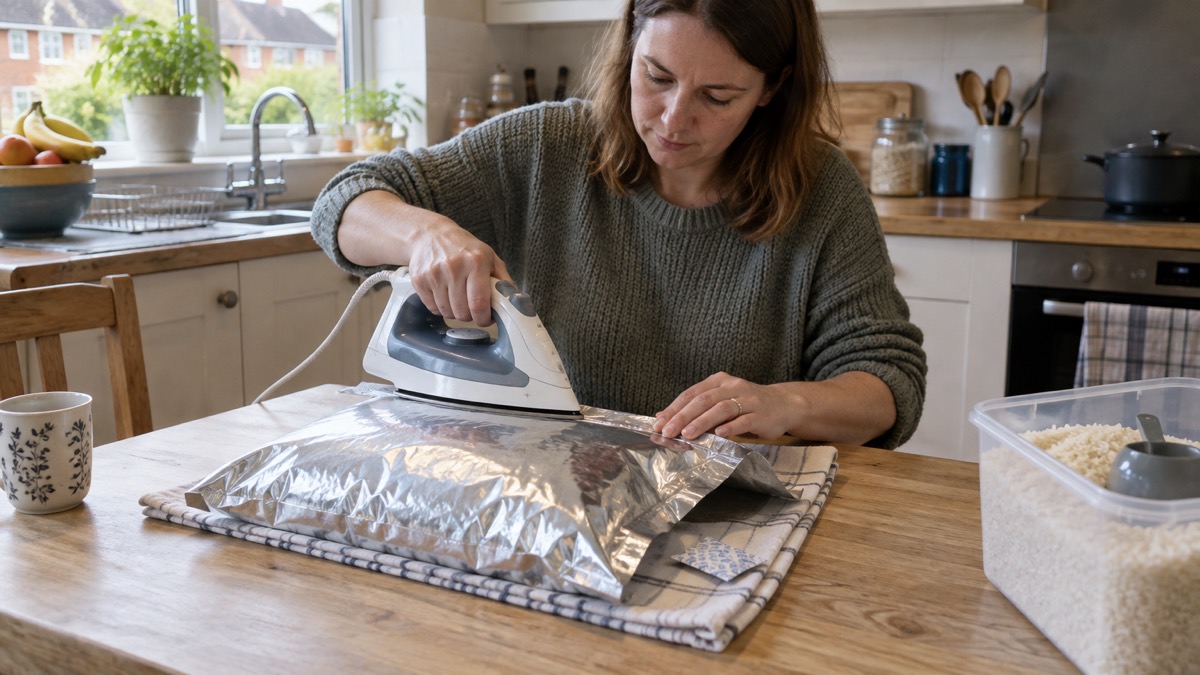
Sealing is the step that makes everything else count, and it needs no specialist equipment. Mylar bags are easily sealed with a normal clothes iron, ceramic hair-straighteners or a vacuum sealer or impulse sealer machine1. For households without any of those, see how to seal Mylar bags without a heat sealer.
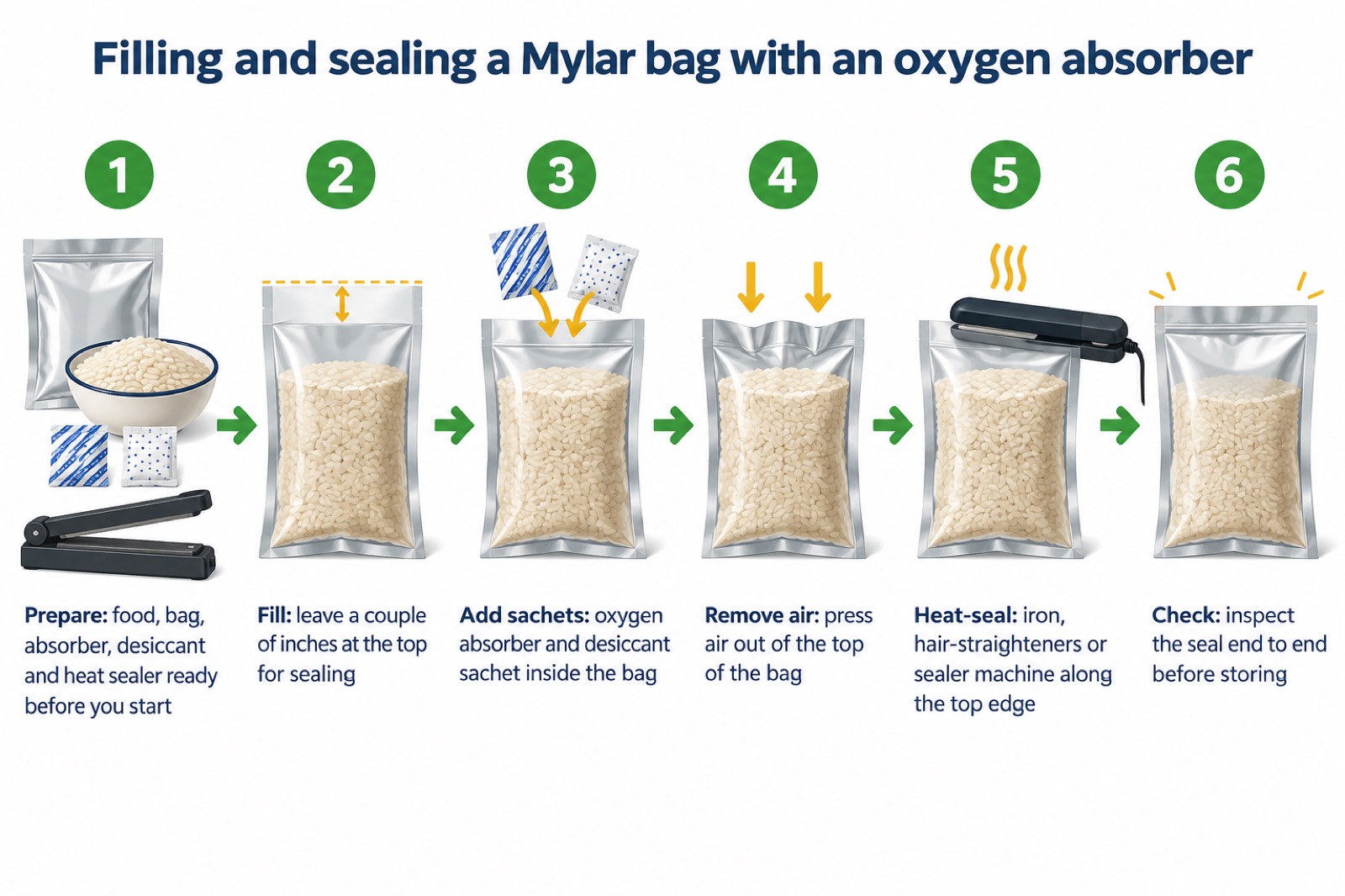
Work in this order:
- Get everything ready before you start: food, bag, absorbers, desiccant and your heat source.
- Fill the bag, leaving a couple of inches at the top for sealing, as the seller advises for the 35cm x 50cm bag1. A bag filled to the very top cannot be sealed cleanly.
- Add the oxygen absorber and the desiccant sachet, matched to the bag size as set out above2.
- Press out as much air as you can from the top of the bag, then lay the top edge flat on a hard, heatproof surface.
- Seal the bag: the sellers state Mylar bags are easily sealed with a normal clothes iron, ceramic hair-straighteners or a vacuum sealer or impulse sealer machine.
- Check the seal all the way across before you walk away: a pinhole or an unsealed section lets oxygen back in and undoes the absorber's work.
One habit worth building: label each bag as you seal it, with the food, the quantity and the date. A row of identical foil bags on a shelf tells you nothing a year later, and a store you cannot identify is a store you cannot rotate. Our guide to rotating your store, first in, first out explains how to use older bags before newer ones.
Storing sealed bags: a lidded bucket and a cool, dry place
A sealed bag is tough, but it is still a bag, and it does better with mechanical protection around it. The standard practice is to store sealed bags inside a lidded bucket or similar rigid container, which guards against puncture, crushing and rodents' teeth, makes the store stackable, and keeps bags upright. Official emergency supplies guidance points the same way for stores generally: keep tinned foods in a dry place where the temperature is fairly cool, and store boxed food in tightly closed plastic or metal containers to protect it from pests6.
The bucket also buys you a second line of defence in a flood. Food Standards Scotland advises that food in water-resistant packaging such as metal cans, sealed pouches and tetra packs can be kept after flooding if it is not damaged, provided the outside of the packaging is cleaned and sanitised first to avoid cross-contamination15. UK Government flood advice says the same: you can keep food in water-resistant packaging including undamaged metal cans, sealed plastic pots and pouches, and tetra packs, washing the outside before storage or opening16. A sealed Mylar bag inside a lidded bucket is about as water-resistant as household packaging gets, but anything that has been underwater needs the inspection and cleaning those guides describe, and our page on food after a flood covers the full decisions.
Where to put the buckets is covered in keeping a long-term store cool, dry and free of pests. The short version is on that page: keep the store cool, dry and dark. If your area floods, where to keep an emergency store if your area floods helps you choose the spot.
Babies, formula and special needs in a Mylar-based store
A dry store built on Mylar bags covers the household's staples, but households with a baby have separate needs that the bags do not meet. Which? advises that if you have a baby or young child you should include ready-to-feed baby formula in your emergency supplies, alongside long-life or powdered milk for protein and calcium17. Ready-to-feed is the emergency choice because it needs no safe water and no preparation. Buckinghamshire Council's grab bag guidance lists the same family of items: food, milk formula, drinks you use, food bowls, sterile bottles and sterilising tablets for babies and small children18.
Powdered formula is a manufactured product with its own use-by dates and is not a candidate for decades-long bag storage. If you express milk and are displaced to a rest centre, the Breastfeeding Network notes you can ask about fridge or freezer space that may be available for you to store your expressed milk in19. For making up formula safely when the power is off, see how to make up baby formula in a power cut, and for the wider picture, babies, young children and medical diets in an emergency.
Bulk pasta and other dry staples: a worked example
Pasta is the classic Mylar food, and it shows every part of the method working together. A heavy-duty 35cm x 50cm bag holds 7 to 8kg, depending on the brand, with a couple of inches left at the top for sealing, and spaghetti or linguine laid sideways is the seller's own illustration of fitting an awkward shape1. A large bag takes around 10kg of rice with room to spare7, and pasta of similar density behaves similarly.
For a bulk pasta store, then: a heavy-duty bag, an oxygen absorber and a desiccant sachet, a couple of inches of headspace, a hot iron across the full width, and the sealed bag into a lidded bucket in a cool, dry room. Label it, date it, and stack it behind the bags you will open first.
Pasta, rice, oats and pulses each have their own quirks of fat content and shelf life, set out in rice, pasta, oats and pulses for long-term storage. Glass jars are an alternative for smaller quantities, and the trade-offs are compared in Mylar bags or glass jars for dry food. If you are assembling everything at once, the long-term food storage kit checklist lists the bags, absorbers, desiccants and containers together.
Sources (19)
- Mylar Shop: Mylar bags and accessories, Mylar Shop, 2025
- Large Heavy Duty Mylar Bag 48cm x 74cm, Mylar Shop, 2026
- 100g Silica Desiccant Sachets, Mylar Shop, 2026
- Mylar Standup Ziplock Bags - 25cm x 35cm, mylarshop.com
- Heavy Duty Mylar Bag 25cm x 35cm, Mylar Shop, 2026
- Emergency supplies kit, Denbighshire County Council, 2020
- Large Mylar Bag 48cm x 74cm, Mylar Shop, 2026
- Mylar Ziplock Bag 20cm x 25cm, Mylar Shop, 2026
- Botulism (Clostridium botulinum), Food Standards Agency, 2026
- Consumer advice for food preservation at home, GOV.UK, 2026
- Food storage, Food Standards Scotland, 2026
- How to chill, freeze and defrost food safely, Food Standards Agency, 2017
- Preparing and cooking food safely, NHS inform, 2026
- 60g Silica Desiccant Sachets, Mylar Shop, 2026
- Food safety in the kitchen: flooding, Food Standards Scotland, 2026
- Food safety after a flood: consumer advice, GOV.UK, 2018
- Emergency kit packing list, Which?, 2026
- Emergency grab bag, Buckinghamshire Council, 2023
- Feeding your baby in an emergency situation, The Breastfeeding Network, 2026
 Long-Term Storage Kit Checklist
 Store Cupboard Checklist
 30-Day Household Checklist
 How Much Emergency Food to Store
 What to Store in an Emergency
 Starting a Store Cupboard
 Shelf Life and Date Labels
 Rotating Your Food Store
 Long-Term Storage Conditions
 Meals Without Power
 Self-Heating Meals
 Tinned Food Guide
 Rice, Pasta and Pulses Storage
 Freeze-Dried Meals
 Emergency Ration Packs