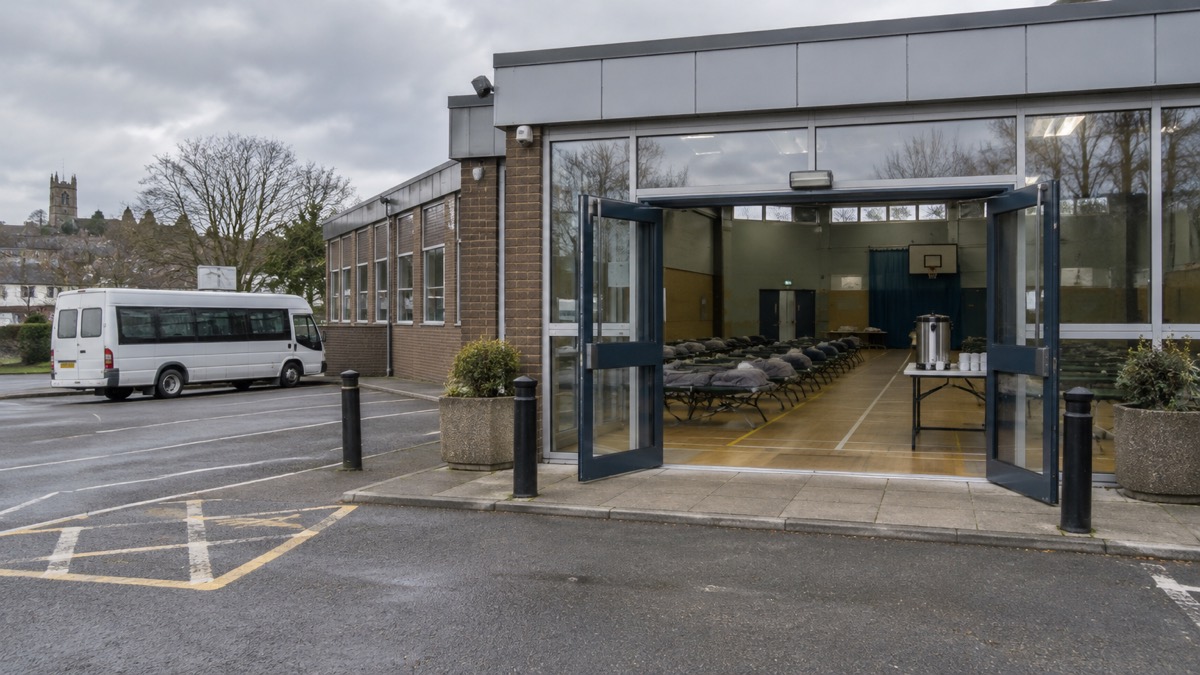
If the emergency services tell you to leave your home and you have nowhere to go, you do not need to work out shelter for yourself. Your local council has a legal duty to look after people made unintentionally homeless by an emergency, and the usual way it does that is to open a rest centre: a temporary shelter where you get basic care, welfare support, information and advice1. A rest centre is typically a leisure centre, community building, school hall or village hall taken over for the purpose3.
The timings are worth knowing so you can plan around them. A rest centre usually opens approximately 2 hours after the event, and typically stays in operation for 48 hours or so5. In the meantime, if you can go to relatives or friends, or another place of safety, that is normally the better option, and councils themselves list it first among your choices3. If you go elsewhere instead, tell the police or rest centre staff where you have gone, so nobody is sent searching for you6.
What a rest centre actually is
A rest centre is a temporary shelter for people who are evacuated and unable to stay with family and friends, where basic care and welfare support as well as information and advice is provided1. Nottinghamshire Council describes it as a facility, such as a leisure centre, where the immediate welfare needs of those evacuated can be met2. In planning terms it is a building designated or taken over by the local authority for the temporary accommodation of evacuees and homeless survivors, with the potential for overnight facilities8. A community plan from Aberaeron in Wales puts it more plainly: a building designated by a local authority for the temporary accommodation of evacuees, which may include overnight accommodation9.
The key word is "temporary". A rest centre is not a hotel and not a replacement home. It exists to cover the gap between leaving your home and either returning to it or moving into more suitable accommodation. Shropshire Council says as much from the other direction: it has a responsibility to provide temporary shelter and welfare for evacuees unable to stay with friends and family4.
So the rest centre is the safety net, not the default. If a flood, fire, gas leak or other emergency makes your street unsafe and you have a relative nearby with a spare room, going there is usually quicker and more comfortable than a communal hall. The rest centre is there for the households who have no such option, and for people caught out away from home. If you are stranded by an emergency, the council will provide basic accommodation at a welfare or rest centre10.
Who runs rest centres
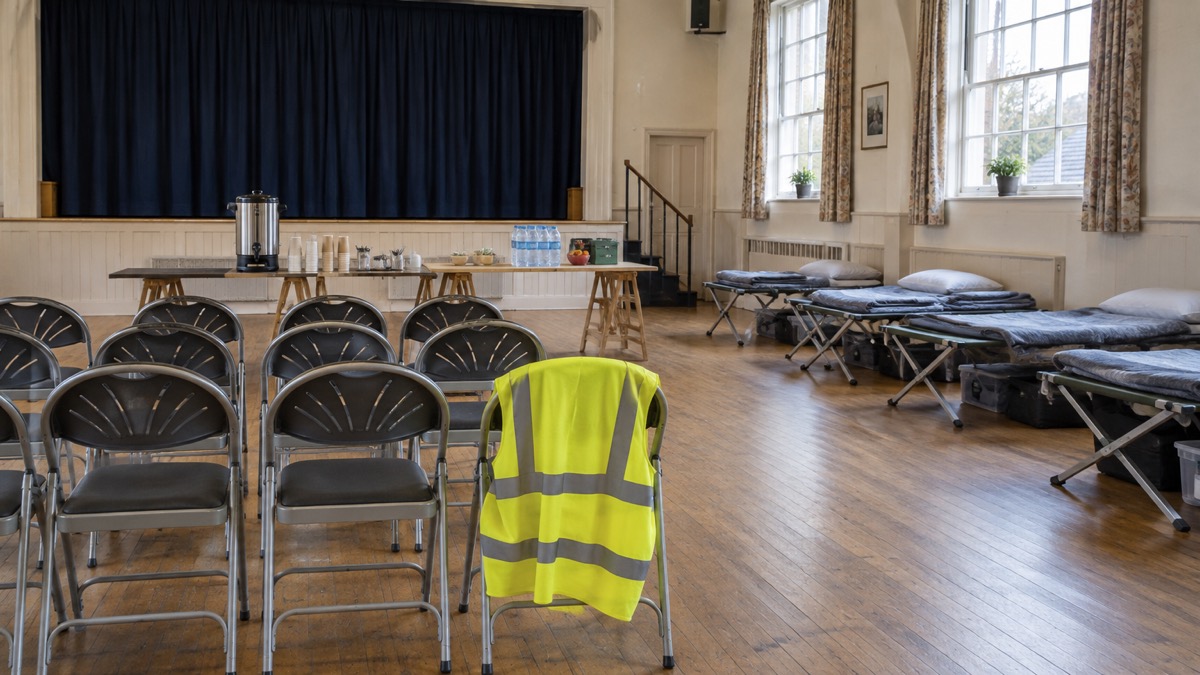
Rest centres are set up and run by your local council. Argyll and Bute Council states it plainly: these centres are usually set up by the Council, which tries at all times to make them as comfortable as possible11. Cornwall Council's emergency plan gives lead responsibility to the local authority, with assistance from adult care, health and wellbeing services and the local partnership trust, and contributions from the police, the NHS, the voluntary sector and representatives of faith communities5.
The split of roles matters for what you can expect. The emergency services, normally the police or fire and rescue service, decide whether an evacuation is necessary; it is then the council's duty to ensure the welfare of those made unintentionally homeless12. National recovery guidance from the UK government puts the same duty in national terms: local authorities are responsible for co-ordinating welfare support for their communities in an emergency, including providing temporary shelter through rest centres and meeting any need for temporary accommodation where an evacuation is extended13.
In practice this means the people you meet at a rest centre are a mixture. Council staff will run the registration desk and organise catering and bedding. Volunteers from the voluntary sector and faith communities often help with refreshments and company. NHS and adult care staff attend where people need medical or care support, and the police liaise on who has been accounted for. None of this is something you need to arrange: the council's emergency accommodation plan covers setting up and running a rest centre when homes and communities need to be evacuated14.
Where rest centres are held
You cannot usually look up your nearest rest centre in advance, because the location is decided at the time of the incident6. What you can expect is a publicly accessible building within a short, preferably walkable, distance of the evacuated area15. A community building such as a village hall is a common choice15. In Moray, in Scotland, the premises generally used are community education centres or town or village halls16. West Yorkshire Prepared describes emergency rest centres as usually being in local venues such as a leisure or community building17.
Some councils do pre-designate sites. Shropshire has a number of sites across the county pre-designated as rest centres, providing short-term and overnight accommodation and meals4. Lancashire has a number of designated evacuation centres, and the people running them are trained to give support and advice18. Even so, a pre-designated site is a starting point rather than a promise: the council will pick whichever designated or taken-over building suits the incident, the numbers involved and the hazards in the area.
Community emergency plans give a sense of the range of buildings that can be pressed into service. Aberaeron's community plan in Wales lists Aberaeron Leisure Centre as a local authority rest centre and safe place, and Holy Trinity Church Hall as another rest centre and safe place, with refreshments to be provided at non-local-authority venues such as the Memorial Hall or Church Hall9.
| Type of venue | Examples from official plans | Notes |
|---|---|---|
| Leisure centres | Aberaeron Leisure Centre; leisure centres generally2 | Space, showers and catering capacity |
| Community and church halls | village halls, Memorial Hall, Church Hall9 | Common choice, walkable from the evacuated area |
| Schools and education centres | community education centres in Moray16 | Typically used outside school hours |
| Pre-designated sites | designated sites across Shropshire and Lancashire4 | Decided at the time of the incident which to open |
How quickly a rest centre opens, and how long it stays open
Cornwall Council's published timescales are the clearest guide to what happens and when. A rest centre is opened approximately 2 hours after the event and remains in operation for 48 hours or so5. That two-hour gap is not delay for its own sake: the council has to identify a safe building outside the affected area, staff it, and get bedding, catering and registration arranged. In the first hours, other facilities cover the gap.
Cornwall's plan sets out the sequence5:
| Facility | Opens | Stays open |
|---|---|---|
| Shelter, evacuation assembly point or emergency refuge | As soon as possible | The first few hours after the event |
| Survivor reception centre | Immediately | The first few hours after the event |
| Rest centre | Approximately 2 hours after the event | Around 48 hours |
| Family and friends reception centre | Within the first 12 hours | Possibly many weeks, particularly where foreign nationals are involved |
The 48-hour figure is a typical duration, not a rule. Evacuation itself may be for some time, ranging from a few hours to several months12, and Lancashire Prepared makes the same point: evacuation may last from a few hours to much longer, so be sure to bring your emergency pack10. In a real event, the network operator SP Energy Networks reported that during a major storm its rest centres, opened with Local Resilience Forums, provided warm space, showers, hot water, food and drinks, generators, accommodation, hot food and vouchers, while district emergency action centres stayed open and operational for 18 hours per day with staff staying overnight19. Rest centres in serious events are not a one-evening affair, and they are not abandoned after one night either.
Getting there if you cannot leave on your own
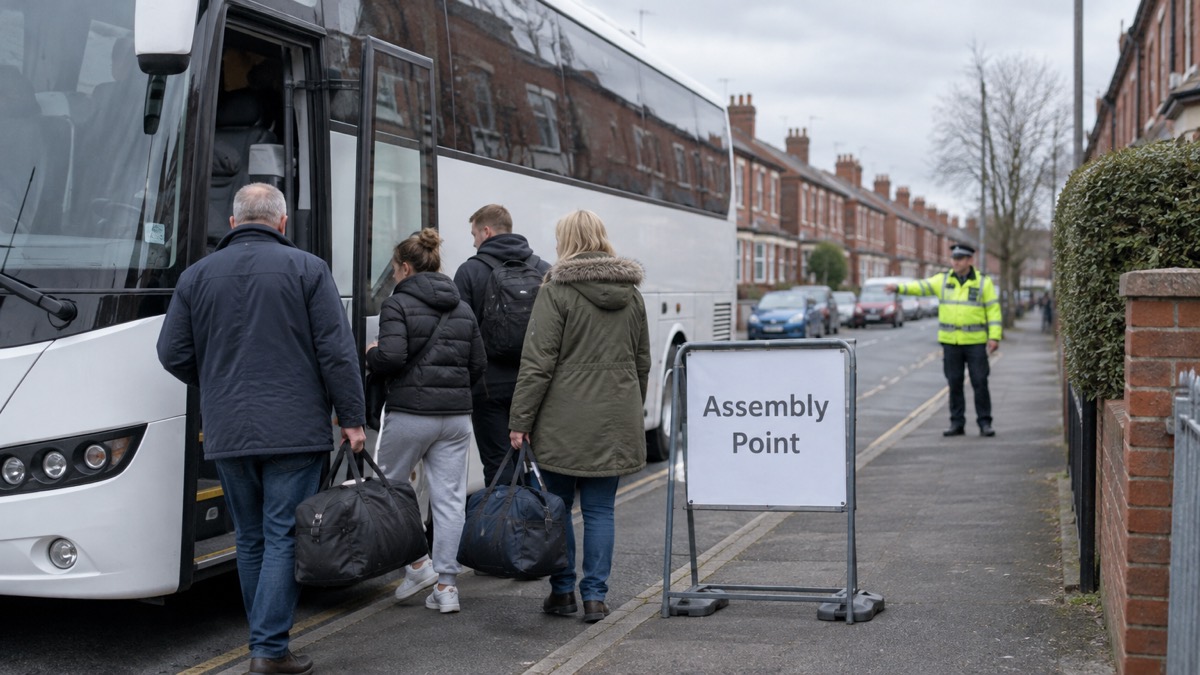
If you have your own transport, use it and go directly to the rest centre or reception centre you are told about20. If you do not, transport will be provided. Surrey Council states that the location of the rest centre is decided at the time of the incident and transport will be provided for you to get there if you have no transport of your own6. Shropshire Council says the same for the most vulnerable evacuees who may not be able to self-evacuate: transportation will be provided to the nearest rest centre4.
The pattern is consistent across different emergency types. Portsmouth's radiation emergency guide advises residents to use their own transport, and if they do not have any, they will be told where to meet and transport will be provided21. Southampton's equivalent leaflet says that if you have to leave you should stay with friends or relatives outside the affected area, and if you do not have anyone, special arrangements will be made to look after you in a safe place22. Westmorland and Furness Council's booklet adds a detail for a hazardous-release type of emergency: if you do not have transport, the police may ask you to walk to an assembly point from where a bus will take you to the reception centre, and if travelling by car you should keep all windows closed and turn off the heater and ventilation20.
If you need help to evacuate because of mobility or other difficulties, ask for it in advance rather than on the night. The fire and rescue service advises older people and people with mobility issues to plan their escape carefully, consider keeping a phone by the bed to call 999 if they cannot get out, and speak to their local fire and rescue service for tailored advice23. In managed buildings, residents who need help to evacuate are entitled to a Personal Emergency Evacuation Plan agreed with the landlord, management agent or Responsible Person24. If you have neighbours who will struggle, official guidance from an Oxfordshire community booklet says to support them and alert the local council if further help is needed, such as transport, medication, temporary accommodation or medical attention12.
What help you get at a rest centre
The support on offer goes beyond a roof and a chair. Moray Council lists what a rest centre provides: registering and recording of evacuees to ensure they receive appropriate support; catering; arranging longer-term accommodation; first aid; enabling contact with family and friends; and providing information on the emergency and its impacts16. West Yorkshire Prepared summarises it as short-term shelter, warmth, food and refreshment17. Cornwall's Strategic Rest Centre guidance adds a place to sleep temporarily, food, refreshments and a quiet place for prayers7.
Free food and bedding are provided at evacuation centres, and most will let you bring your pets25. Birmingham City Council confirms that if you go to a rest centre run by your local council, arrangements will be made to keep pets safe26. Lewisham Council describes the facilities as seating and very basic sleeping facilities, for example blankets and airbeds, and says staff will be able to direct you to further help and arrange transport there if it is needed27.
In a real storm event, SP Energy Networks reported that rest centres opened with Local Resilience Forums provided warm space, showers, hot water, food and drinks, and that generators, accommodation, hot food and vouchers were provided19. That is a realistic picture of what a well-run rest centre delivers in a prolonged emergency: warmth, washing, hot food and a place to sit while the situation outside is resolved.
What a rest centre is not, is a substitute for your own supplies in the first hours. It opens roughly two hours after the event5, and you may be waiting at an assembly point before that. Bring your emergency pack with you: evacuation may last from a few hours to much longer10. For what to pack, see our before you leave checklist and the wider emergency kit guide.
Registering when you arrive
When you arrive at a rest centre you will be asked to register by providing your name and address11. Lewisham Council says you will be asked to provide details of yourself and any family members who are present27. This is not bureaucracy for its own sake: registration is how the council records evacuees to ensure they receive appropriate support16, and how the emergency services account for everyone from the affected area.
Once registered, you are not locked in. Lewisham Council is explicit: once you have registered at the centre, you can come and go whenever you like, but you will need to sign in and out and let staff know where you are going so they can account for you27.
The same rule applies even more strongly if you never go to the rest centre at all. Surrey Council advises that if the evacuation is overnight and you choose not to stay at the rest centre, you should inform the emergency services of where you have gone and how you can be contacted by calling 1016. Essex Prepared adds the reason: so everyone is accounted for and unnecessary searches are avoided, and a carer can do this for you if required28. Westmorland and Furness Council goes further for people heading to friends or relatives: it is vital that you register at the reception centre first, so that if someone asks the police about you, they can say where you are20. Moray Council's advice is the same in shorter form: if you have made alternative arrangements and do not go to or stay at the rest centre, let the police or council staff know16.
Sleeping overnight, and what happens after 48 hours
Overnight facilities at a rest centre are basic. Cornwall describes the building as having the potential for overnight facilities, and states that it is intended that, whenever possible, more suitable overnight accommodation will be sourced, depending on the number of evacuees and the type of incident5. Lewisham's description of seating, blankets and airbeds is a fair expectation for a first night27. If the evacuation continues, tell staff: arranging longer-term accommodation is part of the rest centre's stated role16.
For longer displacements, the council's housing duties take over. Lewisham Council commits that if you have been evacuated from your home in the borough and have not been able to return for more than 24 hours because of the emergency, it will help you look for alternative accommodation27. National recovery guidance sets out the planning assumptions behind this: in past emergencies, 60% of impacted people left the area and stayed with relatives or friends, a further 30% used available hotels in safe areas, and 10% needed assisted sheltering13. The lesson for your own planning is that the system expects most households to look after themselves first, and the council's accommodation help is concentrated on the minority who cannot.
The rest centre is best understood as the first 48 hours of a chain: assembly point, rest centre, then either home, family and friends, hotel, or council-arranged accommodation. Our guides on returning home after an emergency and recovering after a major emergency cover the later stages.
If you are homeless because of an emergency but were not evacuated
Rest centres are not only for people moved out of a designated evacuation zone. A rest centre is defined in council plans as a building for the temporary accommodation of evacuees and homeless survivors8, and the council's duty covers people made unintentionally homeless by the emergency once the emergency services have decided an evacuation is necessary12. If your home becomes uninhabitable after a fire, Warwickshire Council's advice is to seek temporary shelter with family, friends or an emergency accommodation centre29.
In major incidents with casualties, a further facility appears: a Survivor Reception Centre, set up in the immediate aftermath where survivors not requiring acute hospital treatment can be taken for short-term shelter, first aid, interviews and documentation8. If you are caught up in an incident but not hurt badly enough for hospital, this is where you would be taken first, before or instead of a rest centre. A Family and Friends Reception Centre may also open within the first 12 hours for people looking for loved ones5.
What to bring with you
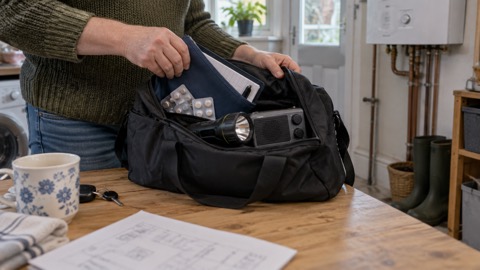
Official evacuation checklists are consistent about what to pack, and the rest centre's basic facilities mean these items matter for comfort and health rather than survival. Portsmouth's radiation emergency booklet, whose checklist applies to any evacuation, advises packing warm clothing and bedding, medicines or special food, baby food, clothes, nappies, toys and books, and private documents and valuables; making sure fires are out and appliances are switched off and unplugged; then locking up and leaving30.
- Warm clothing and bedding, because sleeping facilities are blankets and airbeds27
- Medicines and any special food you depend on12
- Baby food, clothes, nappies, and toys and books for children30
- Private documents and valuables30
- Your emergency pack, because evacuation may last from a few hours to much longer10
- Pet carriers or leads, since arrangements will be made to keep pets safe25
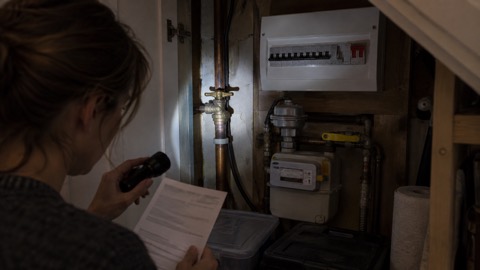
Before you leave, make sure fires are out and appliances are switched off and unplugged, then lock up30. Our page on shutting off utilities explains where the stopcock, gas valve and fuse box usually are.
Getting ready in advance
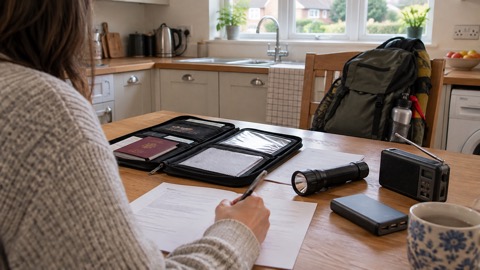
You cannot predict which building will become your rest centre, but you can prepare for the things that will make any rest centre stay easier. Make a household emergency plan that names the relatives or friends you would go to first, and make sure everyone in the household knows the arrangement. Keep an emergency pack ready so you can leave at short notice with medicines, documents and baby supplies rather than gathering them under pressure10. If you or someone in your household would need help to self-evacuate, speak to your local fire and rescue service for tailored advice23, and in a managed building ask for a Personal Emergency Evacuation Plan24.
If you are older, disabled or medically dependent, our guide to extra help in an emergency covers the support you can register for in advance. If you have pets, read pets and animals in an emergency alongside this page, since arrangements will be made to keep them safe at council rest centres26. And if you want to understand how your street would be looked after collectively, community resilience explains how local plans like Aberaeron's identify halls and volunteers in advance9.
Sources (30)
- Flood support and rest centres, Ashford Borough Council
- Flooding: before, during and after FAQ, Nottinghamshire County Council
- Preparing for emergencies, Somerset Council
- What happens in an emergency, Shropshire Council
- Reception centres, Cornwall Council
- Prepare for emergencies: homes prepared, Surrey County Council
- Humanitarian assistance and evacuations, Cornwall Council
- Emergency plan, Reigate and Banstead Borough Council
- Aberaeron Community Emergency Plan 2024, Aberaeron Town Council, 2024
- Protect yourself: terrorist attack, Lancashire Prepared
- Preparing for civil emergencies in Argyll and Bute, Argyll and Bute Council
- Are You Ready booklet, Culham Parish Council, 2025
- National Recovery Guidance: humanitarian aspects, UK Government, 2013
- Council emergency plans, Nottinghamshire County Council
- Community Emergency Plan template, North Yorkshire Local Resilience Forum, 2025
- Emergency preparations you can do, Moray Council
- Pets in emergencies, West Yorkshire Prepared
- Flooding support, Lancashire County Council
- ScottishPower Energy Networks paper, Senedd Business Committee, 2025
- What to do in an Emergency booklet 2023 to 2027, Westmorland and Furness Council, 2023
- Radiation emergency guide for residents, Portsmouth City Council, 2023
- Radiation emergency leaflet for residents, Southampton City Council, 2024
- Fire safety escape planning, Fire Kills campaign, 2026
- External wall fire review process, Dorset and Wiltshire Fire and Rescue Service, 2026
- What to do in a flood leaflet, Environment Agency, 2010
- Birmingham Prepared: are you ready, Birmingham City Council, 2026
- What to do if you are evacuated, Lewisham Council, 2023
- Step 2: during an emergency, Essex Prepared, 2026
- Dealing with the aftermath of a fire, Warwickshire County Council
- REPPIR residents booklet 2024, Portsmouth City Council, 2024
 30-Day Household Checklist
 Emergency Plan Template
 Supply Interruption Checklist
 Household Emergency Plan
 Emergencies to Prepare For
 Community Risk Registers
 What to Do in an Emergency
 Sheltering in Place
 Staying Put or Leaving
 If You Are Asked to Evacuate
 Planning Your Evacuation
 Stopcock, Gas Valve and Fuse Box
 Returning Home
 Recovering After an Emergency
 Scotland Emergency Planning