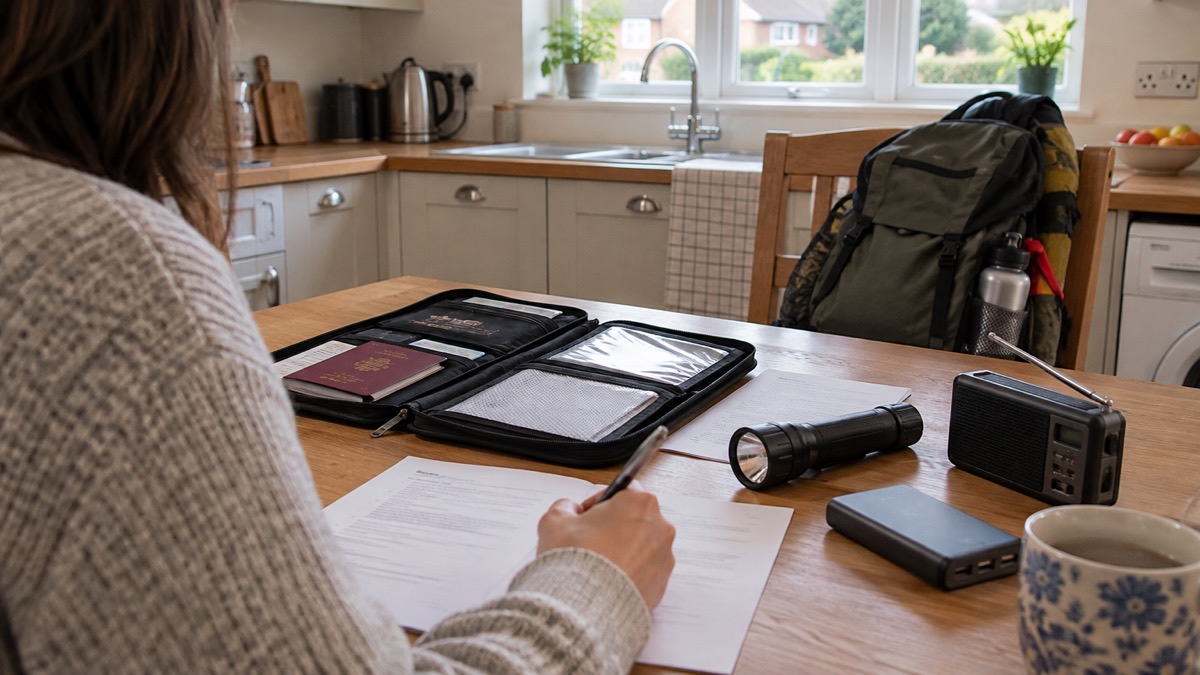
A household emergency plan is a short written document that says who does what, who to contact and where to meet if an emergency separates you or forces you from your home. The Government's Be Ready campaign publishes a fill-in household emergency plan, and its core advice is simple: record your emergency contacts, agree how you would leave home quickly, know how to turn off your gas, electricity and water, and keep supplies for at least three days1.
You do not need any special knowledge to write one. The Scottish Government's home emergency plan template is a 2 page PDF3, so a plan does not have to be a long document. Set aside half an hour, sit down with the people you live with, and fill it in together. Emergencies that could disrupt daily life include severe weather such as snow, ice, flooding, heatwave and high winds, infectious diseases, transport accidents and industrial incidents3, and a plan gives you the decisions to make before you need them.
This page walks through each part of the plan in the order you would write it: contacts and meeting points, utility shut-offs, three days of supplies, a grab bag, arrangements for pets and the car, a contingency plan if you look after someone, and where to keep the finished document.
What to write down: contacts, meeting points and key information
Start with the people. Your plan should contain emergency contact details for your family or the people you live with, as well as details relating to your insurance and utility providers6. Include the contact details of members of the family you will need to inform, your local doctor's number, and the numbers for your gas, electricity and water suppliers7. Add the emergency numbers you may need: 999 for the emergency services8, and 105 for power cuts4.
Pre-arrange meeting points where members of your family and those close to you can gather in an emergency9. Choose at least two: one near your home, in case you are separated by a fire or flood, and one further away, in case you cannot get back to your area at all. Write down who collects children or dependants from school or day care, and in what order you would try to contact each other if mobile networks are busy.
A useful trick for mobile phones is the ICE system. ICE stands for In Case of Emergency: add the letters ICE in front of a person who should be contacted in an emergency in your phone's memory, and make sure that person has agreed to be your ICE partner and has a list of people to contact on your behalf10. More than one contact can be added by numbering each contact, for example ICE 111. Paper still matters, though: put your address by the phone so that children can read it out to the emergency services8.
For staying in touch more broadly, see Staying Informed and in Touch in an Emergency.
| What to record | Examples |
|---|---|
| Household contacts | Family members, the people you live with, who to inform first6 |
| Meeting points | One near home, one further away, agreed in advance9 |
| Services | Local doctor, gas, electricity and water suppliers, insurance6 |
| Emergency numbers | 999, 105 for power cuts4 |
| Phone entries | ICE contacts, numbered ICE 1, ICE 210 |
How to turn off gas, electricity and water
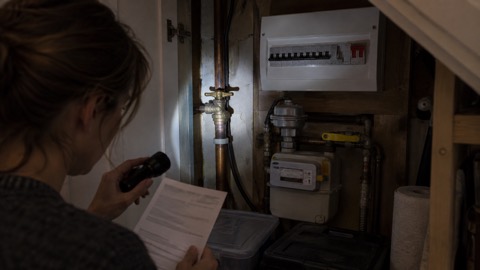
Every plan should include instructions about where and how to switch off your gas, electricity and water12. Identify where these services come into your home and how to turn them off, including the stopcock for water13. The London Fire Brigade advises making sure you know how to turn off your gas, water and electrical supplies in an emergency14, and the Be Ready campaign notes you will need to turn these off if you have to leave your home due to flooding or for other reasons such as a leak2.
It is worth checking where these are and showing family, in case you need to turn them off quickly in an emergency15. A plan that only one adult can follow is only half a plan: walk everyone old enough through it, and note the locations in writing so you can find them under stress. Our guide to Finding Your Stopcock, Gas Valve and Fuse Box goes into the detail.
The reason is safety: relighting or restoring a gas supply incorrectly can leave an appliance unlit or a leak undetected. If you smell gas, do not switch anything on or off, open windows and doors, and call the gas emergency line. In Scotland the gas emergency number is 0800 111 99917. Scottish Water can be reached on 0800 077 8778 and Floodline Scotland on 0345 988 118817.
Supplies for three days: water, food and the rest
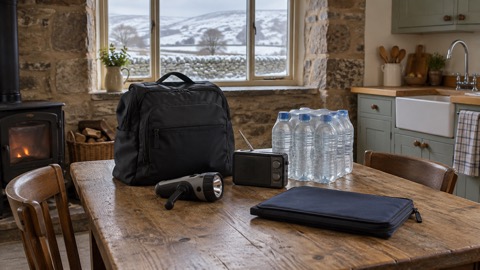
Your plan should say what supplies you keep and where. Plan for at least three days11, and consider what supplies you and your household might need during an emergency lasting a few days, such as a power cut or a flood18.
Water is the item most households underestimate. The Be Ready checklist recommends bottled water for 3 days, at 3 litres per person per day for drinking, and notes that more would be needed for other tasks such as cooking and washing2. North Devon Council advises that a minimum of 2.5 to 3 litres of drinking water per person per day is recommended by the World Health Organisation for survival, and that 10 litres per person per day will make you more comfortable by also providing for basic cooking and hygiene needs19. Dumfries and Galloway Council's household emergency pack guidance says 2.5 litres of bottled water per person for each day20. Birmingham City Council advises at least 3 litres per person per day for cooking and washing21. The figures differ slightly between sources, but the practical rule is the same: store at least 3 litres per person per day for drinking, and more if you can, because cooking and washing add to it.
For food, keep non-perishable food to last at least 3 days that does not require cooking or refrigerating, for example tinned meat, fruit or vegetables, plus a tin opener1. Birmingham's suggested household emergency supplies list gives a fuller picture of what else to keep21:
- long-life food such as canned food, dried food and energy bars, and a manual can opener
- a torch with spare batteries or a wind-up torch
- a camping stove and a camping lantern
- medication and a first aid kit
- a copy of your household emergency plan
- pet food, water and routine medication
- a sleeping bag or warm blanket for each person
- hand sanitiser and toiletries, such as toothpaste and a toothbrush
- rubbish sacks, toilet rolls, and duct tape to seal doors, windows and vents if advised to do so
Our Emergency Kit, Water in an Emergency and Emergency Food guides cover each of these in depth.
Grab bags: what to pack if you must leave quickly
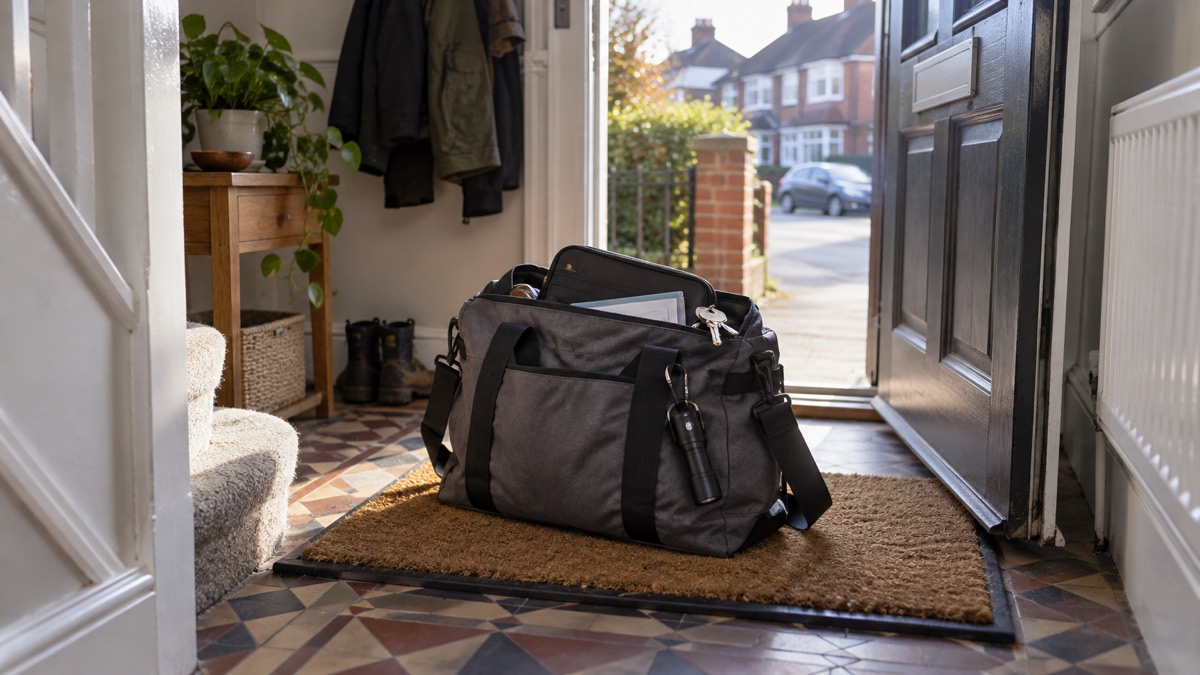
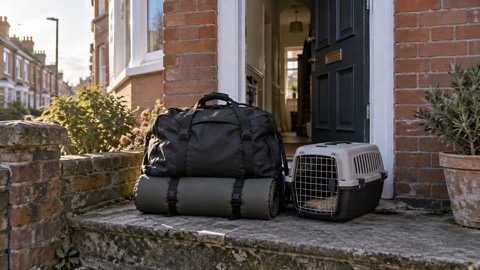
The other half of your plan covers leaving home. Pack a grab bag of essential items that might be helpful if you have to leave your home at short notice6. The Be Ready campaign suggests keeping some essential items you might need to take with you if asked to leave your home quickly in a spare bag, sometimes called a grab bag5.
Ideally, prepare a small easy-to-carry bag with essentials and store it in an accessible place ready to go. At the very least, have an up-to-date checklist of things to put into your emergency grab bag22. Edinburgh's evacuation guidance for residents makes the same point: if you have to evacuate your home, it will make things a lot easier if you have prepared a grab bag in advance containing a packing list to follow10. Medication belongs in the pack itself20, because prescriptions cannot always be collected at short notice.
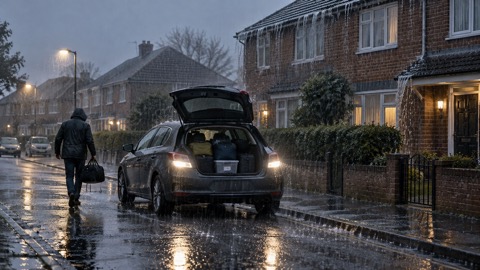
If you are asked to leave, the North Wales Resilience Forum's household guidance says to leave as quickly and calmly as possible: turn off electricity, gas and water, unplug appliances, lock doors and windows, take your emergency kit, take bottled water and blankets if leaving by car, take pets with carriers or leads and pet food, and tune in to local radio or trusted social media23. Somerset Council suggests preparing an evacuation checklist of items you would need to take, and keeping a basic emergency kit in your vehicle depending on the time of year24. Greater Manchester advises preparing a household emergency plan that contains all the information you need to leave your property quickly and calmly if evacuated, using the template on the Government's Prepare website18. See Planning How Your Household Would Leave Home and Before You Leave Home in an Emergency: Checklist.
Pets, the car and staying indoors
Your plan should cover the situations in between leaving and staying. For pets, include pet food, water and routine medication in your household supplies21, and note in the plan that pets go with you if you evacuate, with carriers or leads23. Our Pets and Animals in an Emergency guide covers this in full.
For the car, keep a basic emergency kit in your vehicle depending on the time of year24. Note in your plan where the car is usually parked, who holds the keys, and what you would take in it if you left by car, such as bottled water and blankets23.
For staying indoors, the Scottish Government's home emergency plan is direct: if it is not safe to go out, go indoors and close all windows and doors, stay indoors, and stay up to date using radio, TV or online17. Write into your plan which room you would gather in, where torches and the battery or wind-up radio are kept, and how you would seal doors, windows and vents with duct tape if advised to do so21. See Sheltering in Place: Staying Indoors When Danger Is Outside and Staying Put or Leaving: How to Decide.
If you look after someone: a carer's contingency plan
If you are an unpaid carer, your plan needs an extra layer. As a carer, it is important to have a plan in place to help you and the person you care for in an emergency25. This is usually called a contingency plan, and it gives you peace of mind that, in an emergency, you and your cared for person's wishes about replacement care have already been documented25.
Include who to contact in an emergency, covering family, friends and professionals26, and who can be your emergency contacts27. Make a plan with the person you care for about how you will contact them in an emergency12. Think through what happens if you are suddenly unavailable: who has a key, who knows their medication and routines, and who they would want to step in.
Help exists to build this. Caring for Carers can help you with a contingency plan and signpost you to the Carers Emergency response service, who may be able to provide carers for your loved one in an emergency if they need this level of support25. Carers UK offers an interactive online tool to help you create an emergency plan, at www.carersuk.org/search/planning-for-emergencies27. Your local council's carers support service is the place to ask first. See Extra Help in an Emergency for the wider support available to older, disabled and medically dependent households.
Where to keep the plan, and how often to review it
A plan nobody can find is not a plan. Keep a printed or handwritten copy somewhere handy and make sure everyone in your home knows where it is4. The Royal Borough of Windsor and Maidenhead's advice is to download the plan, fill it in, agree it in advance with your household, print it out and keep it somewhere safe16. A paper copy matters because a power cut or network failure can take your phone and broadband with it.
Keep door and window keys where everyone you live with can find them, for example on hooks behind curtains or boxes on window sills, and take a few minutes to practise your escape plan regularly28. Staffordshire Fire and Rescue Service also advises putting your address by the phone so that children can read it out to the emergency services8.
Set a reminder every six months to check expiry dates and swap out items that need replacing, or update your kit if your household needs have changed5. Review your plan on an annual basis and check all the details are still correct29. A calendar reminder twice a year is enough to keep supplies usable and the plan accurate.
Free templates you can fill in today
You do not have to write your plan from a blank page. Several official templates exist:
| Template | Who publishes it | What it gives you |
|---|---|---|
| Home Emergency Plan | Scottish Government (ready.scot) | A 2 page PDF plan3 |
| Your Home Emergency Plan | Royal Borough of Windsor and Maidenhead | A fill-in plan with grab bag guidance, emergency numbers and utility isolation advice16 |
| Personal emergency plan templates | Somerset Council | Templates for personal, parish and business emergency plans24 |
In Wales, the North Wales Resilience Forum's guidance notes that a template to help develop a home emergency plan is available from www.nwc-reps.org.uk23. In Scotland, ready.scot publishes the plan and offers further advice and emergency kit suggestions17. Our own Household Emergency Plan Template: What to Fill In page walks through the fields one by one.
What emergencies to plan for
Plan for the situations most likely to affect your household rather than every possibility. Household emergency preparation applies when there is unplanned separation from family members31: an emergency that starts while people are at work, school or elsewhere. Power cuts, flooding, storms and gas or heating failures are the everyday cases a UK household most often faces, and the same plan serves all of them, because the actions are the same: know your contacts, know your shut-offs, have supplies, and know whether you would stay or leave.
Your local community risk register lists the specific risks where you live; see Community Risk Registers: Finding the Risks Where You Live and Which Emergencies Should a UK Household Prepare For?. For what to do once an emergency is under way, see What to Do in an Emergency at Home.
One last point to write into your plan: criminals may take advantage of emergencies by sharing scams or false information, so keep your devices and personal information secure4. Agree in advance that your household will check news via local radio or trusted official sources rather than forwarded messages, and be wary of unexpected requests for money or personal details.
Sources (31)
- Be Ready Household Emergency Plan (PDF), UK Government Be Ready campaign, 2026
- Be Ready for Emergencies, UK Government Be Ready campaign, 2026
- Home Emergency Plan (PDF), Scottish Government, 2026-03-24
- Prepare an Emergency Plan, Ready Scotland, 2026-10-29
- Get Prepared for Emergencies, UK Government Prepare campaign, 2026-10-21
- Preparing Yourself for Emergencies, London Resilience Partnership, 2026-10-25
- Preparing for an Emergency, Nottinghamshire County Council, 2026-10-29
- Plan Your Escape, Staffordshire Fire and Rescue Service, 2026-10-29
- Preparing for Civil Emergencies in Argyll and Bute, Argyll and Bute Council, 2026
- Evacuation Advice for Residents, City of Edinburgh Council, 2019
- Preparing for Emergencies, North Hertfordshire District Council, 2015-01-12
- Easy Read: Disabled Persons and Carers (PDF), UK Government Prepare campaign, 2024-07
- Northumbria Local Resilience Forum, Northumberland County Council, 2026-10-28
- Preparing for a Flood, London Fire Brigade, 2026-10-25
- Prepare Yourself, Wiltshire and Swindon Prepared, 2026-10-25
- Your Home Emergency Plan (PDF), Royal Borough of Windsor and Maidenhead, 2025-10
- Home Emergency Plan (PDF), Ready Scotland, 2026
- Prepare Yourself, Greater Manchester Combined Authority, 2026-10-29
- Be Prepared for Emergencies, North Devon Council, 2026-10-29
- Create a Household Emergency Life-Saving Plan, Dumfries and Galloway Council, 2026
- Are You Ready?, Birmingham City Council, 2026-05-06
- Step 1: Preparation, Essex Prepared, 2026-10-29
- Preparing for an Emergency: What You Need to Know (PDF), North Wales Resilience Forum, 2020
- Preparing for Emergencies, Somerset Council, 2026-09-17
- Planning Ahead as a Carer, Beacon Medical Group (NHS), 2026
- Plan for Emergencies and Changes, Staffordshire County Council, 2026
- Carers Handbook: Emergency Plan, Oxford Health NHS Foundation Trust, 2025-09-16
- Home Fire Action Plan, Surrey County Council, 2026-08-24
- Community Emergency Plan Template (PDF), North Yorkshire Local Resilience Forum, 2025-02
- Message in a Bottle Scheme (PDF), Torbay and South Devon NHS Foundation Trust, 2019-02
- Protecting Your Family, Essex Prepared, 2026-10-29
 30-Day Household Checklist
 Emergency Plan Template
 Supply Interruption Checklist
 Emergencies to Prepare For
 Community Risk Registers
 What to Do in an Emergency
 Sheltering in Place
 Staying Put or Leaving
 If You Are Asked to Evacuate
 Planning Your Evacuation
 Rest Centres
 Stopcock, Gas Valve and Fuse Box
 Returning Home
 Recovering After an Emergency
 Scotland Emergency Planning