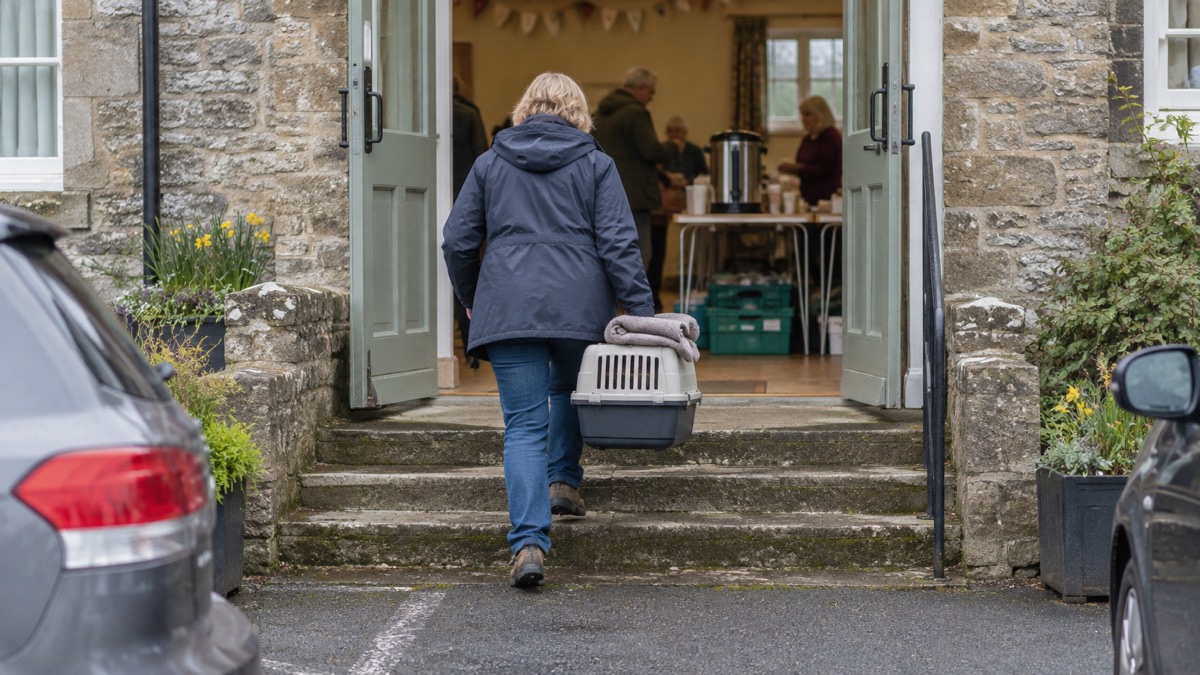
Pets are an important part of family life, and your emergency plans should include how you will look after them1. Councils across the UK make the same point: if you are a pet owner, a household disaster plan must include your pets, and being prepared can save their lives2. Yet the pet section is the part most households leave out, and it is the part that causes the most difficulty on the night, because shelters, hotels and rest centres do not always take animals.
The good news is that a pet emergency plan is short. It needs four things: a person who will look after your animals if you cannot, a place they can go if you have to leave home, a grab bag with their food and medication, and a few seasonal precautions around fireworks, floods and winter grit. This page walks through each of those in the order you need them, and shows how the pet section fits into your wider household emergency plan.
Pets belong in the household plan
Every piece of official guidance on household emergency planning in the UK says the same thing about animals: plan for them. North Devon Council tells households to plan for medication, mobility, communication or care needs, "including the needs of pets"8. Anglesey's Home Emergency Plan template asks you to consider the needs of pets or other animals9. Buckinghamshire's emergency grab bag guidance is another council making the same point: your pets belong in your household plan and your grab bag10.
The reason is simple. In an emergency, strange sights, sounds and smells can cause your pets to become disoriented and lost4. An animal that is frightened behaves unpredictably, and a household that has not decided in advance who grabs the cat, where the carrier is and what the dog eats will lose precious minutes at exactly the moment they matter. London Resilience's preparedness advice puts the practical steps in one line: microchip your pets, put a pet sticker in the front window so responders know animals are inside, know your pets' hiding places, carry a picture of the pet, and invest in a sturdy carrier and harness5.
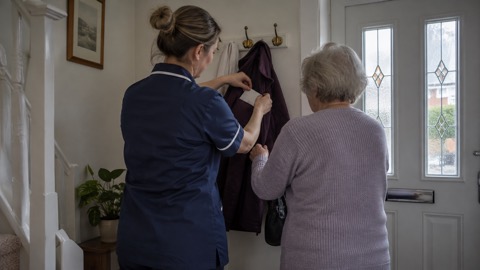
If you care for another person, their plan needs a pet entry too. Norfolk County Council's carer's emergency plan guidance says the plan should record whether the person you care for has pets and who will care for them in an emergency11. The same applies in reverse: if a relative or neighbour helps you, make sure they know your animals.
Your responsibility for your animals does not pause
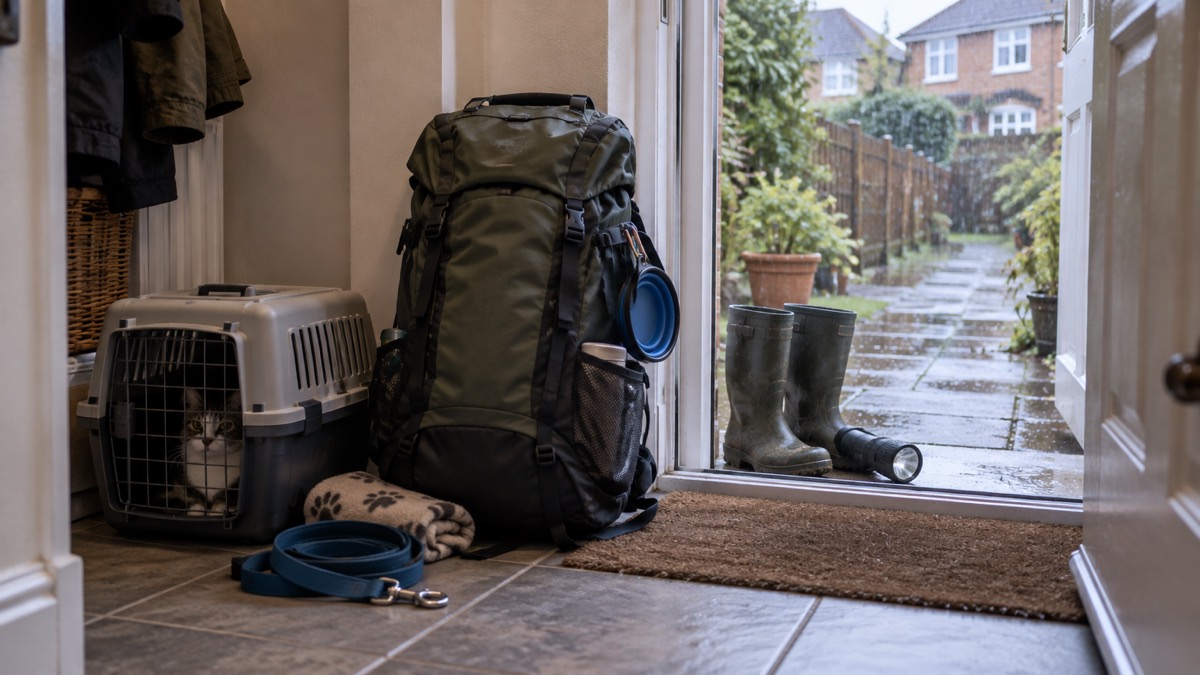
An emergency does not suspend your responsibility for the animals you keep. Slough Borough Council's guidance is blunt that a household disaster plan must include pets if you are a pet owner, and that being prepared can save their lives2. South Gloucestershire Council publishes a step-by-step guide to preparing your pets for an emergency, and while it notes that its guide is provided for advice purposes only, the expectation it sets out is that owners plan ahead for their animals12.
Two points of responsibility are worth fixing in your mind.
First, if something happens to you, your animals still need looking after. Suffolk County Council's Family Carers Emergency Plan guidance describes creating a plan which sets out in advance what needs to happen to the person you care for in an emergency if you are unable to continue providing care, and identifies someone to be contacted13. Nottinghamshire's easy-read version explains the benefit plainly: this means the person you care for will still be looked after if something happens to you14. Apply the same thinking to your pets: name a person, and make sure they have agreed.
Second, a plan is a plan, not an emergency service. Argyll and Bute Council's community emergency planning guidance states that in any emergency, having a plan is not a substitute for calling 9996. If your pet is injured, if there is a fire, or if a person is in danger, call 999 first and work your plan second.
Take your pets with you if you have to leave
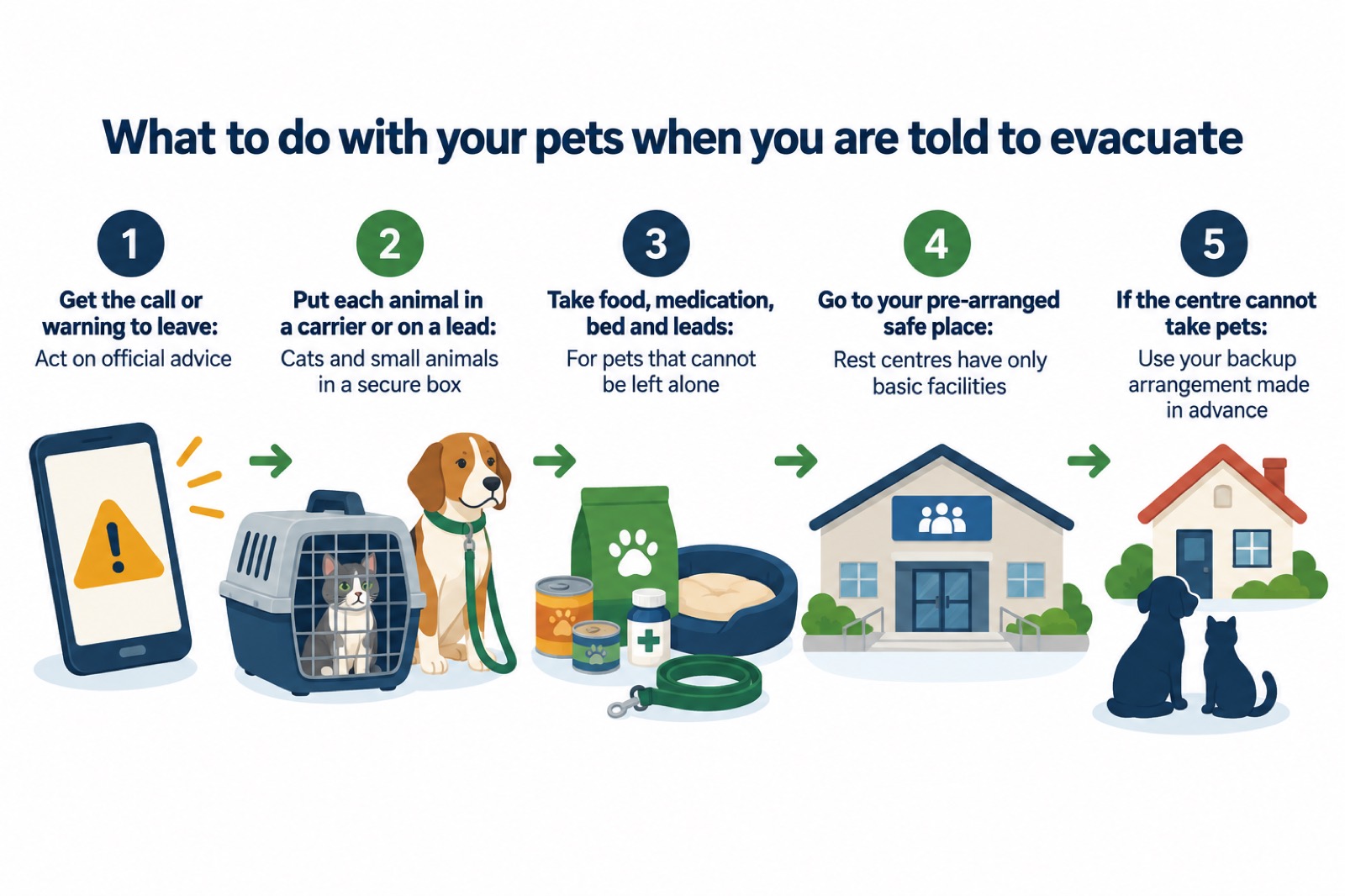
If you are told to evacuate, the default answer is that the animals come with you. Lincolnshire County Council's emergency advice says simply: "Take your pets with you"3. Essex Prepared's guidance for households during an emergency says the same, with the practical detail: take your pets with suitable carriers, leads and food supplies16.
What you take depends on the animal. Scottish Borders Council advises that if you have pets which cannot be left alone for a sustained period, you should take some food, a basket or bed, and leads17. Surrey's in-case-of-emergency template asks households to consider whether they need to take their pets with them18. For dogs, cats and small animals, the other councils' advice is clear: take them with you, with suitable carriers, leads and food supplies.
The harder question is where you all go. Lancashire Prepared warns that if you have pets, you need to plan where they can stay, because there will only be basic facilities at the rest centre19. Cotswold District Council's flooding guidance is more encouraging about rest centres themselves: most evacuation centres will let you bring your pets, but take their food, and put cats and small animals in a pet carrier or secure box20. Westminster City Council takes the opposite line for its own area: if you have pets you should have a plan for where they can stay in the event you are evacuated, and you are advised not to bring them to an evacuation centre21.
Assume the rest centre may not take your pet, and have somewhere else lined up. If you have advance warning of an emergency, Westminster's animal welfare advice is to consider placing your pet somewhere safe such as a cattery or in boarding kennels22.
One situation deserves special mention: an ambulance coming to your home. South Western Ambulance Service NHS Foundation Trust advises people waiting for an ambulance to put pets somewhere safe23. The Welsh ambulance service's equivalent guidance adds detail: put pets somewhere safe where they will not be in the way, and open the door and wave to the ambulance when it comes24. A frightened dog in a hallway delays paramedics.
If you are away from home when an evacuation happens, Birmingham City Council advises agreeing a plan with a trusted neighbour, and making sure they know your pet and where to find a lead or carrier1. That arrangement needs to be made now, not during the incident. For more on the specific problem of rest centres and pets, see can I take my dog or cat to an emergency rest centre, and for the hardest case, what to do if you have to leave a pet behind in an evacuation.
Arrange a safe place for your pet before you need it
This is the single most important item on the page, and the one councils repeat most often. Birmingham's guidance tells households to plan so your pets have a safe place to stay1. Slough's is starker: some emergency shelters cannot accept pets, and it may be difficult, if not impossible, to find shelter for your animals in the midst of a disaster, so plan ahead2. Buckinghamshire's grab bag guidance says to know a safe place where you can take your pets before disasters and emergencies happen10.
Work through the options in order of preference:
- Family or friends outside your immediate area who have agreed in advance to take your animals, and who have met the animals before.
- A trusted neighbour who knows your pet and knows where your leads and carriers are kept1.
- Boarding kennels or a cattery, which Westminster's animal welfare advice suggests using if you have advance warning of an emergency22.
- Your vet or an animal shelter, which Buckinghamshire's guidance points to as sources of additional advice on where your pet could go10.
Write the arrangement down, with phone numbers, in the same place as the rest of your household plan. Tell everyone in the household what it is, including children, so any of them can act on it. Check the arrangement still stands once or twice a year: people move, circumstances change, and a plan nobody has confirmed is not a plan.
For animals that cannot be moved into someone's home, the same principle applies with more logistics. If you keep horses or livestock, their transport and destination need arranging well in advance; the horses and livestock page covers that in detail.
What to pack in a pet emergency kit
Your pet's kit lives inside your household grab bag, or beside it. Council emergency kit checklists across the UK include pet supplies as a standard item: Wiltshire's kit guidance lists emergency medication and food for pets25, Neath Port Talbot's checklist says to keep baby and pet supplies at home26, and North Devon's includes pet food, medication, a water bowl and a suitable carrier where needed8. Scotland's Ready Scotland kit guidance includes pet supplies and any documents or supplies for assistance animals27.
Medway Council's pet emergency grab bag list sets out what to pack for your animals: a lead or carrier for every animal, any medications your animals need, pet food, vaccination certificates, litter, paper towelling or bedding if needed, and toys4:
| Item | Why it goes in |
|---|---|
| A lead or carrier for every animal | So you can move each pet safely; if they will not all fit in the bag, keep them as close to your bag as possible4 |
| Any medications your animals need | Regular medicines may be unobtainable during an emergency4 |
| Pet food | Rest centres and hosts will not necessarily supply it20 |
| Vaccination certificates | Boarding kennels and catteries may ask for them4 |
| Litter, paper towelling or bedding | For cats and small animals kept indoors4 |
| Toys | Familiar items reduce stress in a strange place4 |
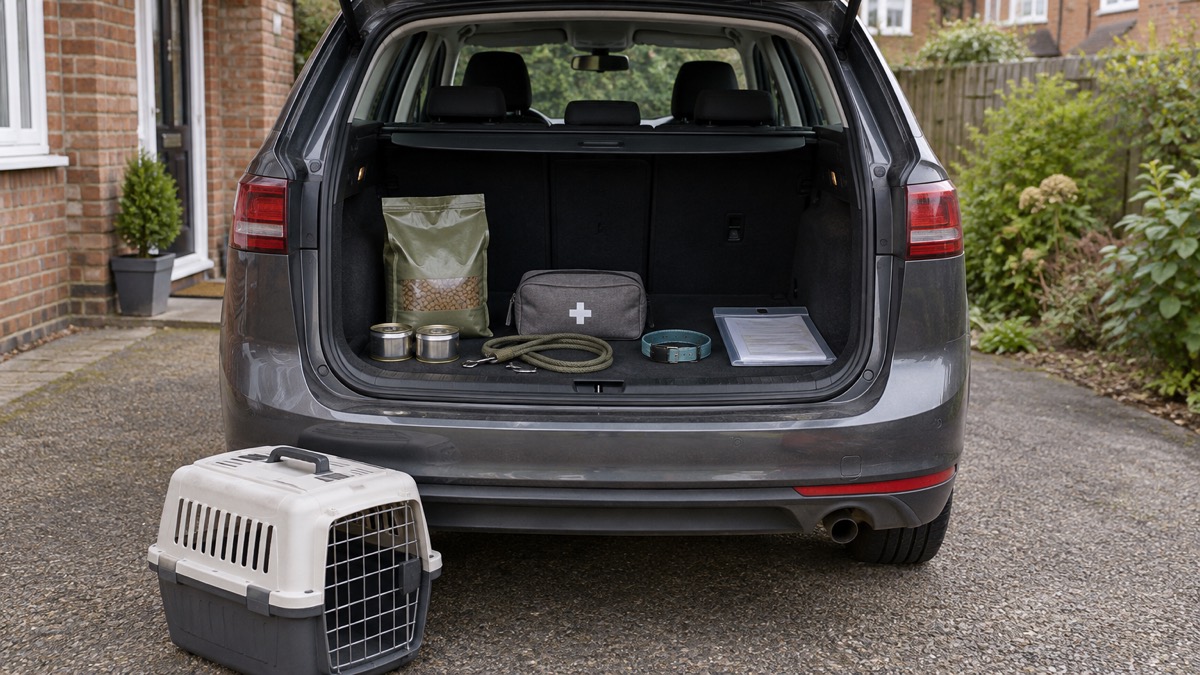
Buckinghamshire's guidance adds the longer-term view for a fuller pet emergency kit: keep several days' supply of food in an airtight, waterproof container; store a water bowl and several days' supply of water; keep an extra supply of your pet's regular medicine in a waterproof container; and include a first aid kit, a collar with ID tag and a harness or leash, a crate or sturdy carrier ideally one for each pet, grooming items, sanitation needs including pet litter and a litter box, newspapers, paper towels and plastic bags, a picture of you and your pet together, and familiar items such as favourite toys, treats or bedding10.
The household kit around it matters too. Carmarthenshire's emergency kit checklist puts the top ten items in one list: your household emergency plan including emergency contact numbers, a battery torch with spare batteries or a wind-up torch, a first aid kit, important documents, bottled water and ready-to-eat food that will not go off, spare keys, spare glasses, toiletries and details of important medicines, and pencil, paper, penknife and whistle, with pet supplies included28. Dumfries and Galloway's household emergency pack guidance includes a first aid kit29, and the same checklist appears in Carmarthenshire's English-language preparedness pages30. For the animal-specific version, see pet first aid kits, and for quantities, how much pet food and water to store for an emergency.
Lincolnshire's kit advice adds pet food and treats, and pet care items if required31, which is a useful reminder that the kit should suit your actual animals: a litter tray for a cat, a harness for a dog, bedding for a rabbit.
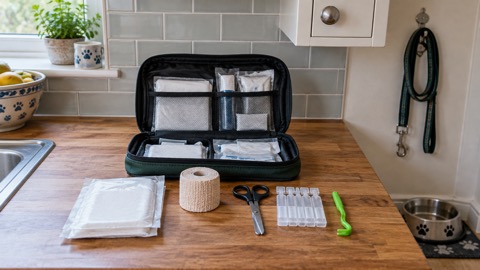
*A pet emergency kit laid out item by item: food, medication, lead, carrier, vaccination certificates and familiar toys.
Fireworks: keep pets indoors and never leave them outside
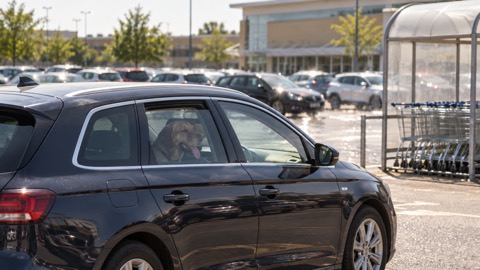
Fireworks are the emergency most pet-owning households actually face, several times a year, and the advice is consistent: keep your pets indoors and safe while fireworks are being let off. Do not tie your dog up outside while fireworks are being let off, for example outside a shop while you pop inside, and do not leave them in the garden or in the car. Make sure dogs and cats have access to clean water at all times, ideally in a large bowl filled to the brim. Remember that as an animal owner you have a legal duty of care for your pet's welfare, which includes taking reasonable steps to meet their needs.
"If your neighbours have pets, they will need to keep them indoors, so let them know well in advance."
The underlying risk is the one Medway Council describes for emergencies generally: strange sights, sounds and smells can cause your pets to become disoriented and lost4. A dog that bolts on bonfire night may travel a long way before it stops. The precautions follow directly:
- Keep pets indoors while displays are going on33.
- Make sure cats and dogs wear ID tags, and that microchip details are up to date5.
- Know your pets' hiding places so you can find and check on them quickly5.
- Tell neighbours in advance if you are letting off fireworks yourself32.
If your pet is badly affected by fireworks, speak to your vet before the season starts so that you have a plan in place before the first display. If a pet is injured or in serious distress at any point, seek veterinary help; emergency vets covers out-of-hours care. For other animals, see how to keep horses safe during fireworks and protecting rabbits and guinea pigs from fireworks.
Winter hazards: grit and rock salt
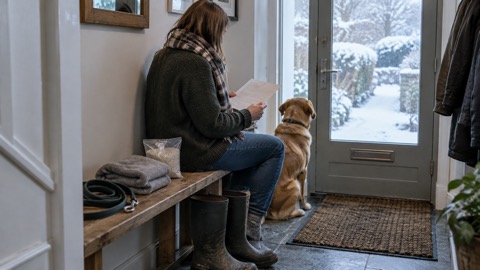
When the clocks go back and the gritters come out, a new hazard arrives for dogs and cats. The Met Office, reporting British Veterinary Association advice, warns that grit or rock salt can be extremely toxic to dogs and cats if ingested7. Dogs pick it up on their paws on winter walks and swallow it when they lick themselves clean.
The precaution is simple and the BVA's advice, as reported by the Met Office, is to pack a towel to remove toxic grit or rock salt from your dog's paws when you are out and about7. Wipe paws and legs after every walk on treated paths and roads, before your dog can lick them.
Winter also changes what belongs in the car. Neath Port Talbot's emergency car kit checklist includes a snow shovel in the event of an emergency26. If you are travelling with pets in winter, that shovel, the paw towel and your pet's food and water belong in the car with you. For more detail, see is rock salt dangerous to dogs' and cats' paws, pets in cold weather, snow and ice, and walking a dog safely in snow and darkness.
Floods and other specific emergencies
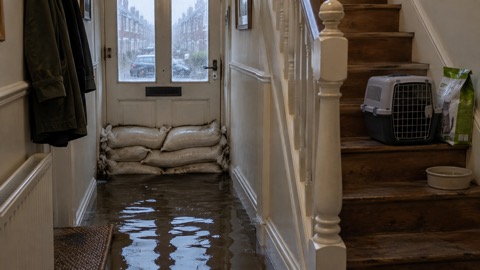
On a flood warning, the fire and rescue service's flooding advice is to bring pets indoors and provide a litter tray35. Cats in particular need that indoor toilet option once going outside becomes unsafe. If the warning escalates towards evacuation, the earlier sections of this page apply: carriers ready, food packed, pre-arranged destination known. The keeping pets safe before, during and after a flood page covers the full sequence.
The same pattern holds for other emergencies. Whatever the cause, a power cut, a storm, a gas leak or a major incident, the pet section of your plan answers the same three questions: who takes the animals, where do they go, and what do they need with them. A power cut raises its own animal-specific problems, for example for fish tanks and reptile heat lamps; see how long can fish survive without a filter in a power cut and are reptile heat lamps a fire risk.
Where to get advice and help
Buckinghamshire Council's pet emergency plan guidance says to contact your local emergency management office, animal shelter or animal control office to get additional advice and information if you are unsure how to care for your pet in case of an emergency10. In practice, in the UK that means your local authority's emergency planning team, your vet, and animal welfare organisations.
- Your vet for health planning, medication supplies and firework-season advice, and out-of-hours emergency care.
- Your council's emergency planning or civil contingencies team for local arrangements, including what your local rest centres do about pets.
- Your neighbours and community for the trusted-person arrangements that make the plan work; the community resilience page covers how those relationships are built.
- 999 in any emergency where life is in danger, including fire. Warwickshire County Council's home fire escape plan guidance is unambiguous: call 99936. A plan is never a substitute for it6.
If you are a carer, or you need extra help in an emergency for other reasons, the extra help page sets out the wider support available, including carer's emergency plans of the kind Norfolk and Suffolk describe11.
Linking the pet plan to the rest of the household plan
The pet section is not a separate document. It is one part of the household emergency plan you should already have, and it works best when it shares that plan's structure. Your household plan, kept in the grab bag, should include your emergency contact numbers28, and the pet carer's number belongs on that same list. Your kit holds pet supplies alongside the torch, first aid kit and bottled water8. Your evacuation arrangements cover the whole household, animals included3.
A household with a pet section in its plan has, in effect, made five decisions in advance: the animals come when you leave3; a named person looks after them if you cannot11; a safe place is arranged and confirmed1; a grab bag with their food, medication and carriers is packed4; and 999 is still called when life is in danger6. Write those five lines into your plan this week, confirm the safe place, and the hardest part of pet preparedness is done.
Sources (36)
- Are You Ready, Birmingham City Council, 2026-06-05
- Pets and Livestock Emergency Preparation, Slough Borough Council, 2026-10-29
- Get Help and Advice in an Emergency, Lincolnshire County Council, 2026-10-29
- Looking After Your Pets in an Emergency, Medway Council, 2026-10-29
- Boost Your Resilience: 30 Ways, London Resilience Partnership, 2016
- Responding and Recovering, Argyll and Bute Council, 2026
- Weather Hacks to Try as Clocks Go Back, Met Office, 2023-10-26
- Be Prepared for Emergencies, North Devon Council, 2026-10-29
- Home Emergency Plan, Isle of Anglesey County Council, 2020
- Emergency Grab Bag, Buckinghamshire Council, 2023-08-25
- Carer's Emergency Plan, Norfolk County Council, 2026-10-29
- Preparing Your Pets for an Emergency, South Gloucestershire Council, 2010
- Family Carers Emergency Plan, Suffolk County Council, 2026-10-29
- Help in an Emergency (Easy Read), Nottinghamshire County Council, 2026-04-14
- Disabled People and Carers, Ready Scotland, 2026-10-25
- Step 2: During an Emergency, Essex Prepared, 2026-10-29
- Emergency Planning, Scottish Borders Council, 2026-10-29
- ICE Template, Surrey Prepared, Surrey County Council, 2026-10-29
- Protect Yourself: Terrorist Attack, Lancashire Prepared, 2026-10-29
- Preparing Your Home for Flooding, Cotswold District Council, 2020
- Prepare Your Household for Emergencies, Westminster City Council, 2014-04
- Pet Welfare Emergency, Westminster City Council, 2025-09-24
- What to Do When the Ambulance Is Coming, South Western Ambulance Service NHS Foundation Trust, 2026-10-29
- What Happens When You Call 999, Welsh Ambulance Service, 2022
- Planning for an Emergency Kit, Wiltshire Council, 2026-10-29
- NPT Prepared Emergency Kit Checklist, Neath Port Talbot Council, 2026-10-29
- Emergency Kit, Ready Scotland, 2026-10-29
- Get Prepared: Emergency Kit Checklist, Carmarthenshire County Council, 2026-10-28
- Create a Household Emergency Lifesaving Plan, Dumfries and Galloway Council, 2026
- Get Prepared, Carmarthenshire County Council, 2026-10-25
- Get Help and Advice in an Emergency, Lincolnshire County Council, 2026-10-29
- Firework Safety 2023, Scottish Fire and Rescue Service, 2023-11-03
- Fireworks Safety, Manchester Fire and Rescue Service, 2026-10-29
- Keep Your Pets Safe, Cornwall Fire and Rescue Service, 2025-09-02
- Flooding Advice, Mid and West Wales Fire and Rescue Service, 2026-10-29
- Making a Home Escape Plan, Warwickshire County Council, 2026-10-29
 Pet Emergency Documents
 Storing Pet Food and Water
 Carer's Emergency Plan
 Antifreeze Poisoning
 Pets in Cold Weather and Snow
 Emergency Vets and Out-of-Hours
 Pet First Aid Kits
 Keeping Pets Safe in Floods
 How Fast a Car Heats Up
 Keeping Pets Cool in Hot Weather
 Oak Processionary Moth and Dogs