
For most healthy dogs, the answer is yes: you can and should keep walking in snow, but you change how you do it. The ground under fresh snow is often compacted snow that has turned to ice, and that is where the risk lies, for your dog and for you. The fire and rescue services are blunt about the biggest danger: keep dogs on a lead near frozen water, and never go onto the ice after one1.
So the practical routine is this. Pick a route you know, favour pavements along main roads and gritted or cleared paths, and wear footwear with good grip3. Keep your dog on a lead anywhere near water, and never throw sticks or balls onto ice5. After dark, make sure someone knows your route and when you plan to arrive, and wear clothing that is visible in the dark7. Dry your dog off as soon as you are home and make sure they keep warm8.
The rest of this page sets out how to handle slippery ground, what to do around frozen ponds and rivers, how to walk safely in the dark, and when the sensible choice is to cut the walk short.
Walk a healthy dog in snow if you can, but take care on slippery ground
Winter walking is normal and good for your dog, provided you adjust to the conditions. The main hazard is not the fresh snow itself but what happens to it: compacted snow presents a more slippery surface than fresh snow, and it may have turned to ice9. Black ice is easy to miss, so treat any shiny or polished-looking patch as ice3.
Your own footing matters as much as your dog's. The Met Office advises leaving the house five minutes earlier than usual to avoid rushing, which increases the risk of slips and falls, and wearing footwear with good grip4. NHS Tayside gives the same advice for wintry weather: dress warmly, wear sensible shoes with a good grip, and take care on icy surfaces11. The London Fire Brigade's winter guide adds waterproof non-slip shoes12.
Where you walk changes the risk. Try to use pavements along main roads, which are likely to be less slippery, and walk on gritted or cleared paths if you can3. Be aware that only certain footways and cycle lanes and tracks are salted or cleared of snow, so a route that is usually easy may not be treated13. People walking on snow and ice have a responsibility to be careful themselves14.
If your own path or drive is icy, grit or cat litter lessens the risk of slipping on compacted snow, and sand or salt on icy paths or steps can help prevent slips15. Sand or ash will not stop a path icing over as well as salt, but it provides good grip under foot17.
Slippery paths and icy surfaces
Ice, rain, mud and fallen leaves all create slippery conditions in the winter months, so take extra care throughout the season, not only on the coldest days18. Paths can become very slippery in wet or wintry weather, especially close to water, so watch your footing near riverbanks and canal edges19.
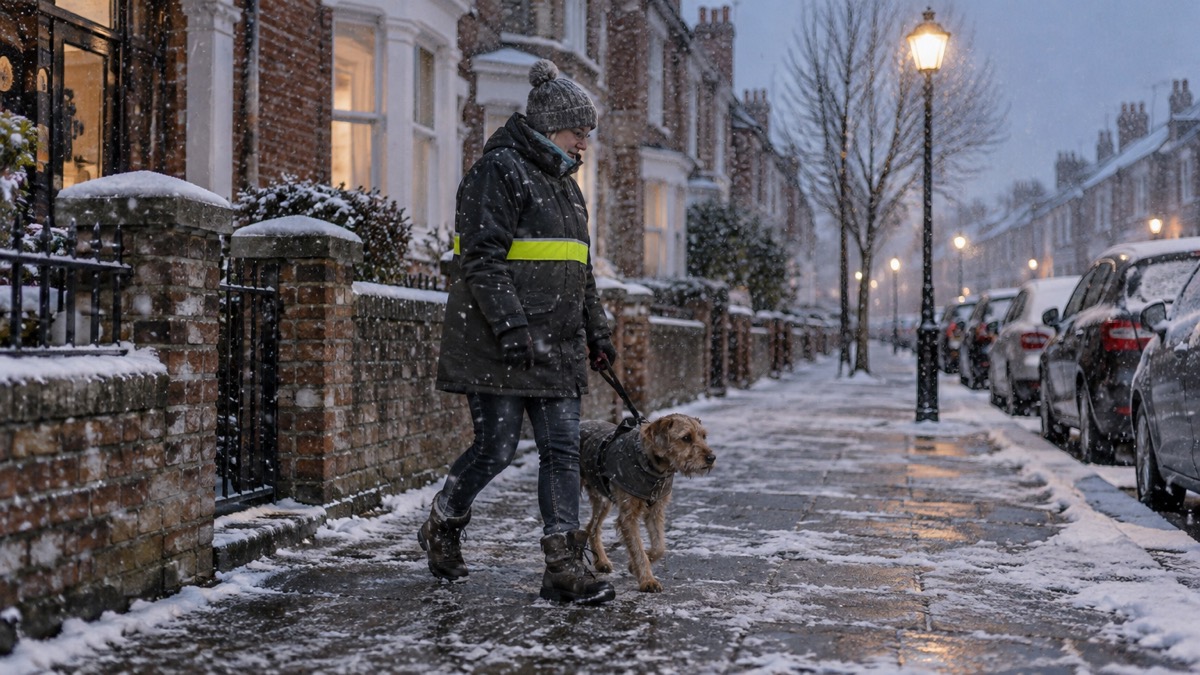
A dog pulling on the lead can cause you to lose your balance, so take care when walking your dog in icy conditions8. A short, fixed lead and a route without steep or cambered sections helps. If your dog pulls hard, consider walking where there is a rail or hedge to steady yourself, and keep both hands free where you can.
Footwear and clothing do a lot of the work. The advice across the UK's health and fire services is consistent: warm clothing, sensible shoes with a good grip, and extra care on icy or wet surfaces11. Pedestrians should also take extra care near roads, because motorists may not stop as quickly as normal in winter conditions13.
| Hazard | What to do | Who advises it |
|---|---|---|
| Compacted snow that may be ice | Take care, treat it as slippery | Met Office, Lancashire Prepared3 |
| Untreated pavements | Try to use pavements along main roads, which are likely to be less slippery | Met Office4 |
| Pulling dog on ice | Expect to lose balance, keep control | nidirect8 |
| Icy path at home | Put down grit or cat litter to lessen the risk of slipping on compacted snow | Ceredigion County Council15 |
| Icy paths or steps | Sand or salt can help prevent slips | Oxford Health16 |
| Gritting before snow | Sand or ash will not stop the path icing over as well as salt, but will give good grip underfoot | Derbyshire17 |
Frozen ponds, lakes and rivers: keep your dog and yourself off the ice
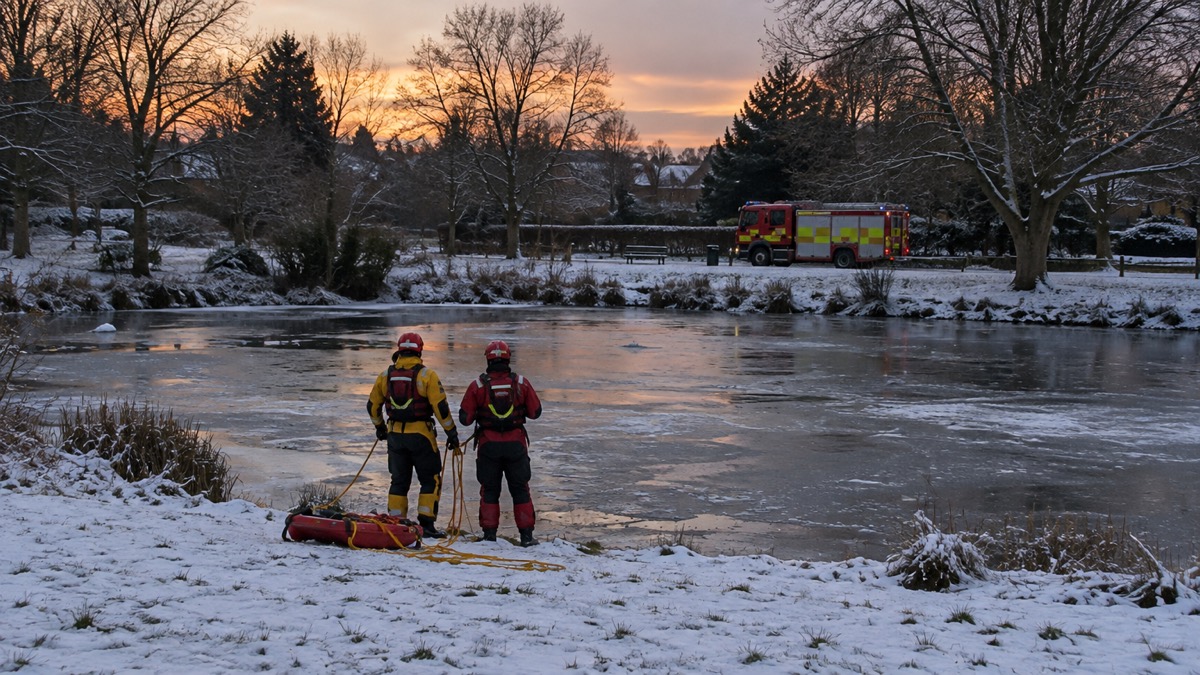
This is the section to read before you set out. Going onto frozen ponds, reservoirs, lakes and canals in freezing temperatures is dangerous and can have fatal results, and the ice is not always as thick as it may appear and can easily break2. The London Fire Brigade's instruction is absolute: never go onto any type of frozen water, and when walking nearby, always keep away from the edge and keep dogs on a lead20.
Do not walk on ice-covered lakes, ponds or rivers when walking your dog or by yourself5. Keep your dog on a lead near frozen water, and do not throw sticks or balls onto the ice, because a dog will follow them6. Ready Scotland's advice is the same: stay off frozen waterways, make sure children are aware of the dangers, and keep pets off icy water21.
If you walk near a river, loch or canal, follow the local water safety guidance for dog walkers22. Near flooded ground, keep dogs on a lead close to water, because a dog running free risks struggling to slow itself on slippery banks and paths and ending up in deep or fast-flowing water23.
"Never enter the water to rescue your dog. They often manage to scramble out on their own."
Why people end up in water they never meant to enter
Most people who drown in the UK never intended to get wet. Most people who drown had no intention of entering the water, such as people walking, with causes being slips, trips and falls, so stick to proper pathways and keep clear of the edge24. A dog going through ice is exactly this kind of situation: never enter the water to rescue your dog, because you are likely to end up in danger too. Call 999 and ask for help25.
The fire and rescue services repeat one message in different words. Never enter the water to rescue your dog, who will rescue you? Most dogs manage to scramble out, and some owners are not so lucky1. Do not get into danger yourself while trying to rescue a dog from water18. If your dog cannot get out and is in danger, never go into the water, because you are likely to end up in danger too. Call 999 and ask for help2.
Walking in the dark
Winter daylight is short, so many walks happen after dark. Ready Scotland's advice for walking in snow and ice is to make sure someone knows your route and when you plan to arrive, and to wear clothing that is visible in the dark7. That single habit covers most of the risk: if something happens, someone knows where to look and roughly when.
Keep your dog on a lead near roads and water after dark. Motorists may not stop as quickly as normal in winter conditions, so take extra care near roads13. Keep an eye on the forecast, and if you need to take your dog outside in poor conditions, keep it on a lead25.
Stick to routes you know. Familiar ground means you know where the slippery corners, the water edges and the busy junctions are, and you are less likely to be surprised by an untreated stretch. If you are walking in a storm rather than snow, the same lead advice applies; our page on whether to walk your dog in a storm covers that separately.
Short walks for older dogs, and when to skip a walk
Older pets, flat-faced breeds and dogs with known heart or lung problems need particular care in extreme temperatures26. In hot weather the advice is to avoid the hottest parts of the day and walk early or late26. In cold weather the equivalent is to shorten the walk, avoid the worst of the cold, and get home to warmth.
After a walk in snowy, icy or wet conditions, dry your pet off as quickly as possible and make sure they keep warm8. Do not leave your dog outside a shop in extremely cold weather, as it can be stressful for them27.
Skip or shorten the walk when:
- the ground is genuinely icy and your route has no treated alternative;
- a weather warning is in force for your area;
- your dog is very old, unwell, or a breed that struggles in extreme cold;
- it is dark and you cannot make yourself visible.
A short lead walk for toileting is better than a long route on ice. If your dog seems unwell after a cold walk, our page on hypothermia in dogs and cats explains the signs. For the wider picture on keeping animals safe through winter, see pets in cold weather, snow and ice, and for the household side of a cold snap, storms, snow and ice.
Sources (27)
- Water safety, Greater Manchester Fire and Rescue Service, 2026-10-25
- Frozen water safety, Greater Manchester Fire and Rescue Service, 2026-10-29
- Winter water safety, Met Office, 2026-10-25
- Met Office Weather Ready tips for snow and ice, Met Office, 2025-11-19
- Keeping warm in winter, Derbyshire County Council, 2026-10-29
- Stay safe, stay off frozen water, North Wales Fire and Rescue Service, 2026-10-29
- Cold, snow and ice, Ready Scotland, 2026-03-25
- Staying warm in winter, nidirect, 2026-10-06
- Cold weather and snow, Lancashire Prepared, 2026-10-29
- Travelling in heavy snow and ice, Met Office, 2026-10-25
- Winter health advice, NHS Tayside, 2026-10-29
- Extreme weather winter guide, London Fire Brigade, 2025-01
- Winter driving and riding tips, Derbyshire County Council, 2026-10-29
- Snow Code, Derbyshire County Council, 2026-10-25
- Snow and ice advice, Ceredigion County Council, 2026-10-29
- Weather safety, Oxford Health NHS Foundation Trust, 2026-09-18
- Clearing paths and driveways, Met Office, 2026-10-29
- Advice for runners and walkers, London Fire Brigade, 2026-10-25
- Water safety outdoors, Surrey County Council, 2026-10-25
- Winter water safety, London Fire Brigade, 2026-10-25
- Cold, snow and ice, Ready Scotland, 2026-03-25
- Water safety, Scottish Fire and Rescue Service, 2026-10-25
- Communities affected by flooding, Derbyshire County Council, 2026-10-29
- Water safety tips for runners and walkers, National Fire Chiefs Council
- Strong winds and heavy rain warning: information and advice, nidirect, 2026-01-27
- Tips for keeping older people cool, Met Office, 2026-10-29
- Weather hacks, Met Office, 2026-10-25
 Pet Emergency Documents
 Storing Pet Food and Water
 Carer's Emergency Plan
 Pet Birds in Cold Weather
 Birds and Chickens in Heat
 Breaking a Car Window for a Dog
 Keeping a Cat Cool in a Heatwave
 Chocolate Poisoning in Dogs
 Christmas Hazards for Pets
 Dog Left Alone on a Hot Day
 Dog in a Hot Car
 Hypothermia in Dogs and Cats
 Dogs in Water or Coast Trouble
 Fireworks and Small Pets
 Fish in a Power Cut