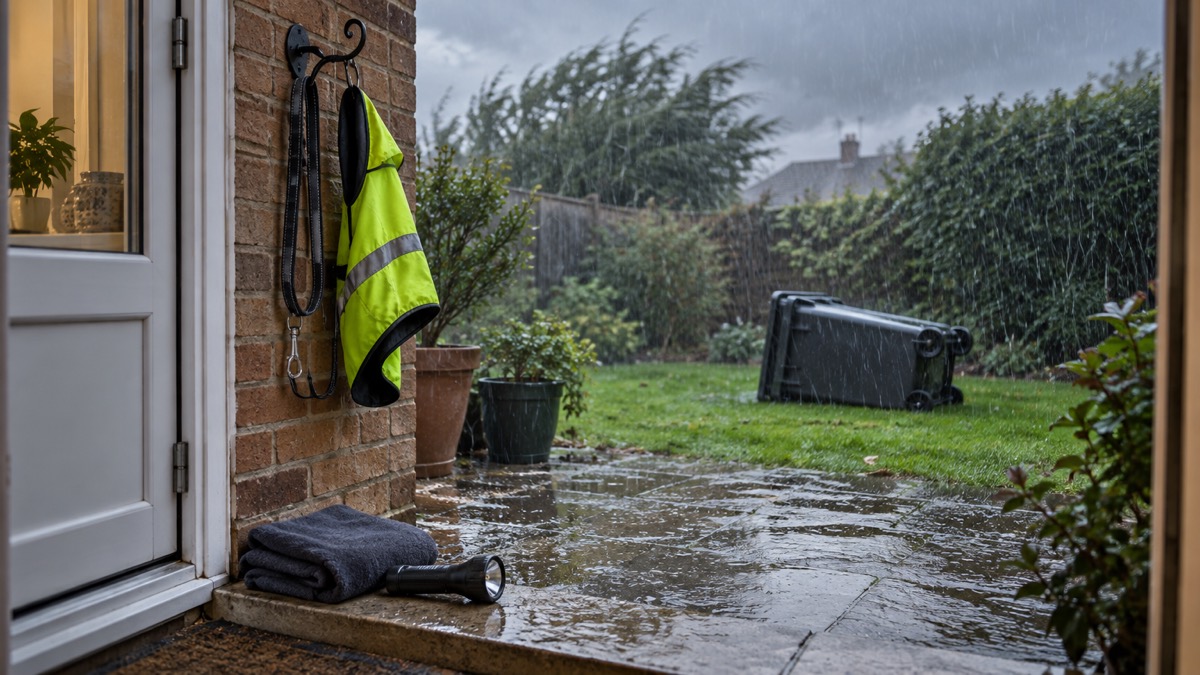
When a storm is forecast, the safest answer for most dogs is no walk at all. Dogs Trust advises keeping an eye on the forecast and avoiding taking your dog out when there is a risk of extreme weather1. The government's storm guidance goes further: try not to go outside unless absolutely necessary, and if you do go out, try not to walk or shelter close to buildings, fences, boundary walls and trees2.
If your dog does need to go out, keep it on a lead. Northern Ireland's official storm warning says to keep an eye on the forecast and, if you need to take your dog outside, keep it on a lead3. Take the shortest possible route, away from anything that could fall or blow over, and come straight back in.
The risks are not just the wind. Flood water can contain raw sewage and hidden hazards, and even shallow fast-flowing water can knock a person over4. After a storm, walls, buildings and trees may have been weakened and can come down later6. A missed walk is a small price against those dangers.
Check the forecast before you go out
The single most useful habit is to look at the forecast before you put the lead on. The Met Office says to check the weather forecast before you go out, and to keep up to date with the latest forecasts on its website, app and social media channels8. The government's storm guidance adds that you should pay particular attention to any National Severe Weather Warnings covering your area and act on any advice issued2.
That matters for dogs because a warning tells you what kind of day it is going to be. A yellow warning for wind means branches and garden furniture can move; a warning for rain means paths and underpasses may flood. The Met Office's WeatherReady tips make the same point: know what the forecast holds before you leave8.
If a storm is forecast, act before it arrives. Which? advises calling cats and dogs indoors and sealing cat flaps to stop them venturing out in bad weather9. Wiltshire and Swindon Prepared says to ensure pets are brought inside, if appropriate, when storms or extreme heat is forecast10. Doing this the night before means your dog is already safe and settled when the weather turns.
A simple routine helps:
- Check the forecast and any warnings for your area before the first walk of the day8.
- Bring pets inside and shut cat flaps when a storm is forecast9.
- Plan a shorter route close to home, away from trees, walls and water2.
- Keep a lead by the door so a quick toilet break needs no searching.
Keep your dog on a lead if it must go outside
If your dog needs a toilet break during a storm, the rule is simple: lead on, out and back. Northern Ireland's storm warning says to keep an eye on the forecast and, if you need to take your dog outside, keep it on a lead3. The same advice appears in the Met Office's strong wind guidance, which says to take care if walking near cliffs, know your route and keep dogs on a lead at the coast11.
A lead does two things. It keeps your dog close to you when a gust or a falling branch frightens it, and it stops it running towards something dangerous. The PDSA says loud noises might cause pets to become frightened and run away, which is why it advises keeping pets indoors during bad weather12. A frightened dog on a lead cannot bolt into a road or towards flood water.
There are places where a lead is essential whatever the weather:
- Near water: fire and rescue services advise keeping your dog on a lead near water, and the London Fire Brigade's winter water safety guidance says simply: keep your dog on a lead13. Devon and Somerset Fire and Rescue Service advises keeping dogs on leads near fast flowing or flooding rivers, where banks are steep or unstable, and near cliffs14.
- Near the coast in strong wind: the Met Office says to take care near cliffs, know your route and keep dogs on a lead at the coast11. North Yorkshire Fire and Rescue Service gives the same advice15.
- In unfamiliar areas: the PDSA says to make sure your dog will reliably come back before letting it off the lead, and to keep it on a lead when walking in unfamiliar areas12.
- In icy conditions: the Met Office warns that a dog pulling on the lead can cause you to lose your balance16.
"Keep your dog on a lead."
Dogs frightened of thunder: how to settle them
Thunder is frightening for many dogs, and the first step is to stop them getting out. The PDSA says it is sensible to keep your pets indoors during bad weather and on nights when fireworks are likely, as loud noises might cause them to become frightened and run away12. If a storm is forecast, Which? advises calling cats and dogs indoors and sealing cat flaps to stop them venturing out9.
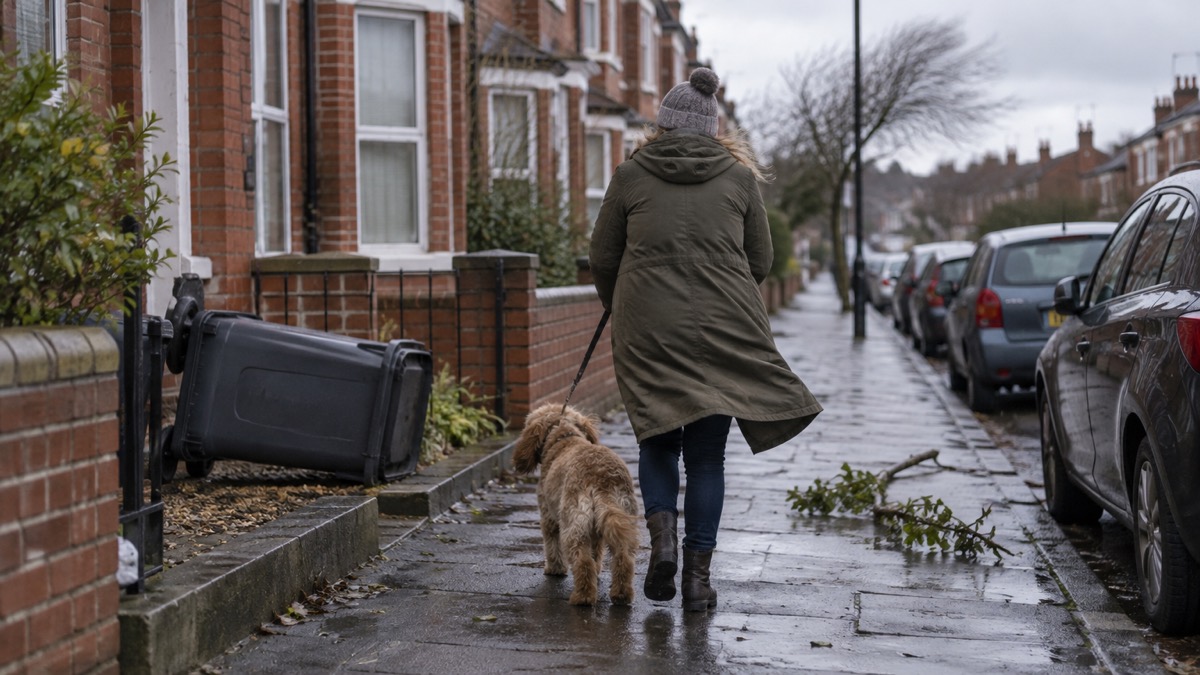
Once your dog is inside, keep things calm and predictable. Close curtains and windows to muffle sound and sight of lightning, and put on a radio or television at normal volume. Stay in the room with your dog if that settles it, and let it choose where to lie. Do not force it outside for a walk while the storm is overhead; a toilet break can wait until the worst has passed, and a short lead walk between squalls is enough.
If your dog is very distressed, speak to your vet about it. The PDSA's missing pets guidance is about prevention, not treatment, so the practical message is to keep the dog in and reduce the chance of it bolting12. A dog that has run off in a storm is much harder to find than one kept indoors.
Walking near flooded paths and standing water
Flood water is the most dangerous thing a dog walker can meet in bad weather. Public Health Wales says do not walk, drive or allow children or pets to play in floodwaters4. Scotland's ready.scot says do not walk or cycle through standing or flowing flood water, because even shallow fast-flowing water can knock you over or move a vehicle5. The same warning appears in England and Wales guidance17.
Dogs are at risk for a different reason: they run free and cannot judge a slippery bank. Derbyshire County Council advises dog walkers to keep their dogs on leads close to water, because dogs running free risk struggling to slow themselves on slippery banks and paths and ending up in deep or fast-flowing water7. The fire and rescue services give the same message: keep dogs on leads near fast flowing or flooding rivers, where banks are steep or unstable, and near cliffs14.
After a flood, the danger does not end when the water goes down. Belfast City Council says not to let children or pets play on grass or paved areas which have been flooded until the areas have been cleaned19. Cornwall Fire and Rescue Service warns that even shallow water moving fast can sweep you off your feet, and that hidden dangers include open drains, damaged road surfaces, submerged debris and deep channels, which can cause serious injury or death17.
If you live near a river or the sea, keep a long line or a spare lead by the door so a dog can be kept close on a flooded path without being let off. If a flood warning is in force, bring pets indoors and provide a litter tray where that suits the animal18.
Fallen trees, weakened walls and debris after the storm
The hours after a storm can be as dangerous as the storm itself. Lancashire Prepared advises not walking too close to walls, buildings and trees after a storm, as they may have been weakened6. The government's storm guidance says the same: do not walk too close to walls, buildings and trees as they could have been weakened2. Northern Ireland's warning repeats it3.
That advice matters for dog walkers because the obvious route, the park or the lane with the big trees, is exactly where the damage is. A tree that looks intact can have a cracked limb waiting to drop, and a garden wall can be loose after being battered by wind. Choose a different route for a few days, well away from mature trees, boundary walls and anything that looks newly damaged.
The Met Office's strong wind guidance adds two more points for anyone walking a dog: take care near cliffs, know your route and keep dogs on a lead at the coast11. North Yorkshire Fire and Rescue Service gives the same advice for high winds and heavy rain15.
A short checklist for the days after a storm:
- Walk a different route, away from mature trees and old walls6.
- Keep your dog on a lead even on familiar ground20.
- Report damaged trees or walls to your council if they are on public land.
Where to get help and what to do next
If your dog goes missing in a storm, act quickly. The PDSA's missing pets guidance is the place to start: it explains what to do if a pet goes missing, and the same prevention advice, keeping pets in during bad weather, is the surest protection12. If your dog gets into trouble in water or at the coast, do not go in after it; call for help and follow the fire and rescue service's water safety advice13.
For the wider picture, the Pets and Animals in an Emergency: A Household Guide sets out how to plan for your animals, and Including Your Pets in a Household Emergency Plan explains what to write down before a storm arrives. If flooding is forecast where you live, Keeping Pets Safe Before, During and After a Flood covers the practical steps, and Storms, Snow and Ice: A Household Guide covers the household side.
For hot weather, the same principles apply in reverse: the Met Office says do the five-second tarmac test before taking a dog out for a walk, and if it feels too hot for you, it is too hot for your dog's paws21. The Keeping Dogs, Cats and Small Animals Cool in Hot Weather page covers that in full.
If you are walking in snow or ice, the Met Office warns that a dog pulling on the lead can cause you to lose your balance16. Walking a Dog Safely in Snow and Darkness has more on that.
Sources (21)
- Stormy weather advice for dogs, Dogs Trust, 2026
- Storms, UK Government Prepare campaign, 2026-10-19
- Strong winds and heavy rain warning: information and advice, nidirect, 2026-01-27
- Flooding and health, Public Health Wales, 2026-07-31
- Flooding, ready.scot, 2026-03-24
- Storms and gales, Lancashire Prepared, 2026-10-29
- Communities affected by flooding, Derbyshire County Council, 2026-10-29
- Top tips to be WeatherReady, Met Office, 2026-10-25
- Storm damage: how to protect your home from a thunderstorm, Which?, 2026-10-21
- Your pets, Wiltshire and Swindon Prepared, 2026-10-25
- Stay safe in strong wind, Met Office, 2026-10-26
- Missing pets, PDSA, 2026-10-29
- Winter water safety, London Fire Brigade, 2026-10-25
- Water safety, Devon and Somerset Fire and Rescue Service, 2025-08-20
- Keeping safe during high winds and heavy rain, North Yorkshire Fire and Rescue Service, 2024-01-22
- Staying warm in winter, nidirect, 2026-10-06
- Flooding, Cornwall Fire and Rescue Service, 2026-10-29
- Flooding advice, Mid and West Wales Fire and Rescue Service, 2026-10-29
- Flooding advice, Belfast City Council, 2026-10-29
- Winter & Cold Weather Care for Dogs - RSPCA - rspca.org.uk, RSPCA
- Hot weather and its impacts, Met Office, 2026-10-29
 Pet Emergency Documents
 Storing Pet Food and Water
 Carer's Emergency Plan
 Pet Birds in Cold Weather
 Birds and Chickens in Heat
 Breaking a Car Window for a Dog
 Keeping a Cat Cool in a Heatwave
 Chocolate Poisoning in Dogs
 Christmas Hazards for Pets
 Dog Left Alone on a Hot Day
 Dog in a Hot Car
 Hypothermia in Dogs and Cats
 Dogs in Water or Coast Trouble
 Fireworks and Small Pets
 Fish in a Power Cut