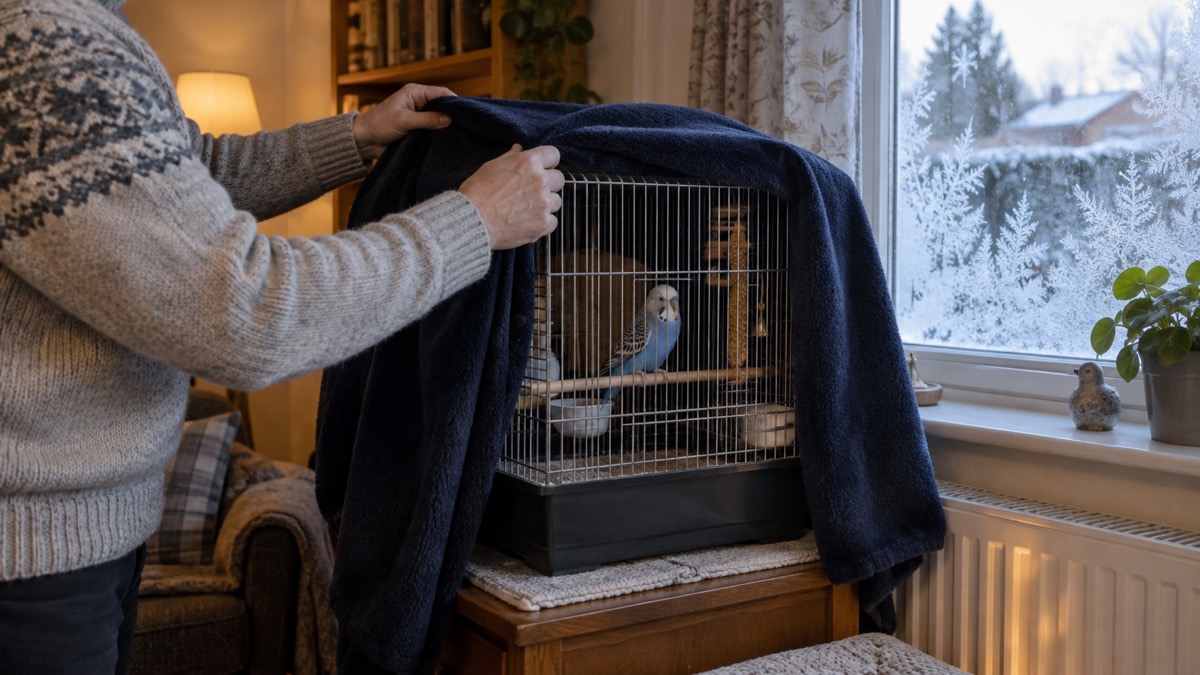
Pet birds feel the cold sooner than most people expect. The RSPCA warns that pet birds in winter can be at risk of getting cold, especially if the temperature drops below 10°C (50°F)1. That is a temperature many British homes and outbuildings reach on an ordinary winter night, so the job is not only about the very coldest spells.
The good news is that the main measures are simple and cost nothing. Keep the cage away from radiators and draughts, and use a cage cover to hold warmth in1. For birds in aviaries, coops or runs, provide plenty of additional dry, warm bedding such as straw, and cover the enclosure to keep wind and rain out1. If you keep poultry or any other captive birds, register them: since October 2024 all keepers must register regardless of how many they keep2.
This page sets out what to do for indoor cage birds and for birds kept outside, how to keep bedding dry, what to do if the heating fails, and how to recognise when a bird has got too cold.
Move the cage away from radiators and draughts
The RSPCA's advice for indoor birds is short and specific: keep the cage away from radiators and draughts, and use a cage cover to retain heat1. Both halves matter, and they pull in opposite directions. A radiator is a source of dry, direct heat that can overheat a bird that cannot move away from it, while a draught strips warmth from a bird that cannot move out of it either. The aim is a steady, moderate temperature, not the warmest corner of the house.
In practice, that means an inside wall rather than an outside one, away from windows, external doors, chimneys and vents. A windowsill looks bright and pleasant but is the coldest place in the room after dark, and a gap around an old frame lets cold air straight onto the cage. If the room has a radiator, leave a clear gap between it and the cage rather than pushing the cage against it.
The same principle applies to other pets, and the RSPCA notes that many pets will seek out warm places in the house for themselves, such as blankets, patches of sunlight or the space by a radiator3. A bird in a cage cannot do that, which is why the cage position is your job rather than the bird's.
If the household heating fails in cold weather, the general cold-weather advice is to wrap up warm and close doors and curtains to keep heat inside4. For a bird, the equivalent is to move the cage to the smallest, most sheltered room you are keeping warm, keep doors shut, and cover the cage. Our guide to gas and heating failures covers the household side of that in more detail.
A cage cover helps hold in warmth
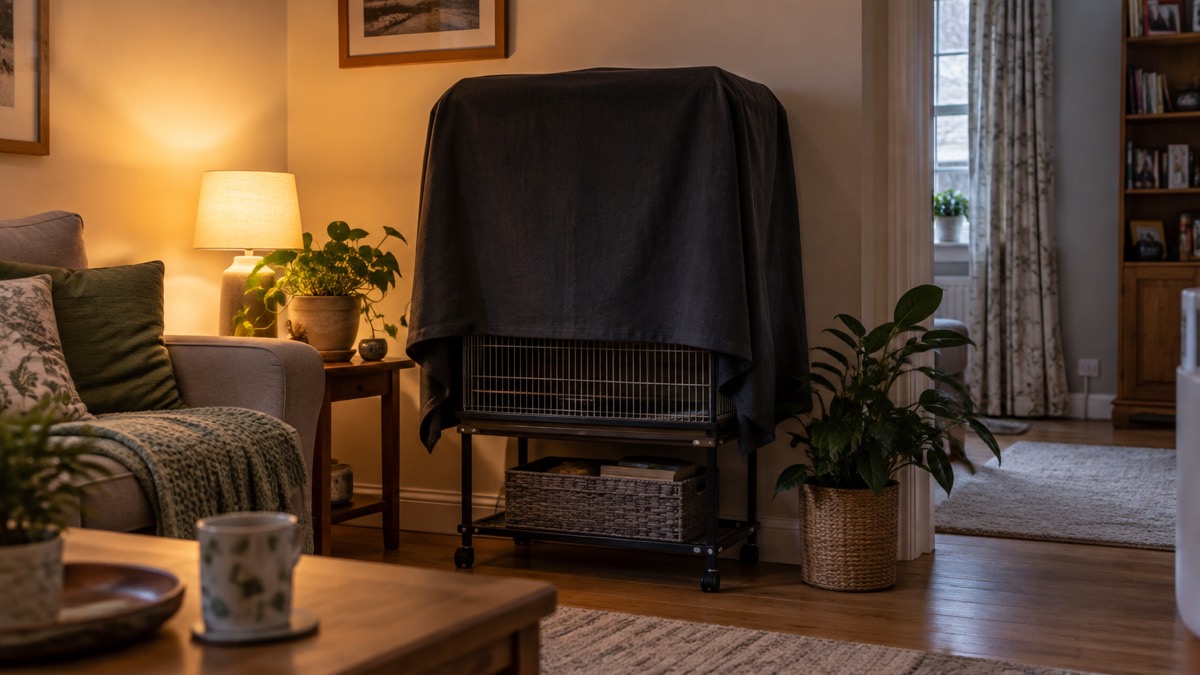
A cage cover is the second half of the RSPCA's indoor advice, used to retain heat1. It works like a curtain or a blanket over a window: it slows the loss of warmth from the cage, and it does not generate any heat of its own. On a mild night in a warm room it makes little difference; in a cold snap, or in a room that cools overnight when the heating goes off, it is the difference between a bird sitting in still air and a bird sitting in a draught.
Cover the cage once the bird has settled for the night, and leave enough of a gap that air still moves. A cover that seals the cage completely traps stale air and moisture. Use a breathable fabric rather than plastic sheeting, and keep the cover clear of anything that could get hot.
The same covering idea appears in official advice for other outdoor pets in severe weather. The Met Office, quoting the British Veterinary Association, advises that rabbit and guinea pig owners protect hutches from snow, cold draughts and winter rain5. The principle transfers: shelter from wind and wet matters as much as temperature.
Birds in aviaries, coops and runs need extra dry bedding
For birds kept outside, the RSPCA's advice is to provide plenty of additional dry, warm bedding such as straw, and to cover enclosures to keep the wind and rain out1. The word that carries the weight is dry. Bedding only insulates while it is dry, and the RSPCA warns that wet coats or feathers can lead to hypothermia, advising that you dry a pet thoroughly if it gets wet3.
So the routine for an aviary, coop or run in winter is a daily check rather than a one-off job:
- Add bedding generously. Straw is the material the RSPCA names, and more of it is better than a thin layer1.
- Check it every day. Remove anything damp and replace it, especially after rain or a thaw.
- Keep the bedding loose. Packed bedding holds moisture and stops air moving.
- Cover the enclosure to keep wind and rain out, as the RSPCA advises1.
- Watch the water. In freezing weather, water containers ice over; check and refresh them at least daily.
The same approach is standard for other outdoor animals. Guidance for livestock in cold weather is to provide extra insulation and straw for bedding, especially for young animals6. Young, old and small birds are the ones to check most often, because they lose heat fastest.
If a bird does get wet, dry it thoroughly and keep it warm3. The PDSA's advice for pets that have become too cold is to dry them off with a towel if wet, warm them with blankets underneath and over them, and take them to a vet even if they seem okay7. For a bird, handle gently and keep it out of draughts while it dries.
Covering outdoor enclosures in cold weather
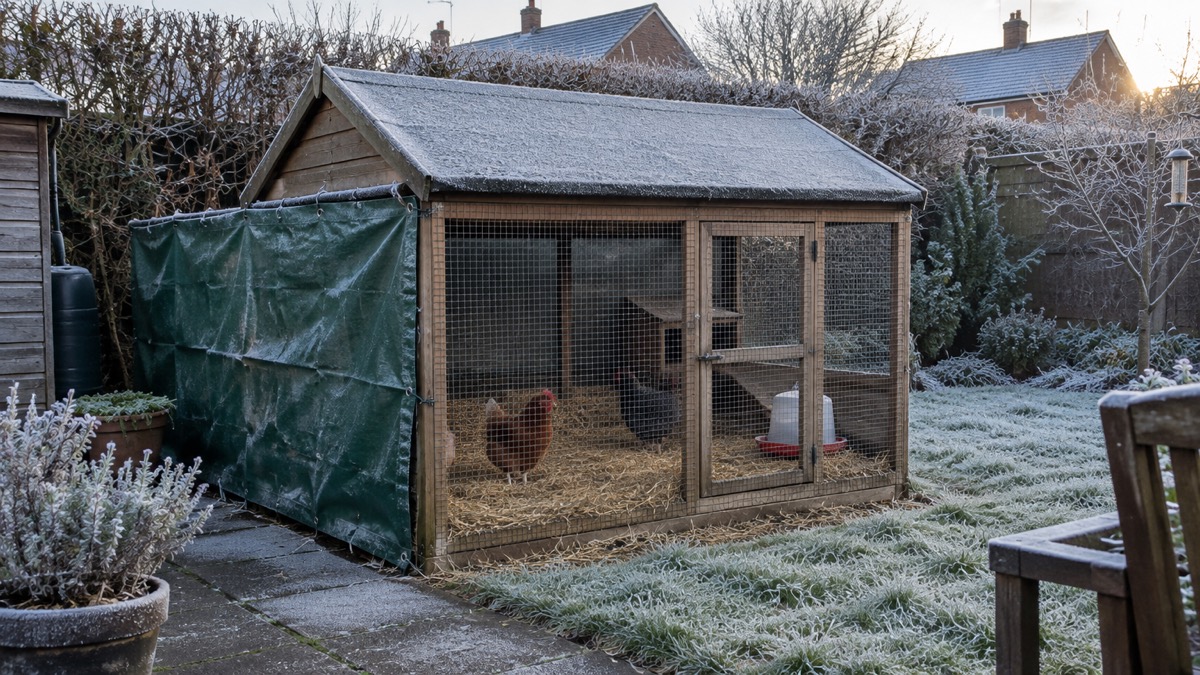
Covering an outdoor enclosure does two jobs at once: it keeps wind and rain off the birds, and it keeps the bedding dry1. Wind is the part people underestimate. A bird with dry feathers in still air copes with cold far better than the same bird in a draught, because moving air strips warmth from the surface continuously.
Cover the exposed side or sides rather than sealing the structure. Air still has to move, or moisture builds up inside and the bedding gets damp from the inside out. Clear sheeting or a tarpaulin fixed to the windward face, leaving the leeward side open, is the usual arrangement. Check fixings before forecast gales, because a loose cover that flaps is worse than none.
The Met Office's seasonal advice for pets in cold weather, drawing on the British Veterinary Association, is that owners need to be vigilant and take steps to ensure hutches are protected from the snow, cold draughts and winter rain8. The same winter-proofing logic applies to an aviary or coop: block the wind and the wet, keep the bedding dry, and check the structure after storms.
For small pets in outdoor hutches, the RSPCA advises keeping the hutch out of the wind, rain, snow and sleet, raising it to prevent frost from the ground, and insulating the walls with cardboard, blankets or insulation boards while keeping it well ventilated9. Those measures translate directly to a bird enclosure: raise it off frozen ground if you can, insulate the walls, and never block ventilation entirely.
If the power goes in cold weather
A power cut in winter takes away the heating at the moment you need it most. The general advice is to wrap up warm and close doors and curtains to keep heat inside4. For a bird, the priorities are the same as at any other time: move the cage to the warmest sheltered room, keep doors closed, and cover the cage.
For pets that depend on powered heat, there is specific guidance. For pets like bearded dragons, a battery-powered lamp can help maintain the temperature, and tanks can be covered with blankets to help maintain temperature if the outage is long10. The same logic applies to a bird room: a battery-powered light or a hot water bottle wrapped in a towel placed near, not against, the cage can take the edge off, provided the bird cannot chew or reach anything hot.
Do not run a generator indoors, in a garage or in a shed to power a heater. Generators produce carbon monoxide and must only be used outdoors, well away from windows and doors. Our guide to backup power at home sets out the safe options, and power cuts covers the household side of an outage.
All poultry keepers must register their birds
Since October 2024 all keepers of poultry or any other captive birds must register, regardless of how many they keep2. That includes a handful of backyard hens. Registration lets the authorities contact you during an outbreak, so you can be told quickly about disease control measures in your area2.
The rule covers chickens, ducks, turkeys, geese, pigeon bred for meat, partridge, quail, guinea fowl and pheasants, and any pet bird or bird kept outside for shows, races, exhibitions, competitions, breeding or for sale2. Register through the government's poultry registration service, and keep a copy of the registration with your other pet documents; official advice on pet emergency kits is to keep a copy of any ID and registration documents11.
Bird keepers should follow DEFRA for the latest advice12. In a disease control zone, keepers must follow biosecurity rules, keep a record of anyone who transports or markets poultry or poultry eggs, comply with biosecurity rules imposed by a veterinary inspector, not organise or attend bird gatherings, and not release game birds2. Our guide to animal disease outbreaks explains what those zones mean for a household.
How to tell if a bird has got too cold
A bird that is too cold will often fluff its feathers and sit hunched, and may be less active than usual. If you find a bird wet, cold and unresponsive, act: dry it off with a towel if wet, warm it with blankets underneath and over it, and take it to a vet even if it seems okay7. The PDSA advises giving lukewarm, not hot, water if the animal is awake and able to drink, and slowly increasing the surrounding temperature without warming too quickly or burning them7. Call your vet immediately7.
For other pets in cold weather, our guide to pets in cold weather, snow and ice covers the household-wide picture, and how to keep rabbits and guinea pigs warm in winter covers outdoor hutches in the same conditions.
Sources (12)
- Pet birds in winter, RSPCA, 2026-10-29
- Avian Influenza (Bird Flu), Suffolk County Council, 2026-10-29
- Pets in cold weather, RSPCA, 2026-10-29
- What to do in a power cut, Which?, 2026-06-04
- WeatherReady weather hacks, Met Office, 2026-10-25
- Helpful advice in a Power Cut (1MB).pdf, .pdf), SP Energy Networks
- Hypothermia in pets, PDSA, 2021-12
- Winter #WeatherHacks - Met Office, Met Office
- Rabbits in winter, RSPCA, 2026-10-29
- Tips to prepare for a power cut, Electricity North West, 2026-10-26
- Your pets, Wiltshire and Swindon Prepared, 2026-10-25
- Community Risk Register 2025, North Yorkshire Council, 2025-04
 Pet Emergency Documents
 Storing Pet Food and Water
 Carer's Emergency Plan
 Birds and Chickens in Heat
 Breaking a Car Window for a Dog
 Keeping a Cat Cool in a Heatwave
 Chocolate Poisoning in Dogs
 Christmas Hazards for Pets
 Dog Left Alone on a Hot Day
 Dog in a Hot Car
 Hypothermia in Dogs and Cats
 Dogs in Water or Coast Trouble
 Fireworks and Small Pets
 Fish in a Power Cut
 Flystrike in Rabbits