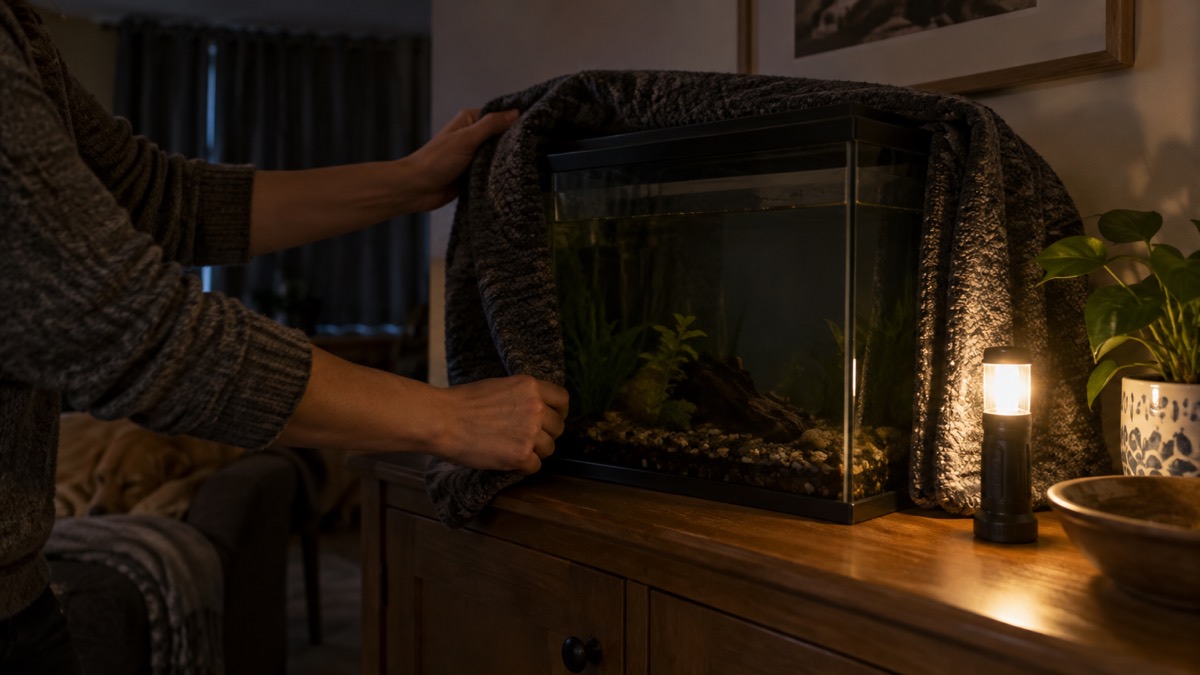
Most fish will manage for a couple of hours without power, and many cope with far longer if the water is kept moving and warm. The first thing to do when the electricity goes off is nothing dramatic: leave the tank alone, keep the room warm, and plan to disturb the water surface for five minutes each hour so oxygen keeps dissolving into it1.
The filter is not the immediate problem. The bacteria inside it are what process fish waste, and they need flowing, oxygenated water to survive. Oxygen matters more than filtration in the first few hours, and warmth matters more than food.
This page sets out what to do as soon as the power goes off, how to keep the tank warm without a heater, what kit to have ready before the next cut, what can go wrong, and how to restart the filter safely. It is written for an ordinary household with a tank or a pond, not for a specialist breeder.
What to do for your fish as soon as the power goes off
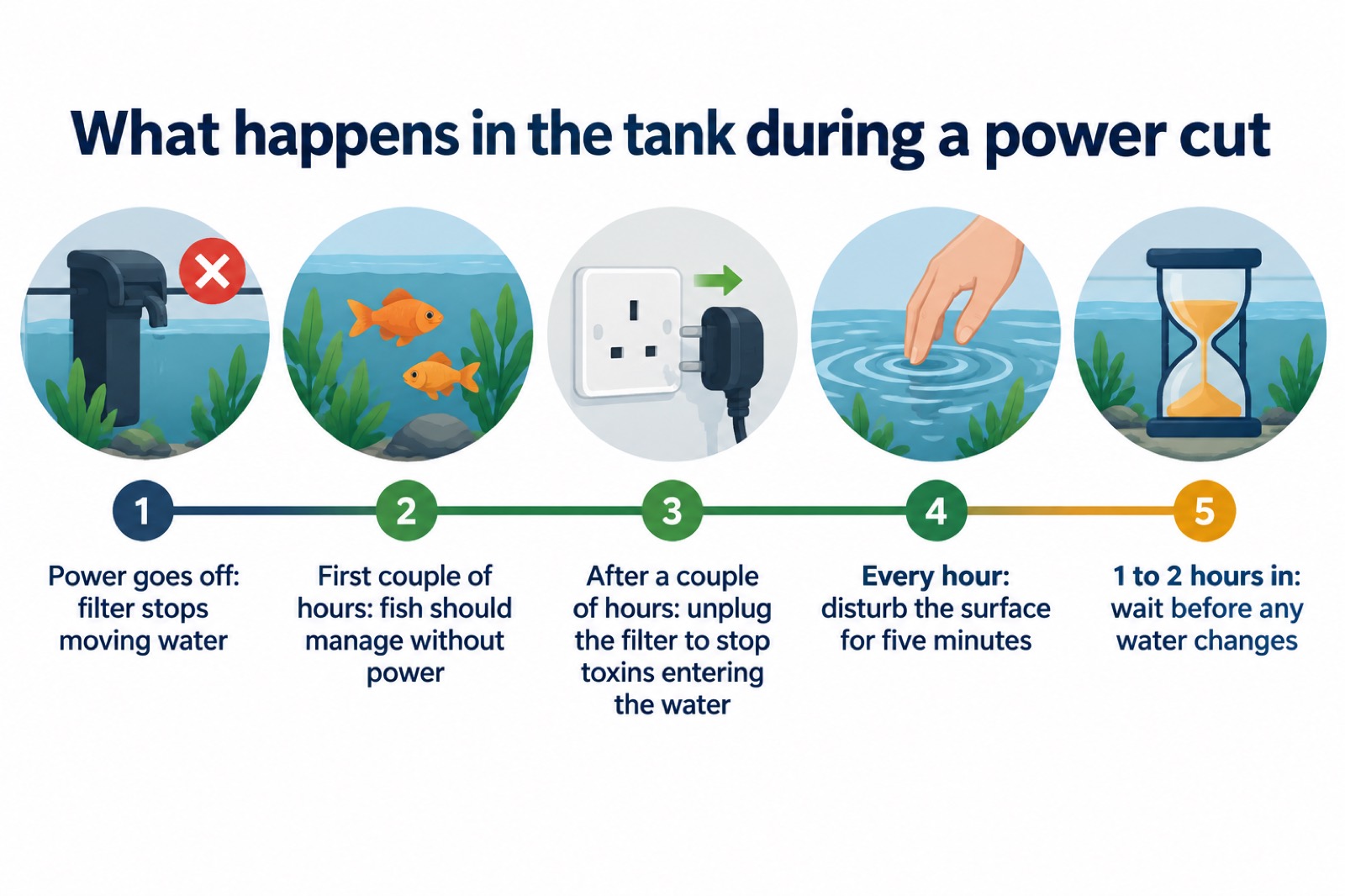
The first hour is about calm and oxygen. Fish and reptiles should manage for a couple of hours without power, so there is no need to move fish between containers straight away1. Keep the room at its normal temperature, close doors to stop draughts, and leave the tank covered as usual.
The single most useful action is to keep the water surface moving. Fish suppliers recommend disturbing the water surface for five minutes each hour during a power cut. A good way is to fill a jug with tank water then pour it back in, making as much movement as possible2. This simple routine keeps oxygen dissolving into the water without any equipment at all.
Do not feed the fish. Try not to feed them during this time, or cut down how much food you give them, to minimise waste, because the tank's filtration system will not be working3. Uneaten food and the waste that follows it are the main things that foul the water when a filter is off.
After a couple of hours, unplug the filter. SSEN's advice is that fish and reptiles should manage for a couple of hours without power, and after this time you may need to unplug your filter to stop harmful toxins entering the water1. Leaving a stopped filter connected does no harm in itself, but restarting it later without thought can push stagnant water back into the tank.
Oxygen matters more than the filter in the first few hours
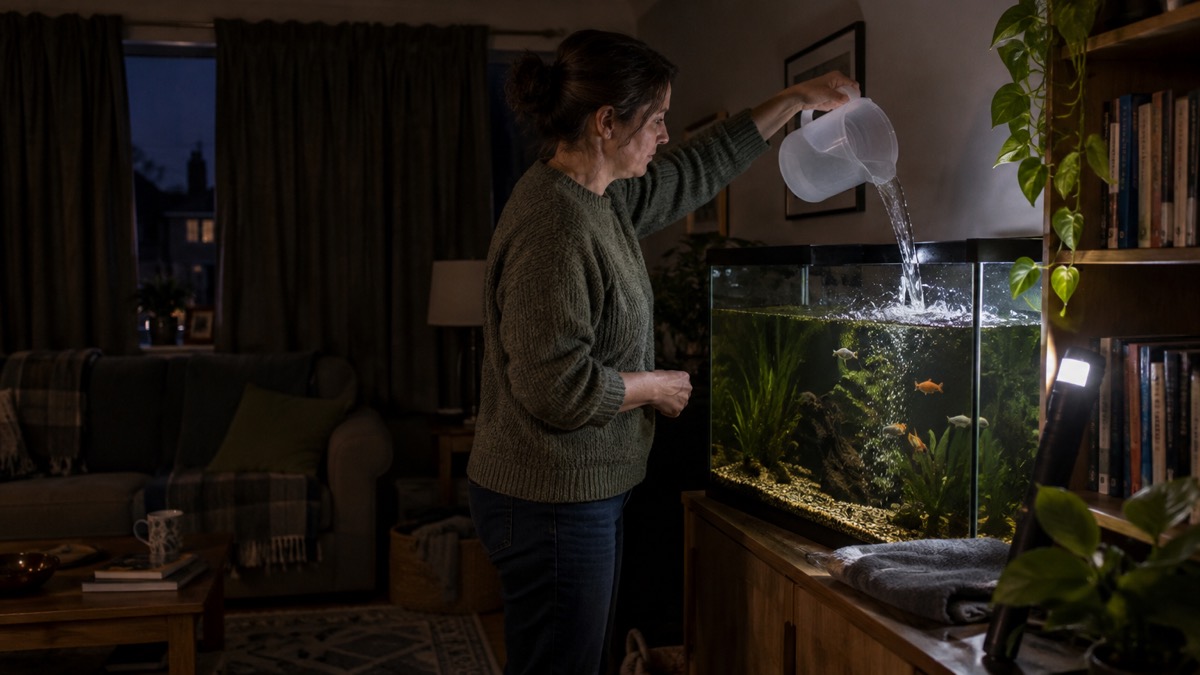
A filter does two jobs: it moves water and it houses the bacteria that break down fish waste. In a short cut, the movement matters more. Without it, the water surface goes still, oxygen levels fall, and fish come to the top to gasp.
Fish waste, plant and algae growth, overfeeding and lack of filtration produce poisonous nitrogenous waste that lowers oxygen levels, and algal growth can change pH levels daily5. A biological filter can remove that waste, but only if it is properly maintained and running5. When the pump stops, the waste keeps being produced while the removal stops.
That is why the hourly surface disturbance is the priority, and why feeding less helps. Every mouthful of food becomes waste that the filter cannot process while the power is off.
If you have a battery air pump, this is the moment to use it. Fish suppliers recommend a cheap bubble-up filter that can run off a battery-powered air pump, and if you do not have one, a normal bicycle pump or oxygen tablets can be used instead6. A battery air pump running a sponge filter does the same job as the main filter in miniature: it moves water and keeps the bacteria alive.
Keeping the tank warm without a heater
Tropical fish need roughly 24 to 27C to thrive3. When the heater goes off, the tank does not cool instantly. Water holds heat, and a covered tank in a warm room will lose it slowly. The aim is to slow that loss, not to blast heat into the tank.
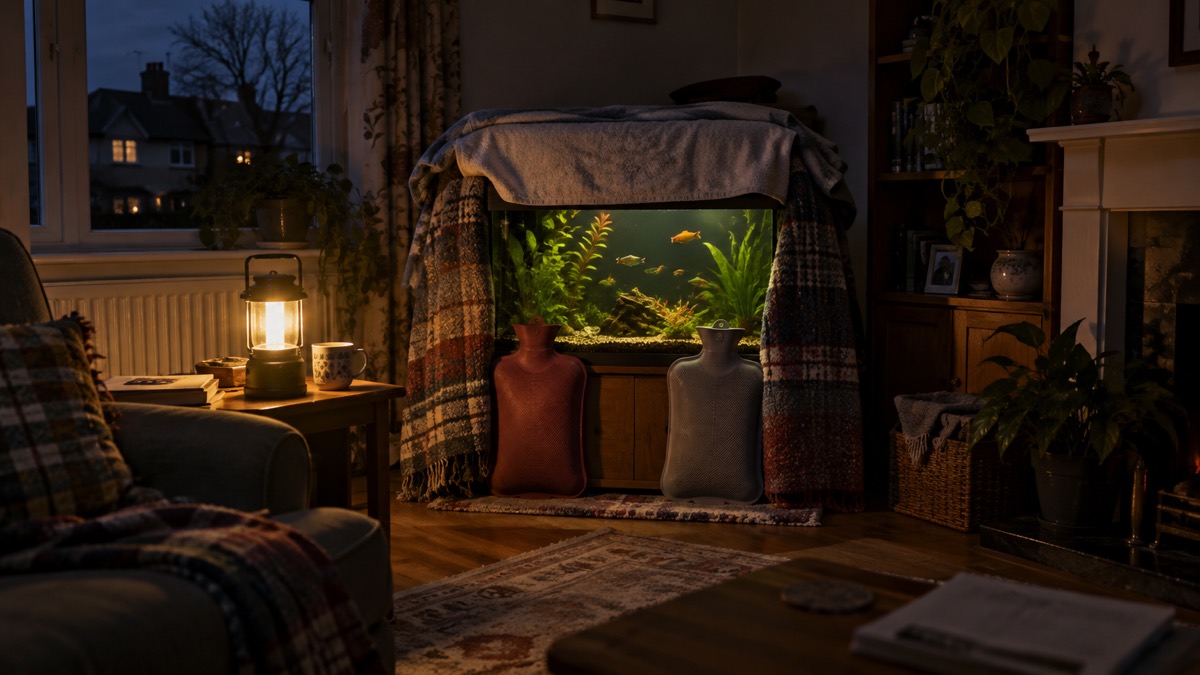
For insulation, wrap the fish tank in blankets. If possible, fill hot water bottles with warm water and place them around the outside of the tank, paying particular attention to the aquarium hood where most heat is lost3. The same advice appears in other guidance: wrap the tank in blankets and/or fill hot water bottles with warm water and place them around the outside of the tank for insulation4.
Most fish cope well with a gradual rise or fall in water temperature over a 24 hour period and should make a full recovery, though they may become sluggish and behave differently3. Only delicate species might be badly affected3. That is reassuring for most households: a slow drop over a day is survivable, and the fish may simply sit quietly until the power returns.
Battery air pumps and other kit to get ready before a power cut
The kit that matters is small, cheap and best bought before the power goes off. A battery-powered air pump with a sponge filter is the core item. Fish suppliers recommend a cheap bubble-up filter that can be run off a battery-powered air pump during a power cut3. If you do not have one, a normal bicycle pump or oxygen tablets can be used instead6.
| Kit | What it does for the tank | Who it suits |
|---|---|---|
| Battery air pump and sponge filter | Moves water and keeps oxygen and filter bacteria alive | Any household with a tank, especially tropical fish3 |
| Bicycle pump or oxygen tablets | Backup for surface movement and oxygen if no pump is available | Households caught without a battery pump4 |
| Blankets and hot water bottles | Slow heat loss from the tank, especially at the hood | Tropical tanks in a cold room3 |
| Battery powered filter | Can be used for short times during power cuts | Small tanks and short outages7 |
Citizens Advice puts it plainly: if you have a tropical fish tank you can buy battery powered filters which can be used for short times during power cuts8. That is the realistic expectation. A battery filter is a stopgap, not a replacement for the mains filter over a long outage.
For a planned cut, the same preparation applies. Be prepared to unplug tank filters and wrap the tank with a blanket or foil9. If you have received a letter informing you of a planned power cut, plan ahead and use a cheap bubble-up filter that can be run off a battery-powered air pump during the cut4.
What can go wrong when the filter stops
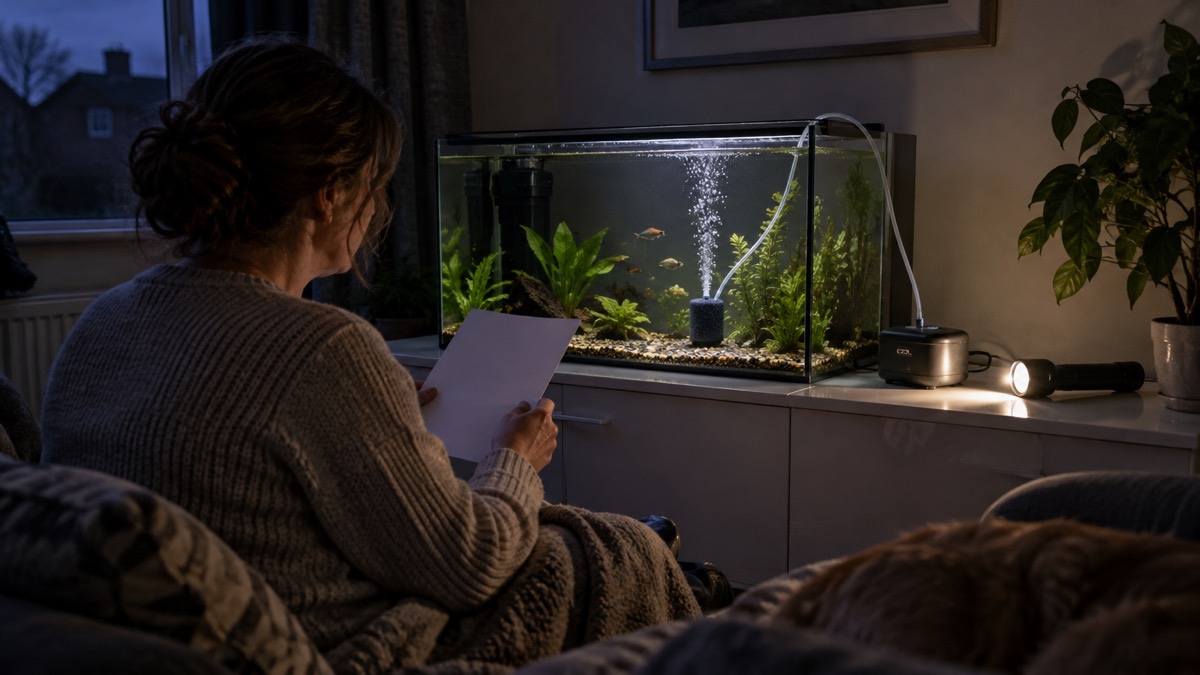
The main risk is not the filter itself but what happens in the water while it is off. Waste builds up, oxygen falls, and the bacteria that keep the tank safe begin to die back. The longer the outage, the more the tank drifts from its normal balance.
A second risk is the restart. If a filter has been sitting full of stagnant water for hours, switching it back on can push that water into the tank. That is why the advice is to unplug it after a couple of hours rather than leave it connected1.
A third risk is over-reaction. Doing a large water change straight away can stress fish and disturb the bacteria in the gravel. The guidance is to wait 1 to 2 hours before making any changes to the aquarium4. After that, small, gentle changes are better than a deep clean.
If the power cut is part of a wider emergency, the same household rules apply as for any other appliance. Switch off and unplug appliances, especially items such as fires, cookers, irons and hair straighteners, in case you forget they are on when power is restored10. Switch off items such as irons, ovens, electric fires and fryers as they could pose a hazard if the power comes back on when you are not there11.
Restarting the filter safely when the power comes back
When the electricity returns, restart the filter and let it run before you feed the fish again. Check that water is flowing and that the media is still wet and in place. Keep the filter media wet through the outage rather than replacing it, so the bacteria stay in the system.
Keep one light switched on so you know when power is restored12. That is standard power cut advice, and it applies to the room with the tank as much as anywhere else. If the tank is in a room you do not use often, a small light or a reminder on your phone will tell you the moment the supply is back.
For other appliances, the advice is to switch off and unplug items such as fires, cookers, irons and hair straighteners in case you forget they are on when power is restored10. A gas boiler should work without any intervention when the electricity supply returns13. The tank filter is the one piece of equipment you do want to switch back on promptly.
If you are unsure about the state of the tank after a long outage, contact your local fish or tropical animal supplier for further information14. Speak to your local pet shop, aquarium or vet to understand what conditions the fish you keep are healthiest in15. They can advise on water testing and whether the filter bacteria need help to recover.
Where to get help and advice
For the power cut itself, your network operator is the first call. Keep a mobile phone charged and write down important phone numbers16. Check on vulnerable neighbours or family, and if it is a localised power cut, consider staying with friends or relatives until your power is back on16.
For the fish, the people who know your setup best are your local aquatic shop and your vet. Contact your local fish or tropical animal supplier for further information if you are unsure14. Always make sure you speak to your local pet shop, aquarium or vet to understand what conditions the fish you keep are healthiest in15.
If you keep other animals, the same planning applies. Our guide to including your pets in a household emergency plan covers food, water and transport, and the pets and animals section has advice for floods, heat and cold. For the wider household, see power cuts and backup power at home.
Sources (16)
- What to do during a power cut, SSEN
- Power cut, Energy Networks Association
- How do I look after my tropical fish during a power cut, UK Power Networks
- What about my tropical fish, NIE Networks
- Water quality in the home, Dwr Cymru
- Repeat power cuts, SSEN
- Water quality, Severn Trent
- Prepare for a power cut, Citizens Advice
- Tips to prepare for a power cut, Electricity North West
- What to do in a power cut, SP Energy Networks
- What to do in a power cut - Met Office, Met Office
- Storm Lilian | Northern Powergrid, Northern Powergrid
- Incident hub, SGN
- Planned outage, SSEN
- Water quality in the home, Hafren Dyfrdwy
- Power cuts, West Yorkshire Prepared
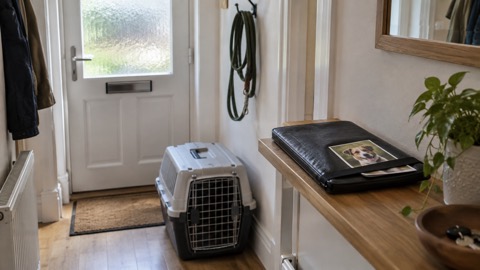 Pet Emergency Documents
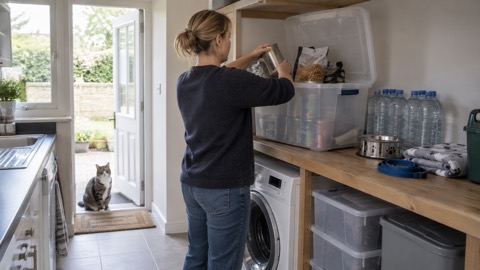 Storing Pet Food and Water
 Carer's Emergency Plan
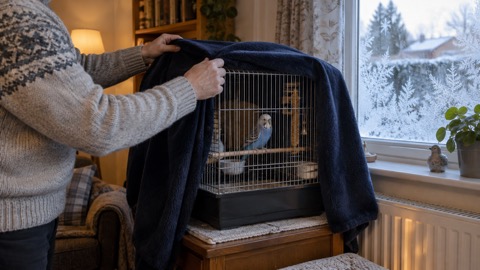 Pet Birds in Cold Weather
 Birds and Chickens in Heat
 Breaking a Car Window for a Dog
 Keeping a Cat Cool in a Heatwave
 Chocolate Poisoning in Dogs
 Christmas Hazards for Pets
 Dog Left Alone on a Hot Day
 Dog in a Hot Car
 Hypothermia in Dogs and Cats
 Dogs in Water or Coast Trouble
 Fireworks and Small Pets
 Flystrike in Rabbits