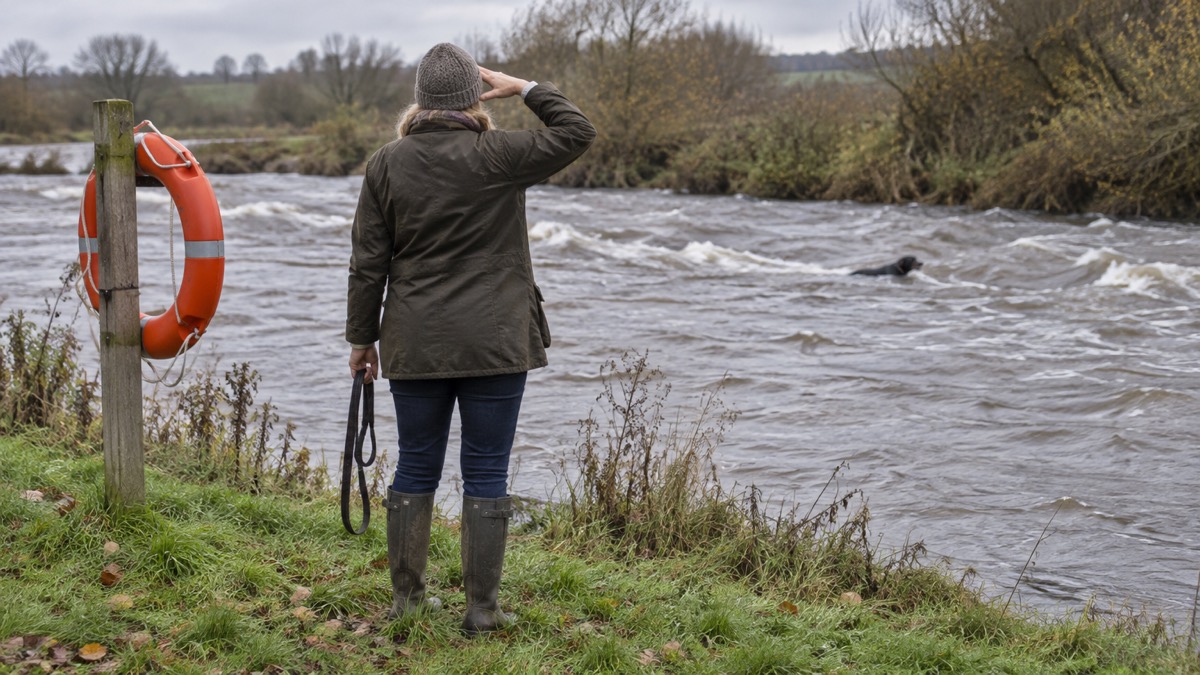
If your dog gets into trouble in water, mud or at the coast, the single most important thing is not to go in after it. Fire and rescue services across the UK give the same instruction: never enter the water to rescue your dog, because you are likely to end up in danger too1. Most dogs manage to get out of the water by themselves, and some owners who went in after theirs have not been so lucky3.
What to do instead is to call for help. Ring 999 and ask for the fire and rescue service if you are inland, or the Coastguard if you are at the coast4. While you wait, move to a point where your dog can reach you safely and keep calling it, and give the operator the most accurate location you can5.
This page sets out what to do in the first minutes, how to help without putting yourself at risk, when to ring 999 and who to ask for, and how to keep the walk safe so it does not happen again. It applies across England, Scotland, Wales and Northern Ireland, where the same emergency numbers and the same water safety advice apply.
Do not go into the water or mud after your dog
The instinct to wade in after a struggling dog is strong, and it is the thing that turns a dog rescue into a human one. The fire and rescue services are blunt about it: if your dog cannot get out and is in danger, never go into the water, as you are likely to end up in danger too1. Devon and Somerset Fire and Rescue Service put it as a direct instruction: never jump in water to rescue your dog, because dogs are usually able to get out themselves and you could put your life in danger2.
The same rule holds on ice. If a dog goes onto frozen water and gets into difficulty, do not attempt to carry out a rescue, and never throw sticks or balls onto the ice for your dog in the first place7. Keep dogs on a lead near frozen water8.
Mud is the case people underestimate. Soft ground, estuary mud and flooded ground can hold an adult as firmly as a dog, and the emergency services treat a person stuck in mud as a rescue in its own right. The advice does not change: stay out, call for help, and keep yourself on solid ground.
Move to where your dog can reach you safely and call it
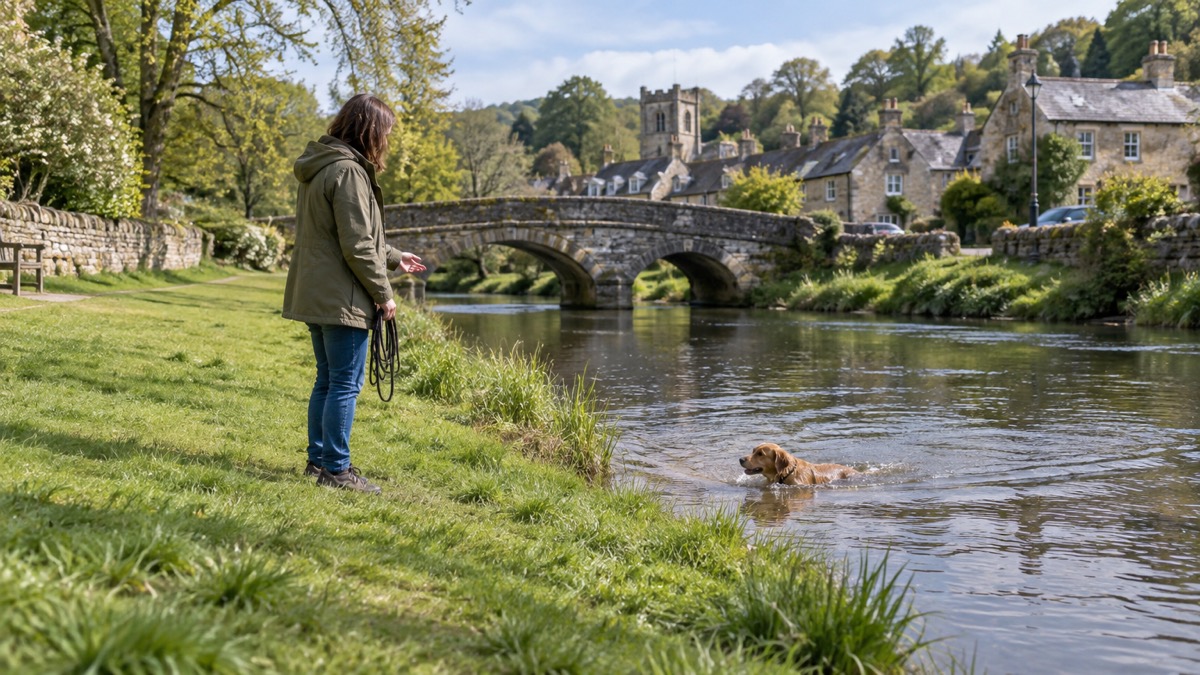
Once you have decided not to go in, your job is to make it as easy as possible for the dog to get out on its own. Most dogs will be able to get out of the water by themselves1. Fire services repeat the point: dogs generally get out of the water themselves, so do not be tempted to go in after them5.
In practice that means:
- Move along the bank or shore to a point with a gentle slope, steps or a low edge where the dog can climb out, rather than a steep or undercut bank.
- Keep calling your dog in a calm, familiar voice, and stay where it can see and hear you.
- Keep other dogs and people back so the dog has a clear route out.
- Have the lead ready so you can clip it on the moment the dog is within reach.
- Give an accurate location when you call for help, as precisely as you can9.
If your dog cannot get out and is in danger, that is the point to ring for help rather than improvise1. North Yorkshire Fire and Rescue Service advises that if you have a concern, ring 999 and ask for the fire and rescue service5.
Many owners get into trouble trying to rescue a pet
The reason the fire services repeat this advice so often is that people keep doing it. Surrey Fire and Rescue Service asks the question directly: never enter the water to rescue your dog, who will rescue you? Most dogs manage to scramble out, but some owners are not so lucky3. Greater Manchester Fire and Rescue Service uses the same words10, and its water safety pages carry the same warning8.
The pattern is well documented. Greater Manchester Fire and Rescue Service describes a call to a young girl who had gone into the water to try to get her dog out: her dog had been swept away and she had gone in after him9. That is the sequence the advice is designed to break: the dog gets into difficulty, the owner follows, and the emergency services end up looking for two.
The same principle applies when the person in trouble is not you. If someone else is in trouble in the water, do not go in after them. Call 999, tell them to float on their back, and throw something that floats if you can do so safely6. Forestry and Land Scotland gives the same instruction for a person or an animal in distress: immediately call for help, do not jump in after them, and if there is no public rescue equipment nearby, throw anything that will float11.
"Never enter the water to rescue your dog, who will rescue you? Most dogs manage to scramble out - some owners are not so lucky"
When to call 999 and ask for the Coastguard
Ring 999 as soon as your dog cannot get out and is in danger, or as soon as a person is in trouble. The number is the same across the UK; what changes is who you ask for.
| Where you are | Who to ask for on 999 | Source |
|---|---|---|
| Inland water: river, canal, lake, loch, reservoir, flooded ground | Fire and rescue service | 4 |
| At the coast or in the sea | HM Coastguard | 4 |
| Coast, with a threat to life | Coastguard | 12 |
| Someone else in trouble in the water | 999, then follow the operator's instructions | 6 |
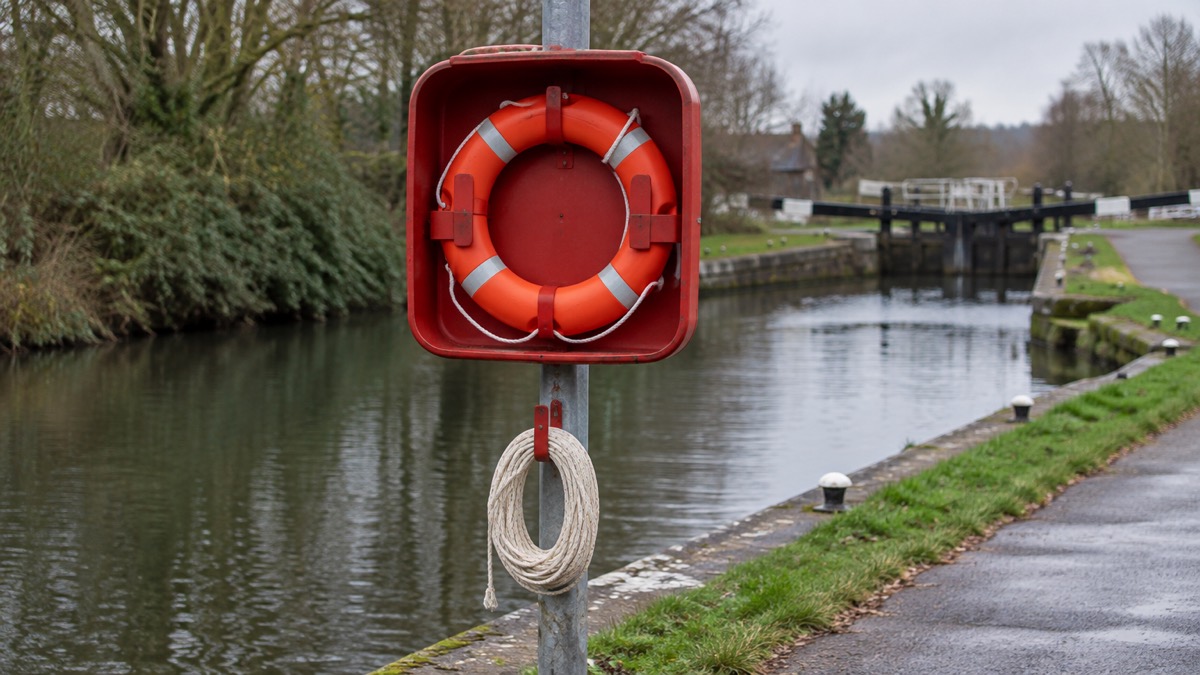
The Met Office water safety code is simple: if you get into trouble at the coast or in the sea, call 999 and ask for HM Coastguard13. Cornwall Council gives the same advice for anyone in trouble on the coast14, and Suffolk Fire and Rescue Service says to ask for the Coastguard at the coast15. Inland, ask for the fire and rescue service4.
When you call, be ready to give:
- The location, as precisely as you can9.
- What has happened, and whether a person or a dog is in the water.
- How many people and animals are involved.
- A callback number and a description of what you are wearing, so you can be spotted.
Cumberland Council's storm advice is clear that if you need help from the Coastguard and there is a threat to life, call 99912. Do not wait to see whether the dog gets out before you call if it is clearly in difficulty.
Keeping the walk safe: leads, cliffs and fast water
Most of these incidents are preventable on the walk itself. The fire and rescue services set out where a lead matters most:
- Near quarries, clifftops and fast-flowing water: keep dogs on leads2.
- Near fast-flowing or flooding rivers, steep or unstable banks, and cliffs: keep dogs on leads4.
- Close to water in flood conditions: keep dogs on leads, because a dog running free risks struggling to slow itself on slippery banks and paths and ending up in deep or fast-flowing water16.
- At the coast in strong wind: take care near cliffs, know your route, and keep dogs on a lead17.
- Near frozen water in winter: keep your dog on a lead18.
- Anywhere near water: make sure you can control your dog on and off the lead19.
The Met Office adds that you should take care if walking near cliffs, know your route, and keep dogs on a lead at the coast17. If you are walking in an area with rivers, lochs or other water, follow the local safety guidance for that spot20.
After the dog is out of the water
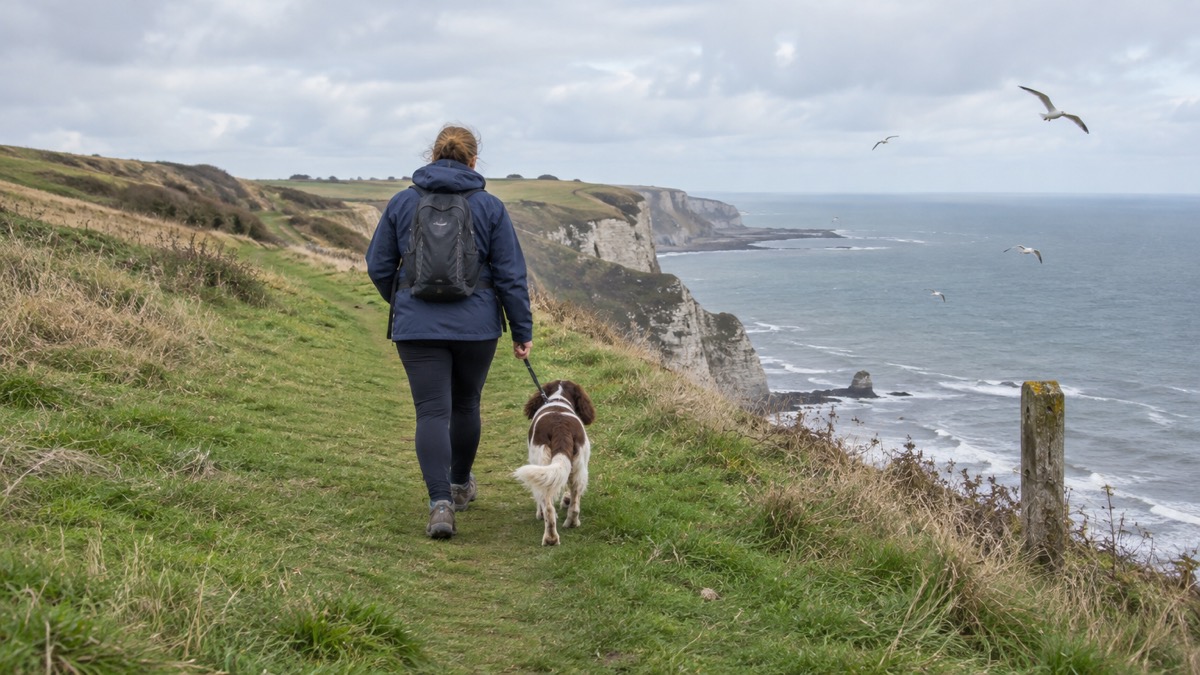
Once your dog is out, clip the lead on and move away from the water's edge before you check it over. Most dogs will have got themselves out and will be shaken but fine1. Give it a moment, keep it warm, and watch for any injury or distress.
If your dog has been in flood water, there is more to think about. Keep pets away from grass or affected areas until they have been cleaned21. If you are dealing with flooding at home, bring pets indoors and provide a litter tray22, and keep their food, water and bedding somewhere safe, with carriers and leads close at hand23. If your dog seems unwell after being in the water, contact your vet; our guide to emergency vets and out-of-hours care explains how the 24-hour rule works.
It is also worth building the water risk into your household plan before the next walk. Our guide to including your pets in a household emergency plan covers what to arrange in advance, and keeping pets safe before, during and after a flood covers the wider picture. For winter-specific risks, see dogs and frozen ponds and pets in cold weather, snow and ice.
Sources (23)
- Be Water Aware, Devon and Somerset Fire and Rescue Service, 2026-07-24
- Top causes of rescues and how to avoid them, Devon and Somerset Fire and Rescue Service, 2026
- Water safety, Surrey County Council, 2026-10-25
- Water safety, Devon and Somerset Fire and Rescue Service, 2025-08-20
- Near water, North Yorkshire Fire and Rescue Service, 2026-05-29
- Light nights campaign, North Yorkshire Fire and Rescue Service, 2026-06-10
- Stay safe, stay off frozen water, North Wales Fire and Rescue Service, 2026-10-29
- Water safety, Greater Manchester Fire and Rescue Service, 2026-10-29
- Water safety, Greater Manchester Fire and Rescue Service, 2026-10-29
- Staying safe, Greater Manchester Fire and Rescue Service, 2026-10-28
- Water safety, Forestry and Land Scotland, 2026-10-29
- Key contacts in a storm, Cumberland Council, 2026
- Water safety code, Met Office, 2026-10-29
- Storm preparation, Cornwall Council, 2026-10-29
- Warm weather safety, Suffolk Fire and Rescue Service, 2026-10-29
- Communities affected by flooding, Derbyshire County Council, 2026-10-29
- Stay safe in strong wind, Met Office, 2026-10-26
- Winter water safety, London Fire Brigade, 2026-10-25
- Advice for runners and walkers, London Fire Brigade, 2026-10-25
- Water safety, Scottish Fire and Rescue Service, 2026-10-25
- Flooding checklist for residents, Perth and Kinross Council, 2024-08-01
- Flooding advice, Mid and West Wales Fire and Rescue Service, 2026-10-29
- Flooding guide for older communities, Scottish Environment Protection Agency, 2026-10-29
 Pet Emergency Documents
 Storing Pet Food and Water
 Carer's Emergency Plan
 Pet Birds in Cold Weather
 Birds and Chickens in Heat
 Breaking a Car Window for a Dog
 Keeping a Cat Cool in a Heatwave
 Chocolate Poisoning in Dogs
 Christmas Hazards for Pets
 Dog Left Alone on a Hot Day
 Dog in a Hot Car
 Hypothermia in Dogs and Cats
 Fireworks and Small Pets
 Fish in a Power Cut
 Flystrike in Rabbits