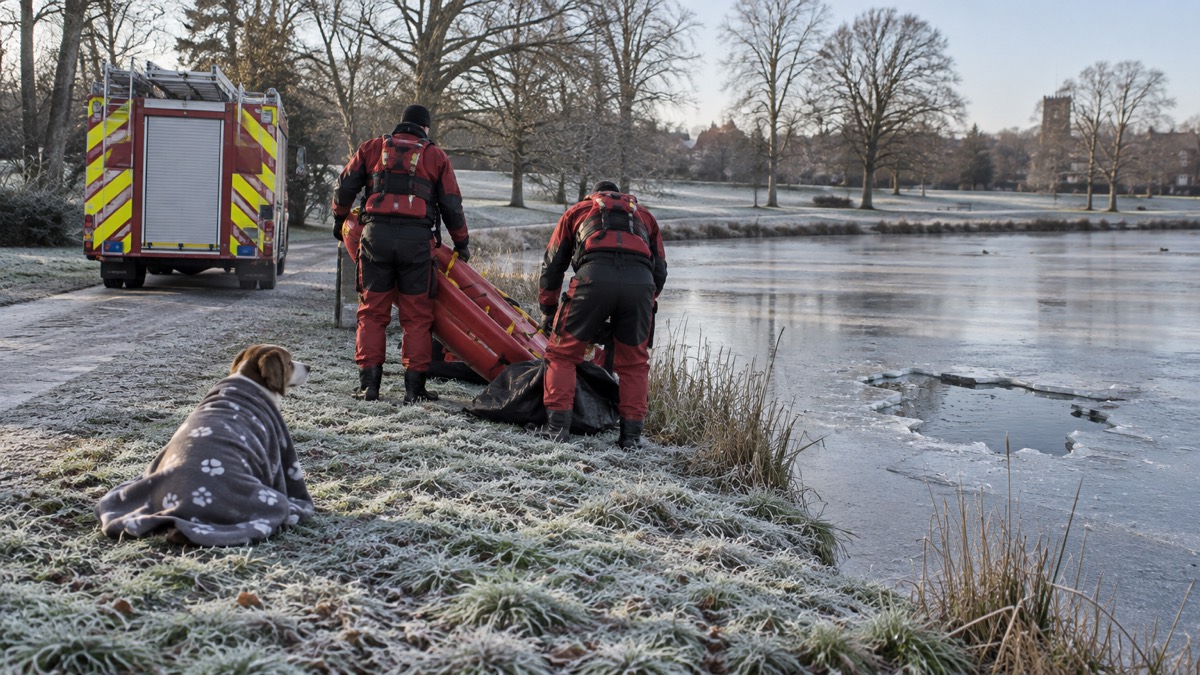
If your dog runs onto a frozen pond and the ice gives way, the single most important thing is this: do not go onto the ice or into the water after it. Every fire and rescue service that issues winter water advice says the same. You are likely to end up in the freezing water yourself and unable to help the animal1. Stay on the bank, shout for help and phone 9992. Inland, ask for the fire and rescue service; at the coast, ask for the Coastguard3.
Dogs often get themselves out. North Yorkshire Fire & Rescue Service notes that dogs generally get out of the water themselves and urges owners not to be tempted to go in after them4. The RNLI gives the same advice for the coast: if the dog goes into water or gets stuck in mud, do not go after it, move to a place it can reach safely and call it5. Your job is to be the calm person on the bank, not a second casualty.
The best outcome is that your dog never gets onto the ice at all. Keep it on a lead near frozen water, and never throw sticks or balls onto ice6. The RSPCA warns that ice on ponds and lakes can be thin and may not support a pet's weight7. This page sets out what to do now if a dog is in trouble, how to help from the bank, how to care for a dog afterwards, and how to keep dogs and children away from frozen water on winter walks.
Never go onto the ice after a dog
The instruction is blunt because the danger is real. Manchester Fire and Rescue Service says that if a dog or other animal ventures onto the ice, or falls through it, you should not go onto the ice to rescue it, because you are likely to end up in the freezing water and unable to help the animal1. Cheshire Fire and Rescue Service puts it just as plainly: never go onto the ice or into the water after a pet or person8. London Fire Brigade's winter guidance is to never go onto any type of frozen water, and when walking nearby to always keep away from the edge and keep dogs on a lead10.
Going onto frozen ponds, reservoirs, lakes and canals is dangerous and can have fatal results, because the ice can easily break1. That applies however solid it looks. North Wales Fire and Rescue Service advises never to venture onto frozen ponds and lakes, no matter how safe it looks1. The same service says that if a dog goes onto the ice and gets into difficulty, you should not attempt to carry out a rescue1.
"If a dog, or other animal, ventures onto the ice, or falls through it, do not go onto the ice to rescue it, you are likely to end up in the freezing water and unable to help the animal"
The reasoning is simple. A dog is lower to the ground and spreads its weight differently, and it may scramble back out. A person standing upright concentrates weight on a small area, and the ice at the edge is often the weakest. If you go through, the cold water quickly affects your ability to move and breathe, and the dog then has two casualties to worry about. The fire and rescue services train and equip for this; you do not.
If your dog goes through the ice: call 999 and ask for the fire service
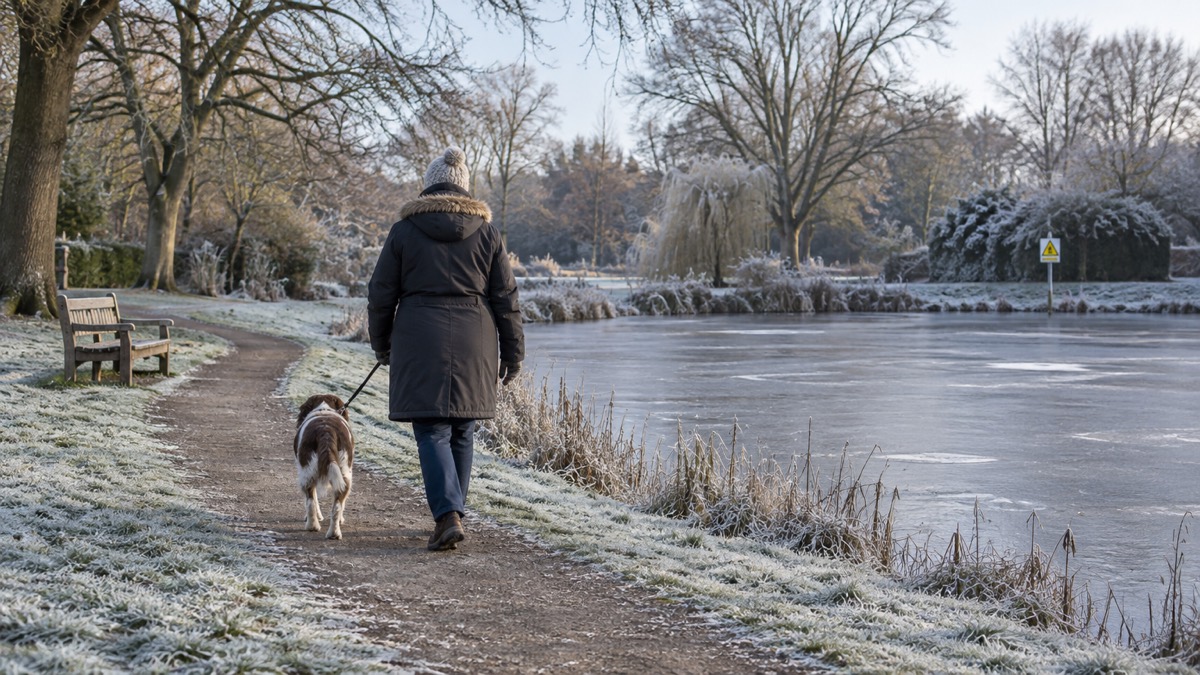
If your dog cannot get out of the water, do not enter the water yourself, as you could be putting yourself in danger. Call 999 and ask for the Fire and Rescue Service inland, or the Coastguard at the sea, as the emergency services are trained and ready to rescue your dog3. London Fire Brigade's advice for someone else or a pet falling through ice is to stay on the bank, shout for help and phone 9992. Devon and Somerset Fire and Rescue Service says you should never attempt to carry out a rescue; call 999 for help6. Its Be Water Aware campaign repeats it: if your dog can't get out and is in danger, never go into the water, as you are likely to end up in danger too; call 999 and ask for help11.
A few practical points make that call count:
- Give a precise location. Use a landmark, a postcode, a what3words reference if you have the app, or a description of the pond and the nearest road. The operator needs to find you quickly.
- Say what has happened. A dog through ice, how long it has been in, whether it is still visible and moving.
- Stay on the line. The operator may ask you to keep the dog in sight and talk you through what to do.
- Keep other people and dogs back. A crowd at the edge adds weight and risk, and other dogs may follow.
Helping a dog out from the bank without putting yourself at risk
You can still help without stepping onto the ice. The RNLI's advice for a dog in water or mud is to move to a place it can reach safely and call it, because it will probably get out by itself5. London Fire Brigade's advice for walkers is not to get into danger yourself while trying to rescue a dog from water12. Put those together and the safe approach is to stay on solid ground, move along the bank to somewhere the dog can climb out, and call it calmly.
What that looks like in practice:
- Stay on the bank, well back from the edge. Wet, icy banks crumble, and the edge is the weakest part.
- Move to a slipway, shallow shelf or gently sloping bank where the dog can get a footing and climb out.
- Call the dog from a place it can reach safely. If the dog goes into water or gets stuck in mud, do not go after it; move to a place it can get to safely and call it, as it will probably get out by itself12.
- Do not reach out over the ice with your arm or a stick. You can be pulled in, and the ice you are leaning on can give way. Do not get into danger yourself while trying to rescue a dog from water11.
- Keep other dogs on leads so they do not follow the dog into the water.
If the dog is out but exhausted, do not chase it. Let it settle, then put it on a lead and get it warm. If it is still in the water and cannot get out, that is the point to call 999 and ask for the fire service3. Do not wait to see whether it manages; the cold water will tire it quickly.
Ice that looks solid can still give way under a dog
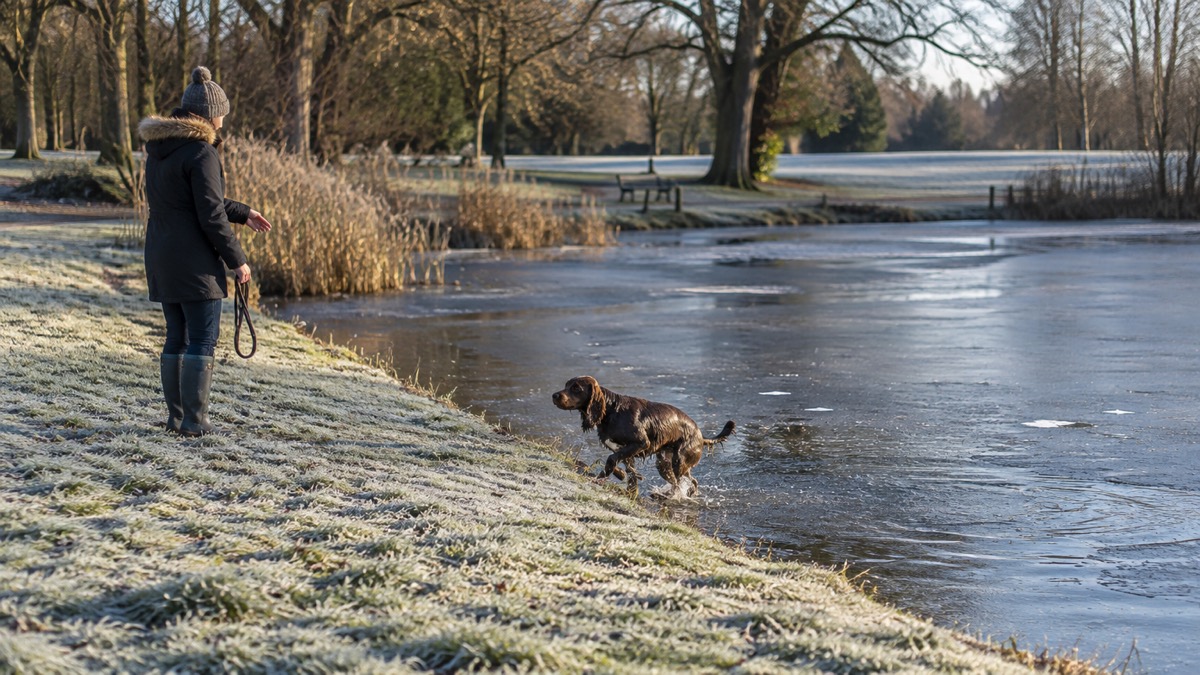
The RSPCA warns that ice on ponds and lakes can be thin and may not support your pet's weight, and advises keeping pets away from frozen surfaces7. Its dog-specific winter advice is to keep dogs away from frozen ponds and lakes because thin ice may break under their weight6. That is the whole problem: ice that holds a dog for a few steps can fail under it, and ice that holds a dog will not hold you.
Fire services describe frozen ponds, reservoirs, lakes and canals as dangerous with potentially fatal results, because the ice can easily break1. The Met Office's winter water safety advice is to stay off frozen waterways, make sure children are aware of the dangers and keep pets off icy water9. The same message appears in Scotland's Ready Scotland cold, snow and ice guidance13.
A dog's own resilience is not a reason to relax. Simon Dowling of Manchester Fire and Rescue Service has said that dogs are pretty good in the water really and they generally put up with the cold temperatures a lot better than we do14. That is reassuring about a dog that has fallen in and got out, but it does not make the ice safe. The cold water still drains a dog's strength, and a dog that cannot get out will tire.
After the rescue: warming your dog and getting vet care
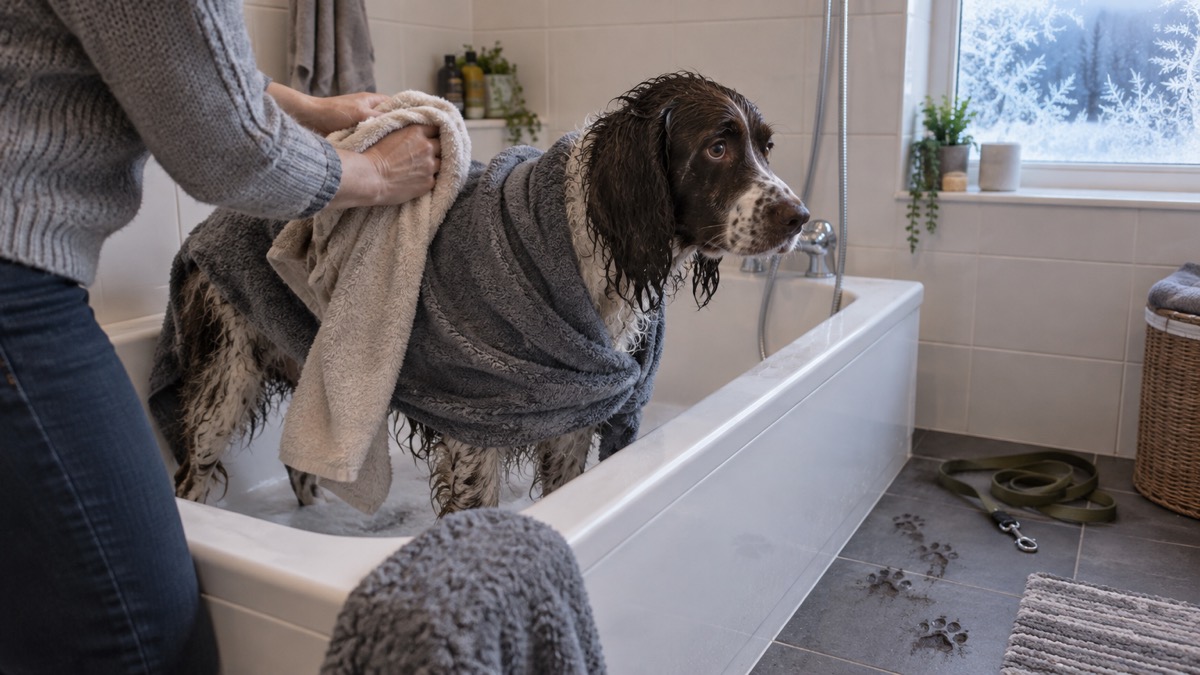
Once your dog is out, the priority is to get it dry, warm and checked. Government guidance for cold weather says that after a walk in snowy, icy or wet conditions you should dry your pet off as quickly as possible and make sure they keep warm15. A dog that has been in icy water needs more than a towel rub: it needs to be warmed steadily and watched closely.
Know the signs that a dog is dangerously cold. The RSPCA lists shivering (which will stop if the dog becomes severely cold), drowsiness and confusion, loss of coordination, pale gums, and loss of consciousness or collapse7. If you see these, treat it as an emergency and contact your vet. For comparison, Ceredigion County Council's cold weather advice for people lists uncontrollable shivering, memory loss, disorientation, incoherence, slurred speech, drowsiness and apparent exhaustion as signs of hypothermia, and says to move the person to a warm location, remove wet clothing, warm from the inside with a warm non-alcoholic drink if conscious, and get medical help immediately16. The principle for a dog is the same: warm it, dry it, and get help.
What to do:
- Get the dog indoors or into a warm car as soon as possible.
- Dry it thoroughly with towels, including the belly, legs and ears.
- Wrap it in a dry blanket and keep it still and calm.
- Offer small amounts of water once it is settled, but do not force it.
- Call your vet for advice, and take the dog in if it is shivering uncontrollably, drowsy, confused, uncoordinated or has pale gums7.
If your dog has swallowed water or is coughing, struggling to breathe or vomiting, treat it as urgent and call your vet. Drowning first aid guidance notes that young children can drown in small amounts of water, including ponds and paddling pools18, and the same caution applies to any animal that has been submerged.
Keeping dogs away from frozen water on winter walks
Prevention is straightforward and mostly about habits. Government cold weather guidance is explicit: do not walk on ice-covered lakes, ponds or rivers when walking your dog or by yourself19. The RSPCA's winter advice for dogs is to keep them away from frozen ponds and lakes because thin ice may break under their weight6. Ready Scotland's guidance is to stay off frozen waterways, make sure children are aware of the dangers and keep pets off icy water13.
The lead is your main tool. London Fire Brigade's winter water safety advice is to keep your dog on a lead2. Devon and Somerset Fire and Rescue Service says dog owners should keep their pet on a lead and not throw sticks or balls onto the ice6. Derbyshire County Council advises dog-walkers to keep their dogs on leads close to water, because dogs running free risk struggling to slow themselves on slippery banks and paths and ending up in deep or fast-flowing water20. Devon and Somerset Fire and Rescue Service also advises keeping dogs on leads near quarries, clifftops and fast-flowing water21, and its general water safety advice is to keep dogs on leads near fast flowing or flooding rivers, where banks are steep or unstable, and near cliffs3.
A lead protects you too. Government guidance warns that a dog pulling on the lead can cause you to lose your balance in icy conditions15. Oxford Health NHS Foundation Trust's falls advice is to keep outdoor steps, paths and garden walkways clear of ice and frost22. So on a winter walk:
- Put the lead on before you reach the water, not at the edge.
- Keep back from the bank, especially where it is steep, undercut or icy.
- Avoid throwing balls or sticks anywhere near frozen water6.
- Choose routes away from ponds, lakes and canals on very cold days.
- Take care on icy paths, since a dog pulling on the lead can cause you to lose your balance15.
Garden ponds, cats and antifreeze
A garden pond is the frozen water your pet meets most often. Keep pets away from frozen surfaces, because ice on a garden pond can be thin and may not support their weight7. Do not walk on it yourself either19. If you have a cat, keep the cat flap clear, as freezing temperatures or snowy nights might cause it to freeze or ice over, blocking access back inside23.
Antifreeze deserves a mention because it is used more in winter and is attractive to animals. Cats, dogs, other small animals and birds may be inclined to drink from treated water features24. Mop up any spillages, and store antifreeze in a sealed, labelled container out of your pets' reach24. If you suspect a pet has drunk antifreeze, contact your vet immediately.
Children and frozen water
Children copy what they see, and a child going onto ice to rescue a pet is a serious risk. Young children can drown in small amounts of water, including ponds and paddling pools18. Devon and Somerset Fire and Rescue Service advises reminding your child not to play on frozen rivers, lakes, ponds or canals when the weather gets colder25. Ready Scotland's guidance is to make sure children are aware of the dangers and keep pets off icy water13. Tell children the rule in advance: never go onto the ice, and if a pet or person is in trouble, stay on the bank, shout for help and phone 9992.
If the ice is part of a flood
Frozen water and flooding can arrive together, and the advice overlaps. Keep pets on a lead or limit garden access until floodwater has receded, keep them out of the affected area until clean-up is complete, and clean away mud and dry pets well26. Belfast City Council advises not letting children or pets play in or near flood water, or with toys that have been in flood water, until they have been cleaned with disinfectant27. If you must leave pets, place them upstairs if possible, otherwise somewhere dry, with food and water28.
For more on keeping animals safe through cold snaps and floods, see Pets in Cold Weather, Snow and Ice, Keeping Pets Safe Before, During and After a Flood and Hypothermia in Dogs and Cats: Signs and What to Do. If your dog gets into trouble in water or at the coast more generally, What to Do If Your Dog Gets Into Trouble in Water or at the Coast covers the wider picture, and Walking a Dog Safely in Snow and Darkness covers winter walks. For antifreeze, see Antifreeze Poisoning in Cats and Dogs.
Sources (28)
- Frozen water safety, Manchester Fire and Rescue Service, 2026-10-29
- Winter water safety, London Fire Brigade, 2026-10-25
- Water safety, Devon and Somerset Fire and Rescue Service, 2025-08-20
- Near water, North Yorkshire Fire & Rescue Service, 2026-05-29
- Dog walking, RNLI, 2026-10-29
- Frozen water dangers, Devon and Somerset Fire and Rescue Service, 2024-01-18
- Winter advice for dogs, RSPCA, 2026-10-29
- Ice safety, Cheshire Fire and Rescue Service, 2026-05-27
- Winter water safety, Met Office, 2026-10-25
- Extreme weather winter guide, London Fire Brigade, 2025-01
- Be water aware, Devon and Somerset Fire and Rescue Service, 2026-07-24
- Advice for runners and walkers, London Fire Brigade, 2026-10-25
- Cold, snow and ice, Ready Scotland, 2026-03-25
- Water safety - Greater Manchester Fire Rescue Service, Greater Manchester Fire Rescue Service
- Staying warm in winter | nidirect, nidirect
- Snow and ice, Ceredigion County Council, 2026-10-29
- Dog Hot Weather Safety Tips & Help | Dogs Trust, Dogs Trust
- Drowning first aid, NHS Inform, 2026-07-24
- Keeping warm in winter, Derbyshire County Council, 2026-10-29
- Communities affected by flooding, Derbyshire County Council, 2026-10-29
- Top causes of rescues and how to avoid them, Devon and Somerset Fire and Rescue Service, 2026
- Falls guidance at home, Oxford Health NHS Foundation Trust, 2026-09-15
- Winter advice for cats, RSPCA, 2026-10-29
- Antifreeze poisoning in cats, Woodgreen, 2023-11-29
- Back to school safely, Devon and Somerset Fire and Rescue Service, 2025-08-20
- How to recover from flooding - GOV.UK, GOV.UK (UK Health Security Agency / Department of Health and Social Care)
- Flooding advice, Belfast City Council, 2026-10-29
- animals-in-a-flood.pdf, Northamptonshire Flood Toolkit (hosted by Deanshanger Parish Council)
 Pet Emergency Documents
 Storing Pet Food and Water
 Carer's Emergency Plan
 Pet Birds in Cold Weather
 Birds and Chickens in Heat
 Breaking a Car Window for a Dog
 Keeping a Cat Cool in a Heatwave
 Chocolate Poisoning in Dogs
 Christmas Hazards for Pets
 Dog Left Alone on a Hot Day
 Dog in a Hot Car
 Hypothermia in Dogs and Cats
 Dogs in Water or Coast Trouble
 Fireworks and Small Pets
 Fish in a Power Cut