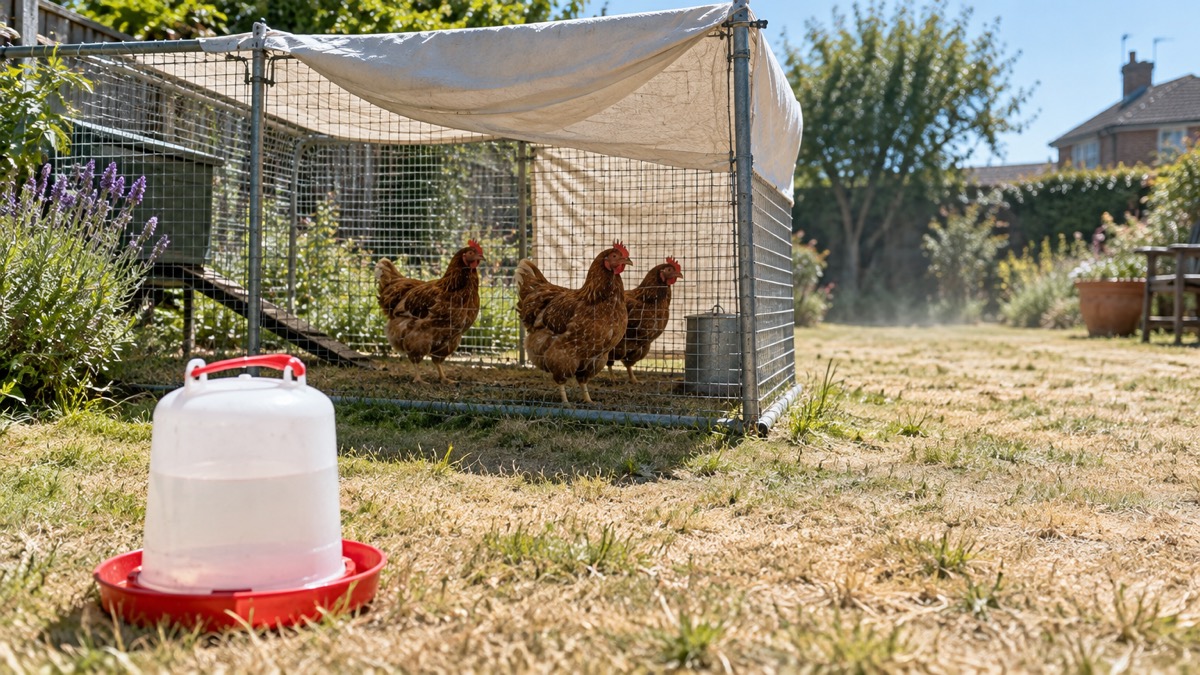
Birds cope with heat badly when they cannot get out of the sun. A budgie, parrot or hen in a cage or run that sits in direct sunlight has no way to move itself to a cooler spot, so the job falls to you. The first thing to do is shade: keep indoor birds out of direct sunlight and make sure aviary birds have shaded areas1. Then check water and airflow, because every pet needs fresh water, adequate ventilation and shade from direct sunlight2.
If the day is very hot, move the bird to the coolest room in the house rather than leaving it in a shed, conservatory or garage. Those buildings heat up fast, and the same warning applies to any pet left in a conservatory, caravan, shed or tent on a warm day3. For backyard chickens, give the run a covered, shaded area and move it as the sun moves across the garden.
The rest of this page sets out where to put a cage, how to shade a run, how to keep yourself and your birds cool through a heatwave, and which winter habits to drop in summer. If you keep other animals too, the same principles run through our guide to keeping dogs, cats and small animals cool in hot weather.
Shade first: keep birds and chickens out of direct sun
Shade is the single most useful thing you can give a bird in hot weather, and it is the first item in the RSPCA's summer advice for birds: keep indoor captive birds out of direct sunlight and ensure aviary birds have shaded areas1. The reason is simple. A bird in a cage cannot walk to the shade, and a run fixed in one spot stays in the sun all afternoon unless you move it or cover it.
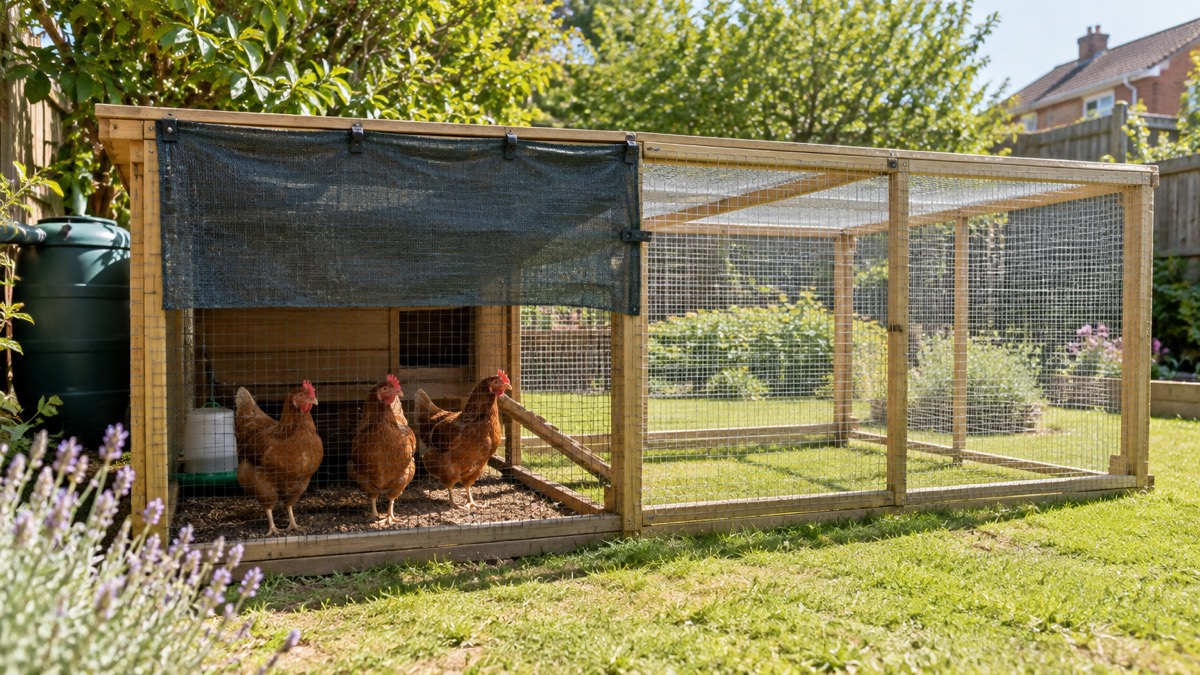
For chickens and other birds in a run, the aim is a covered area the birds can retreat into. Blue Cross advises positioning hutches and runs in the shade, moving them as necessary, and keeping them off the ground to improve ventilation6. The best runs have a covered area that provides both shade and shelter7. If your run is fixed, add shade over part of it rather than over all of it.
A damp towel over part of a wire mesh run adds shade, but do not cover the entire run, because the birds still need airflow2. The same technique is recommended for guinea pigs and rabbits, where covering the top of a wire mesh run with damp towels provides extra shade2.
For indoor birds, shade means keeping the cage out of the sun's path through the day, not just at midday. Watch where the sun lands in the morning and again in the afternoon, because a spot that is shaded at nine o'clock can be in full sun by two.
Where to put a cage on a hot day
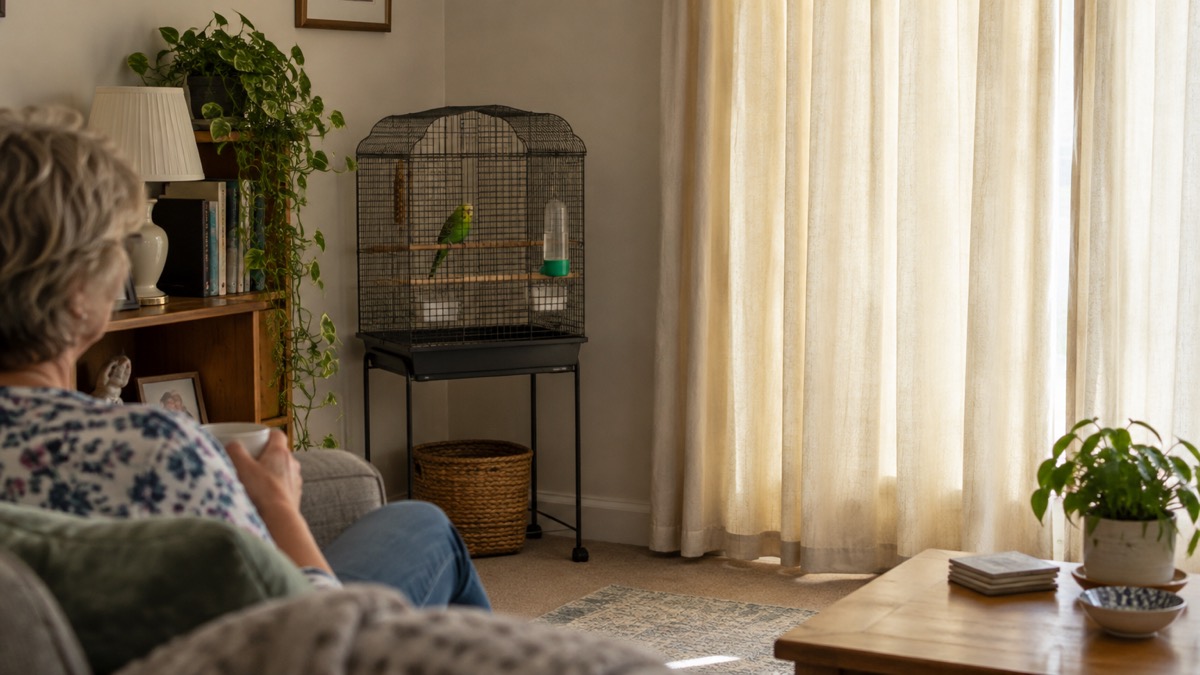
The right spot for a cage on a hot day is a shaded, ventilated room away from sunlit glass. Official hot weather advice is consistent on this: keep your home cool by closing windows and curtains in rooms that face the sun8, and shade or cover windows exposed to direct sunlight, keeping those windows closed during the day10. The point is to block the sun before it heats the room, rather than to open everything up.
That changes where a cage should go. A cage in a sunlit window behaves like a small greenhouse, so move it out of the direct beam and into a room you have shaded. Light-coloured curtains or blinds kept closed, external awnings or umbrellas, and shading paint on the glass all help block the sun11. If you have a choice of rooms, pick the coolest one and keep the door open for airflow.
For birds kept outdoors, the same logic applies to the run. Position it in shade and move it as the sun moves6. If you cannot move a hutch or run, turn it so it faces a wall or fence rather than the open garden, which is the advice given for small outdoor pets who cannot be brought inside13. For birds in an aviary, make sure there are shaded areas within it1.
If you take a bird outside for fresh air and sunlight, make sure it is in a secure aviary, cage or carrier so it cannot escape1. Put it in shade, never in direct sun, and bring it back in if the day turns very hot.
Keeping yourself and your birds cool in a heatwave
Looking after birds through a heatwave is easier if you keep the house cool and look after yourself at the same time. Official advice for the public is to stay out of the heat, cool yourself down, keep your environment cool, and look out for others14. The same steps that keep a household comfortable keep a bird room comfortable.
- Shade the windows in rooms that face the sun, and keep those windows closed during the day10.
- Open windows when the air outside is cooler, such as at night8.
- Stay in the shade and drink plenty of water, and avoid strenuous activity during the hottest part of the day15.
- Keep out bowls of water for wildlife such as birds and hedgehogs, which helps garden birds too2.
For the birds themselves, fresh water is the constant. Make sure all pets always have access to fresh water to drink, adequate ventilation, and shade from direct sunlight2. In Wales, the fire and rescue service gives the same message: ensure pets have a constant supply of fresh water, do not let them out for long periods, and never leave them in a car14.
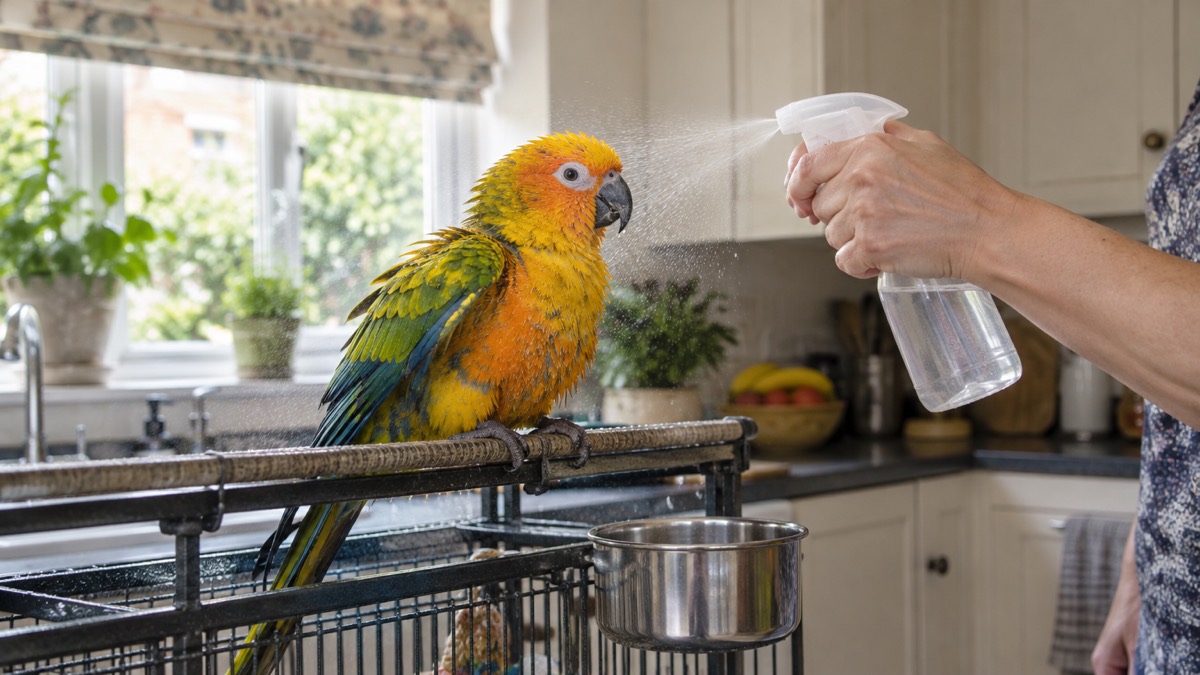
Many birds, such as parrots, enjoy being gently misted with cool water, to cool off and maintain feather condition1. Offer it gently and stop if the bird seems stressed. Misting is a comfort, not a substitute for shade and water.
If you keep other pets as well, the cooling methods differ by animal. Rabbits can have frozen plastic bottles of water placed in their enclosure, alongside plenty of fresh water16. Guinea pigs should be brought indoors in very hot weather and kept in a cool room, not a shed, conservatory or garage, which can become extremely hot17. Cats need shady spots if they go outside, and sheds, greenhouses and summerhouses should be checked before you close them up, as cats can get trapped and become too hot or dehydrated18.
Winter cage advice that does not apply in summer
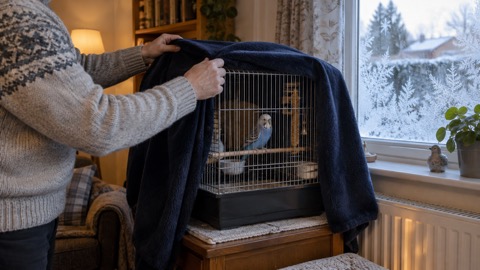
A lot of the bird care advice you will find is written for cold weather, and following it in a heatwave can do harm. The clearest example is the cage cover. In winter, you can help maintain a comfortable temperature by keeping your bird's cage away from radiators and drafts, and using a cage cover to retain heat5. In summer, a cover does the opposite: it holds warmth in and cuts the airflow a bird needs. Put the cover away until the cold returns, and see our guide to keeping pet birds warm in cold weather when it does.
The same applies to other winter habits. Winter advice includes providing plenty of additional dry, warm bedding such as straw and covering enclosures to keep wind and rain out5. In summer, covering an enclosure works against you unless it is a partial shade cloth that still lets air through. Never house animals, including birds, in greenhouses, and take care with conservatories, which the RSPCA flags as unsuitable housing for birds at any time of year5.
| Winter advice | Why it does not apply in summer |
|---|---|
| Use a cage cover to retain heat5 | Traps heat and blocks airflow in a heatwave |
| Add dry, warm bedding and cover enclosures5 | Covering an enclosure reduces ventilation unless it is partial shade |
| Keep the cage away from drafts5 | In summer, gentle airflow helps; draughts are still best avoided |
| Check that water is not frozen19 | In summer, check instead that water is fresh and available2 |
Other winter routines are simply irrelevant now. Checking that rabbits' and guinea pigs' water is not frozen20, or providing a waterproof outdoor shelter for a cat21, are cold-weather jobs. In summer the equivalent checks are water, shade and ventilation.
If a power cut hits during a heatwave, the priorities stay the same: keep the home cool where possible13, and keep the birds in the coolest, most ventilated room. For pets that depend on heat lamps, a battery-powered lamp can help maintain temperature, and tanks can be covered with blankets if an outage is long22. Birds do not need added heat in summer, so leave lamps and covers off.
Where to get help and further advice
If you are unsure about your bird in hot weather, the RSPCA publishes summer advice for pets, and local councils point residents to it: if you have a pet, see advice from the RSPCA on how to keep your pet cool in the summer23. The Blue Cross also publishes summer cooling guidance for pets6, and the Met Office's hot weather advice covers the impacts of heat and how to prepare2.
For backyard poultry and other livestock, the same shade, water and ventilation principles apply, and our guide to keeping horses and livestock cool in a heatwave covers larger animals. If you are planning ahead for the whole household, including pets, see including your pets in a household emergency plan and our wider pets and animals guide.
Sources (23)
- Summer advice for other pets, RSPCA, 2026
- Hot weather and its impacts, Met Office, 2026
- Dogs die in hot cars and on hot walks, PDSA, 2026
- Hot weather advice, nidirect, 2026
- Caring for pet birds in winter, RSPCA, 2026
- How to keep pets cool in summer, Blue Cross, 4 July 2023
- PA summer survival guide, Blue Cross, 2019
- Hot weather, UK Government Prepare campaign, 2026
- Beat the heat: staying safe in hot weather, GOV.UK, 2026
- Stay safe this summer, Cornwall Council, 2026
- Beat the heat, Oxfordshire County Council, 2026
- Your dog could die in a hot car | Pet advice | Woodgreen, Woodgreen
- Fireworks and pets, Blue Cross, 26 November 2025
- Heat summary: temperature and mortality, GOV.UK, 19 December 2024
- How to stay safe during a heatwave, Devon and Somerset Fire and Rescue Service, 23 June 2026
- Adverse weather events, Llangattock Community Council, 2026
- How to keep guinea pigs cool in the summer, Blue Cross, reviewed 23 October 2023
- Keeping Your Cat Safe in Summer - RSPCA - rspca.org.uk, RSPCA
- Stay warm at winter, Belfast City Council, 2026
- Winter hacks this winter, Wiltshire and Swindon Prepared, 2026
- Cyngor ar ddiogelwch mewn tywydd poeth, Mid and West Wales Fire and Rescue Service, 2026
- Tips to prepare for a power cut, Electricity North West
- How to keep cool this summer, Lancashire County Council, 2026
 Pet Emergency Documents
 Storing Pet Food and Water
 Carer's Emergency Plan
 Pet Birds in Cold Weather
 Breaking a Car Window for a Dog
 Keeping a Cat Cool in a Heatwave
 Chocolate Poisoning in Dogs
 Christmas Hazards for Pets
 Dog Left Alone on a Hot Day
 Dog in a Hot Car
 Hypothermia in Dogs and Cats
 Dogs in Water or Coast Trouble
 Fireworks and Small Pets
 Fish in a Power Cut
 Flystrike in Rabbits