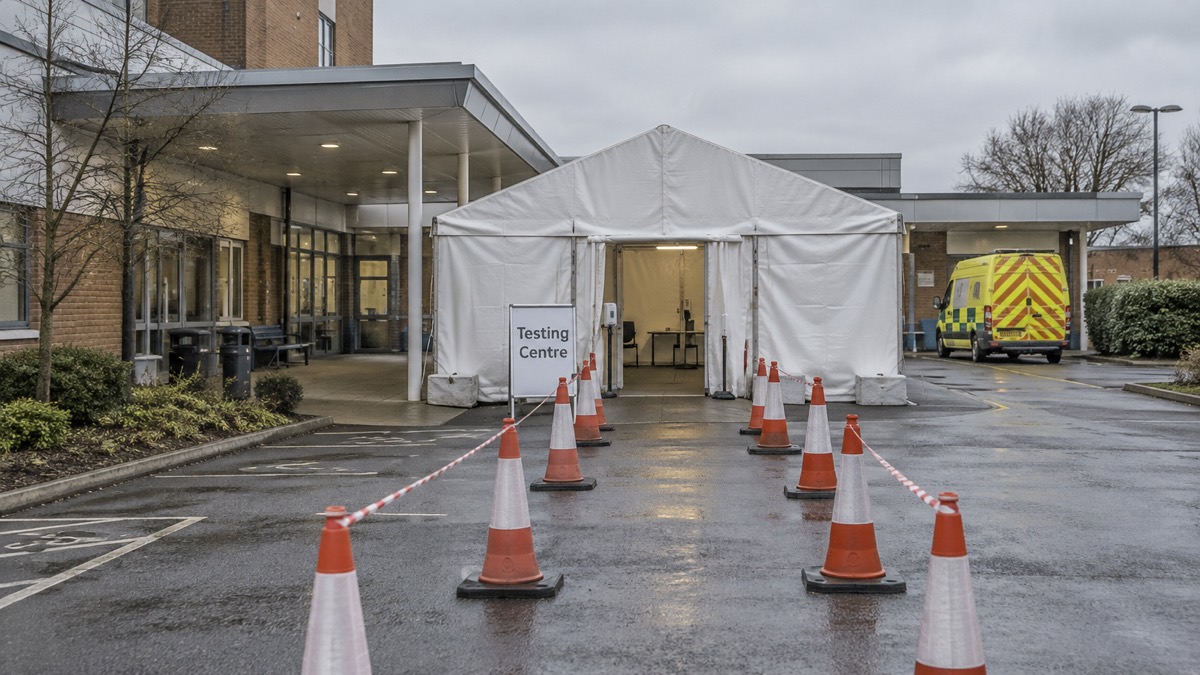
The UK Health Security Agency, usually called UKHSA, is the Government's national body responsible for England-wide public health protection1. For an ordinary household it shows up in three main ways: it controls and manages outbreaks of communicable diseases2, it runs the Weather-Health Alerting System with the Met Office, issuing heat-health and cold-health alerts3, and it publishes public advice on health risks from flooding, radiation emergencies and other hazards4. Its data dashboard also provides public health data across England5.
The alerts are the part most households will meet. They are colour-coded green, yellow, amber or red, they are free to receive by email, and they tell you when hot or cold weather is likely to affect people's health where you live3. The heat alerting season runs through the summer and the cold alerting season runs from 1 November to the end of March6. This page explains what UKHSA does, what each alert level means, what to do when one is issued, and how to find your local health protection team.
What the UK Health Security Agency does for households in England
UKHSA is responsible for controlling and managing outbreaks of communicable disease, from food poisoning and measles through to new and emerging infections2. When doctors suspect cases of certain infectious diseases, they have a legal duty to notify their local authority or their local UKHSA health protection team2. Investigations are then carried out by UKHSA officers or by environmental health officers employed by the local council, who trace the source of the infection and take steps to prevent further spread10. In practice, this is the machinery behind the outbreak notices you sometimes see in local news, and it is why a restaurant may be closed or a school year group sent home.
The agency's work reaches households in other ways too. Local councils hold their own responsibility for public health and work closely with UKHSA11, and the agency's data dashboard provides public health data across England5. UKHSA also looks at health impacts in England when severe weather strikes, working alongside the Met Office's weather warnings12. Its guidance covers chemical and radiation emergencies, including what to do about evacuations, pets, food and water13, and it assesses risks to public health following a radiation emergency overseas14.
One thing to be clear about: UKHSA's remit is England. The UKHSA is the Government's national body responsible for England-wide public health protection1, and its weather-health alert service currently operates in England only15. Households in Scotland, Wales and Northern Ireland should follow their own national public health bodies: public health advice in Scotland is given by Public Health Scotland, in Wales by Public Health Wales, and in Northern Ireland by the HSC Public Health Agency16.
Weather-health alerts: green, yellow, amber and red
The Weather-Health Alerting System is provided by UKHSA in partnership with the Met Office3. It is made up of two parts: the Heat-Health Alerts (HHA) for hot weather and the Cold-Health Alerts (CHA) for cold weather3. Its purpose is to give early warning when adverse temperatures are likely to impact the health and wellbeing of the population17. During summer and winter, UKHSA and the Met Office monitor weather forecasts, and when periods of particularly hot or cold weather are forecast they carry out a joint risk assessment and issue alerts when the weather could affect health18.
Each alert is given a colour based on two things combined: the impact the weather conditions could have on health, and the likelihood of those impacts being realised17. The levels run from green, meaning preparedness, through yellow, meaning response, and amber, meaning enhanced response, up to red, meaning emergency response3.
| Colour | What it means | What it asks of you |
|---|---|---|
| Green | Preparedness3 | Keep an eye on forecasts; no unusual action needed yet |
| Yellow | Response3 | Weather could affect health; check on anyone vulnerable and follow seasonal advice |
| Amber | Coloured amber based on the combination of the impact the weather conditions could have and the likelihood of those impacts being realised3 | Significant impacts expected; take the season's protective steps seriously |
| Red | Coloured red based on the combination of the impact the weather conditions could have and the likelihood of those impacts being realised3 | Severe impacts expected; follow official advice closely and check on vulnerable people daily |
The alerts are aimed primarily at health and social care professionals and anyone with a role in reducing health impacts from extended periods of hot or cold weather15, but they are freely available and can be accessed by the public19, and they are written to help health and social care professionals, emergency responders, the voluntary sector and the public prepare for adverse weather18. A household that registers receives the same information the care sector works from, which is useful when you are looking after an older relative or someone with a health condition.
It helps to know how these differ from Met Office weather warnings. Met Office warnings tell you about the weather itself, such as an amber extreme heat warning12, while UKHSA weather-health alerts tell you what that weather is expected to do to people's health18. The two often appear together, and both are worth heeding. For staying informed generally, see our guide to staying informed in an emergency.
Heat-health alerts and what each level asks households to do
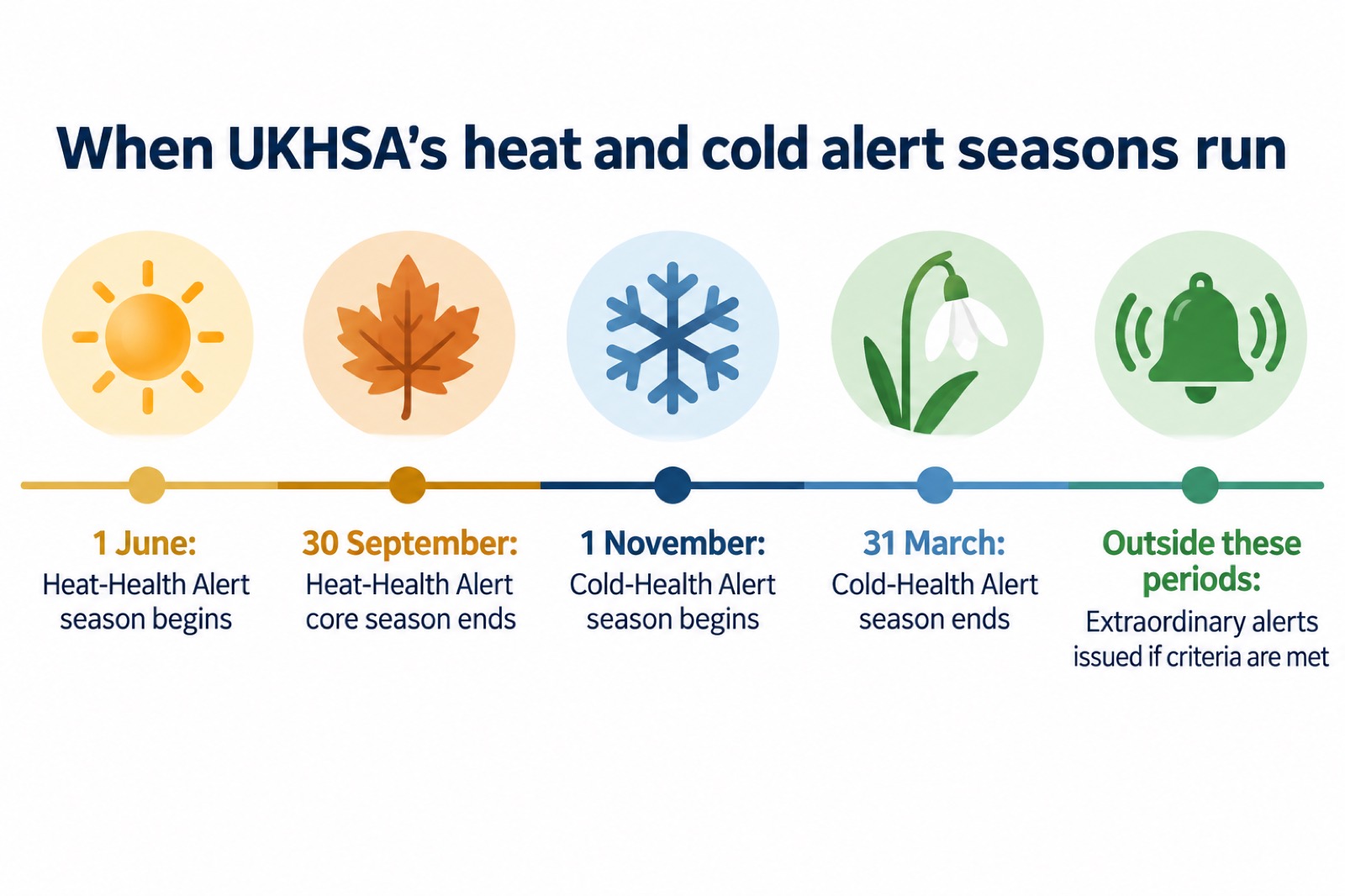
The heat-health alert service is provided by UKHSA in partnership with the Met Office20. The core alerting season for the Heat-Health Alerts runs from 1 June to 30 September6, though one official source describes the system as operating in England from 1 June to 15 September21; the documents differ on the end date, so treat late summer alerts as possible either way. If heat occurs outside the core period, an extraordinary alert will be issued22.
The alerts are based on Met Office regional daytime and night-time maximum temperature forecasts, which are monitored, and when certain temperature thresholds are reached an assessment is made of the potential impacts and their likelihood20. The system has four levels of response, based on the temperature thresholds reached and an assessment of impact by UKHSA and the Met Office21. This is why a hot day in one region can trigger an alert while the same temperature elsewhere does not: the thresholds are regional, and the impact assessment matters as much as the number on the thermometer.
What each level asks of a household follows the colour. At yellow, be aware that the heat could affect you or people you look after, particularly older people, young children and those with health conditions, and follow the standard advice on keeping cool and hydrated. At amber, treat the protective steps as necessary rather than optional: keep out of the sun at its hottest, keep your home cool, and check on neighbours and relatives. At red, follow official advice closely, and if you are supporting someone at high risk, be prepared to monitor them actively. UKHSA has also developed Adverse Weather and Health Plan action cards containing a list of potential actions aligned with the yellow, amber and red alerts22, and the Adverse Weather and Health Plan recommends steps for the NHS, local authorities, social care and other public agencies, for professionals working with people at risk, and for individuals, local communities and voluntary groups23.
For the practical side of getting through a hot spell, see our heatwaves and drought guide, and for what to do about illness, our pages on dehydration at home and medicines in a heatwave.
Cold-health alerts run from 1 November to 31 March
The Cold-Health Alerts focus on the season between 1 November and 31 March every year7. The core cold-health alerting period is described in most official guidance as 1 November to 31 March19, though some documents state that the Cold-Health Alert operates from 1 November to 30 March17; the difference is a single day and does not change what you should do. During the winter, UKHSA and the Met Office monitor weather forecasts, and where adverse cold weather is forecast they carry out a joint risk assessment19.
Cold-Health Alerts are issued when cold weather is forecast that could lead to significant impacts on health, and the system provides suggested actions to protect health and reduce cold-related harms24. The cold-health alerting season operates from 1 November to 31 March19. Like the heat alerts, they are coloured yellow, amber or red based on the combination of the impact the weather conditions could have and the likelihood of those impacts being realised24. The system applies to England24. An example of the system in action: in November 2025 UKHSA issued an amber cold health alert alongside Met Office snow and ice warnings25.
The forecasts behind the alerts look well ahead. The cold-health alerting system uses regional forecasts of weather conditions for the following 5 days, then 6 to 15 days, and 16 to 30 days19, which is why an alert can arrive a week or more before the cold does. Voluntary and community sector organisations are asked to ensure staff and volunteers are familiar with the cold-health alert action card and their local plans before 1 November each year26, and households can usefully do the same: get winter ready before the season starts, not during the first alert.
For more detail on the levels, see our page on yellow, amber and red cold-health alerts, and for the wider picture, our storms, snow and ice guide.
Keeping warm at home: 18 to 21C in the rooms you use
When a cold-health alert is in force, the advice converges on a few simple numbers. Use a room thermometer, and keep your living room between 18 and 21C8. Heat the rooms you spend the most time in, such as the living room or bedroom, to at least 18C27. Set your thermostat at around 18 to 21C and heat all the rooms you use in the day28. The Scottish Government's Ready Scotland campaign gives the same figure: heat your home to at least 18C in the rooms you regularly use, if you can16.
You do not have to heat the whole house to the same temperature. Concentrating warmth on the rooms you actually use, and closing doors to the ones you do not, is the approach behind the official advice27. What you wear matters as much as the thermostat: wear several layers of thin clothing rather than one thick layer27, advice repeated by Ready Scotland16. Layers trap warm air between them and can be adjusted as you move around.
At the red alert level, the official action card for the voluntary and community sector asks organisations to actively monitor high-risk individuals during cold weather episodes, considering daily visits or phone calls to those vulnerable to cold-related illnesses26. A household can apply the same standard to its own relatives: when a red cold-health alert is issued, check on older or vulnerable family members and neighbours every day. For people who need extra help year round, see our guide to extra help in an emergency, and for heating when the power or gas fails, our heating and cooking guide.
How to sign up for weather-health alerts by email
The alerts are free and arrive by email, but you have to register. Users need to register for the Weather-Health Alert system, where they can specify the government region they wish to receive alerts for9. Once an alert is issued it is cascaded to everyone registered and made available on the dedicated web platform26. Weather-Health Alerts are distributed by email to all those who have registered to receive them17, and individuals can register to receive the heat-health alerts via an online form20. Make sure you are registered to receive the alerts directly by email by completing the registration form3.
A few points worth knowing when you sign up:
- Choose your region. The registration form lets you specify the government region you want alerts for9, which matters because the temperature thresholds are regional20.
- Register once for both. The Weather-Health Alerting System covers heat and cold24, so one registration serves summer and winter.
- Check the platform too. Issued alerts are made available on the dedicated web platform26, which is useful if you want to check the current status without waiting for an email.
- Note the service's history. This service, previously issued by the Met Office, is now issued by UKHSA's new online alerting system but remains in association with the Met Office7, so older references to a Met Office heatwave alert service refer to the same thing.
The service operates through the whole year with a seasonal focus15, and an out-of-season alert may still be issued if impacts from adverse weather on health, heat or cold, are expected17. So registering in spring means you are already on the list when the first hot spell or the first cold snap arrives early.
Outbreaks and infectious disease: the agency's role
UKHSA's other half is infectious disease control. The agency is responsible for controlling and managing outbreaks of communicable diseases2, and in community risk registers an outbreak of an emerging infectious disease is listed with UKHSA as the lead agency29. Doctors have a legal duty to notify their local authority or local UKHSA health protection team of suspected cases of certain infectious diseases2, and investigations are carried out by UKHSA officers or council environmental health officers, who trace the source of infection and take steps to prevent further spread10.
The local layer matters to households. The Local Authority Health Protection Team works closely with UKHSA and other organisations to respond quickly to possible outbreaks2. If you hear of cases at your child's school or in your town, it is this local team, working with UKHSA, that is coordinating the response. For what to do when an outbreak reaches your area, see our guides on infectious disease outbreaks near you, stopping infections spreading at home and staying at home when ill.
Animal diseases are handled slightly differently. Bird flu affects poultry and wild birds, with the potential to spill over into humans, and areas near coasts and wetlands can see increased risk because of migratory birds30. The Department for Environment, Food and Rural Affairs (DEFRA) and local authorities monitor and respond to outbreaks30. For households, the practical point is not to touch dead wild birds and to report them. More detail is on our bird flu page.
Food safety sits alongside this. The food standards agencies oversee the safety of food4, and in Surrey's community risk register, food supply contamination is listed with the Food Standards Agency and UKHSA together29. If a food contamination incident affects products in your kitchen, the recall advice will come through these channels, and UKHSA's role is the health protection side of the response.
Radiation emergencies overseas and drought: where the agency advises
UKHSA also advises on hazards beyond infections and weather. Its Radiation, Chemical and Environmental Hazards Division offers advice, monitoring, assessments and information4. Following a radiation emergency overseas, UKHSA will assess the risks to public health and works with government partners on monitoring and decontaminating people arriving in the UK14. The public guidance on radiation emergencies can also be used by local authorities to support specific advice they issue for nuclear emergency response plans31.
The UKHSA guidance on what to do in a radiation emergency provides information related to evacuations, pets, use of stable iodine and safety advice related to food and water13, and its chemical emergency guidance covers evacuations, pets, food and water, and information on specific hazardous chemicals13. These are the documents behind official advice if a nuclear or chemical incident ever affects the UK. Households can read the practical steps now in our guide to major incidents.
Drought and heat fall under the same weather-health umbrella. The Adverse Weather and Health Plan, which the alerting system underpins6, is the framework through which UKHSA and its partners plan for the health effects of severe heat and other adverse weather24. For the household side of dry spells and water shortages, see our heatwaves and drought guide and our water in an emergency guide.
From Public Health England to UKHSA: finding older guidance
If you are searching for guidance and keep finding references to Public Health England, that is the same organisation under its former name. UKHSA was formerly known as Public Health England (PHE)10. Documents, contact addresses and older published guidance can still carry the PHE name, and UKHSA publications carry a gateway number and an accessibility contact, publications@ukhsa.gov.uk31.
The continuity runs through the agency's public information work. Public Health England published a migrant health guide on NHS entitlements available in multiple languages32, and the NHS website also includes health information and resources in community languages32. Some NHS bodies provide dedicated guides for older adults and childbearing women in some of these languages32. If you or a neighbour needs health advice in another language, these are the places to look.
The Adverse Weather and Health Plan is the clearest example of the new agency's scope. It was created by UKHSA in association with the Met Office and other partners23, and was developed by scientists and public health experts in UKHSA's new Centre for Climate and Health Security24. It exists to protect people from the health effects of adverse weather and build community resilience24, as part of a commitment under the climate change National Adaptation Programme24. The Weather-Health Alerting System, developed by UKHSA in partnership with the Met Office, underpins it24. For households, the plan is the reason the alerts, the action cards and the seasonal advice all fit together, and it is worth knowing it exists when you want the official reasoning behind a piece of advice. For the wider system UKHSA sits within, see our guide to how the UK prepares for emergencies.
Sources (32)
- Community Risk Register, West Yorkshire Prepared, 2025
- Disease control, Derbyshire County Council
- UKHSA heat and cold alerts, Essex Prepared
- Nuclear emergencies: information for the public, GOV.UK, 2026
- Early warning and weather forecasts, GOV.UK
- Weather-health alerts, UKHSA dashboard
- Cold-weather alerts, Met Office
- Keeping warm in winter, Nottinghamshire County Council
- Weather-Health Alert system user guide, GOV.UK, 2026
- Infectious diseases control, Northumberland County Council
- Flood, City of York Council
- Amber extreme heat warning issued by the Met Office, Met Office, 2026
- Hazardous substance exposure, Essex Prepared
- What to do in a radiation emergency, GOV.UK, 2024
- Stay well in winter, Met Office
- Cold, snow and ice, Ready Scotland, 2026
- Weather-Health Alerting (WHA) system, GOV.UK, 2024
- What is the difference between weather-health alerts and severe weather warnings, Wiltshire and Swindon Prepared
- Cold-health alerting system overview, GOV.UK, 2025
- Heat-health alert service, Met Office
- Heatwave, Surrey County Council
- Heat-health alerting system, GOV.UK, 2024
- Heatwave, Met Office
- Adverse Weather and Health Plan, Local Government Association, 2026
- Met Office Weather Ready tips for snow and ice, Met Office, 2025
- Cold-health alert action card for the voluntary and community sector, GOV.UK, 2025
- Cold weather, snow and ice, Prepare campaign, 2026
- Seasonal winter advice, Suffolk Fire and Rescue Service
- Community Risk Register 2026, Surrey County Council, 2026
- Animal disease, Essex Prepared
- Radiation emergencies: information for the public, GOV.UK, 2023
- Translated COVID-19 guidance, Greater London Authority
 Medicine Cabinet Checklist
 Sick at Home Supplies Kit
 Caring for Someone Ill at Home
 Pandemics and UK Household Plans
 Outbreaks Near You
 Staying Home When Ill
 Stopping Infections at Home
 Caring for a Sick Person at Home
 Keeping Prescription Medicine
 Medicine Shortages Explained
 Storing Medicines Safely
 Urgent Care and A&E
 Vaccines Against Outbreaks
 Flu Symptoms and Getting Help
 COVID-19 Symptoms and Testing