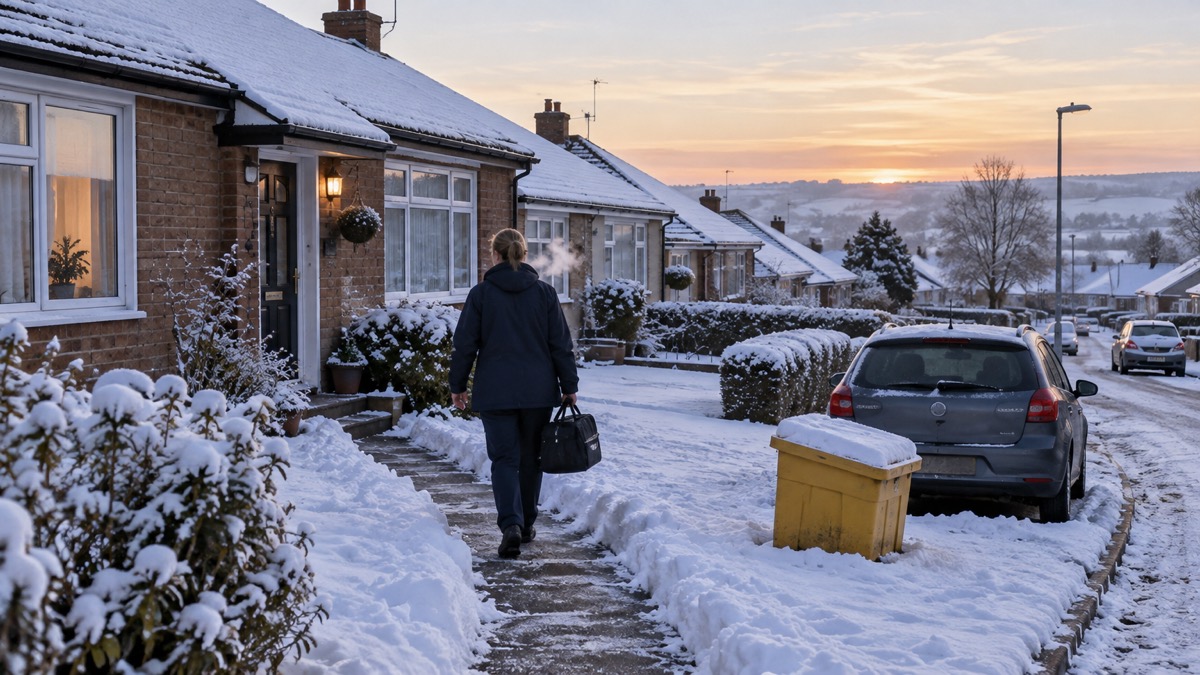
Cold-health alerts are issued when cold weather is forecast that could lead to significant impacts on health1. They are not a weather forecast with a colour on it: they are a health warning, and each one comes with suggested actions to protect health and reduce cold-related harms1. The colour tells you how serious the risk is and how confident the forecasters are, and it runs from yellow through amber to red2.
For an ordinary household, the practical answer is simple. When an alert is issued, read it, check on anyone you know who is older, unwell or living alone, and make sure your home is warm enough and your cupboards hold what you need so nobody has to go out in the worst of the cold. The alerting season runs from 1 November to 31 March each year, though alerts can be issued outside it3.
The sections below explain who issues the alerts, what each colour means, what to do at each level, and how to have them sent to you. If you are supporting a relative who needs extra help, the Extra Help in an Emergency guide covers the wider arrangements.
What a cold-health alert is warning you about
A cold-health alert is issued when the weather conditions have the potential to impact the health and wellbeing of the population6. The system exists to give early warning when adverse temperatures are likely to affect health, and to provide key advice at that point7. It is aimed at professionals within the health and social care sector and those who have a role in responding to cold weather, but it is freely available and can be accessed by the public1.
The colour is not chosen on temperature alone. Alerts are given a colour based on the combination of the impact the weather conditions could have and the likelihood of those impacts being realised2. That is why a forecast that looks modest on paper can still produce an amber alert: the question is what it would do to people, not just how low the thermometer goes.
The service considers two aspects: adverse cold weather and health-sector resilience4. In other words, it weighs both the cold itself and whether the local health and care system is in a position to cope with it. A cold snap arriving when hospitals and care services are already stretched can justify a higher level than the same temperatures in a quiet week.
The alerts are separate from the Met Office's National Severe Weather Warning Service9. The Met Office's own Cold Weather Alerts inform you when cold weather, snow or ice has been forecast to enable you to take the necessary precautions to stay safe and well10. The health alerts will often differ from the National Severe Weather Warnings on occasion, because the severe weather service also considers other impacts of severe weather such as to infrastructure4. A yellow rain warning and a yellow cold-health alert are answering different questions, and you may see one without the other.
Yellow, amber or red: what each level means
The alerts are given a colour, yellow, amber or red, based on the combination of impact and likelihood1. The cold mortality monitoring report for England describes them as yellow (response), amber (enhanced response) and red (emergency response) levels5. The Met Office notes that the Cold-Health Alert service has four colour states, like the Heat-Health Alert, with green as the quiet baseline before any response is needed4.
| Level | What it signals | What it asks of services | What it means for a household |
|---|---|---|---|
| Green | No alert in force | Preparedness | Nothing to do beyond normal winter readiness |
| Yellow | Action required within health and social care; may also be issued when forecast confidence is low but worst-case impacts could be significant2 | Monitor temperatures where vulnerable people spend time2 | Check on anyone vulnerable; keep rooms warm |
| Amber | Enhanced response | Actively monitor high-risk individuals, with visitor or phone call arrangements in place2 | Make contact with relatives and neighbours who live alone |
| Red | Emergency response; significant risk to life for everyone, including the healthy population2 | Consider daily visits or phone calls to those vulnerable to cold-related illness2 | Treat as serious for every member of the household, not only the frail |
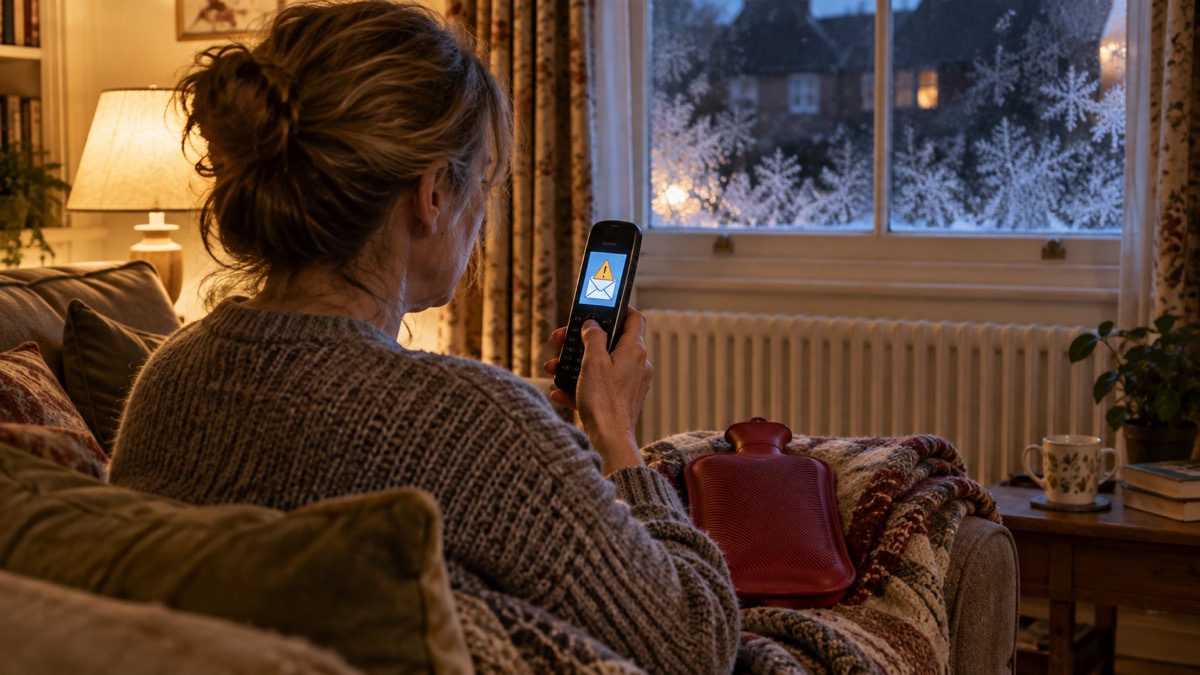
Yellow alerts cover a range of situations in which action is required within the health and social care sector2. They may be issued during periods which would be unlikely to impact most people but where the particularly vulnerable are likely to struggle to cope, or where confidence in the weather forecast is low but more significant impacts could occur if the worst-case scenario is realised, in which case the alert may be upgraded as confidence improves4. A yellow alert is therefore not a reassurance that nothing will happen; it can be an early signal that may escalate.
The step up to red is the one to take seriously. A red cold-health alert would indicate significant risk to life for everyone, including the healthy population2. That is a different order of warning from the lower levels, and it is the point at which even healthy adults should be limiting time outdoors and checking that their homes can be kept warm.
What to do when an alert is issued
Start by reading the alert itself. Users should review every cold-health alert when issued to ensure they fully understand the potential impacts and how likely they are to occur2. The colour is a summary; the text tells you what is expected where you live and when.
For a household, the actions fall into a short list:
- Check the temperature where people spend time. The voluntary and community sector action card for a yellow alert asks for monitoring of the temperature in places where vulnerable individuals spend substantial time2.
- Make contact with anyone at risk. For an amber alert, the same guidance asks for high-risk individuals to be actively monitored during cold weather episodes, checking that those most vulnerable to cold-related illnesses have visitor or phone call arrangements in place2.
- Consider daily contact at red. For a red alert, it asks for daily visits or phone calls to those vulnerable to cold-related illnesses to be considered2.
- Sort out shopping before the cold bites. Home visits should check that there are adequate arrangements for food shopping and other essentials, to reduce the need for vulnerable people to go out in adverse cold weather12.
- Keep illness at home. Official winter health advice is to stay at home if you are not well13.
Social care managers are given the same direction: if a cold-health alert is issued, ensure that high-risk individuals are actively monitored during cold weather episodes, and that those most vulnerable to cold-related illnesses have visitor or phone call arrangements in place14. If you have a relative in a care setting, an alert is a reasonable moment to ask how they are being checked on.
For the practical side of keeping a home warm when the heating fails, see Gas and Heating Failures and Heating and Cooking Without Mains Power or Gas.
Alert season: 1 November to 31 March
The core alerting season runs from 1 November to 31 March each year3. The Cold-Health Alerting system's core period, within which the alerts are issued, is 1 November to 31 March each year1. The Met Office states that the Cold-Health Alerts focus on the season between 1st November to 31st March every year4.
One official document gives the operating period as 1 November to 30 March3. The great majority of the guidance, including the UKHSA overview and the Met Office, gives 31 March, and that is the date to plan around; treat the 30 March reference as an inconsistency in the published material rather than a change to the season.
During the core period, cold-health planners are issued every Monday and Friday1. That rhythm is useful to know: it means the picture is refreshed twice a week through the winter, so a quiet Monday does not rule out an alert on Friday.
Outside the season, alerts do not stop altogether. An out-of-season alert may still be issued if impacts from adverse weather on health (heat or cold) are expected3. The UKHSA overview adds that extraordinary alerts may be issued if an episode of cold that can impact health occurs outside of this period1. A cold snap in late October or early April can therefore still produce a warning, and the same actions apply.
Who issues the alerts and how to have them sent to you
During the winter, the UK Health Security Agency and the Met Office monitor weather forecasts and carry out a joint risk assessment1. Weather forecasts are provided by the Met Office, and cold-health risk scores are determined by the UKHSA Extreme Events and Health Protection Team6. The UK Health Security Agency page explains more about how the agency works with local partners.
To receive alerts, complete the registration form to receive them by email1. Once a cold-health alert is issued, it will be cascaded to everyone registered to receive the alerts2. Weather-Health Alerts are distributed via email to all those who have registered to receive them once they are issued15. The Met Office also offers a free Cold Health Alerts service to keep you up to date16.
You do not need to be a professional to sign up. The alerts are aimed at professionals within the health and social care sector and those who have a role in responding to cold weather, but they are freely available and can be accessed by the public1. For a household with an older relative or a neighbour living alone, an email alert is a useful prompt to pick up the phone.
The content of these alerts is aimed at health and social care organisations and other professionals that work with individuals or communities who may be affected by hot or cold weather17. That shapes the language: they are written for people who will act on them on behalf of others, which is exactly what a carer does.
Protecting vulnerable people during a cold alert
Cold weather does not affect everyone equally, and the alert system is built around that fact. The guidance on supporting vulnerable people before and during cold weather exists to protect the population groups most at risk from the health impacts of cold weather18. The cold mortality monitoring report for England tracks deaths through the winter, and its definition of a cold episode is set in line with the temperature threshold for issuing a yellow Cold Health Alert5.
If you are looking after someone at home, the alert level gives you a ready-made checklist. At yellow, monitor the temperature in the rooms they use2. At amber, make sure there is a visitor or phone call arrangement in place and that someone is actively monitoring them2. At red, consider daily visits or phone calls2. In all cases, check that food shopping and other essentials are arranged so they do not have to go out in the cold12.
The alerts themselves are aimed at professionals within the health and social care sector and those who have a role in responding to cold weather to protect health, though they are freely available and can be accessed by the public1. The guidance behind them is written for professionals on how to protect the population groups most at risk from the health impacts of cold weather13. For an amber alert, that means actively monitoring high-risk individuals during cold weather episodes, checking that those most vulnerable to cold-related illnesses have visitor or phone call arrangements in place7.
If someone you support has a health condition that makes cold weather harder to manage, the People at Higher Risk in an Outbreak page covers protecting vulnerable relatives more broadly, and Staying at Home When Ill covers the days when going out is not an option.
Sources (18)
- Cold-health alerting system overview, GOV.UK, 2025-09-24
- Cold-health alert action card for the voluntary and community sector, GOV.UK, 2025-09-24
- Weather-health alert system user guide, GOV.UK, 2026-04-22
- Cold weather alerts, Met Office, 2026-10-26
- Cold mortality monitoring report winter 2024 to 2025, GOV.UK, 2026-02-18
- Cold-health alert risk score, UKHSA, 2025-05-08
- Be prepared, West Midlands Ambulance Service, 2026-06-16
- Weather-health alerting system, GOV.UK, 2024-12-19
- What is the difference between weather health alerts and severe weather warnings, Wiltshire and Swindon Prepared, 2026-10-25
- Asthma - Met Office, Met Office
- Weather health alerts, UKHSA, 2026-10-29
- Supporting vulnerable people before and during cold weather for healthcare professionals, GOV.UK, 2025-09-24
- Staying well in winter, Derbyshire County Council, 2026-10-29
- Supporting vulnerable people before and during cold weather for adult social care managers, GOV.UK, 2025-09-24
- Weather-health alerting (WHA) system, GOV.UK, 2023-06-01
- How adult social care can help in severe winter weather, Surrey County Council, 2026-10-28
- Adverse weather and health plan, Local Government Association, 2026
- Supporting vulnerable people before and during cold weather, GOV.UK, 2025-09-24
 Medicine Cabinet Checklist
 Sick at Home Supplies Kit
 Caring for Someone Ill at Home
 How Long to Stay Home With COVID
 Time Off After Sickness
 Stopping Flu Spreading at Home
 How Long to Wash Your Hands
 When to Call 111 or 999
 When Your GP Is Closed
 Disposing of Unused Medicines
 Medicines in a Heatwave
 Taking Someone Else's Medicine
 Ordering Repeat Prescriptions
 Treating Dehydration at Home
 The Glass Test for Meningitis