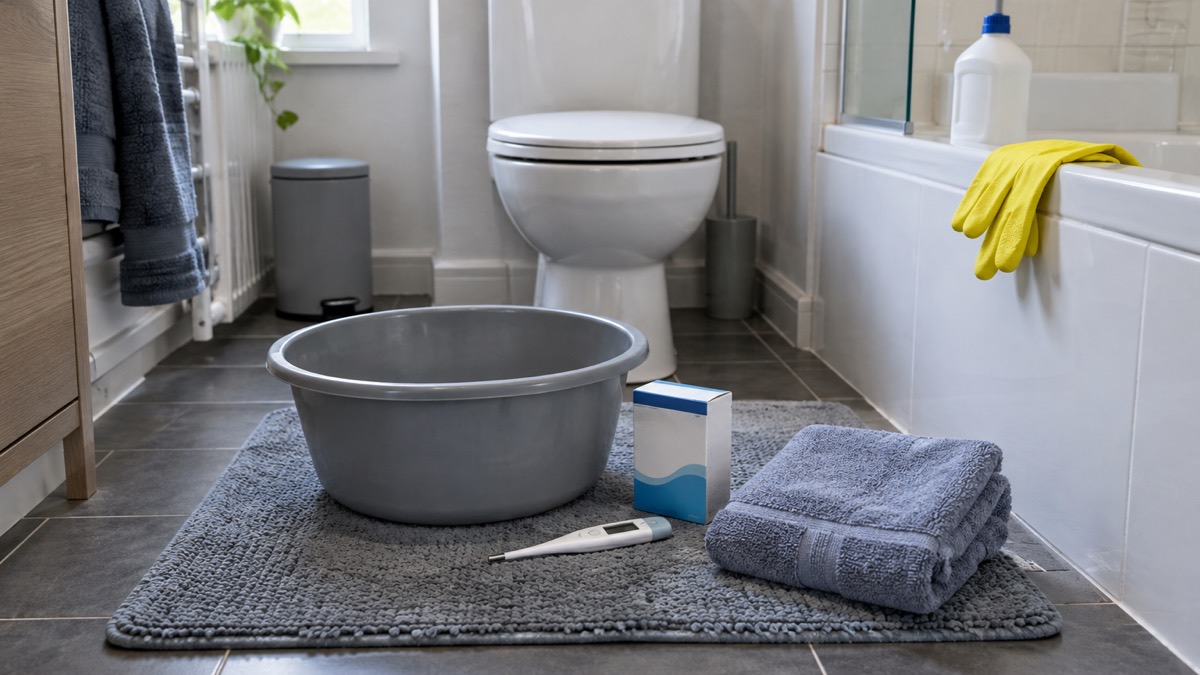
If you have vomiting or diarrhoea, the short answer is to stay off work, school or nursery until you have been free of symptoms for 48 hours. That is the rule repeated across official UK guidance, and it applies to adults and children alike. The illness itself usually passes in a few days, but you remain infectious for a while after you feel better, which is why the wait matters1.
The 48 hours is counted from the last episode of vomiting or diarrhoea, not from when you started feeling unwell. For norovirus, official guidance says not to go to school, nursery or work, or visit others in hospital or care homes, until 48 hours after the last episode of sickness or diarrhoea2. NHS guidance puts it the same way: do not go back until you have not been sick or had diarrhoea for 2 days1.
Some illnesses need a longer wait. Cryptosporidiosis, a waterborne infection, keeps you infectious while you have symptoms and requires you to be free of diarrhoea and vomiting for 48 hours before returning, with extra cleaning at home for at least 48 hours after symptoms stop3. Food handlers and care workers have stricter duties and must tell their employer. This page sets out the rules, the exceptions and when to seek help.
Stay off for 48 hours after the last episode
The 48-hour rule is the single most useful thing to remember. It means that from the moment of your last bout of vomiting or diarrhoea, you wait two full days before mixing with others again. Official guidance for diarrhoea symptoms is explicit: stay off work, school or nursery until you have been completely free from any diarrhoea symptoms for 48 hours6. Norovirus guidance from local authorities and NHS bodies repeats the same figure in slightly different words: do not go to school, nursery or work until you have not been sick or had diarrhoea for 2 days1.
Why 48 hours and not 24? Because you can still pass the infection on after you feel well. Norovirus symptoms begin around 12 to 48 hours after you become infected and can last for 12 to 60 hours, so the illness itself may be short, but the infectious period outlasts it8. The guidance from NHS England infection prevention teams is that anyone with symptoms should be isolated or avoid contact with others for a minimum of 48 hours after their symptoms have stopped8.
The rule applies to more than work and school. You should not visit relatives or friends in hospital or residential and nursing homes if you have been in contact with someone with diarrhoea and vomiting in the last 48 hours9. Do not visit health care settings if you, or someone you have been in contact with, has had diarrhoea and/or vomiting until 48 hours after symptoms have ceased8.
For most people the illness is a stomach bug that should stop in a few days10. Stay at home and get plenty of rest while it passes10. If you are still not feeling well after a few days, or if symptoms worsen, contact NHS 11111.
When you are infectious and should stay at home
You are most infectious while you have symptoms, but the risk does not end when the vomiting stops. The 48-hour wait exists because the virus or bacteria can still be shed. For norovirus, the main symptoms include a sudden onset of nausea, followed by projectile vomiting and diarrhoea, usually 1 to 2 days after becoming infected12. The illness can last 12 to 60 hours8, or between 12 and 72 hours according to one NHS trust13.
Different infections carry different exclusion periods, and it helps to know which one you are dealing with. The table below sets out the main ones.
| Illness | How long to stay off | Source |
|---|---|---|
| Vomiting and diarrhoea (general) | Until 48 hours after the last episode | 1 |
| Norovirus | Until 48 hours after symptoms stop | 1 |
| Salmonella | Until symptom-free for at least 48 hours | 14 |
| E. coli (STEC) | Until symptom-free for at least 48 hours | 15 |
| Hepatitis A | At least a week after symptoms first started | 16 |
| Scarlet fever | At least 24 hours after starting antibiotics | 17 |
| Measles | At least 4 days from when the rash first appeared | 18 |
| COVID-19 (positive test) | 3 days after the test for under 18s; 5 days for adults | 20 |
The COVID-19 figures differ by age and by nation. NHS guidance says people under 18 should try to stay at home and avoid contact with other people for 3 days after the day the test was taken20. Suffolk County Council's winter advice says that if you have a positive COVID-19 test result you should try to stay at home and avoid contact with other people for 5 days after the day you took the test, even if you have no symptoms21. These are separate pieces of guidance and the difference reflects the age group and the setting.
If you have diarrhoea or you are being sick, stay at home until 48 hours after they have stopped22. That simple formulation from COVID-19 testing guidance is a useful fallback for any stomach illness.
Cryptosporidiosis: why the wait to return is longer
Cryptosporidiosis is a waterborne infection that behaves differently from a short stomach bug. Symptoms include profuse watery diarrhoea, stomach pains, nausea or vomiting, low-grade fever and loss of appetite, which can lead to dehydration and weight loss3. Symptoms usually last for about 2 weeks but can be longer, especially in people with weak immune systems3.
The return-to-work rule is the same 48 hours, but the context is more serious. While you are ill and have symptoms, you are infectious and should stay off work or school. You should not return to work or school until you have been free from diarrhoea and/or vomiting for 48 hours3. Because cryptosporidiosis is highly infectious, you need to be very clean around your home for at least 48 hours after your symptoms stop3.
There is a further precaution that does not apply to norovirus in the same way: you can pass cryptosporidium in your faeces for several weeks even if you no longer have symptoms3. That is why the guidance is firm about hygiene after recovery. Do not prepare food for others until you have been symptom-free for at least 48 hours3.
If you work with vulnerable groups, such as the young, the elderly or those in poor health, or if you handle food, you should tell your employer you have had cryptosporidiosis3. That is a duty that goes beyond the general 48-hour rule.
Returning to work or school safely
The return to work or school depends on who you are and what you do. For most people who do not work with food, the general guide is that you can return 24 hours after symptoms have stopped4. But that is a general guide, and the 48-hour rule is the safer standard used across norovirus and diarrhoea guidance1. Where the two figures differ, follow the 48-hour rule unless your employer or local health protection team advises otherwise.
For children, the rule is clear. Children under 5 should not attend nursery or school until 48 hours after their diarrhoea and vomiting have settled4. Keep your child at home while they are unwell, and if they are not vomiting too often, give them frequent, small amounts of water, for example a couple of tablespoons full every 10 minutes, to stop them becoming dehydrated23.
Food handlers and care workers face stricter rules. Food handlers and health care or nursery workers in contact with highly susceptible people cannot return to work until symptom-free for 48 hours and must inform their employer of symptoms5. If you work in a food business or caring environment, you have a legal duty to tell your employer that you are suffering from an illness6. People who prepare food as part of their work must inform their employers of their illness and should not return to work within 48 hours of the last symptom4. Childminders should not look after children until they have been symptom-free for 48 hours6.
If you are suffering with diarrhoea and/or vomiting and need an ambulance, tell the crew as soon as possible so that they take the necessary precautions to prevent spread24.
Stopping the spread at home
The 48-hour rule is about protecting others, and the same principle applies inside your home. Stay at home and get plenty of rest10. Wash your hands well with soap and water, especially after using the toilet and before preparing food. Keep the toilet, flush handles, taps and door handles clean.
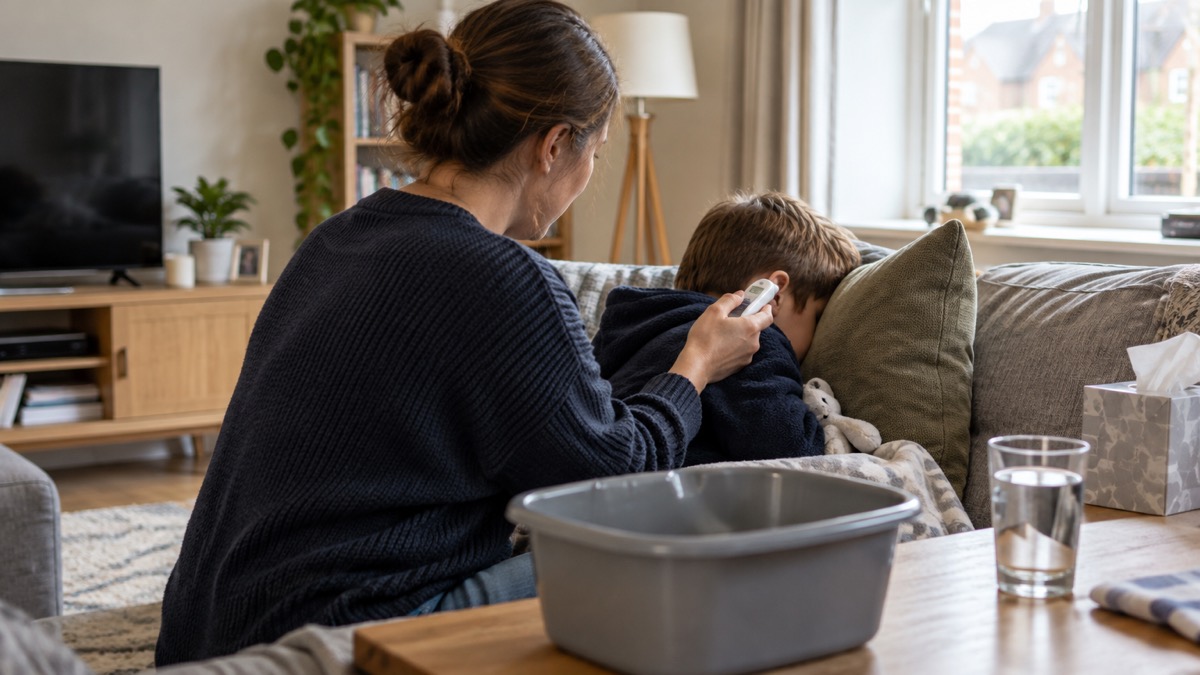
Do not prepare food for others until you have been symptom-free for at least 48 hours3. That applies whether or not you are a food handler by trade. If you have been in contact with someone with diarrhoea and vomiting in the last 48 hours, do not visit relatives or friends in hospital or residential and nursing homes9.
Anyone who has the symptoms should be isolated or avoid contact with others for a minimum of 48 hours after their symptoms have stopped8. That means separate towels, separate cups and cutlery where possible, and avoiding shared food.
For more on household hygiene during illness, see Stopping Infections Spreading at Home: Hands, Cleaning and Fresh Air and Staying at Home When Ill: Keeping Your Household and Others Safe.
When to get medical help
Most bouts of vomiting and diarrhoea settle without medical help. But some signs mean you should seek advice. Contact NHS 111 if you are worried about a baby under 12 months, a child stops feeding, there are signs of dehydration, you cannot keep fluid down, there is bloody diarrhoea, or diarrhoea lasts more than 7 days or vomiting more than 2 days1.
The Scottish guidance lists similar triggers: symptoms of severe dehydration, vomiting constantly and unable to keep down fluids, bloody diarrhoea, diarrhoea for more than 7 days or vomiting for more than 2 days, a recent return from a part of the world with poor sanitation, or kidney disease, inflammatory bowel disease or a weak immune system with diarrhoea and vomiting7.
Call 999 or 112 or go to A&E if the vomit contains blood or looks like ground coffee, there is a stiff neck and pain when looking at bright lights, or there is a sudden onset of severe abdominal pain25.
If you are still not feeling well after a few days or if symptoms worsen, contact NHS 11111. For help deciding which service to use, see When to Call 111 and When to Call 999 and NHS 111: What It Can Help With and How to Use It.
Sources (25)
- Norovirus, NHS, 2024-12-31
- Norovirus, Derbyshire County Council, 2026-10-29
- Cryptosporidium: public advice, GOV.UK, 2023-11-01
- Food poisoning, Somerset Council, 2026-07-09
- Food poisoning, Belfast City Council, 2026-10-29
- Food poisoning and waterborne infections, Shropshire Council, 2026-10-29
- Food poisoning, NHS inform, 2026-08-17
- Norovirus, NHS Cheshire and Merseyside, 2024-09-20
- Norovirus, Warwickshire County Council, 2026-10-29
- Vomiting, North West Ambulance Service, 2025-03-13
- Self care, NHS Cheshire and Merseyside, 2024-01-11
- How to stop norovirus spreading, GOV.UK, 2023-04-17
- Norovirus, Wrightington, Wigan and Leigh Teaching Hospitals NHS Foundation Trust, 2025-08
- Eggs imported from Ukraine warning, Food Standards Scotland, 2026-10-10
- Rapunzel Biosnacky seeds recall, Food Standards Scotland, 2026-08-07
- Foodborne viruses, Food Standards Scotland, 2026-10-25
- Scarlet fever, Derbyshire County Council, 2026-10-29
- Measles factsheet, GOV.UK, 2026-10-29
- Measles, Derbyshire County Council, 2026-10-29
- COVID-19 symptoms and what to do, NHS, 2026
- Seasonal winter advice, Suffolk County Council, 2026-10-29
- COVID-19 testing in Suffolk, Suffolk County Council, 2022-01-25
- What to do if your child is unwell, North East London ICB, 2024-10
- Patient advice: infection prevention and control, South Western Ambulance Service NHS Foundation Trust, 2026-10-29
- Sickness and diarrhoea, St John Ambulance, 2026-10-28
 Medicine Cabinet Checklist
 Sick at Home Supplies Kit
 Caring for Someone Ill at Home
 How Long to Stay Home With COVID
 Stopping Flu Spreading at Home
 How Long to Wash Your Hands
 When to Call 111 or 999
 When Your GP Is Closed
 Disposing of Unused Medicines
 Medicines in a Heatwave
 Taking Someone Else's Medicine
 Ordering Repeat Prescriptions
 Treating Dehydration at Home
 Cold-Health Alerts Explained
 The Glass Test for Meningitis