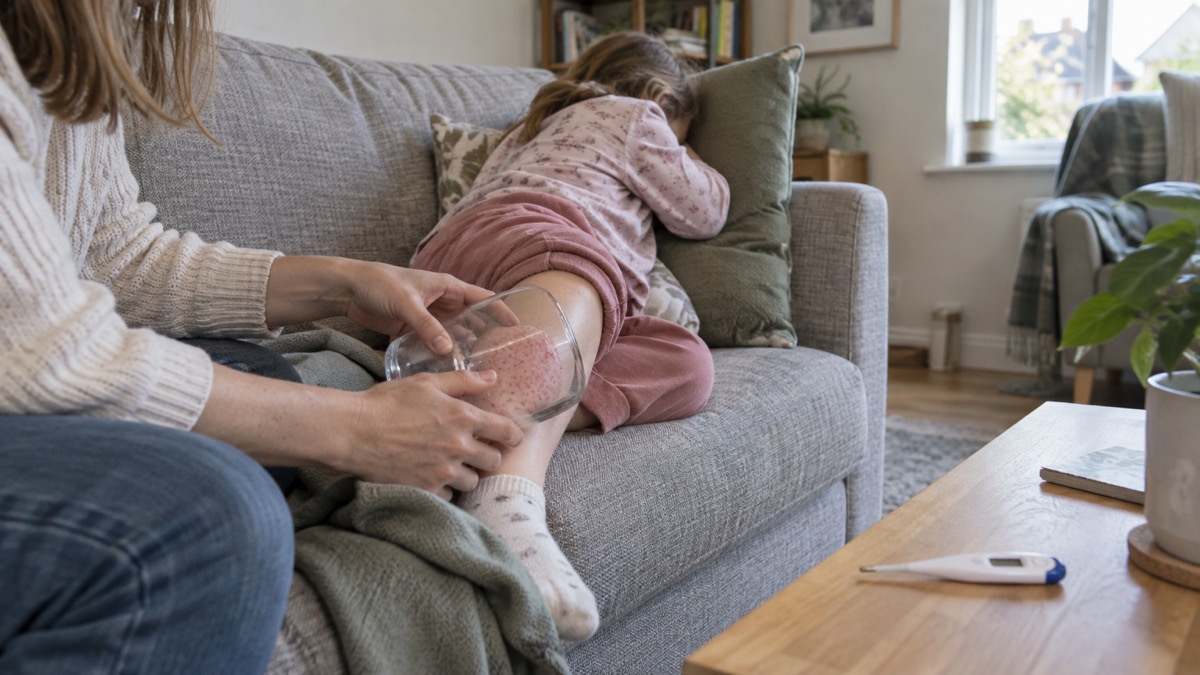
A rash that does not fade when you press a clear glass firmly against it can be a sign of meningococcal septicaemia, and it is a medical emergency1. To do the glass test, press the side of a clear glass firmly against the skin and look through it. Most rashes fade under pressure. If you can still see the marks clearly through the glass, get urgent medical help immediately3.
The test is quick and needs nothing more than a clear tumbler, which is why it is sometimes called the tumbler test4. But it is only one sign among many, and it is not a test you can pass or fail. Not everyone with meningitis gets a rash, and it can be a late sign or may not appear at all5. The rash itself is actually caused by septicaemia, the blood poisoning that can accompany the infection5.
So the glass test sits inside a bigger rule: if someone is ill and getting worse, especially with a fever, do not wait for a rash before getting help2. Meningitis and sepsis can come on suddenly, progress very quickly and kill in hours2. This page shows you how to do the test, where to look on darker skin, and when to pick up the phone rather than reach for a glass.
How to do the glass test
Press the side of a clear glass firmly against the skin over the rash1. Look through the glass at the marks underneath. Most rashes will fade when pressed, and that is the usual result3. If you can still see the marks clearly through the glass, it may be meningitis, and you should get urgent medical help immediately3.
A few practical points make the test easier to trust:
- Use the side of the glass, not the base. The side gives a flat, firm surface against the skin1.
- Press firmly. A light touch can leave the skin pale anyway and tell you nothing.
- Use a clear glass. You need to see the rash through it, so a coloured or frosted tumbler is no good.
- Look in good light. Spots can be faint, and poor light makes them harder to judge.
- Test more than one spot. Check several marks rather than a single one.
The test is used widely enough that official winter health advice for families points parents to it when a child has a fever with a rash6. It is a simple first-aid check, not a diagnosis. A fading rash does not prove someone is fine, and a non-fading rash does not prove they have meningitis. What it does is flag a possible emergency fast, so you act sooner.
What a rash that does not fade can mean
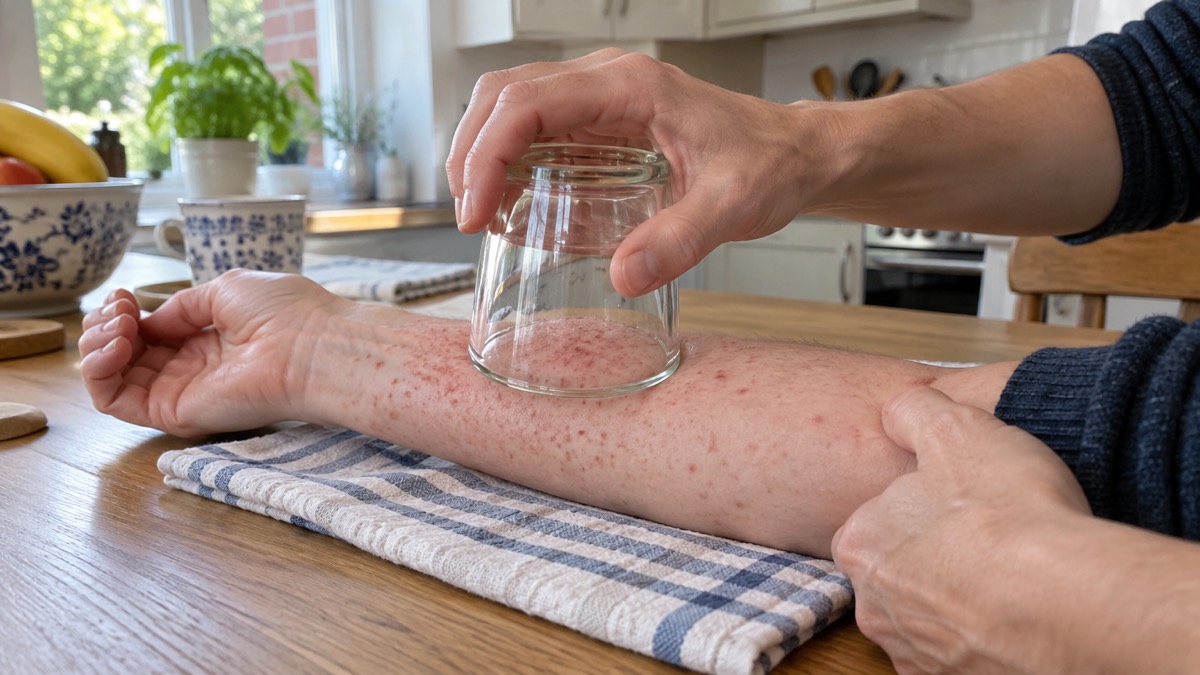
A rash that does not fade under pressure can be a sign of meningococcal septicaemia1. Septicaemia is blood poisoning, and it is the cause of the rash associated with meningitis5. The rash usually starts as small spots but quickly becomes deep purple patches2. It is one of the red, high-risk signs to act on, alongside blue skin, lips or tongue and very pale or mottled skin4.
The rash is not the only sign, and often not the first. Meningococcal disease can bring a sudden high fever, a severe and worsening headache, a stiff neck, vomiting and diarrhoea, joint and muscle pain, dislike of bright lights, very cold hands and feet, seizures, confusion or delirium, and extreme sleepiness or difficulty waking7. Meningitis more broadly brings drowsiness or difficulty waking, confusion and irritability, severe muscle pain, pale blotchy skin, spots or rash, severe headache, stiff neck, dislike of bright lights, and convulsions or seizures4.
The same non-fading rash appears on the official list of sepsis symptoms for both adults and older children, and for babies and young children, described as the same as meningitis8. Sepsis guidance is careful to add that this type of rash is rare in sepsis, but it may be a symptom of meningitis9. In other words, a non-fading rash points you towards meningitis and septicaemia, and either way it means urgent help.
Checking for a rash on dark skin
On dark skin, the spots or rash can be more difficult to see2. That does not make the illness any less serious, and it does not mean the glass test is useless. It means you look in the places where a rash shows up best.
Check lighter areas such as the palms of the hands, the soles of the feet, inside the eyelids and the roof of the mouth1. The darker the skin, the harder it is to see a septicaemic rash, so these lighter areas are where to concentrate4. The same principle applies to other skin signs: on black or brown skin, blue, grey, pale or blotchy skin, lips or tongue may be easier to see on the palms of the hands or soles of the feet9. First aid guidance for shock makes the same point, telling you to look at the palms and the base of the feet for grey-blue skin on darker skin11.
| What to check | Why it helps |
|---|---|
| Palms of the hands | Lighter skin shows colour changes and spots more clearly1 |
| Soles of the feet | Same reason, and easy to miss when a child is dressed1 |
| Inside the eyelids | A lighter surface that is often overlooked1 |
| Roof of the mouth | Another lighter area to check1 |
Undress the person enough to see their whole body, and use good light. If you are checking a child, look at the nappy area and the feet as well as the trunk. A rash that is hard to see is not a reason to relax: if the person is unwell, act on how ill they are.
Where the glass test falls short
The glass test is useful, but it has real limits, and knowing them keeps you safe.
Not everyone gets a rash. Not everyone gets this rash, and you should never wait for one, because it can be a late sign or may not appear at all2. It is a common misconception that meningitis always brings a rash, but a rash does not appear in all cases10.
Symptoms arrive in any order. Meningitis symptoms can appear in any order, and some may not appear at all4. Meningitis and septicaemia symptoms can be easily mistaken for other childhood illnesses10. A child can look like they have a bad cold and be seriously ill within hours.
It can move fast. Meningitis and sepsis can come on suddenly, progress very quickly, kill in hours, and leave survivors with serious health problems or lifelong disabilities including brain or nerve damage, deafness, blindness or epilepsy2. Both meningitis and sepsis can kill in hours4.
A fading rash is not an all-clear. A rash that does fade when pressed with a clear glass is classed as a medium-risk sign, not a red one, but it does not rule out illness4. If someone is drowsy, confused, has a stiff neck or is getting worse, get help whatever the glass shows.
It is not a diagnosis. The test tells you whether a rash fades. It cannot tell you what is causing the illness. That is a job for medical staff.
Babies and young children: do not wait for every symptom
Babies and young children are particularly vulnerable to meningitis because they cannot easily fight infection while their immune system is still developing5. Meningitis is more common in babies, children and young adults, although anyone of any age can get it3.
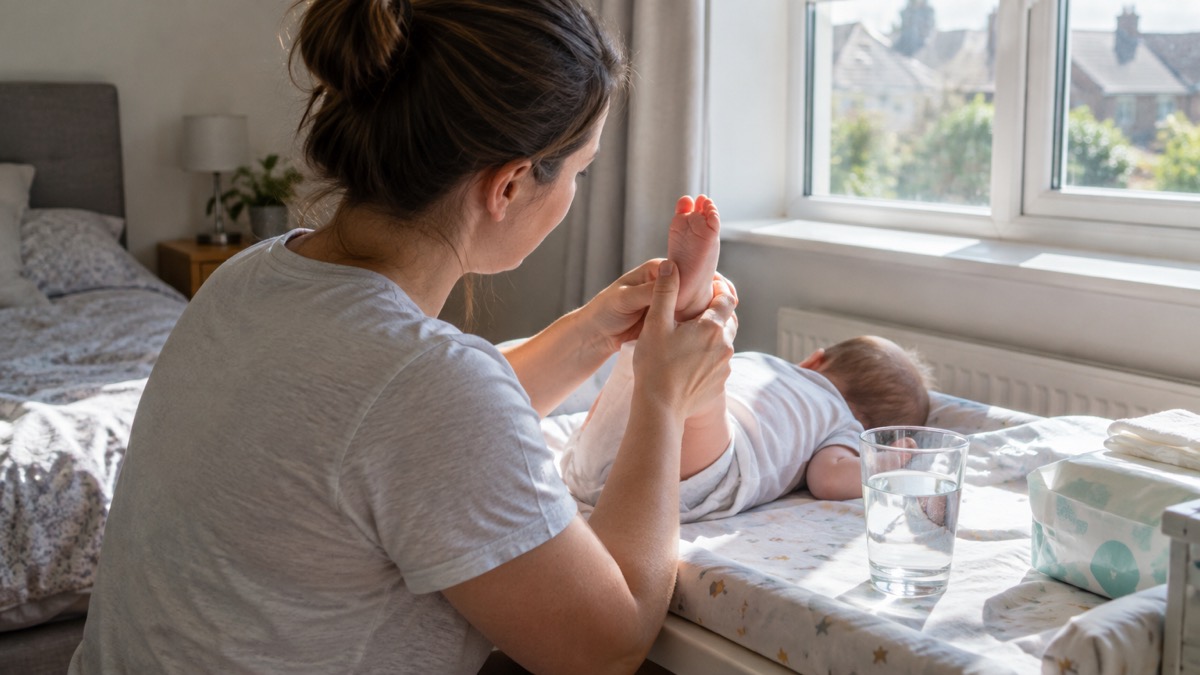
If a baby or child has a rash, press the side of a clear glass against their skin12. Most rashes will fade when pressed. If you can still see the rash through the glass, it may be meningitis12. But do not wait for all the symptoms to appear, because a baby or child with meningitis can deteriorate very quickly12.
Young children may not describe symptoms well, so watch for behaviour as well as marks. Signs to act on include a fever with cold hands and feet, being drowsy or difficult to wake, confusion and irritability, severe muscle pain, pale blotchy skin, spots or a rash, severe headache, stiff neck, dislike of bright lights, and convulsions or seizures13. A high temperature with hands and feet that feel cold to touch, joint and limb pain, vomiting, sensitivity to light and drowsiness are also warning signs3.
When to call 999 and when to use NHS 111
If you suspect someone has meningitis, call 999 or 112 immediately, or take them to your nearest emergency department straight away, so they can get urgent treatment as soon as possible3. Call 999 if you see the emergency symptoms in a baby or child12.
Use NHS 111 for urgent but not life-threatening health advice, or when your GP surgery is closed and you cannot get help elsewhere14. You can also call NHS 111 or your GP practice for advice if you have questions about meningococcal disease15. In Wales, NHS 111 Wales covers urgent advice, and its sepsis pages set out the signs to act on16.
| Situation | What to do |
|---|---|
| Rash does not fade under a glass, or you suspect meningitis | Call 999 or 112, or go to the nearest emergency department3 |
| Baby or child ill and getting worse, with or without a rash | Get medical help immediately2 |
| Urgent advice, not life-threatening, or GP closed | NHS 11114 |
| Questions about meningococcal disease | NHS 111 or your GP practice15 |
For a mental health emergency where someone is in immediate danger or at risk of serious self-harm, call 99917.
Where to get help and support
Meningitis Now runs a nurse-led helpline on 0808 80 10 388, and you can email helpline@meningitisnow.org18. The charity also produces a signs and symptoms card, which you can order by calling the Freephone Helpline on 0808 80 10 388 or by emailing helpline@meningitisnow.org18. Keeping a card on the fridge or in a wallet means the signs are to hand when you are worried and not thinking clearly.
The Meningitis Research Foundation offers support services on 080 8800 3344 in the UK, or 1800 41 33 44 in the Republic of Ireland10. These are support lines for questions and reassurance, not emergency numbers. In an emergency, always call 999 or 112 first.
For more on the signs to act on and how the illness behaves, see our guide to meningitis and meningococcal disease. If you are unsure whether a symptom needs emergency care or a call to NHS 111, our page on when to call 111 and when to call 999 sets out the difference. And if you are caring for someone who is ill at home, our guide to looking after someone who is ill covers the practical side.
Sources (18)
- The Glass Test, Meningitis Now, 2026-10-29
- Meningitis, Public Health Wales, 2026-10-15
- Meningitis first aid, St John Ambulance, 2026-10-28
- Signs and symptoms, Meningitis Research Foundation, 2026
- Signs and symptoms in babies and toddlers, Meningitis Now, 2026-10-29
- Your Health Guide Winter 2025, NHS Western Isles, 2025-12
- UKHSA meningitis B outbreak: what you need to know, Wiltshire and Swindon Prepared, 2026-10-25
- Sepsis, NHS, 2026-01-12
- Sepsis, St John Ambulance, 2026-10-28
- Signs and symptoms in toddlers, Meningitis Research Foundation, 2026
- Shock, St John Ambulance, 2026-10-28
- Meningitis first aid for babies and children, British Red Cross, 2026-10-29
- Signs and symptoms in children, Meningitis Now, 2026-10-29
- Storm preparation, Cornwall Council, 2026-10-29
- Meningitis and meningococcal disease, Public Health Wales, 2026-10-15
- Sepsis, NHS 111 Wales, 2026
- Urgent help, NHS South West London, 2026-10-29
- Signs and symptoms cards, Meningitis Now, 2026-10-29
 Medicine Cabinet Checklist
 Sick at Home Supplies Kit
 Caring for Someone Ill at Home
 How Long to Stay Home With COVID
 Time Off After Sickness
 Stopping Flu Spreading at Home
 How Long to Wash Your Hands
 When to Call 111 or 999
 When Your GP Is Closed
 Disposing of Unused Medicines
 Medicines in a Heatwave
 Taking Someone Else's Medicine
 Ordering Repeat Prescriptions
 Treating Dehydration at Home
 Cold-Health Alerts Explained