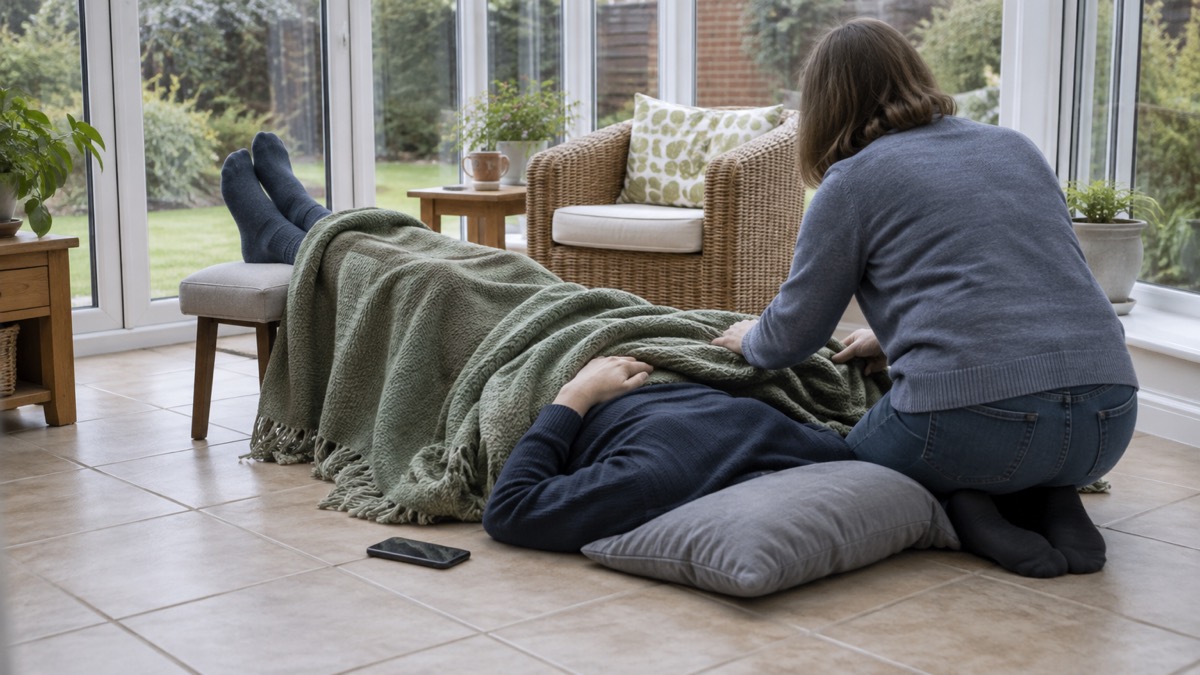
Shock, in first aid terms, is a life-threatening condition that needs to be treated immediately. It happens when organs like the brain and heart stop getting enough oxygen and nutrients, usually because of severe bleeding, a serious burn, a major injury or a severe allergic reaction1. Phone 999 for emergency help straight away and tell the call handler that you think the person has signs of shock1.
While you wait, your job is simple and it matters: treat any injury you can see that could be causing the shock, such as severe bleeding, keep the person warm, and reassure them that you will help them1. The early signs to look for are a fast pulse, pale, cold and clammy skin, and sweating1. As shock develops, the skin can turn grey-blue, especially inside the lips, the pulse becomes weak, and the person may feel weak, dizzy, nauseous and very thirsty1.
This page explains what shock is, how to recognise it at each stage, and what to do while the ambulance is on its way. It is written for ordinary households, and every instruction comes from official NHS and UK health guidance.
Call 999 straight away: shock is life-threatening
Shock is not a condition you manage at home or wait to see whether it improves. NHS inform describes it plainly: "Shock is a life-threatening condition that needs to be treated immediately"1. The treatment that actually reverses shock, replacing lost blood or fluid and fixing the underlying cause, is hospital treatment. What you do at the scene buys time and stops things getting worse, but it does not replace the ambulance.
So the first action is the phone call. Phone 999 for emergency help and tell the call handler that you think the person has signs of shock1. If someone else is with you, ask them to make the call while you help the injured person, and give the call handler details of the injury and the extent of any bleeding3. If you are alone, make the call yourself before doing anything else that takes time.
The same rule applies across the emergencies that most often cause shock. Phone 999 for emergency help if someone has had an electric shock4. Call 999 if severe bleeding is not controlled, because shock can develop and the person may become unresponsive3. Call 999 if a child stops breathing, is unconscious, is bleeding heavily, has blue, grey, pale or blotchy skin, lips or tongue, or has been severely injured5. If you are unsure whether it is serious enough for 999, the call handler will decide with you, and it is always better to call and be told it is not needed than to wait.
If you want to understand what happens after the call, our page on how ambulance services prioritise 999 calls explains how response times are set.
What shock actually is: vital organs not getting enough oxygen
The word "shock" is used loosely in everyday speech, and this causes real confusion at the worst moment. People say they are "in shock" after bad news or a fright, meaning an emotional reaction. First aid shock is something entirely different and far more serious: a physical failure of the circulation. NHS inform defines it as the body not getting enough oxygen to the vital organs6, and explains that it happens when organs like the brain and heart stop getting enough oxygen and nutrients1.
The usual route to that failure is fluid loss. When someone loses a lot of blood from a wound, or a large amount of fluid from a serious burn, there is not enough volume left in the circulation to keep blood flowing to the organs. The heart speeds up to compensate, which is why an early sign is a fast pulse1. As the shortfall worsens, the body pulls blood away from the skin and towards the core, which is why the skin becomes pale, cold and clammy, and later grey-blue1. Eventually the brain itself is affected, which produces the late signs: restlessness, gasping and unresponsiveness1.
Several emergencies can end in shock, and knowing them helps you expect it:
- Severe bleeding: if severe bleeding is not controlled, shock can develop and the person may become unresponsive3.
- Severe burns and scalds: shock is listed among the serious effects of burns6.
- Broken bones: a fracture can show signs of shock, especially if the thigh bone or pelvis are injured7.
- Severe dehydration: shock is a serious complication of dehydration8.
- Anaphylaxis: a severe allergic reaction can produce shock, and official guidance includes lying the person down and raising their legs to treat them for shock2.
- Heart attack: a heart attack can produce ashen skin, blueness on the lips, a rapid heartbeat and lots of sweating, signs that overlap with shock9.
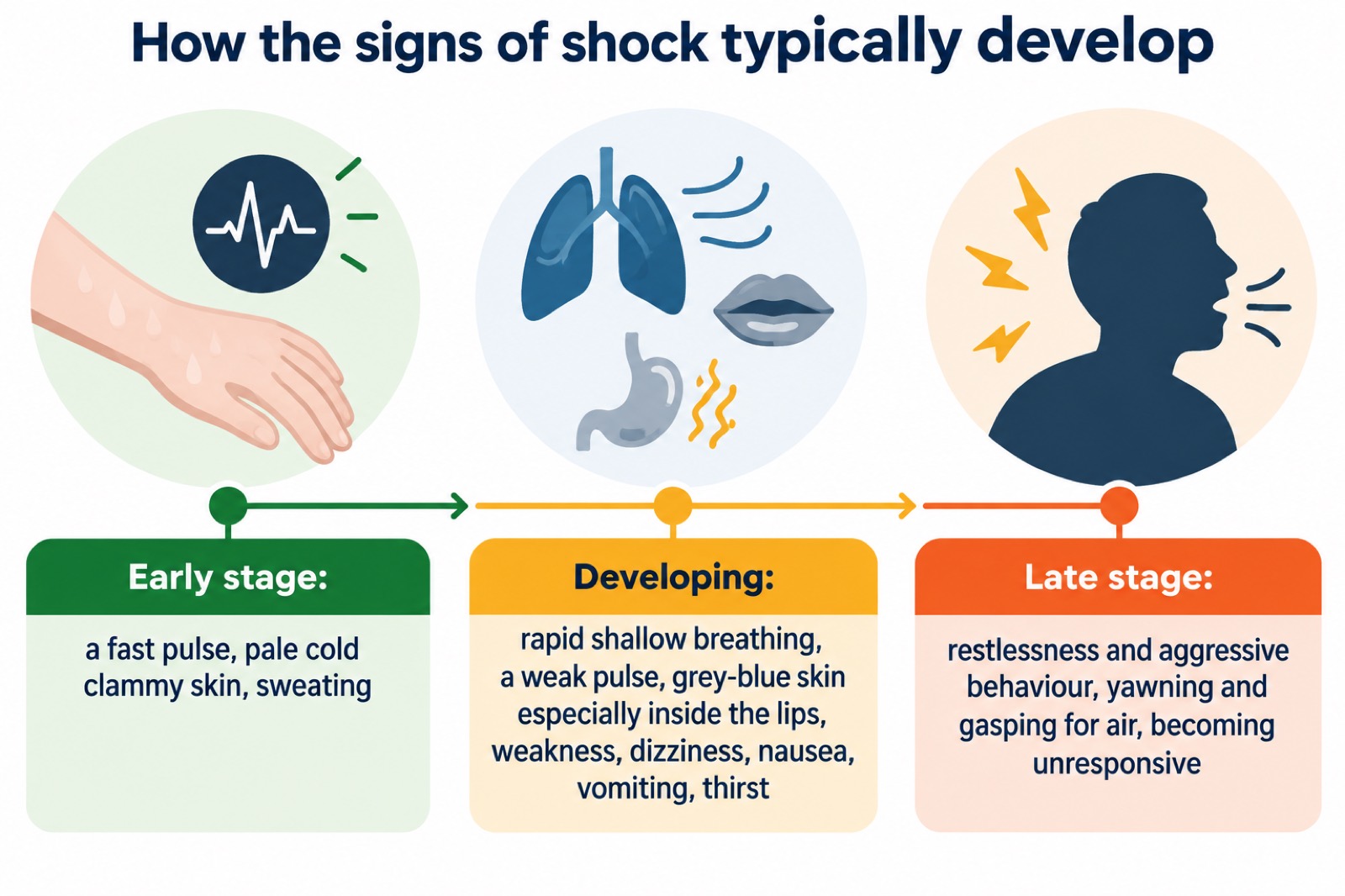
The stages below show how the condition typically moves. They are a guide to what you may see, not a timetable: shock can progress quickly, and the signs can overlap.
Early signs: what to look for first
At first, shock may cause a fast pulse, pale, cold and clammy skin, and sweating1. These are the signs most likely to appear in the minutes after a serious injury, and they are the ones to check deliberately rather than wait to notice. If someone has been badly hurt, or badly burned, or has a suspected broken thigh or pelvis, expect shock and look for these signs rather than hoping they will not appear7.
Check the pulse at the wrist or neck and count how fast it beats. Feel the skin, particularly on the face and hands: cold and clammy means damp as well as pale. Sweating that does not match the room temperature or the person's exertion is part of the same picture1.
None of these signs alone proves shock. A fast heartbeat also appears in heatstroke10, and sweating, breathlessness and nausea appear in a heart attack alongside chest pain9. This is why the context matters as much as the signs: shock after an injury, a burn or heavy bleeding is the pattern to act on. If the person has chest pain that does not go away, treat it as a possible heart attack and phone 9999. Our page on what to do if someone is having a heart attack covers that separately.
Signs that shock is getting worse
As shock develops, it can cause rapid, shallow breathing, a weak pulse, grey-blue skin especially inside the lips, weakness and dizziness, nausea and vomiting, and thirst1. The change from a fast pulse to a weak pulse is the important one to understand: the early fast pulse is the heart working hard to compensate, and the later weak pulse means it is starting to fail at that work. If you check a pulse more than once and it has become hard to find or faint, the person's condition is worsening.
Grey-blue skin, especially inside the lips, is a sign to act on immediately. NHS guidance on urgent symptoms describes blue, grey, pale or blotchy skin, lips or tongue, skin that feels cold, difficulty breathing or taking lots of quick breaths, confusion, and being sleepier than normal or difficult to wake as reasons to call 999 or go to A&E, and notes that these could be signs of shock8. On brown or black skin, this colour change may be easier to see on the palms of the hands8. Look there if you are unsure.
Thirst, nausea and vomiting are uncomfortable for the person but they are also diagnostic: they show the circulation is under strain. Do not respond to thirst by giving the person a drink. The correct response is the 999 call, treating what you can see, warmth and reassurance1.
If symptoms worsen quickly, seek medical help promptly11. In practice, with shock, that means the 999 call should already have been made, and you should tell the call handler about the worsening signs when they check back with you.
Late signs: restlessness, gasping and unresponsiveness
As the brain's oxygen supply weakens further, shock can cause restlessness and aggressive behaviour, yawning and gasping for air, and the person becoming unresponsive1. These are late signs, and they mean the situation is critical.
Restlessness and aggressive behaviour can be misread by helpers and bystanders. A person who is irritable, agitated or even lashing out after a serious injury may not be being difficult: their brain is short of oxygen. Do not respond by restraining them or arguing with them. Keep treating the cause, keep them warm, keep talking to them calmly, and tell the ambulance service what you are seeing1.
Yawning and gasping for air are signs of the brain's oxygen supply failing1. Gasping can be mistaken for normal breathing when it is not. If someone becomes unresponsive and their breathing is irregular, gasping or absent, check their breathing and be prepared to start CPR2. Our page on how to check if someone is breathing shows how to do this, and agonal breathing explains why gasping still counts as not breathing.
What to do while help comes
Once the 999 call is made and any visible cause is being treated, your task is to hold the person steady until the ambulance arrives. The guidance is consistent across the conditions that cause shock.
- Treat any injuries you can see that could be causing the shock, for example severe bleeding1. Bleeding comes first: apply direct pressure to the wound before managing the airway if the casualty is bleeding severely12.
- Help the person into the right position. If they are pale with a weak pulse, lie them down and raise their legs to treat them for shock2. If they are struggling to breathe, help them to sit in the position that makes breathing easier2.
- Keep them warm. Reassure the casualty and cover them to keep them warm while you wait for help to arrive13.
- Reassure them. Tell the casualty that you will help them1. Stay as calm as possible to reduce their stress9, and stay calm yourself14.
- Monitor them until help arrives9. Keep checking their breathing and their response to you, and note the time if they have a seizure or any other change15.
- Do not give them anything to eat or drink. A person in shock may be thirsty or vomiting1, and first aid guidance for comparable emergencies is explicit: after a seizure, the person should have no food or drink until they have fully recovered15.
- If they become unresponsive, check their breathing and be prepared to start CPR2.
Two of these deserve a little more explanation. Lying the person down and raising their legs is the classic shock position, and official anaphylaxis guidance states it directly: if the person becomes pale with a weak pulse, lie them down and raise their legs to treat them for shock2. But breathing comes first: if the person finds breathing easier sitting up, let them sit2.
Keeping the person warm matters because a body in shock is already struggling to regulate itself, and cooling makes that worse. Cover them with a coat, blanket or whatever is to hand while you wait13. Do not go to the other extreme: never place a child with a burn in a bath full of cold water, as this can cause them to go into shock and cause other complications16, and do not use ice on a burn16.
Reassurance is not a soft extra. Official guidance tells you to reassure the casualty that you will help them1, to stay as calm as possible to reduce the casualty's stress9, and to stay calm while waiting for the ambulance14. A calm voice and a clear account of what is happening and what help is coming genuinely help the person, and they help you keep thinking clearly too.
Treat the cause you can see: severe bleeding first
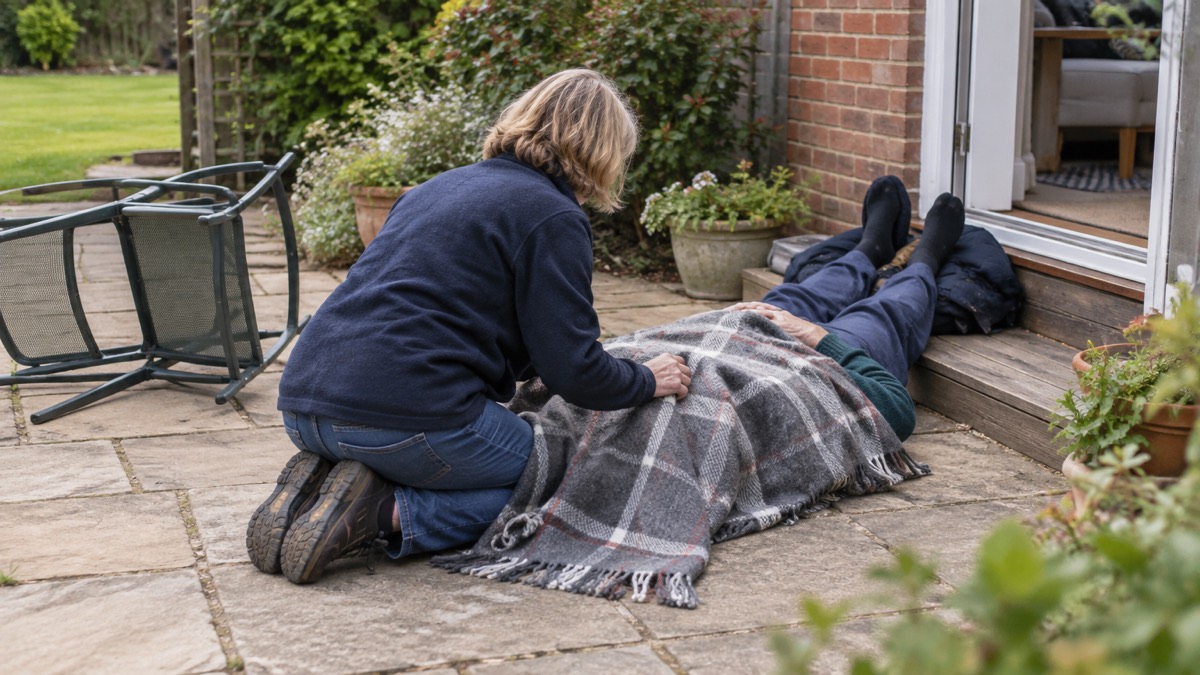
If the casualty shows signs of shock, treat any injuries you can see that could be causing it, for example severe bleeding1. This is the one intervention available to you that directly slows the slide into shock, and it comes before everything else in first aid terms: if the casualty is bleeding severely, you must deal with this first, applying direct pressure to the wound before managing their airway12.
The method is straightforward. Phone 999 for help, asking someone else to call if possible, and give the call handler details of the injury and the extent of the bleeding3. If nothing is stuck in the wound, apply pressure to the wound using a clean pad or dressing and keep doing this until the bleeding stops17. Keep the pressure on and keep monitoring the person, because if severe bleeding is not controlled, shock can develop and the person may become unresponsive3.
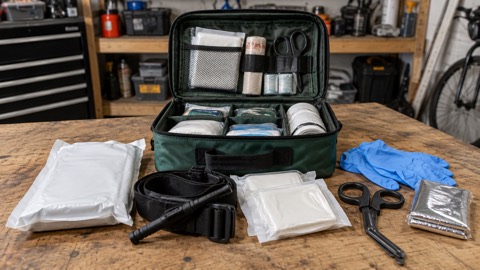
If an object is stuck in the wound, do not pull it out: pressure around it, not on it, is the approach, and our page on whether you should remove an object stuck in a wound covers this. For the full sequence, see how to stop severe bleeding, and for what to keep at home, our bleeding control kit checklist.
Broken bones can also cause shock, especially if the thigh bone or pelvis are injured7. Advise the casualty to stay still, support the joints below and above the injured area with your hands, and place padding around the injury for extra support7. If you cannot easily move the person without causing pain, do not move them; call 999 for an ambulance5. Our page on what to do for a suspected broken bone goes through this in full.
Shock after burns and scalds
Burns and scalds can sometimes lead to further problems, including shock, heat exhaustion, infection and scarring18. The first aid for the burn itself is also the main thing you can do to limit how much shock develops.
Cool the affected area immediately with cool running water for at least 20 minutes19. If there is no running water, immerse the burn or scald in cold water or use any other cool fluid, such as milk or another cold drink5. Do not use ice16. Carrying out the first aid tasks as soon as possible can also reduce the long term effects of burn injuries in relation to scarring16.
While you cool the burn, watch for signs of breathing difficulty13, and watch for the signs of shock described above. Reassure the casualty and cover them to keep them warm while you wait for help to arrive13. Note the balance here: the burn is cooled, but the person is kept warm. These are not in conflict; they are both part of the same sequence.
Call for help according to the severity: consult a pharmacist, your GP, call 111, or dial 999 in severe cases19. A burn that has produced signs of shock is a 999 burn. Symptoms that show a burn is serious include red skin, peeling skin, pain in the area of the burn, blisters, swelling, and white or charred skin6.
For the full sequence of burn first aid, see burns and scalds: how to cool, cover and get help, and for covering a burn, burn gel or cling film.
Shock in children
The signs of shock in a child are the same signs, but children can deteriorate quickly, and the official guidance on when to call 999 for a child is worth knowing in advance. Call 999 if your child stops breathing, is struggling to breathe, is choking, is unconscious, is limp and floppy, has a cut that will not stop bleeding or is gaping open, will not wake up, has a seizure or fit, has a swollen mouth, lips, throat or tongue, has blue, grey, pale or blotchy skin, lips or tongue, seems suddenly confused or distressed, has been severely injured, has swallowed a poison or too much medicine, or is bleeding heavily5.
If you get no response from your child, call 999 and start CPR straight away5. If your child loses consciousness or has a fit, place them in the recovery position, call 999 immediately and follow their instructions20. Our pages on how to do CPR on a child and how to do CPR on a baby under one cover the technique.
Two child-specific dangers are worth fixing in mind. First, the burn bath warning above: never place a child in a bath full of cold water, as this can cause them to go into shock and other complications16. Cool the burn with running water for at least 20 minutes instead19. Second, young children are at risk of electric shock because they are more likely to put their fingers or other objects into electrical wall sockets4. If a child is electrocuted and unresponsive, try tapping their feet or stroking their neck and shouting "hello" or "wake up"; if you get no response, call 999 and start CPR straight away5.
Heat-related illness in children can also produce shock-like signs. Symptoms of heatstroke may include confusion or lack of co-ordination, seizures (fits), loss of consciousness, high body temperature, red hot skin, fast heartbeat, fast shallow breathing and diarrhoea20. Our page on heatstroke covers what to do.
If the person becomes unresponsive
If the person becomes unresponsive, this is the moment to switch from holding steady to active resuscitation. The guidance is the same across the conditions that lead there.
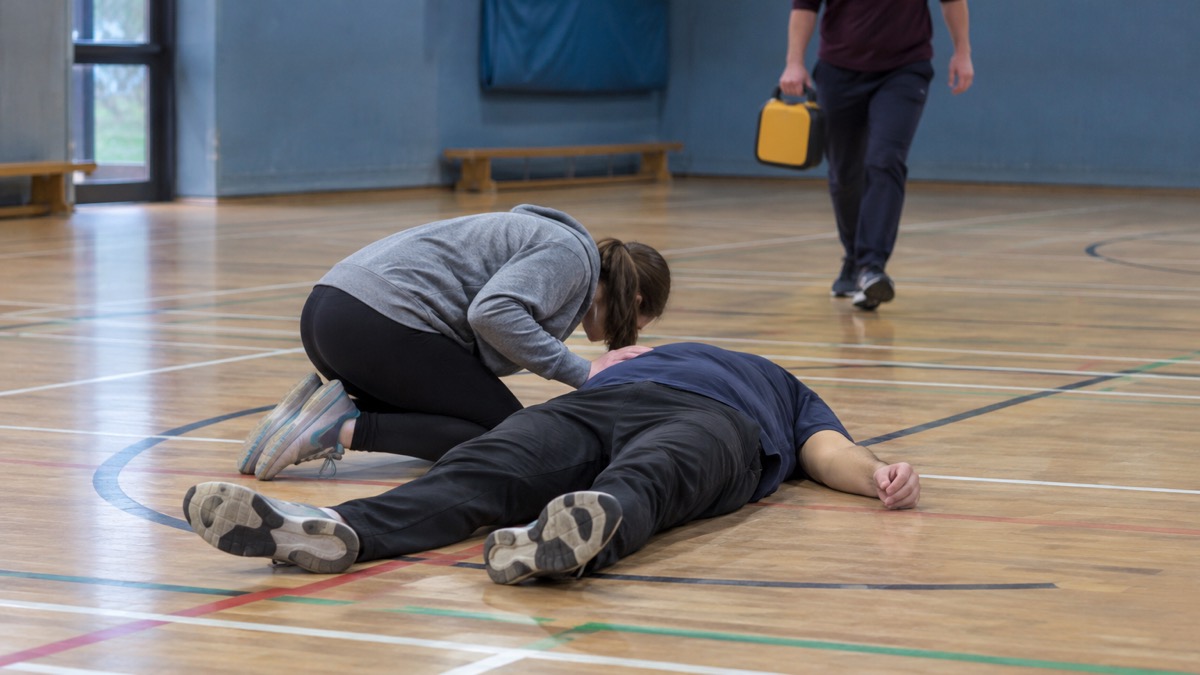
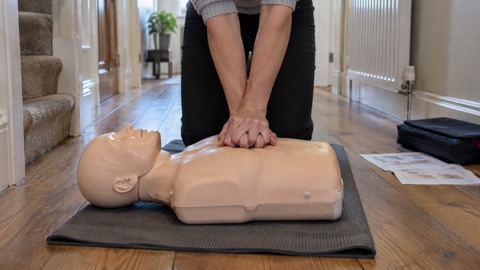
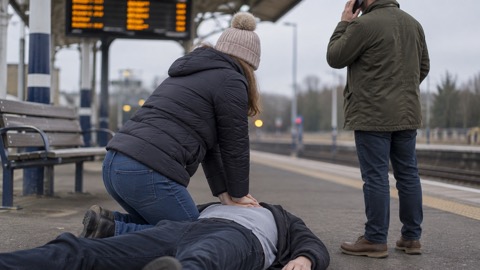
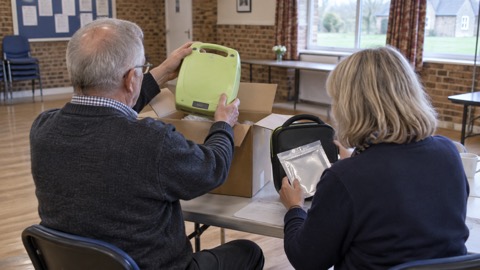
If the person becomes unresponsive, check their breathing and be prepared to start CPR2. If they're not breathing, phone 999 and start CPR immediately, and ask someone nearby to get a defibrillator12. Defibrillation is an essential part in trying to save the life of someone in cardiac arrest21. A defibrillator can be used without training: our page on whether you can use a defibrillator without training answers this directly, and public access defibrillators explains how to find the nearest one.
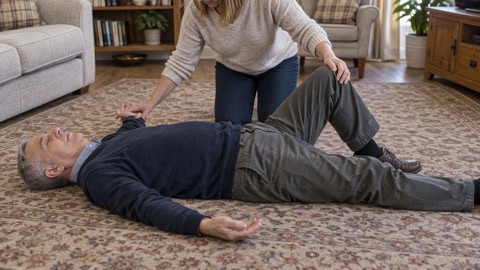
If the person is breathing but unresponsive, put them in the recovery position and tell the ambulance service, then check their breathing and pulse and carry out CPR if they show no sign of life22. The recovery position keeps the airway clear while you wait, and our page on the recovery position shows how to do it.
One special case needs care. If the person has had an electric shock, do not move them unless they are in immediate danger and they are no longer in contact with the electricity4. Once you are sure the casualty is no longer in contact with the electricity, check their airway, breathing and circulation4. The electrical current may have stunned them as it passed through their body, causing breathing and heartbeat to stop4. Our page on what to do if someone gets an electric shock covers the full sequence.
Getting ready before anything happens
First aid is the immediate treatment given to anyone who is injured, stops breathing or requires assistance, and anyone can learn these skills23. A household that expects to cope with a bad injury does three things in advance.
- Learn CPR and the recovery position. Free online training exists, and our page on learning CPR free online lists the options. A first aid course builds the confidence to act; see first aid courses for types and where to find one.
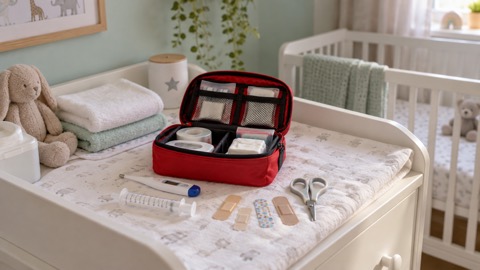
- Keep a first aid kit at home. Official emergency advice for households includes a first aid kit among the essentials24. Our first aid kits for the home page covers contents, and the baby and child kit checklist covers what families with small children should add.
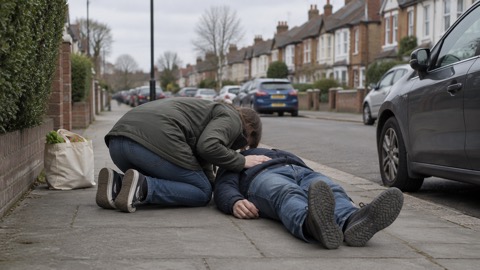
- Know the primary survey. The sequence of danger, response, airway and breathing is what you fall back on when someone is hurt12. Our page on what to do first walks through it.
Teaching children how to ring 999 is also part of household readiness; our page on teaching children basic life-saving skills covers it. And if someone in your household has a severe allergy, knowing in advance that anaphylaxis can cause shock, and that lying the person down and raising their legs treats it2, is worth the few minutes it takes to read our page on what to do if you suspect anaphylaxis.
Sources (24)
- Shock first aid, NHS inform, 2026-07-24
- Anaphylaxis first aid, NHS inform, 2026-07-24
- Severe bleeding first aid, NHS inform, 2026-07-24
- Electric shock first aid, NHS inform, 2026-07-24
- What to do if your child has an accident, NHS, 2025-12-18
- Burns and scalds, NHS inform, 2026-07-31
- Fracture first aid, NHS inform, 2026-07-24
- Dehydration, NHS, 2026-05-01
- Heart attack first aid, NHS inform, 2026-07-24
- Staying well in hot weather, Berkshire Healthcare NHS Foundation Trust, 2026-10-29
- Take care of yourself this winter, Staffordshire County Council, 2026
- How to do a primary survey, NHS inform, 2026-07-24
- Burns first aid, NHS inform, 2026-07-24
- What to do when the ambulance is coming, South Western Ambulance Service NHS Foundation Trust, 2026-10-29
- What to do if someone has a seizure (fit), NHS, 2023-12-19
- Burn injuries first aid, Northern Burn Care Network, 2022-03-11
- First aid facts leaflet, North West Ambulance Service NHS Foundation Trust, 2019-04
- Shock Symptoms and First Aid | St John Ambulance, St John Ambulance
- Burns prevention and tips, Mid and South Essex NHS Foundation Trust, 2026-10-25
- Looking after children in hot weather, UK Government, 2024-12-19
- First aid provisions, Protect UK, 2026-06-01
- Heat exhaustion and heatstroke, NHS, 2026-05-28
- Basic Life Support, Sheffield Children's NHS Foundation Trust, 2023-07-24
- Get help and advice in an emergency, Lincolnshire County Council, 2026-10-29
 Baby and Child Kit Checklist
 Bleeding Control Kit Checklist
 Car Kit Checklist
 Danger, Response, Airway
 CPR Steps for Adults
 2025 Resuscitation Guidelines
 Defibrillators (AEDs)
 Public Access Defibrillators
 Choosing a Defibrillator
 The Recovery Position
 Choking First Aid
 Cuts, Grazes and Wounds
 Burns and Scalds
 Adrenaline Auto-Injectors
 Sepsis Signs to Act On