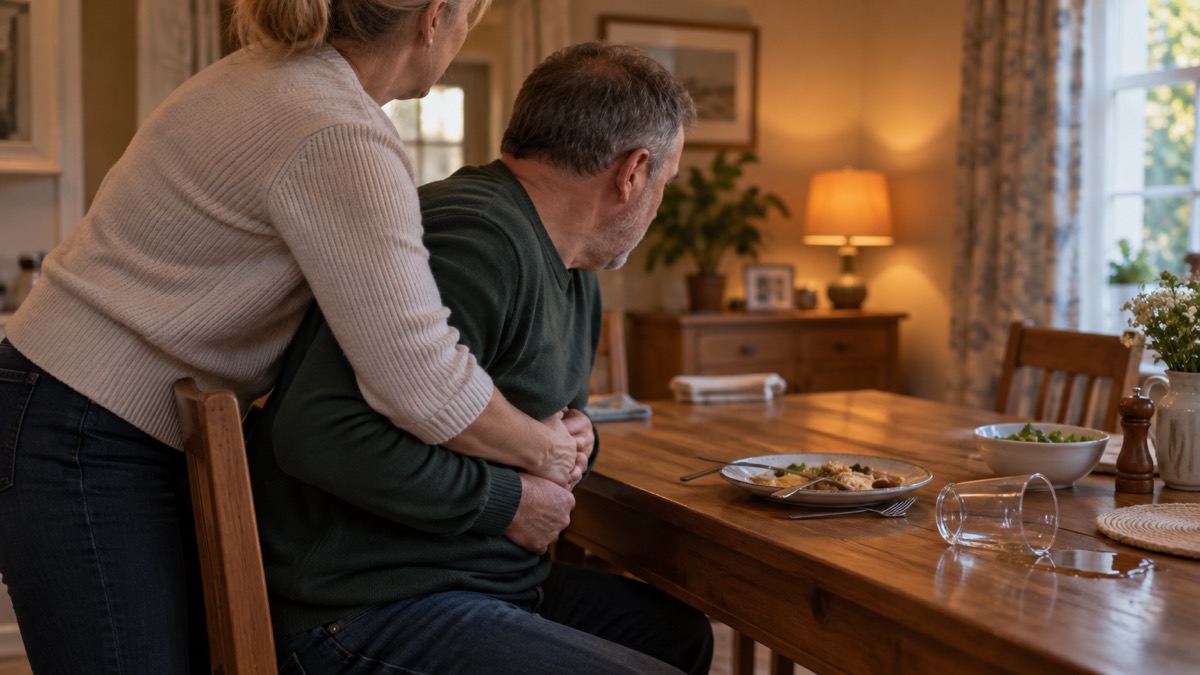
When someone chokes, their airway is either partly or fully blocked, which means they cannot breathe properly1. The treatment is short and physical: encourage them to cough, and if that fails, give up to five sharp back blows between the shoulder blades, then up to five abdominal thrusts, and call 999 if the blockage has not cleared2. If the person becomes unresponsive at any point, call 999 and start CPR3.
This page covers adults and children over one year old. Babies under one need a different technique, and young children have their own considerations, so both are covered in their own sections below with links to full pages on each.
How to recognise that someone is choking
Choking is quiet. The NHS guidance on weaning notes that a choking baby or child is often silent rather than gasping dramatically, and that on white skin the skin may begin to look blue, which is called cyanosis5. On brown or black skin, the gums, the inside of the lips or the fingernails may begin to look blue instead, so those are the places to check5.
The clearest signs in an adult or older child are that the person cannot speak, cannot cough effectively, or is clutching at their throat. A person who can cough loudly and speak is still moving air: their airway is only partly blocked. NHS guidance for children says that if the child is coughing loudly, encourage them to carry on coughing and do not leave them4. A person who cannot cough or make sound at all has a fully blocked airway and needs back blows straight away.
With young children there is an extra clue. NHS 111 Wales notes that if a child suddenly starts coughing, is not otherwise ill and has a habit of putting small objects in their mouth, there is a good chance they are choking6. Choking in young children most often happens while they are playing or eating7, so a child who goes quiet mid-game or mid-meal should be checked immediately.
If you are unsure whether the person is choking, ask them: "Are you choking?" If they can answer, even in a whisper, their airway is partly open. If they cannot answer at all, treat it as severe choking and act.
Start with coughing: what to do for mild choking
For an adult or child over one year old who is coughing and can still breathe, the first and safest treatment is to encourage the cough. NHS guidance says to encourage them to keep coughing to try to clear the blockage, and to ask them to try to spit out the object if it is in their mouth2. Coughing is the body's own way of shifting an obstruction, and a strong cough is often more effective than anything a helper can do from outside.
Two things not to do at this stage. First, do not put your fingers in their mouth to help them, as they may bite you accidentally2. Second, do not leave them, even if they seem to be coping: a partly blocked airway can become fully blocked without warning, so stay with them and watch4.
Keep encouraging the cough until one of two things happens: the object comes out and they can breathe and speak normally again, or they deteriorate. Deterioration means the cough weakens or stops, they can no longer speak or make sound, or their colour changes. At that point, move straight to back blows8.
Up to five back blows between the shoulder blades
Back blows are the first physical treatment for severe choking in anyone over one year old. NHS guidance gives the technique in full: stand behind the person and slightly to one side, support their chest with one hand, lean them forward so the object can come out of the mouth rather than going further in, then give up to 5 sharp blows between their shoulder blades with the heel of your hand2. The North West Ambulance Service describes the same technique for use when coughing does not work1.
The lean forward matters. With the person bent forward, a blow to the back can dislodge the object so it falls out of the mouth. With the person upright, a dislodged object can slip back down the airway. Supporting their chest with one hand keeps them steady while your other hand delivers the blows.
Each blow should be sharp and distinct, delivered with the heel of the hand, the fleshy part at the base of the palm. After each blow, check whether the blockage has cleared2. Stop as soon as the object comes out and the person can breathe, cough or speak. If you have given five back blows and the airway is still blocked, move on to abdominal thrusts2.
Abdominal thrusts: where your fist goes and how to pull
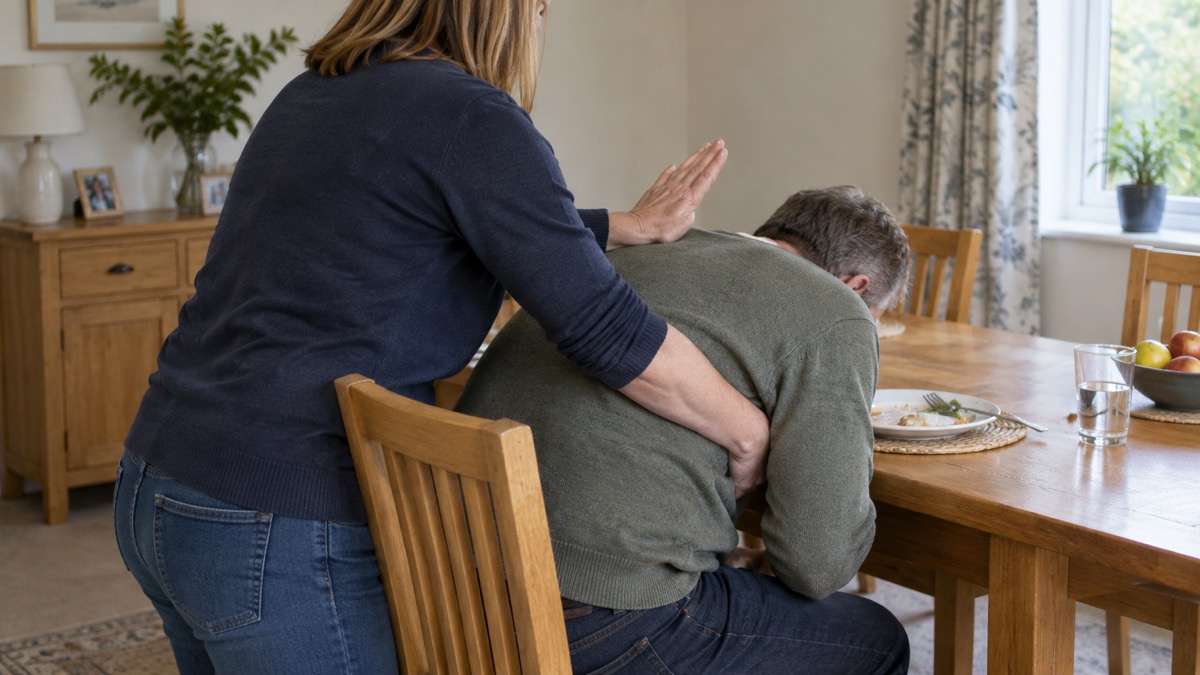
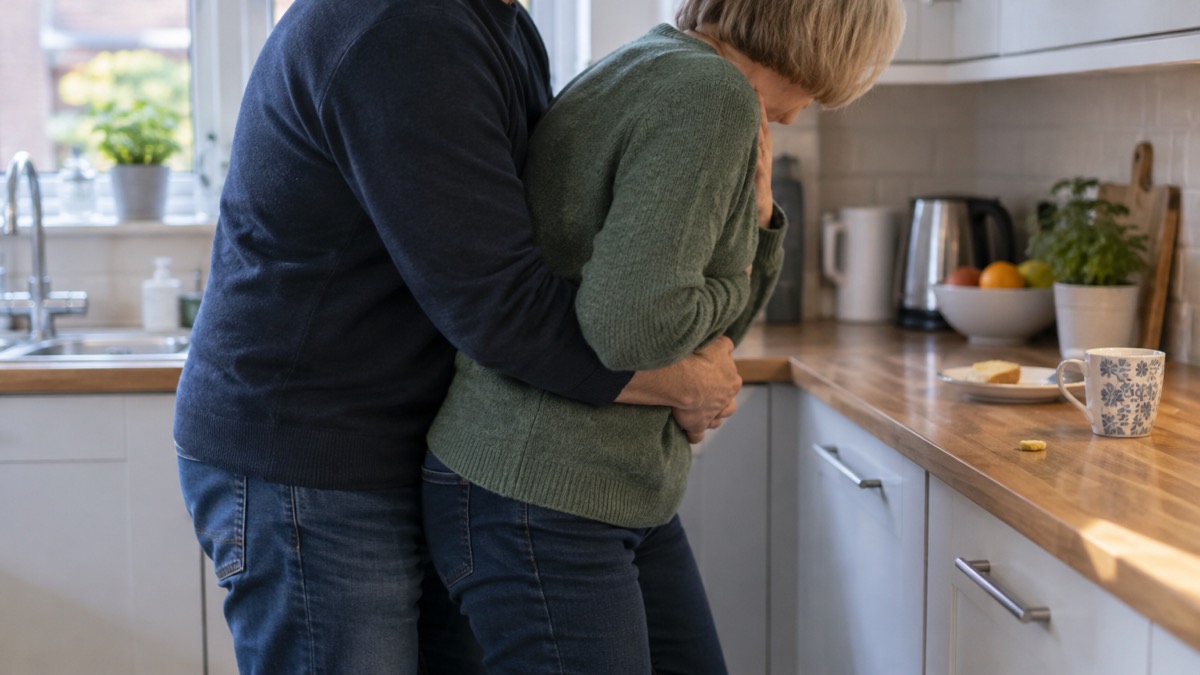
Abdominal thrusts are the second technique for adults and children over one year old, used when back blows have not cleared the blockage. NHS guidance sets out the position: stand behind the person, place your arms around their waist and bend them forward, clench one fist and place it just above their belly button, place your other hand on top of your fist, then pull sharply inwards and upwards2. Repeat this movement up to 5 times2.
The placement is the part people get wrong. The fist goes above the belly button, not over it and not on the ribs. For children over one year, NHS guidance describes the position as between the navel and the ribs7. The pull is a sharp, single inward-and-upward jerk, as if trying to lift the person slightly: the aim is to force air out of the lungs and push the object up and out.
Two groups must never receive abdominal thrusts. NHS guidance states the technique is not for babies under one year old or pregnant women2. Babies need back blows and chest thrusts instead, covered below, and a pregnant woman should receive chest thrusts rather than pressure on the abdomen.
If five abdominal thrusts have not cleared the blockage and the person is still conscious, do not stop. NHS guidance says to continue cycles of 5 back blows and 5 abdominal thrusts until help arrives2. The Resuscitation Council UK's adult basic life support guidance, which underpins NHS advice, sets out the same sequence: encourage coughing, and if the victim deteriorates, give up to 5 back slaps followed by up to 5 abdominal thrusts, alternating the two if the obstruction is not relieved8.
Call 999 if the blockage has not cleared
Call 999 as soon as it is clear that coughing, back blows and abdominal thrusts have not solved the problem. NHS guidance for adults says to phone 999 for help if the blockage has not cleared3, and the East of England Ambulance Service lists choking among the life-threatening emergencies for which 999 is the right number9. Tell the 999 operator the person is choking, then continue cycles of 5 back blows and 5 abdominal thrusts until help arrives2.
If you are alone with a choking adult, the guidance is to shout for help first, before or during the first cycle of treatment, so that someone can call for you. If you are alone with a choking child, NHS guidance is explicit: call 999, putting the phone on speakerphone so your hands are free, and do not leave the child at any stage4. A speakerphone call lets you keep giving back blows and thrusts while talking to the operator.
The same rule applies across the UK. NHS guidance for children in England and Wales says to call 999 if the blockage does not come out after trying back blows and either chest or abdominal thrusts, and to keep trying the cycle until help arrives7. In Northern Ireland, the Northern Ireland Ambulance Service lists choking among the reasons to call 99910.
If they become unresponsive: start CPR
A choking person who becomes unresponsive needs CPR, not more thrusts. NHS inform guidance for Scotland says that if the person becomes unresponsive, you should open the airway by lifting the chin and tilting the head back, check their breathing, and begin CPR if they are not breathing3. East Sussex Healthcare NHS Trust's emergency department leaflet gives the same instruction: if they lose consciousness and are not breathing, begin cardiopulmonary resuscitation with chest compressions2.
Call 999 immediately if you have not already. The North West Ambulance Service says that if they become unresponsive you should call 999 right away1, and NHS guidance on CPR says that if an adult is unresponsive and not breathing normally, you need to call 999 or 112 for emergency help and start CPR straight away11. In Scotland, NHS inform's adult CPR guidance says that if they are not breathing, phone 999 and begin chest compressions12.
Chest compressions on an unresponsive choking person can themselves dislodge the object, which is why CPR continues rather than returning to back blows. The full steps of CPR, including compression rate and depth, are covered on our page on how to do CPR, and how to check whether someone is breathing is covered separately. If you have not done CPR before, the 999 call handler will talk you through it.
One point that applies after the event, whoever you treated: abdominal thrusts and chest compressions can potentially cause serious internal injuries, and the Resuscitation Council UK guidance says all victims successfully treated with these measures should be examined afterwards for injury8. If your abdominal thrusts cleared the blockage, the person should still be checked by a medical professional, even if they feel fine.
Choking babies and young children: what changes
Everything above applies to adults and children over one year old. Babies under one are different in two ways: they need different techniques, and they must never receive abdominal thrusts2.
For a baby under one who is choking, NHS guidance from the North West Ambulance Service says to sit down and lay the baby face down along your thighs, supporting their head with your hand, and give up to five sharp back blows with the heel of one hand in the middle of the back between the shoulder blades1. If that does not clear the blockage, lay the baby face up along the length of your thighs, find the breastbone and place two fingers in the middle, then push down on the chest up to five times, repeating until the blockage is cleared1. NHS guidance for children over one uses back blows and abdominal thrusts, with the fist placed between the navel and the ribs7.
For a choking child in a high chair, NHS weaning guidance says to shout for help, get them out of the high chair, support their chest and chin with one hand, and give five sharp blows between the shoulder blades with the heel of your hand5. You cannot position a child properly for back blows while they remain strapped in the chair, which is why getting them out comes first.
If a choking baby or child becomes unresponsive, NHS guidance says to put the child on a firm, flat surface, shout for help, call 999 on speakerphone so your hands are free, and not leave the child at any stage4. For a baby who is unresponsive and not breathing, Wirral University Teaching Hospital guidance says that if you cannot achieve effective breaths, you must immediately begin giving chest compressions to try to relieve the obstruction quickly13.
Full step-by-step guides are on our pages on what to do if a child is choking and what to do if a baby is choking, and baby CPR is covered separately.
Never use a blind finger sweep
Do not poke blindly or repeatedly with your fingers inside a choking person's mouth. NHS guidance for children is blunt about why: you could make things worse by pushing the object further in and making it harder to remove4. NHS inform guidance for adults says the same: do not put your fingers in the mouth after back blows3.
The instruction appears at every stage of the guidance. During mild choking, do not put your fingers in their mouth to help them, as they may bite you accidentally2. After back blows, when the object may be visible at the back of the mouth, the temptation is strongest, but a blind grab risks pushing it back down. If the object is clearly visible and loose, the person can be asked to spit it out2; it is not for a helper to hook it out by feel.
The only exception in the guidance is a deliberate, seen sweep, and NHS guidance does not teach it for the public. The rule to remember is simple: fingers out unless you can see exactly what you are doing and the person cannot bite or gag it further in.
Cutting and choosing food so small children are less likely to choke
Prevention matters as much as technique, because food is the most common thing for babies and toddlers to choke on14. NHS guidance says that to avoid choking while eating, you should think about size, shape and texture when preparing your child's food7.
The most specific advice concerns small round foods. NHS guidance from Berkshire says always to chop grapes in half lengthways and ideally into quarters15. Grapes are the third most common cause of death in food-related accidents15, which is why they get their own instruction. Their size and shape means a whole grape can seal a small child's airway completely.
Some foods should not be given to small children at all. Whole nuts and boiled sweets should not be given to young children14, and Berkshire Healthcare advises avoiding peanuts for children under the age of 615.
Supervision matters as much as preparation. NHS guidance says to stay with your child when they are eating and to encourage them to sit still, as running around while eating could make them choke14. Choking in young children most often happens while they are playing or eating7, so the two highest-risk moments are mealtimes and unsupervised play with small objects nearby.
Getting help and learning more
Choking is a 999 emergency when the blockage does not clear3. If the blockage has cleared but the person received abdominal thrusts or chest compressions, they should be examined for injury afterwards8. NHS guidance on childhood accidents says to call 999 if a child stops breathing, is struggling to breathe, is choking, is unconscious, or has blue, grey, pale or blotchy skin, lips or tongue16.
The techniques on this page are worth practising before you need them. A first aid course builds the muscle memory that is hard to summon in an emergency, and free online CPR training exists: see our pages on first aid courses and learning CPR free online. Teaching children to recognise an emergency and ring 999, including using speakerphone, is covered on our page about teaching children basic life-saving skills.
The sequence on this page follows the Resuscitation Council UK's approach, reflected in NHS guidance across the four nations: encourage coughing, then up to five back blows, then up to five abdominal thrusts, alternating until the obstruction clears or help arrives8. The Resuscitation Council UK published its 2025 first aid guidelines on 27 October 2025, and what changed for bystanders is summarised on our page about the 2025 resuscitation guidelines. For the wider picture of first aid at home, start with our first aid at home guide.
Sources (16)
- Choking emergency advice, North West Ambulance Service, 29 March 2023
- Choking first aid leaflet, East Sussex Healthcare NHS Trust, November 2025
- Adult choking first aid, NHS inform, 22 October 2026
- Choking: keeping your child safe, Central and North West London NHS Foundation Trust, 29 October 2026
- Choking and gagging on food, NHS, 2026
- How to stop a child from choking, NHS 111 Wales, 5 July 2023
- How to stop a child from choking, NHS, 28 October 2024
- Adult basic life support and automated external defibrillation, East London NHS Foundation Trust, 2015
- Using 999, East of England Ambulance Service, 28 October 2026
- When to call 999, Northern Ireland Ambulance Service, 29 October 2026
- CPR, NHS, 29 October 2026
- How to give an adult CPR, NHS inform, 8 September 2026
- Choking infant: going home advice, Wirral University Teaching Hospital NHS Foundation Trust, 29 October 2026
- Baby and toddler safety, NHS, 19 February 2026
- Child safety, Berkshire Healthcare NHS Foundation Trust, 29 October 2026
- What to do if your child has an accident, NHS, 18 December 2025
 Baby and Child Kit Checklist
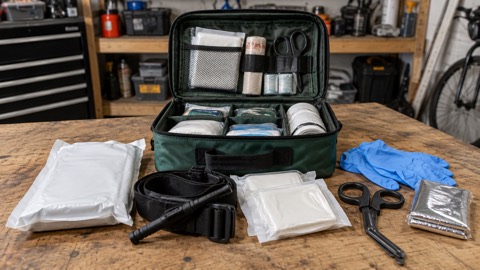 Bleeding Control Kit Checklist
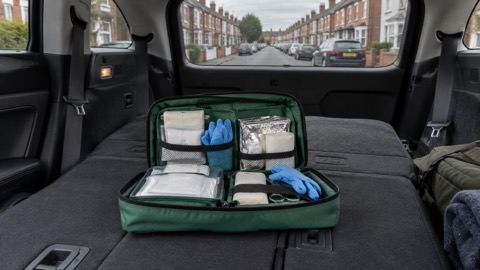 Car Kit Checklist
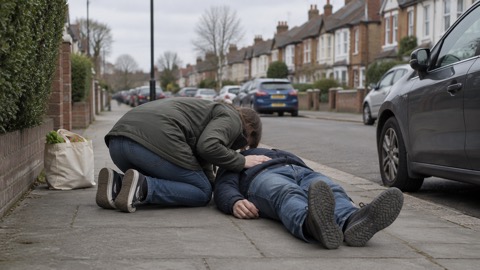 Danger, Response, Airway
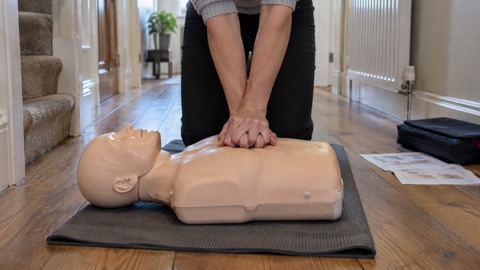 CPR Steps for Adults
 2025 Resuscitation Guidelines
 Defibrillators (AEDs)
 Public Access Defibrillators
 Choosing a Defibrillator
 The Recovery Position
 Cuts, Grazes and Wounds
 Burns and Scalds
 Adrenaline Auto-Injectors
 Sepsis Signs to Act On
 Shock Signs and What to Do