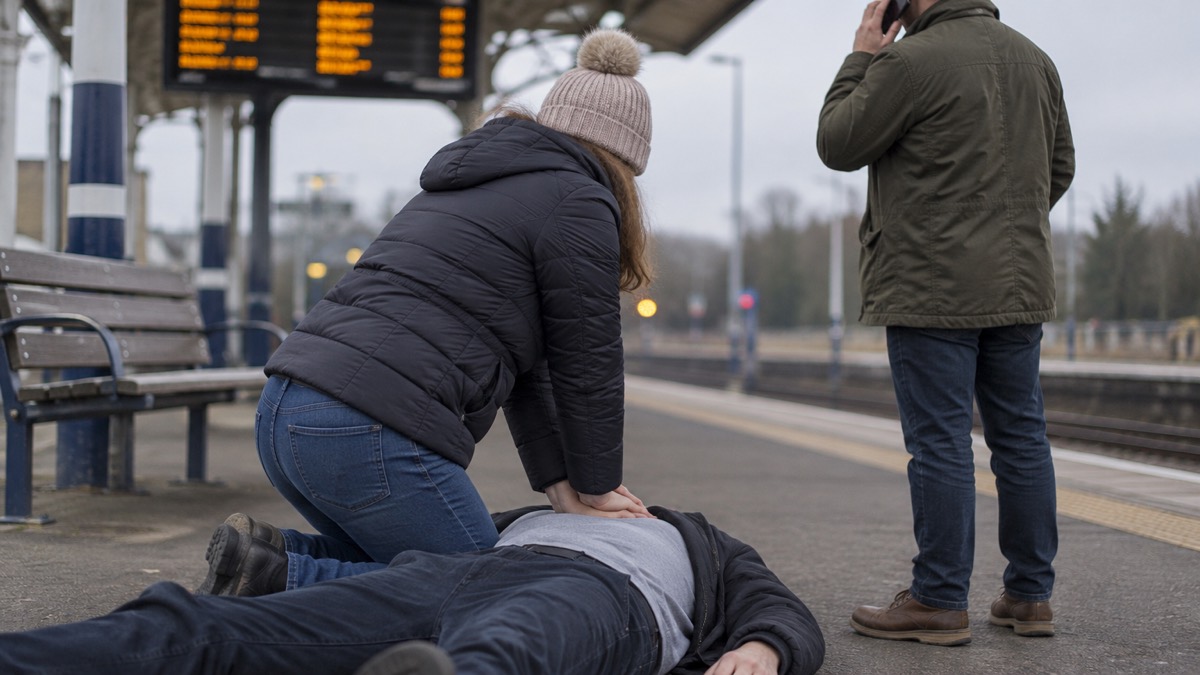
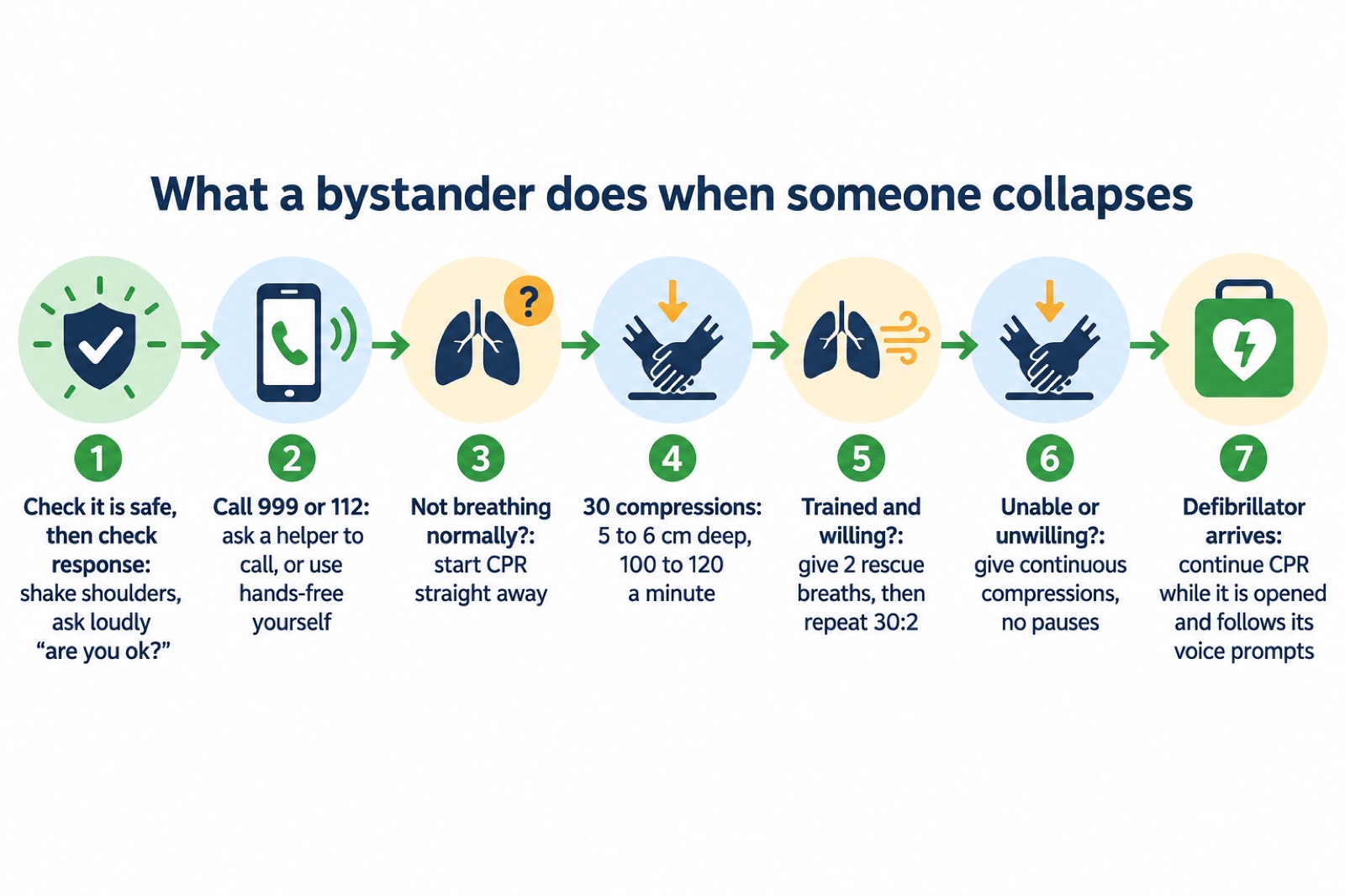
If someone collapses and is not breathing normally, the current UK guidance for bystanders comes down to a short sequence: make sure it is safe, check for a response, call 999 or 112, and start chest compressions straight away, pressing down about 5 to 6 cm at a rate of 100 to 120 a minute1. If you are trained and willing, you give two rescue breaths after every 30 compressions; if you are not, you keep compressing without stopping1. The NHS is blunt about why this matters: without CPR, a person in cardiac arrest will die within minutes2.
The core of the guidance has been stable across every official source, and the practical steps a bystander takes are the same whether you read the NHS pages for England, NHS inform in Scotland, or the CPR guidance published by each ambulance service. What this page sets out is what a member of the public actually does under the current guidance: when to call, when to start, how fast and deep to press, what to do about rescue breaths, how it changes for children and babies, and how to get a defibrillator for a workplace or community.
Call 999 first, then check breathing
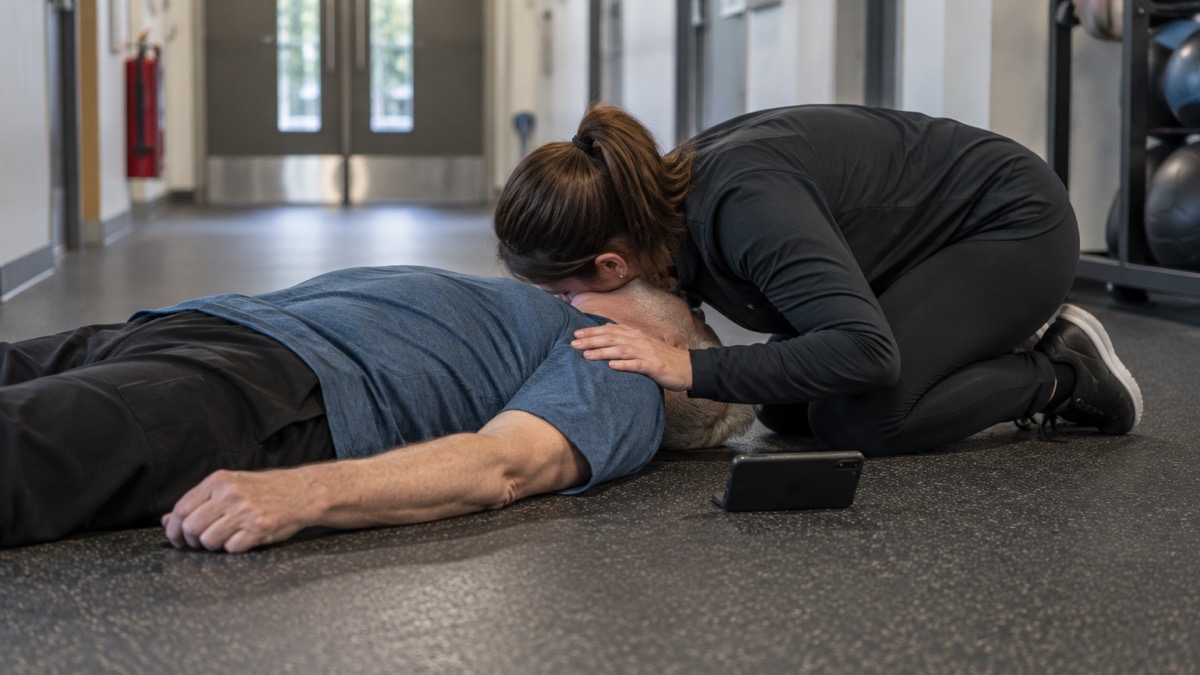
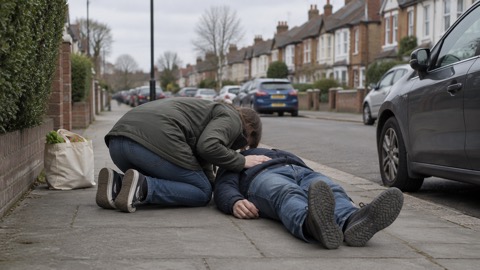
The guidance is consistent across the UK: if you find someone collapsed, first make sure it is safe to approach, then check for a response by shaking their shoulders gently and asking loudly "are you ok?"1. Shout for help, and ask a helper to call 999 or 112, or put your phone on hands-free and call yourself1. If the person is not breathing, phone 999 and start CPR immediately, and ask someone nearby to get a defibrillator5.
The order matters because of what happens on the phone. Ambulance service call handlers are trained to talk you through what to do: the Scottish Ambulance Service states that its call handlers will provide immediately life-saving instructions such as CPR if required6, and the Welsh Ambulance Service says to phone 999 immediately and start CPR, because its call handlers can guide you through the process and will direct you to the closest public access defibrillator7. London Ambulance Service describes the same sequence from the other end of the line: it will check that the patient is conscious and breathing, ask what has happened, and then ask further questions to get the right help8. So the call is not a delay before help starts; it is the moment help starts.
Difficulty breathing is itself one of the reasons to call 999 in every nation: the Northern Ireland Ambulance Service lists it among the reasons to call9, as does the Scottish Ambulance Service for Scotland10. If the person is unresponsive but breathing normally, the picture changes: you do not start compressions. Devon and Somerset Fire and Rescue Service advises calling 999 or 112 for emergency help, keeping checking their level of response until help arrives, and if the casualty stops breathing at any time, calling 999 or 112 and preparing to give CPR11. That is the point at which this guidance takes over. Our page on how to check if someone is breathing covers that check in detail, and the primary survey walks through the full sequence of danger, response, airway and breathing.
Start CPR on anyone unresponsive who is not breathing normally
The trigger for CPR is the same wherever you read it: an adult who is unresponsive and not breathing normally. The NHS states that if an adult is unresponsive and not breathing normally, you need to call 999 or 112 for emergency help and start CPR straight away1. The same rule is applied to children: if a baby or child is unresponsive and not breathing normally, call 999 and start CPR straight away12, and the Royal Wolverhampton healthy child service tells parents that if a child is unresponsive and not breathing normally, they should dial 999 immediately for an ambulance and start child CPR13.
The words "not breathing normally" carry weight, and they cover a trap that catches bystanders. A person in cardiac arrest may make gasping, irregular or noisy breaths, which are not normal breathing, and CPR should still be started. The defibrillator information pack published by South Central Ambulance Service in August 2026 puts the rule in operational terms: CPR should always be started when it is clear that the casualty is unconscious and not breathing normally, and CPR should continue while the AED is being opened3. Our page on agonal breathing explains this sign and why it does not mean you should hold back.
The rule also holds in specific emergencies. NHS guidance on poisoning says to start CPR if someone is unresponsive and not breathing14. A hospital choking leaflet approved by emergency department consultants, applying to adults and children over one year old, says that if a choking person loses consciousness and is not breathing, you should begin CPR with chest compressions15. In a near-drowning, if the person is not breathing, Devon and Somerset Fire and Rescue Service advises five rescue breaths first, then CPR as 30 compressions followed by two breaths, continuing until help arrives11; NHS inform in Scotland gives the same sequence of 30 compressions then two rescue breaths for a drowned casualty16. The unifying principle is simple: unresponsive and not breathing normally means CPR, whatever caused it.
How fast and how deep: 100 to 120 a minute, 5 to 6 cm
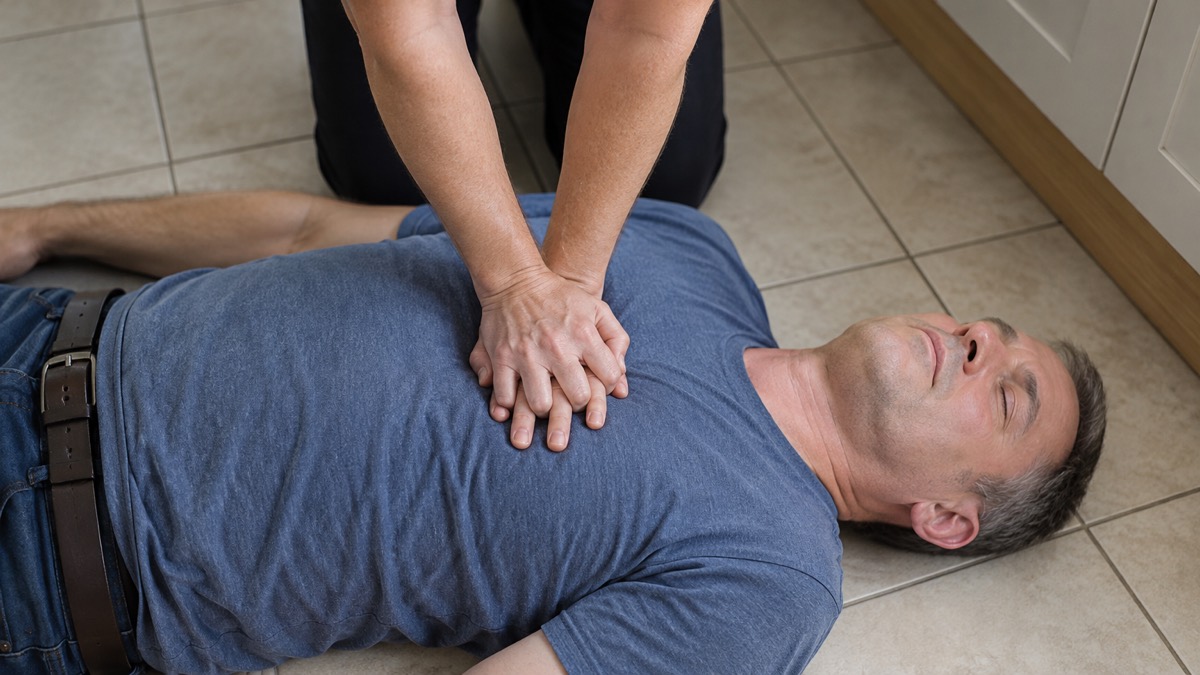
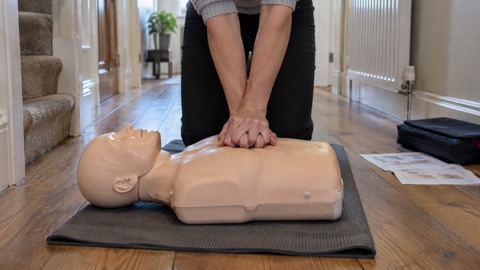
Two numbers decide whether your compressions work, and every official source gives the same pair. Push at a rate of 100 to 120 per minute1, and press down hard, to a depth of about five to six centimetres, before releasing the pressure and allowing the chest to come back up1. NHS inform adds the detail of technique: lean directly over the casualty's chest and press down vertically for about 5 to 6 cm17. Yorkshire Ambulance Service's Restart a Heart guidance stresses using your body weight, not just your arms, pressing straight down by 5 to 6 cm18, and North East Ambulance Service says the same: press down hard and fast by 5 to 6 cm on their chest19.
The rate is easier to hold than it sounds. North West Ambulance Service describes it as approximately two compressions per second20, and North East Ambulance Service's training material gives the same figure, two per second4. London Ambulance Service compresses the whole technique into its DRSABCD steps: arms straight, press down 5 to 6 cm deep, and keep going at a rate of 100 to 120 per minute21. If you have ever done training to the beat of a well-known song, that is the effect you are aiming for: steady, uninterrupted, and fast enough that you would not be able to hold a conversation over it.
Two faults matter most. The first is pressing too shallowly: the depth is what moves blood around the body, since CPR, as NHS inform defines it, helps to pump blood around the body when the heart cannot17. The second is stopping. Yorkshire Ambulance Service says to repeat the compressions at 100 to 120 a minute until an ambulance arrives, you become exhausted, or the person shows signs of life18, and North East Ambulance Service says to keep going until the ambulance arrives19. Every pause in compressions is blood not moving, which is why the guidance is to minimise interruptions rather than to check repeatedly whether it is working. Our page on how fast and how deep chest compressions should be takes these two numbers further.
30 compressions to 2 rescue breaths, or hands-only
The rhythm of full CPR is 30 compressions, then two rescue breaths, repeated. The NHS states that if you are trained to do so, after 30 compressions you provide two rescue breaths, and you keep alternating 30 compressions with two breaths, written 30:2, until help arrives or the person recovers1. NHS inform gives the same instruction for adults: give 2 rescue breaths after 30 chest compressions, if you're trained to do so17.
The crucial qualification is the one that removes the biggest barrier for bystanders. NHS inform states it directly: if you're unable or unwilling to provide rescue breaths, give continuous chest compressions17. The NHS page says the same1. This is hands-only CPR, and Yorkshire Ambulance Service teaches it as the default for an untrained witness of a cardiac arrest: call 999 and start CPR straight away, pressing straight down by 5 to 6 cm and repeating at 100 to 120 times a minute until an ambulance arrives, you become exhausted or the person shows signs of life18. North West Ambulance Service tells learners to just concentrate on compression at a rate of 100 to 120 per minute22. If you are on the phone to 999, the call handler will coach you through either version.
One situation tilts the balance towards breaths. In drowning, the heart stops because breathing has stopped, so the oxygen matters more. NHS inform's drowning first aid guidance says to follow rescue breaths with 30 chest compressions, then 2 rescue breaths16, and Devon and Somerset Fire and Rescue Service advises five rescue breaths first for a not-breathing casualty pulled from water, then 30 compressions and two breaths, continuing until help arrives11. Our pages on rescue breaths or hands-only CPR and what to do after someone nearly drowns cover both branches.
The risk of harm from CPR is low
The single most useful thing for a hesitant bystander to know is that the official guidance says you cannot make things worse. North East Ambulance Service's CPR training material states it in capital letters: "you can cause no harm to the person by giving them chest compressions BUT you may save their life!"4. The Scottish Ambulance Service's first aid education pages make the positive case: starting CPR will give that person a better chance of survival23.
"you can cause no harm to the person by giving them chest compressions BUT you may save their life!"
The arithmetic of delay explains the urgency. South Western Ambulance Service states that the chance of survival decreases by 10% for each minute that passes without CPR and defibrillation2, and the Northern Ireland Ambulance Service gives the same figure, about 10% for every minute without CPR and defibrillation24. South Western Ambulance Service adds the consequence plainly: without CPR, the person will die within minutes2. That is why the guidance pushes the decision to the simplest possible test, unresponsive and not breathing normally, rather than asking a bystander to diagnose anything.
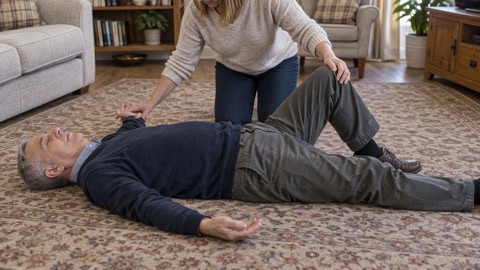
This is also why the guidance does not ask you to check for a pulse. Checking a pulse reliably is hard even for trained staff, and the cost of getting it wrong by delaying compressions is measured in that 10% a minute. If the person is breathing normally, you do not compress; if they are not, you do. If someone starts breathing normally again during CPR, stop compressions and move to the recovery position; our page on what to do if someone starts breathing during CPR covers that moment, and the recovery position explains how to place them.
Children and babies: same rhythm, shallower compressions, breaths from the start
For children and babies the structure of CPR is the same, 30 compressions to 2 breaths at 100 to 120 a minute, but the depth is smaller and rescue breaths are given more weight. The NHS page on resuscitating a child says to combine chest compressions with rescue breaths, providing 2 breaths after every 30 compressions12, and to push down 4 cm for a baby or infant, or 5 cm for a child, which is approximately one-third of the chest depth12. North West Ambulance Service confirms the principle: for children and infants we still compress approximately one-third of the chest depth, at the same rate of 100 to 120 compressions per minute22.
| Adult | Child over 1 year | Baby under 1 year | |
|---|---|---|---|
| Compression depth | about 5 to 6 cm1 | about 5 cm, a third of chest depth12 | about 4 cm, a third of chest depth12 |
| Rate | 100 to 120 a minute1 | 100 to 120 a minute25 | 100 to 120 a minute26 |
| Ratio | 30:2 if trained; continuous if not1 | 30:2, with 5 initial breaths25 | 30:2 if trained26 |
| Call | 999 or 1121 | 999 if the child isn't breathing25 | 999 if the baby isn't breathing26 |
The airway is opened differently by age, and this is where technique matters most. For a child over one year, the NHS says to open the airway by tilting the head back with a hand on the forehead and lifting the chin with fingertips under the point of the chin12. For a baby under one, the head should be in a neutral position, with the head and neck in line, lifting the chin with fingertips under the point of the chin12. Over-extending a baby's neck can itself close the airway, which is why the neutral position is specified.
NHS inform's child CPR page adds the detail on breaths: give 2 rescue breaths after 30 chest compressions if trained, repeating the cycle, and repeat to give 5 rescue breaths initially, each full breath taking 1 second25. Its baby CPR page says to give 2 rescue breaths after 30 chest compressions, if you're trained to do so26. Before starting, check for hazards such as electrical equipment or traffic12. If you cannot get effective breaths, make up to 5 attempts to achieve breaths enough to make the chest visibly rise, then move on to chest compressions combined with rescue breaths12. Keep going until your child shows signs of life, normal breathing, coughing, or movement of arms or legs, at which point you put them in the recovery position, or until qualified help arrives12. Our pages on child CPR and baby CPR give the full step-by-step for each.
Choking in adults and children
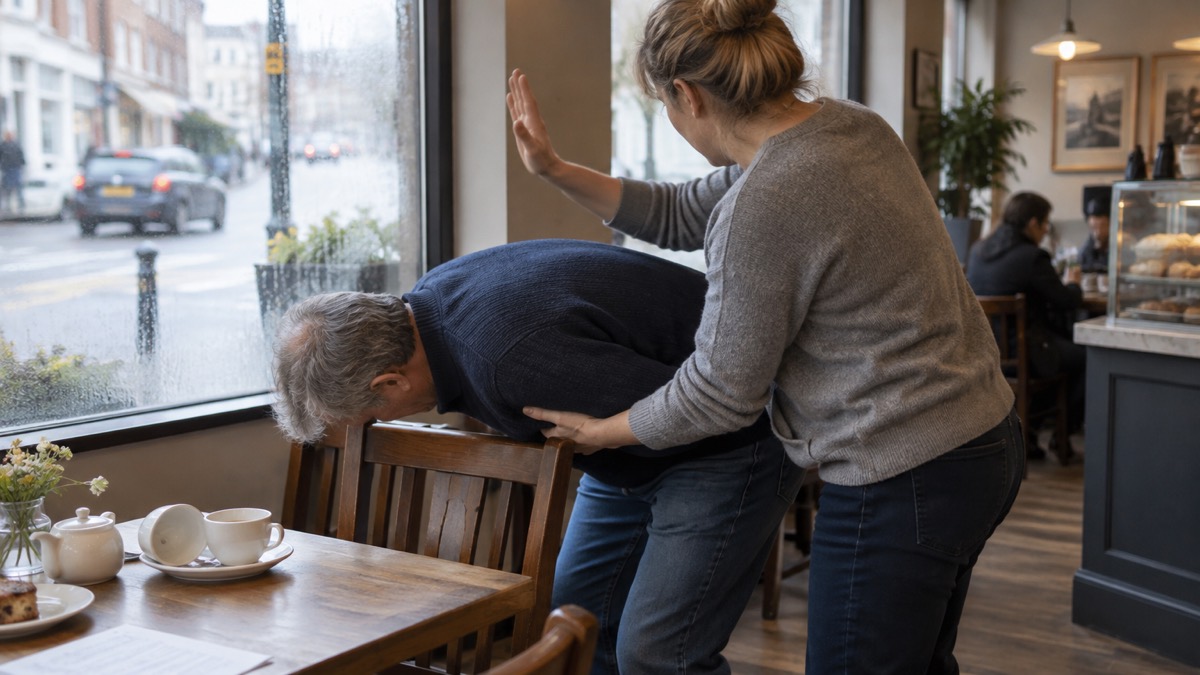
Choking connects to resuscitation at one point: the moment the person goes quiet and limp. The NHS guidance for parents is that if a choking child is or becomes unconscious, you start CPR, following the child resuscitation steps27. The hospital choking leaflet, which applies to adults and children over one year old and was approved in November 2025 by emergency department consultants, says that if they lose consciousness and are not breathing, you should begin CPR with chest compressions15.
The sequence before that point is set out in the choking algorithms used across the UK, and the details differ by age, which is why the guidance separates adults and children over one year from babies under one. For adults, the Resuscitation Council UK's 2025 first aid guidelines advise an escalating approach with cough, back blows and abdominal thrusts15. The adult choking algorithm sets out the escalation for a conscious patient with severe airway obstruction: give 5 back blows then 5 abdominal thrusts, continuing treatments until the obstruction is relieved, and call the ambulance service15. For a baby under one, abdominal thrusts are not used; the sequence is back blows and chest thrusts. Our pages on what to do if someone is choking, child choking and baby choking give each sequence in full, and the LifeVac anti-choking travel kit page covers the device some households keep as a backup.
Getting a defibrillator for a workplace or community
A defibrillator is the other half of resuscitation, and the guidance is clear that it belongs with CPR rather than instead of it. The public access defibrillator guide for communities sets out the priority in a suspected cardiac arrest: call 999 and give the person immediate CPR while the defibrillator is brought to them3. The same guide notes that familiarisation and training in the use of a defibrillator is part of the HSE's First aid in work guidance, and that there may be potential consequences for some employers under common law if a defibrillator is not provided3.
For a group thinking about where to place one, South Central Ambulance Service recommends sites with a large footfall, for example a public telephone box, outside a pub, village hall or community centre, with 24/7 access to the public, an unlocked cabinet, and clear signage and lighting28. Those conditions are about the clock as much as the crowd: a defibrillator that can only be reached during office hours is not available for most of the cardiac arrests that happen near it. The Welsh Ambulance Service reinforces the bystander's side of this: call handlers will direct you to the closest public access defibrillator7, and NHS inform's primary survey advice is to ask someone nearby to get a defibrillator as soon as you start CPR5.
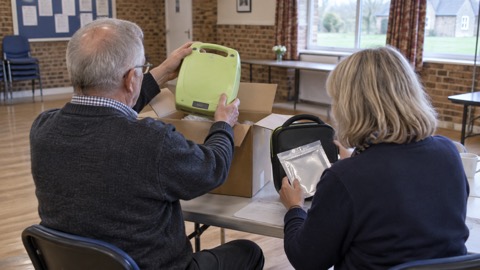
If you are choosing one for a home, club or village, our page on choosing a defibrillator sets out the options, public access defibrillators covers finding the nearest one, and the defibrillator guardian checklist covers the routine checks a community unit needs. You do not need training to use one: the device talks you through it, as our page on using a defibrillator without training explains.
Where to learn, and where the full guidance lives
Reading the steps is useful; practising them once makes them available under pressure. Ambulance services and first aid organisations across the UK offer public CPR training, and the Resuscitation Council UK provides practical information for businesses and organisations considering purchasing an AED23. Our pages on first aid courses and learning CPR free online list the options, including short online trainers you can complete at home.
For the guidance itself, the practical steps for the public are published on the NHS CPR page1 and on NHS inform's adult CPR page, which carries a source date of 8 September 202617. The formal basic life support guidelines that underpin these pages are published by the Resuscitation Council UK; North West Ambulance Service notes that its advice on protecting yourself during CPR comes from UK Resuscitation guidelines22. Each ambulance service publishes its own bystander guidance on the same steps, so whichever page you keep on your phone, the numbers will match: 999, 100 to 120 a minute, 5 to 6 cm, 30:2.
Sources (28)
- How to do CPR, NHS, NHS, 2026
- Restart a Heart, South Western Ambulance Service, South Western Ambulance Service, 2026
- Public Access Defibrillator Information Pack, South Central Ambulance Service, South Central Ambulance Service, August 2026
- CPR training material, North East Ambulance Service, North East Ambulance Service, November 2024
- How to do a primary survey, NHS inform, NHS inform, 2026
- Phoning 999, Scottish Ambulance Service, Scottish Ambulance Service, 2026
- Reasons people call 999, Welsh Ambulance Service, Welsh Ambulance Service, 2026
- Your local 999 and 111 services, London Ambulance Service, London Ambulance Service, 2026
- When to call 999, Northern Ireland Ambulance Service, Northern Ireland Ambulance Service, 2026
- When should you call 999, Scottish Ambulance Service, Scottish Ambulance Service, 2026
- Water safety, Devon and Somerset Fire and Rescue Service, Devon and Somerset Fire and Rescue Service, 2026
- How to resuscitate a child, NHS, NHS, 21 May 2026
- Basic first aid for toddlers, Royal Wolverhampton healthy child service, Royal Wolverhampton NHS Trust, 2026
- Poisoning, NHS, NHS, 12 June 2025
- Choking first advice leaflet, East Sussex Healthcare NHS Trust, East Sussex Healthcare NHS Trust, November 2025
- Drowning first aid, NHS inform, NHS inform, 24 July 2026
- How to give an adult CPR, NHS inform, NHS inform, 8 September 2026
- How do I perform CPR, Yorkshire Ambulance Service Restart a Heart, Yorkshire Ambulance Service, 2026
- Learning CPR, North East Ambulance Service, North East Ambulance Service, 2026
- How to do CPR, North West Ambulance Service, North West Ambulance Service, 13 March 2025
- Steps to learn how to save a life, London Ambulance Service, London Ambulance Service, 12 August 2026
- Learn to save a life, North West Ambulance Service, North West Ambulance Service, 18 June 2024
- Learning CPR, Scottish Ambulance Service, Scottish Ambulance Service, 2026
- First responders, Northern Ireland Ambulance Service, Northern Ireland Ambulance Service, 2026
- How to give a child CPR, NHS inform, NHS inform, 24 July 2026
- How to give a baby CPR, NHS inform, NHS inform, 24 July 2026
- Choking in children, Hillingdon CNWL, Central and North West London NHS Foundation Trust, 2026
- Public access defibrillators, South Central Ambulance Service, South Central Ambulance Service, 2026
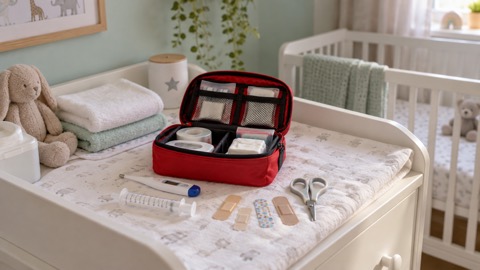 Baby and Child Kit Checklist
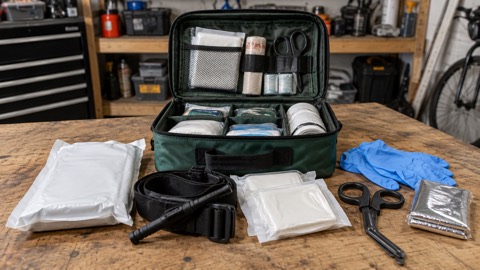 Bleeding Control Kit Checklist
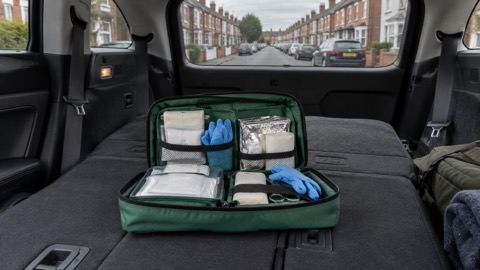 Car Kit Checklist
 Danger, Response, Airway
 CPR Steps for Adults
 Defibrillators (AEDs)
 Public Access Defibrillators
 Choosing a Defibrillator
 The Recovery Position
 Choking First Aid
 Cuts, Grazes and Wounds
 Burns and Scalds
 Adrenaline Auto-Injectors
 Sepsis Signs to Act On
 Shock Signs and What to Do