
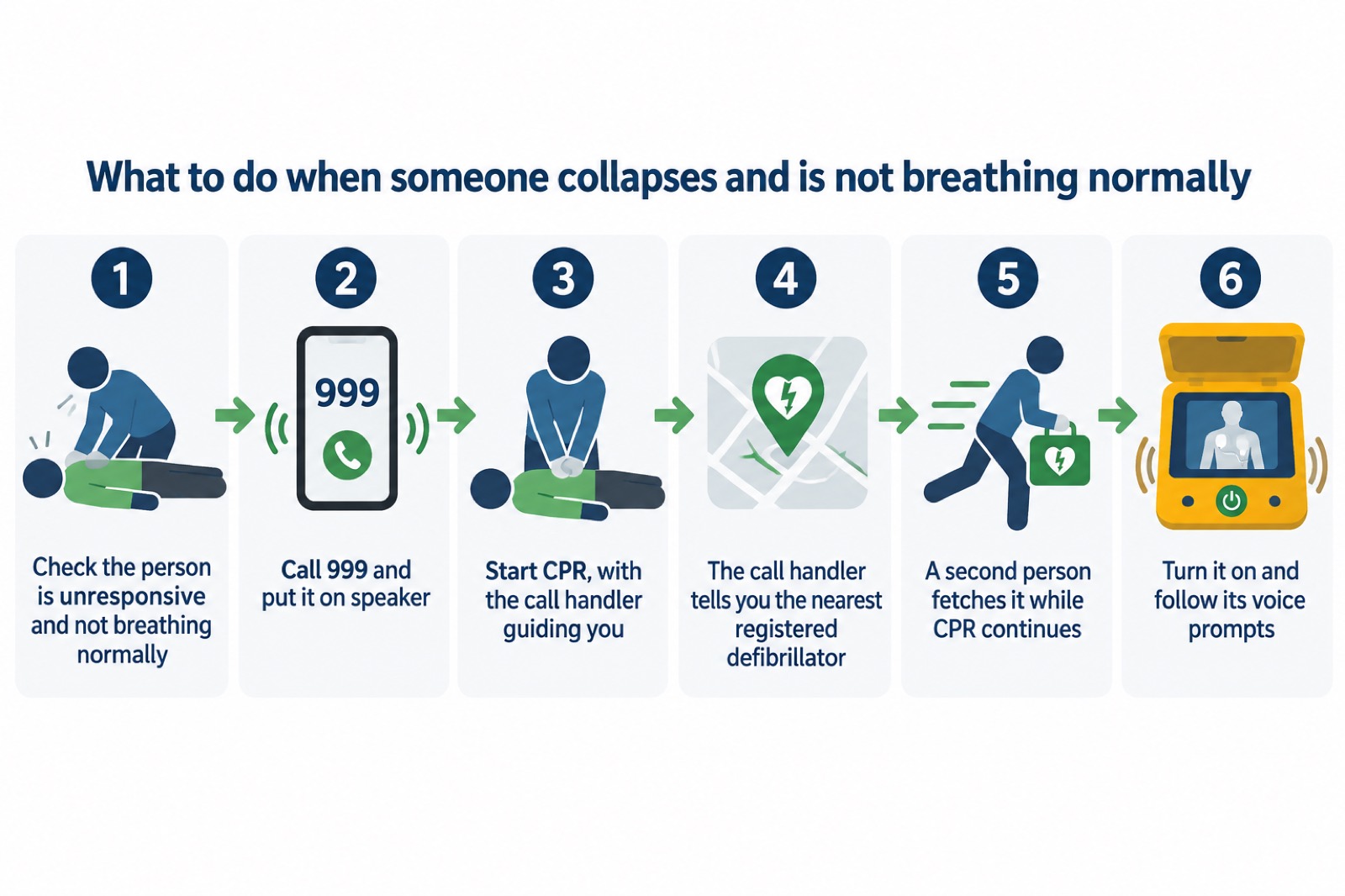
If someone collapses and is not breathing normally, call 999 immediately and start CPR. The call handler will talk you through what to do and will tell you the location of the nearest defibrillator registered on The Circuit, the national defibrillator network1. You do not need training to use one: anyone can use a defibrillator, and the device itself talks you through every step2.
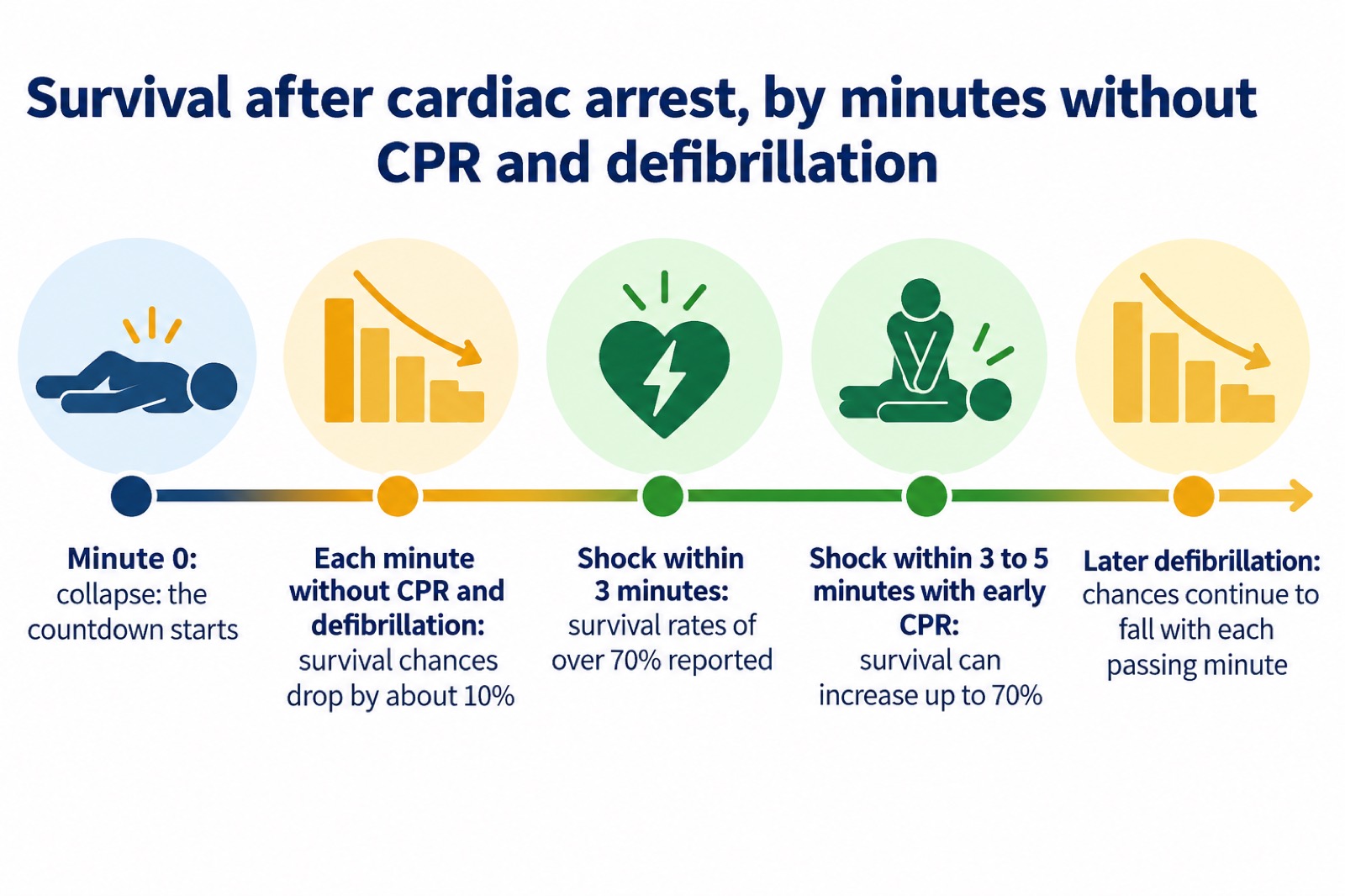
The reason to act fast is simple. Using a defibrillator within 3 to 5 minutes of collapse can increase survival rates by up to 70%2, and survival chances drop by about 10% for every minute without CPR and defibrillation4. A shock given within three minutes of cardiac arrest provides the best chance of survival5.
Call 999 first, then send someone for the defibrillator
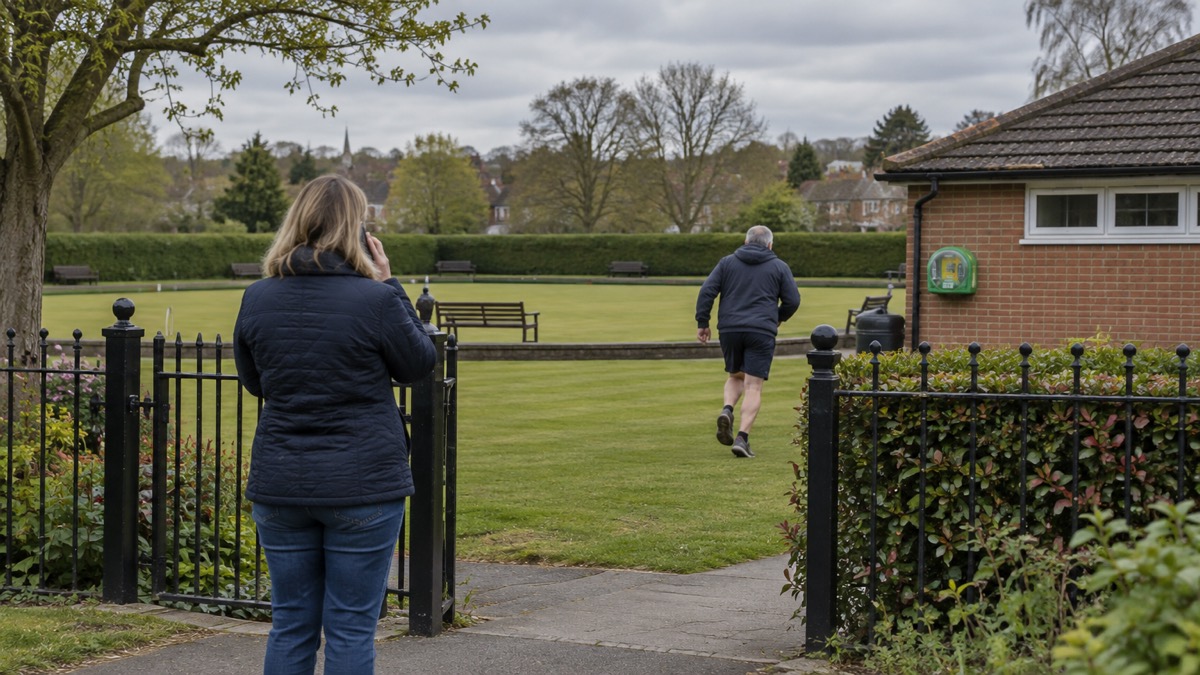
The single most important thing to know about finding a defibrillator in an emergency is that you do not have to find it yourself. Trained staff answering emergency 999 calls instruct people at the scene of a cardiac arrest to give CPR and use a defibrillator if one is available, and they will tell the caller the location of the nearest defibrillator registered on The Circuit1. Ambulance services across the UK say the same thing in their own words: emergency call handlers will help direct callers to the nearest available device and explain how to use it4, and in Wales the ambulance service advises callers to phone 999 immediately and start CPR, with call handlers guiding the process and directing callers to the closest public access defibrillator10.
This is why the order of actions matters. The priority is to call 999 and give the person immediate CPR while the defibrillator is brought to them1. If other people are present, send a second person to fetch the defibrillator while you stay on the phone and keep compressions going. In Northern Ireland, the ambulance service describes exactly this arrangement: a second person retrieves the defibrillator, which will be within a one-mile radius, allowing the first caller to continue giving CPR11. London Ambulance Service describes the same intervention: calling 999 immediately, starting chest compressions if it is safe to do so, and sending someone to get a defibrillator if one is nearby12.
If you are on your own, follow the call handler's instructions: they will tell you whether to fetch a defibrillator yourself or stay with the casualty, based on how close the nearest registered device is. The ambulance call taker will give you instructions to help you deliver CPR and can tell you if there is a public access defibrillator nearby13. For the compressions themselves, see How to Do CPR: Hands-Only Steps for Adults, and for the first checks before you start, see What to Do First: Danger, Response, Airway and Breathing.
Anyone can use one, with no training
Every ambulance service in the UK makes this point plainly, because hesitation costs lives. The Scottish Ambulance Service states: "You don't need to be medically trained, and you should never hesitate to use one in an emergency"3. North East Ambulance Service puts it even more simply: "Anyone can use a defibrillator. You do not need training."13 South Western Ambulance Service says automatic or semi-automatic defibrillators are easy and safe to use by anyone with little or no training, with the device talking you through what to do and many devices showing pictures as well7. NHS inform in Scotland confirms AEDs can be used without training14, and London Ambulance Service says that when you switch one on, it will give you clear instructions on what to do15.
There is no legal barrier either. In the United Kingdom, there are no legal restrictions to the use of a defibrillator, and using one on someone who is unconscious and not breathing normally cannot make the person's condition worse2. A consensus statement from the Resuscitation Council UK adds that public access defibrillators can be used effectively and safely by people without prior training5. So if you are first on the scene, the device is there for you: open the cabinet, take it, switch it on and follow the voice. If you want to build confidence beforehand, ambulance services run free familiarisation sessions: South Western Ambulance Service's community CPR and defibrillator sessions need no prior medical knowledge16, and there are free online options described in Learning CPR Free Online.
How the device guides you, and why it only shocks when needed
A public access defibrillator is an Automated External Defibrillator (AED) designed for use by anyone in a cardiac emergency11. It analyses the electrical activity of the heart and delivers a shock if it detects a life-threatening abnormal rhythm3. The crucial point for a nervous first-time user is that the machine decides, not you. An AED is pre-programmed to assess the rhythm and provide a shock only if required17, and it will only shock someone who has collapsed and is not breathing normally, whose heart is in an uncoordinated chaotic rhythm17. As the Scottish Ambulance Service puts it, they will only administer a shock if one is needed, meaning it is extremely unlikely to cause harm3.
Once you have switched it on and applied the pads (see Where Do Defibrillator Pads Go?), the device tells you to stop CPR and analyses the heart's rhythm, and you follow its visual and verbal prompts18. If a shock is needed, it tells people to stand back. Some defibrillators are fully automated and have no shock button at all: they warn you they are going to shock, tell you when they have delivered the shock, and tell you when to continue chest compressions18. Semi-automatic devices have a shock button, and the defibrillator tells you when to press it; after the shock it tells you to continue CPR for two minutes before it re-analyses18. The AED gives clear instructions to make sure everyone is clear of the casualty before shocking, so that no one else is harmed19.
For a fuller walkthrough of the device itself, see Defibrillators (AEDs): What They Do and How to Use One, and for the difference between the two types, see Semi-Automatic or Fully Automatic Defibrillator: Which Suits a Home or Community?.
Why three minutes matters
The numbers behind defibrillation are what make placement and access so important. Using a defibrillator within 3 to 5 minutes of collapse can increase survival rates by up to 70%2, and survival rates of over 70% have been reported when defibrillation is performed within three minutes of someone collapsing2. South Western Ambulance Service gives the same figure from the official side: when early CPR and a defibrillator are used within the first 3 to 5 minutes, survival rates can increase up to 70%16, and defibrillation within five minutes can result in survival rates as high as 70%19. Northern Ireland Ambulance Service adds that early defibrillation can double or triple the chances of survival, especially if administered within the first few minutes of a cardiac arrest11.
Working against you is the clock. For every minute someone is in cardiac arrest without receiving CPR and having a defibrillator used on them, their chances of survival decrease by 10%, according to East of England Ambulance Service4. Northern Ireland's community first responder guidance gives the same figure: survival chances drop by about 10% for every minute without CPR and defibrillation20.
This is why the Resuscitation Council UK sets a placement rule for communities: ideally, a defibrillator should be accessible within 200 metres or a two-minute brisk walk, meaning four minutes there and back, from where it is anticipated it might be needed1. When you check your area, that is the standard to measure it against.
Finding a defibrillator near you before an emergency
You do not have to wait for a 999 call to find out what is near you. South Central Ambulance Service points the public to www.defibfinder.uk to find out if there is a defibrillator near you8. The Defib Finder shows the location and accessibility of existing defibrillators in your area, and the Resuscitation Council UK advises checking it before installing a new device, so you do not duplicate one already nearby2. One caveat from community resilience guidance in Essex: not all AEDs are listed there, so treat it as a good resource rather than a complete map21.
Knowing where your nearest one is in advance is worth the few minutes it takes. Defibrillators are located in large shops, GP surgeries, dentists, libraries and many other public places12, and ambulance stations, fire stations and local supermarkets are just some of the community buildings that have AEDs for public access use11. Walk the route from your home, your workplace or your child's school, and note how long the round trip takes. If it is longer than four minutes at a brisk pace, that is the gap a community scheme could close, and the Resuscitation Council UK's community guide is written for exactly that purpose1.
Cabinets, codes and access out of hours
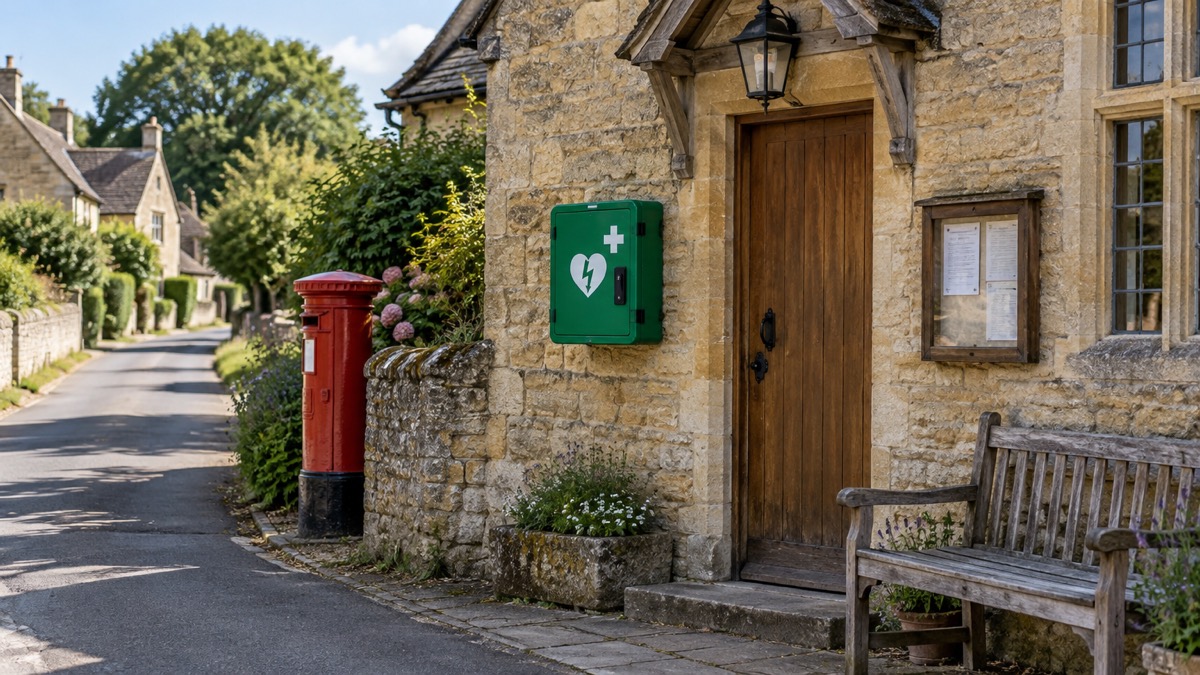
Most public defibrillators live in a cabinet on an outside wall. These are placed in a cabinet that can be accessed 24 hours a day by anyone who needs to use one, and in an emergency the cabinet is accessed via a code given to the person who rings 99919. That is the system working as intended: the code is recorded on The Circuit when the defibrillator is registered, so the emergency call handler can provide it to bystanders1.
The strong preference among both officials and independent guidance, though, is for unlocked cabinets. The Resuscitation Council UK recommends that defibrillators are kept in unlocked cabinets to enable access 24 hours a day, 365 days a year2, and NHS England's cardiac arrest programme says public access defibrillators should be kept in unlocked cabinets so people can get to them quickly in an emergency, because locked cabinets need extra steps, like getting a code, which can slow things down9. South Western Ambulance Service likewise does not recommend lockable cabinets7. If a locked cabinet is chosen anyway, the Scottish Ambulance Service notes the access code can be added when registering the defibrillator on The Circuit22, and Northern Ireland's registration process includes the access code for secure cabinets among the required details11.
If a locked cabinet is used, the Resuscitation Council UK sets conditions: ensure the lock is simple to operate and well maintained with a suitable lubricant, the keypad is visible and well-lit at night, and the unlocking code is accurately recorded on The Circuit1. Those conditions exist because of what the data shows. Data from The Circuit suggests that many occasions where cabinets are forced open are neither vandalism nor theft, but people responding to genuine emergencies struggling to operate the lock or obtain the unlocking code2. For more on this, see How to Get the Code for a Locked Defibrillator Cabinet and Indoor or Outdoor Defibrillator Cabinet: Which Do You Need?.
On the cabinet itself, the guidance is practical. The cabinet should be weatherproof1, and outdoor AED cabinets should be temperature-controlled to keep the device within its recommended range, preserving battery life and optimal function22. Only the defibrillator and its associated equipment should be stored within the cabinet, because additional items can distract from CPR or defibrillation1.
| Cabinet choice | Access | What to watch |
|---|---|---|
| Unlocked cabinet | 24 hours a day, 365 days a year, no code needed2 | Recommended by the Resuscitation Council UK and NHS England2 |
| Locked cabinet | Code given by the 999 call handler in an emergency19 | Lock must be simple, well-lit and maintained; code recorded on The Circuit1 |
| Indoor location | Only when the building is open | Can still be registered with specific access details23 |
The Circuit: the national network behind every 999 call
The Circuit is the national defibrillator network: an online database that records the location of publicly accessible defibrillators in the UK, connecting them to NHS ambulance services so that in the crucial moments after a cardiac arrest they can be accessed quickly24. All 14 of the UK's ambulance services are linked to The Circuit and can direct a bystander to the closest registered PAD1. When someone calls 999 for a cardiac arrest, the ambulance service can access The Circuit database to find the closest defibrillator registered with them, which can be used before the ambulance arrives24.
The network was developed by the British Heart Foundation in partnership with the Association of Ambulance Chief Executives, Resuscitation Council UK, St John Ambulance and NHS England9, with Save a Life Cymru also named among the partners25. All data protection governance has been assured24. The scale is substantial and growing: over 110,000 defibrillators are registered on The Circuit, though it is estimated that tens of thousands are not yet registered25. In Northern Ireland, as of September 2025, there were over 3,800 PADs registered11, and in the South Central Ambulance Service region there are now over 8,200 registered public access defibrillators23, which were deployed to over 550 incidents in 2024/2523.
The consequence of not registering is stark, and ambulance services state it plainly. If your defibrillator is not registered on The Circuit, it will not be visible to the Scottish Ambulance Service and may not be deployed when it is needed most26. South Western Ambulance Service makes the same point: if your defibrillator is not registered, "we won't know it exists"7. Registration is free and takes as little as five minutes25, or less than five minutes according to NHS England9. Organisations with more than ten defibrillators can register them using an organisation account with additional functionality and reporting2.
Registering a defibrillator and choosing where to put it
If you manage a defibrillator in your community, workplace or school, register it on The Circuit at www.thecircuit.uk9. It will only take a few minutes23. In Wales, the ambulance service also asks that defibrillators are registered with them for public use so they can be easily located when needed27, and older clinical guidance likewise directed owners to register the location and availability of devices with their local ambulance services28. Even if your defibrillator is inside and not accessible 24/7, you can still register it with specific access details23. For help with a purchase, South Central Ambulance Service directs businesses to its charity team and local community groups to its defibrillator email address8.
Where you site it shapes whether it ever gets used. The Scottish Ambulance Service advises placing it in a prominent, easily visible location26, and its guidance recommends locations with a large footfall, such as a public telephone box, outside a pub, village hall or community centre, with 24/7 public access, an unlocked cabinet, clear signage and lighting8. The Resuscitation Council UK's AED guide adds busy areas such as airports, train and bus stations, and local landmarks such as pubs, places of worship and schools2. Measure the distance against the 200-metre or two-minute rule1, and remember that whenever possible defibrillators should be made available 24 hours a day to maximise their availability, because in rural communities or workplaces with difficult access a local defibrillator may be the only realistic chance of survival2. Grants may be available towards the cost, and charities regularly run schemes providing fully funded defibrillators and unlocked cabinets for community groups, often targeting areas with higher cardiac arrest risk or no registered defibrillators2. For the buying decision itself, see Choosing a Defibrillator for a Home, Club or Village.
Looking after a community defibrillator
All defibrillators need to be checked regularly to ensure they are response ready23. The Resuscitation Council UK's community guide sets out how: nominate a defibrillator guardian to undertake the tasks and receive alerts from The Circuit, with an agreement for the role to continue if the guardian is absent1. Checks should be carried out as per manufacturer guidance and your risk assessment, with a process to ensure this is maintained and recorded1. The Circuit supports guardians with reminders, such as when pads are due to expire and prompts to regularly check their defibrillator and update its record25. A full checklist of what to inspect is in Defibrillator Guardian Checklist.
Signage needs the same care. An assessment should be made of where directional signs should be placed, a test run completed once the signs are installed, and sign checks included in the routine checking process1. After a defibrillator has been used, sanitise it, return it to its usual place, and replace used disposables, especially the pads, then update its status on The Circuit so the ambulance service knows it is emergency rescue ready again1.
The consumables have defined lifespans, which is why the reminders matter. Pads must have a shelf life of a minimum of two years from the date of supply1, and batteries must have a shelf life of at least three years and a life expectancy of at least two years once inserted into the device1. Budget for the long term: the Resuscitation Council UK advises considering how you will fund maintenance, the storage cabinet, directional signage, replacing consumables, insurance premiums, and replacement of batteries and pads1. More detail is in How Long Do Defibrillator Batteries and Pads Last?.
On theft and vandalism, the evidence is reassuring. In practice this is rare, and missing defibrillators are generally the result of deployment to an emergency rather than theft1. If you are on an incident where someone has collected a public access defibrillator, South Western Ambulance Service asks you to complete its online form so the device can be made live again, and to keep submitting the report until contacted7.
What a public defibrillator must be able to do
If you are buying for a community scheme, the Resuscitation Council UK publishes a minimum specification for publicly accessible defibrillators, and it is the yardstick to check any device against1. The headline requirements: the device must deliver a shock energy of at least 150 J (130 J for pulsed biphasic waveform devices), be able to shock VF and VT above 150 BPM in an adult (above 180 BPM if it has paediatric settings), and complete its initial analysis plus charge, ready to deliver an initial shock, in a maximum of 15 seconds1. It must operate on a battery-only basis, with a battery shock capacity of a minimum of 30 full discharges at maximum energy throughout the standard battery life1.
| Requirement | Minimum standard |
|---|---|
| Shock energy | At least 150 J, or 130 J for pulsed biphasic waveforms1 |
| Time to first shock | Analysis plus charge, maximum 15 seconds2 |
| Adult shock rhythms | VF and VT above 150 BPM1 |
| Paediatric shock rhythms (if fitted) | VF and VT above 180 BPM1 |
| Battery shock capacity | Minimum 30 full discharges at maximum energy1 |
| Battery life once inserted | At least 2 years; shelf life at least 3 years1 |
| Pads shelf life | Minimum 2 years from date of supply1 |
| Device life expectancy | At least 5 years; warranty at least 5 years1 |
| Weight | Not to exceed 4kg including battery, case and standard accessories1 |
| Operating temperature | Able to be stored and to operate at 0 to 40 degrees C1 |
| Water protection | IP rating of 4 or above1 |
| Repair turnaround | No more than 2 working days from notification of a unit error1 |
The specification also covers usability and resilience, which is what makes these devices safe in untrained hands: voice prompts in English including a safety message, visual prompts, and simple controls that can be understood by a non-expert1. The device must have a biphasic waveform or one of comparable efficacy, impedance control and automatic discharge control, an indicator confirming self-test success, a low battery alarm, a real-time clock or time-stamped events, data storage and data connectivity, and it must withstand daily cleaning with detergent and disinfection1. The purchase price must include, as a minimum, one set of pads, or one set each of adult and paediatric pads where these are separate, with any adult/paediatric mode key included2. Finally, the device must be compatible with the most recent Resuscitation Council UK or European Resuscitation Council Guidelines1, which are covered in The 2025 Resuscitation Guidelines: What Changed for Bystanders.
Sources (28)
- Public access defibrillators: a guide for communities, Resuscitation Council UK, October 2025
- AED Guide, Resuscitation Council UK, 2026
- Public Access Defibrillators, Scottish Ambulance Service, 2026
- Cardiac arrest, East of England Ambulance Service, 2026
- Consensus statement on AED cabinets, Resuscitation Council UK, 2015
- Defibrillators & AEDs | Defibrillator Packages | defibshop, defibshop
- Defibrillators, South Western Ambulance Service, 2026
- Public Access Defibrillators (AED), South Central Ambulance Service, 2026
- Improving outcomes in cardiac arrest, NHS England, 2026
- Some of the reasons people call 999, Welsh Ambulance Services University NHS Trust, 2026
- Public access defibrillators (AED), Northern Ireland Ambulance Service, 2026
- Emergency heart care, London Ambulance Service, 2026
- Emergency advice: learning CPR, North East Ambulance Service, 2024
- How to use an AED, NHS inform Scotland, 2026
- Defibrillators: become a London Lifesaver, London Ambulance Service, 2026
- CPR and defibrillator training, South Western Ambulance Service, 2026
- Public Access Defibrillator Information Pack, South Central Ambulance Service, August 2026
- How to use a defibrillator, St John Ambulance, 2026
- Learn to save a life, North West Ambulance Service, 2024
- Community First Responders, Northern Ireland Ambulance Service, 2026
- Developing community resilience, Essex Prepared, 2026
- Purchasing a public access defibrillator, Scottish Ambulance Service, 2026
- Public access defibrillators and community first responders, South Central Ambulance Service, 2026
- The Circuit: the new defibrillator database, North West Ambulance Service, 2025
- The Circuit: national defibrillator network, Resuscitation Council UK, 2026
- AED placement and registration, Scottish Ambulance Service, 2026
- Register your defibrillator, Welsh Ambulance Services University NHS Trust, 2026
- Adult basic life support and automated external defibrillation, East London NHS Foundation Trust, 2022
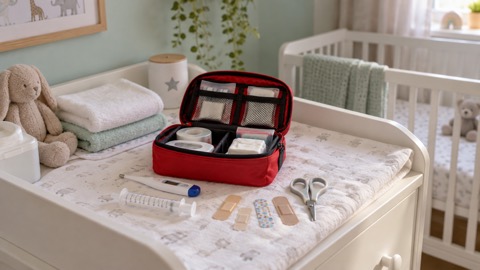 Baby and Child Kit Checklist
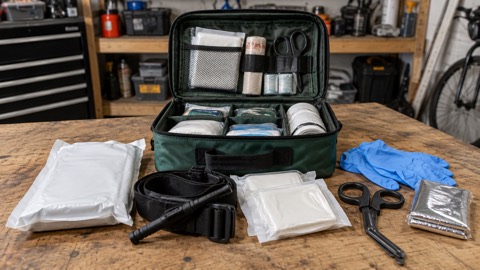 Bleeding Control Kit Checklist
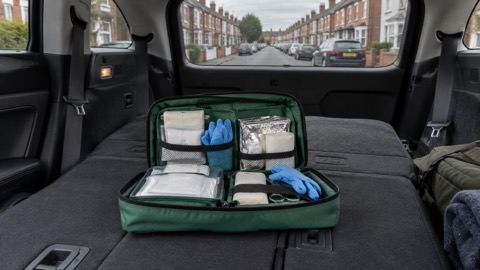 Car Kit Checklist
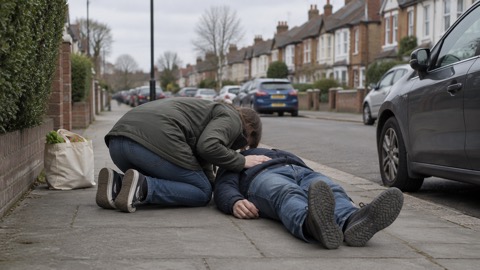 Danger, Response, Airway
 CPR Steps for Adults
 2025 Resuscitation Guidelines
 Defibrillators (AEDs)
 Choosing a Defibrillator
 The Recovery Position
 Choking First Aid
 Cuts, Grazes and Wounds
 Burns and Scalds
 Adrenaline Auto-Injectors
 Sepsis Signs to Act On
 Shock Signs and What to Do