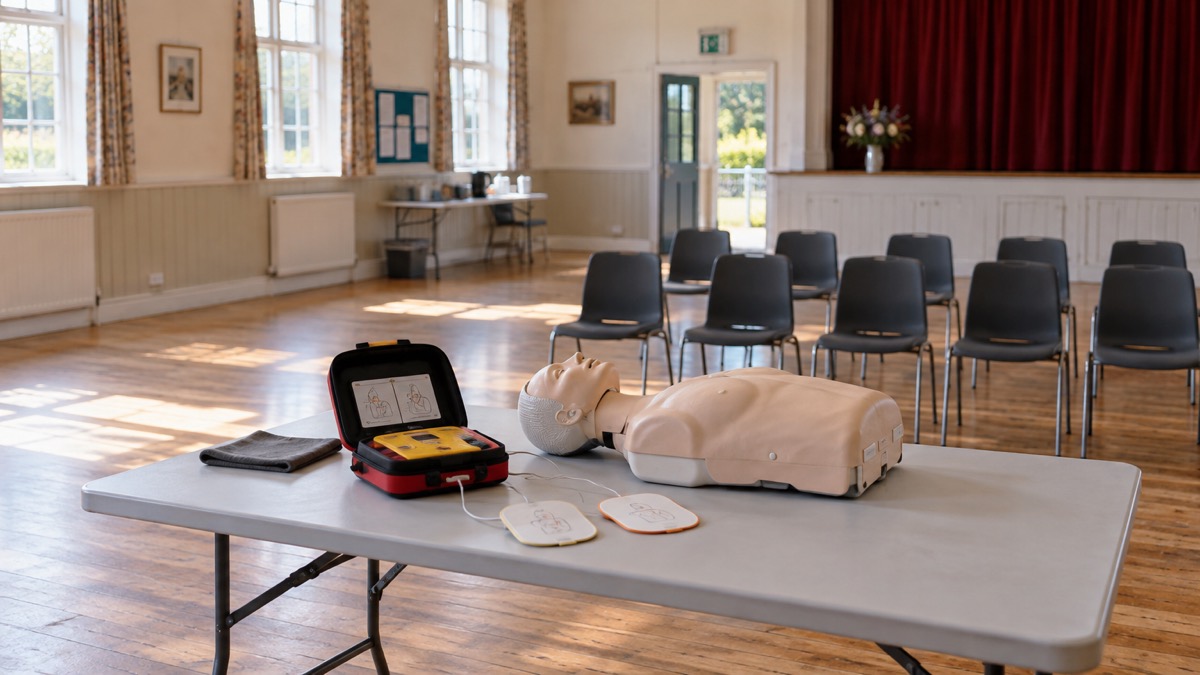
If you want to learn first aid, the quickest route for most households is a free community CPR and defibrillator session run by an NHS ambulance trust. These usually take 60 to 90 minutes, need no prior medical knowledge, and are delivered by trained volunteers1. In the South West they are run by the South Western Ambulance Service NHS Foundation Trust1, and other trusts run equivalents, including a basic life support awareness session in the South Central Ambulance Service area lasting 90 to 120 minutes2.
The reason to prioritise this is simple and stark: in a cardiac arrest, survival chances drop by about 10% for every minute without CPR and defibrillation3. When early CPR and a defibrillator are used within the first 3 to 5 minutes, survival rates can increase up to 70%1. A single evening session covers the skills that make that difference.
Beyond the free sessions, St John Ambulance and the British Red Cross run certified first aid courses for individuals, workplaces and community groups, and there are specific routes for parents of young children and for people in Wales, Scotland and Northern Ireland. This page sets out each type, what it covers, and how to find one near you.
Where to find a first aid course near you
The starting point is the official advice: many organisations run first aid courses, and nidirect, the Northern Ireland government service, says simply that if you want to learn, they are widely available5. For most people in the UK, the practical answer is one of three routes.
The first is the big training charities. Local courses are provided by St John Ambulance and the British Red Cross, according to community preparedness guidance4. Both run scheduled courses that individuals can join, and both also deliver training to organisations. West Yorkshire Prepared, the regional resilience forum for West Yorkshire, repeats the same advice: a simple first aid course can give you basic skills that could help save a life, with local courses from St John Ambulance or British Red Cross7.
The second is your local NHS ambulance service. NHS guidance on childhood accidents notes that St John Ambulance, the British Red Cross and your local NHS ambulance service all run first aid courses8. Ambulance trusts run the free community CPR and defibrillator sessions described in the next section, and some run wider training programmes.
The third is your employer or your community. The Be Ready campaign advises checking online to find free workshops, or asking whether your employer will pay for a course9. Community groups can also arrange sessions directly with a training provider, which is covered further down this page.
A useful habit alongside any course is to keep first aid guidance on your phone. Community preparedness advice for households suggests downloading a first aid app, such as the free app from the Red Cross, and keeping a first aid kit in your home and car10. Our page on first aid kits for the home covers what to keep in one.
Free community CPR and defibrillator sessions: 60 to 90 minutes
The most accessible form of first aid training in the UK is the free community session run by NHS ambulance trusts. In the South West, the South Western Ambulance Service NHS Foundation Trust runs CPR and defibrillator familiarisation sessions that usually take about 60 to 90 minutes, are delivered by a Community Training Volunteer, and are designed to give people the skills, confidence and knowledge to act fast in an emergency1. No prior medical knowledge is needed1.
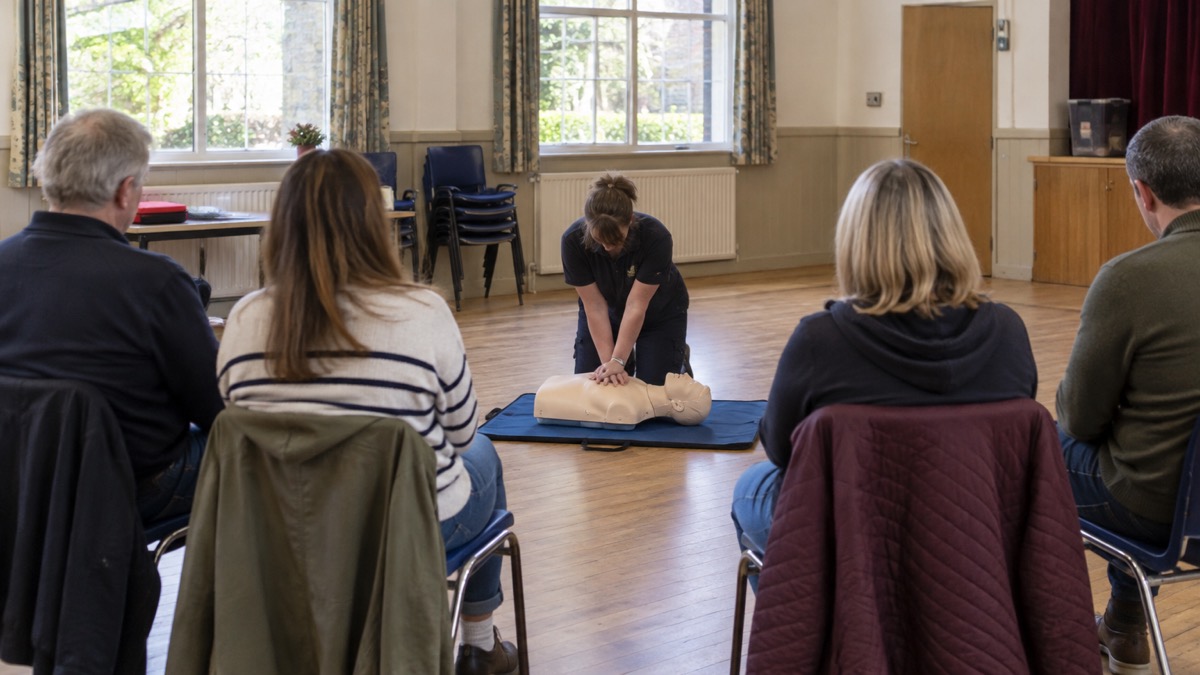
In the South Central Ambulance Service area, the equivalent is a basic life support awareness training session lasting 90 to 120 minutes2. The August 2026 Public Access Defibrillator information pack from the same trust confirms the 90 to 120 minute duration and notes that the session covers giving CPR and using a defibrillator11.
These sessions are free, short and local, which makes them the natural first step for a household. To find one, check your regional ambulance trust's website: trusts that run them advertise them under community training, community first responders or public access defibrillation. In the South West, sessions are delivered by a Community Training Volunteer from the South Western Ambulance Service NHS Foundation Trust, and no prior medical knowledge is needed1.
If no session is running near you soon, there is a free online alternative. RevivR teaches lifesaving CPR in 15 minutes for free, using your mobile phone and a cushion, and you receive your own CPR certificate at the end6. Our page on learning CPR free online goes into that in more detail.
| Session type | Typical length | Who runs it | What you get |
|---|---|---|---|
| CPR and defibrillator familiarisation | 60 to 90 minutes, usually1 | South Western Ambulance Service Community Training Volunteers1 | Practical CPR and defibrillator skills, no certificate |
| Basic life support awareness training | 90 to 120 minutes2 | South Central Ambulance Service2 | CPR and defibrillator familiarisation |
| RevivR online CPR training | 15 minutes6 | Online tool promoted by Cheshire Fire and Rescue Service6 | CPR technique practice at home |
| Certified first aid course | Varies by course | St John Ambulance, British Red Cross4 | Training and certification |
What a CPR and defibrillator session teaches
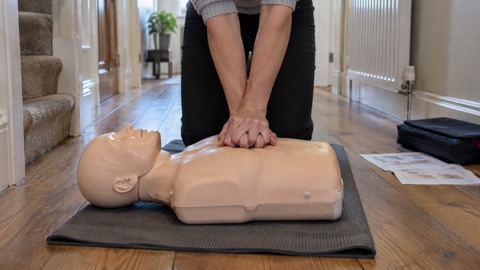
A community session is built around the first minutes of a cardiac arrest, because those are the minutes that decide the outcome. The South Western Ambulance Service sessions cover how to recognise a cardiac arrest, how to perform effective CPR, how to safely use a public access defibrillator, and what happens when you call 999 and how you fit into the response1.
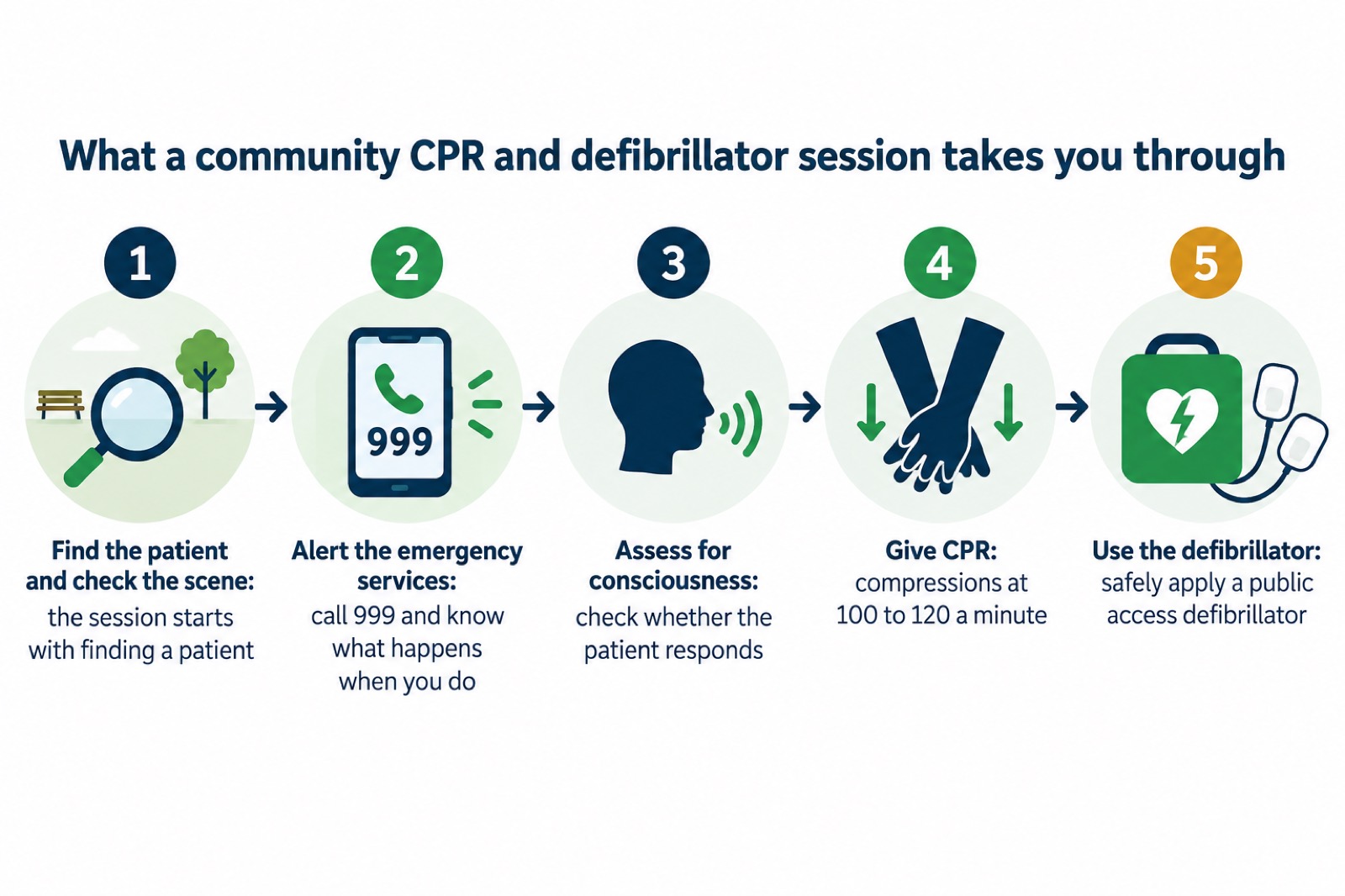
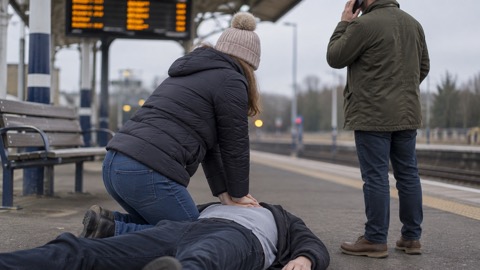
The South Central Ambulance Service session covers the same ground in a slightly different order: finding a patient, alerting the emergency services, assessing the patient for consciousness, CPR, and how to use the defibrillator2. The trust's information pack describes the same content11.
In Wales, Save a Life Cymru, supported by the Welsh Ambulance Services University NHS Trust, runs training designed to build your confidence to recognise a cardiac arrest, perform CPR, and use a defibrillator12. The Welsh Ambulance Service also supports familiarisation courses in basic life support and use of the defibrillator13.
The CPR technique itself is taught to a national standard. The North East Ambulance Service advises repeating chest compressions at a rate of 100 to 120 times a minute, approximately two per second, until an ambulance arrives or for as long as you can14. For children aged 1 to 8 years old, the same service advises that after every 30 chest compressions at a rate of 100 to 120 a minute, you give two breaths and continue the cycles until the child begins to recover or emergency help arrives14. A session gives you supervised practice of exactly this, which is the thing a video cannot.
Sessions also cover how you fit into the wider response. Community First Responders, volunteers dispatched alongside ambulances, are trained in the first three links of the Chain of Survival: early recognition of cardiac arrest, early CPR and early defibrillation3. A layperson who has done a session can supply those same first minutes while the ambulance is on its way.
St John Ambulance sessions for community groups
St John Ambulance is one of the two main training charities in the UK, and it delivers certified training courses to companies, local authorities, schools, community groups and individuals15. That range matters for households in two ways: you can join a scheduled course as an individual, or, if you belong to a group such as a residents' association, a faith group, a sports club or a school parent body, the group can arrange training for its members.
St John Ambulance's advice pages cover everything from the basics of emergency first aid, such as CPR and the recovery position, to advice on treating common conditions at home, plus specialist advice for treating children and babies15. A GP practice in Leeds, echoing the charity's own position, notes that St John Ambulance believes everyone should learn at least the basic first aid techniques16.
If you want to arrange something for your street, village or group, our page on community resilience covers how local groups prepare together, and first aid training is one of the most common first steps a group takes.
Awareness sessions give no certificate
It is worth being clear about what a free awareness session is and is not. A familiarisation session teaches you real, practical skills, but it is not a certified first aid qualification. Certification comes from the certified courses run by bodies such as St John Ambulance and the British Red Cross15.
The distinction matters most in workplaces, where an employer's first aid obligations are tied to qualified first aiders rather than to people who have done an awareness session. The Health and Safety Executive makes the underlying point on its official first aid poster, which states:
"This poster is not a substitute for effective first-aid training."
For a household, none of this diminishes the value of a free session. The skills taught are the ones that keep a person alive until an ambulance arrives. But if you need a certificate, for work, for volunteering or for a role such as a community first responder, you need a certified course. In Northern Ireland, for example, Community First Responders begin with a two-day course held over a weekend at the trust's Clinical Education Training Centre at Knockbracken Healthcare Park, covering essential skills18. Volunteering as a responder is one route to deeper training for people who want it.
Certified first aid courses for individuals and workplaces
For a qualification, the established providers are St John Ambulance and the British Red Cross. Community preparedness guidance names both as the providers of local courses, and notes that a simple first aid course can provide basic skills that could help you save the life of a family member or friend4.
What a general first aid course covers is broader than a CPR session. nidirect, the Northern Ireland government service, lists the content of first aid training as dealing with an emergency, how to do CPR and put someone in the recovery position, dealing with head injuries, severe bleeding, burns and broken or sprained bones, what to do in cases of seizures, heart attacks or strokes, and what to do if someone chokes, has a severe allergic reaction or a diabetic emergency19. That breadth is the reason a certified course takes longer than an awareness session, and it is what equips you for the accidents that actually happen in and around the home.
The East of England Ambulance Service, in its guidance on staying safe, puts the case plainly: learning first aid and CPR is one of the most useful things you can do, first aid training is provided by a number of charities and commercial organisations, and you can find the right training by searching online for "first aid training"20.
Two further options are worth knowing about. First, psychological first aid: Wiltshire and Swindon Prepared notes that there is an online course in psychological first aid, as well as a specialised course to deliver it to children, and advises completing training before attempting to deliver it21. This is training in supporting people emotionally after an emergency such as a flood, and it suits people who already have a role in their community. Second, funding: the UK government's Prepare campaign suggests asking whether your employer will pay for a course9, which can be one way to gain a certified qualification without meeting the cost yourself.
Our first aid at home section covers the techniques themselves, from the primary survey to CPR, the recovery position and defibrillators, so you can refresh what a course taught you at any time.
Courses in Wales, Scotland and Northern Ireland
The picture differs slightly by nation, and it is worth knowing what is available where you live.
In Wales, Save a Life Cymru is the national programme, committed to supporting CPR training and public access defibrillation across Wales, and the Welsh Ambulance Services University NHS Trust supports familiarisation courses in basic life support and use of the defibrillator13. The trust also runs a First Responder Scheme in which volunteers are trained by the Welsh Ambulance Service to administer basic first aid skills, oxygen therapy, CPR and the use of a defibrillator, and are sent to certain types of calls at the same time as an ambulance22. For community groups wanting to organise training, Natural Resources Wales notes that the Wales Council for Voluntary Action (WCVA) offers courses and help with funding23.
In Northern Ireland, the Red Cross and St John Ambulance offer first aid training courses19, and nidirect sets out the same broad course content described above5. The Northern Ireland Ambulance Service also trains Community First Responders through its two-day weekend course at Knockbracken Healthcare Park18.
In Scotland, the same charities provide courses. The Restart A Heart initiative invited schools across Scotland and the UK to take part in mass CPR training in October 2026, which makes schools a good route for families with children.
| Nation | Community CPR training | Certified courses | Extra routes |
|---|---|---|---|
| England | Ambulance trust community sessions | St John Ambulance, British Red Cross | Free workshops advertised online |
| Wales | Welsh Ambulance Service familiarisation courses in basic life support and defibrillator use, and Save a Life Cymru's CPR training | St John Ambulance, British Red Cross | WCVA courses and help with funding |
| Scotland | School-based Restart A Heart events | St John Ambulance, British Red Cross | Charity-run local courses |
| Northern Ireland | Ambulance trust community training | Red Cross and St John Ambulance19 | Community First Responder two-day course18 |
First aid courses for parents of young children
If you have a baby or young child, the NHS is unusually direct about training. Its page on resuscitating a baby states that it is highly recommended that every parent goes on a first aid course, as it makes the process much easier to understand and remember24. The NHS page on resuscitating a child says the same: every parent or carer should go on a first aid course25.
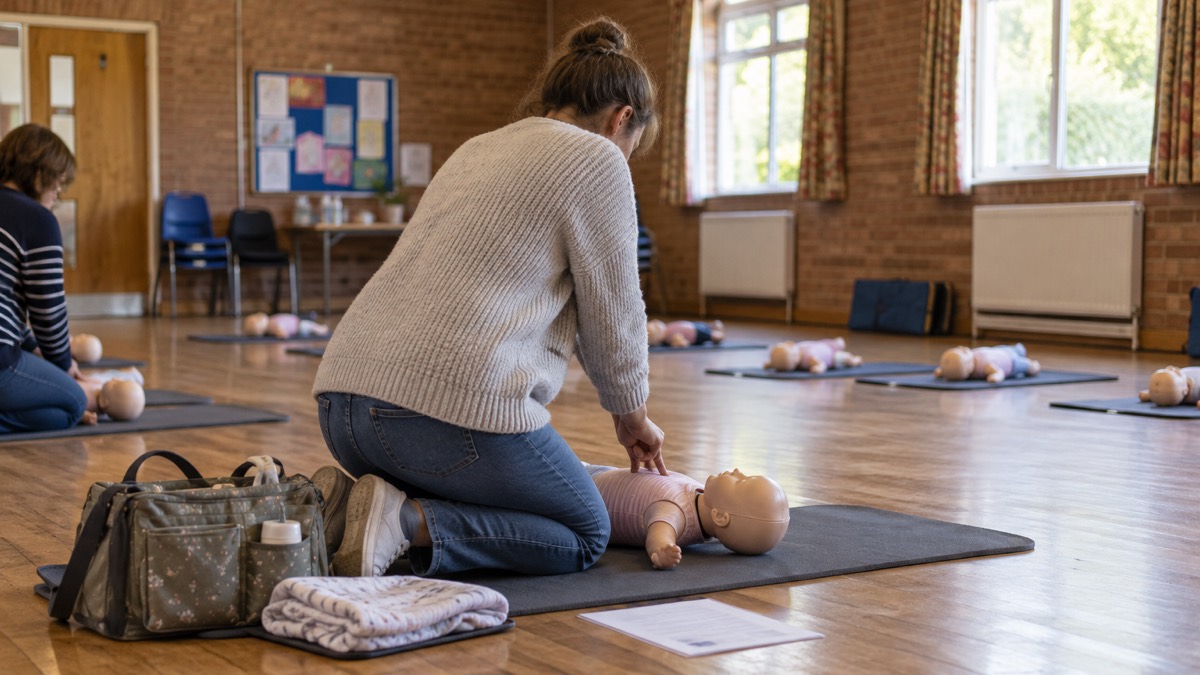
The practical routes for parents are several. nidirect advises that if you have a young child, you can ask your health visitor about available first aid courses5, and NHS guidance adds that your local children's centre may also run courses8. In Carmarthenshire, the Early Years Integration Team runs Safety Sessions for parents to be and new parents, covering a basic life support and choking demonstration26. St John Ambulance offers specialist advice for treating children and babies as part of its training and advice15.
What parents most need to know before a course is the difference between adult and child technique. The NHS highly recommends that every parent or carer goes on a first aid course, as it makes this process much easier to understand and remember, and in an emergency the guidance is unequivocal: call 99927. Our pages on baby CPR, child CPR and child choking cover these techniques step by step.
A course for parents also pairs naturally with a properly stocked kit. nidirect suggests a home first aid kit could include plasters, bandages, safety pins or tape, pain relievers, a medical spoon or syringe for giving babies and children their medicines, antiseptic lotion or saline for cleaning wounds, cotton wool, a thermometer, tweezers for splinters, sharp scissors, sun block of factor 25 or higher for children, and child insect repellent5. Our baby and child kit checklist builds on this.
Why learning basic first aid matters
Every official body that comments on household preparedness says the same thing about first aid, and they say it for the same reason. Greater Manchester's guidance on preparing your community puts it most concretely: learn first aid because it can take some time for emergency services to arrive at an incident, and by learning first aid you can save lives and look after those who are injured28. That gap, between the moment something happens and the moment an ambulance arrives, is exactly what a session prepares you for.
The advice is blunt about why: it can take some time for emergency services to arrive at an incident, and by learning first aid you can save lives and look after those who are injured. The numbers behind it are the ones this page opened with: survival chances in a cardiac arrest drop by about 10% for every minute without CPR and defibrillation3, and early CPR plus a defibrillator within 3 to 5 minutes can push survival rates up to 70%1. An ambulance cannot arrive within 3 to 5 minutes in most cases. A trained neighbour, family member or passer-by can.
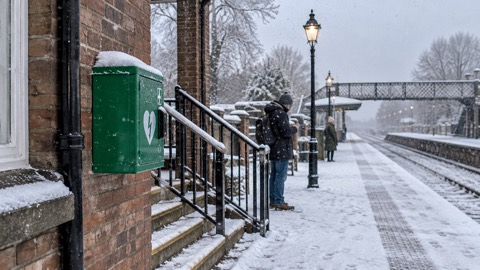
There is also a community dimension. ProtectUK, the police-led counter-terrorism preparedness service, describes how Public Access Trauma first aid kits in public places are intended to increase first aid resilience amongst the general public and improve the survivability of a person with life threatening injuries, and notes that the kits are for use by any person, regardless of their level of training29. A public that has done CPR sessions makes those kits, and the defibrillators in cabinets across the country, genuinely usable. Our page on public access defibrillators explains how to find your nearest one.
If you take one action from this page, make it this: learn first aid. It can take some time for emergency services to arrive at an incident, and by learning first aid you can save lives and look after those who are injured.
Sources (29)
- CPR and defibrillator training, South Western Ambulance Service NHS Foundation Trust
- Basic life support awareness training, South Central Ambulance Service NHS Foundation Trust
- Community First Responders, Northern Ireland Ambulance Service
- Are You Ready booklet, Culham Parish Council, September 2025
- First aid, nidirect, 4 December 2025
- Safe and well booklet, Cheshire Fire and Rescue Service
- Advice for households, West Yorkshire Prepared, 29 October 2026
- What to do if your child has an accident, NHS, 18 December 2025
- Get prepared for emergencies, UK Government Prepare campaign, 21 October 2026
- Step 1: preparation, Essex Prepared
- Public Access Defibrillator information pack, August 2026, South Central Ambulance Service NHS Foundation Trust, August 2026
- Save a Life Cymru, Welsh Ambulance Services University NHS Trust
- Register your defibrillator, Welsh Ambulance Services University NHS Trust
- How to do CPR, North East Ambulance Service NHS Foundation Trust, 13 March 2025
- First aid, NHS, 25 October 2026
- First aid self-help, Aireborough Family Practice
- Basic advice on first aid at work poster, Health and Safety Executive, 2017
- First Responders, Northern Ireland Ambulance Service, 29 October 2026
- Household emergency kit, nidirect, 6 July 2026
- Staying safe from a terrorist incident, East of England Ambulance Service NHS Trust, 29 October 2026
- Flooding and health, mental health, Wiltshire and Swindon Prepared, 25 October 2026
- Welsh Ambulance Service FAQ, NHS 111 Wales, 2021
- Community flood plan, Natural Resources Wales
- Resuscitating a baby, NHS 111 Wales, 27 June 2023
- How to resuscitate a child, NHS, 21 May 2026
- Early Years Integration Team home safety, Carmarthenshire Family Information Service, 10 September 2024
- Paediatric cardiac arrest first aid guide, North East Ambulance Service NHS Foundation Trust, November 2024
- Prepare your community, Greater Manchester Combined Authority, 29 October 2026
- Public Access Trauma first aid kits and equipment, ProtectUK, 1 June 2026
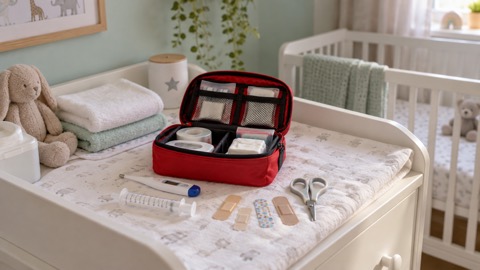 Baby and Child Kit Checklist
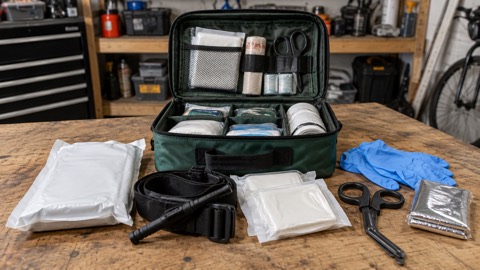 Bleeding Control Kit Checklist
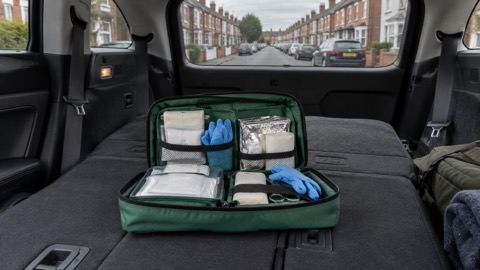 Car Kit Checklist
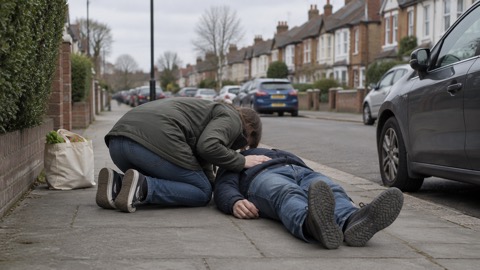 Danger, Response, Airway
 CPR Steps for Adults
 2025 Resuscitation Guidelines
 Defibrillators (AEDs)
 Public Access Defibrillators
 Choosing a Defibrillator
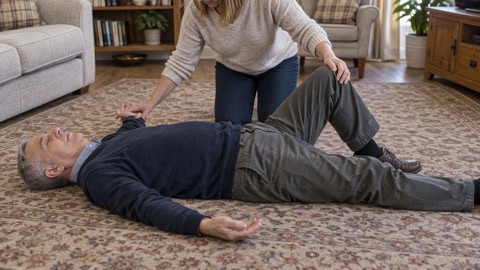 The Recovery Position
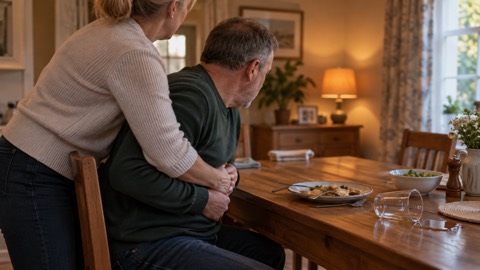 Choking First Aid
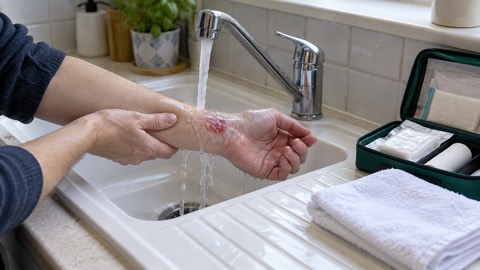 Cuts, Grazes and Wounds
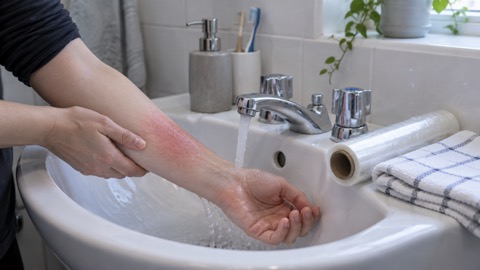 Burns and Scalds
 Adrenaline Auto-Injectors
 Sepsis Signs to Act On