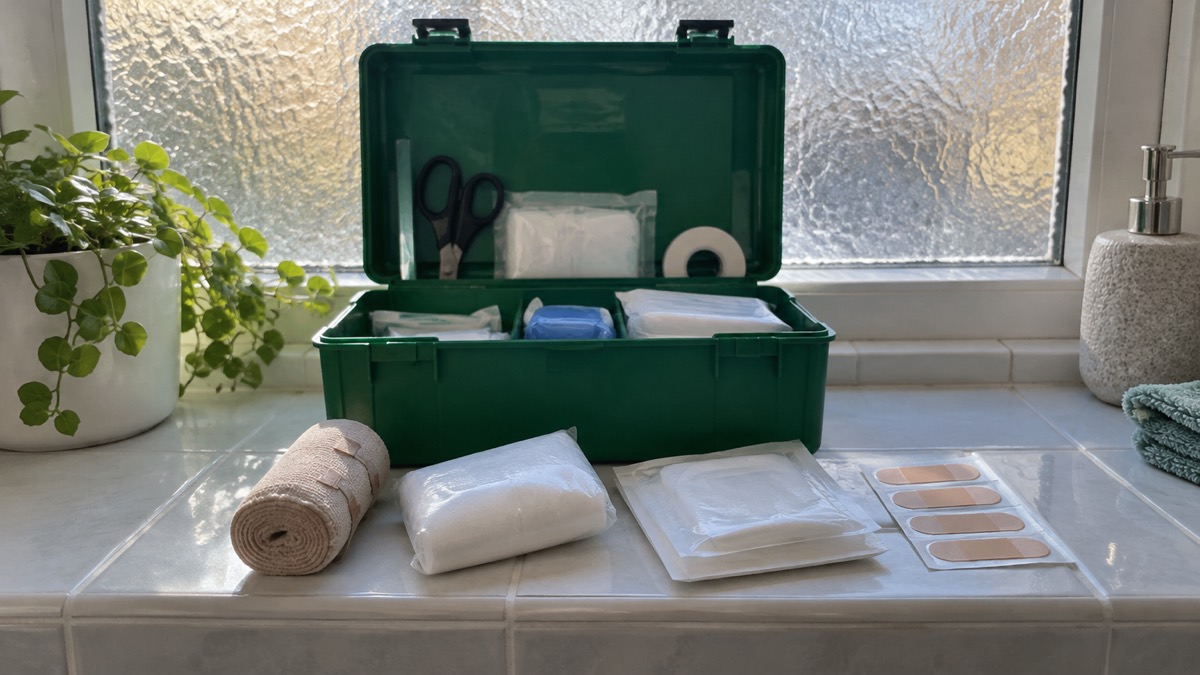
Most households own a first aid kit whose contents they have never really looked at: a jumble of plasters, a rolled bandage still in its wrapper, a triangular cloth of unknown purpose. When someone actually cuts themselves, the question is not "do I have something" but "which one, and how do I use it". This page answers that, item by item.
The short version: plasters are for minor cuts once the wound has been washed and dried1; sterile dressing pads, which come with a bandage attached, cover most common wounds whenever a plaster is too small2; and bandages come in three main types, roller, tubular and triangular, each with a different job3. For anything that bleeds heavily, the priority is pressing on the wound with a clean pad or dressing and keeping that pressure on until the bleeding stops4, and calling 999 if you cannot control it.
The three main types of bandage
St John Ambulance, one of the UK's main first aid training bodies, is straightforward about this: "There are three main types of bandages:" roller bandages, tubular bandages and triangular bandages3. Each does a different job, and knowing which is which turns a confusing kit into a usable one.
| Type | What it looks like | What it is for |
|---|---|---|
| Roller bandage | A long strip rolled up, including crepe and conforming versions | Supporting injured limbs, limiting swelling, keeping pressure on wounds, holding dressings in place, especially at ankles, knees, wrists or elbows3 |
| Tubular bandage | A tube of fabric, like a short sock with no end | Supporting injured joints and holding dressings on fingers or toes3 |
| Triangular bandage | A large triangle of cloth, often with two long ends to tie | Slings to support a wrist, arm or shoulder injury, and, folded, a bandage or dressing for large wounds3 |
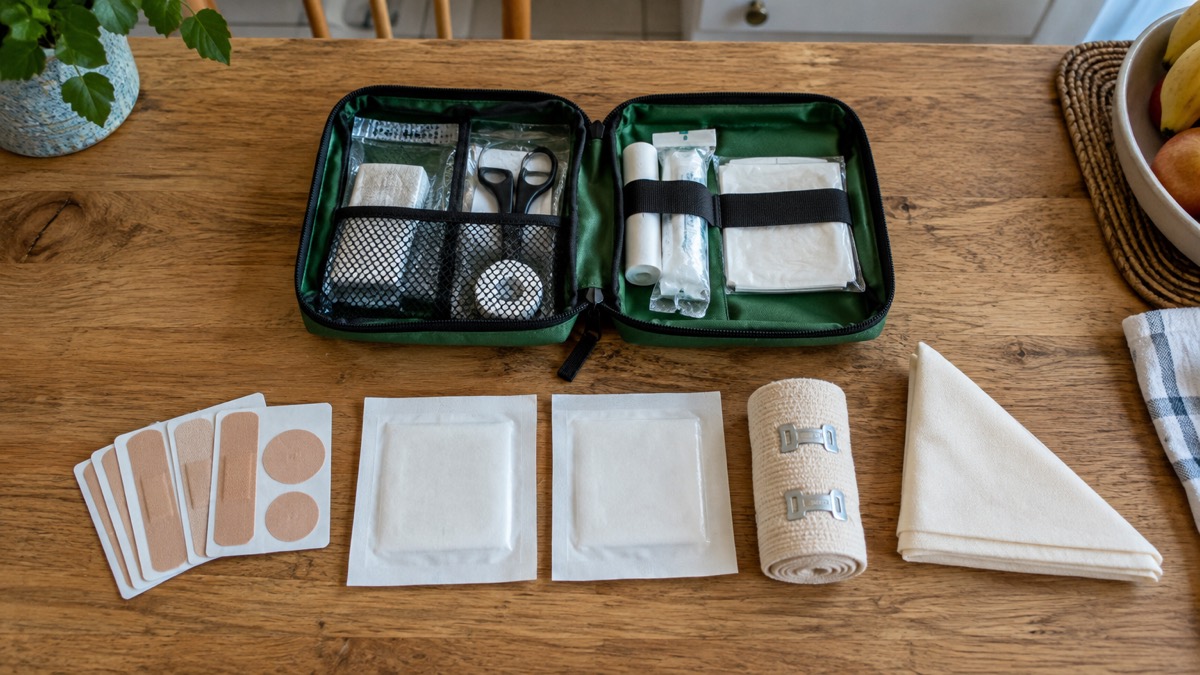
The NHS lists several varieties of roller bandage for a home kit: conforming, open-weave, support and self-adhesive6. Conforming and open-weave versions are for holding dressings in place; support bandages, of which crepe is a well-known example, are for injured joints. Self-adhesive bandages stick to themselves rather than to skin, which makes them easier to put on one-handed.
Integrated care boards in England describe the same core purpose in their self-care advice: bandages can support injured limbs, such as a sprained wrist, and also apply direct pressure to larger cuts before being treated in hospital7. That second use, pressure, is the one people forget, and it matters most when the bleeding is serious. The sections below take each item in turn, in the order you are likely to reach for it.
Plasters: for small cuts, once the wound is washed and dried
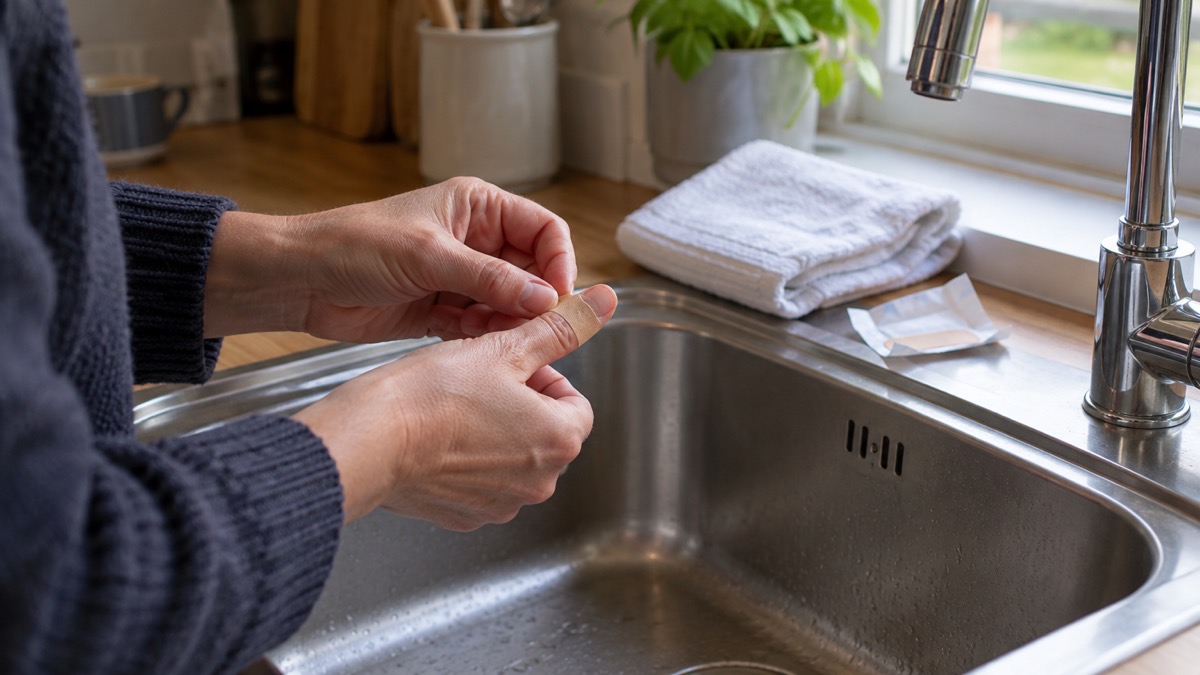
Plasters are the everyday workhorse of the kit, kept for minor cuts. The order matters: wash the wound first, then dry the skin around it, then apply the plaster. A plaster stuck over an unwashed cut seals dirt against the skin, so cleaning comes before covering.
NHS guidance on what to keep in a first aid kit describes adhesive plasters as strips that come in either breathable fabric or waterproof material, ideal for everyday scrapes6. A range of sizes matters more than it sounds: a strip plaster that is too big for a fingertip rolls off, and one that is too small for a grazed knee does not cover the wound.
For babies and children, NHS Wales 111 advice is to buy sticking plasters in a variety of sizes for minor cuts, blisters and sore spots, alongside adhesive tape, crepe bandages, tubular bandages, triangular bandages and sterile gauze dressings9.
Waterproof plasters and when they earn their place
Waterproof plasters come into their own in specific situations. The clearest one is flooding. Public Health Wales advises that if you have open cuts or sores you should keep them clean and dry, and waterproof plasters and bandages can help10. Council and preparedness guidance across England and Wales says the same thing for flood clean-up: cover open cuts and wounds on exposed skin with a waterproof plaster11, and NHS Inform in Scotland advises cleaning any open cuts and covering them with waterproof plasters14. If you are clearing flood water or handling wet, contaminated material, an ordinary fabric plaster will soak through and peel away exactly when you need it most.
Blister plasters
A gel-based adhesive wound dressing, usually sold as a blister plaster, cushions the area and prevents further rubbing, so you stay comfortable while healing6. It is thicker than an ordinary plaster and is designed to stay over a blister under friction. Put one on as soon as a hot spot starts, before the skin breaks, and it will do the most good.
Sterile dressing pads: when a plaster is too small
The next step up from a plaster is the sterile dressing pad. NHS Wales 111 describes these as pads which come in a variety of sizes and have a bandage attached to them, used to cover most common wounds whenever a plaster is too small2. The design is clever: the sterile pad goes straight over the wound and the attached bandage wraps around the limb to hold it there, so you are not hunting for a separate bandage with one hand pressed on a cut.
The NHS lists the full family of wound coverings for a home kit: sterile wound dressing, sterile eye pad, sterile pad, fabric plasters and waterproof plasters6. Dressing pads with roller bandages are, in the NHS's words, some of the most most practical options: they are quick to apply and useful in emergency care6.
Eye pads
A sterile eye pad is used for a small wound to the area around the eye, or for a non-embedded foreign object such as dirt or grit in the eye, while you wait for medical advice2. The key word is non-embedded: if something is stuck into the eye itself, do not pad over it, get help. For more on this, see our page on eye injuries.
Tape and scissors
Adhesive tape is used to secure bandages2, and the NHS lists scissors as essential for cutting tape, bandages or clothing6. Keep both in the kit. One firm rule from NHS advice on applying dressings: never wrap tape all the way around the injured part, as this could reduce the blood flow. If you need to maintain pressure to control bleeding, use a roller bandage instead1.
If blood soaks through a dressing
This is the point where official guidance differs, and it is worth knowing both versions so you are not thrown by a first aid course that teaches the other one.
NHS guidance on severe bleeding, and NHS advice on applying dressings, both say that if blood comes through the dressing you should remove it and reapply pressure with a new dressing or pad, then secure the new dressing with a bandage once the bleeding is controlled1. NHS Inform in Scotland teaches the same sequence for cuts and grazes: if it keeps bleeding, leave the first bandage in place, add another and keep pressing firmly for another 10 minutes16.
NHS Wales 111 guidance goes the other way for severe wounds: if blood soaks through the dressing, do not remove it, but apply a large dressing over the top as a second layer2. NHS advice on baby accidents agrees: if blood soaks through the pad or dressing, leave it there and put another pad or dressing over the top17. NHS guidance on child accidents says to replace it with a new one if possible18.
The practical reading is this: for a severe wound, where removing the dressing could disturb a clot that is forming, layer a fresh pad on top and get medical help. For a smaller cut that keeps oozing, the Scottish guidance of leaving the first layer in place, adding another and pressing for another 10 minutes is the pattern to follow16. In both cases, keep firm pressure on. North West Ambulance Service's advice on heavy bleeding is to apply pressure to the wound using a clean pad or dressing and keep doing this until the bleeding stops4, and, if you can, use a bandage to secure the dressing19.
For a child, NHS advice adds one more step: raise the injured limb if possible to help stop the bleeding, but not if the limb might be broken17. Our page on severe bleeding covers the full sequence.
Crepe bandages for sprained ankles and wrists
Crepe bandages are the support bandage most households already own. NHS Wales 111 says crepe bandages are mainly used for sprained or strained ankles or wrists2, and an NHS family medicine chest guide lists a 3 inch crepe bandage for sprained joints and for holding dressings in the correct place20. St John Ambulance groups them under roller bandages, used to support injured limbs, limit swelling, maintain pressure on wounds and hold dressings in place, particularly at ankles, knees, wrists or elbows3.
The maker Reliance Medical describes the material: crepe bandages are made from cotton, woven and elasticated to help the healing of sprains and strains, and they provide compression to injured areas with medium to light support without restricting natural joint movement21. That balance, compression without rigidity, is what makes crepe the right choice for a joint you still need to move gently, and our page on sprains and strains explains the rest of the treatment.
How tight is right
NHS advice on applying a bandage gives the rule in one line: apply the bandage firmly, but not so tight that it is restricting circulation5. St John Ambulance teaches the same, and adds that you should start bandaging from the front and the injured side of the casualty3. If fingers or toes beyond the bandage go pale, cold or numb, it is too tight: rewrap it more loosely.
Swelling that does not go down could be a break
NHS Wales 111 gives a clear warning on crepe bandages: if the swelling does not go down, it could be a break, so you should seek medical advice as an x-ray may be needed2. A sprain and a fracture can look and feel very similar in the first hours. Support the joint, raise it, and if the swelling persists, do not keep re-bandaging at home, get it looked at. Our page on broken bones sets out the signs.
Tubular bandages for fingers, toes and joints
A tubular bandage is a tube of stretchy fabric. St John Ambulance says to use these to support injured joints and hold dressings on fingers or toes3, and the NHS adds that they keep dressings on fingers or toes in place, or support joints like elbows and knees6. Elasticated tubular bandages can be used to support injured joints such as the elbow or knee3.
They solve a real problem: a plaster or dressing on a fingertip or toe will not stay put under an ordinary bandage, because there is nothing to wrap around. You cut a short length of tubular bandage, stretch it over the finger or toe, and it holds everything in place while still allowing movement.
Gauze tubular bandages need an applicator
There are two kinds. Elasticated tubular bandage goes on by hand. Gauze tubular bandages, a finer woven tube used to secure dressings on toes and fingers3, are applied to the injury with a special applicator3. If you buy gauze tubular bandages, buy the applicator at the same time and keep it in the kit with them.
Tubular bandage sizes, from 4.5cm to 10cm
Tubular bandages come in lettered sizes by width. The maker Reliance Medical publishes this chart21:
| Size | Width | Suits |
|---|---|---|
| A | 4.5cm | Child's small limb, child's medium limb |
| B | 6.25cm | Adult small arm, child's large limb |
| C | 6.75cm | Adult medium arm, adult small ankle, adult large arm |
| D | 7.5cm | Adult medium ankle, adult small leg, adult large ankle |
| E | 8.75cm | Adult medium leg, adult small thigh |
| F | 10cm | Adult large leg, adult medium thigh |
The maker notes that the chart is guidance only21. For a child, Size A at 4.5cm is the starting point for a small or medium limb, and Size B at 6.25cm for a child's large limb; an adult-sized tube on a child's finger will simply not grip. When in doubt, buy the size that matches the limb it must cover, not the age of the person.
Using a bandage to press on a larger cut
Bandages have a second job beyond support: pressure. Integrated care board self-care advice is that bandages can apply direct pressure to larger cuts before being treated in hospital7, and the maker Reliance Medical describes pressure bandages as designed to help stem heavy blood flow from an injury by applying pressure21.
The technique is the one described above: press on the wound with a clean pad or dressing and keep pressing until the bleeding stops4, then, if you can, use a bandage to secure the dressing19. North West Ambulance Service's children's first aid guidance teaches the same sequence for heavy bleeding19.
The triangular bandage: the most versatile item in the kit
St John Ambulance lists triangular bandages as slings to support a wrist, arm or shoulder injury, and, folded, as a bandage and dressing for large wounds3. NHS Wales 111 gives the fuller list of uses: as a sling to lift a limb, tied at the back of the neck; to help prevent blood loss; to secure a fractured collar bone or hand; and for sprains and strains if a crepe bandage is not available22. The NHS describes them as soft, foldable pieces of cloth that work as slings or bandages, wrapped around limbs for support or to secure dressings in place6.
One further point from NHS guidance: if triangular bandages come sealed and sterile, they are also safe for covering large wounds or burns6. An unwrapped one from a kit that has been opened for years is still useful as a sling, but not as a wound covering.
"If they come sealed and sterile, they're also safe for covering large wounds or burns."
What not to bandage: burns
Burns are the exception to almost everything on this page: do not use plasters or adhesive bandages on burned skin. Our page on burns and scalds covers cooling and covering burns properly.
What to keep ready, and where
Pulling this together, a household kit that can dress and bandage most everyday injuries needs:
- Plasters in a range of sizes, waterproof if possible8
- Sterile dressing pads in a variety of sizes, with bandages attached2
- Crepe bandages for sprained joints and holding dressings in place20
- Tubular bandages, with the applicator if you keep the gauze kind6
- Triangular bandages, sealed if you want them usable on wounds6
- Sterile eye pads6
- Adhesive tape to secure bandages, never wrapped fully around a limb2
- Scissors for cutting tape, bandages or clothing6
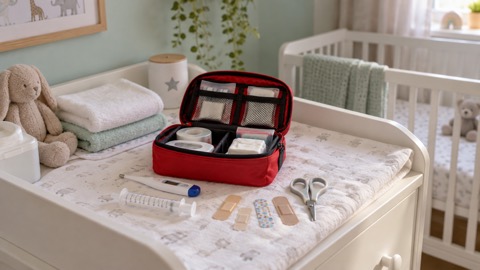
NHS Wales 111's advice for a baby's first aid kit lists the same core: sticking plasters in a variety of sizes, adhesive tape, crepe bandages, tubular bandages, triangular bandages and sterile gauze dressings9. Our page on first aid kits for the home covers the rest of the kit, and the baby and child kit checklist covers what changes when there are small children in the house.
Carrying plasters when you are out
Preparedness guidance for being out and about makes a simple point: "It can be frustrating when you cut yourself or get sore feet in shoes, so having a plaster is really handy."24 A few plasters and a blister dressing in a coat pocket, handbag or the car's glovebox deal with the most common minor injuries away from home. Official grab bag guidance for emergencies likewise includes medication and a first aid kit25. Our car kit checklist covers injuries on the road.
When to stop and get help
Dressings and bandages are for wounds you can manage. Get medical advice when:
- Swelling after a sprain does not go down, because it could be a break and an x-ray may be needed2
- A wound is severe: apply the dressing and seek medical advice2
- Bleeding continues despite firm pressure, or soaks through layer after layer15
- Something is embedded in the wound or the eye2
- A burn needs covering: use a non-adhesive dressing and get appropriate help26
For heavy bleeding you cannot control, call 999. Our pages on severe bleeding and how ambulance services prioritise 999 calls explain what happens next.
Sources (26)
- How do I apply plasters and other dressings?, NHS
- First aid kit, NHS 111 Wales
- Bandages and dressings, St John Ambulance
- Heavy bleeding, North West Ambulance Service, 2019-04-25
- How do I apply a bandage?, NHS, 2025-04-28
- What should I keep in my first aid kit?, NHS
- What should you have in your medicines box, Leicester, Leicestershire and Rutland ICB, 2025-09
- Self-care advice, Birmingham and Solihull ICB
- Pregnancy: safety first aid kit, NHS 111 Wales, 2021-04-19
- Flooding and health, Public Health Wales, 2026-07-31
- Cleaning up and returning home after flooding, Derbyshire County Council, 2026-10-29
- After a flood, Manchester City Council, 2026-10-29
- Flooding and health: safely cleaning your home, Wiltshire and Swindon Prepared, 2026-10-25
- How to protect your health when flooding occurs, NHS Inform Scotland, 2025-11-07
- Severe bleeding first aid, NHS Inform Scotland, 2026-07-24
- Cuts and grazes, NHS Inform Scotland
- Safety: accidents, NHS 111 Wales, 2023-05-17
- What to do if your child has an accident, NHS, 2025-12-18
- What to do when someone is hurt: heavy bleeding, North West Ambulance Service, 2025-03-13
- The family medicine chest, Vallance Medical Centre NHS
- Bandages FAQs, Reliance Medical, 2023
- First aid kit, NHS 111 Wales
- Keep well stocked medicine cabinet at home, Black Country ICB
- Out and about preparedness, Wiltshire and Swindon Prepared, 2026-10-25
- Reduce the risk of wildfire damage to your property, Hampshire and Isle of Wight Fire and Rescue Service, 2026-08-27
- Burns: first aid for babies and children, British Red Cross, 2026-10-25
 Baby and Child Kit Checklist
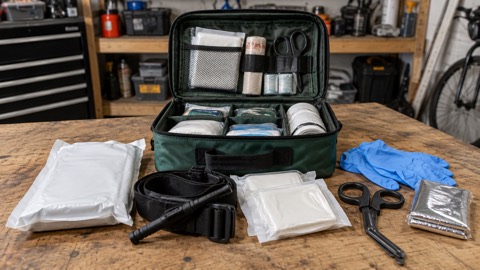 Bleeding Control Kit Checklist
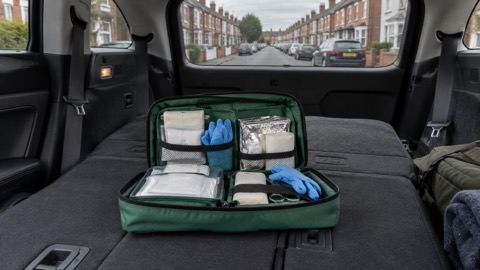 Car Kit Checklist
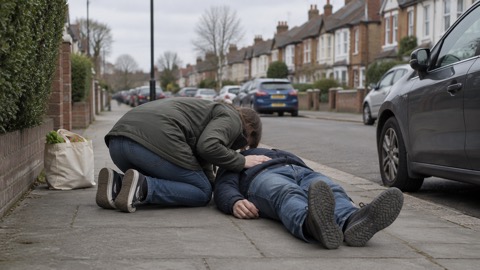 Danger, Response, Airway
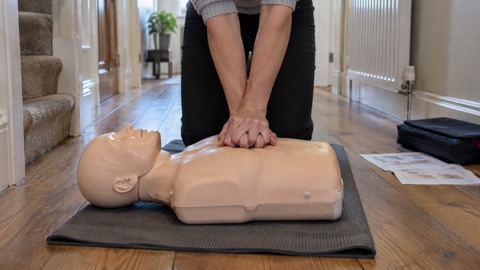 CPR Steps for Adults
 2025 Resuscitation Guidelines
 Defibrillators (AEDs)
 Public Access Defibrillators
 Choosing a Defibrillator
 The Recovery Position
 Choking First Aid
 Cuts, Grazes and Wounds
 Burns and Scalds
 Adrenaline Auto-Injectors
 Sepsis Signs to Act On