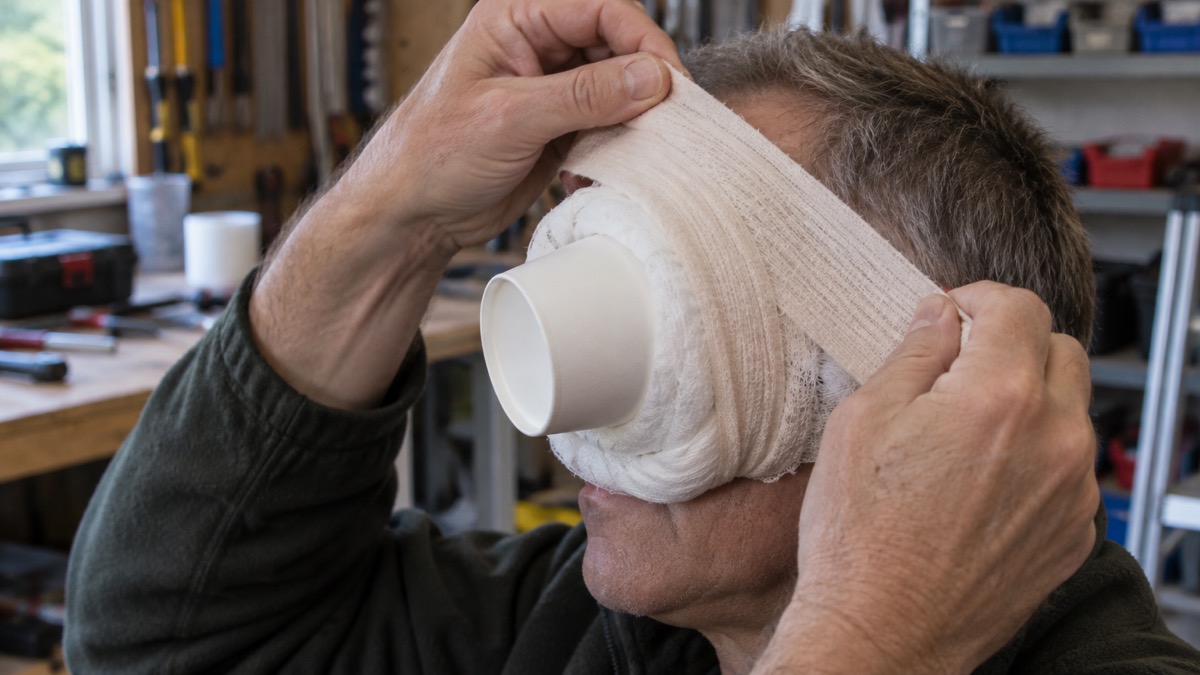
Most eye injuries at home are minor: a fleck of grit on a windy day, dust from drilling, or a knock from a ball or a door. The first thing to know is that rinsing and covering solve most of these, and that the one thing you must never do is rub. Official first aid guidance for something in the eye is to wash the eye out with clean water and then lightly cover it1. If a chemical has gone into the eye, the instruction is stronger: flush immediately with clean, cold water for at least 20 minutes, then lightly cover the eye to stop yourself rubbing it2.
The second thing to know is when to stop and get help. If anything is embedded in the eye, or stuck in a wound near it, official guidance is clear: do not try to remove it3. Leave the object in place, protect the eye, and get medical help. For an urgent eye problem, such as a red eye, a painful eye, a sudden change in vision, or something in your eye you cannot remove yourself, contact your optometry practice first by telephone rather than your GP practice or community pharmacy4.
This page walks through each situation in the order you are likely to meet it: grit and dirt, something stuck, covering the eye, a blow, chemicals, and the signs that need urgent help. It finishes with what to keep at home.
Grit or dirt in the eye: what to do first
Grit, dust and dirt are the most common eye nuisance a household meets, whether from gardening, DIY, a windy walk or a child playing in a sandpit. The treatment is rinsing, and the sooner the better. Official self-care advice lists eyewash solution in the home medicine cabinet precisely because it helps wash out grit or dirt in the eyes5, and first aid guidance for something in the eye is to wash it out with clean water1.
Work through it in order:
- Stop the person rubbing the eye. Rubbing drives grit across the surface and can scratch it or push it further in.
- Rinse the eye with clean water or eyewash solution, which helps wash out grit or dirt in the eyes5.
- If rinsing does not clear it, or the grit will not come out, stop trying and get advice. Something in your eye that you cannot remove yourself is an urgent eye problem, and the advice is to contact your optometry practice first by telephone4.
- Once the eye is comfortable, or while you wait for advice, lightly cover it to stop rubbing1.
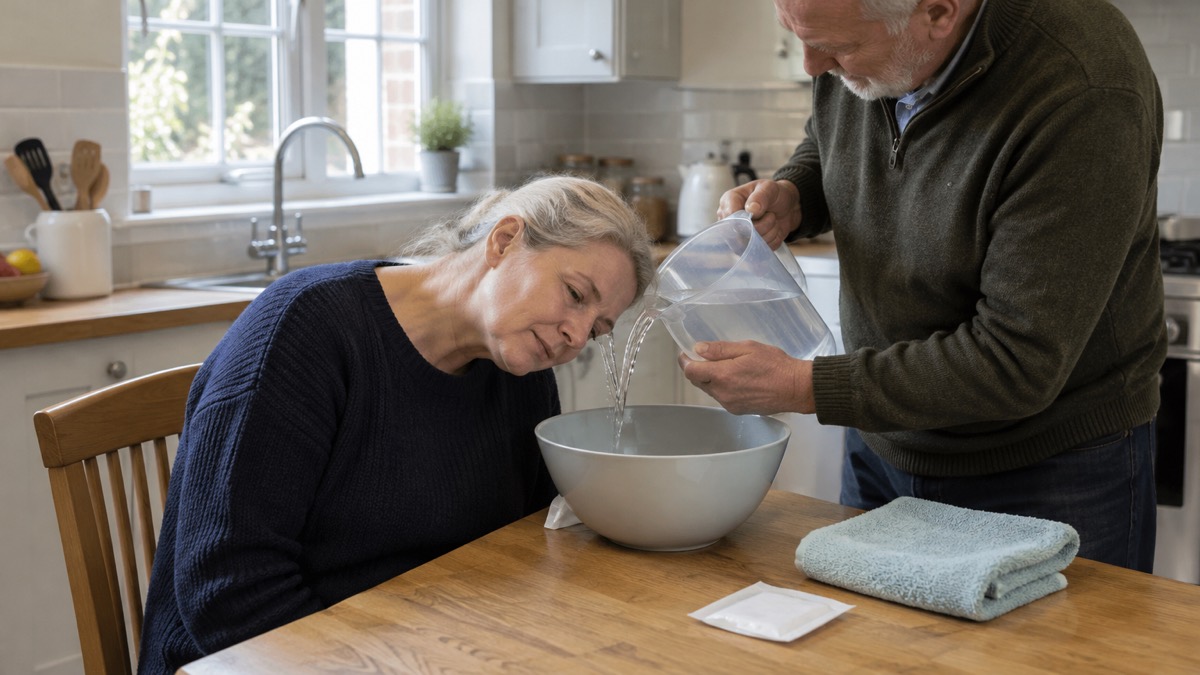
If you can, go and get a first aid kit7. A bottle of eyewash and a sterile eye pad turn a fumbling job into a calm one. If the eye stays painful, red or watery after the grit seems to have gone, treat it as an eye problem that needs advice rather than hoping it settles: contact your optometry practice or local optician8.
One distinction matters before you rinse: is the grit loose, or is it stuck? Loose grit moves when water flows over it and the eye waters. Anything that is embedded, that sits fixed when you look at it, or that came in at speed, such as a metal fragment from grinding, is not a rinsing job. That is the next section.
Something stuck in the eye: leave it in place
If anything is embedded in the eye or in the skin around it, the rule from official first aid guidance is blunt: do not try to remove the object3. The same rule runs through official guidance on embedded objects in wounds: if there is something stuck in the wound, do not remove it; press firmly on either side of the object and build up padding around it before bandaging, so you avoid putting pressure on the object itself9. NHS guidance for children says the same about objects lodged firmly in the body: leave it where it is and take them to the nearest A&E department or minor injuries unit10.
The reason is that the object is doing two jobs you cannot replicate. It is plugging whatever bleeding there is, and it is showing the medical staff exactly what went in, how deep and at what angle. Pulling it out removes what is helping plug the hole and stop the blood flow10, so leave it in place and get medical help.
So the steps are:
- Do not touch or remove the object, and do not let the injured person rub or blink hard against it.
- Do not poke at the eye. Official choking guidance makes a point that applies here too: if you can see the object, you may try to remove it, but never poke blindly or repeatedly with your fingers11. With an eye, if it is not clearly loose and rinsable, do not try at all.
- Build padding around the object, not over it, so nothing presses on it9.
- Get to A&E or call 999, depending on how bad it is and how the person looks.
While you wait for help or travel, keep the person still and calm. If they look pale or feel unwell after the accident, lie them down and keep them covered up and warm, but not too hot10. Those are the early signs of shock, and keeping the person still, warm and reassured is the right approach while help comes10.
Covering an injured eye with a sterile eye pad
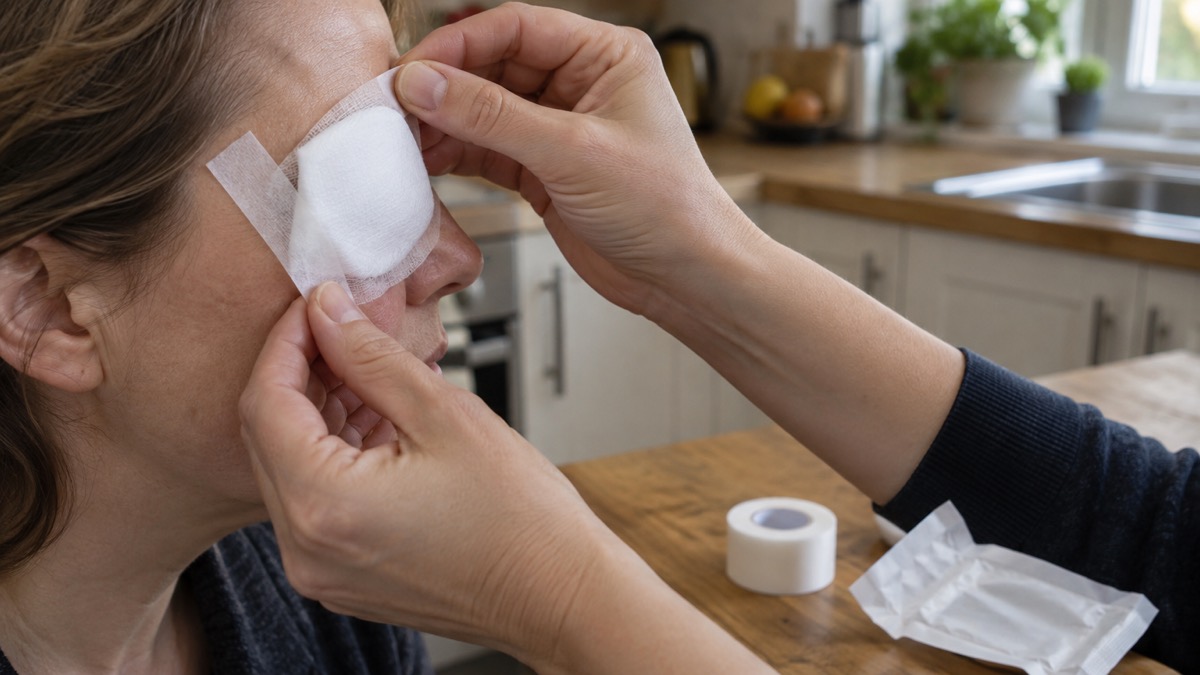
Once the eye is rinsed, or while you wait for help with something embedded, the eye needs covering. NHS first aid kit guidance lists the sterile eye pad among the dressings a household should hold12, and NHS 111 Wales first aid guidance explains when to use one: for a small wound, or for a foreign object in the eye such as dirt or grit that is not embedded, you can use an eye pad or small dressing until you get medical advice13.
The key word is lightly. Official guidance for eyes, including eyes affected by chemicals, is to lightly cover the eye1. You are aiming to stop rubbing and shield the eye from further dirt and knocks, not to press a pad onto it. A pad pressed hard against a painful eye, or over anything embedded, does harm.
To apply one:
- Put on gloves to protect yourself before treating the casualty, if they are available6.
- Ask the person to keep the injured eye closed. Keeping it closed is itself part of the protection.
- Place the sterile eye pad over the closed eye without pressing on it.
- Fix it in place with tape or a bandage looped around the head, firm enough to stay put, loose enough that it does not press.
Check the pad as you go. NHS guidance on dressings for cuts says that if blood soaks through the pad or dressing, replace it with a new one if possible10. The same logic applies to an eye pad: a soaked or dirty pad is no longer protecting anything, so swap it for a fresh sterile one.
Keep at least two sterile eye dressings at home, as first aid kit guidance recommends6. Two means you can replace a soaked pad, or cover an eye on two separate occasions, without a trip to a pharmacy at the wrong moment. For a fuller list of what each dressing and bandage is for, see dressings, bandages and plasters.
A blow to the eye: first steps
A ball, an elbow, a door edge or a fall: a blow to the eye is usually startling rather than dangerous, but it needs the same calm sequence as any accident. First aid can treat all sorts of minor bumps and scrapes, but you should see a doctor for more serious accidents15. So the first question after a blow is not about the eye alone, it is about the whole person.
Work through it:
- Check how the person is overall before you focus on the eye. If they look pale or feel unwell after the accident, lie them down and keep them covered up and warm, but not too hot10.
- Look at the eye without touching it. Do not press on it, and do not ask the person to squeeze it shut and rub it.
- Ask what they can see. Any sudden change in vision is an urgent eye problem, and the advice is to contact your optometry practice first by telephone4.
- If the blow came with a cut, treat it as a wound: if nothing is stuck in it, apply pressure with a clean pad or dressing and keep doing this until the bleeding stops9. If something is stuck, pad around it and get help3.
A blow that breaks the skin around the eye, or that you suspect has done more than bruise, is not a home-treated injury. If the eye is very painful, seek medical advice: call 111 or attend an Eye Casualty, Emergency Department or Urgent Treatment Centre2. A suspected broken bone around the eye also means being very gentle if you have to move the person, steadying the injury with a hand above and below it, comforting them and taking them to hospital10.
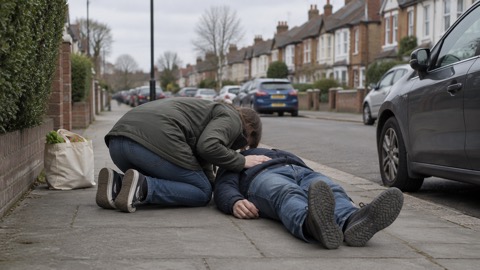
For the general sequence of checking someone who has been hurt, danger, response, airway and breathing, see the primary survey, and for the wider signs to watch for afterwards, see head injury: when to get medical help.
Chemicals in the eye
A chemical in the eye is the one eye injury where minutes matter most, and where the action is unambiguous. Official guidance is to flush the eye immediately with clean, cold water for at least 20 minutes, then lightly cover the eye to stop yourself rubbing it2. Twenty minutes feels like a long time with an eye burning under a tap, but it is the instruction, and it is a minimum, not a target.
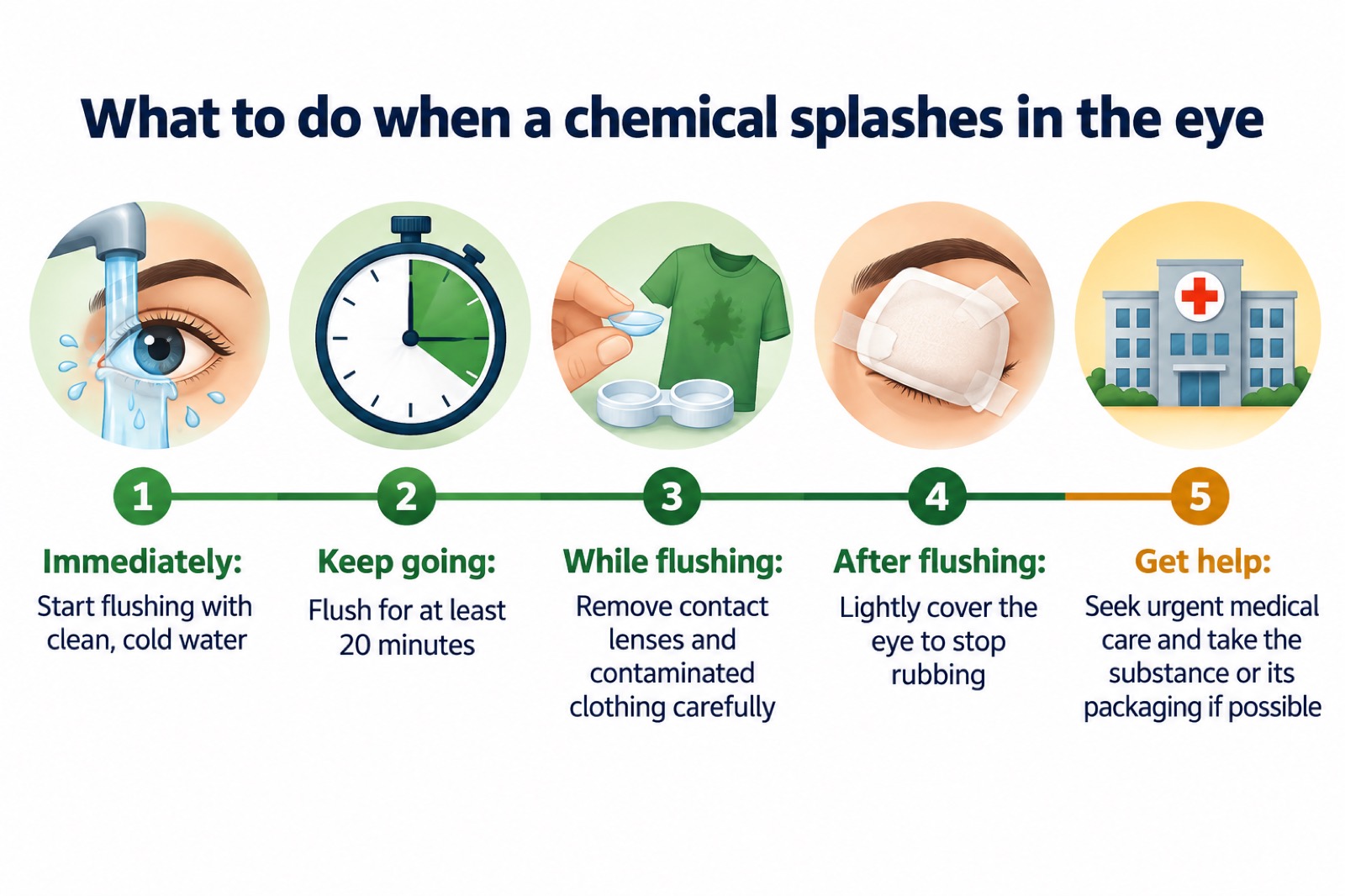
The full sequence, drawn from official poisoning and burn guidance:
- Start rinsing at once. Use clean, cold water2. Specialist eye injury guidance also allows urgent irrigation with a sterile isotonic solution such as Hartmann's or Normal Saline, an amphoteric solution, or water16.
- Protect yourself. If the casualty is contaminated with chemicals, wear protective gloves, goggles or a mask18. You help nobody by becoming a second casualty.
- Remove contact lenses. Official burn first aid guidance says to remove all nappies, jewellery and contact lenses16. A lens can hold chemical against the eye.
- Remove contaminated clothing carefully to prevent further exposure19, and avoid chemical cross-contamination, for example letting water that has rinsed the eye run onto skin or clothing that then touches the eye again16.
- Cover the eye lightly once rinsing is done, to stop rubbing2.
- Get urgent medical help, and take some of the substance or its packaging to show doctors at the hospital, if possible17.
If you do not know what the chemical is, look for clues around you, such as bottles or containers nearby18. Some substance releases are not obvious at first: official counter-terrorism guidance notes that first indicators may include unexplained signs of skin, eye or airway irritation, nausea, vomiting, twitching, sweating, disorientation and breathing difficulties20. If several people around you have irritated eyes or breathing trouble at the same time, treat it as a possible hazardous substance incident, get away from the source, and call 999.
For the full detail on rinsing times and solutions, see chemical burns and eye splashes, and for swallowed chemicals, what to do if a child swallows pills or chemicals.
When an eye injury needs urgent help
Most grit and most knocks end at home. The rest need a professional, and the dividing line is worth learning before you need it. First aid can treat all sorts of minor bumps and scrapes, but you should see a doctor for more serious accidents15.
Go to A&E, call 999, or get to an urgent treatment centre for:
- Anything embedded in the eye or the skin around it. Leave it in place and get help3.
- A chemical in the eye, after you have started rinsing. This needs hospital assessment even if it feels better2.
- A sudden change in vision, a red or painful eye, or something in the eye you cannot remove yourself. Contact your optometry practice first by telephone4.
- An object in the eye that is not easy to remove, or an eye that is very painful. Seek medical advice: call 111 or attend an Eye Casualty, Emergency Department or Urgent Treatment Centre2.
- Signs of shock: pale, unwell, faint. Lie them down and keep them covered up and warm, but not too hot10.
- A serious medical condition alongside the injury. Official burn guidance says to seek help immediately if the person has a serious medical condition21.
For less urgent problems, the routes differ slightly across the UK. In Northern Ireland, the advice for an urgent eye problem is to contact your optometry practice first by telephone, rather than your GP practice or community pharmacy4. Elsewhere, official winter health advice is to speak to your local pharmacy for advice about minor illnesses, treatments and medication, and to contact your local optician if you have an eye problem8. NHS 111, or 111 online, can direct you in England, and 111 in Wales and Scotland, when you are unsure which service fits.
If the eye problem follows a burn or scald to the face, the severity decides the destination: see your GP or go to a minor injuries unit or A&E, depending on how bad it is10. And if a burn injury is serious or meets the criteria for specialised burn care, the emergency doctor will contact the specialised burns service for advice and possible transfer to the most appropriate burn service22. Your job is the first link in that chain: cool, cover and get the person to the right door.
What to keep in a household first aid kit for eyes
Official guidance is consistent about what a home kit should contain, and it is important to have a well-stocked first aid kit in your home so you can deal with minor accidents and injuries6. For eyes specifically, three items matter.
| Item | What it is for | How many to keep |
|---|---|---|
| Sterile eye pad or sterile eye dressings | Covering a small wound or a non-embedded foreign object such as dirt or grit until you get medical advice13 | At least 26 |
| Eyewash solution | Washing out grit or dirt in the eyes5 | At least one bottle |
| Eye bath | Helping you direct eyewash into the eye steadily6 | One |
Around those three, the wider kit supports eye injuries indirectly. NHS guidance on first aid kits lists plasters in a variety of sizes and shapes, small, medium and large sterile gauze dressings, at least 2 sterile eye dressings, triangular bandages, crepe rolled bandages, safety pins, disposable sterile gloves, tweezers, scissors, alcohol-free cleansing wipes, sticky tape, a digital thermometer, creams and painkillers, distilled water for cleaning wounds, and eye wash and eye bath6. A simpler self-care list from NHS guidance in the Black Country includes bandages, plasters in a range of sizes, eyewash solution, a thermometer, sterile dressings, tweezers and antiseptic5.
Two details are worth acting on. Disposable sterile gloves and distilled water for cleaning wounds are both listed among the contents of a basic first aid kit6, alongside eyewash and an eye bath, so a well-stocked kit covers the eye as well as the everyday cuts and grazes. For the full picture on choosing a kit, see first aid kits for the home, and for the British Standard contents, BS 8599 kits explained.
For rinsing eyes specifically, there is a choice to make between small sterile saline pods and a larger eyewash bottle; the trade-offs are set out in saline pods or an eyewash bottle for rinsing eyes.
Where an eye pad is the wrong choice
An eye pad is for a small wound or loose, non-embedded grit13. There are situations where padding an eye, or padding it the obvious way, is the wrong move.
- Anything embedded. Do not cover the object with a pad that presses on it. Build padding around the object and bandage over that, avoiding pressure on the object itself9. If in doubt, leave the covering to the professionals and get to hospital.
- A chemical injury, before rinsing. Covering comes after at least 20 minutes of flushing, not instead of it2. A pad over chemical in the eye holds it there.
- A burn to the eye or face. Burn guidance is to cover loosely, not firmly: cover loosely with clean cling film, a plastic bag or a pillowcase14. The same light touch applies to the eye, which official guidance says to cover lightly1. Do not attempt to remove clothing if it is stuck to the skin; leave that for medical staff22.
- A soaked or dirty pad. If blood soaks through the pad or dressing, replace it with a new one if possible10. Re-taping a soaked pad adds nothing.
The common thread is pressure. Eyes, burns and embedded objects all share one rule: protect without pressing. If you find yourself wanting to press something onto an eye, stop and get help instead.
Children and eye injuries
Children add two complications: they rub, and they cannot always tell you what happened. NHS guidance on childhood accidents gives the framework. If your child looks pale or feels unwell after an accident, lie them down and keep them covered up and warm, but not too hot10. If you have to move a child with a serious injury, be very gentle, put one hand above the injury and the other below it to steady and support it, using blankets or clothing if necessary, comfort your child and take them to hospital10.
For the eye itself, the same rules as adults apply, with less patience available:
- Stop the rubbing first. A child with grit in an eye will want to rub hard; hold the hand, distract, and rinse.
- Rinse with clean water or eyewash if nothing is embedded1.
- Cover lightly with a sterile eye pad if needed13.
- If something is lodged firmly, leave it where it is and take them to the nearest A&E department or minor injuries unit10.
NHS guidance also flags a related childhood emergency worth knowing: if a child has a button battery lodged in their nose or ear, take them to A&E or an urgent treatment centre10. The same principle of leaving lodged objects alone and going straight to hospital applies.
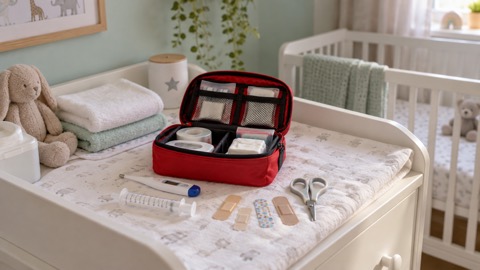
For teaching children what to do in an emergency, including how to ring 999, see teaching children basic life-saving skills, and for a kit matched to a household with children, the baby and child kit checklist.
Sources (22)
- Staying safe over the summer, Healthier Together (NHS), 2026-10-29
- Poisoning and accidental swallowing, Healthier Together (NHS), 2026-10-29
- Severe bleeding first aid, NHS inform, 2026-07-24
- COVID-19 and urgent eye problems, Health and Social Care Northern Ireland, 2024-07-11
- Keep a well stocked medicine cabinet at home, NHS Black Country Integrated Care Board, 2026-10-28
- What should I keep in my first aid kit?, Collingwood Surgery (NHS), 2026-10-28
- Cuts and grazes, North West Ambulance Service, 2024-01-31
- Your Health Guide Winter 2025, Winter and Ill Health Board (NHS Scotland), 2025-12
- First aid facts leaflet, North West Ambulance Service, 2019-04
- What to do if your child has an accident, NHS, 2025-12-18
- How to stop a child from choking, NHS, 2024-10-28
- What should I keep in my first aid kit?, NHS, 2026-10-25
- First aid kit and sterile eyepads, NHS 111 Wales, 2021
- Burns and scalds prevention, Healthier Together (NHS), 2026-10-25
- First aid, nidirect (Northern Ireland government), 2025-12-04
- Chemical eye injury guidance, London and South East Burns Network (NHS), 2026
- Poisoning, NHS, 2025-06-12
- Poisoning first aid, NHS inform, 2026-07-24
- Burns prevention and tips, Mid and South Essex NHS Foundation Trust, 2026-10-25
- Hazardous substances, Protect UK, 2024-08-22
- Burn awareness, Cheshire Fire and Rescue Service, 2026-05-20
- Burns first aid, Northern Burn Care Network (NHS), 2022-03-11
 Baby and Child Kit Checklist
 Bleeding Control Kit Checklist
 Car Kit Checklist
 Danger, Response, Airway
 CPR Steps for Adults
 2025 Resuscitation Guidelines
 Defibrillators (AEDs)
 Public Access Defibrillators
 Choosing a Defibrillator
 The Recovery Position
 Choking First Aid
 Cuts, Grazes and Wounds
 Burns and Scalds
 Adrenaline Auto-Injectors
 Sepsis Signs to Act On