
If you have shopped for a first aid kit in the UK, you will have seen "BS 8599" printed on the box. It is the British Standard for first aid kit contents: a published specification that sets out what a kit should contain, in what quantities, and how kits should be sized for the number of people they serve. The Health and Safety Executive (HSE), the body that regulates first aid at work in Great Britain, puts it plainly: "If you are buying a kit look for British Standard (BS) 8599."1
The standard comes in two parts that matter to most buyers. BS 8599-1 covers workplace kits, which come in small, medium and large sizes. BS 8599-2 covers vehicle kits, which are sized by vehicle type and passenger numbers, from a motorcycle or private car up to a full-size coach2. Neither part is a legal requirement in itself: the HSE is clear that "By law, your kit doesn't have to meet this standard but you should check it contains what you've identified in your needs assessment"1. For a household, the standard is best treated as a reliable shorthand for a well-thought-out kit, whether you keep it at home or in the car.
What BS 8599 is, and what it is not
BS 8599 is a British Standard: a published specification drawn up so that anyone buying a first aid kit can know, from the marking on the box, that the kit contains a defined set of items in defined quantities. The maker Wallace Cameron describes its BS 8599-1 (2019) kits as reflecting "the most up-to-date changes in both workplace practice and risks, making them demonstrably more 'fit for purpose' in today's environment"5. In other words, the standard is periodically revised so that kit contents track how people actually work and what injuries actually happen.
What the standard is not is a law. The HSE, which enforces first aid at work in Great Britain, states that a kit does not have to meet BS 8599 by law; what matters is that the contents match what a needs assessment has identified1. The standard sits alongside that duty as a convenient way of meeting it, and makers such as Wallace Cameron state that all BS 8599-1 (2019) standard first aid kits comply with HSE regulations3.
For a household, the same logic applies with the workplace duty stripped out. The NHS advises keeping a first aid kit at home and keeping it up to date "to ensure you can respond quickly and confidently"6. A BS 8599 kit is one way to do that, because someone else has already done the thinking about quantities and ranges of items. Local authorities across England make the same point at household level: Nottinghamshire County Council lists a first aid kit among the contents of an emergency kit7, Wiltshire Council includes toiletries and a personal first aid kit8, and Lincolnshire County Council's emergency advice likewise lists a first aid kit9.
If you are building or checking a household kit rather than buying a standard one, our page on first aid kits for the home sets out the contents to think about, and our comparison of a ready-made kit against building your own may help you decide which route suits you.
The two parts: BS 8599-1 for workplaces, BS 8599-2 for vehicles
The standard is published in parts, and the two you will meet on shop shelves are Part 1 and Part 2.
BS 8599-1 is the workplace part. Kits marked to it are packed for use where people work, and makers describe them as suitable for a wide range of settings: Wallace Cameron lists construction and industrial, education and childcare, transport, recreation, sports and leisure, retail and public spaces, and offices, with the kit particularly suited to construction, manufacturing and logistics3. Steroplast sells the same range in green boxes marked BS8599-1 Compliant, in small, medium and large sizes, each with a wall bracket included10.
BS 8599-2 is the vehicle part. As Steroplast summarises it: "BS8599-2:2019 is the British Standard for vehicle first aid kits. It outlines the recommended contents for motor vehicles to ensure appropriate first aid can be provided during roadside incidents."2 The company states its BS8599-2:19-compliant vehicle kits follow HSE guidance on what should be included to keep passengers and drivers safe10. Vehicle kits are sold in small hard plastic boxes and in green nylon pouches, all marked British Standard Compliant10.
There is also a hybrid worth knowing about: the travel and motoring kit. Reliance Medical's Aura3 kit is marked as compliant with both BS 8599-1:2019 and BS 8599-2:2014, combining workplace-style contents with motoring items in a single box measuring 20.5cm high x 20cm wide x 6.5cm deep4. The published guidance with that kit states that "Staff working remotely from a company vehicle should be equipped with a travel and motoring first aid kit. This does not supersede BS8599-2 for vehicle first aid kits"4. For a household, that dual-compliant type is a sensible single box for the car boot if you want one kit that serves both roadside and everyday injuries.
Workplace kits: small, medium and large
BS 8599-1 kits come in three sizes, and the size you choose depends on two things: how many people the kit serves, and how risky the environment is. Wallace Cameron publishes the sizing guidance for its BS 8599-1 (2019) kits as follows3:
| Environment | Small kit | Medium kit | Large kit |
|---|---|---|---|
| Low risk | Up to 25 employees | 26 to 100 employees | More than 100 employees |
| Higher risk | Up to 5 people | 6 to 25 people | 26 or more people |
Steroplast's own green box range is labelled by headcount in a similar spirit: the small box is marked for up to 25 people, the medium box for 25 to 50 people, and the large box for 50+ people10. The two makers' labelling differs at the margins, so treat the numbers as guidance rather than a hard threshold, and step up a size when in doubt.
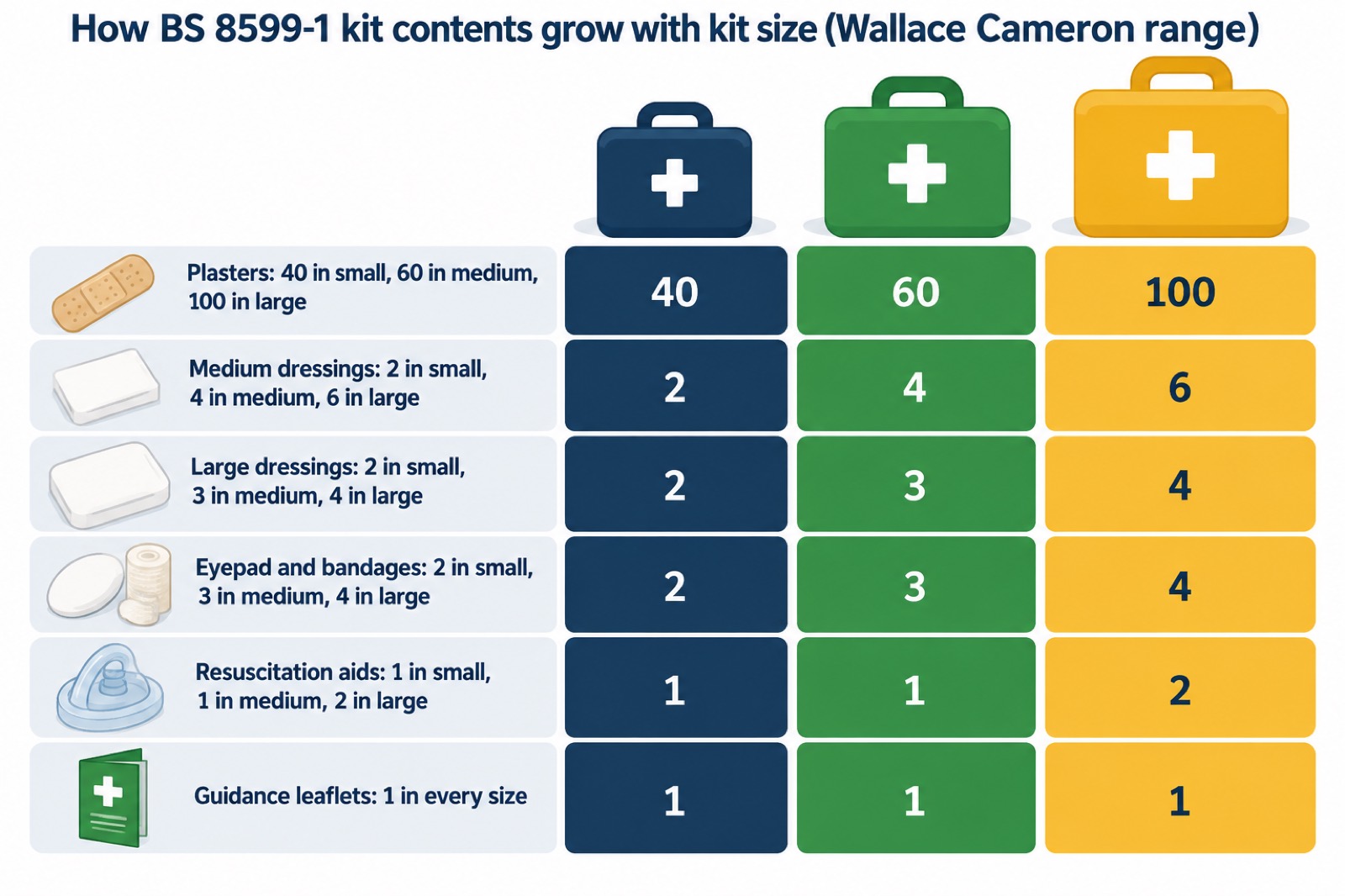
The contents scale with the size. Taking Wallace Cameron's sustainable BS 8599-1 (2019) range as an example, the small kit (product 1000144) contains 40 plasters, 2 medium dressings, 2 large dressings, 1 conforming bandage, 2 triangular bandages, 6 pairs of gloves, 1 resuscitation aid, 2 eyepads and bandages, 1 pair of scissors and 1 first aid guidance leaflet3. The medium kit (1000145) raises this to 60 plasters, 4 medium dressings, 3 large dressings, 2 conforming bandages, 3 triangular bandages, 1 resuscitation aid, 3 eyepads and bandages, 2 thermal blankets, 1 pair of scissors and 1 leaflet3. The large kit (1000146) carries 100 plasters, 6 medium dressings, 4 large dressings, 2 conforming bandages, 2 resuscitation aids, 4 eyepads and bandages and 1 leaflet3.
The physical boxes scale too. Steroplast's small and medium green boxes both measure 26.5cm x 27.5cm x 9cm, while the large box measures 34cm x 27cm x 10cm10. All three include a wall bracket, so the kit can be fixed where people can find it10.
For a household, the small kit is usually the right starting point. Its contents map closely onto what a family actually uses: plasters for cuts and grazes, medium and large dressings and conforming bandages for bleeding, triangular bandages for slings, gloves for cleanliness, saline wipes for cleaning a wound, and a foil or thermal blanket for shock or cold. If you want to understand what each dressing type is for before you buy, see dressings, bandages and plasters, and for treating the injuries themselves, cuts, grazes and wounds and burns and scalds.
Vehicle kits: sized by vehicle type and passenger numbers
BS 8599-2 takes a different approach to sizing. As the guidance published with Reliance Medical's vehicle kits puts it: "The size and the quantity of kits for any vehicle is determined by the vehicle type and passenger numbers."4 Steroplast sells its BS 8599-2 range in four configurations2:
| Kit size | Passengers | Typical vehicles |
|---|---|---|
| Small | 1 to 3 | Motorcycles, private cars |
| Medium | 1 to 8 | Vans, taxis, small company vehicles |
| Large | 1 to 16 | Minibuses, small coaches |
| 2 x Large | 17 or more | Full-size coaches, buses, multi-level vehicles |
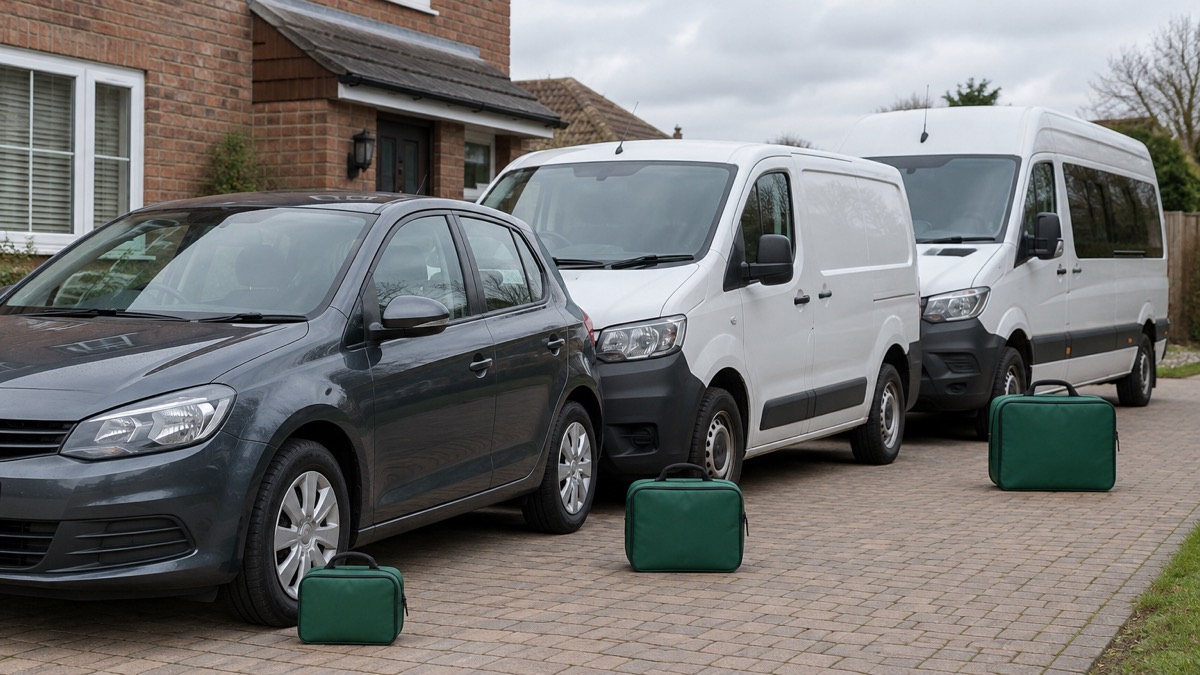
The Reliance guidance makes the same point for the large kit: it is for minibus, bus and coach, with a maximum of 16 passengers, and larger passenger vehicles require multiple kits to suit4. So a family car takes a small kit, and if you drive a seven-seat vehicle or a camper you are into medium territory.
The contents are tuned for roadside incidents rather than office paperwork. Steroplast's large BS 8599-2 kit, in a pouch measuring 26cm x 18cm x 6.5cm and weighing 1.1kg, carries 3 foil blankets, 4 burn dressings, 2 adhesive wound dressings, 20 saline cleansing wipes, 1 pair of Tuff Cut scissors, 1 first aid emergency leaflet and more2. The Reliance travel and motoring kit adds trauma dressings in medium and large sizes, 2 burn dressings of 10cm x 10cm, 1 adult foil blanket, 10 washproof assorted plasters, 2 pairs of gloves, 1 triangular bandage, shears, 10 cleansing wipes, 1 resuscitation device and 1 guidance leaflet4. The trauma dressings and burn dressings reflect what actually happens in a collision: heavy bleeding and burns from hot engine parts or fluids.
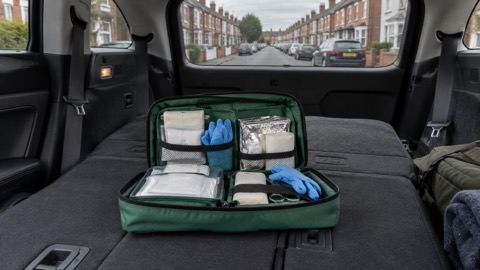
If you carry a kit in the car, our car kit checklist for injuries on the road goes beyond the standard contents to the other items worth having after a collision, and severe bleeding explains how the trauma dressings in these kits are actually used.
How BS 8599 relates to HSE first aid guidance
The legal backdrop, briefly, is this. The Health and Safety (First-Aid) Regulations 1981 require employers to provide adequate and appropriate equipment, facilities and personnel so that their employees receive immediate attention if they are injured or taken ill at work12. That duty is about adequacy, not about any particular standard, which is why the HSE says a kit need not meet BS 8599 by law so long as it contains what your needs assessment identified1.
BS 8599-1 exists to make meeting that duty straightforward. Wallace Cameron states that all BS 8599-1 (2019) standard first aid kits comply with HSE regulations3, and its workplace kit range as a whole is developed to meet HSE and BS 8599-1 (2019) standards13. Individual components are made to the same benchmarks: the company's triangular bandage is described as compliant with HSE and BS 8599-1 (2019) first aid standards and "a key component in both HSE and BS 8599-1 (2019) workplace first aid kits"14, and its sterile saline wipes are stated to be fully compliant with medical device regulations and usable in both HSE and BS 8599-1 (2019) first aid kits15.
Two points of HSE-adjacent guidance are worth knowing even as a household. First, defibrillator familiarisation and training is part of the HSE's first aid at work guidance, and the HSE strongly recommends workplace first aiders receive annual refresher training to maintain competency16. Second, the HSE publishes a "basic advice on first aid at work" poster, ISBN 9780717666706, which provides basic advice on first aid for use in an emergency17. Neither applies to a household, but both show the direction of travel: a kit is one half of preparedness, and knowing what to do with it is the other. Our pages on first aid courses and learning CPR free online cover the training half.
On the resuscitation side, the Resuscitation Council UK's current guidance is worth a look if you keep a kit that includes a resuscitation aid. Its first aid guidelines advise an ABCDE approach to promptly identify and treat life-threatening conditions: Airway, Breathing, Circulation, Disability, Exposure18. Its defibrillator guidance covers familiarisation and training in the use of a defibrillator as part of workplace first aid16. For the practical steps, see how to do CPR and defibrillators and how to use one.
Checking which edition a kit meets
The standard carries a year in its title, and kits on sale today are marked to different editions. The current workplace edition is BS 8599-1:2019: Wallace Cameron's sustainable workplace range is fully compliant with BS 8599-1 (2019)3, and Reliance's first aid stations are likewise marked BS8599-1:2019 compliant5. On the vehicle side, Steroplast's current vehicle kits are marked BS8599-2:20192, while the Reliance travel and motoring kit is marked to the earlier BS8599-2:2014 vehicle edition alongside BS8599-1:20194. Both editions are on sale, and the pack marking tells you which you are holding.
The practical advice is simple: check the marking on the box before you buy, and check it again if you are refilling an older kit, so that the refill matches the edition the kit claims. The same habit serves elsewhere in household safety. Devon and Somerset Fire and Rescue Service advises buyers of fire blankets to "Always look for the British Standard mark (BS EN: 1869:1997 or BS 7944:1999)"19, and UK Power Networks advises householders to purchase electrical equipment that complies with the British Standards Institution20. A standard mark on the product is the quickest way to know what you are getting.
Keeping a kit up to standard: refills and replacement items
A first aid kit is not a buy-once item. The NHS advises keeping your first aid kit up to date so you can respond quickly and confidently6, and in a workplace context the duty to keep contents adequate is continuous. In practice that means replacing what has been used, checking dates on sterile items, and swapping out anything damaged or dirty.
The refill trade exists to make this straightforward. Wallace Cameron's BS 8599-1 (2019) workplace first aid kit includes 1 first aid guidance leaflet among its contents21, and refill packs exist to restore a part-used kit to that standard rather than leaving gaps. Steroplast likewise confirms that refill packs and individual items are available for its BS 8599-2 vehicle kits2, so a used dressing or a torn glove does not mean buying a whole new kit.
A simple checking routine for any BS 8599 kit, home or vehicle:
- Check the kit still holds its first aid guidance leaflet, 1 leaflet in the Wallace Cameron BS 8599-1 (2019) workplace kit21
- Refill and upgrade existing workplace eye wash kits with key components recommended by BS8599-1:2026 where your kit includes eye wash21
- Replace any used item from a refill pack, since Steroplast supplies refill packs and individual items for its BS 8599-2 vehicle kits2
- Re-check after any incident, however small, since a grazed knee can empty a plaster strip without anyone noticing
Wall stations, eye wash and the extras around a standard kit
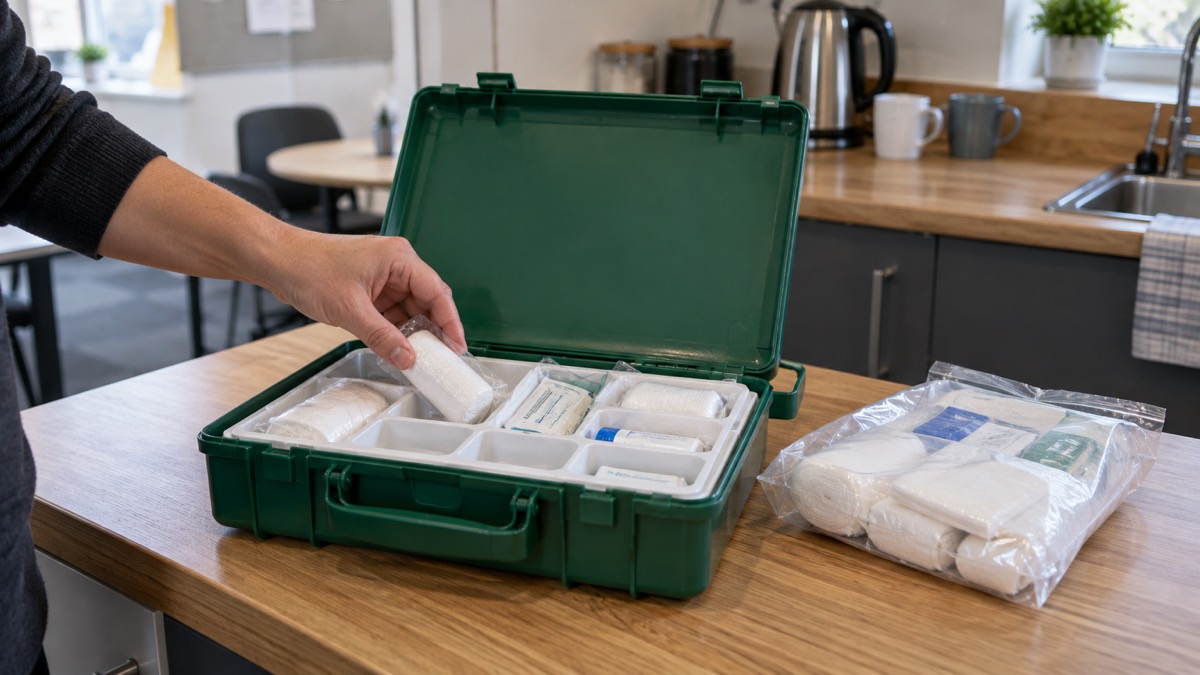
Beyond the basic boxes, the BS 8599 world includes a few fixtures worth knowing about, mostly seen in workplaces but available to anyone.
Wall-mounted first aid stations. Reliance Medical's BS8599-1:2019 compliant first aid station is a deluxe wall station for storing first aid supplies, manufactured from high quality, wipe-clean ABS plastic with a dustproof lid to keep contents clean5. Each wall panel displays all the British Standard compliant contents in a way that ensures effortless selection of specific components5. The station can be supplied holding a BS8599-1:2019 small workplace kit (product reference 3410)5. For a household, the principle is what matters: the kit lives in one visible place and everyone knows where.
Eye wash. The BS 8599-1 kits themselves carry eyepads and bandages, 2 in the small kit, 3 in the medium and 4 in the large3, plus sterile saline wipes for cleaning around the eye15. Where a fuller rinsing capability is needed, dedicated eye wash stations exist: Reliance's 906 and 909 Eye Pod stations each contain 2 dressings, an eye pad, 2 x 500ml eye wash bottles and a mirror22. Our comparison of saline pods against an eyewash bottle sets out the choices for rinsing eyes at home, and eye injuries covers what to do for grit, objects and blows.
Guidance leaflets and posters. The Wallace Cameron BS 8599-1 (2019) workplace kit includes 1 first aid guidance leaflet among its contents21. The leaflet is a prompt, not a course. For a wall reference, the HSE's basic advice on first aid at work poster, ISBN 9780717666706, provides basic advice on first aid for use in an emergency17.
Trauma and bleeding control. A household BS 8599 kit covers everyday injuries, but trauma dressings and tourniquets are a step beyond it, belonging to the bleeding control world. Our bleeding control kit checklist covers what belongs in one and when.
What BS 8599 means for a household buyer
Pulling it together, the standard matters to an ordinary household in three ways.
First, it is a quality shorthand. When a kit is marked BS 8599-1:2019 or BS 8599-2:2019, a named specification stands behind the contents list, and the HSE itself suggests looking for the marking when buying1. That is worth having when comparing kits that otherwise look alike.
Second, it is a sizing guide. The workplace logic, more people and higher risk means a bigger kit, translates directly to households: a small kit serves a family, and a household with particular risks, say a member who works with tools at home, steps up a size. The vehicle logic is even simpler: count the seats and match the kit2.
Third, it is a maintenance system. Because refills exist for every size and the contents lists are published, a BS 8599 kit can be kept complete for years without guesswork2. That fits the wider preparedness habit: a first aid kit sits alongside the torch, the water and the other items in a household emergency kit, and it only works if it is checked7. Our emergency kit guide and getting started page place the first aid kit in that wider context.
Sources (22)
- What to put in your first aid kit, Health and Safety Executive, 2026
- BS8599-2 Vehicle First Aid Kit, Steroplast, 2026-10-29
- Sustainable BS 8599-1 (2019) Workplace First Aid Kit, Wallace Cameron, 2026-05-15
- Aura3 BS8599-2 Motoring kit datasheet, Reliance Medical, 2023-02-15
- BS8599-1:2019 Compliant First Aid Station, Reliance Medical, 2021-03-17
- What should I keep in my first aid kit?, NHS, 2026-10-25
- Preparing for an emergency, Nottinghamshire County Council, 2026-10-29
- Planning for an emergency kit, Wiltshire Council, 2026-10-29
- Get help and advice in an emergency, Lincolnshire County Council, 2026-10-29
- First aid kits, Steroplast, 2026-10-28
- HSE first aid kits case, Steroplast, 2026-10-29
- Standards for public access trauma (PACT) first aid kits and equipment, ProtectUK, 2026-06-01
- Workplace first aid kits, Wallace Cameron, 2026-10-29
- Sustainable Triangular Bandage, Wallace Cameron, 2026-05-15
- Sustainable Sterile Saline Wipes, Wallace Cameron, 2026-05-15
- AED Guide, Resuscitation Council UK, 2026
- Basic advice on first aid at work poster, Health and Safety Executive, 2017
- Resuscitation Council UK first aid guidelines, Resuscitation Council UK, 2025-10-27
- Fire safety equipment, Devon and Somerset Fire and Rescue Service, 2026
- How do I keep equipment safe during a power cut?, Northern Ireland Electricity Networks, 2026-10-25
- First Aid Kit Refills, Wallace Cameron, 2026-05-15
- Eye Pod Station flyer, Reliance Medical, 2023
 Baby and Child Kit Checklist
 Bleeding Control Kit Checklist
 Car Kit Checklist
 Danger, Response, Airway
 CPR Steps for Adults
 2025 Resuscitation Guidelines
 Defibrillators (AEDs)
 Public Access Defibrillators
 Choosing a Defibrillator
 The Recovery Position
 Choking First Aid
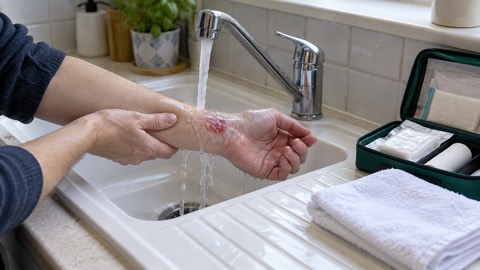 Cuts, Grazes and Wounds
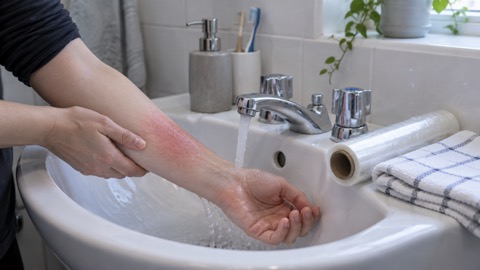 Burns and Scalds
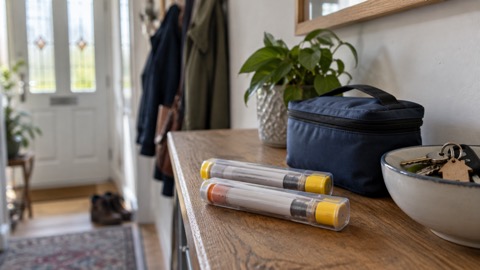 Adrenaline Auto-Injectors
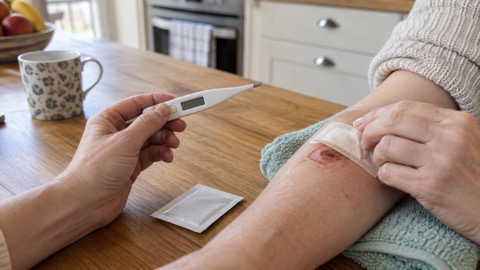 Sepsis Signs to Act On