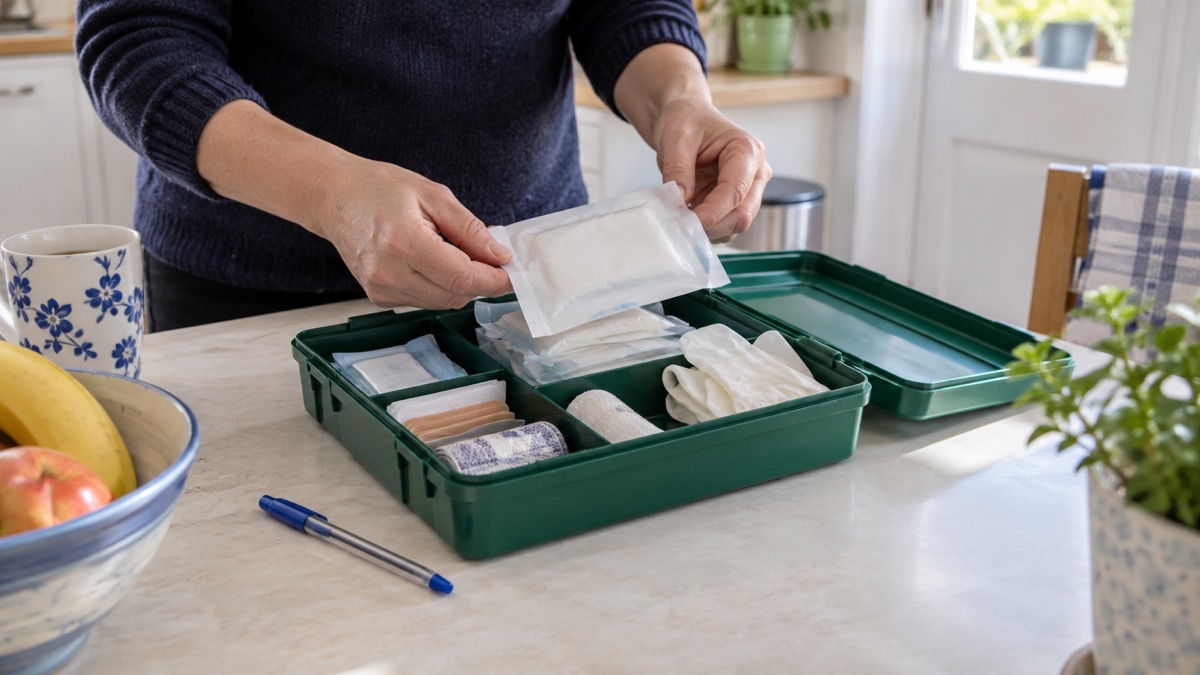
A small workplace first aid kit is one of the most useful things a household can put in its emergency cupboard, and the Wallace Cameron small kit is built for exactly that job: a boxed set of dressings, plasters, bandages and gloves that lets you deal with a cut, a graze or a bleed while you wait for help or decide whether help is needed. Wallace Cameron states that its workplace kits are developed to meet HSE and BS 8599-1 (2019) standards1.
For a household preparing for a power cut, a flood, a storm or an outbreak, the kit matters because injuries happen at the worst times. A fall on a dark stair during a power cut, a cut clearing up after a flood, a scald while cooking without mains gas: all of these need a dressing and a clean pair of gloves before anything else. The kit does not replace training or a call to 999, but it means you are not hunting through kitchen drawers for a plaster while someone is bleeding.
This page covers what the kit is for, what it holds, who it suits, how to use it in an emergency, where to store it, how to check it and what to do about expiry dates on sterile items. It is written for a household that wants to be ready, not for a facilities manager, though the same kit serves both.
What the Wallace Cameron Small Workplace First Aid Kit is for
The kit is a workplace first aid kit, which means it is designed around the injuries that happen in ordinary working life: cuts, grazes, small wounds, eye splashes and the occasional bleed that needs a proper dressing rather than a plaster. Wallace Cameron makes it in a range of sizes, with small, medium and large workplace kits listed alongside each other, and states that the range is developed to meet HSE and BS 8599-1 (2019) standards7. The small kit is the entry size in that range.
For a household, that makes it a sensible core kit rather than a specialist one. It is not a trauma kit and it is not a burns kit; it is the general-purpose box you reach for first. The First Aid at Home: A Household Guide sets out the wider picture of what a home should hold, and the First Aid Kits for the Home: Contents and How to Choose page helps if you are deciding between a ready-made kit and building your own.
What the kit does for a household in an emergency is simple: it puts the right item in one known place. In a power cut, a flood clean-up or a storm, the difference between a small injury and a bigger problem is often whether a sterile dressing and a pair of gloves were within reach. The kit is also a prompt: having it means you have thought about first aid before you needed it.
Wallace Cameron lists its workplace kits across a range of industries, including construction and industrial settings, education and childcare, healthcare, offices and workspaces, retail and public spaces, and sports and leisure1. That breadth is a fair guide to what the kit is expected to handle: the everyday injuries of ordinary life, not major trauma.
Specifications: what the kit contains
The kit's contents follow the workplace first aid standard, and the HSE publishes the minimum list that a low-risk workplace kit should contain2:
- a leaflet giving general guidance on first aid
- individually wrapped sterile plasters of assorted sizes
- sterile eye pads
- individually wrapped triangular bandages, preferably sterile
- safety pins
- large and medium-sized sterile, individually wrapped, unmedicated wound dressings
- disposable gloves
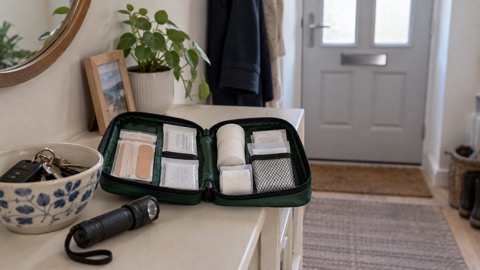
That is the minimum for low-risk work such as desk-based work, and it is a good description of what a small workplace kit is built around2. The kit is supplied as a boxed set, and first aid kits are typically stored in a green box with a white cross that should be easy to locate8.
| What the kit is built around | What it is for |
|---|---|
| Plasters, assorted sizes | Small cuts and grazes |
| Sterile eye pads | Eye injuries and covering an eye |
| Triangular bandages and safety pins | Supporting an injured arm or hand |
| Sterile wound dressings, medium and large | Larger cuts and bleeding wounds |
| Disposable gloves | Protecting you and the casualty |
| General first aid leaflet | Guidance on what to do first |
The exact contents vary by pack size and by range, so check the label on the box you receive rather than assuming. If you want to understand how the British Standard sizes kits, the BS 8599 Kits Explained: What the British Standard Covers page goes through it. For a household that wants to add to the kit, the Dressings, Bandages and Plasters: What Each One Is For page explains what each item does.
Who the small kit suits at home and at work
The small kit suits two kinds of buyer: a small workplace with a handful of staff, and a household that wants one boxed kit rather than a drawer of odds and ends. Wallace Cameron makes small, medium and large workplace kits, listed alongside each other7.
At work, it fits a low-risk setting: an office, a shop, a small studio or a workshop where the work is desk-based or light. The HSE's minimum list is written for exactly that kind of low-risk work2. At home, it fits a flat or a small house, and it is a sensible size to keep in a cupboard or to carry in the car.
It is less suited to a large household, a club or a site with several people working at height or with machinery, where a medium or large kit matches the number of people better. If you are choosing between sizes, the Wallace Cameron Medium Workplace First Aid Kit and Wallace Cameron Large Workplace First Aid Kit pages set out the bigger options. A household with young children may also want the Wallace Cameron Family First Aid Kit alongside it.
For a household preparing for emergencies, the small kit is a good first kit and a good second kit: one at home, one in the car. It is not a substitute for a bleeding control kit if you want to be ready for severe bleeding, and it is not a burns kit. The Ready-Made Kit or Building Your Own: Which Suits a Household? page helps you decide whether to add to it.
Using the kit in an emergency
In an emergency, the kit is the second thing you reach for, not the first. The first is your own safety: check for danger before you touch anyone, then follow the steps on the What to Do First: Danger, Response, Airway and Breathing page. Only then open the kit.
A simple order of work:
- Make the area safe and protect yourself. Put on disposable gloves from the kit before you touch a wound or blood. The Protecting Yourself When Helping: Gloves, Masks and Needle Injuries page covers this in detail.
- Deal with severe bleeding first. Press firmly on the wound with a sterile dressing from the kit and keep pressing. The How to Stop Severe Bleeding page sets out the technique.
- Clean and cover cuts and grazes. The Cuts, Grazes and Wounds: Cleaning and Dressing at Home page explains how to clean a wound and which dressing to use.
- Support an injured limb. Use a triangular bandage and safety pins from the kit to support an arm or hand while you get advice.
- Cover an eye injury. Use a sterile eye pad from the kit and get medical advice. The Eye Injuries: Grit, Objects and Blows to the Eye page explains when it needs a doctor.
- Call for help if needed. Ring 999 or 111 if the injury is serious, and have the Information to Have Ready for the Ambulance Crew to hand.
The kit supports first aid; it does not replace training. If you have not done a course, the First Aid Courses: Types, Length and Where to Find One page explains the options, and the Learning CPR Free Online: RevivR and Other Options page covers free online training. For a household with children, the Teaching Children Basic Life-Saving Skills and How to Ring 999 page is worth reading together.
Where to store the kit
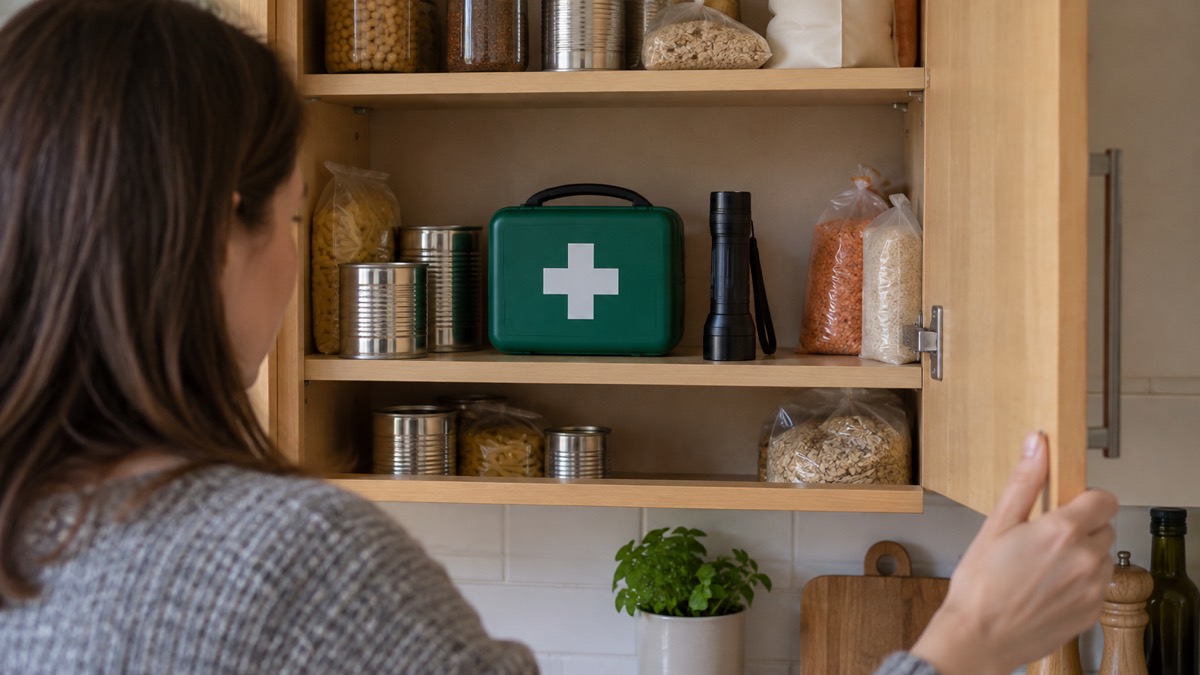
Store the kit where you will find it in the dark, in a hurry, and with one hand. The maker's guidance for a home kit is to keep it in a safe, dry and easily accessible place, such as a kitchen cupboard out of reach of small children, under the stairs, in a family bathroom or the living room3. First aid kits are also typically stored in a green box with a white cross and should be easy to locate8.
A few practical points for a household preparing for emergencies:
- Keep it dry. A bathroom cupboard is fine if it is away from the shower and the bath; a damp cupboard ruins cardboard packaging and can damage sterile wrappers.
- Keep it out of reach of small children, as the maker advises3, and tell older children where it is.
- Put a torch beside it. In a power cut you will be looking for the kit in the dark, and the Emergency Lighting at Home: Torches, Lanterns and Candles page explains what to keep.
- Keep a second kit in the car. NHS Scotland advises keeping one stocked at home, in your vehicle or at work9. The Car Kit Checklist for Injuries on the Road lists what to add.
- Tell the household where it is. A kit nobody can find is not a kit.
If you want the kit off the floor, check the box you receive for mounting points before you drill anything. The product information does not state a wall fixing, so a shelf at eye level is the simpler answer.
Checking the kit and replacing used items
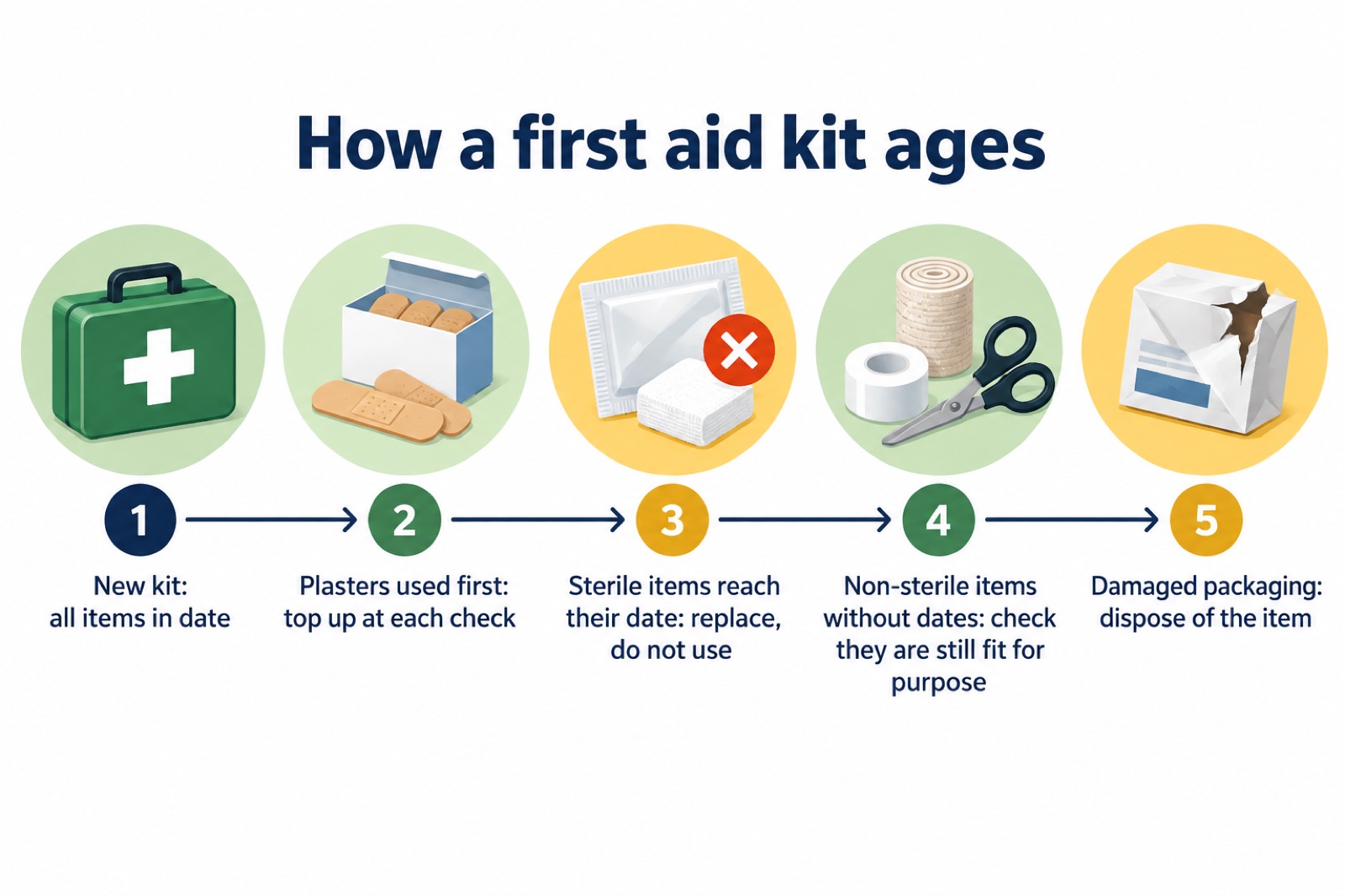
Check the kit regularly. The HSE advises checking your kit regularly, noting that many items, particularly sterile ones, are marked with expiry dates, and replacing expired items and disposing of them safely2. The British Red Cross adds that some items have shorter expiry dates and some get used more frequently, so it may be appropriate to stock up on extra plasters to replenish kits during regular checks10.
A simple routine for a household:
- Check it twice a year, for example when the clocks change, and after any incident where you used it.
- Read the dates on every sterile item: dressings, eye pads and wipes.
- Replace what has expired or been used, and dispose of the old items safely2. The How to Dispose of Used or Out-of-Date First Aid Supplies guidance covers safe disposal.
- Stock up on extra plasters so you can quickly replenish the kit during regular checks, as some items get used more frequently than others5.
- Check non-sterile items without dates to make sure they are still fit for purpose2.
When you restock, Wallace Cameron sells refill kits that are ideal for routine restocking or replacing used contents after an incident11. The refills are described as compatible with both HSE and BS 8599-1 (2019) workplace kits, and are suitable for a range of settings from offices and schools to construction and industrial sites7. Catering versions include blue detectable plasters for food handling areas11. Buying a refill rather than a new kit keeps the box you already know.
Expiry dates on sterile items
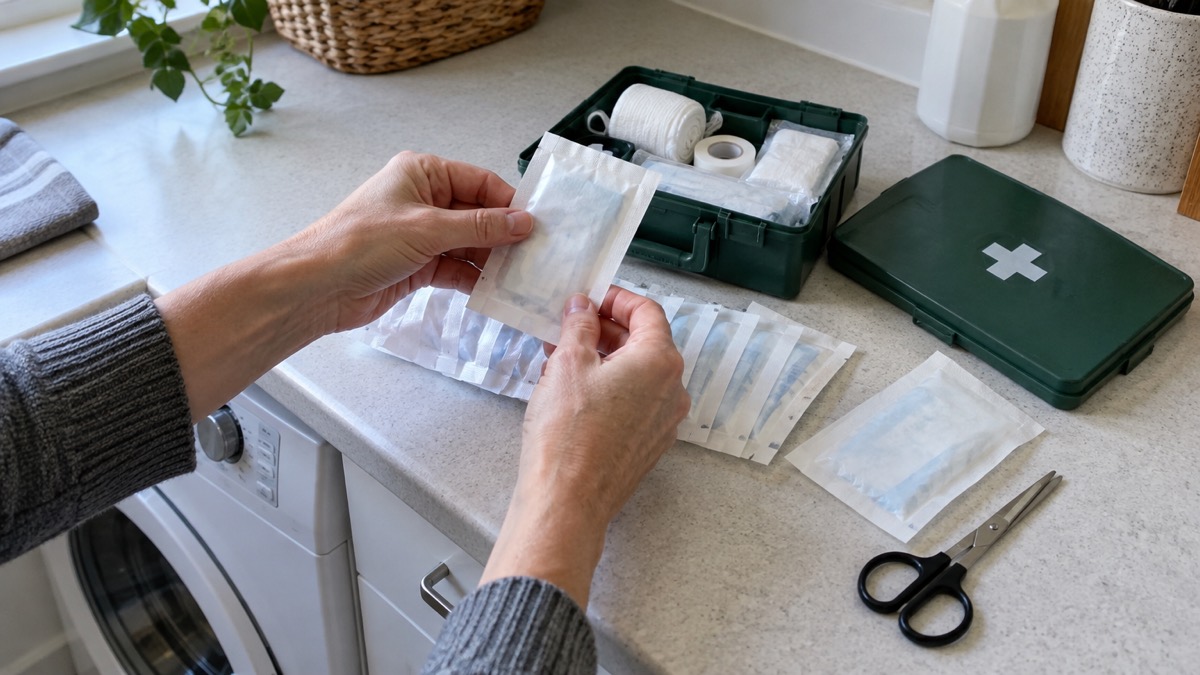
Sterile items are the part of the kit that ages. Manufacturers can only guarantee an item is sterile up to its expiration date, and using an expired dressing or wipe on an open wound can lead to infection and illness4. That is why the date on the packet matters more than the date on the box.
The official advice on wipes is a good example of how carefully this is treated. Following a product safety notice, the public was advised to ensure that a first aid kit only contains wipes marked as sterile, that the packaging around wipes marked as sterile is not damaged, and that products are in date, disposing of any wipes with damaged packaging or past their expiry date12.
"please ensure your first aid kit only contains wipes marked as 'sterile', the packaging around wipes marked as 'sterile'"
For non-sterile items without dates, the HSE advises checking that they are still fit for purpose2. A triangular bandage that has been used to sling an arm can be washed and reused; a sterile dressing that has been opened cannot be resterilised and should be replaced.
Support and safety notices
Wallace Cameron lists its workplace kits across construction and industrial settings, education and childcare, healthcare and first aid, hygiene and janitorial, offices and workspaces, recreation, sports and leisure, and retail and public spaces1. That range is a sign of how widely the kit is used, and it means spares and refills are easy to find. The maker's own product pages are the place to check the contents of a specific pack and the refills that match it11.
On safety, three points bear on a household:
- Sterile means in date. Replace expired sterile items rather than using them4, and check that wipes are marked sterile and their packaging is undamaged12.
- Gloves protect you as well as the casualty. Put them on before you touch blood or a wound, as the Protecting Yourself When Helping: Gloves, Masks and Needle Injuries page explains.
- A kit is not a diagnosis. If an injury is serious, or you are unsure, ring 999 or 111. The How Ambulance Services Prioritise 999 Calls and Response Times page explains what happens next.
For a household building a wider emergency plan, the kit belongs with the other basics: water, food, light and warmth. The Emergency Kit: What a UK Household Should Keep Ready page sets out the full list, and the Getting Started: Preparing Your Household for an Emergency page is the place to begin. If someone in the household has a medical condition, the Message in a Bottle: Keeping Medical Details Where Responders Look page explains how to make their details easy to find.
Sources (12)
- Workplace First Aid Kits, Wallace Cameron, 2026-10-29
- What to put in your first aid kit, Health and Safety Executive, 2026
- Keeping a first aid kit at home, Steroplast, 2022-08-10
- How to dispose of used or out-of-date first aid supplies, Steroplast, 2023-03-02
- Emergency kit checklist, Neath Port Talbot Council, 2026-10-29
- Emergency kit, Ready Scotland, 2026-10-22
- Wallace Cameron Sustainable First Aid Kit Refill, Wallace Cameron, 2026-08-21
- What to put in a first aid kit, St John Ambulance, 2026-10-29
- Avoiding slips, trips and falls in winter, NHS Scotland, 2026-10-29
- How often should first aid kits be checked and maintained?, British Red Cross, 2025-01-20
- Wallace Cameron First Aid Kit Refills, Wallace Cameron, 2026-05-15
- Public advised to stop using certain non-sterile alcohol-free wipes, GOV.UK, 2025-08-04

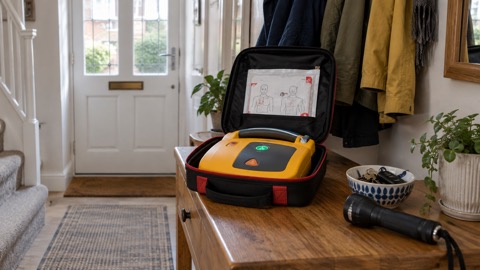 HeartSine samaritan PAD 350P
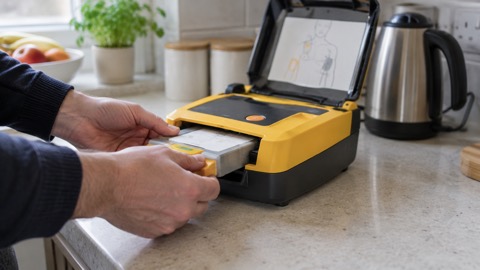 HeartSine Pad-Pak
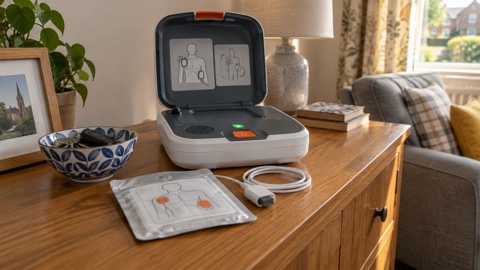 Stryker LIFEPAK CR2
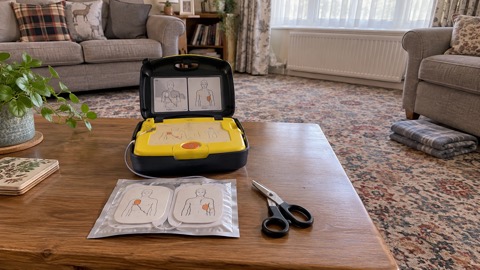 ZOLL AED 3 Defibrillator
 ZOLL AED Plus Defibrillator
 Cardiac Science Powerheart G5
 Philips HeartStart FRx AED
 LifeVac Anti-Choking Travel Kit
 Wallace Cameron Family Kit
 Burnshield Hydrogel Spray 125ml
 Burnshield Hydrogel Gel 50ml
 EpiPen Adrenaline Auto-Injector