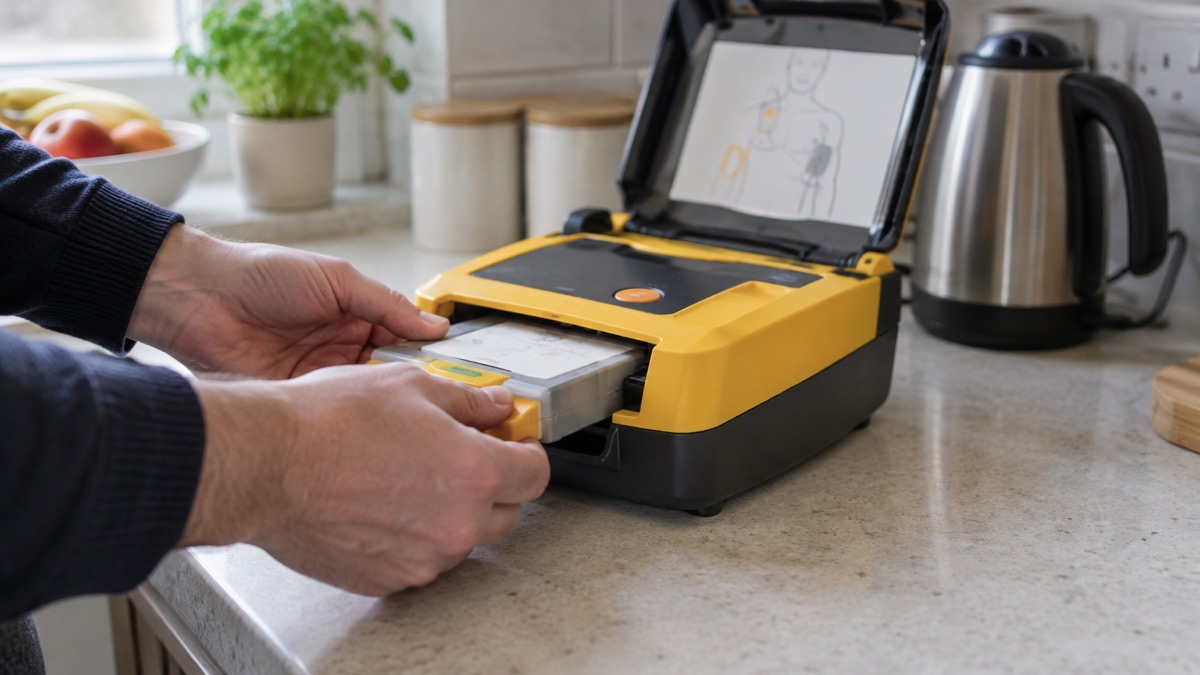
The HeartSine Pad-Pak is the part of a HeartSine samaritan defibrillator that most often needs your attention. It is a single sealed cartridge that holds both the battery and the two electrode pads, so one expiry date covers everything that wears out. Fit it, check it, and replace it when the date comes round or after the device has been used on someone.
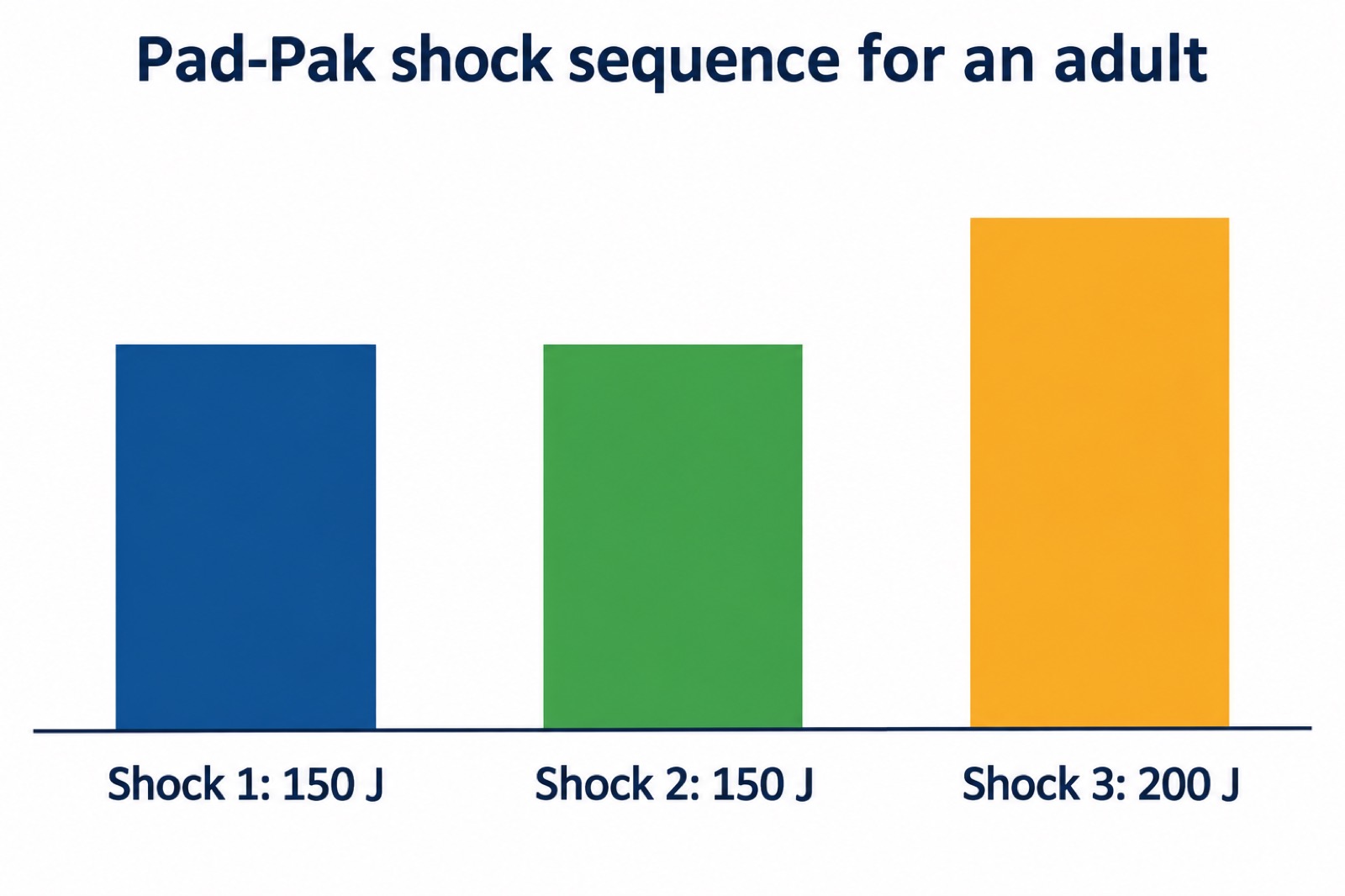
The figures that decide how you look after it are simple. A new Pad-Pak has a shelf life of four years from the date of manufacture1, and when new it holds enough charge for more than 60 shocks at 200 J or 6 hours of battery use2. The adult cartridge delivers shocks of 150 J, 150 J and then 200 J3. It is for patients over 8 years old or over 25 kg (55 lb); children between 1 and 8 years, or up to 25 kg, need the Pediatric-Pak2.
If your device is beeping and showing a red status indicator while switched on, HeartSine's manual is blunt about what that means: there is insufficient battery capacity to deliver a shock, and you should replace the Pad-Pak immediately or seek an alternative defibrillator3. That is not a fault to watch for a few weeks. It is the moment to act.
One cartridge for battery and pads
Most defibrillators ask you to keep two consumables in stock: a battery and a set of pads, each with its own date. The Pad-Pak combines them. It is described as an integrated battery and electrode single-use cartridge with one expiration date4, and it is the interchangeable pack that the samaritan range runs on2. The battery inside is a LiMnO2 cell rated 18V, 1500mAh, and it is not rechargeable3.
That design has a practical consequence for a household, club or village that owns a samaritan. There is only one thing to buy, one date to diarise and one part to fit. When you swap the Pad-Pak you are renewing the pads and the battery together, so you cannot end up with a fresh battery and out-of-date pads, which is a common way for a defibrillator to fail at the moment it is needed.
The trade-off is that you cannot replace one half on its own. If the pad pouch has been broken or compromised in any way, the whole cartridge must be replaced, even if the battery is still good2. Store it somewhere the pouch will not be punctured or crushed, and keep it away from anything that might pierce the foil.
Four years from manufacture, not from purchase
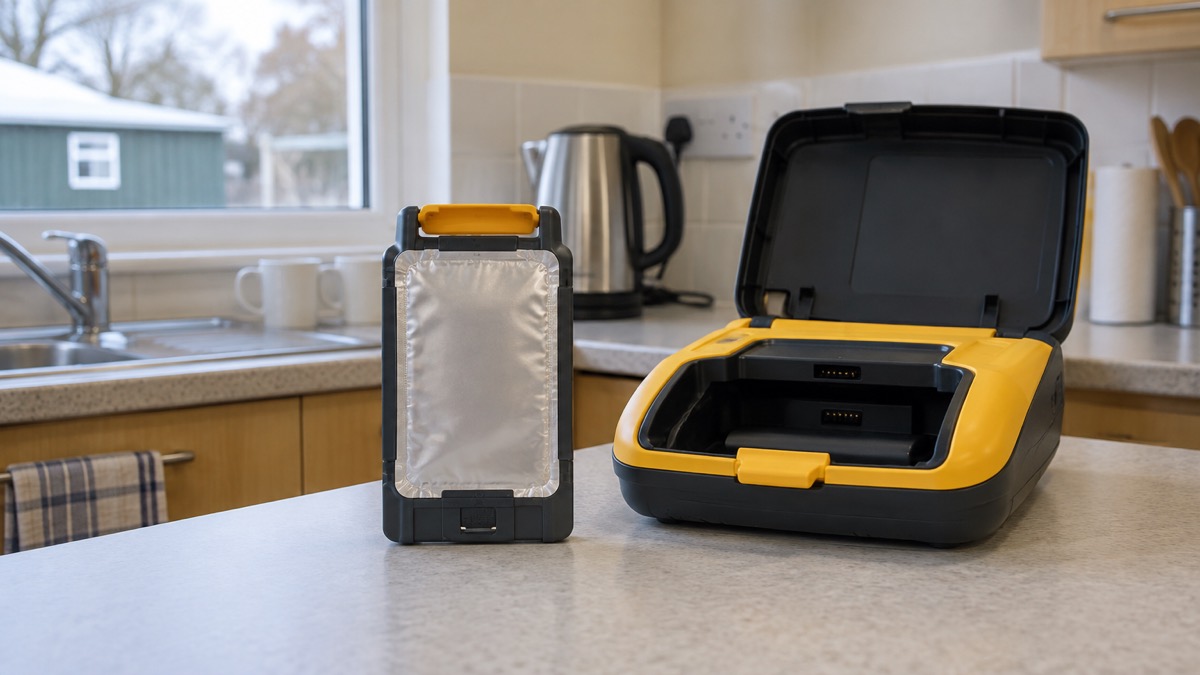
The Pad-Pak has a shelf life of four years from the date of manufacture1. That is the maker's figure, and it is the one to plan around. Note the wording: from manufacture, not from the day it arrives with you. A cartridge that has sat in a stockroom for a year has three years left, not four, so always read the date printed on the pack rather than the date on your order.
For context, the Resuscitation Council UK's minimum specification for a publicly accessible defibrillator requires compatible self-adhesive pads to have a shelf life of at least two years from the date of supply, and to be capable of being pre-connected5. The Pad-Pak's four-year figure sits comfortably above that floor, which is one reason the samaritan range is common in community schemes.
Checking the date is part of ordinary upkeep. HeartSine's manual says the devices need no servicing or testing because they run a weekly self-test, but it still asks owners to check the status indicator weekly and to check for physical damage and the Pad-Pak expiry monthly3. Put the expiry month in a calendar, on the cabinet, or in whatever record your group keeps. Northern Ireland Ambulance Service lists the pads expiry date among the details to record when a defibrillator is registered with it7, which is a useful prompt for what to write down.
What the battery will do, and what it will not
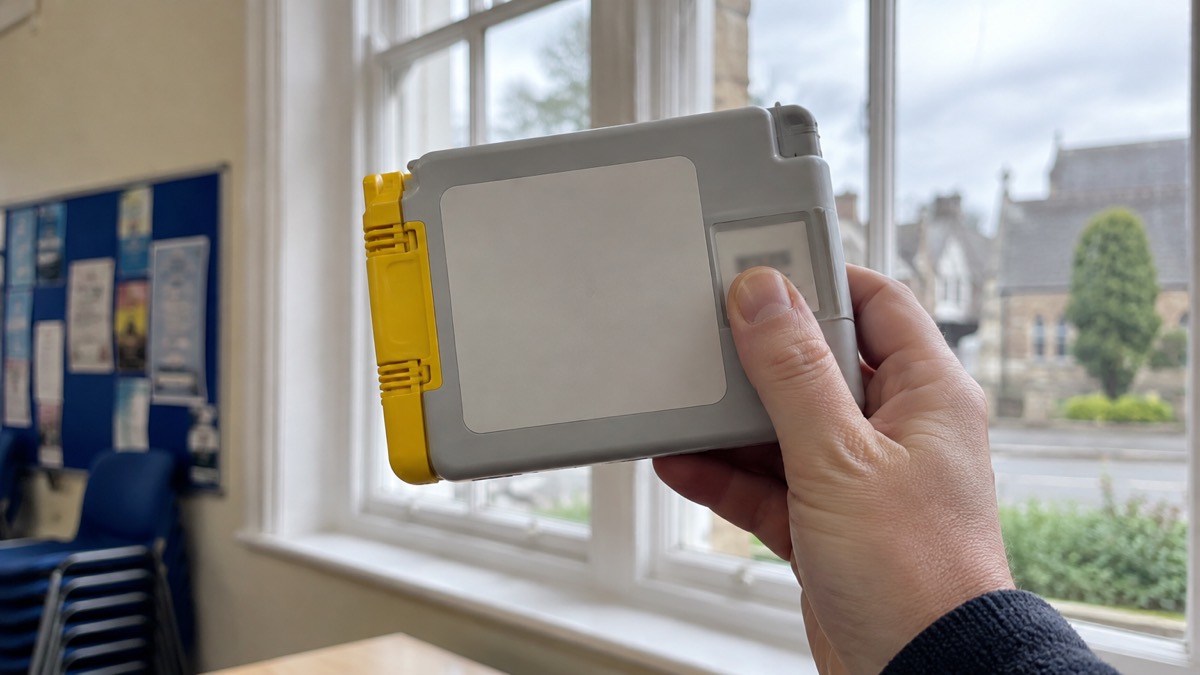
A new Pad-Pak is specified to deliver more than 60 shocks at 200 J, or 6 hours of battery use2. That is far more than a single resuscitation is likely to need, and it reflects the fact that the battery also powers the device's monitoring, prompts and self-tests while it is switched on.
Capacity falls with age. HeartSine's UK manual gives the figure at the end of life as more than 10 shocks at 200 J at 4 years8. In other words, a Pad-Pak that is nearly out of date may still deliver a handful of shocks, but you should not be relying on it as your plan. The device itself will warn you before that point.
| Measure | Figure | Source |
|---|---|---|
| Shocks when new | More than 60 at 200 J | HeartSine manual2 |
| Battery use when new | 6 hours | HeartSine manual2 |
| Shocks at 4 years | More than 10 at 200 J | HeartSine UK manual8 |
| Charging time to 150 J | Typically under 8 seconds | HeartSine manual2 |
| Charging time to 200 J | Typically under 12 seconds | HeartSine manual2 |
The charging times matter in use rather than in storage: the device needs to charge before it can advise a shock, and typically does so in under 8 seconds at 150 J and under 12 seconds at 200 J2. That is quick, but it is not instant, which is why the prompts tell you to stand clear and let the device work rather than rushing it.
Shock energy: 150 J, 150 J, then 200 J
The adult Pad-Pak delivers an escalating sequence: 150 J for the first shock, 150 J for the second, and 200 J for the third3. The delivered energy varies slightly with the patient's resistance, given by HeartSine as 135 to 165 J on the 150 J setting and 180 to 220 J on the 200 J setting across patient resistances of 25 to 225 ohms2.
For comparison, the Resuscitation Council UK's minimum specification for a public access defibrillator is a shock energy of at least 150 J, or a minimum of 130 J for pulsed biphasic waveform devices5. The Pad-Pak's sequence meets that specification at every step.
You do not choose the energy. The device selects it and tells you what to do. Your job is to make sure the pads are on bare, dry skin in the right places, that nobody is touching the casualty when a shock is advised, and that you follow the voice prompts without second-guessing them.
Adult Pad-Pak or Pediatric-Pak: who each is for
The adult Pad-Pak is intended for patients greater than 8 years old or over 25 kg (55 lb)2. The Pediatric-Pak is for children between 1 and 8 years of age, or up to 25 kg (55 lb)2. Both fit the same device, so the choice is about the patient, not the machine.
The practical rule from HeartSine is not to delay. The manual states that you should not delay therapy if you are unsure of the exact age or weight, and that if the Pediatric-Pak is unavailable you may use an adult Pad-Pak3. The British Red Cross gives the same guidance in plain terms: for children aged one to eight, paediatric pads should be used, and if they are not available, use standard pads with one on the centre of the chest and one on the centre of the back9.
There is one caution when you do that. HeartSine warns that if a paediatric patient is treated with an adult Pad-Pak, you should ignore the CPR Advisor feedback prompts, because CPR Advisor is currently only intended to provide feedback on adult patients2.
If you keep a samaritan where children are likely to be, such as a village hall, a sports club or a school, it is worth holding a Pediatric-Pak alongside the adult cartridge, and checking both dates. The Pediatric-Pak contains a magnetic component with a surface strength of 6500 gauss, so HeartSine advises against storing it next to magnetically sensitive media2.
Where the pads go
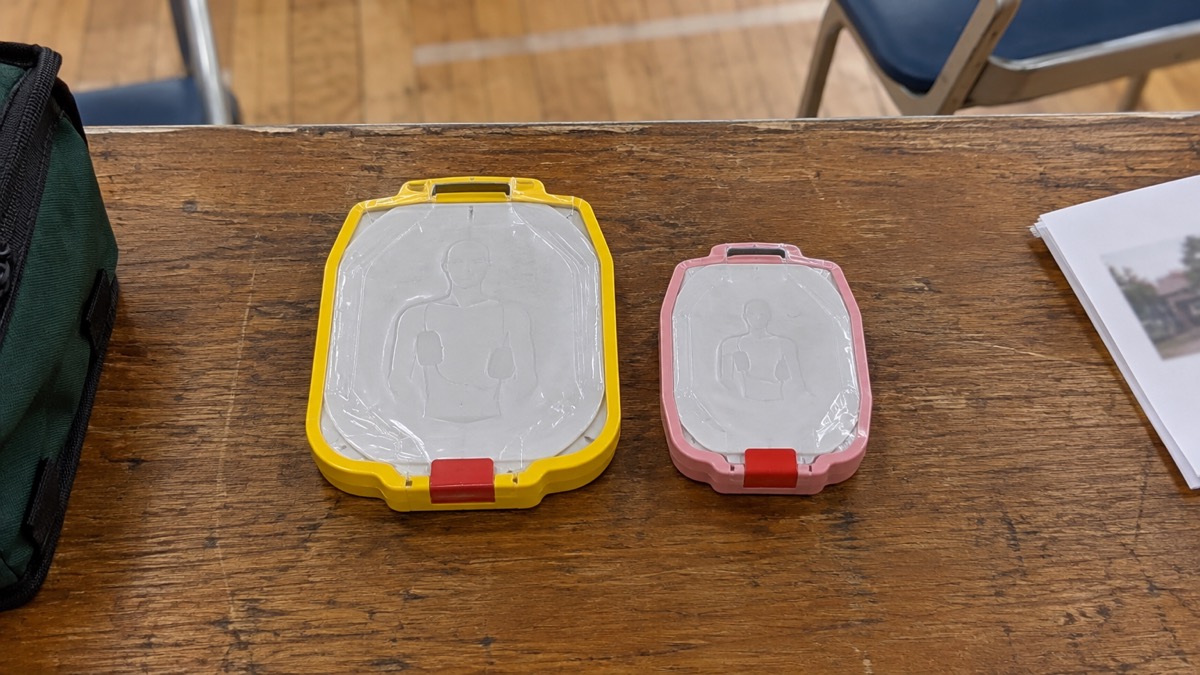
For an adult, the Pad-Pak uses anterior-lateral placement2. In practice that means one pad to the right of the breastbone, below the collarbone, and the other in the left mid-axillary line, roughly over the position of the V6 ECG electrode10. HeartSine's own instruction is to place the first pad vertically on the bare chest and the second horizontally on the rib cage, with the pads at least 2.5 cm (1 inch) apart and never touching3. On large-breasted patients, place the left pad to the side of or underneath the left breast3.
For a child, HeartSine allows two options: anterior-posterior or anterior-lateral, and for small children one pad on the centre of the chest and one on the centre of the back3. The British Red Cross describes the same back-and-chest arrangement for a child aged one to eight11.
| Specification | Figure |
|---|---|
| Electrode active area | 15 in² (100 cm²)2 |
| Electrode cable length | 3.3 feet (1 m)2 |
| Adult placement | Anterior-lateral2 |
| Paediatric placement | Anterior-posterior or anterior-lateral2 |
| Minimum pad separation | 2.5 cm (1 inch), never touching3 |
The 1 m cable gives you room to work on the floor beside the casualty without stretching. The 100 cm² active area is the working surface of each pad, which is why placement matters: a pad half on a rib and half in the air is not doing its job. Dry the chest if it is wet, and remove any patch medication from the area before you apply the pads.
Single use only, and how to dispose of it
The Pad-Pak and Pediatric-Pak are single use only. HeartSine's manual explains why in plain terms: reuse may cause the AED to be unable to deliver therapy, leading to a failure to resuscitate, and it may also lead to cross-infection between patients3. The adhesive is spent once it has been applied, and the battery has been drawn down.
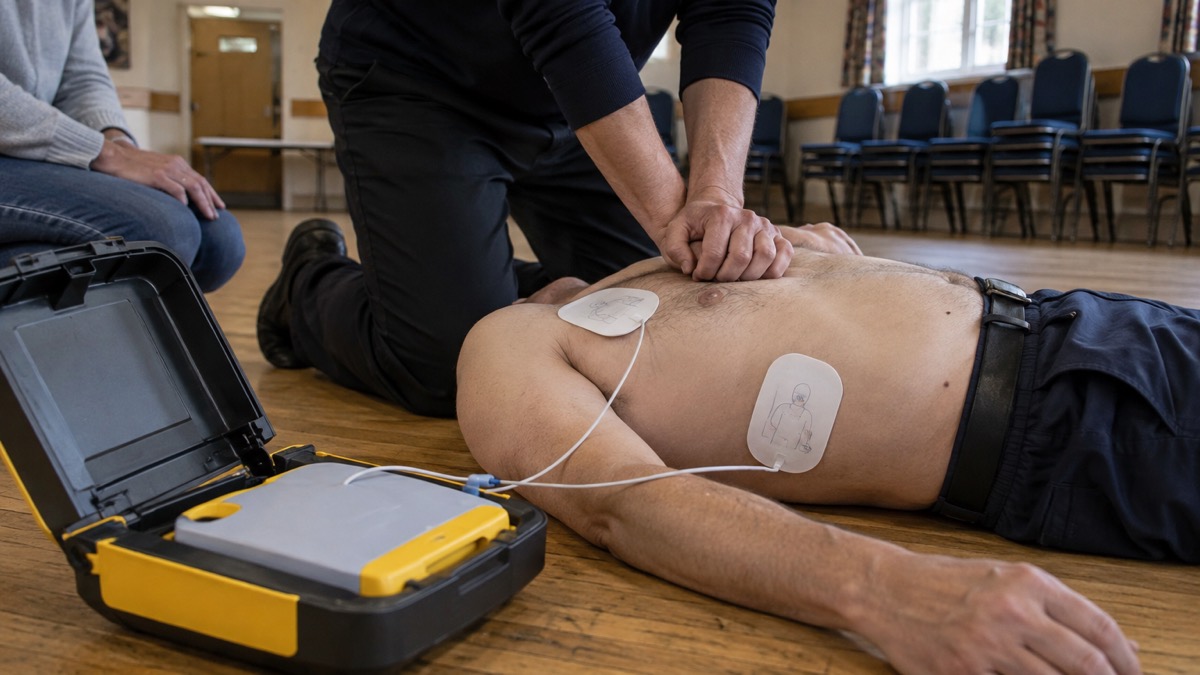
So after any use, however brief, the cartridge comes off and a new one goes on. The same applies if the pouch sealing the electrode pads has been broken or compromised in any way2. Do not open a Pad-Pak to look at it, and do not refold used pads.
Disposal is not a bin job. The Pad-Pak and Pediatric-Pak contain lithium batteries and cannot be disposed of in normal waste; HeartSine says to dispose of each at an appropriate recycling facility according to your local requirements, or return it to an Authorised Distributor3. Your local council's household waste recycling centre will take batteries, and many defibrillator suppliers will take the old cartridge back when they send a replacement.
Fitting, checking and storing it
Fitting a Pad-Pak is a single action: the cartridge slides into the device and clicks home, and the device runs its self-test. HeartSine's manual notes that the samaritan range needs no servicing or testing because it performs a weekly self-test3, so once the cartridge is in, the device is looking after itself.
Your routine is small but it needs to be regular:
- Weekly: check the status indicator3.
- Monthly: check for physical damage and check the Pad-Pak expiry date3.
- After any use: replace the Pad-Pak and dispose of the old one properly3.
- Before the expiry date: order a replacement, allowing for lead times.
Storage conditions matter to the warranty. HeartSine states that the warranty is void if the device is opened, modified, misused, has its serial number removed, is used or stored outside its temperature range, has a Pad-Pak not returned in its original packaging, or is tested using unapproved methods2. In practice: keep it in its cabinet or case, at a sensible indoor temperature, and do not take it apart to see how it works.
Which models it fits, and the aviation version
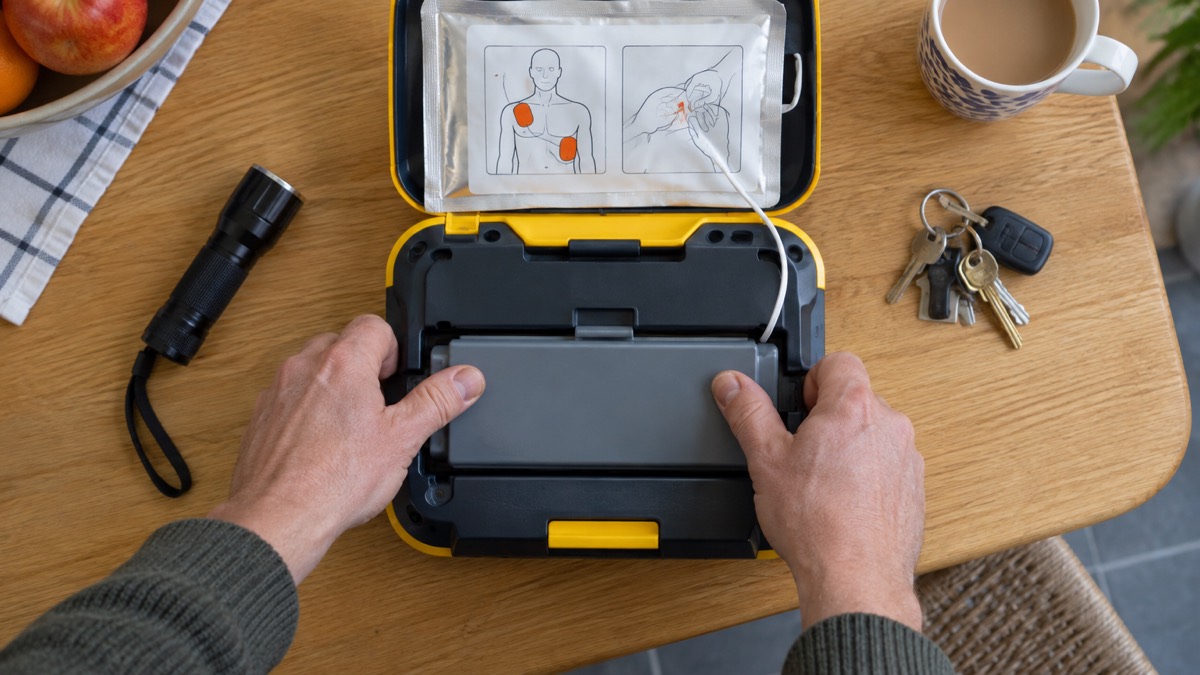
The Pad-Pak is the interchangeable battery and electrode pack used across the HeartSine samaritan PAD range. HeartSine's manuals cover it on the SAM 350P, 360P and 450P, where it gives a four-year electrode and battery life2. The device is compatible with both the adult Pad-Pak and the Pediatric-Pak2. If you are buying a replacement, check the model name on the front of your device and the part number on the old cartridge before ordering.
For aircraft, a TSO/ETSO-certified Pad-Pak is available for use on commercial fixed-wing aircraft, tested to RTCA DO-227 (ETSO-C142a)8. That certification belongs to the aviation version specifically. If you fly with a defibrillator, confirm with the airline and check which cartridge your device carries.
Support, warranty and getting replacements
HeartSine is part of Stryker, and support runs through Authorised Distributors rather than direct from a shop counter. Your first call for a replacement Pad-Pak, a Pediatric-Pak or a warranty question is the distributor who supplied the device.
Supply has been tight. Defib Store states that it is receiving monthly deliveries of Pad-Pak consumables and that customers should expect a 4 week lead time on any new Pad-Pak orders13. The same retailer says Stryker has restarted production and expects stock of the HeartSine Samaritan 350P, 360P and 500P devices before the end of 20264. Treat those as the retailer's statements about its own stock, and order well before your expiry date rather than in the week it falls due.
If you are choosing or reviewing a defibrillator for a home, club or village, our guide to choosing a defibrillator sets out what to weigh up, and the HeartSine samaritan PAD 350P page covers that model in detail. For the wider picture on how these devices are used, see Defibrillators (AEDs): What They Do and How to Use One, and for upkeep routines, the Defibrillator Guardian Checklist. If you are ever unsure whether to use one, the answer is to use it: the British Red Cross advises that an AED should be used on anyone who is unresponsive and not breathing normally9.
Sources (13)
- HeartSine samaritan PAD 500P product page, Stryker, 2026
- HeartSine samaritan PAD 350P, 360P and 450P User Manual, HeartSine, 2022
- HeartSine samaritan PAD 350P, 360P and 500P User Manual (EN-UK), HeartSine, 2022
- HeartSine samaritan PAD 350P semi-automatic defibrillator, Defib Store, 2026
- AED Guide, Resuscitation Council UK, 2026
- Public access defibrillators: A guide for communities, Resuscitation Council UK, 2025
- AED registration and community defibrillators, Northern Ireland Ambulance Service, 2026
- HeartSine samaritan PAD 350P, 360P and 500P User Manual (UK), HeartSine, 2022
- Unresponsive and not breathing when an AED is available, British Red Cross, 2026
- Community defibrillator guidance, Whitstone Parish Council, 2010
- Unresponsive and not breathing: child, British Red Cross, 2026
- HeartSine 350P OTC Handbook, HeartSine, 2022
- HeartSine samaritan PAD 360P with outdoor cabinet, Defib Store, 2026