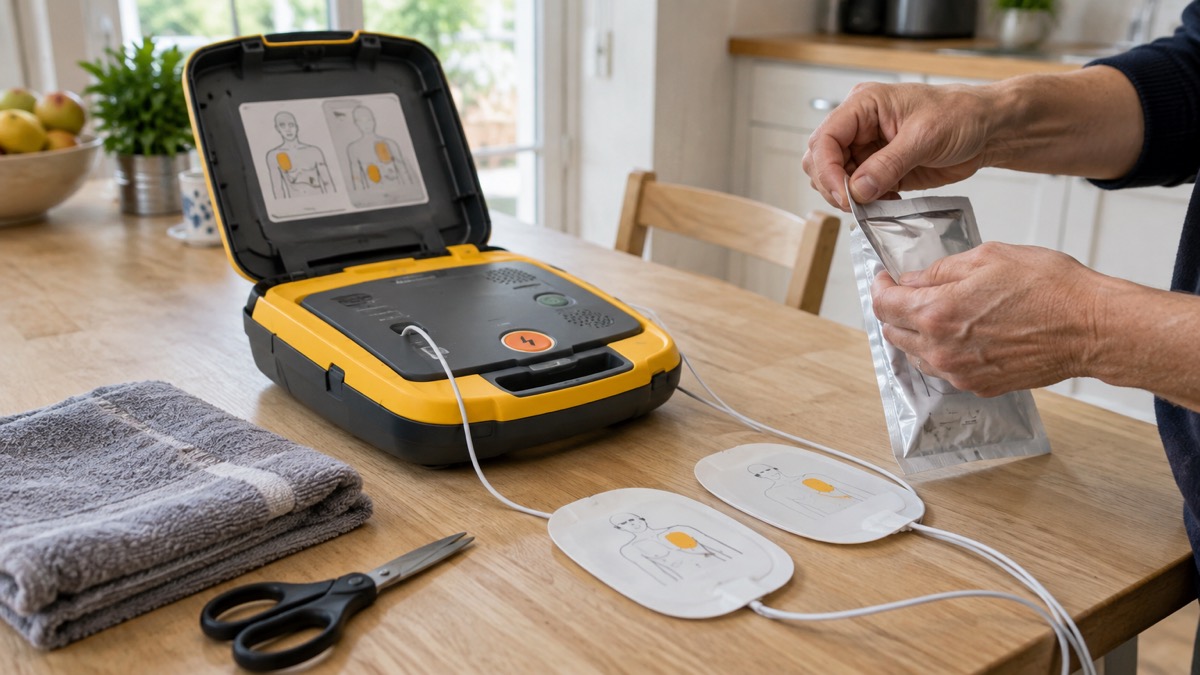
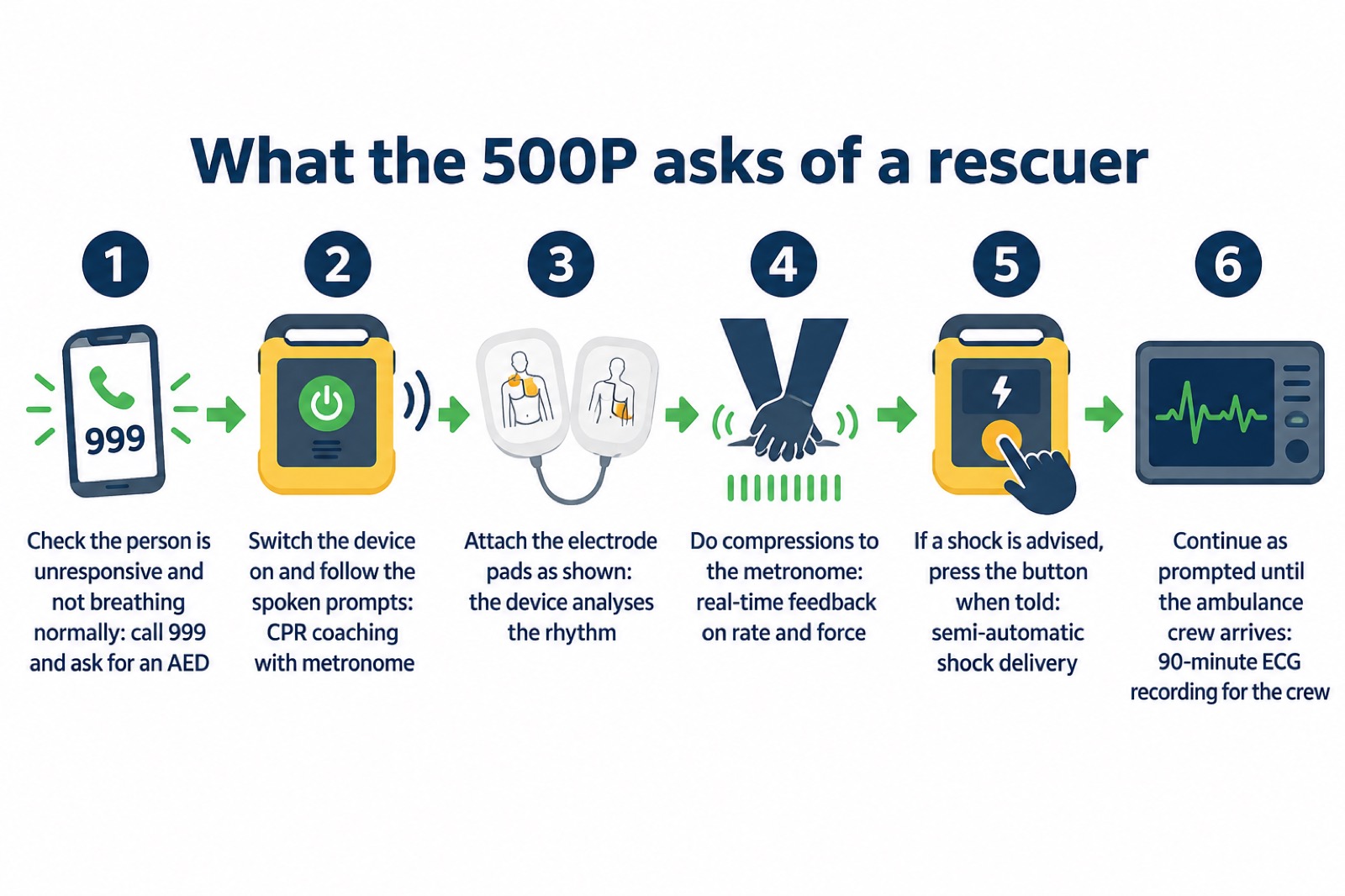
If someone in your household collapses and is not breathing normally, the HeartSine samaritan PAD 500P is a defibrillator built to talk an untrained rescuer through what to do. It is a semi-automatic automated external defibrillator with an integrated CPR Advisor: it gives spoken and visual prompts, coaches chest compressions with a metronome, and tells you how hard and how fast you are pushing. It then analyses the heart rhythm and, if a shock is needed, tells you to press the button to deliver it1.
For a household, the practical points are these. It weighs 1.1 kg and has one of the most compact footprints of its kind, so it fits in a cupboard, a hallway or a car boot and is easy to carry to a neighbour1. It has a 4-year electrode and battery life, and the battery and electrode come as one integrated unit, so maintenance is a single change every four years rather than two separate parts to track2. It is protected against dust and water to IP56, which matters if it lives in a garage, a boat or a village hall2.
This page sets out what the 500P does, its specifications, how it guides a rescuer, what changes when you use it on a child, and how to keep it ready between emergencies. It is one device in a wider plan: read it alongside Defibrillators (AEDs): What They Do and How to Use One and Choosing a Defibrillator for a Home, Club or Village.
What the samaritan PAD 500P is, and what it does for a household
The 500P sits in the middle of the HeartSine range. The maker describes it as a semi-automatic automated external defibrillator with CPR Advisor, and says it helps rescuers deliver a lifesaving shock while also providing real-time visual and verbal feedback on the force and rate of compressions1. In a house, that combination is the point: the hardest part of a cardiac arrest for an untrained person is not pressing a button, it is doing compressions well enough, for long enough, while waiting for an ambulance.
The device is semi-automatic, which means it analyses the rhythm and then prompts the rescuer to press the shock button rather than delivering the shock itself2. That choice suits some households and not others; the trade-offs are set out in Semi-Automatic or Fully Automatic Defibrillator: Which Suits a Home or Community?.
Its shock technology is SCOPE, short for Self-Compensating Output Pulse Envelope: a low energy escalating biphasic waveform that automatically adjusts for patient impedance1. The 500P is specified to work across an operating impedance range of 20 to 230 ohms2. In plain terms, the device measures how much each patient's body resists the current and shapes the shock accordingly, rather than giving everyone the same fixed dose.
A distributor's overview describes the 500P as having advanced CPR advisor technology and calls it ideal for environments such as schools and sports facilities4. That is a seller's characterisation, not a clinical claim, but it points at the same household logic: a device that coaches the rescuer is most useful where the rescuer is unlikely to have done CPR before.
Specifications: 1.1 kg, IP56 and 90 minutes of ECG recording
The figures that decide whether a device suits a home are size, weight, ruggedness and how much it records for the crew that arrives. The 500P's are set out below, all from the maker's own product pages.
| Specification | HeartSine samaritan PAD 500P |
|---|---|
| Type | Semi-automatic AED with integrated CPR Advisor1 |
| Shock delivery | Semi-automatic2 |
| Weight | 1.1 kg1 |
| Footprint | One of the most compact1 |
| Dust and water protection | IP562 |
| ECG recording time | 90 minutes2 |
| Operating impedance range | 20 to 230 ohms2 |
| Shock protocol | Low energy escalating protocol (SCOPE)2 |
| CPR guidance | CPR coaching with metronome; audible and visual metronome for rate guidance2 |
| CPR feedback | ICG-based real-time feedback on CPR rate and force2 |
| Self-test | Automatic self-test2 |
| Software | Field upgradeable2 |
| Electrode and battery life | 4 years, integrated for one-change maintenance2 |
| Carry case | Included2 |
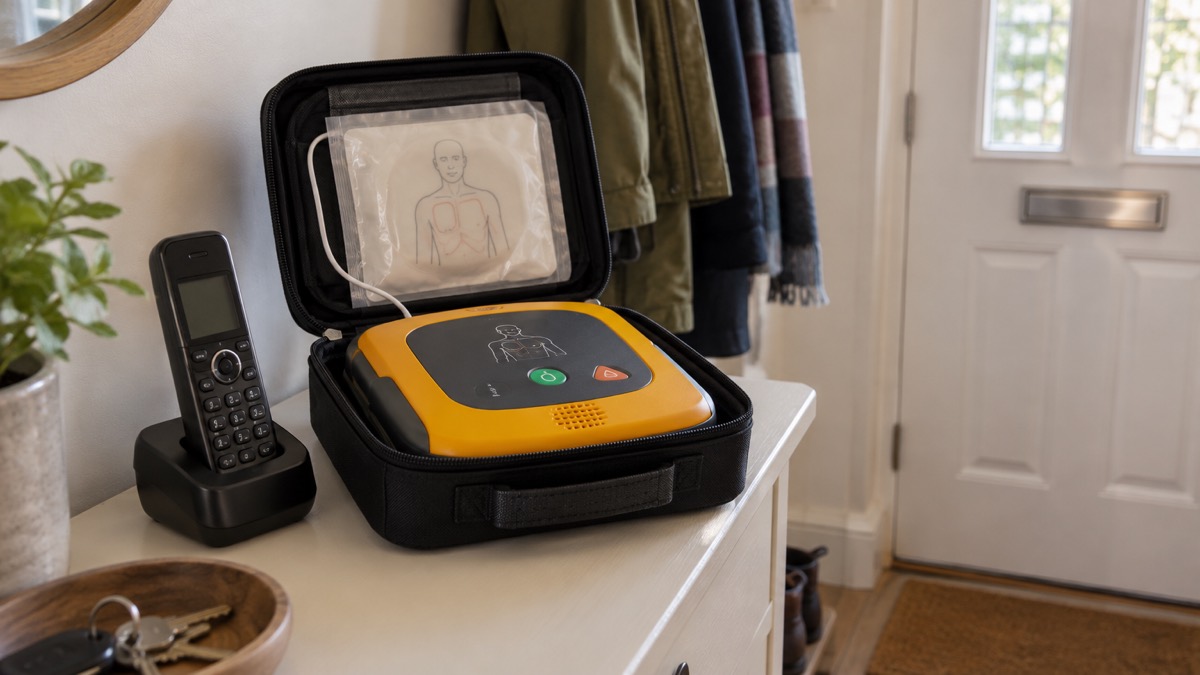
Two of these deserve a word for a household. The IP56 rating is a high level of protection against dust and water3, which is what allows the device to live somewhere less than pristine, such as a workshop, a porch or a clubhouse, without you worrying about it. The 90-minute ECG recording time means the device keeps a record of the heart rhythm for the ambulance crew to read on arrival2; you do not need to do anything to make that happen.
The maker's manual for the range reports testing of the ECG arrhythmia analysis algorithm: a minimum test sample size of 200 episodes of coarse ventricular fibrillation, with 350 episodes tested and the sensitivity goal of over 90% met, and a specificity goal of over 95% met with an observed sample size of 117 asystole episodes5. That is the maker's own validation data, and it describes the algorithm family rather than the 500P alone.
How it guides a rescuer through CPR and a shock
The sequence with a semi-automatic AED is short, and the 500P is designed to be followed by voice. The maker's own training videos walk through setting up the device, using it on an adult, using it on a child, maintaining it, and the CPR Advisor7. Watching them once, calmly, before you ever need them is the single most useful preparation a household can do with this device.
The device provides CPR coaching with a metronome, and an audible and visual metronome for rate guidance2. It also gives ICG-based real-time feedback on CPR rate and force2, which the maker describes as specific feedback on the force and rate of compressions1. A distributor's overview describes the same system as using real-time feedback based on impedance cardiography to guide rescuers on the depth and rate of chest compressions4. The practical effect is that the machine tells you to push harder or faster, or to slow down, while you are doing it.
The 500P does not replace training. It is built for the person who has none, but a household that keeps one should still know the basics of What to Do First: Danger, Response, Airway and Breathing and How to Do CPR: Hands-Only Steps for Adults. If you have never used a defibrillator, Can You Use a Defibrillator Without Training? answers that directly, and Where Do Defibrillator Pads Go? covers the one physical step people get wrong.
Using it on a child: what changes with a Pediatric-Pak
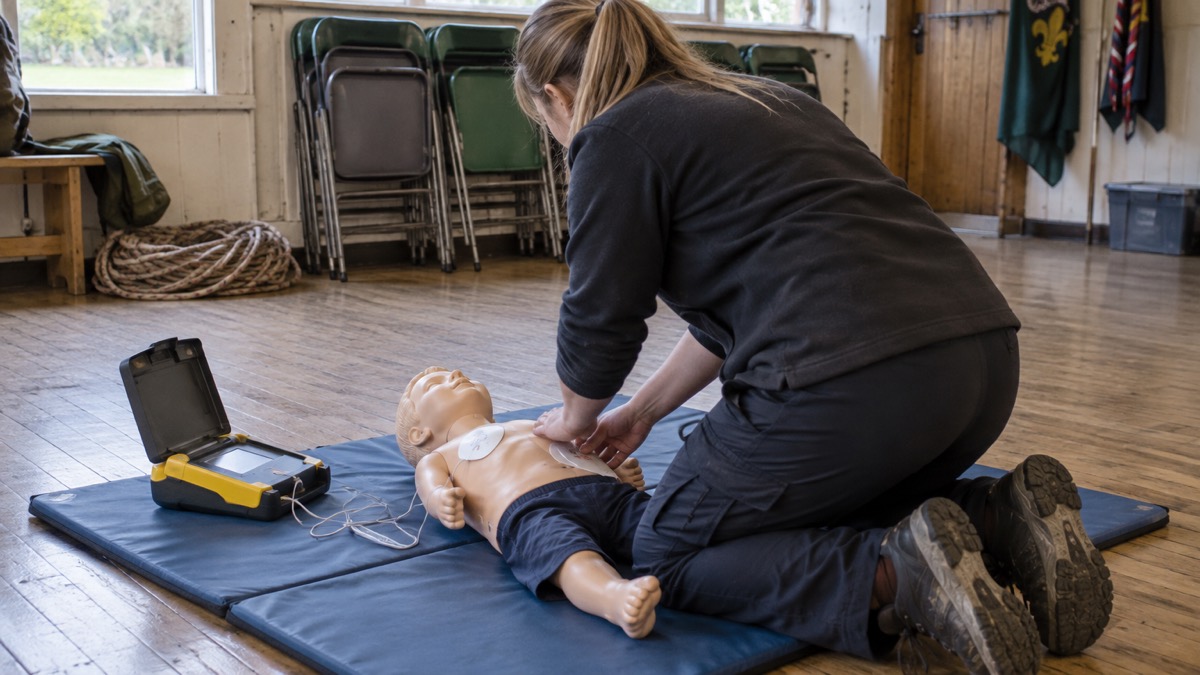
The 500P is pediatric compatible, but with a condition the maker states plainly: if a Pediatric-Pak is used, the CPR Rate Advisor function is disabled2. That is the single most important thing to understand about child use on this model. The device still coaches and still delivers a shock when needed, but the real-time rate feedback that helps an adult rescuer on an adult casualty is switched off.
The maker's training videos include a separate walkthrough for using the SAM 500P on a child7, which is worth watching if there are children in the household, a school or a club. The general rules on pad placement and energy for children are covered in Can You Use a Defibrillator on a Child or Baby?, and the compression technique itself in How to Do CPR on a Child and How to Do CPR on a Baby Under One.
For a household, the practical question is whether to keep a Pediatric-Pak alongside the adult pads. The answer depends on who is in the house and who might visit. A home with young children, or a village hall used by a parent and toddler group, has a clearer case than a household of adults. The Pad-Pak itself, which combines the battery and electrode in one cartridge, is described in HeartSine Pad-Pak: Battery and Electrode Cartridge.
Maintenance and readiness: one change, every 4 years
The 500P is built around one-change maintenance: the battery and electrode are integrated into a single unit, and the maker gives a 4-year electrode and battery life2. That is the whole routine for most households. Fit the Pad-Pak, note the date it expires, and diarise a replacement before that date. The wider principles are in How Long Do Defibrillator Batteries and Pads Last?.
The device runs an automatic self-test5, so between changes your job is to glance at its status indicator and act if it reports a fault. A short monthly check, recorded somewhere visible, is the habit that keeps a household device ready; the Defibrillator Guardian Checklist sets out what to look at. The software is field upgradeable2, so a maker update does not mean replacing the unit.
Where the device lives matters as much as its condition. The carry case is included2, and keeping the device in it, with the Pad-Pak fitted, means it can be lifted and carried to a neighbour, a lane end or a sports pitch without assembly. The IP56 rating gives a high level of protection against dust and water3, so a garage or porch is not ruled out, but a cupboard inside the house, near where people spend their time, is easier to reach in a hurry.
For a household with several devices, or a club with a fleet, HeartSine connected AEDs use Wi-Fi to provide remote readiness information and complete weekly self-tests for every AED in the fleet3. A single home unit does not need that; the automatic self-test and a monthly glance do the same job.
Stock, support and what the maker's data shows
Availability has been the practical obstacle. Stryker, which owns HeartSine, restarted production, and the UK supplier Defib Store expects stock of the HeartSine Samaritan 350P, 360P and 500P devices before the end of 20268. That is a supplier's expectation rather than a promise, so if you are equipping a home or a village hall, ask the seller whether they hold the device now, and check the Pad-Pak date before you accept delivery.
On how the range performs in real use, HeartSine collected postmarket clinical data on 805 events from 28 countries between January 2012 and December 2015, covering its public access defibrillators including the 500P. Among 322 shocks delivered, 91.0% were successful on the first shock, and 58.1% of patients survived to hospital admission6. These are the maker's own reports from real incidents, not a controlled trial, and they describe the range rather than the 500P alone. Treat them as context, not as a prediction for any one household.
The maker publishes free training videos covering set up, adult use, child use, maintenance and the CPR Advisor7, and the device's software can be updated in the field2. For a household, the sensible plan is: decide whether a semi-automatic device suits you, watch the maker's videos before you need them, fit the Pad-Pak and note its date, check the status indicator monthly, and know where the nearest public access defibrillator is as a backup, which Public Access Defibrillators: Finding the Nearest One explains.
If you are still deciding what to keep at home, start with First Aid at Home: A Household Guide and First Aid Kits for the Home: Contents and How to Choose. A defibrillator is one part of a household plan, not the whole of it.
Sources (8)
- HeartSine samaritan PAD 500P product page, HeartSine, 2026-11-02
- HeartSine products, HeartSine, 2026-11-02
- HeartSine samaritan PAD 500P, Stryker, 2026
- Exploring HeartSine's innovative defibrillator range, Defibshop, 2026-10-29
- HeartSine SAM 350P, 360P and 450P user manual (Ed4), HeartSine, 2020
- HeartSine SAM 350P, 360P and 450P combo user manual (Ed3), HeartSine, 2022
- AED training videos, HeartSine, 2026-11-02
- HeartSine Samaritan PAD 350P semi-automatic defibrillator, Defib Store, 2026

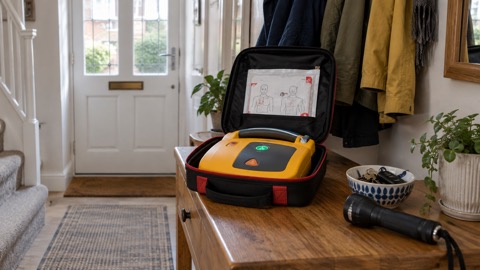 HeartSine samaritan PAD 350P
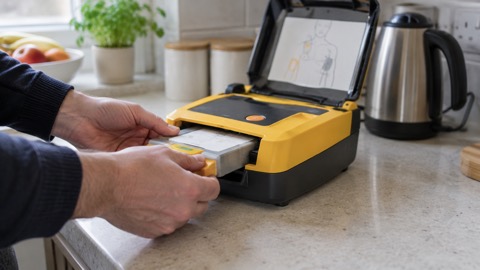 HeartSine Pad-Pak
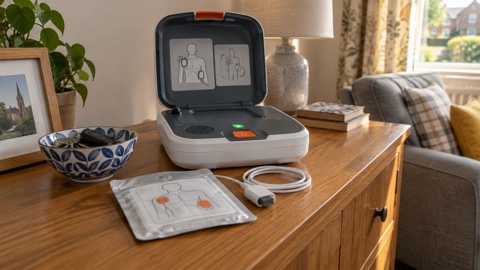 Stryker LIFEPAK CR2
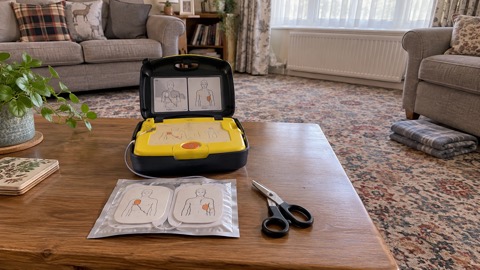 ZOLL AED 3 Defibrillator
 ZOLL AED Plus Defibrillator
 Cardiac Science Powerheart G5
 Philips HeartStart FRx AED
 LifeVac Anti-Choking Travel Kit
 Wallace Cameron Family Kit
 Burnshield Hydrogel Spray 125ml
 Burnshield Hydrogel Gel 50ml
 EpiPen Adrenaline Auto-Injector