

HeartSine makes the samaritan PAD range of automated external defibrillators (AEDs), the compact units that talk a bystander through restarting a heart in cardiac arrest. The devices are made in the U.K. at the company's Belfast site, and HeartSine is now a division of Stryker, so support and warranty registration run through Stryker contact details1.
For a household, the point of an AED is the gap it fills. A cardiac arrest can happen at home, at a club, in a village hall or on a street where the ambulance is minutes away, and a defibrillator is the piece of kit that lets whoever is nearest act before help arrives. HeartSine's own manual states the samaritan PAD is suitable for use in all professional and domestic establishments3. That is why so many community schemes, sports clubs and workplaces hold one, and why a household thinking about emergency readiness may want to know what is nearby and how it is kept ready.
This page covers what HeartSine makes, how each model differs, how the Pad-Pak keeps a unit ready between emergencies, how to register for the eight-year limited warranty, and how to check your device for safety notices. It does not cover how to perform CPR or use an AED step by step; for that, see our First Aid at Home guide.
HeartSine is now a division of Stryker
The name on the device is HeartSine, but the company behind it is Stryker. The manual gives the maker's details as HeartSine Technologies, Ltd., 203 Airport Road West, Belfast, BT3 9ED, United Kingdom, with telephone +44 28 9093 9400, fax +44 28 9093 9401 and the support email heartsinesupport@stryker.com2. The warranty registration page and the support route both use the Stryker email address, which is the simplest way to tell that the two names belong to the same organisation1.
What this means in practice is that you deal with one organisation whichever name you started from. If you are registering a device, asking about cover, or reporting a problem, the Stryker support address is the one to use, and the Belfast office number reaches the same company1. The sale of a HeartSine samaritan PAD is restricted to Stryker or its authorised distributors, or an approved sub-distributor, person or entity, in their appointed territory, so a unit bought new should have come through that route1.
For a household, the branding question matters mainly at the moment you need help. Keep the model name and serial number written down with your other emergency information, so that when you contact support you can give both straight away. The same record helps if you are handing the device on, or if a community group is taking over the upkeep of a unit that was bought under the HeartSine name.
Established in 1998: where the HeartSine name comes from
HeartSine was established in 1998, and the name reflects the company's focus on the heart. The devices carry the marking Made in U.K., and the Belfast address in the manual is where the company is based2. That manufacturing base is part of why the brand turns up so often in British community defibrillator schemes: the units are built here, and the support line is a U.K. number.
The wider picture of community defibrillators in the UK has moved on since then. The Heartsafe Communities scheme was set up in May 2023, formed by the British Heart Foundation together with St John Ambulance, Resuscitation Council UK and the Oliver Cookson Foundation4. That scheme is about where defibrillators are placed and how communities are encouraged to register and maintain them, rather than about any one maker, but it explains why you may see a HeartSine unit in a village hall, a sports pavilion or a shopping centre near you.
If you are mapping what is available in your area as part of your household planning, the practical step is to find out where your nearest public defibrillator is and whether it is registered. South Western Ambulance Service's Saving Lives Together website can be used to find your closest defibrillator6. Knowing that before an emergency is worth more than knowing the maker's history, but the two connect: a device that is registered and checked is one that will be ready when someone needs it.
What HeartSine makes for UK households
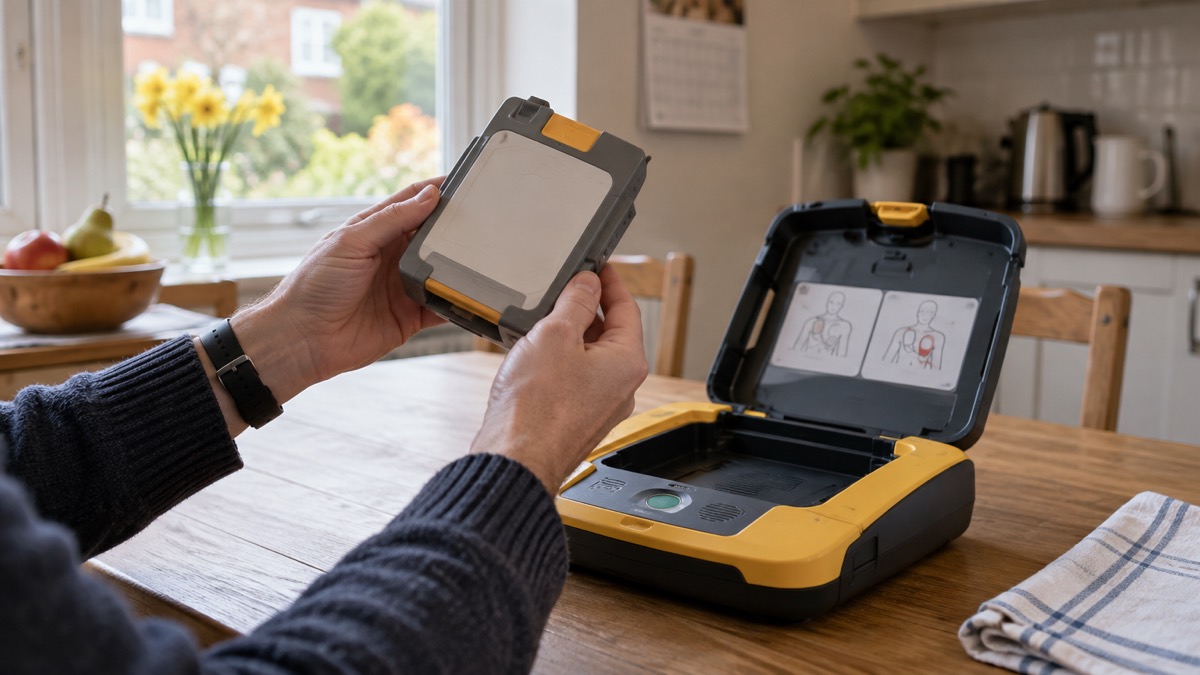
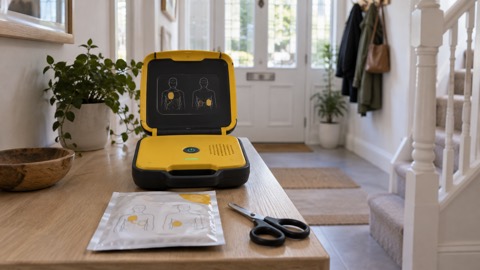
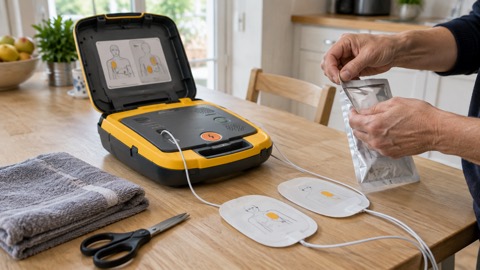
HeartSine's product for households and community settings is the samaritan PAD, an automated external defibrillator designed to be used by someone with no medical training. The manual describes it as suitable for use in all professional and domestic establishments, which is the maker's way of saying it is not confined to hospitals or clinics3. It is a portable unit with a battery and electrode pads combined in a single replaceable cartridge, the Pad-Pak, so that keeping it ready is a matter of checking a status light and watching an expiry date rather than servicing components.
The samaritan PAD range shares a common design. The controls are an On/Off button on all models, a Shock button on the SAM 350P and 500P only, and a Green Tab2. The therapeutic shock waveform is the SCOPE (Self Compensating Output Pulse Envelope) optimised biphasic escalating waveform, which compensates energy, slope and envelope for patient impedance2. In plain terms, the device adjusts the shock to the person it is treating, which is the kind of detail a household does not need to act on but which explains why the unit is more than a simple box.
The maker's published performance figures give a sense of how the device decides. For shockable rhythms, the sensitivity goal for coarse ventricular fibrillation is over 90 per cent, met on a test sample of 350, and for rapid ventricular tachycardia over 75 per cent, met on a test sample of 533. For non-shockable rhythms, the specificity goal is over 95 per cent, met on a test sample of 1532. These are the maker's stated results from its own testing, not a comparison with any other make.
Where the kit fits a household plan is in the First Aid at Home section. An AED is not a substitute for knowing what to do; it is the equipment that supports a rescuer during a cardiac arrest. If your household includes someone at higher risk, or you are part of a group that holds a defibrillator, the useful preparation is knowing where the unit is, how to check it, and who is responsible for it.
HeartSine products and where to find each one
The samaritan PAD range is sold in several models, and the differences that matter to a household are the controls, the pads and the data. The table below sets out what the maker's manual and support pages say about each.
| Model | What it is | Controls and features | Where to read more |
|---|---|---|---|
| HeartSine samaritan PAD 350P | AED with a Shock button | On/Off button, Shock button, Green Tab; SCOPE waveform2 | HeartSine samaritan PAD 350P |
| HeartSine samaritan PAD 360P | AED in the samaritan range | On/Off button and Green Tab2 | HeartSine samaritan PAD 360P |
| HeartSine samaritan PAD 500P | AED with a Shock button | On/Off button, Shock button, Green Tab2 | HeartSine samaritan PAD 500P |
| HeartSine Pad-Pak | Battery and electrode cartridge | Combined battery and pads, replaced as one unit | HeartSine Pad-Pak |
The 350P and 500P have a Shock button, which means the rescuer is prompted to deliver the shock; the 360P has the On/Off button and Green Tab2. All models share the SCOPE waveform2. The manual also notes that the device is UL Classified, with the complete marking on the product3.
Two accessories matter for keeping a unit in service. The Pad-Pak is the combined battery and electrode cartridge, and it is the part with an expiry date, so it is the one a household or guardian checks monthly3. The HeartSine Pediatric-Pak is the paediatric version of the pads, for use on children. Both are listed on the site's product pages, and the Pad-Pak has its own page at HeartSine Pad-Pak: Battery and Electrode Cartridge.
The samaritan PAD records event data after use. HeartSine Saver EVO software manages that event data and can be downloaded from the website at no extra cost, with an optional USB data cable required2. For a community group or a workplace, that is how the record of a use is passed on to the ambulance service or the clinical team; for a household, it is a detail to mention to whoever maintains the unit.
Keeping a HeartSine unit ready between emergencies
A defibrillator that has sat unchecked for two years is not ready, however good it was when new. The maker's maintenance schedule is simple and can be done in under a minute. Weekly, check the status indicator; monthly, check the Pad-Pak expiration date and check for physical damage. For more information, contact your local Stryker representative1.
The status indicator is the device's own self-test. If it is not flashing green every 5 to 10 seconds, or if it is flashing red, or you hear continuous beeping, a problem has been detected3. That is the moment to stop relying on the unit and contact support.
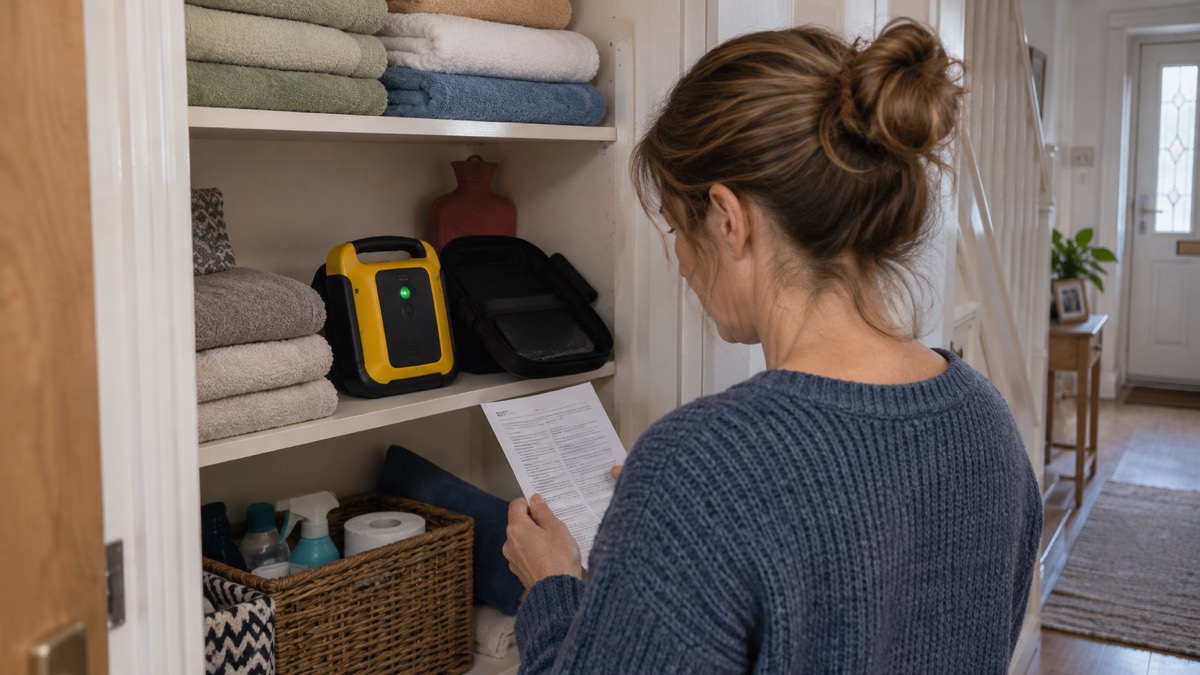
The Pad-Pak expiry date is the other date to watch. Because the battery and pads are one cartridge, replacing the Pad-Pak renews both, and the monthly check is the moment to note the date in a diary or on a household calendar. South Central Ambulance Service, which works with defibrillator guardians, asks guardians who are unsure what to do or how to replace old pads or batteries to get in touch with its team at defib@scas.nhs.uk7. That is a useful route for a community unit even if the maker's own support is the first call.
The manual also states that HeartSine devices cannot be tested using industry-standard simulators and manikins, and directs users to HeartSine Technologies or an Authorised Distributor for assistance2. So the weekly and monthly checks are the whole of the routine testing a household should do; anything more is a question for the maker.
Support: contact your local Stryker representative
Support for a HeartSine device runs through Stryker. The support email is heartsinesupport@stryker.com, and the manual gives the same address for further information, alongside the website1. The Belfast office can be reached on +44 28 9093 9400, with fax on +44 28 9093 94012. For a household, the email route is usually the simplest, because it lets you send the model and serial number in writing.
When you contact support, have three things ready: the model name, the serial number, and a note of what the status indicator is doing. If the online warranty registration will not accept a 14-digit serial number, leave off the last three digits and enter only the first 11 digits, for example 22D91149310, and if you are still unable to register, contact heartsinesupport@stryker.com1. That single instruction solves most registration problems.
For a device that cannot be tested with standard simulators and manikins, the manual directs you to HeartSine Technologies or your Authorised Distributor for assistance2. If you are unsure who your distributor is, ask support and they can point you to the right representative for your area.
If the emergency is happening now, support is not the first call. In a cardiac arrest, call 999 and follow the ambulance service's instructions; the defibrillator is there to be used while help is on its way. Our Health Emergencies guide covers the wider household planning around medical emergencies, and Extra Help in an Emergency covers households with someone medically dependent.
Warranty: who to ask about cover
HeartSine AEDs are backed by an eight-year limited warranty, for the original end user1. To ensure the warranty is active, complete and submit the online warranty registration or the product registration card that came with your AED1. Registration is the step that turns the warranty from a promise into a record tied to your device.
You can register in more than one way. The manual sets out registering online at the HeartSine registration tool, completing the Warranty Card, or sending an email to heartsinesupport@stryker.com with your name, address and device serial number2. The support page repeats the online and card routes1. Whichever you use, keep a note of the date you registered and the serial number you used.
The warranty has exclusions, and they are worth knowing before you rely on it. The warranty does not apply if the device has been opened, unauthorised modifications have been made, it has been used contrary to the manual, the serial number has been removed, it has been used or stored outside its temperature range, the Pad-Pak has not been returned in its original packaging, or it has been tested using unapproved methods2. The manual puts the same list in its own words, saying HeartSine Technologies or its Authorised Distributors are not obliged to replace or repair under warranty if one or more of those conditions applies3.
For a household, the practical reading is: do not open the unit, do not test it with anything other than the checks the manual describes, keep it within its stated temperature range, and keep the packaging if you ever return a Pad-Pak. If you are unsure whether something you have done affects cover, ask support before you act.
If your documents are lost, the manufacturer or the retailer where you bought the goods is the place to ask; guidance on recovering warranties and registration cards after a fire or flood says warranties and registration cards are held by manufacturers, or you can contact the retailer8. Our Home Emergencies guide covers what to do in the first hours of a fire or flood at home.
Safety notices and recalls: how to check yours
Registering your device is the first line of defence against a recall you never hear about. Fire and rescue services across the UK make the same point about electrical products generally: register your electrical items with the manufacturer to be informed of any safety recalls9. Registering your product with the manufacturer is also how you receive safety updates, recalls and warranties10.
If you have not registered, you can still check. Product recalls can be checked via Electrical Safety First or the UK government website11. The Office for Product Safety and Standards issues recalls and alert notices on its website12. Electrical Safety First's product recalls page explains what to do with a recalled appliance13, and its online product checker at www.electricalsafetyfirst.org.uk/recall lets you search14. Not all recalls affect every product sold and may require you to check the serial number of your item; the recall notice will tell you what to do next14.
For a HeartSine device specifically, the maker's own instruction is to report any serious incident that occurs with the device to HeartSine Technologies, Ltd. and to your national competent authority or other local regulatory authority as per local regulations2. In practice, email heartsinesupport@stryker.com with the model, serial number and a description of what happened, and keep a record of the report.
The routine checks in this guide are also a safety net. A unit whose status indicator is not flashing green every 5 to 10 seconds, is flashing red, or is beeping continuously has detected a problem, and that is the signal to stop relying on it and contact support3. Checking the Pad-Pak expiry date monthly catches the other common failure, a cartridge that has quietly gone out of date3.
Where a defibrillator fits a household plan
An AED is one of the few pieces of emergency kit that is used on someone else as often as on your own household. That changes how you plan for it. If you hold one, the plan is about access and upkeep: where it lives, who checks it, and how a visitor or a neighbour would find it. If you do not hold one, the plan is about knowing where the nearest public unit is and how to reach it, which is the same kind of preparation as knowing where the nearest pharmacy or defibrillator-equipped sports centre is.
The community side matters as much as the kit. The Heartsafe Communities scheme, set up in May 2023 by the British Heart Foundation with St John Ambulance, Resuscitation Council UK and the Oliver Cookson Foundation, is the framework many community defibrillators sit within4. Our Community Resilience guide covers how neighbours and local groups organise around shared equipment, and Getting Started sets out how a household builds a plan from the ground up.
For the clinical side, the NHS in Scotland's information on cardiac arrest explains what a cardiac arrest is and why speed matters15, and its guides to CPR for a child and for a baby set out what a rescuer should do16. The British Heart Foundation's CPR training resources are another route to learning the skills that go with the equipment4. An AED supports a rescuer; it does not replace the training.
Finally, keep the device in the same place in your household emergency plan as your other kit. Our Emergency Kit guide sets out what a household should keep ready, and a defibrillator, where a household or group holds one, belongs on that list with its check dates noted.
Sources (17)
- HeartSine online warranty registration, HeartSine, 2026
- HeartSine samaritan PAD 350/360/500 user manual (UK), HeartSine, 2022
- HeartSine samaritan PAD 350/360/500 user manual (IE), HeartSine, 2022
- CPR training resources, British Heart Foundation, 2026
- Heartsafe Communities report launched today, Resuscitation Council UK, 2024
- Summer top tips and advice, South Western Ambulance Service NHS Foundation Trust, 2026
- SCAS urges defibrillator guardians to keep checking their devices, South Central Ambulance Service NHS Foundation Trust, 2026
- After fire or flood, Devon and Somerset Fire and Rescue Service, 2020
- Electrical safety, Greater Manchester Fire and Rescue Service, 2026
- E-bikes, Cheshire Fire and Rescue Service, 2026
- Lithium-ion batteries, Scottish Fire and Rescue Service, 2025
- Electrical items, London Fire Brigade, 2026
- Causes of fires: electrical safety, Devon and Somerset Fire and Rescue Service, 2025
- Product Safety Alerts, Reports and Recalls, North Yorkshire Fire and Rescue Service, 2023
- Cardiac arrest, NHS inform, 2026
- How to give a child CPR, NHS inform, 2026
- How to give a baby CPR, NHS inform, 2026
 HeartSine samaritan PAD 350P
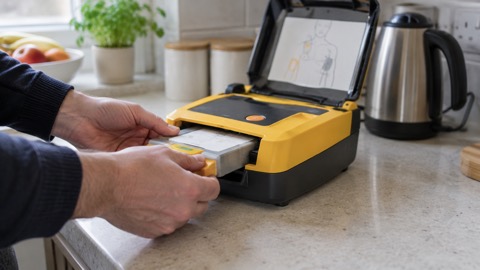 HeartSine Pad-Pak: Battery and Electrode Cartridge
 HeartSine samaritan PAD 360P
 HeartSine samaritan PAD 500P