

Philips is a name most UK households already own something from, and in an emergency the useful parts of its range are the simple ones: a torch that works when the mains fails, a radio that still receives updates, and batteries that are the right type for the device they go in. The official advice for a power cut is consistent across the UK: use battery-operated lights or torches rather than candles, and keep spare batteries to hand1. A torch, a portable radio and replacement batteries are named as emergency kit items by fire and rescue services2.
What you do now is small. Keep torches and spare batteries where everyone in the home knows to find them, in case the power goes when it is dark outside3. Write down the frequencies of the national or local radio stations you use for news, so you can find them on a battery or wind-up set4. Buy batteries that suit the device and meet the manufacturer's specifications, and buy replacements from a supplier you trust5. Then register your appliances so that a safety alert or recall reaches you7.
Philips kit for UK households in an emergency
Philips makes a wide range of household electrical goods, and this page covers the parts of that range that earn a place in a home emergency kit: portable lighting, batteries and chargers, radios, and the small electricals that need safe handling when the power goes. The test for any of it is not the badge on the case but whether it does a job on the night the lights go out. Official household emergency kit lists are built around exactly those jobs: a wind-up or battery radio with spare batteries, a battery or dynamo powered torch, and spare batteries, alongside the first aid kit, the bottled water and the paperwork10.
That framing matters because an emergency kit is a system, not a shopping list. A torch with flat batteries is a plastic tube. A radio with no written-down frequency is a box that hums. A power bank that has sat uncharged in a drawer since last winter is a paperweight. The sections below take each type of kit in turn, say what it does for the household, and link to the fuller guides on this site for the detail.
- Lighting: torches and battery lights for a power cut, covered in Emergency Lighting at Home: Torches, Lanterns and Candles and Power Cuts: A Household Guide.
- Batteries and charging: the right type for each device, and safe charging, covered in Backup Power at Home: A Household Guide.
- Radio and updates: following official information when the internet and TV are down, covered in Staying Informed and in Touch in an Emergency: A Household Guide.
- The wider kit: what else belongs in the box, covered in Emergency Kit: What a UK Household Should Keep Ready.
If you are starting from nothing, the place to begin is Getting Started: Preparing Your Household for an Emergency, which sets out the order to do things in. The rest of this page assumes you have a torch, a radio and a box of batteries, and want to know how to choose, store and look after them.
Torches and portable lighting for power cuts
Light is the first thing a household notices when the power fails, and the first thing official advice addresses. During a power cut, use battery-operated lights or torches as your alternative light source8. Fire and rescue services across the UK say the same thing in stronger terms: if you need to light your home when you are without power, choose torches or battery-powered lights rather than candles12. The reason is straightforward. A candle is an open flame in a dark room, often held by someone who is moving around, and the fire services see the consequences.
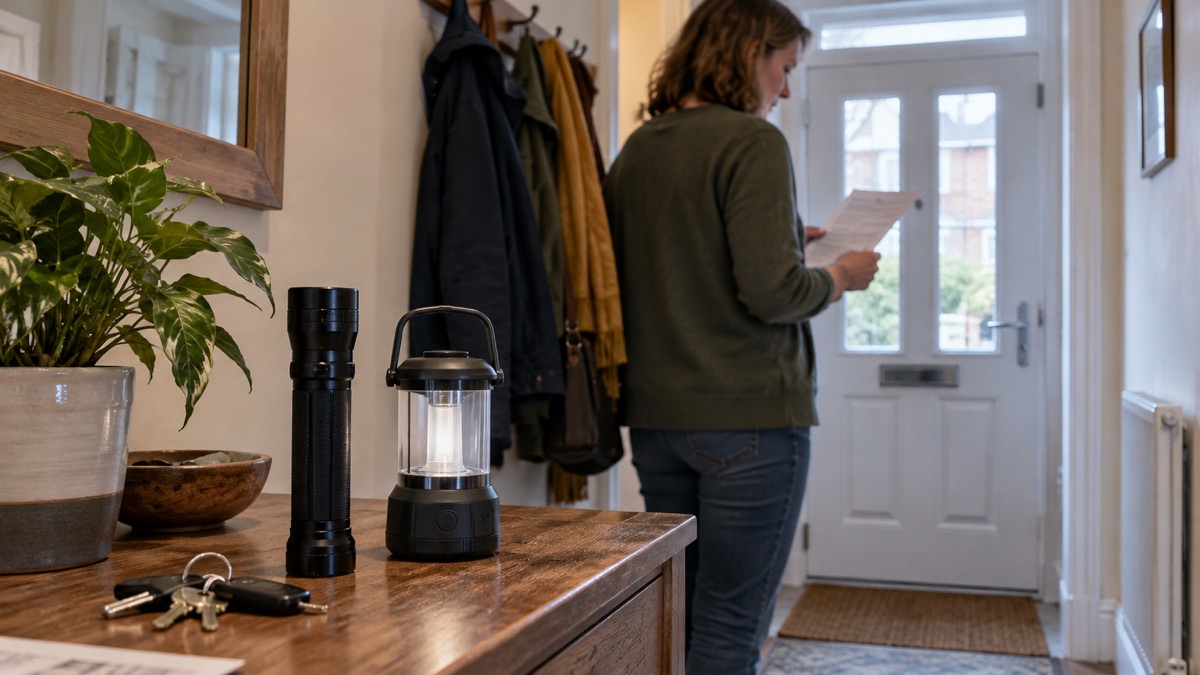
What a household actually needs is modest: enough light to move safely between rooms, find the fuse box, read a label or settle a child, and a light that can be carried. Keep some torches and spare batteries to hand in case the power cut happens when it is dark outside, and make sure everyone in your home knows where they are kept3. A torch kept handy is the standard line in local authority power cut advice13. Storms and power cuts guidance from fire services lists a torch, a portable radio, replacement batteries, matches and bottled water as the core of an emergency kit2.
A few practical points decide whether the torch helps:
- One per person, plus one for the hall. A single torch in a kitchen drawer leaves everyone else in the dark.
- A head torch leaves your hands free for the fuse box, the meter cupboard or a first aid kit.
- Check the batteries on a fixed date. A torch that has not been switched on since last winter may not switch on now.
- Keep a light where you sleep. A power cut at night is the common case, and a torch by the bed costs nothing to store.
The fuller guide to choosing between torches, lanterns and candles, and why candles come last, is in Emergency Lighting at Home: Torches, Lanterns and Candles. For what happens to the rest of the house when the supply fails, see Power Cuts: A Household Guide.
Batteries: choosing the right type for your kit
Batteries are where emergency kit most often fails quietly. The official advice is to buy the correct battery or device: make sure batteries are suitable for the device they are intended for and meet the manufacturer's specifications5. That single line rules out the drawer of mixed cells of unknown age and the cheap multipack bought for a device it does not fit.
For anything rechargeable, the fire and rescue services are specific. Use the correct charger9. If you are buying additional batteries or chargers, make sure they are compatible with your device and intended to work with it, and buy from the reputable retailer you made the original purchase from6. If you need a replacement battery or charger, choose a branded, genuine product from a supplier you can trust15. Only purchase your device and charging equipment from a trusted seller, and check product reviews16.
| What you are buying | What to check | Who advises |
|---|---|---|
| Disposable cells for a torch or radio | The size and type the device specifies, and the manufacturer's specifications | Fire and rescue service guidance5 |
| A replacement rechargeable battery | Compatible with your device, branded and genuine, from a supplier you trust | Fire and rescue service guidance15 |
| A charger | The correct charger for that device, compatible and intended to work with it | Fire and rescue service guidance9 |
| A new device with a built-in battery | A trusted seller, and product reviews checked before you buy | Fire and rescue service guidance16 |
Store batteries out of the device if it will sit unused for months, keep them in their packaging so the type is readable, and keep a note of which device takes which size. A household with three torches, a radio and a lantern can easily need three different cell types, and finding that out by torchlight is avoidable. The wider question of charging and stored power is covered in Backup Power at Home: A Household Guide.
Radios for following official updates
When the power is out and the mobile network is congested, a radio is often the only way to hear what is happening. Bradford Council's flood pack lists a portable radio to monitor local news and weather broadcasts19. The government's Be Ready checklist goes further and tells you to keep an FM radio, battery or wind up, and to write down the frequencies of any national or local radio stations you use for news4. That written note is the part people skip, and it is the part that matters: a radio you cannot tune is no use in the dark.
A radio belongs in the same box as the torch, and for the same reason. The emergency kit lists published by councils and fire services routinely pair them: a torch, portable radio, replacement batteries, matches and bottled water2; a wind-up or battery radio with spare batteries among the household kit10. Keep the radio with its batteries, and check it receives a signal where you would actually use it, which for many households is a kitchen or a upstairs room rather than a cellar.
- Write the frequencies down of any national or local radio stations you use for news, so you can find them again during an outage4.
- Test the set on the same date you check the torches.
- Keep spare batteries of the right size with the radio, not in a general drawer.
- Know your local station as well as the national one, since local news carries the details of a power cut or a road closure.
For the wider question of how to stay in touch when phone and internet services are disrupted, see Staying Informed and in Touch in an Emergency: A Household Guide.
Using Philips kit safely during a power cut
The dangerous moments in a power cut are the ones either side of the supply returning. Greater Manchester Combined Authority's advice is to turn off items such as irons, ovens, electric fires and fryers, and to unplug your TV and computer, as they can be damaged if there is a surge when power goes back on20. Do that as soon as the lights go out, while you still have a torch in your hand.
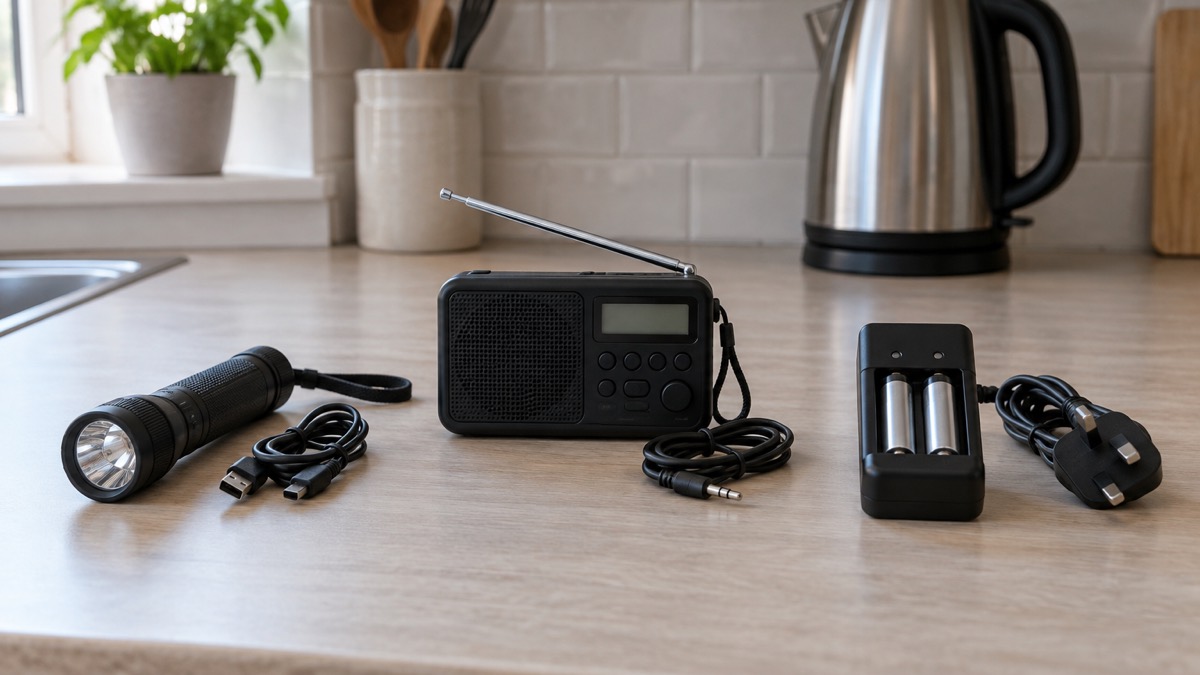
Charging is the other risk. Fire and rescue services advise using the correct charger for a device9, buying chargers compatible with the device and from the retailer you bought the original from6, and choosing branded, genuine replacement batteries and chargers from a supplier you trust15. Do not charge a device on a soft surface or overnight beside a bed if you can avoid it, and unplug a charger that has finished its job. If a battery or charger becomes hot, swollen or discoloured, stop using it and dispose of it safely at a designated recycling facility18.
For the electrical safety picture in the home more broadly, see Home Emergencies: Fire, Carbon Monoxide, Gas Leaks and Burst Pipes. If your household depends on powered medical equipment, the arrangements for priority support are set out in Extra Help in an Emergency: Older, Disabled and Medically Dependent Households.
Storing Philips kit so it works when you need it
Storage is what separates a kit from a collection of objects. Keep the kit together in an easily accessible area, and make sure as many people as possible know where to find it19. That is the whole principle: one place, known to everyone, reachable without moving furniture or climbing into a loft.
The kit around your Philips torch and radio should include the basics that official lists agree on. Store some bottled water and non-perishable tinned food that does not need cooking, such as ready-to-eat tinned meat, fruit or vegetables, and a tin opener, plus ready-made baby formula and pet food if needed20. Include water for drinking and sanitation, and pet care items if required21. A first aid kit appears on list after list22. Keep spare glasses or contact lenses at home24, and sanitary items and toiletries25. A copy of your local household emergency guide, with your own details filled in, is worth keeping in the box26.
| Storage point | What to keep there | Why |
|---|---|---|
| A safe place at home you can reach easily | Torch, lantern, spare batteries, radio | Kept together in a waterproof bag so the kit is easy to reach19 |
| Somewhere high up | Batteries in packaging, written radio frequencies, first aid kit | A flood kit is stored in a waterproof box and put somewhere high up4 |
| Easy to reach places | Items you use day to day | Storing everyday items within reach helps prevent falls7 |
Check the kit on a fixed date each year, replace batteries that have leaked or expired, and run the radio for a few minutes. Store batteries away from heat and out of reach of small children, and keep the torch out of a damp shed.
Support and warranty for UK owners
The most useful thing a UK owner can do for support is register the appliance. Register electrical appliances with the manufacturers or at registermyappliance.org.uk to receive updates or safety information27. Registration is how a safety alert or product recall finds you rather than waiting for you to look for it7. When you register, you will typically be asked for the model name or number, the serial number and the purchase date28, so note them down when the product arrives and keep them with the household paperwork.
When you buy, make sure an electrical appliance has a British or European safety mark27. That mark is the quick check that the product has been through the safety assessment expected of it, and it is the first thing to look for on a torch, charger or radio bought from an unfamiliar seller.
For spare parts and consumables, follow the maker's own instructions for your model. Some equipment has a serviceable filter with a set interval: for the NIPPY 4/4+ change the white filter on the side of the machine monthly, and for the Lumis 100/150 change the filter every six months, with a reminder on screen that you reset using the round button to the right of the screen29. Those intervals come from the maker's manual for those machines; check the manual for your own device rather than assuming the same schedule.
Safety notices and recalls: how to check yours
A recall is only useful if it reaches you, and the check takes a couple of minutes. Use Electrical Safety First's online product checker to see if any of your appliances have been recalled18. You can also check the list of recalled items on the Electrical Safety First website, which explains what to do with your recalled appliance28. Do this before winter, and again whenever you add a second-hand or inherited appliance to the house.
Recall notices are published by the maker and displayed where the product was sold. A recent example of the form they take: A.Vogel Ltd is recalling the above product, and point of sale notices will be displayed in all retail stores that are selling this product and on their website30. The pattern is the same for any recalled item: stop using it as instructed, follow the notice, and do not pass it on to someone else.
Counterfeit goods are part of the same picture. Buy from a reputable supplier, because there is a market in counterfeit filters that may not perform as claimed and could be harmful to health31. Avoid counterfeit or cheaply made products, and verify that they meet the necessary safety requirements and carry CE or UKCA marking18. For batteries and chargers, the same rule applies: a branded, genuine product from a supplier you can trust15.
Where to get help and how to dispose of old kit
Old batteries and broken electricals are a fire risk if they go in the wrong bin, and the advice is uniform across the UK fire and rescue services. Do not put old batteries or electrical items in any of your household bins, including recycling bins9. Drop batteries at designated collection points in shops, supermarkets, or check with your local authority5. Take all batteries and battery-containing electricals to a safe drop-off, and never put batteries in your rubbish or recycling9. Check items for hidden batteries before recycling32.
For devices with a battery you cannot remove, take it to a household waste recycling centre or return it to a retailer when buying a replacement33. If you are recycling a water filter candle, recyclability depends on the manufacturer, so check with them: some companies recycle the plastic parts for you and the ceramic part may be composted31.
If you need help during an emergency, the arrangements differ slightly across the UK. In Scotland, households are advised to build a home emergency kit, with advice available at Ready Scotland26. For households that need extra support, from older people to those dependent on powered medical equipment, the routes to help are set out in Extra Help in an Emergency: Older, Disabled and Medically Dependent Households, and the wider picture of how UK arrangements work is in How the UK Prepares for Emergencies: A Household Guide.
Sources (33)
- Power cuts - Be Ready, beready.campaign.gov.uk
- Storms and power cuts, Devon and Somerset Fire and Rescue Service, 2022
- 12 tips to prepare for a power cut, Horsted Keynes Parish Council, 2026
- Get prepared for emergencies, UK Government Prepare campaign, 2026
- Battery safety, West Yorkshire Fire and Rescue Service, 2026
- Lithium batteries, Surrey County Council, 2026
- Stay fire safe, Greater Manchester Fire and Rescue Service, 2026
- Planning for an emergency kit, Wiltshire Council, 2026
- Battery safety, Tower Hamlets Council, 2026
- Preparing for an emergency: what you need to know, Isle of Anglesey County Council, 2020
- Preparing for emergencies, North Hertfordshire District Council, 2015
- Fire service sees worrying increase in carbon monoxide incidents and fire risks due to power cuts, Devon and Somerset Fire and Rescue Service, 2022
- Power cuts, Scottish Fire and Rescue Service, 2026
- Adverse weather events, Llangattock Community Council, 2026
- Batteries, Humberside Fire and Rescue Service, 2026
- Battery fires, Devon and Somerset Fire and Rescue Service, 2026
- Lithium battery fire safety, Tandridge District Council, 2026
- Fire safety tips: smoking, vaping and e-cigarettes, Warwickshire County Council, 2026
- Create a flood pack, Bradford Council, 2026
- Loss of essential services, Greater Manchester Combined Authority, 2026
- Get help and advice in an emergency, Lincolnshire County Council, 2026
- Prepare for emergencies, Dumfries and Galloway Council, 2026
- Preparing for an emergency, Nottinghamshire County Council, 2026
- Emergency kit checklist, Neath Port Talbot Council, 2026
- Emergency kit, Ready Scotland, 2026
- Prepare power cut, Highland Council, 2026
- Electrical safety, Devon and Somerset Fire and Rescue Service, 2026
- Electrical safety, Scottish Fire and Rescue Service, 2026
- NIPPY and Lumis machine guidance, Leeds Teaching Hospitals NHS Trust, 2024
- A.Vogel Ltd recalls Rapunzel Biosnacky Das Original Red Clover seeds, Food Standards Scotland, 2026
- Water filter candles, Drinking Water Quality Regulator for Scotland, 2026
- Be battery aware, Greater Manchester Fire and Rescue Service, 2026
- Lithium battery fire safety, Mid and West Wales Fire and Rescue Service, 2026
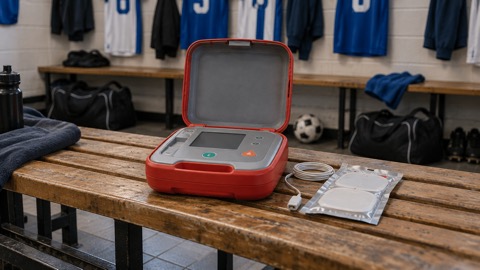 Philips HeartStart FRx AED