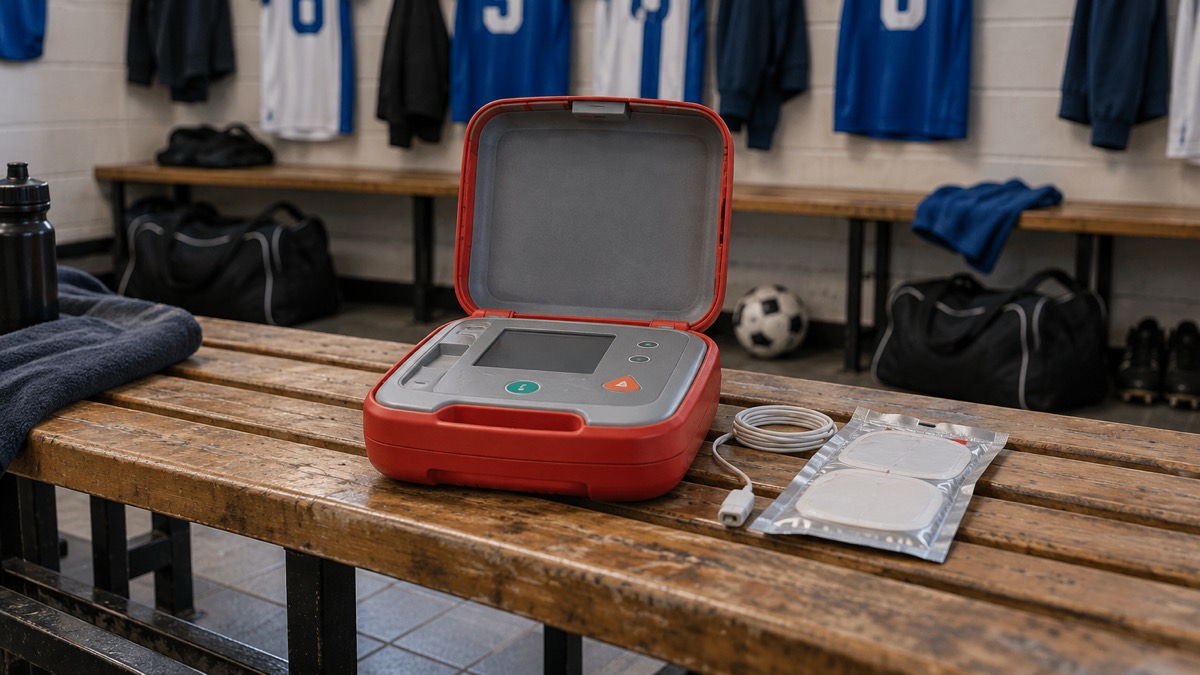
The Philips HeartStart FRx is a semi-automatic automated external defibrillator (AED): a portable machine that analyses a heart rhythm and, if a shock is needed, tells the rescuer to press an orange button to deliver it. It is built for people with minimal training, and it talks you through the whole thing. Press the green on/off button, place the pads on the patient's bare chest as directed, and press the orange Shock button only when the device tells you to1.
If someone is unresponsive and not breathing normally, the first thing to do is ring 999 and start CPR. Ambulance call handlers can guide you through CPR and will direct you to the closest public access defibrillator3. If a defibrillator is to hand, turn it on, attach the pads to the bare chest and follow every voice prompt; the machine decides whether a shock is required and either delivers it or tells you to press the button4. Survival chances drop by about 10% for every minute without CPR and defibrillation, so speed matters more than confidence5.
The FRx is designed to be kept ready rather than packed away. It runs automatic daily self-tests, shows a status indicator when it is ready for use, and warns of a low battery6. Its battery typically lasts 4 years when stored and maintained as the owner's manual directs, and its pads have a 24 month life1. This page sets out what the machine does, how to use it on an adult and on a child, how to look after it, and what to do if something goes wrong.
What the HeartStart FRx is and who it suits
The FRx is a semi-automatic defibrillator, which means it analyses the rhythm and prepares the shock, but the rescuer presses the button that delivers it2. That is the opposite of a fully automatic model, which shocks without the rescuer pressing anything; if you are weighing up which suits a home, club or village, our comparison of semi-automatic and fully automatic defibrillators sets the two side by side.
The distributor describes it as suitable for use by rescuers with minimal training, and the maker's design backs that up: real-time, step-by-step voice commands paced to your actions, an audible metronome and CPR guidance to help the responder2. It is also built to be carried and knocked about. The maker says it can withstand rough handling, extreme temperatures and dusty or wet surfaces, and the distributor lists it for harsh environments such as industrial locations, construction sites and use in the rain1.
It treats adults and children, with the child setting engaged by an optional key rather than a separate machine2. It has no connectivity: the distributor lists connectivity as none, with internal memory for storing usage information instead2. That matters for a household or club because there is nothing to pair, no app to keep working and no subscription implied by the device itself.
An AED is only part of the response. The chance of restarting a heart with rescue breaths and chest compressions alone is low; to restart, a heart usually needs an electric shock from an AED7. That is why the machine sits alongside good CPR rather than replacing it. If you have never done either, start with our guide to defibrillators and how to use one, and read can you use a defibrillator without training if that is your worry.
How to use it: green button, pads, then follow the voice
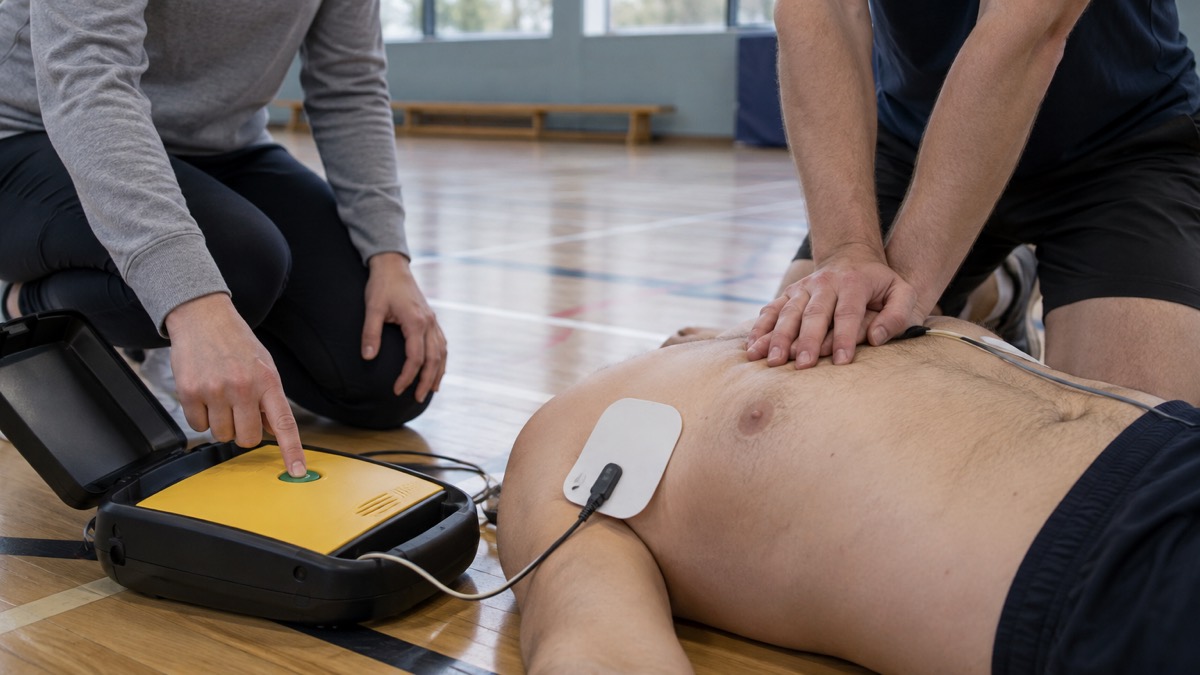
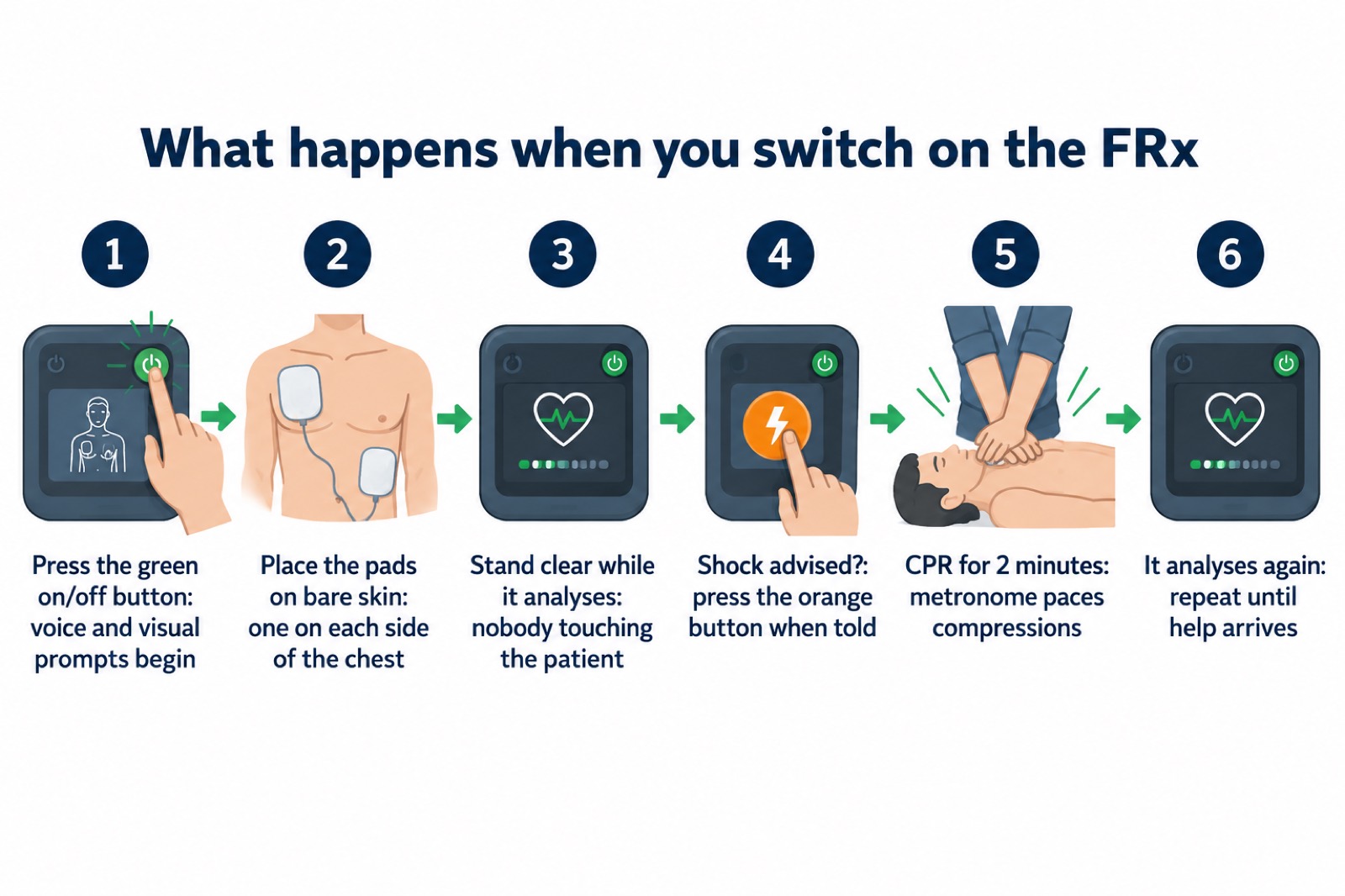
The maker's sequence is short. Press the green on/off button, which activates voice instruction and visual icons; place the pads on the patient as directed; when advised by the device, press the orange Shock button1. The distributor adds that the SMART pads II are pre-connected, which saves time in an emergency2.
Ambulance service guidance fills in the detail around the pads. Open the defibrillator and take out the pads; some turn on when opened, others have a green button; follow the picture showing where to place the pads, one pad on each side of the chest on bare skin. Shave a hairy chest with the razor in the defibrillator and dry a sweaty or wet chest with the cloth provided. Remove clothing above the waist, cutting off a bra if needed with tools such as the scissors in the pack8.
Once the pads are on, the machine takes over the decisions. If a shock is needed, tell people to stand back, press the shock button when told, then continue CPR for two minutes before the defibrillator re-analyses9. NHS Inform gives the same rhythm: after a shock, continue CPR for 2 minutes before the AED re-analyses the heart's rhythm9. If a helper arrives with the defibrillator while you are doing CPR, ask them to switch it on and follow the voice prompts while you carry on10.
Shock in about eight seconds, with voice and metronome coaching
The FRx can deliver a shock after the end of a CPR interval, typically in eight seconds, and the distributor describes the same figure as a shock within 8 seconds following a CPR pause1. In a cardiac arrest that gap is the point of the design: the machine is meant to fit around compressions, not to interrupt them for long.
The coaching is what makes that possible for an untrained rescuer. The maker describes real-time, step-by-step voice commands paced to your actions, with an audible metronome and CPR guidance1. The metronome matters because compression rate is one of the few things a bystander can get measurably right: ambulance service guidance puts hands-only CPR at 100 to 120 compressions a minute12. Our page on how fast and how deep chest compressions should be covers the rate in more detail.
The Resuscitation Council UK's recommended AED settings, published in 2010, describe the pattern the FRx follows: deliver a single shock when a suitable rhythm is detected, no rhythm analysis immediately after the shock, a voice prompt to resume CPR immediately after the shock, and a period of 2 minutes of CPR before further rhythm analysis13. That is why the machine tells you to get straight back to compressions rather than waiting over the patient.
The maker also states that the defibrillation and CPR protocol can be customised using HeartStart Event Review or HeartStart Configure software1. For a household that is simply a fact about the device; changing protocol is a job for whoever manages it, and the factory settings are the ones the voice prompts are built around.
Using it on a child: the infant/child key for under-8s
When treating an infant or child, insert the optional infant/child key and the FRx adjusts its instructions and its therapy1. The distributor states the device is suitable for treating children under 8 years old when used with the key, which is sold separately2. With the key installed, the maker gives the paediatric output as 19A (50J nominal) into a 50 ohm load, against 32A (150J nominal) for an adult1.
The key changes the energy, not the sequence. The Resuscitation Council UK advises turning on child mode if the child is less than eight years old, and adds that if no child mode is available it is better to deliver a larger, adult shock than to wait for an ambulance11. The same body states that adult pads and energy can be safely used on a child if this is the only resource available, with care taken that the pads are not in contact with each other when the shock is delivered14. In other words, a missing key is not a reason to delay.
CPR on a child differs from CPR on an adult. North West Ambulance Service advises 30 chest compressions at 100 to 120 a minute, then two breaths, repeated until the child begins to recover or help arrives16. For a baby, use two fingers; for a child, use one hand17. Check for normal breathing and signs of life for no more than 10 seconds before starting11. Our pages on CPR on a child and CPR on a baby under one take this step by step, and can you use a defibrillator on a child or baby answers the question directly.
Built for rough handling: IP55, 1.2 m drops and 0 to 50 °C
The FRx is specified for places a household device might actually end up: a boot, a workshop, a village hall, a vehicle. The maker states it can withstand up to 500 kg and drops from 1.2 m (4 ft), and rates the enclosure as waterjet proof IPX5 and dust protected IPX5 per IEC605291. The distributor lists the combined rating as IP55 and the drop test as 1 metre; where the two differ, the maker's figure is the one to rely on2.
| Specification | Maker's figure | Distributor's listing |
|---|---|---|
| Enclosure | Waterjet proof IPX5, dust protected IPX51 | IP552 |
| Drop | 1.2 m (4 ft)1 | 1 metre2 |
| Crush | up to 500 kg (1,100 lbs)1 | not listed |
| Operating and standby temperature | 0 to 50 °C (32 to 122 °F)1 | 0 °C to +50 °C2 |
| Relative humidity | not listed | 10% to 75%2 |
| Altitude | 0 to 15,000 feet1 | not listed |
| Vibration | meets MILSTD 810F figures for operating and standby1 | not listed |
The temperature range is the figure most likely to catch a household out. A garage, shed or unheated porch that drops below freezing in winter sits outside the 0 to 50 °C operating and standby range the maker gives1. If the device has been stored somewhere colder, the maker's manual is the place to check what to do before relying on it.
The maker also lists vibration resistance to MILSTD 810F for both operating and standby, and electromagnetic compliance to CISPR II Group I Class B, IEC 61000-4-3 and IEC 61000-4-81. Those are the standards that let a device sit near other electrical equipment, such as in a workshop or plant room, without interference. For a plain household they simply confirm it is built for real rooms rather than a shelf in a clinic.
Battery and pads: 4-year battery, 2-year pads
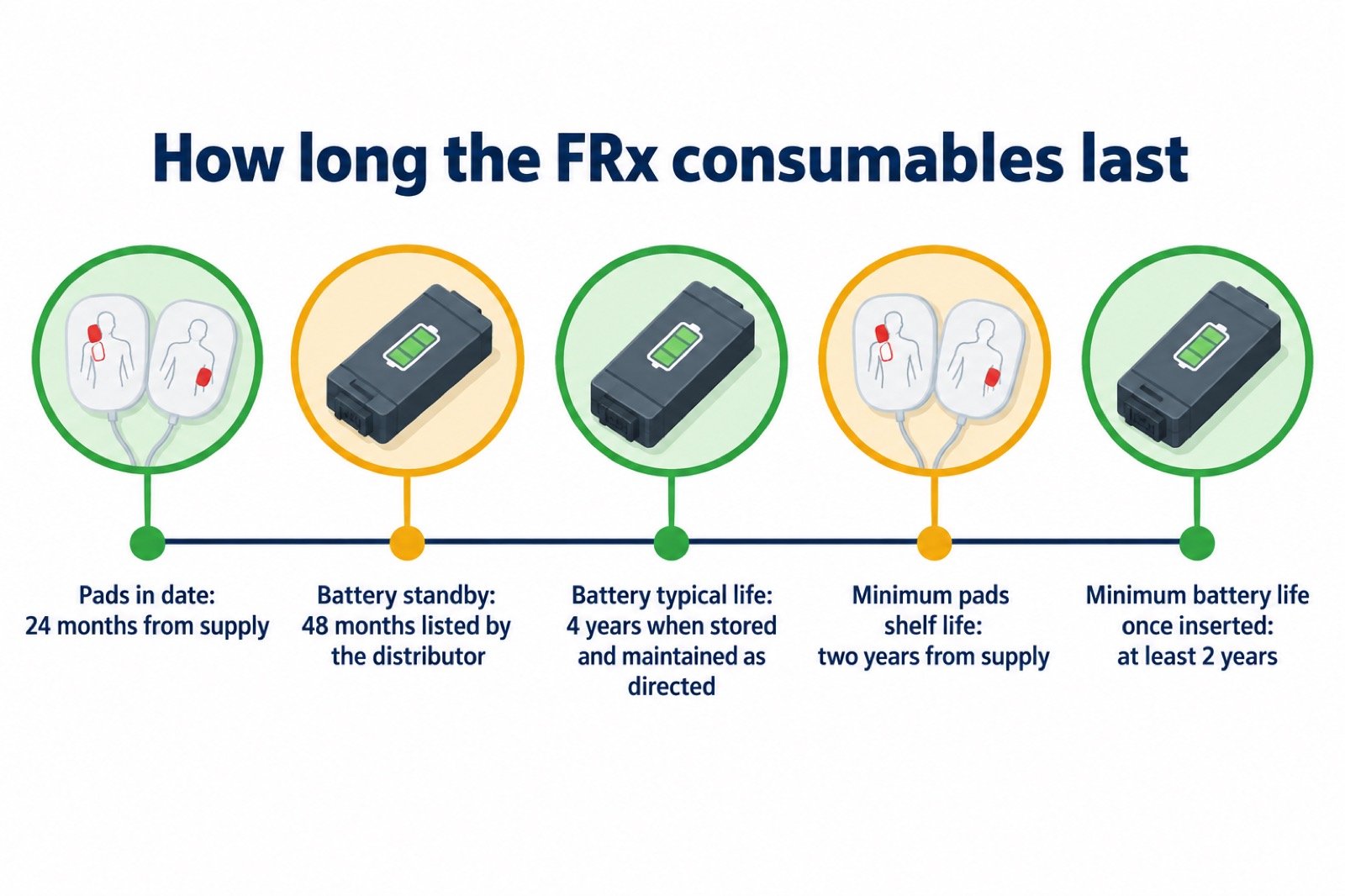
The consumables are what decide whether the machine works when it is needed, and they have a shelf life. The maker states the battery typically lasts 4 years when stored and maintained according to the directions in the owner's manual1. The distributor lists a battery standby life of 48 months and a pad life of 24 months2. The pads are the SMART pads II, pre-connected to save time2.
Those figures sit comfortably above the minimums the Resuscitation Council UK sets for a publicly accessible defibrillator. Its community guidance, published in October 2025, asks for replaceable batteries with a shelf life of at least 3 years and a life expectancy of at least 2 years once inserted, and for pads with a shelf life of at least two years from the date of supply that can be pre-connected14. Its AED guide repeats the same minimums15. Ambulance service guidance notes that AED batteries and pads generally have a shelf life of between 2 and 5 years depending on the model18.
Two practical points follow. First, write the pad expiry date somewhere you will see it, because pads that are out of date may not stick or conduct properly. Second, a battery that is still inside its four years can still run down early if the machine is used or stored badly, which is why the self-tests and the status indicator matter as much as the calendar. Our page on how long defibrillator batteries and pads last covers the general picture across models.
Daily self-tests and the ready light
The FRx checks itself. The maker states it performs a series of automatic daily self-tests to check pad readiness and verify functionality and calibration of circuits and systems6. The distributor lists daily, weekly and monthly self-tests performed by the unit, and status indicators that show when the defibrillator is ready for use and warn of a low battery2.
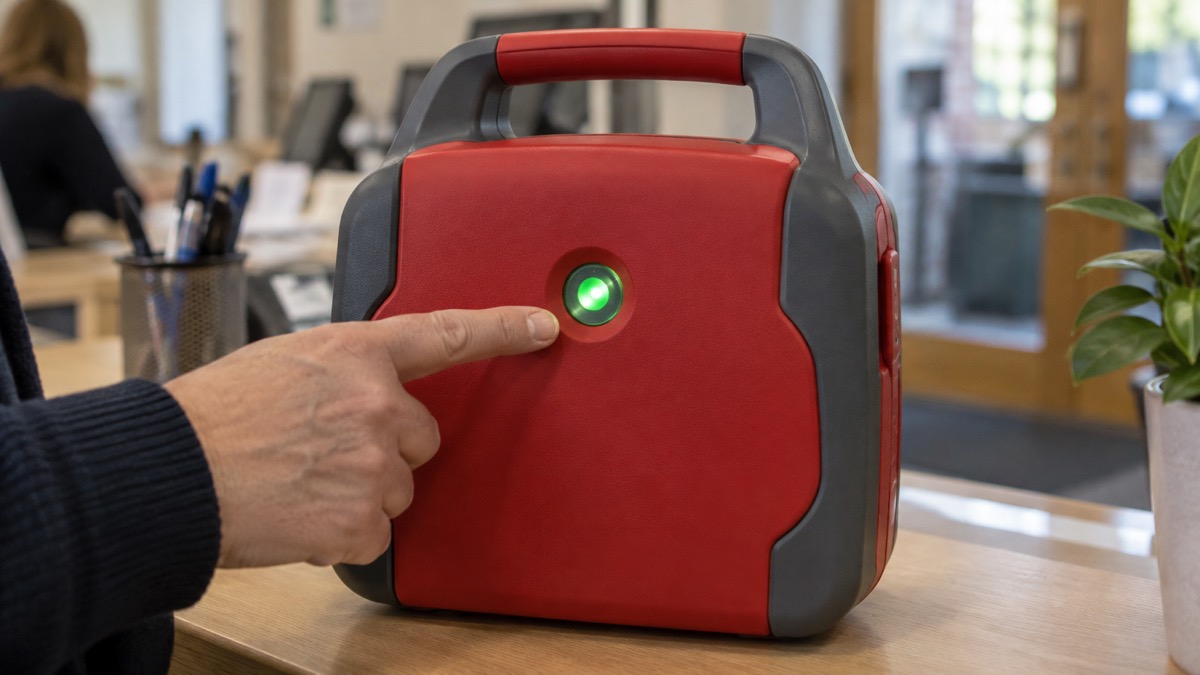
For a household, club or workplace that means the routine is mostly about looking rather than doing. Check the status indicator shows ready, check the pads are in date, and check the battery warning has not appeared. The Resuscitation Council UK's community guidance covers how a public defibrillator should be looked after and checked; our defibrillator guardian checklist turns that into a list you can work through monthly.
Size, weight and what comes in the box
The FRx is small enough to carry one-handed and light enough to hand to someone else. The maker gives the size as 6 x 18 x 22 cm (H x D x W) and the weight as 1.5 kg (3.5 lbs) with battery and pads case, or 1.2 kg (2.6 lbs) without1. The distributor lists 1.50 kg, 180 mm height, 220 mm width and 60 mm depth, with a body of ABS plastic2.
The distributor lists the box contents as one Philips HeartStart FRx defibrillator, one lithium battery, one pair of SMART pads II and a user guide, supplied with a carry case2. The infant/child key is not included and is sold separately2.
| What you get | Detail |
|---|---|
| Defibrillator unit | Model number 8613041 |
| Battery | Lithium, listed as 200 shocks capacity and 48 months standby2 |
| Pads | One pair of SMART pads II, pre-connected, 24 month life2 |
| User guide | Included2 |
| Carry case | Included2 |
| Infant/child key | Optional, sold separately2 |
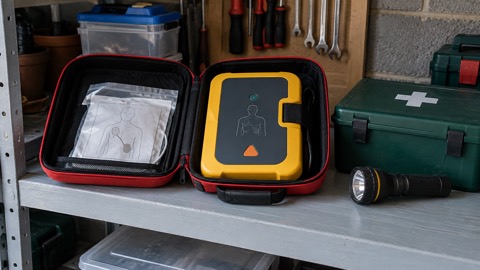
The carry case is worth thinking about as storage rather than just transport. The distributor describes the FRx as suitable for harsh environments including industrial locations, construction sites and use in the rain, and the maker describes it as able to withstand dusty or wet surfaces2. Keeping it in the case, in a place you can reach in seconds, and within the 0 to 50 °C range, is the whole of the storage routine1.
Support, warranty and where to get help
The distributor states an 8 year manufacturer's warranty on the defibrillator unit2. The Resuscitation Council UK's minimum specification for a publicly accessible defibrillator asks for a device warranty of at least 5 years from purchase and a warranty of at least 3 years on the battery or other replaceable power source, so the listed warranty sits above that floor14. Warranty terms are a matter between you and whoever supplies the unit; read them before you buy.
If you need to retrieve what the machine recorded, the distributor lists internal memory that stores usage information for later analysis, with data transfer to a computer via IrDA protocol2. The maker states that the defibrillation and CPR protocol can be customised using HeartStart Event Review or HeartStart Configure software1. In most households and clubs the recording is retrieved by the ambulance service or the device's guardian rather than by the family.
For help in the moment, ring 999. Ambulance service guidance is clear that call handlers can guide you through CPR and will direct you to the closest public access defibrillator3. Northern Ireland Ambulance Service runs a Community First Responder scheme, and its guidance notes that survival chances drop by about 10% for every minute without CPR and defibrillation5. If you are deciding where a defibrillator should live in your community, our guide to public access defibrillators and finding the nearest one and our page on choosing a defibrillator for a home, club or village cover siting and selection. The maker's own product information is at Philips.
Sources (18)
- HeartStart FRx product page, Philips, 2026-10-29
- Philips HeartStart FRx AED Defibrillator with Carry Case, Semi-Automatic, Safelincs, 2026-10-29
- Some of the reasons people call 999, Welsh Ambulance Service, 2026-10-29
- Adult First Aid Booklet, First Aid International, 2025-08
- Community First Responders, Northern Ireland Ambulance Service, 2026-10-29
- HeartStart FRx AED, Philips, 2025-11-28
- Unresponsive and not breathing child, British Red Cross, 2026-10-29
- Defibrillator guidance, North East Ambulance Service, 2024-11
- How to use an AED, NHS Inform, 2026-09-28
- Drowning, St John Ambulance, 2026-10-28
- Child CPR, St John Ambulance, 2026-10-28
- How do I perform CPR, Yorkshire Ambulance Service, 2026-10-29
- AED voice prompt settings, Whitstone Parish Council, 2010
- Public access defibrillators: a guide for communities, Resuscitation Council UK, 2025-10
- AED Guide, Resuscitation Council UK, 2026-01
- How to do CPR, North West Ambulance Service, 2025-03-13
- What to do when someone isn't breathing, North West Ambulance Service, 2025-03-13
- PAD Information Pack, South Central Ambulance Service, 2026-08
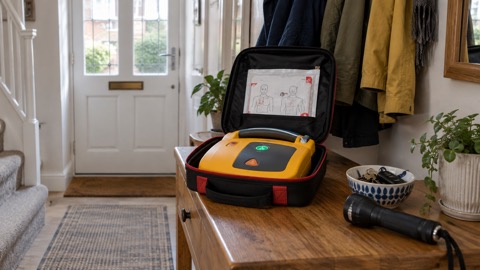 HeartSine samaritan PAD 350P
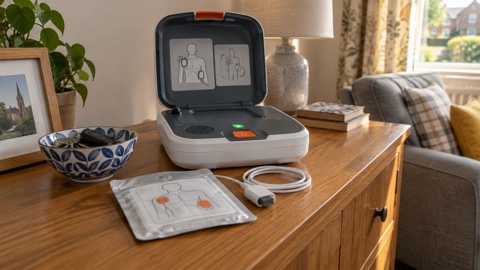 Stryker LIFEPAK CR2
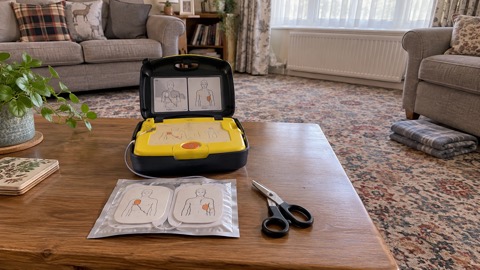 ZOLL AED 3 Defibrillator
 ZOLL AED Plus Defibrillator
 Cardiac Science Powerheart G5