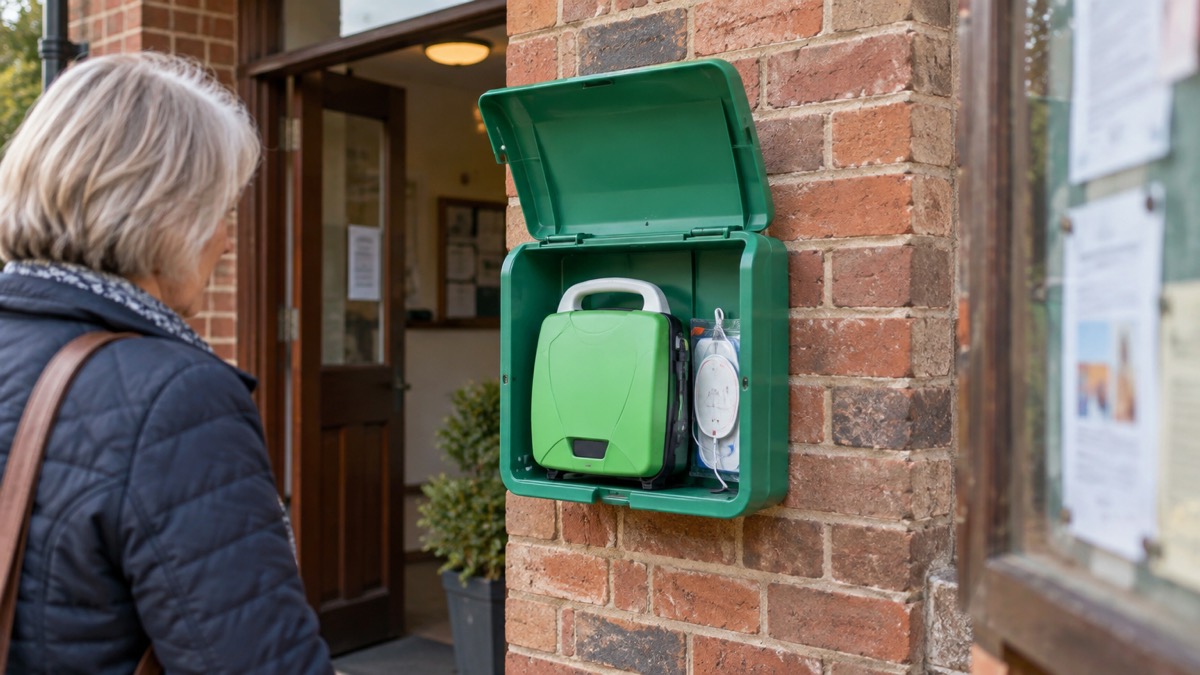
A cardiac arrest is not a heart attack, and the difference decides what you do. When someone is unresponsive and not breathing normally, the priority is to call 999, start chest compressions and get a defibrillator to them as fast as possible. The Powerheart G5 is one of the automated external defibrillators (AEDs) a UK workplace, club or community building might install. It comes in a semi-automatic version, which analyses the heart's rhythm and tells you to press a button to deliver a shock, and a fully automatic version, which delivers the shock itself without you pressing anything1.
What makes it worth understanding before you buy is how it behaves in the minutes that matter. The distributor states it can deliver a shock within 10 seconds or less after the end of a CPR cycle, and its product pages give a typical time of under 10 seconds1. It weighs 2.6 kg, carries an IP55 rating for dust and water, and delivers adult energy of 95J to 354J, falling to 22J to 82J with paediatric pads fitted2. It runs daily, weekly and monthly self-tests and shows a Rescue Ready indicator so you can see at a glance whether it is fit to use1.
This page sets out what the G5 does, what the specifications mean for a household or small organisation, how to use it on an adult and a child, how to keep it ready, and what to expect on warranty, support and delivery. It does not compare it with other defibrillators or recommend it over any other; it explains the product so you can judge whether it suits your circumstances.
What the Powerheart G5 is and which version suits you
The Powerheart G5 is an automated external defibrillator made by Cardiac Science, listed by one distributor under the manufacturer Zoll1. It is designed for workplaces, public spaces and emergency response settings, and the distributor states it is suitable for both responders with medical training and those without3. That matters because most people who fetch an AED in an emergency have never used one. Once you turn it on, it gives clear step-by-step voice instructions, and many AEDs also have visual prompts and images6.
The two versions differ in one decision: who presses the button.
| Version | What happens when a shock is advised | Suits |
|---|---|---|
| Semi-automatic | The device charges and tells you to press the shock button3 | Responders who are willing to press the button when prompted |
| Fully automatic | The device delivers the shock without requiring responder intervention4 | Settings where you want the fewest possible steps under stress |
Both versions are supplied with a battery and electrode pads, and both record up to 90 minutes of event data1. Both are FDA approved and manufactured in the USA, which is worth knowing if you are checking certification for an insurer or a grant2. The semi-automatic version is the one most often stocked for general workplace use; the fully automatic version is listed as available on back-order by one distributor7.
If you are weighing up which type to install, the choice between a semi-automatic and a fully automatic defibrillator is set out in more detail on its own page. What the G5 adds either way is a device that talks you through the rescue rather than expecting you to remember training.
Specifications: 95J to 354J, 2.6 kg and IP55
The figures that decide whether an AED suits a site are its energy output, its size and weight, and how well it survives its environment. The G5's adult therapy range is 95J to 354J, delivered as a variable escalating energy, so the first shock is lower and later shocks step up if they are needed2. The distributor describes the waveform as a STAR biphasic truncated exponential1; another lists it as biphasic truncated exponential2. The device also has a built-in automatic synchronisation feature1.
| Specification | Figure | Source |
|---|---|---|
| Adult energy | 95J to 354J, escalating | 2 |
| Child energy | 22J to 82J with paediatric pads | 2 |
| Weight | 2.6 kg | 2 |
| Dimensions | 9 × 23 × 30 cm | 2 |
| IP rating | IP55 (dust and water) | 2 |
| Drop test | 1 metre | 2 |
| Operating humidity | 10% to 95% | 2 |
| Storage temperature | 0°C to 50°C | 2 |
| Shocks per battery | 420 | 2 |
| Event memory | 90 minutes | 2 |
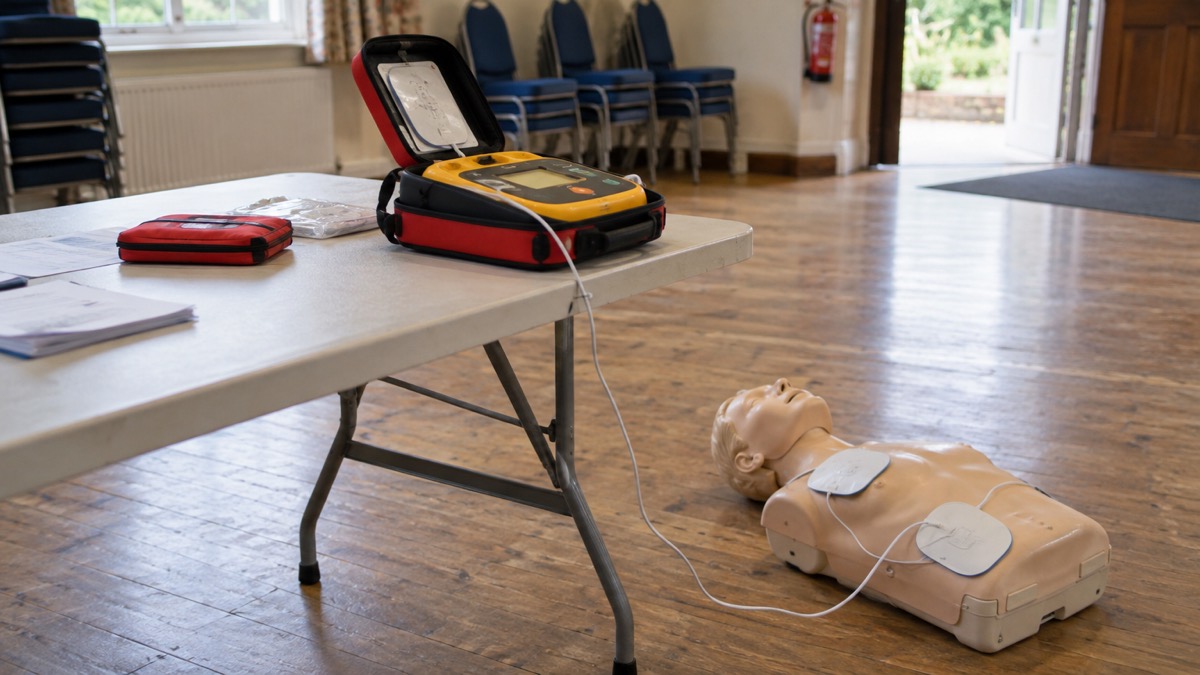
The IP55 rating means the unit is protected against dust and water spray, which is why the distributor describes it as suitable for outdoor settings as well as indoor ones4. The rugged design is built to withstand extreme temperatures, vibrations and challenging environments, and it has passed a 1 metre drop test2. For a village hall, a sports club or a workshop, that robustness is the practical point: an AED that lives in a cold porch or a busy corridor needs to keep working.
One caution on the figures. An independent product page lists the semi-automatic unit at 5 kg and 49 × 180 × 30 cm, which does not match the distributor's 2.6 kg and 9 × 23 × 30 cm3. Where a maker's or distributor's specification and a retailer's listing disagree, take the distributor's figure and check with the supplier before you rely on the dimensions for a cabinet or bracket.
How it guides a rescuer: voice prompts, metronome and CPR feedback
An AED is only as good as the CPR that goes with it. The G5 is built around keeping compressions going and interruptions short. Its RescueCoach prompts provide user-paced instruction, and a metronome sets the rate for chest compressions1. The distributor states that the device monitors the depth and rate of chest compressions and gives clear voice and visual prompts4. An optional Intellisense CPR Feedback Device provides prompting for effective chest compression rate and depth1.
The sequence follows standard AED practice. Turn it on, attach the electrode pads to the casualty's bare chest and follow all voice prompts; the machine will advise if a shock is required and either deliver it automatically or tell you to press a button8. If a helper returns with a defibrillator while you are doing CPR, ask them to switch it on and follow the voice prompts while you continue with CPR9. Listen to instructions from the ambulance controller too; they will tell you what to do and help you to push at the right speed10.
"Once this has been done, you'll be advised to continue CPR for 2 minutes before the AED re-analyses the heart's rhythm."
That two minute cycle is the rhythm of the whole rescue. After a shock, or if no shock is needed, continue CPR for two minutes until the defibrillator re-analyses12. The G5's fast shock feature is designed to fit inside that cycle: it can deliver a shock after the end of a CPR cycle in 10 seconds or less, and the distributor says it is designed to minimise interruptions during CPR1. Defibrillation energy automatically escalates if additional shocks are needed1.
The voice prompts can be changed. Touch a button to switch to one of the chosen languages without restarting or delaying the rescue, and responders can switch between two preset languages instantly1. The optional second language listed is Latin American Spanish or French Canadian1. Resuscitation Council UK guidance requires voice prompt ability in English including a safety message, and simple controls that a non-expert can understand14. Voice prompt, CPR settings and shock protocols can be adjusted through AED Manager software1.
Using it on a child: 22J to 82J with paediatric pads
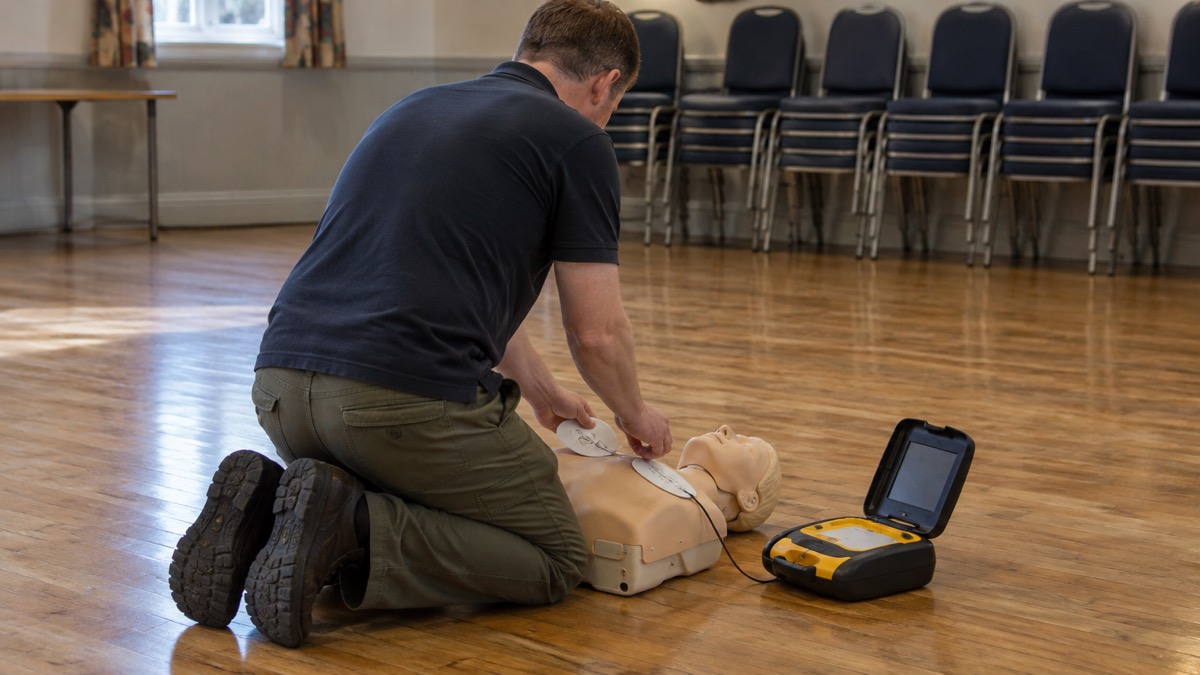
An adult AED can be used on a child, but the energy needs reducing, and the G5 does that automatically when paediatric pads are connected. The distributor states that when the pads are connected the device recognises them and automatically reduces the energy output to suit the young patient, giving a therapy range of 22J to 82J with paediatric prompts1. The pads are non-polarised, so both can be used in either location, and they are compatible with both the fully automatic and semi-automatic G55.
The paediatric pads are intended for small children aged 1 to 8 years or less than 25kg in weight5. They weigh 200g, measure 164mm by 178mm, and have a pad life of 24 months5. The adult pads supplied with the unit carry an age rating of 8 years and over2.
Official and independent guidance agrees on when to use them. Special paediatric pads, which attenuate the current delivered during defibrillation, should be used in children aged between 1 and 8 years if they are available; if not, standard adult-sized pads should be used15. For children aged one to eight, paediatric pads should be used; if not available, use standard pads with one on the centre of the chest and one on the centre of the back16. Adult pads and energy can be safely used on a child if this is the only resource available, but take care that the pads are not in contact with each other when delivering a shock14.
For a baby under one, the same principle applies: use the AED as instructed and continue CPR for two minutes after a shock or if no shock is needed, until the defibrillator re-analyses12. The page on using a defibrillator on a child or baby covers the pad placement in more detail.
Daily, weekly and monthly self-tests and the Rescue Ready indicator
An AED that has failed quietly is worse than no AED, because people believe it will work. The G5 is built to test itself and to say so. Rescue Ready technology performs rigorous daily, weekly and monthly self-tests1. The daily test checks the battery, pads, internal electronics and buttons; every 7 days it adds the CPR feedback accelerometer and high voltage circuits; monthly it runs the daily and weekly tests plus full-energy high voltage tests2.
The results show on visible indicators: Rescue Ready, battery, service and pad status1. The device also gives a "Ready to use" status indicator, an audio condition alert, a battery level indicator, an on-screen message alert and an operating temperature alert2. The status indicators notify users of any maintenance requirements4.
What you do as the owner is simple but not optional:
- Check the Rescue Ready indicator on whatever routine you set for your site, and act on any service or pad alert rather than assuming it will clear1.
- Keep the storage temperature within 0°C to 50°C, since the unit is rated for that range and an operating temperature alert will flag a problem2.
- Record the pad and battery expiry dates and replace before they lapse, not after1.
- Keep the unit where people can find it, and tell the people who share the building where it is.
A defibrillator guardian checklist is a sensible way to make those checks someone's job. The G5's self-testing reduces the burden, but it does not remove the need for a named person to look at the indicator and the expiry dates.
Battery and pads: up to 4 years and up to 2 years
The two consumables decide how often you spend money and how often the device is out of service. The G5 uses an Intellisense G5 Li medical-grade battery, supplied with a 4-year full operational guarantee from date of installation2. The distributor lists a battery life of up to 4 years for the semi-automatic version and up to 5 years for the fully automatic version, and an independent product page gives up to 4 years1. The pads have a life of up to 2 years, and the paediatric pads are listed at 24 months1.
| Item | Life listed | Source |
|---|---|---|
| Battery (semi-automatic) | Up to 4 years | 3 |
| Battery (fully automatic) | Up to 5 years | 2 |
| Adult pads | Up to 2 years | 1 |
| Paediatric pads | 24 months | 5 |
For context, Resuscitation Council UK's minimum specification for a publicly accessible defibrillator is a replaceable battery with a shelf life of at least 3 years and a life expectancy of at least 2 years once inserted14. The G5's figures sit comfortably above that floor.
The battery is not the only thing that ages. The pads are single-use and sealed, and the distributor states it cannot accept returns on defibrillator pads unless all packaging remains unopened and all security seals remain unbroken1. That is a reason to check the expiry date and the model before you break a seal, and to keep spare pads sealed until they are needed. The page on how long defibrillator batteries and pads last explains the general pattern across AEDs.
Warranty, support and delivery in the UK
The G5 carries an 8-year manufacturer warranty on the unit, according to one distributor and one independent product page3. Another distributor lists a 6-year manufacturer warranty, extendable to 10 years at checkout, on both the semi-automatic and fully automatic versions2.
Delivery is where the G5 needs planning. One distributor states a 6 to 9 month lead time on both versions due to component issues with the manufacturer, and lists the fully automatic version as available on back-order2. Another lists an 8 to 12 week delivery time for one variant and 5 to 7 working days for another1. A third lists 2 in stock of the semi-automatic version3.
On delivery charges, one distributor notes that Northern Ireland, the Scottish Highlands and Islands, the Isle of Man, the Channel Islands and the Scilly Isles carry a separate charge and take a little longer2. Another says the product is shipped directly from the supplier and may be subject to additional delivery charges for non-UK mainland addresses1. If you are ordering for a site in those areas, ask for the delivered cost before you order.
The distributor states that the G5 complies with the new BS 8599-1:2019+A1:2026 guidance, which recommends reviewing automated external defibrillators1. BS 8599-1 is the British Standard for workplace first aid kits, and the 2026 amendment brings AED provision into that review. If your workplace first aid kit is checked against the standard, note the AED alongside it. The page on BS 8599 kits explains what the standard covers.
For support, contact the supplier you buy from: one lists a sales email for product questions1, another lists its own2. Neither is a substitute for 999 in an emergency. If you are choosing an AED for a home, club or village, the wider guide to choosing a defibrillator sets out the questions to ask before you buy, and the guide to defibrillators explains what an AED does and how to use one.
Sources (17)
- Powerheart G5 AED, First Aid 4 Less, 2026-10-29
- Cardiac Science Powerheart G5 Semi-Automatic AED with CPRD, Defib Warehouse, 2026
- Cardiac Science Powerheart G5 Semi Automatic Defibrillator, Lives, 2026-09-02
- Cardiac Science Powerheart G5 features and benefits, Defibshop, 2026-10-29
- Cardiac Science Powerheart G5 Paediatric Child/Infant Defibrillator Pads, Safelincs, 2026-10-29
- Understanding defibrillators: what they are and how to use them, British Heart Foundation, 2026-10-29
- Cardiac Science Powerheart G5 CPRD Fully Automatic AED, Defib Warehouse, 2026
- Adult First Aid Booklet, First Aid Training Co-operative, 2025-08
- Drowning, St John Ambulance, 2026-10-28
- Unresponsive casualty, St John Ambulance, 2026-09-18
- How to use an AED, NHS inform, 2026-09-28
- Baby CPR, St John Ambulance, 2026-10-28
- Cardiac arrest, St John Ambulance, 2026-10-29
- Public access defibrillators: a guide for communities, Resuscitation Council UK, 2025-10
- Whitstone Parish Council document, Whitstone Parish Council, 2010
- Unresponsive and not breathing when an AED is available, British Red Cross, 2026-10-29
- AED Guide, Resuscitation Council UK, 2026-01
 HeartSine samaritan PAD 350P
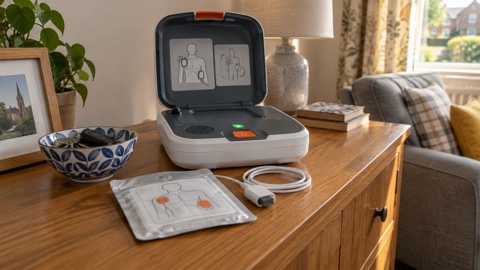 Stryker LIFEPAK CR2
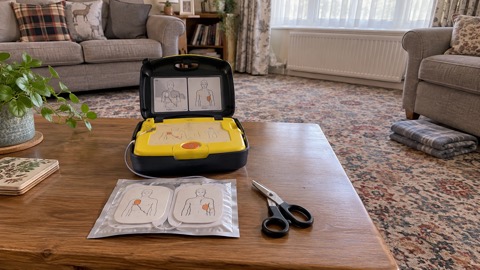 ZOLL AED 3 Defibrillator
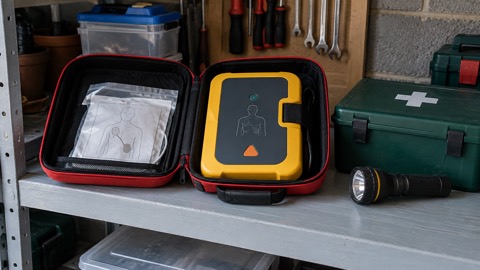 ZOLL AED Plus Defibrillator
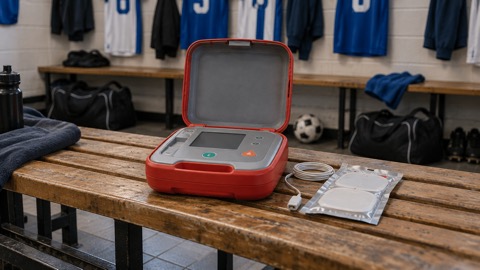 Philips HeartStart FRx AED