

A cardiac arrest can happen anywhere, including at home, and the first few minutes decide the outcome. An automated external defibrillator (AED) is a small, battery-powered machine that analyses the heart and, if a shock is needed, delivers one before the ambulance arrives. ZOLL is one of the makers of this equipment, with a legacy of over 25 years in resuscitation technology and a reputation among first responders and rescuers worldwide1.
For a UK household, the practical questions are simple. Can anyone use one? Yes: NHS Inform states that AEDs can be used without training, and the Scottish Ambulance Service says no prior training is required2. How long does it last between checks? The ZOLL AED Plus has a standby battery life of five years and a weekly default self-test, so it looks after itself between your checks1. And how do you make sure the ambulance service knows it is there? You register it on The Circuit, the national defibrillator database, at www.thecircuit.uk4.
This page covers what ZOLL makes that matters to a household getting ready for an emergency, how to get a defibrillator ready to use, how to store and check it, and where to get support. It does not cover everyday features that make no difference when the power is out or someone has collapsed.
ZOLL: over 25 years in resuscitation technology
ZOLL describes itself as having a legacy of over 25 years in resuscitation technology, trusted by first responders and rescuers worldwide1. That history matters to a household for a practical reason: the equipment has been designed for people who are frightened and untrained, in the street, in a sports hall or in a living room, not only for paramedics.
The design choices that follow from that show up in the specifications. The ZOLL AED Plus is built to be user-friendly, with interactive and intuitive step-by-step instructions that guide even untrained rescuers through the process1. It gives real-time, guideline-compliant CPR feedback with Real CPR Help, so it tells you whether your compressions are deep enough and at the right pace, not just whether a shock is needed1. It is also built to survive the places households and community groups put it: an IP55 rating for dust and water resistance, and vibration compliance to MIL Std. 810F, the minimum helicopter test1.
The ZOLL AED 3 takes a different approach to the same problem. It is a fully automatic defibrillator that delivers a shock when needed without requiring user intervention, and it uses RapidShock analysis to deliver a shock in as little as 5 seconds, minimising CPR interruptions5. In a cardiac arrest, every pause in compressions matters, so a shorter analysis and shock cycle is a real advantage.
Neither machine replaces calling 999 or starting CPR. They sit alongside both. If you are building a household plan, the defibrillator belongs with your first aid arrangements, and the wider question of what to keep ready is covered in Emergency Kit: What a UK Household Should Keep Ready.
What ZOLL makes for UK households
ZOLL's range is broad, but the part that bears on a household emergency plan is narrow: defibrillators, the pads that connect them to a person, the batteries that power them, and the accessories that let you treat someone safely while you wait. The table below sets out what each item does and who it suits.
| Item | What it does | Who it suits |
|---|---|---|
| ZOLL AED Plus (semi-automatic) | Guides an untrained rescuer step by step; gives real-time CPR feedback; you press the shock button when advised1 | Homes, community buildings and workplaces where a named person will respond and wants feedback on compressions |
| ZOLL AED 3 (fully automatic) | Analyses the heart and delivers a shock automatically after a countdown, without the rescuer pressing a button5 | Places where the person responding may be anxious about pressing a button, or where several different people might use it |
| ZOLL CPR-D Padz | The electrode pads supplied with the AED Plus first responder kit1 | Standard adult use |
| ZOLL Pedi-Padz II | Paediatric pads, needed for the AED Plus's child-specific analysis and therapy algorithm1 | Households with young children |
| ZOLL AED 3 Battery Pack | Rechargeable, sealed lithium-ion battery with a five-year shelf life5 | Keeping the AED 3 powered between checks |
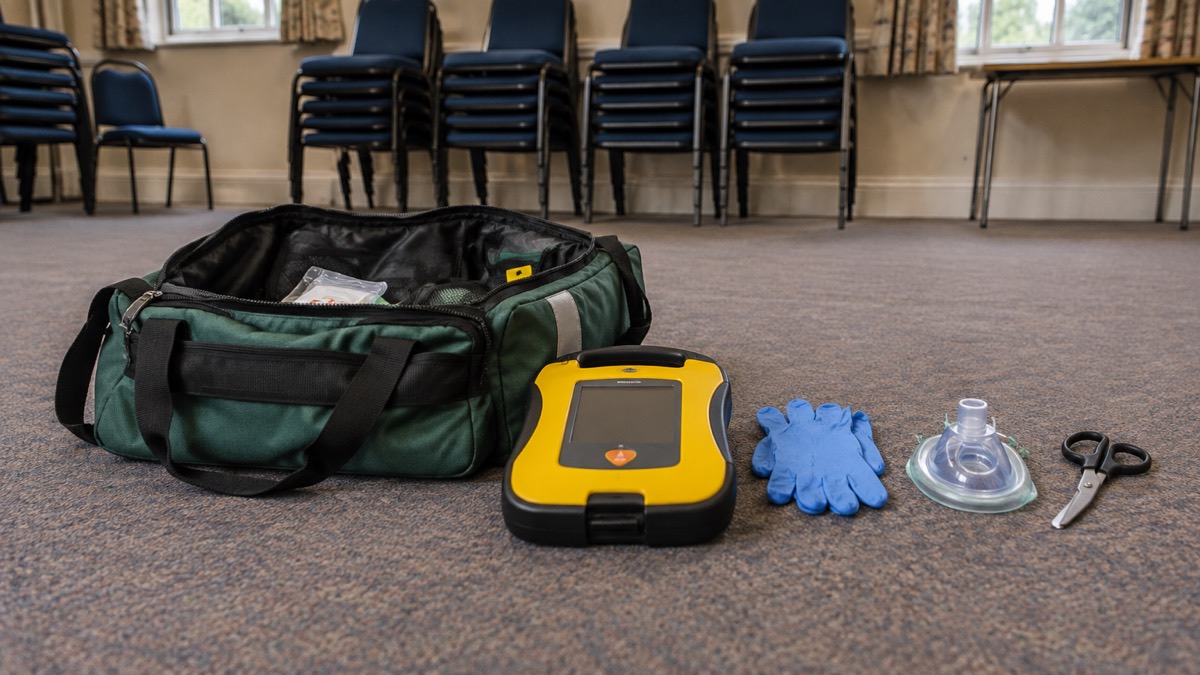
| First Responder Kit | Scissors, disposable gloves, a prep razor, a CPR barrier mask, an absorbent towel and wipes1 | Anyone who might have to treat a stranger or a family member |
The AED Plus comes with ten Duracell 123a lithium batteries with a five-year shelf life, a manual and a soft carry case1.
ZOLL defibrillators (AEDs) for home and community use
The choice between ZOLL's two household-relevant defibrillators comes down to one question: do you want the machine to decide and deliver the shock, or do you want to press the button yourself?
The ZOLL AED Plus is a semi-automatic configuration1. It analyses the heart, and if a shock is advised you press the flashing Shock button1. It recognises ventricular fibrillation and ventricular tachycardia, the two shockable rhythms1. Its charge time is less than 10 seconds with new batteries, and its pre-shock pause is 13 seconds1. For a household, the semi-automatic design has an advantage: because you press the button, you are prompted to make sure nobody is touching the person, which is the moment to check.
The ZOLL AED 3 is fully automatic: if a shock is advised, it delivers the shock after a countdown without you pressing anything5. That removes a decision at the most stressful moment. It also has WiFi and USB connectivity, so its records can be downloaded5.
Both handle children, but differently. The AED Plus needs paediatric pads for its child-specific analysis and therapy algorithm1. The AED 3 has a dedicated child button: press it and the AED automatically adjusts the shock energy and CPR feedback to be appropriate for a child5. If you have young children at home, that difference is worth knowing before you buy.
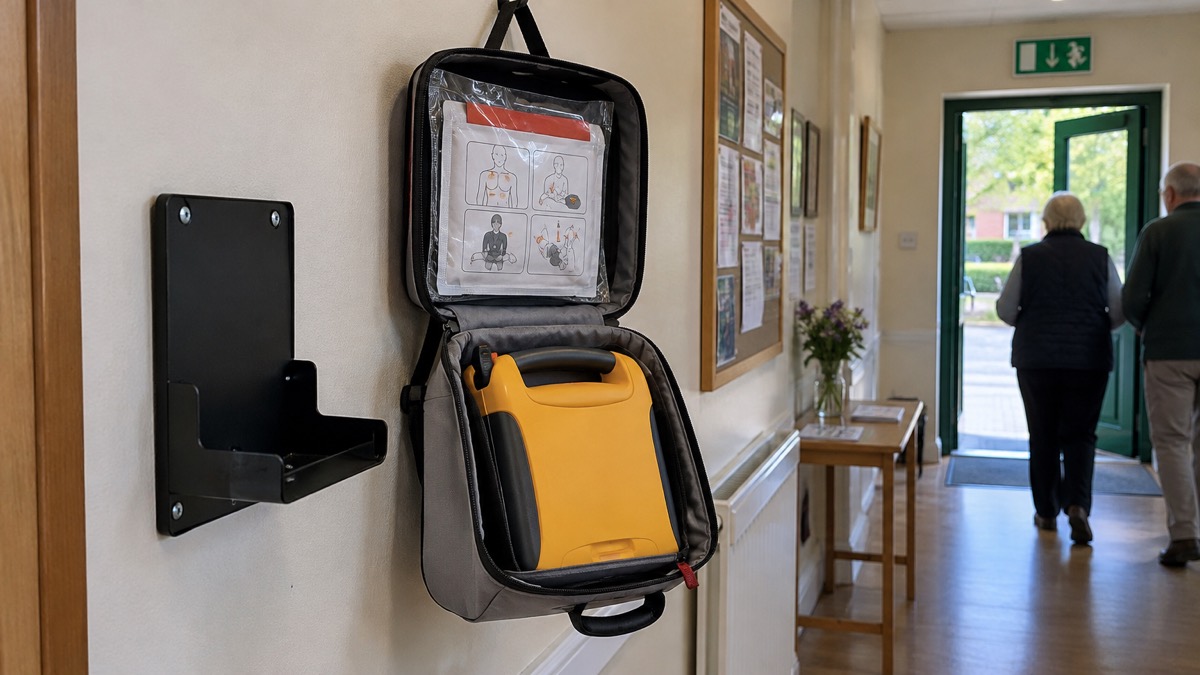
Wherever it lives, the maker's placement advice is the same: it should be placed in easily accessible, well-marked and visible locations that allow for immediate retrieval and use during a cardiac emergency1. A defibrillator in a locked cupboard under a pile of coats is not ready.
What to do first if someone collapses
The defibrillator is the second thing you reach for, not the first. The order is: check for danger, check whether the person is responsive and breathing, call 999, start CPR, and send someone for the defibrillator.
NHS Inform's guidance on using an AED sets out the sequence the machine will then talk you through2. If the person is unresponsive and not breathing normally, begin CPR and use the AED as soon as it arrives. Make sure it is safe to approach, check for a response by gently shaking their shoulders and asking loudly "are you ok?", then shout for help and ask a helper to call 999 or 112, or put your phone on hands-free and call yourself [S89].
If the collapse follows a specific incident, the first aid changes. For someone rescued from cold water or ice, the advice is to make sure the ambulance is on its way, lay them flat, check breathing and pulse and begin resuscitation if necessary, prevent them getting colder with a sleeping bag or blankets including their head, and get them under shelter7. Do not rub their skin, apply hot water or give an alcoholic drink, and keep them wrapped up so they warm up gradually7. For shock, help the casualty to lie down on a blanket or rug to protect them from the cold, and raise and support their legs above the level of their heart to improve blood supply to the vital organs7.
The wider first aid picture, including what to keep in a household first aid kit, is covered in First Aid at Home: A Household Guide.
Getting a ZOLL defibrillator ready to use
An AED is designed to be used by someone who has never seen one before, and the steps are the same on both ZOLL models. The maker's own instructions for the ZOLL AED 3 begin by telling you to turn on the AED5.
- Turn on the AED.
- Follow the spoken and visual prompts.
- If the patient is a child, press the Child button.
- Attach the pads to the patient's bare chest, following the diagrams on the pads to place them in the correct place.
- Stand clear while the device analyses the heart.
- If a shock is advised, the AED automatically delivers a shock after a countdown.
- If no shock is advised or after shock delivery, begin CPR when prompted, following the Real CPR Help prompts for proper compression quality.
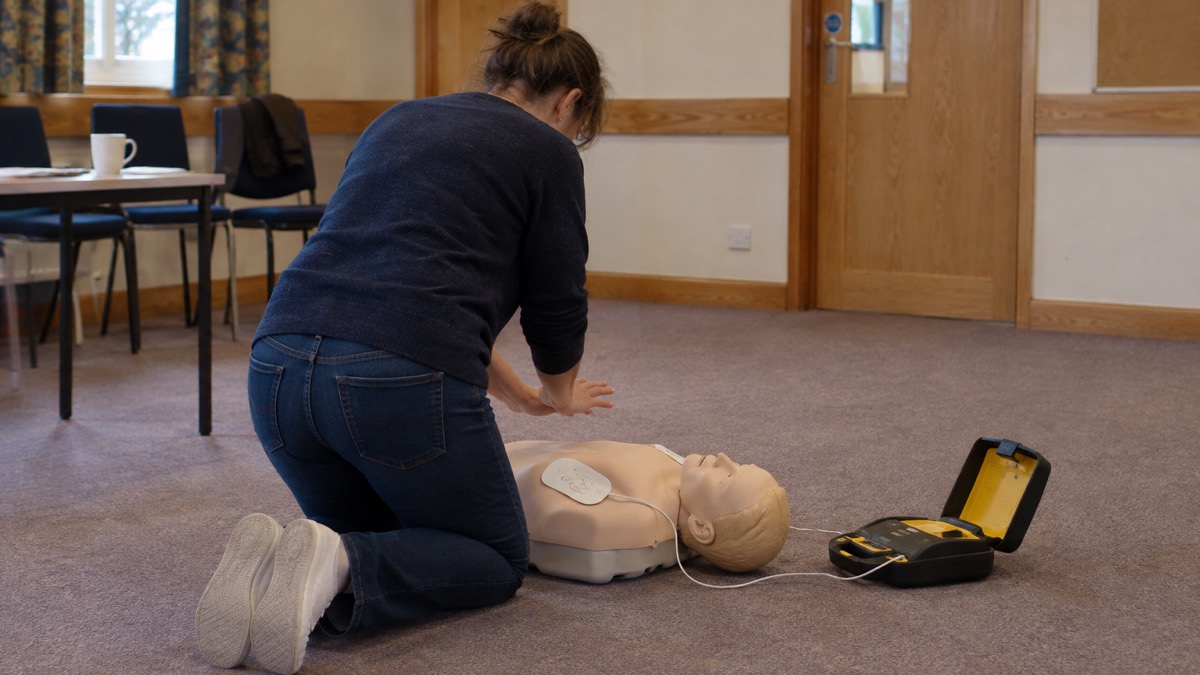
On the semi-automatic ZOLL AED Plus, the sequence is the same except for the shock itself: stand clear while the device analyses the heart, and if a shock is advised, press the flashing Shock button1.
Two practical points make the difference between a smooth rescue and a fumbled one. First, the pads must go on bare skin, so clothing has to be cut or moved; the First Responder Kit supplied with the AED Plus includes scissors for exactly this1. Second, everyone must be clear of the person when the machine analyses and shocks, which is why the prompt to stand clear is a step in its own right1.
Storing and checking a defibrillator at home
A defibrillator that has sat unchecked for years is a risk in itself. Owners or guardians must carry out routine checks, replace the battery when necessary and replace used or out-of-date pads, razors and plastic gloves, following the manufacturer's instructions, and checks should always be recorded on The Circuit8:
- Check the defibrillator is in working order.
- Ensure pads and batteries are within their expiry dates.
- Confirm the device remains accessible and clearly signposted.
- Update any changes to the device's status or location.
- Register the defibrillator on The Circuit if it is not already listed.
The machines help with the first item. The ZOLL AED Plus runs a weekly default self-test1. The ZOLL AED 3's self-test is configurable, with a default of every 7 days5. If a self-test fails, the device will signal it, so a glance at the status indicator as part of a monthly household check is enough.
On consumables, the figures to plan around are these. The ZOLL AED Plus uses ten Duracell 123a lithium batteries with a five-year shelf life, and its standby battery life is five years1. The ZOLL AED 3 battery pack is a rechargeable, sealed lithium-ion unit with a five-year shelf life5. Write the pad and battery expiry dates on the calendar when you install the device, and replace them before they lapse, not after.
Who uses ZOLL equipment: first responders and rescuers
ZOLL equipment is used by professional and volunteer responders as well as households, and that has a bearing on what support comes with it. ZOLL provides comprehensive support including tracking the expiration dates of pads and batteries, responder training and AED certification management1.
In the UK, that responder world includes Community First Responders. In Northern Ireland, Community First Responders provide Basic Life Support and are trained in the first three links of the Chain of Survival: early recognition of cardiac arrest, early CPR and early defibrillation10. The same principle applies at home: the earlier someone recognises what is happening, starts compressions and gets pads on, the better the chance.
For a household, the lesson is not to try to become a responder but to borrow their habits. Know where your nearest public defibrillator is before you need it. The Scottish Ambulance Service points people to www.defibfinder.uk to find out if there is a defibrillator near you4. The South Western Ambulance Service points to its Saving Lives Together website to find your closest defibrillator, and advises that you can take just 15 minutes to learn CPR11.
ZOLL support and warranty in the UK
The warranty position is one of the practical reasons to register a ZOLL device. The ZOLL AED Plus comes with a 7 year warranty: a standard warranty of five years, extended to seven years when you register the device with ZOLL1. That is a straightforward trade: a few minutes of registration buys two more years of cover.
Beyond the warranty, ZOLL's support covers the parts of ownership that are easy to forget: tracking the expiration dates of pads and batteries, responder training and AED certification management1. For a household, the expiry tracking is the useful part, because pads and batteries are the items that quietly go out of date between emergencies.
The support that matters most in an actual emergency, though, comes from the ambulance service, not the maker. That is why registration on The Circuit is part of getting the device ready. The Scottish Ambulance Service asks owners to make sure their defibrillator is registered on the national database so that anyone who rings 999 for a cardiac arrest can access the nearest defibrillator4. The North West Ambulance Service makes the same request and notes that all older community defibrillators that were directly registered with the ambulance service will need to be registered on The Circuit too; you can check whether yours is already registered at www.defibfinder.uk12.
If you are not sure whether your device is listed, check at www.defibfinder.uk before assuming it is9. The London Ambulance Service adds a further point for publicly accessible devices: ensure your defibrillator is located in an accessible and unlocked cabinet, visible to the public, in a well-lit location13. For a home device, the equivalent is a known, reachable spot that every adult in the house can find in the dark.
ZOLL safety notices and recalls
Defibrillators are electrical medical devices, and like any electrical item they can be subject to a product recall or safety notice. The Office for Product Safety and Standards issues recalls and alert notices on its website, and that is the place to check14. The fire and rescue services consistently give the same advice for electrical items generally: register electrical items with the manufacturer to be informed of any safety recalls15.
For a household with a defibrillator, that means two habits. Register the device with ZOLL when you buy it, which also extends the AED Plus warranty to seven years1. And check periodically for recalls or safety notices, in the same way the fire services advise checking white goods and tumble dryers against recall lists18.
The same recall discipline applies to the rest of a household emergency kit. The London Fire Brigade advises checking product recall notices issued by the Office for Product Safety and Standards and contacting the retailer where you purchased the product18. If you keep a defibrillator alongside other electrical equipment in a grab bag or emergency cupboard, check the whole lot at the same time.
Sources (19)
- ZOLL AED Plus Semi Automatic Defibrillator, Steroplast, 2026-10-29
- How to use an AED, NHS Inform, 2026-09-28
- Public Access Defibrillators, Scottish Ambulance Service, 2026-10-29
- AED, Scottish Ambulance Service, 2026-10-29
- ZOLL AED 3 Fully Automatic Defibrillator, Steroplast, 2026-10-28
- Public Access Defibrillators, Scottish Ambulance Service, 2026-10-29
- Shock first aid, NHS Inform, 2026-07-24
- Check your defib because every minute counts, Scottish Ambulance Service, 2026-06-15
- Schools reminded to update defibrillator details over summer holiday period, Scottish Ambulance Service, 2025-07-17
- First Responders, Northern Ireland Ambulance Service, 2026-10-29
- SWASFT’s summer top tips and advice | SWAST Website, South Western Ambulance Service NHS Foundation Trust (SWASFT)
- The Circuit: the new defibrillator database, North West Ambulance Service, 2025-07-10
- Unlocked defibrillator cabinets allow immediate access in an emergency, London Ambulance Service, 2025-01-06
- Electrical items, London Fire Brigade, 2026-10-25
- Maintain appliances and recalls, Greater Manchester Fire and Rescue Service, 2026-10-29
- Electrical fire safety leaflet, Greater Manchester Fire and Rescue Service, 2026
- Electrical fire safety, Warwickshire County Council, 2026-10-29
- Registering your e-bike or e-scooter for safety alerts and product recalls, London Fire Brigade, 2026-10-25
- White goods, Cheshire Fire and Rescue Service, 2026-05-20
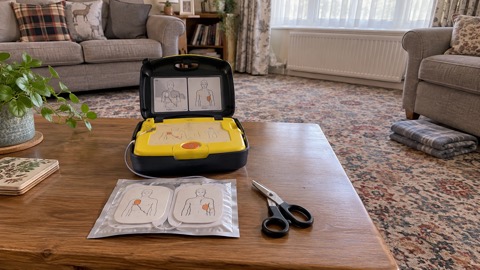 ZOLL AED 3: Fully and Semi-Automatic
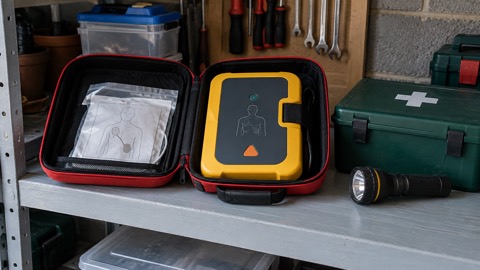 ZOLL AED Plus Semi-Automatic Defibrillator