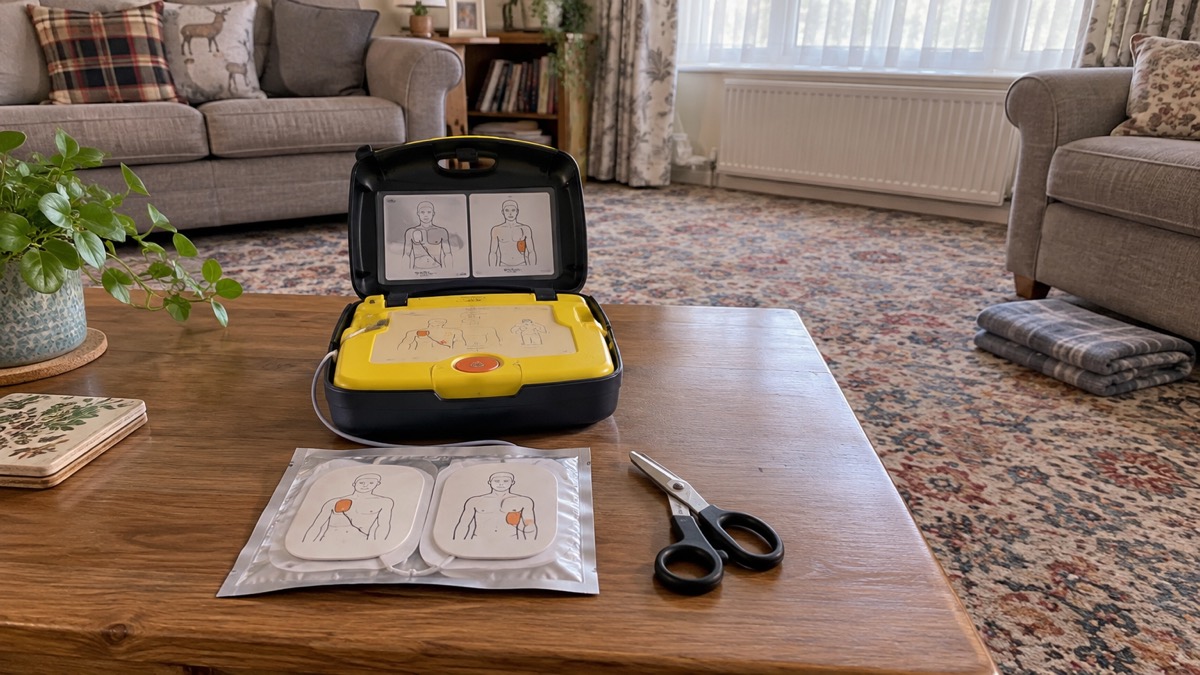
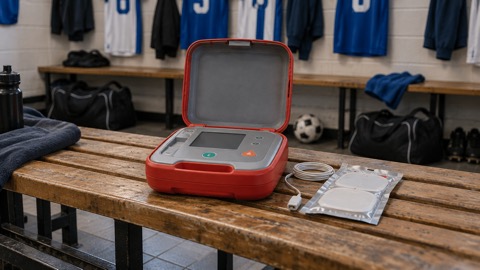
The ZOLL AED 3 is a defibrillator for someone whose heart has stopped. It comes in two versions: a fully automatic model that delivers a shock itself after a countdown, and a semi-automatic model where the rescuer presses the button when told to1. Both talk you through the rescue, both give feedback on how well you are doing chest compressions, and both have a child setting that lowers the shock energy to 50 J, 70 J or 85 J at the press of a button2.
If someone collapses and is not breathing normally, the order is always the same: call 999, start CPR, and send for the nearest defibrillator. The machine does the rest. It analyses the heart, decides whether a shock is needed, and tells you what to do next. You cannot make it shock someone who does not need it, and you do not need training to use it1.
This page sets out what the ZOLL AED 3 does, how to use one step by step, what the specifications mean for a home, club or village, and how to keep the battery and pads ready so the unit works when it is needed. For the wider picture, see Defibrillators (AEDs): What They Do and How to Use One.
Fully automatic or semi-automatic: who presses the shock button
The difference between the two models is one button, and it matters most for a household with one rescuer. Resuscitation Council UK explains that some AEDs will deliver a shock automatically, while others will require the rescuer to press the shock button1. The South Central Ambulance Service public access defibrillator information pack puts it the same way: a semi-automatic unit prompts the user to press the shock button, while a fully automatic unit uses a countdown or voice commands and delivers the shock without the user pressing a shock button4.
On the ZOLL AED 3, the maker describes the fully automatic model as delivering a shock when needed without requiring user intervention, and the semi-automatic model as requiring the rescuer to press a button to administer the shock2.
| Version | Who delivers the shock | Suits |
|---|---|---|
| Fully automatic | The device, after a countdown4 | A lone rescuer whose hands are busy with CPR, or a site where untrained passers-by may be first on scene |
| Semi-automatic | The rescuer, when prompted4 | A team used to defibrillators, or a responder who prefers to control the moment of the shock |
Neither is safer in the sense of doing harm: both analyse the rhythm first and will not advise a shock unless one is needed. The choice is about who is likely to be there. If you are weighing it up for a home, a sports club or a village, the comparison at Semi-Automatic or Fully Automatic Defibrillator: Which Suits a Home or Community? sets out the trade-offs, and Choosing a Defibrillator for a Home, Club or Village covers the wider decision.
Using the ZOLL AED 3 step by step
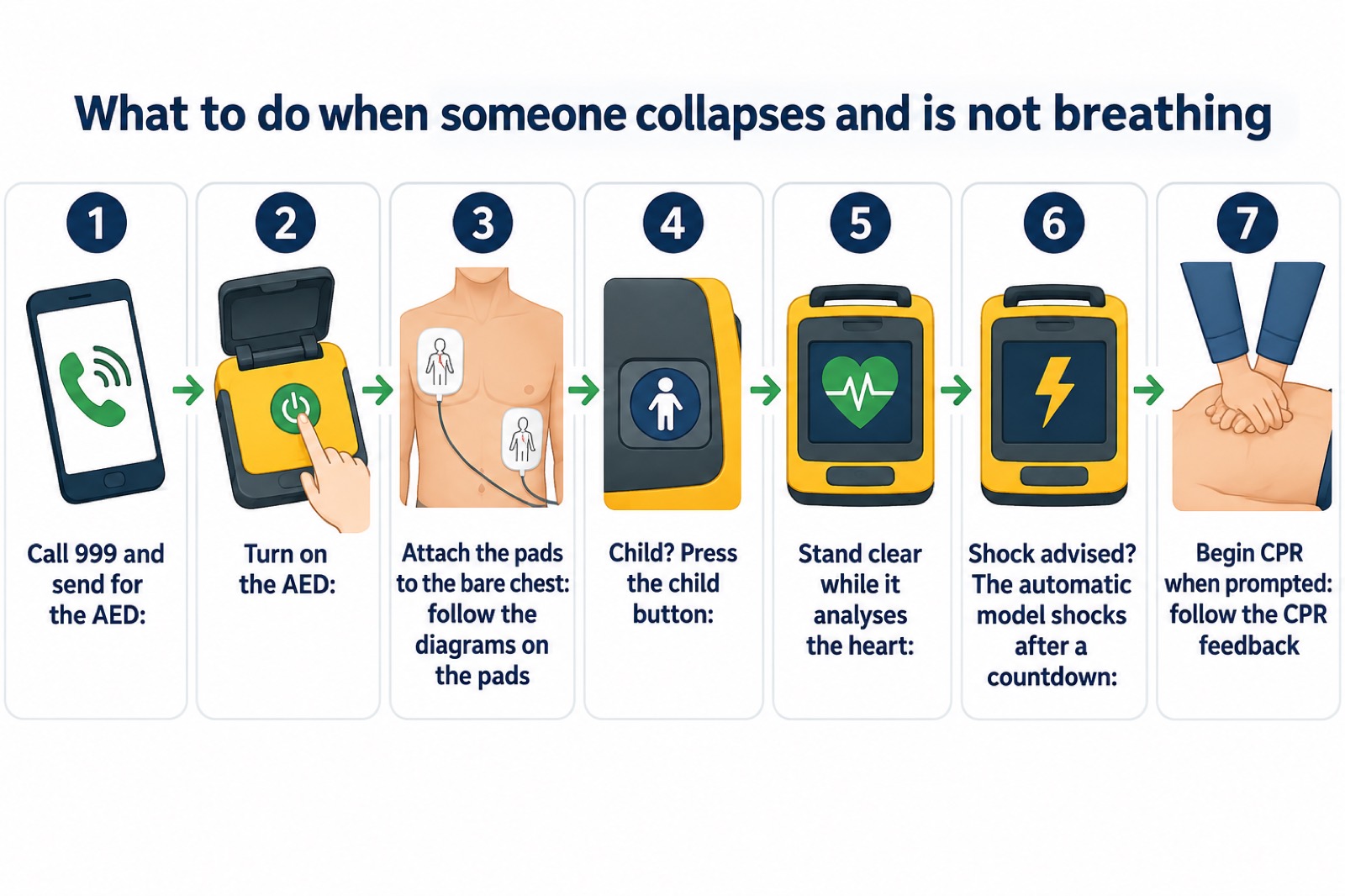
The maker's own instructions run in order, and they match the sequence any AED follows. The first step is to turn on the AED2. From there, the device speaks and shows what to do. Attach the pads to the patient's bare chest, following the diagrams on the pads to place them in the correct place2. If the patient is a child, press the child button2. Stand clear while the device analyses the heart2. If a shock is advised, the fully automatic model delivers it after a countdown2. If no shock is advised, or after shock delivery, begin CPR when prompted and follow the CPR feedback prompts2.
Around those steps, the CPR itself has to be right. The NHS says to press down hard, to a depth of about five to six centimetres, before releasing the pressure and allowing the chest to come back up5. NHS Inform gives the rate as 30 compressions at 100 to 120 per minute6. The British Heart Foundation describes the same rhythm as two per second7. The ZOLL AED 3's feedback is built around those numbers, so the prompts and your hands are working to the same target.
Real CPR Help: feedback on compression depth and rate
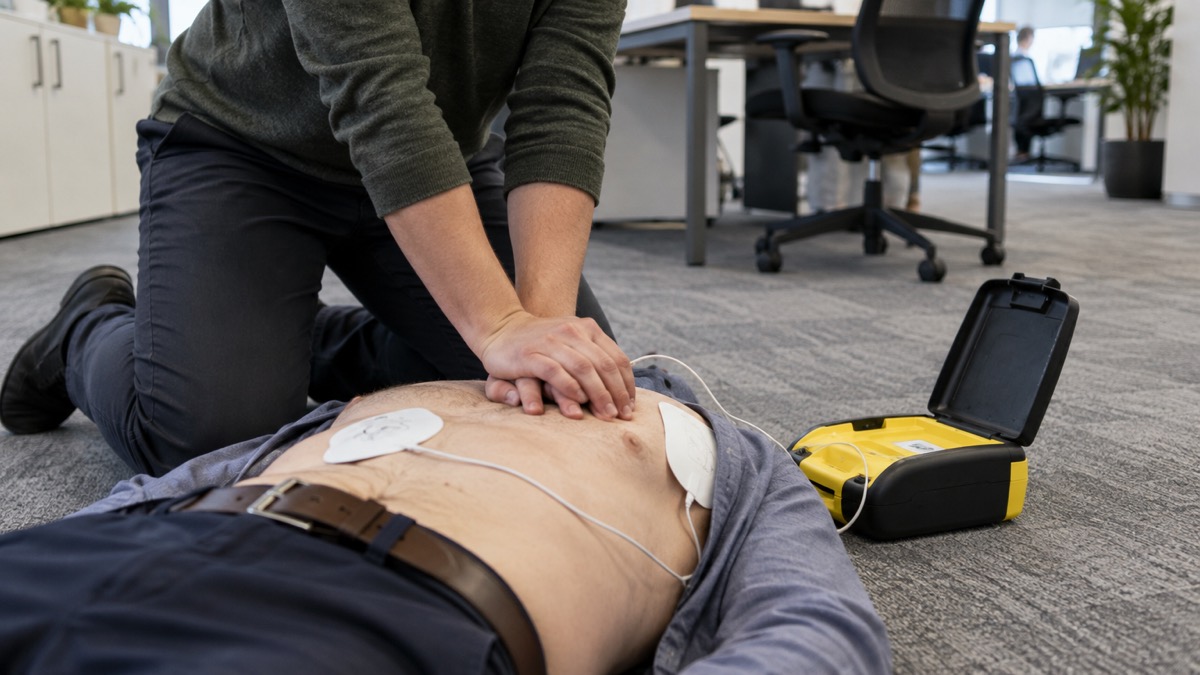
Good compressions are the part of a rescue a machine cannot do for you, and they are the part most people get wrong. The ZOLL AED 3's Real CPR Help guides rescuers with real-time feedback on CPR quality via a full-colour display, showing compression depth and rate2. Audio and visual prompts guide rescuers to "Push Harder" or confirm when they are delivering "Good Compressions"2.
That matters because the target is specific. The NHS puts the depth at about five to six centimetres5, and ambulance services across England give the same figure: the North East Ambulance Service says to press down hard and fast by 5 to 6cm on their chest8, and the Yorkshire Ambulance Service gives 5 to 6cm, or 2 to 2.5 inches9. The British Heart Foundation frames it as one third of the chest depth, or 5 to 6 centimetres7. The rate is 100 to 120 per minute6, which the North West Ambulance Service describes as approximately two per second10.
"Audio and visual prompts guide rescuers to "Push Harder" or confirm when they are delivering "Good Compressions.""
The feedback is a guide, not a substitute for the basics. If you have never done CPR, the How to Do CPR: Hands-Only Steps for Adults page walks through hand placement and body position, and How Fast and How Deep Should Chest Compressions Be? covers the numbers in more detail. The 2025 guidelines changed some of what bystanders are asked to do; The 2025 Resuscitation Guidelines: What Changed for Bystanders explains what is different.
Child mode: shocks of 50 J to 85 J at the press of a button
Children can need a defibrillator too, and the energy has to come down. On the ZOLL AED 3, switching to child mode is simple: press the dedicated child button, and the AED automatically adjusts the shock energy and CPR feedback to be appropriate for a child2. The child settings are 50 J, 70 J and 85 J, against 120 J, 150 J and 200 J for an adult2.
The South Central Ambulance Service pack explains the principle behind paediatric settings: they typically decrease the output of the machine to 50-75 joules and are recommended for children between 1-8 years old, and an unmodified adult AED may be used if no such system is in place4. That last point is the one to remember in a hurry: if the only defibrillator to hand has no child mode, use it anyway rather than delay.
Resuscitation Council UK's minimum specification for a public access defibrillator requires it to be able to shock VF and VT above 150 BPM in an adult, and, if it has paediatric settings, above 180 BPM11. The ZOLL AED 3's child mode is a setting on the same unit rather than a separate set of pads, so there is nothing extra to find in the bag. For more on using a defibrillator on a child, see Can You Use a Defibrillator on a Child or Baby?.
Specifications: 2.5kg, IP55 and a charge in under 7 seconds
The headline numbers decide whether a unit suits a particular wall, cupboard or vehicle. The ZOLL AED 3 weighs 2.5kg with the battery fitted2, and measures 12.7cm by 23.6cm by 24.7cm2. It carries an IP55 ingress protection rating2, which is the maker's statement of how well it keeps out dust and water. It will take a drop test of 1 metre2.
| Specification | Figure | Source |
|---|---|---|
| Weight | 2.5kg with battery | Maker2 |
| Dimensions | 12.7cm x 23.6cm x 24.7cm | Maker2 |
| Ingress protection | IP55 | Maker2 |
| Charge time | Less than 7 seconds with a new battery | Maker2 |
| Pre-shock pause | Less than 5 seconds, typical | Maker2 |
| Shock delivery | As little as 5 seconds | Maker2 |
| Display | High-resolution LCD touchscreen, 5.39cm x 9.5cm | Maker2 |
| Operating temperature | 0°C to 50°C | Maker2 |
| Storage temperature | -30°C to 70°C | Maker2 |
| Humidity | 10% to 95%, non-condensing | Maker2 |
| Connectivity | WiFi and USB | Maker2 |
| Self-test | Configurable, default every 7 days | Maker2 |
The charge time and pre-shock pause are the figures that matter during a rescue: the maker states a charge time of less than 7 seconds with a new battery and a typical pre-shock pause of less than 5 seconds2, and describes the shock as delivered in as little as 5 seconds, minimising CPR interruptions2. Every second spent waiting is a second not spent on compressions, which is why these numbers are quoted at all.
The battery pack itself weighs 317.5 grams3 and has a normal voltage of 12 volts3. The maker's product page for the defibrillator describes the battery as a rechargeable, sealed lithium-ion type with a capacity of 140 shocks at 200 J or 6 hours continuous monitoring2, while the maker's battery page describes it as a disposable lithium manganese dioxide pack, replaced at the end of its life, with a capacity of up to 140 defibrillator discharges at maximum energy3. The two maker pages disagree on the battery chemistry and on whether it is recharged; treat the battery as a consumable that is replaced at end of life, and check the pack you are sent against its own label.
Where it can be kept: storage from -30°C to 70°C
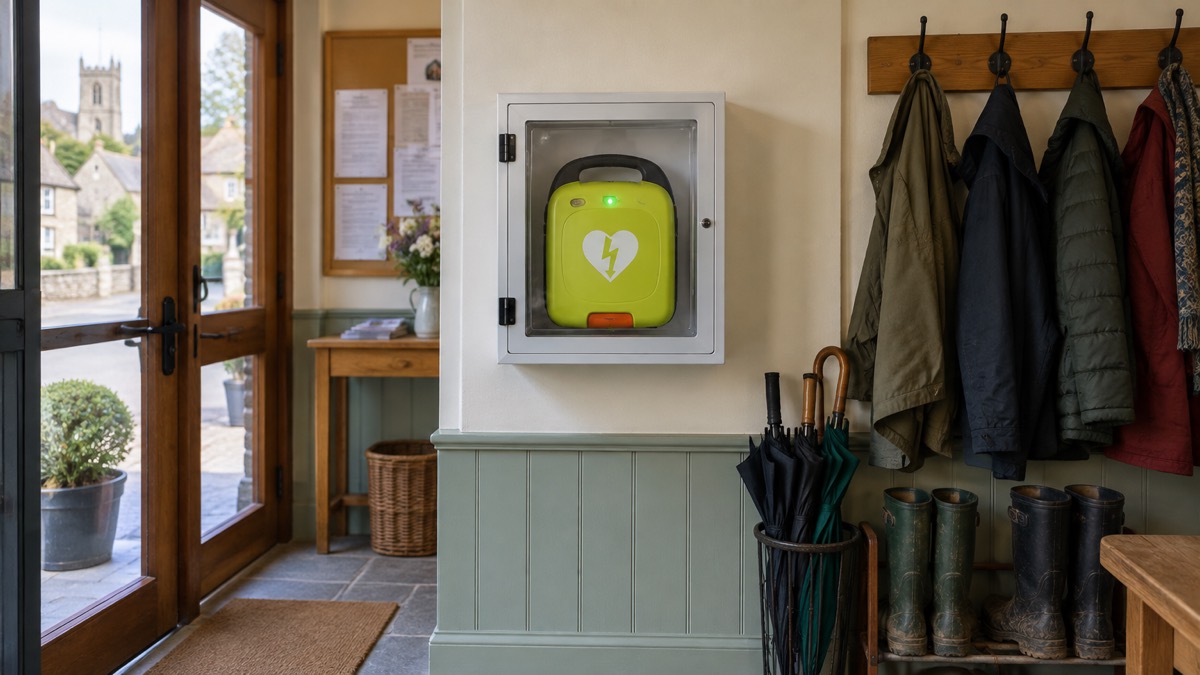
The maker gives a storage temperature range of -30°C to 70°C and an operating range of 0°C to 50°C2. The battery pack's own operating range is 0°C to 50°C3. In plain terms, the unit tolerates a cold garage or a hot cupboard far beyond what a person would, but it should be brought into its operating range before use if it has been stored at an extreme.
That range gives more choice about where it lives: a porch, an unheated village hall or a vehicle, as well as a warm indoor wall. Check the unit's own stated range against the spot you have in mind before you commit to it.
Wherever it goes, the same rules apply as for any battery-powered device in the home. The Health and Safety Executive's advice, carried by North Yorkshire Fire and Rescue Service, is to always follow the battery usage, storage and charging guidelines in the user guide13. Surrey County Council's fire and rescue service advises regularly checking batteries for any damage or wear and tear14. Keep spare batteries securely stored and out of reach of young children: the Alder Hey children's hospital advises checking every battery-powered device in your home and anywhere your child stays, and ensuring the battery case is shut and secured15.
If the unit is going outdoors, the choice between an indoor and an outdoor cabinet is covered at Indoor or Outdoor Defibrillator Cabinet: Which Do You Need?.
Keeping it ready: self-tests, battery and pads
An AED that has not been checked is an unknown quantity. The ZOLL AED 3 runs a self-test that is configurable and defaults to every 7 days2. The battery's standby life depends on how often those tests run: the maker states up to 5 years with weekly self-tests enabled, and up to 3 years with daily self-tests3. The defibrillator product page gives a standby life of 5 years with weekly maintenance2.
The battery is fitted by inserting it into the designated slot on the back of the AED unit until it clicks into place, before the install by date3. The maker advises keeping the battery at a stable temperature of 23°C for up to 2 years to maintain the 5-year standby life once installed3. The maker also lists a shelf life of 5 years for the battery2, while the battery page gives up to 2 years at 23°C before installation3; the two maker pages disagree, so go by the install by date printed on the pack you have.
Pads are the other consumable. The South Central Ambulance Service pack is clear that electrode pads and items like scissors and razors are single use and will need replacing before the AED can be response ready again, and that some items have a limited shelf life4. The same pack lists the ZOLL AED 3's pad shelf life as 5 years4.
- Check the status indicator on a regular schedule and record it.
- Replace pads after any use, and before their expiry date.
- Replace the battery at end of life, using a pack that meets the maker's specification16.
- Keep the unit clean and the battery compartment secure15.
The Defibrillator Guardian Checklist turns these into a routine, and How Long Do Defibrillator Batteries and Pads Last? covers the consumables in more depth.
WiFi, data and what the unit records
The ZOLL AED 3 offers optional WiFi connectivity, enabling cloud-based device management, and connects by WiFi and USB2. In a club or village setting, that means a guardian can see the unit's readiness without opening the cabinet. WiFi is optional: a unit without it still runs its own self-tests and shows its status on the device.
After a rescue, the maker states that the unit stores up to 120 minutes of rescue data, retrievable via USB or cloud2. With RescueNet CaseReview, responders can access event data from any web-enabled device2. The practical instruction for a household is simple: hand the unit to the ambulance crew or the receiving hospital and let them retrieve the data. Do not take it apart or try to download it yourself at the scene.
Warranty: 6 years, or 8 when registered
The distributor's product page states a 6 year manufacturer's warranty on the defibrillator unit, plus 2 additional years when the device is registered with ZOLL, and elsewhere on the same page describes the warranty as 8 years2. The two statements on that page have not been reconciled, so ask the seller to confirm in writing which applies to the unit you are sent, and keep the registration confirmation.
Registration is worth doing whatever the exact term, because it is the route to the extended cover and to the maker's own support. Record the serial number, the date of purchase, the battery install by date and the pads' expiry date together, and diarise the checks.
Where to get help and how to prepare
A defibrillator is one part of a response, not the whole of it. Call 999 first. In Northern Ireland the Northern Ireland Ambulance Service notes that Community First Responders are trained to use an automated external defibrillator17, and the same principle applies across the UK: the call handler can tell you where the nearest public access defibrillator is and, in many areas, give you the code for a locked cabinet. Public Access Defibrillators: Finding the Nearest One explains how to find one before you need it.
If someone in your household has a heart condition, or you are a carer, tell the ambulance service what it needs to know. The Information to Have Ready for the Ambulance Crew checklist covers what to keep by the phone, and Message in a Bottle: Keeping Medical Details Where Responders Look covers the container scheme. Households with older or disabled members can also ask for extra help in an emergency; Extra Help in an Emergency: Older, Disabled and Medically Dependent Households explains the routes.
Learning CPR costs nothing and takes an evening online. Learning CPR Free Online: RevivR and Other Options lists the free courses, and First Aid Courses: Types, Length and Where to Find One covers the classroom options. The First Aid at Home: A Household Guide is the place to start for everything else.
Sources (17)
- Adult basic life support guidelines, Resuscitation Council UK, 2025
- ZOLL AED 3 Fully Automatic Defibrillator, Steroplast, 28 October 2026
- ZOLL AED 3 Battery Pack, Steroplast, 28 October 2026
- PAD information pack, South Central Ambulance Service, August 2026
- How to do CPR, NHS, 29 October 2026
- How to give an adult CPR, NHS Inform, 8 September 2026
- How to do CPR, British Heart Foundation, 29 October 2026
- Learning CPR, North East Ambulance Service, 29 October 2026
- How do I perform CPR, Yorkshire Ambulance Service, 29 October 2026
- How to do CPR, North West Ambulance Service, 13 March 2025
- Public access defibrillators: a guide for communities, Resuscitation Council UK, October 2025
- AED guide, Resuscitation Council UK, January 2026
- Electrical safety, North Yorkshire Fire and Rescue Service, 14 September 2026
- Lithium batteries, Surrey County Council, 28 October 2026
- Swallowed something, Alder Hey Children's NHS Foundation Trust, 25 September 2025
- Product safety campaigns, Peterborough City Council, 29 October 2026
- First responders, Northern Ireland Ambulance Service, 29 October 2026
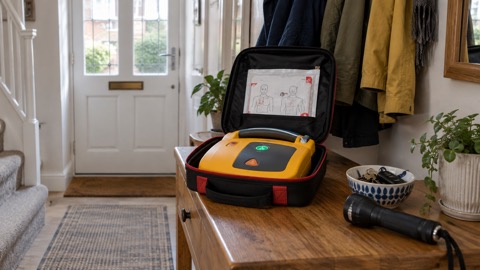 HeartSine samaritan PAD 350P
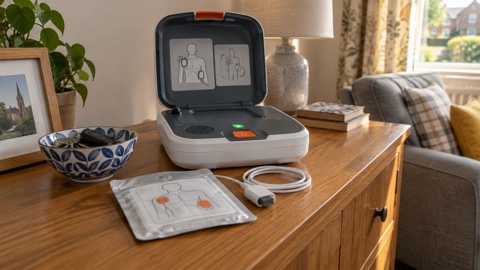 Stryker LIFEPAK CR2
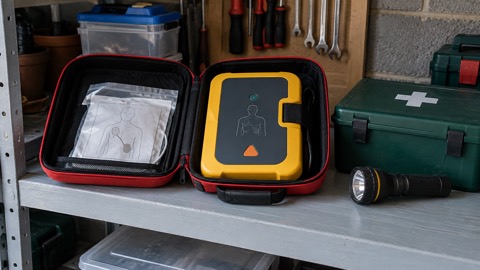 ZOLL AED Plus Defibrillator
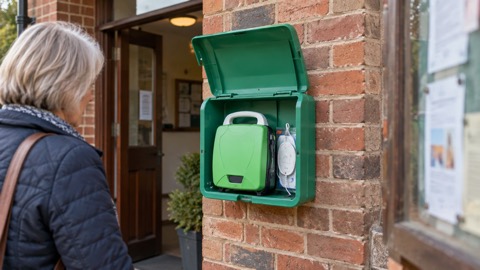 Cardiac Science Powerheart G5
 Philips HeartStart FRx AED