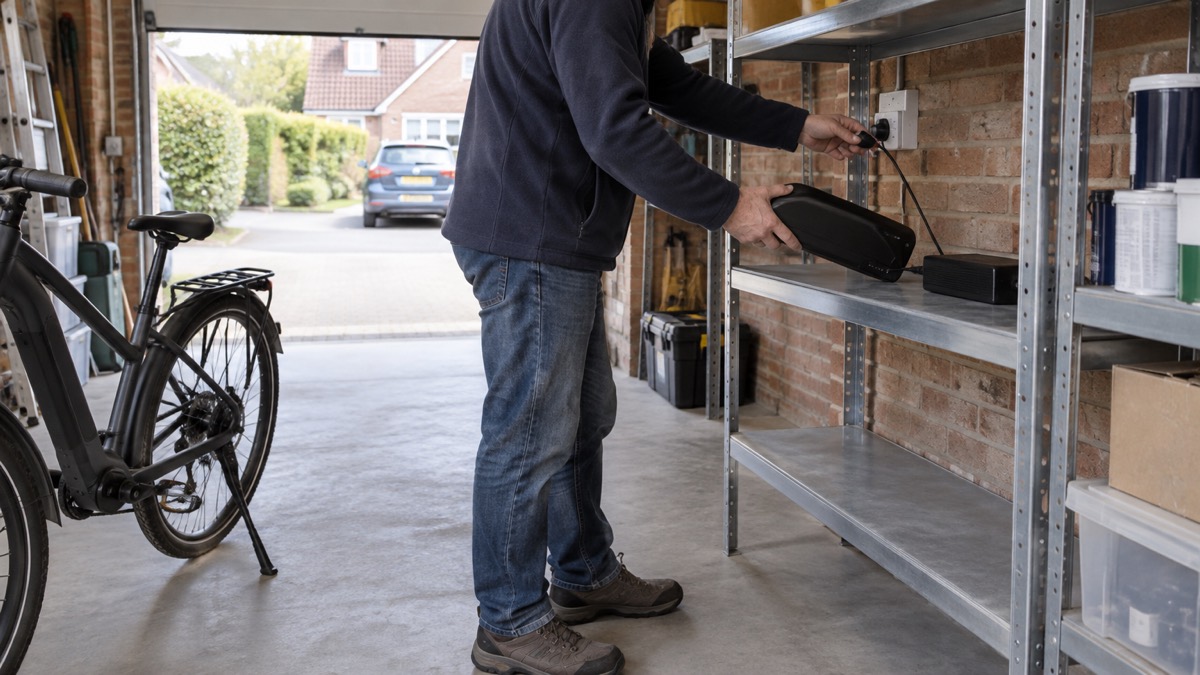
Lithium-ion batteries are in almost every room of a modern home: phones, laptops, vapes, toys, power tools, vacuum cleaners, and the bigger packs inside e-bikes, e-scooters and portable power stations. Most of the time they cause no trouble at all. But when one fails, it fails fast. The National Fire Chiefs Council's advice for a lithium-ion battery fire is simple: "Get Out, Stay Out and Call 999"1.
The reason fire and rescue services across the UK keep repeating this is that these fires behave differently from ordinary house fires. When lithium-ion batteries fail they can ignite quickly and produce intense fires that spread rapidly2. They are hard to put out, they can release toxic fumes, and in the worst cases the battery can explode3. Fire services have seen an increase in the number of fires caused by lithium-ion batteries3, and in November 2025 the National Fire Chiefs Council warned that lithium-ion batteries are now everywhere but safety standards have not kept pace4.
The good news is that most of these fires follow a pattern, and the pattern has known causes: damaged batteries, cheap or counterfeit chargers and cells, unsafe charging habits, and home-made modifications. That means most of the risk is under your control. This page sets out what the fire services actually say: how to charge safely, how to spot a battery that is about to fail, what to do with damaged or cheap batteries, how to store and dispose of them, and how smoke alarms give you the seconds that matter.
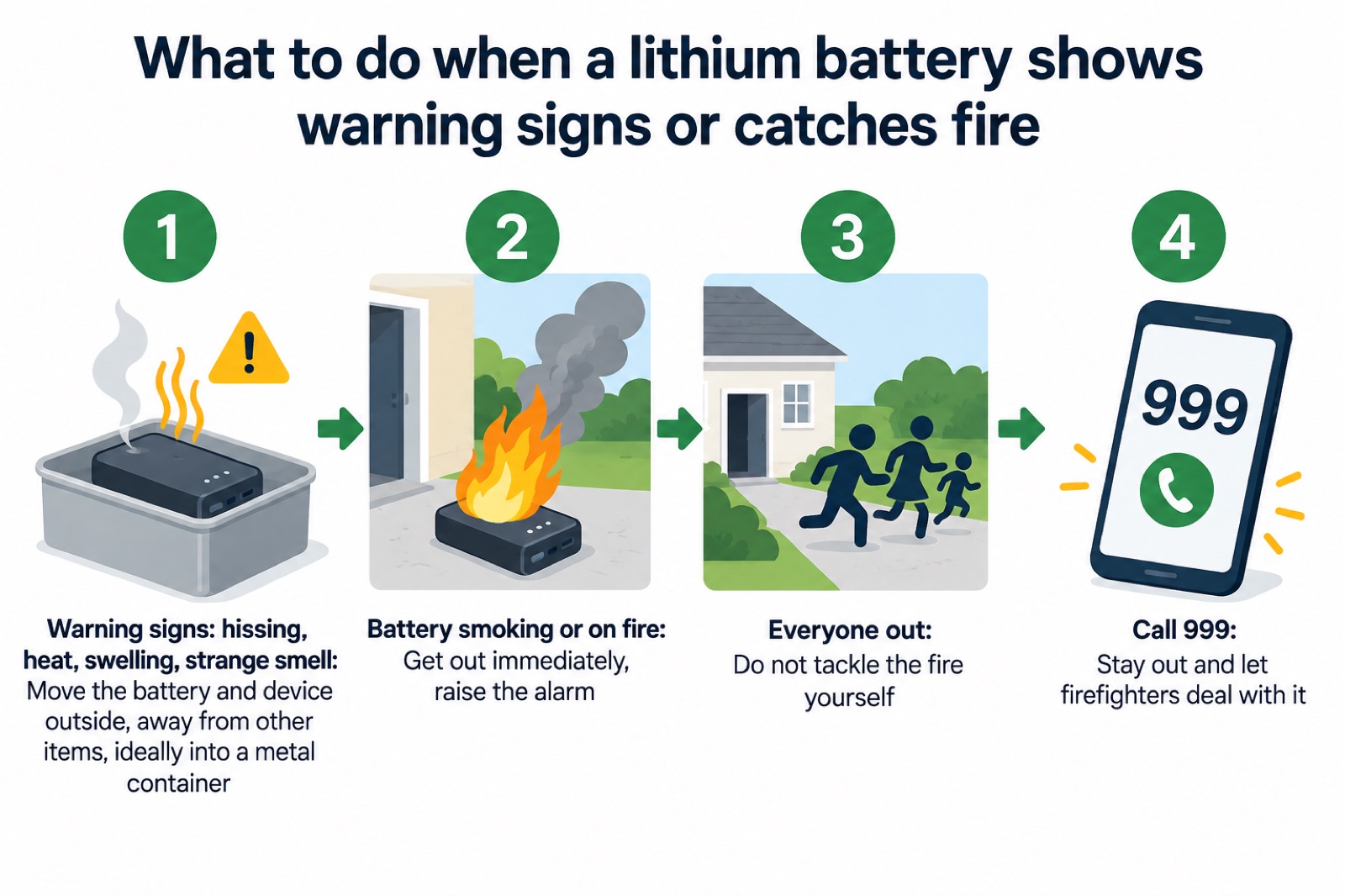
If a battery smokes or catches fire: get out, stay out and call 999
This comes first because it is the one thing you must not get wrong. Every fire and rescue service in the UK gives the same instruction for a lithium-ion battery fire, and it is the same whether the battery is in a phone, a power bank or an e-bike. The National Fire Chiefs Council's campaign message is "Get Out, Stay Out and Call 999"1. London Fire Brigade says that if a battery begins to smoke or catches fire you should get out immediately, raise the alarm, call 999 and not attempt to tackle the fire yourself10. Devon and Somerset Fire and Rescue Service are equally direct: these fires quickly spread and are hard to put out, causing a lot of damage3.

There is a middle case that also needs a plan: a battery that is showing warning signs but has not yet caught fire. Oxfordshire Fire and Rescue Service advises that if you notice warning signs of a failing battery, you should remove the battery and device from your home and store it outside and away from other items, preferably in a metal container, and never try to open or fix it yourself13. If a battery shows signs of swelling, overheating or emitting smoke, Devon and Somerset Fire and Rescue Service advise safely removing it and reporting the incident to the appropriate authorities14.
Anyone who breathes in gases during a battery fire event should seek medical advice because of the potential health hazards, according to Oxfordshire Fire and Rescue Service13. Battery fumes are toxic as well as smoky, so keep people well away from the smoke and mention the exposure to the 999 operator and to any medical staff.
Why lithium-ion batteries catch fire: thermal runaway
The failure at the heart of these fires has a name: thermal runaway. North Yorkshire Fire and Rescue Service describes it as a state where internal temperatures of the battery continue to increase, making it unstable, with a heightened risk of explosion15. Devon and Somerset Fire and Rescue Service explain the mechanism: if one cell of a lithium-ion battery overheats, it can enter a state of thermal runaway which can quickly spread to other cells3. They describe the result as an explosive chemical reaction similar to several fireworks going off at once, with such ferocity and intense heat that it cannot be put out easily3.
This is why the advice is always to leave rather than fight. A fire that is spreading cell to cell inside a sealed battery case cannot be stopped with a bucket of water or an ordinary extinguisher, and the process can restart cells that seemed to have gone quiet. It also explains why prevention matters so much more than reaction: by the time thermal runaway has started, your only job is to get people out.
Thermal runaway needs a trigger, and the triggers are well documented. Devon and Somerset Fire and Rescue Service list overcharging, where charging too long or with too much voltage causes overheating and fires, alongside rapid overheating leading to fire or explosion3. Devon and Somerset's recycling campaign also lists the causes seen in real fires: overcharging batteries, charging devices on flammable surfaces such as on a bed or under a pillow, using batteries that are not recommended by the manufacturer, and exposing batteries to hot temperatures or water14. North Yorkshire Fire and Rescue Service add that these fires often happen when charging the batteries15. In other words, most of the triggers are things a household can control: where you charge, what you charge with, and what condition the battery is in.
Lithium-ion batteries themselves are, as Mid and West Wales Fire and Rescue Service put it, lightweight, energy dense and long-lasting, but they can be more volatile than traditional batteries5. That energy density is exactly why they are everywhere, and it is also why a failure releases so much energy at once. The same service notes that the larger the battery, the larger the danger, and some of the largest lithium batteries can be found in mobility vehicles16. A phone battery failing is serious; a large e-bike or mobility scooter pack failing in a hallway is far worse.
Where lithium-ion batteries are in your home
It helps to know what you are living with. Scottish Fire and Rescue Service list the common carriers: mobile phones, laptops and vapes, as well as larger products like e-bikes, e-scooters and hoverboards6. Mid and West Wales Fire and Rescue Service add laptop computers, mobile phones, children's toys, e-scooters and e-cigarettes5. North Yorkshire Fire and Rescue Service's list includes mobility aids, power-packs, laptops, children's toys, power tools and e-cigarettes15, and the National Fire Chiefs Council note that lithium-ion batteries are increasingly used in household appliances and items such as electric toothbrushes, tools, toys, mobile phones, tablets, laptops and vapes, as well as personal light electric vehicles like e-bikes and e-scooters, and electric vehicles4.
| Where in the home | Typical items |
|---|---|
| Pockets and bags | Phones, vapes, power banks6 |
| Desks and bedrooms | Laptops, tablets, children's toys14 |
| Shed, garage, hallway | E-bikes, e-scooters, hoverboards, mobility scooters4 |
| Emergency kit | Power stations, rechargeable AA and AAA cells15 |
Whatever the size, these batteries are lightweight, energy dense and long-lasting, but they can be more volatile than traditional batteries14.
Each of these items has the potential to cause a serious fire in your home, as North Wales Fire and Rescue Service warn16. That is not a reason to fear them, but it is a reason to apply the same few rules everywhere: charge with the right charger, on a hard surface, away from flammables, and never where a fire could block your way out. If you keep backup power kit for power cuts, those rules apply to it too, especially the storage rules in the sections below.
Safe charging
Charging is where most lithium-ion battery fires happen. London Fire Brigade note that many e-bike and e-scooter battery fires happen in homes while batteries are charging2, and North Yorkshire Fire and Rescue Service say the same: these fires often happen when charging the batteries15. So the charging rules are the ones to get right first.
The rules, drawn from fire and rescue service guidance across the UK:
- Use the right charger. Always use the charger that came with your device or a genuine replacement from a trusted supplier, and unplug after charging5. Use manufacturer-approved chargers3.
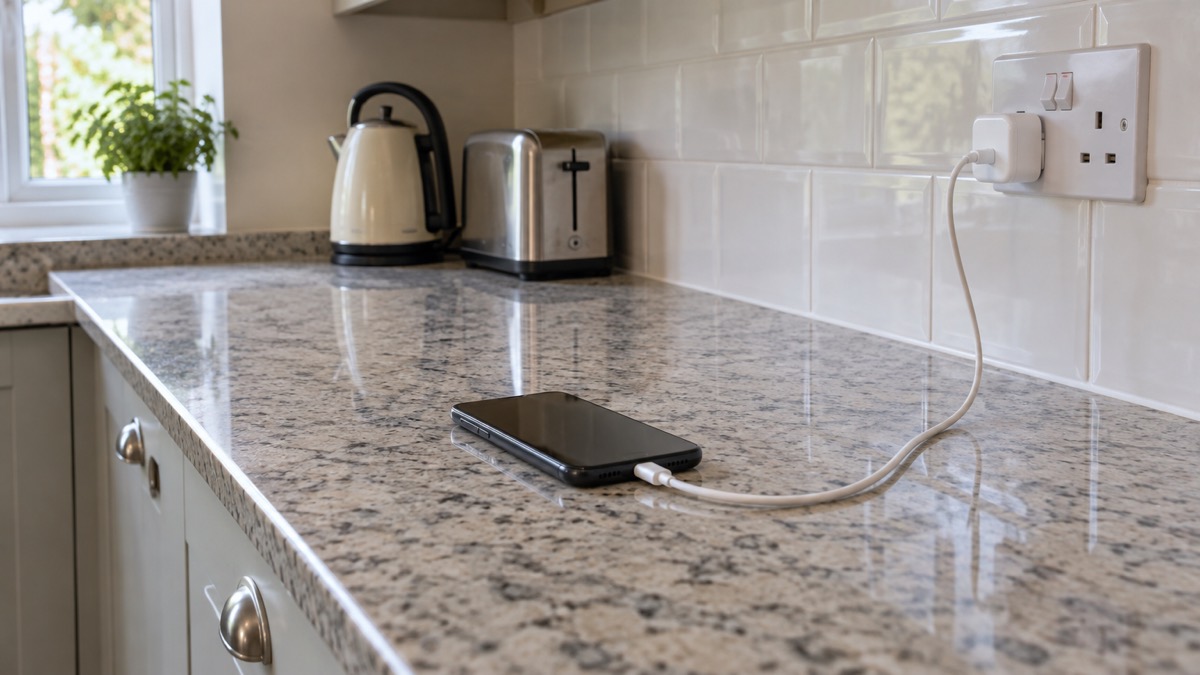
- Charge on a hard, non-flammable surface. Avoid charging on soft, flammable surfaces like bedding3. Charging devices on a bed or under a pillow is a known cause of fires14.
- Do not cover devices while charging. Covering devices traps heat and increases fire risk5.
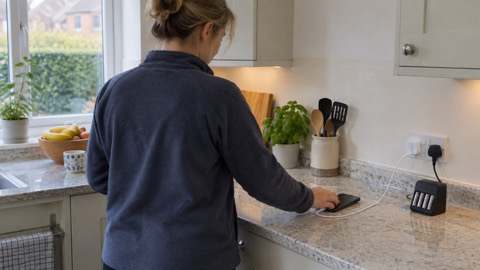
- Keep chargers away from flammable materials. Avoid charging near flammable materials, do not overload power sockets, and use uncoiled extension leads that are properly rated for your devices6.
- Unplug when charging is finished. Overcharging, charging too long or with too much voltage, can cause overheating and fires3.
- Never charge in an escape route. Do not charge in hallways or communal areas that serve as escape routes6, and do not charge or store a battery where it could block your escape13.
- Charge outside where you can. For e-bikes and e-scooters, avoid indoor charging if possible and charge outside13.
Heat and cold change the picture too. London Fire Brigade warn that high temperatures put stress on lithium-ion batteries and increase the risk of overheating, and that heat causes the chemicals inside the battery to break down more quickly, reducing lifespan and affecting charging performance17. At the other end, do not attempt to charge a frozen battery17. If you are weighing up overnight charging or a hot power bank, these are the underlying reasons the fire services give the advice they do.
Damaged, cheap and modified batteries
After charging habits, the next big cause is the condition and origin of the battery itself. Batteries can be damaged by dropping them or by crashing e-bikes or e-scooters, and where a battery is damaged it can overheat and catch fire without warning, according to the National Fire Chiefs Council's e-bike and e-scooter guidance12. Scottish Fire and Rescue Service say the same: a damaged battery should be replaced and should not be used or charged6. Devon and Somerset Fire and Rescue Service explain the mechanism: damaged batteries may release flammable electrolytes, increasing the risk of fire3.
Check your battery regularly for signs of damage12. If a battery shows signs of overheating, swelling or other forms of damage, do not use it: dispose of it appropriately and report the defect to the manufacturer3. If you have a battery that is starting to swell, treat it as a battery on its way to failure, not a cosmetic fault.
Cheap and counterfeit products are the other half of this problem. Mid and West Wales Fire and Rescue Service warn that cheap chargers and batteries may not meet UK safety standards and can be dangerous5. Scottish Fire and Rescue Service advise that when purchasing products that contain lithium-ion batteries you should buy from reputable retailers, especially online, and check that the devices meet British or European safety standards; items which do not meet these standards pose a huge fire risk6. The UK government's guidance on avoiding e-bike and e-scooter fires is blunt about the cause: unsafe, non-compliant or improperly used lithium-ion batteries can cause fires that can be particularly dangerous11.
Modification is the third leg. The National Fire Chiefs Council warn that misuse, such as unsafe charging or product modifications, can significantly increase fire risks4. Home-converted e-bikes, batteries swapped for cells the manufacturer never specified, and chargers bodged together from mismatched parts all fall into this category. If a battery or charger was not made for your device, do not use it with your device.
Recalls are worth a moment of your time as well. Register your electrical products with the manufacturer so you hear about problems directly; if you choose not to register, product recalls can be checked via Electrical Safety First or the UK government website6. A real example: in December 2025 the Office for Product Safety and Standards recalled two Belkin power bank models, the BoostCharge USB-C BPB002 and the Playa USB-C PB0003, because the lithium-ion batteries can overheat in use, leading to localised smoking, melting or a risk of fire. Consumers should stop using the product immediately and complete the recall form on the Belkin website to receive a full refund or replacement18.
E-bikes and e-scooters: the highest-risk batteries at home
If there is one category the fire and rescue services single out, it is e-bikes and e-scooters. London Fire Brigade attended 179 fires involving e-bikes or e-scooters in 2023 alone4. The National Fire Chiefs Council's warning that safety standards have not kept pace was driven largely by these products4. The reasons are a combination of everything already covered: large batteries, often bought cheaply online, often charged indoors overnight, often stored in hallways.
The specific advice for these vehicles goes beyond the general charging rules:
- Charge outside if you possibly can. Avoid indoor charging; if possible charge outside13.
- Never charge or store in an escape route. Do not charge or store a battery in the hallway or where it could block your escape13, and avoid keeping e-bikes or e-scooters in escape routes or communal areas, which could block people from leaving the building safely in a fire6.
- Watch the weather. High temperatures stress lithium-ion batteries and increase the risk of overheating17. Most e-bikes and e-scooters withstand light rain and splashes in normal use, but lithium-ion batteries are not waterproof, and submerging a battery in water or exposing it to heavy flooding can be particularly dangerous17. Do not wash an e-bike or e-scooter with high-pressure water17.
- Learn the warning signs. London Fire Brigade list the signs of a failing e-bike or e-scooter battery, including strong chemical smells10. If you notice warning signs, remove the battery and device from your home, store it outside away from other items, preferably in a metal container, and never try to open or fix it yourself13.
- Buy well. Buy from reputable retailers and check devices meet British or European safety standards6. The UK government's Buy Safe, Be Safe guidance exists specifically because unsafe, non-compliant or improperly used lithium-ion batteries in these vehicles can cause particularly dangerous fires11.
South Wales Fire and Rescue Service add the physical stakes: when lithium-ion batteries are damaged they can overheat, catch on fire, and even lead to explosions19. North Yorkshire Fire and Rescue Service have urged residents to review potential fire risks in their home, including ensuring working smoke alarms, especially in the area where you charge your lithium battery20. That last point matters: if you must charge an e-bike battery indoors, the room it charges in is the room that most needs a working alarm.
Storing batteries you are not using
Storage is the quiet half of battery safety, and it matters most for the kit you keep for emergencies: a power station in a cupboard, power banks in a drawer, rechargeable AAs in a box. Scottish Fire and Rescue Service advise storing the product and its batteries in a cool place, avoiding exposure to extreme heat or cold6. That aligns with London Fire Brigade's warning that heat breaks down the chemicals inside batteries more quickly and cold can leave a battery frozen, which must never be charged in that state17.
For anything with a large battery that will sit unused for an extended period, follow the manufacturer's instructions for storage and maintenance. That is the advice from the National Fire Chiefs Council12, South Wales Fire and Rescue Service19, Scottish Fire and Rescue Service6 and London Fire Brigade alike: follow manufacturer's instructions for the storage and maintenance of lithium-ion batteries if they are not going to be used for extended periods of time. The maker knows the chemistry of their own pack, and their storage instructions override general rules of thumb.
Two placement rules apply to storage as much as to charging. First, never store batteries or e-bikes in hallways, escape routes or communal areas, where a fire could block people from leaving the building6. Second, keep stored batteries away from anything flammable, and somewhere you would notice if a pack started to swell or smell. A cool, dry, visible spot beats a hot loft or a cluttered cupboard under the stairs that also happens to be your escape route.
Never put lithium-ion batteries in the bin
This is the rule people break most often without knowing it, and it causes fires far from their homes. Mid and West Wales Fire and Rescue Service: never throw lithium batteries in household rubbish5. Scottish Fire and Rescue Service: they should never be placed in household waste6. London Fire Brigade: lithium-ion batteries should not be placed in the same bins as your regular rubbish or recycling21. Devon and Somerset Fire and Rescue Service: never place loose batteries or electrical items, including those containing batteries, in general waste bins22.
The reason is mechanical. Scottish Fire and Rescue Service explain that these batteries, when punctured or crushed, can cause fires in bin lorries or landfill sites6, and when damaged or crushed they can ignite without warning22. A bin lorry compactor is a machine designed to crush things, and a battery inside it is exactly the wrong combination. Devon and Somerset Fire and Rescue Service used Global Recycling Day to highlight precisely this risk14.
Where to take them instead: most local recycling centres accept lithium-ion batteries, and they should be disposed of alongside Waste Electrical and Electronic Equipment (WEEE) items; check with your local authority for specific recycling guidelines in your area6. For e-bike and e-scooter batteries specifically, London Fire Brigade advise checking your local authority's website or the Recycle Your Electricals website for the safe disposal route in your area21. North Yorkshire Fire and Rescue Service add that a lithium-ion battery cannot go in household waste: take it to a household refuse and recycling site or contact your local authority20. A damaged or end-of-life battery needs particular care, and there is a separate route for how to dispose of a damaged lithium battery.
Smoke alarms: fit them, test them, replace them after 10 years
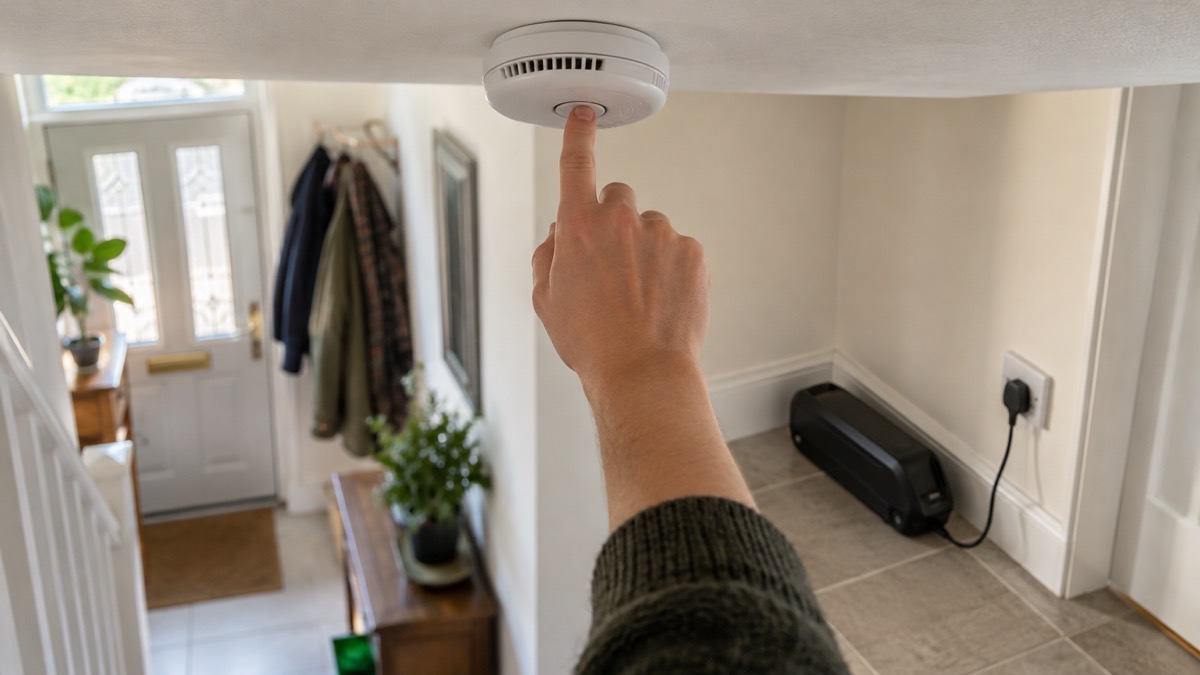
Everything else on this page reduces the chance of a battery fire. Smoke alarms are what give you the time to survive one. Devon and Somerset Fire and Rescue Service state the minimum plainly: you need at least one smoke alarm on each level of your home8. Their recommended positions are the hallway and the top of the stairs, with additional alarms in bedrooms or sleeping areas8. Alarms should be mounted on the ceiling, near the middle of the room, and at least 30cm away from a wall or light8.
| Question | The fire service answer |
|---|---|
| How many alarms? | At least one on each level; hallway and top of stairs recommended8 |
| Where exactly? | On the ceiling, near the middle of the room, at least 30cm from a wall or light8 |
| What about the kitchen? | Do not fit smoke alarms in kitchens or bathrooms; install a heat alarm in the kitchen instead8 |
| What marks should it carry? | A current British Standards or European (CE) safety mark23 |
| How long do they last? | Replace after 10 years, or by the replace-by date on the base9 |
The kitchen point deserves its own line, because a smoke alarm that keeps going off when you cook tends to end up with its battery removed, which is the worst outcome of all. Fit a heat alarm in the kitchen instead: London Fire Brigade's guidance for carers explains the difference between smoke and heat alarms and where to place each24, and heat alarms respond to heat rather than cooking steam, so they are the type suited to kitchens. And never disconnect or take the batteries out of a smoke alarm unless you intend to replace it immediately, as North Yorkshire Fire and Rescue Service insist25.
Testing and batteries. Test alarms regularly: every home should have alarms fitted on the ceiling in all areas of risk, tested regularly24. If your alarm has removable batteries, replace them every year25, and change the battery once a year unless it is a ten-year alarm26. If you are buying a battery alarm, consider one with a sealed long-life (10 year) battery, as both the Northern Ireland Fire and Rescue Service27 and the National Fire Chiefs Council recommend; the NFCC's position statement recommends a sealed battery compartment to prevent tampering or removal of the battery9. The batteries in 10 year alarms cannot be replaced, so you may need to buy a new alarm when one fails28. All smoke alarms, including hard-wired ones, should be replaced after ten years, or by the replace-by date indicated on the base, or earlier if found to be defective9. Never ignore a sounding alarm27.
If you rent. In England, if you live in private rented property your landlord must comply with the Smoke and Carbon Monoxide Alarm (England) Regulations 2015, and should check the alarms are in working order at the start of any new tenancy29. The Northern Ireland Fire and Rescue Service note that ideally alarms should be hardwired and interlinked, which is a legislative requirement for rented accommodation30. If your rented home's alarms are missing or dead, raise it with your landlord and contact your local fire and rescue service for help.
If you are deaf or have a visual impairment. You can get a special alarm if you are deaf, hard of hearing or have a visual impairment31. Sensory alarms include a vibrating pad that goes under the pillow and a flashing strobe light; contact your GP to arrange an assessment30. London Fire Brigade's guidance for carers and support workers covers the same ground: heat alarms for kitchens, alarms fitted on the ceiling in all areas of risk, tested regularly, and specialist alarms for people who cannot hear an ordinary one24.
Free help is available. London Fire Brigade has visited nearly 90,000 Londoners to provide personalised home fire safety advice, many of them vulnerable32, and its online home safety check takes only a few minutes to check your home and get tailored advice for your family32. Contact your local fire and rescue service, or your local council for more information31, to find out what is available in your area.
Where to go from here
The rules on this page compress into four habits: charge with the right charger on a hard surface away from flammables and unplug when done; keep batteries and e-bikes out of escape routes; replace anything damaged, swollen or cheap; and never bin a battery. Around all of it, keep working smoke alarms on every level and test them. If you are building a household emergency kit around batteries, the same rules govern it: see the backup power guide for what to choose, the safe charging checklist for a printable version of these rules, and the warning signs of a dangerous lithium battery for what a failing pack looks like before it fires.
Sources (32)
- Lithium-ion battery safety campaign, National Fire Chiefs Council
- E-bikes and e-scooters fire safety, London Fire Brigade, 2026-10-25
- Battery fires at home, Devon and Somerset Fire and Rescue Service, 2026
- Lithium-ion batteries are everywhere but safety standards haven't caught up, warn fire chiefs, National Fire Chiefs Council, 2025-11-19
- Lithium battery fire safety at home, Mid and West Wales Fire and Rescue Service, 2026-10-26
- Lithium-ion batteries at home, Scottish Fire and Rescue Service, 2025-11-27
- E-bike and E-Scooters | Scottish Fire and Rescue Service, Scottish Fire and Rescue Service
- Advice for parents and guardians, Devon and Somerset Fire and Rescue Service, 2026
- Home detection position statement, National Fire Chiefs Council, 2019-06
- Spot the warning signs: could your e-bike or e-scooter start a fire?, London Fire Brigade, 2026-10-25
- Buy safe, be safe: avoid e-bike and e-scooter fires, UK Government, 2024-10-24
- E-bike and e-scooter fire safety guidance, National Fire Chiefs Council, 2025-01-21
- Charging safety at home, Oxfordshire Fire and Rescue Service, 2026
- Recycle your batteries, prevent fires, Devon and Somerset Fire and Rescue Service, 2024-03-15
- E-scooter, e-bike and mobility scooter fire safety advice, North Yorkshire Fire and Rescue Service, 2026-03-25
- Lithium-ion batteries at home, North Wales Fire and Rescue Service, 2026-10-25
- Heat, cold and rain: how weather conditions affect e-bikes and e-scooters, London Fire Brigade, 2026-10-25
- Recall of Belkin BoostCharge BPB002 and Playa PB0003 power banks, Office for Product Safety and Standards, 2025-12-08
- E-bikes and e-scooters at home, South Wales Fire and Rescue Service, 2026-07-29
- Firefighters urge residents to review potential fire risks in their home, North Yorkshire Fire and Rescue Service, 2023-07-04
- How to dispose of batteries from your e-bike or e-scooter, London Fire Brigade, 2026-10-25
- Residents urged to think before binning batteries, Devon and Somerset Fire and Rescue Service, 2026-07-23
- Smoke alarms, Devon and Somerset Fire and Rescue Service, 2026
- Alarms: guidance for carers and support workers, London Fire Brigade, 2026-10-25
- Smoke and carbon monoxide alarms, North Yorkshire Fire and Rescue Service, 2026-02-20
- Smoke alarms for vulnerable people, Devon and Somerset Fire and Rescue Service, 2026
- Home fire safety, Northern Ireland Fire and Rescue Service, 2026-10-14
- Frequently asked questions: safe at home, North Yorkshire Fire and Rescue Service, 2026-08-18
- Student and rented accommodation safety, North Yorkshire Fire and Rescue Service, 2026-09-21
- Other safety advice, Northern Ireland Fire and Rescue Service, 2026-10-22
- Easy read fire safety booklet, London Fire Brigade, 2026
- Help people be safer in their homes, London Fire Brigade, 2026-10-25
 Power Cut Backup Power Checklist
 Backup Power Before Winter
 Safe Battery Charging at Home
 What to Keep Running in a Cut
 Power During an Outage
 Watts and Watt-Hours
 Portable Power Stations
 Portable Generator Types
 Generator Safety
 LPG Cylinders and Regulators
 Connecting to Your Home's Wiring
 Home Battery Storage
 Portable Solar Panels
 12V Inverters
 Leisure and LiFePO4 Batteries