
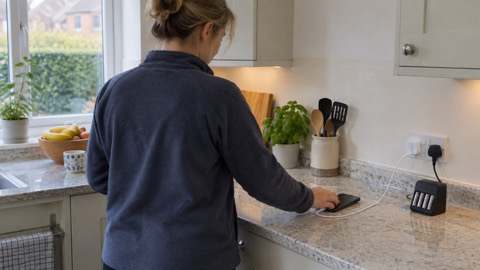
The short answer is no: do not charge a power bank overnight, and do not leave it charging while you are out of the house. That is the direct advice of Electrical Safety First, which says: "Don't charge your power bank overnight or whilst you are out of the house."1 Fire and rescue services across the UK say the same for phones, tablets, laptops and anything else with a lithium-ion battery: charge while you are awake and nearby, and unplug once the charge cycle is complete2.
The reason is not that power banks are badly made. Most power banks use lithium-ion batteries that will naturally get warm during charge and discharge cycles5. Warm is normal. Hot, swollen, hissing or smoking is not, and those are the signs to stop and act on.
There is one clear exception in the guidance: rechargeable AA and AAA cells in a Duracell charger. Duracell states that, due to its built-in safety features, it is safe to leave the cells in the charger overnight, though it still says to unplug the charger after use6. That is the maker's instruction for its own product, and it does not extend to power banks or to other makers' chargers.
Don't charge a power bank overnight or while you are out
The advice is consistent across the UK's fire and rescue services, and it is not limited to power banks. North Wales Fire and Rescue Service says: "Don't charge devices overnight when anyone is asleep or leave on charge when you've left the home."2 Mid and West Wales Fire and Rescue Service says to charge devices while you are awake and nearby, and to avoid charging overnight or when you are out of the house3. Dorset and Wiltshire Fire and Rescue Service says to charge during the day instead of at night while you are sleeping, and to keep charging away from escape routes4.
Electrical Safety First, the independent charity that campaigns on electrical safety, applies the same rule to USB chargers: "Don't use USB chargers overnight or while you are out of the house."9 London Fire Brigade warns students about charging devices overnight and using a dodgy charger10. Staffordshire Fire and Rescue Service lists "Make sure mobile phones, tablets or e-cigarettes aren't charging overnight" as part of a bedtime routine11. Wiltshire and Swindon Preparedness adds: "Never leave a device on charge when you're out of the house or asleep."12
The reason for the timing is simple. A fire that starts while you are awake and in the same room can be smelled, seen and escaped from. A fire that starts at 3am, in a hallway or beside a bedroom door, may block your escape before anyone wakes. That is why the advice is about when you charge, not just what you charge.
The same rule applies with extra force to e-bikes, e-scooters and mobility scooters, whose batteries are larger. Scottish Fire and Rescue Service says: "Never charge batteries while you are asleep or away from the home. Only charge them while you are awake and alert."14 London Fire Brigade says not to leave a battery charging unattended, when you are out or while you are asleep15. South Wales Fire and Rescue Service says not to leave batteries to charge while you are asleep or away from the home16. The National Fire Chiefs Council's Charge Safe campaign says: "Never leave a battery charging unattended. Don't charge it while you are asleep or away from home."17
For mobility scooters and wheelchairs, Dorset and Wiltshire Fire and Rescue Service gives a reason that applies to every device: "You should only charge during the daytime. This is because if something goes wrong with the battery and there is a fire, there would be people awake to raise the alarm."17
Why a charging power bank gets warm, and when warmth means danger
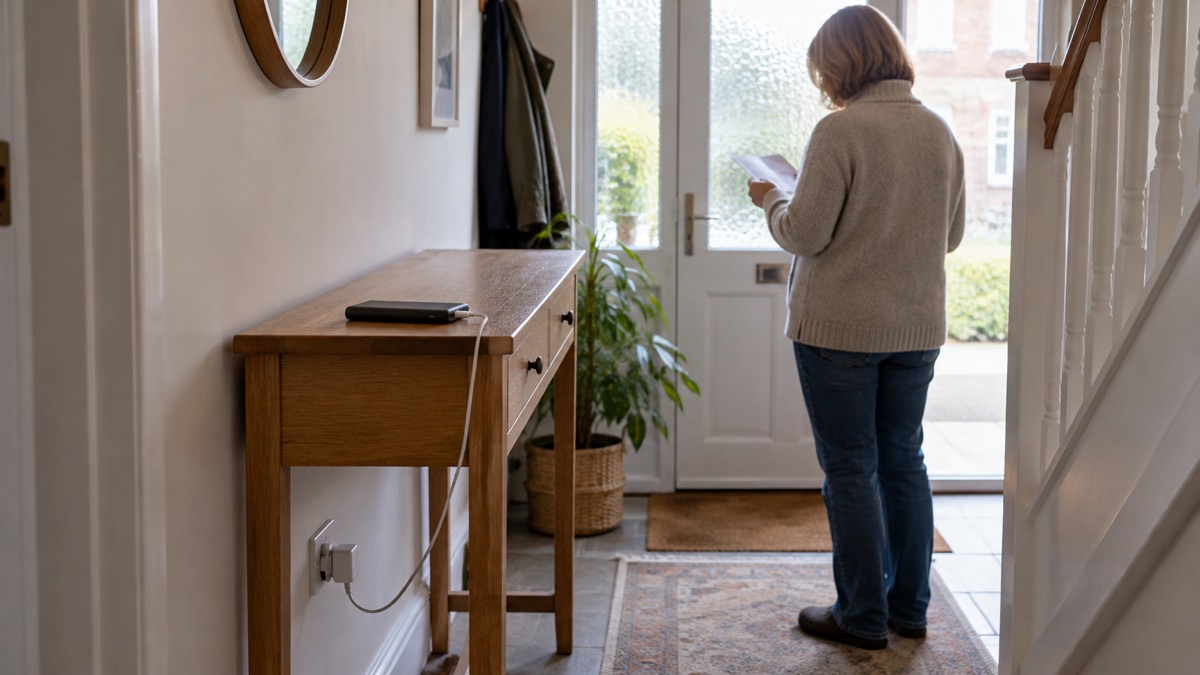
A power bank getting warm while it charges is normal. Electrical Safety First says most power banks use lithium-ion batteries that will naturally get warm during charge and discharge cycles5. The heat comes from the chemistry: energy going into the cells and coming out again produces warmth, and a well-designed power bank manages it.
Warmth becomes a problem when it is trapped or when the battery is being pushed beyond what it was designed for. Mid and West Wales Fire and Rescue Service warns that covering devices while charging "traps heat and increases fire risk"3. Dorset and Wiltshire Fire and Rescue Service says overcharging, charging too long or with too much voltage, can cause overheating and fires4. London Fire Brigade says using the wrong charger can overload the battery and increase the risk of overheating and fire14. Electrical Safety First says to keep a device uncovered and in a well-ventilated environment when charging9.
A power bank that is hot to the touch, rather than warm, is telling you something. So is one that stays hot after it has finished charging, or that gets hotter than it used to. The warning signs fire services list for a failing lithium-ion battery are specific: producing smoke, feeling extremely hot to touch, looking swollen or having any type of lump or leak, making a hissing or cracking sound, smelling unusual, or taking longer to charge or not fully charging8. North Yorkshire Fire and Rescue Service says: "You must stop using or charging your battery immediately if you notice any of the following," and lists overheating, deformation, noise, smell, performance and smoke18.
Bulging or swelling: the sign to stop using it
A swollen battery is the clearest physical sign that a lithium-ion cell has failed and is building pressure inside. London Fire Brigade's instruction is blunt: "Stop charging immediately."20 Oxfordshire Fire and Rescue Service lists "Battery is swelling or expanding" among the warning signs that mean stop19. North Yorkshire Fire and Rescue Service includes deformation in its list of signs to stop using or charging a battery immediately18.
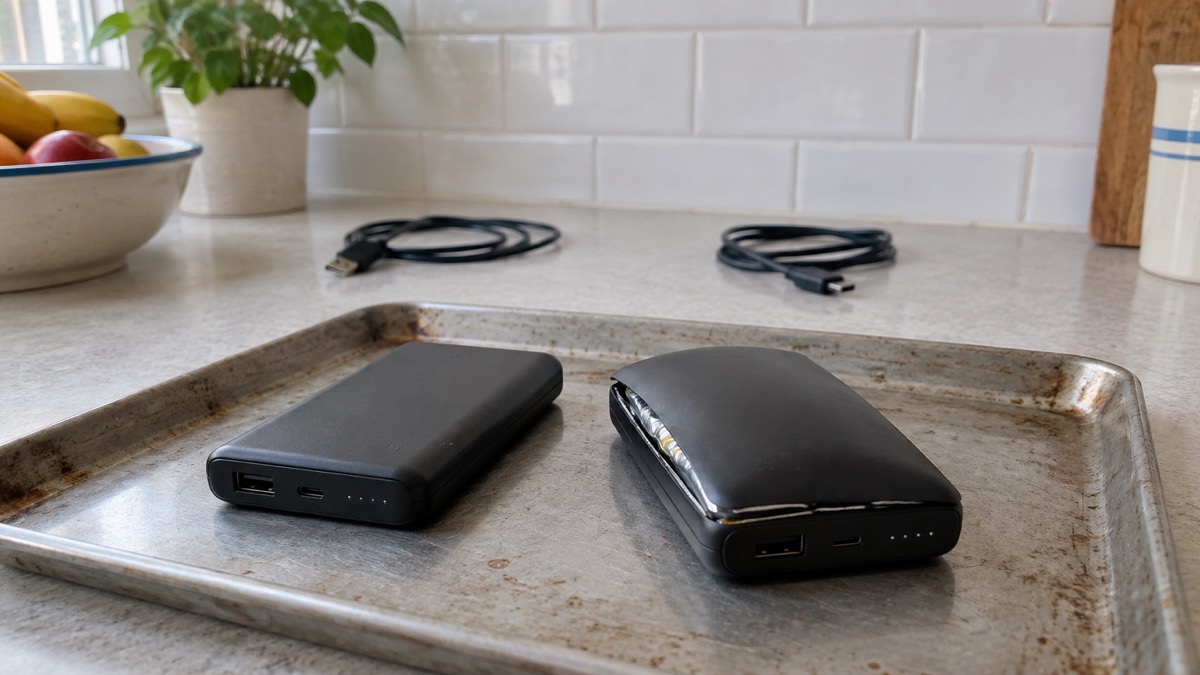
Swelling can happen to any lithium-ion device, including a power bank that has been dropped, overheated, overcharged or simply reached the end of its life. It is not a cosmetic issue. A swollen cell has changed shape because gas has built up inside it, and the same failure that produced the gas can lead to a fire. London Fire Brigade warns that if lithium-ion batteries get damaged or overheat, they may catch fire20.
If you find a swollen power bank, phone or battery:
- Stop charging it and unplug it if it is safe to do so19.
- Do not press, puncture or try to flatten it.
- Move it away from anything that burns, if you can do so without handling it more than necessary.
- Do not put it in the household bin. Take it to a household waste recycling centre that accepts batteries, or follow your council's advice for damaged batteries.
- If it starts smoking, hissing or producing flames, get everyone out and call 999.
The same warning signs apply to e-bike and e-scooter batteries, which are larger and can fail more violently. Scottish Fire and Rescue Service says to stop using or charging immediately if you notice overheating, deformation, noise, smell, performance problems or smoke18. If you have a power bank showing any of these signs, treat it as failed and stop using it, whatever its age.
Charging and using at the same time
It is tempting to plug a power bank into the wall and a phone into the power bank at the same time, so that both are ready when you need them. Electrical Safety First says most portable battery packs do not support charging and discharging at the same time5. In practice, that means a power bank used this way may not charge your phone at all, or may behave unpredictably.
The safer routine is sequential. Charge the power bank while you are awake and nearby, unplug it when it is full, and then use it to charge your phone. That keeps the heat from charging and the heat from discharging apart, and it means you are present for the part of the process most likely to go wrong.
If you are charging several devices, do not overload the socket. Which? advises taking care not to charge laptops or mobile phones overnight and not to plug too many items into the same adaptor22. The National Fire Industry Association says to follow the manufacturer's instructions when charging, always use the approved charger, unplug when finished, charge in an area with a working smoke alarm, avoid overloading sockets and extension leads, and not to cover chargers or battery packs when charging23.
Following the maker's instructions, and what is inside the unit
A power bank contains a battery, circuitry and one or more charging ports, often USB or USB-C5. The battery stores the energy, the circuitry manages charging and output, and the ports are what you plug your cable into. Most power banks use lithium-ion cells, which is why the fire advice is the same as for phones and e-bikes5.
Because the maker designed that circuitry, its instructions are the ones to follow. Electrical Safety First says: "Read the manufacturer's instructions carefully and always follow them."5 Scottish Fire and Rescue Service says to follow the manufacturer's instructions for charging times, never overcharge your battery, and use the manufacturer-approved charger for the product8. South Wales Fire and Rescue Service says to follow the manufacturer's instructions when charging and always unplug your charger when it is finished charging16.
Electrical Safety First also gives storage advice that matters for a power bank kept for emergencies: do not leave it in a parked car where it could get cold in winter or hot in summer, and protect it from damage and do not immerse it in water5. A power bank that has been soaked or frozen has been damaged, even if it looks fine.
Registering the product is part of following the maker's instructions. Electrical Safety First says: "Register your power bank so you can be contacted easily if there is a safety recall of your product."21 Recalls are real: in December 2025 a safety notice told owners of Belkin BoostCharge USB-C BPB002 and Playa USB-C PB0003 power banks to stop using the product immediately and complete the recall form on the Belkin website, because the lithium-ion batteries could overheat while in use, leading to localised smoking, melting or a risk of fire23.
Charging AA and AAA cells overnight in a Duracell charger
Rechargeable AA and AAA cells are a different case from a power bank, and Duracell gives a clear answer for its own chargers. Duracell states: "Yes, due to Duracell's built-in safety features, it is safe to leave the cells in the charger overnight. Duracell does r..." and goes on to say to unplug the charger after use6. The same statement appears across Duracell's support pages for its chargers and rechargeable batteries6.
That is a maker's instruction for its own product, and it should be read narrowly. It applies to Duracell chargers and Duracell rechargeable cells. It does not apply to a power bank, a phone, an e-bike battery or another maker's charger. If you own a different brand of charger, follow that maker's instructions, because the safety features Duracell relies on are specific to its design.
| What you are charging | Overnight? | What the guidance says |
|---|---|---|
| Power bank | No | Do not charge overnight or while out of the house1 |
| Phone, tablet, laptop | No | Charge during the day, unplug when full2 |
| E-bike, e-scooter, mobility scooter | No | Never charge while asleep or away from home14 |
| AA and AAA cells in a Duracell charger | Yes, per the maker | Safe to leave in overnight due to built-in safety features, but unplug after use6 |
| Any other maker's charger | Follow that maker | Read and follow the manufacturer's instructions5 |
For a household building a power cut kit, rechargeable AA and AAA cells are a practical choice for torches and radios, and the Duracell guidance means you can leave them charging while you are in the house. The rest of the kit, from power banks to power stations, follows the daytime charging rule. Our guide to rechargeable AA and AAA batteries and chargers covers what to look for, and the safe battery charging at home checklist sets out the routine step by step.
Sources (23)
- Is your power bank a flight risk?, Electrical Safety First, 2026-10-25
- Lithium-ion batteries, North Wales Fire and Rescue Service, 2026-10-25
- Lithium battery fire safety, Mid and West Wales Fire and Rescue Service, 2026-10-26
- Battery fires, Dorset and Wiltshire Fire and Rescue Service, 2026
- Power banks, Electrical Safety First, 2026-10-26
- Can I use rechargeable batteries in a device?, Duracell, 2026-10-26
- Digital easy read fire safety booklet, London Fire Brigade, 2026
- Lithium-ion batteries, Scottish Fire and Rescue Service, 2025-11-27
- Chargers, Electrical Safety First, 2026-10-26
- Student fire safety, London Fire Brigade, 2026-10-25
- Living alone, Staffordshire Fire and Rescue Service, 2026-10-26
- Reminder not to cut corners with electrical safety this Christmas, Wiltshire and Swindon Prepared, 2026-10-25
- E-bike and e-scooter fire safety, Scottish Fire and Rescue Service, 2026-10-25
- How to charge e-bikes and e-scooters safely, London Fire Brigade, 2026-10-25
- E-bikes and e-scooters, South Wales Fire and Rescue Service, 2026-07-29
- Charge Safe, National Fire Chiefs Council, 2026-10-09
- Fire safety for people with mobility difficulties, Dorset and Wiltshire Fire and Rescue Service, 2026
- Charging safety, Oxfordshire County Council, 2026
- Batteries and chargers, London Fire Brigade, 2026-10-25
- How to dispose of batteries from your e-bike or e-scooter, London Fire Brigade, 2026-10-25
- What to do in a power cut, Which?, 2026-06-04
- Plug sockets: how to avoid overloading your plug sockets at home, Which?, 2026-02-05
- E-bikes and e-scooters fire safety guidance, National Fire Chiefs Council, 2025-01-21
 Power Cut Backup Power Checklist
 Backup Power Before Winter
 Safe Battery Charging at Home
 Running a Generator Indoors
 Carbon Monoxide from Generators
 Generator Sizing for a Power Cut
 Generator Run Time on a Tank
 Storing Petrol at Home
 Diesel Storage at Home
 Storing a Generator
 Generators in Cold Weather
 Generator Noise and Neighbours
 Power Station Capacity Sizing
 Power Station Run Time
 Power Station for a Gas Boiler