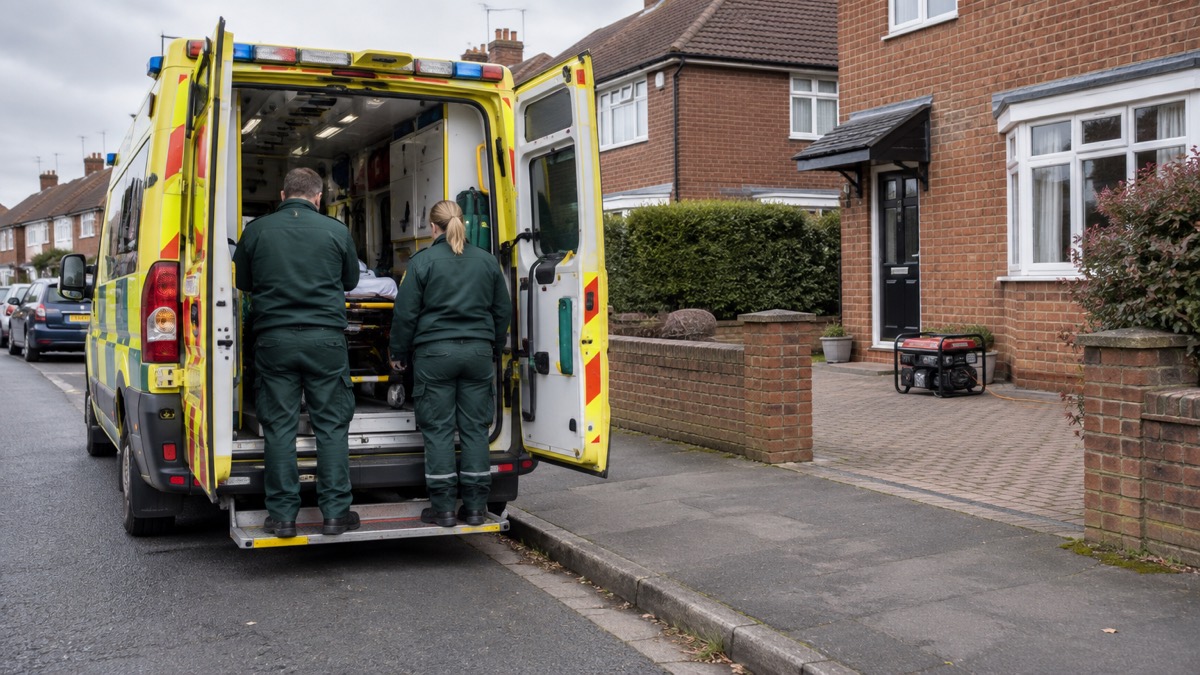
Yes. A petrol generator's exhaust contains carbon monoxide, and the gas can kill. The Health and Safety Executive is blunt about it: using petrol powered equipment such as generators indoors or in enclosed spaces can create significant levels of carbon monoxide, and "even after a few minutes this can create significant levels of carbon monoxide which can kill"1. The danger is not limited to petrol. Any combustible fuel can produce carbon monoxide, in any location, as the independent charity CO-Gas Safety puts it2.
What makes this different from most household hazards is that you get no warning from your senses. Carbon monoxide is difficult to detect because you cannot see, smell or taste it3. By the time someone feels unwell, the exposure has already happened. The answer is not to rely on your nose or on a window cracked open, but to site the generator properly, know the symptoms, and fit an alarm.
This page covers what to do now if you are running a generator, where it must never go, how poisoning presents and who is most vulnerable, what to do if you suspect it, and what an alarm will and will not do for you. If you are still deciding what to buy, the wider Backup Power at Home: A Household Guide sets the options side by side.
Where a generator must never go: indoors, garages and enclosed spaces
The instruction is absolute and repeated across official guidance. Do not use petrol or diesel generators or other similar fuel-driven equipment indoors, because their exhaust gases contain carbon monoxide4. After a flood, never run a petrol or diesel-powered generator indoors, as it can produce fatal levels of carbon monoxide7. For farmers, the warning is that standby generators must never be used indoors, as the fumes from the engine can be lethal8.
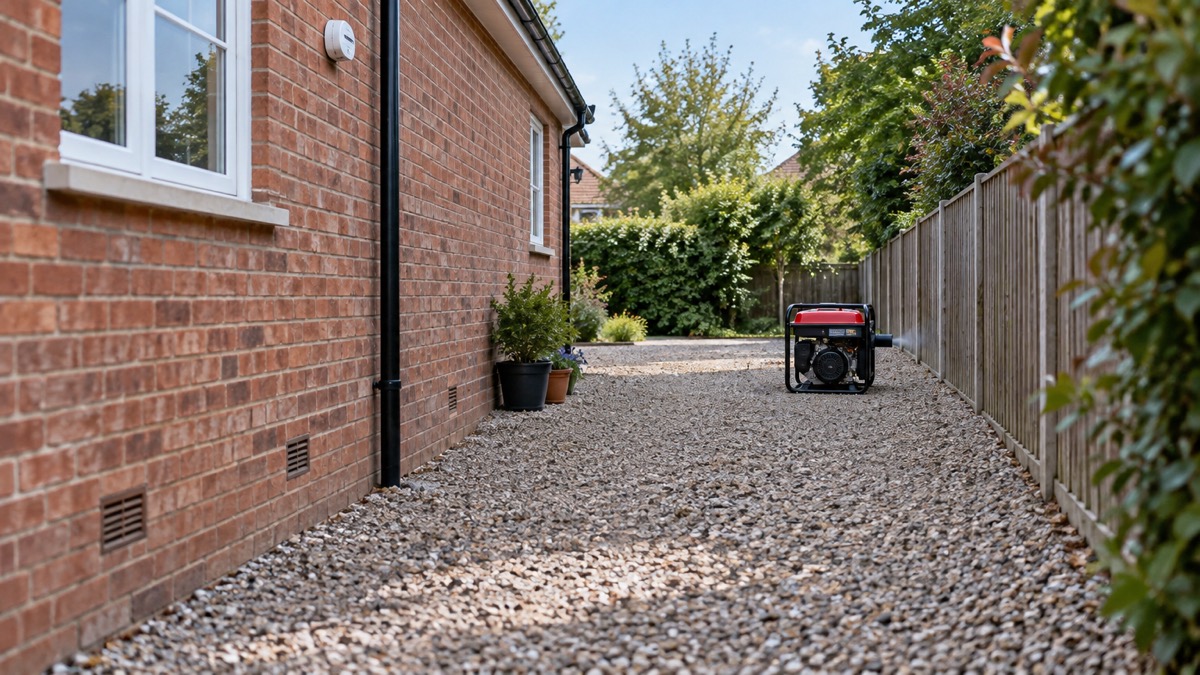
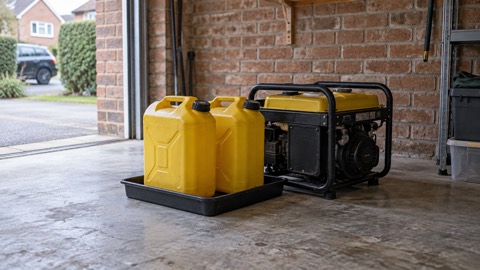
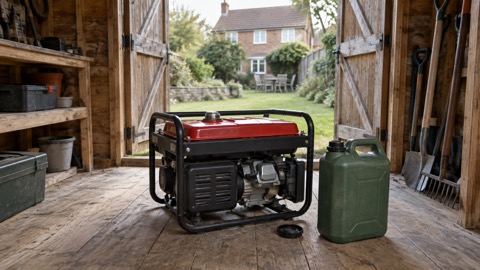
"Indoors" is wider than the kitchen. The NHS lists turning on vehicle or lawn mower engines in an enclosed space such as a garage as a way carbon monoxide builds up9. Welsh health guidance adds the same point: do not leave vehicles or other engines on inside garages10. A garage attached to the house, a shed with the door shut, a conservatory, a porch or a cellar all count as enclosed spaces. So does a tent or caravan: incidents and fatalities occur in holiday homes, caravans and on board boats where faulty appliances or petrol-powered generators have led to poisoning11.
The reason a garage is so dangerous is that the gas has nowhere to go. It seeps through the gaps around a connecting door into the house, and it collects rather than dispersing. Opening the garage door helps ventilation but does not make an enclosed space safe for a running generator, and it is not what the official advice permits.
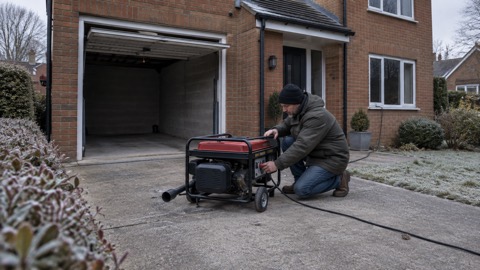
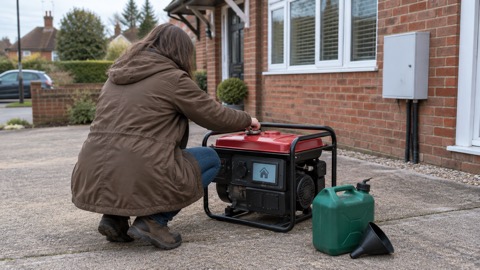
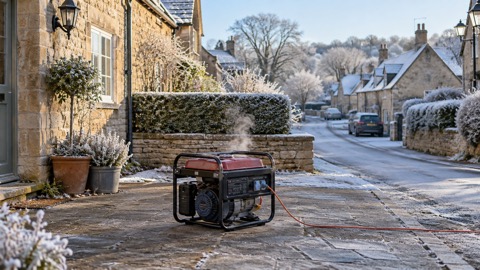
Site it outside instead, on stable ground, with the exhaust pointing away from doors, windows and vents. Northern Ireland Electricity Networks advises that if you are using a generator you should be careful where you site it because of carbon monoxide, and make sure there is plenty of air flow around the generator to supply oxygen and remove the fumes12. The Met Office makes the same point about fuel-burning equipment generally: there must be good ventilation, and it must be used with a carbon monoxide alarm8.
Symptoms of carbon monoxide poisoning and how they are mistaken for flu
The reason carbon monoxide is so often missed is that it looks like something ordinary. Early symptoms can mimic many common ailments and may easily be confused with food poisoning, viral infections, flu or simple tiredness9. The NHS lists the symptoms to watch for: headache, dizziness, feeling sick or being sick, feeling weak, tiredness and confusion, chest and muscle pain, shortness of breath, your face turning hot and red, and loss of vision16. Other official lists add breathlessness, loss of consciousness, pains in the chest or stomach, erratic behaviour and visual problems9.
| What you may notice | Why it is easy to dismiss |
|---|---|
| Headache, dizziness, tiredness | Put down to a long day, a virus or a bad night's sleep9 |
| Feeling sick or being sick | Mistaken for food poisoning9 |
| Confusion, erratic behaviour | Attributed to stress or exhaustion9 |
| Breathlessness, chest pain | Assumed to be a cold, flu or existing condition9 |
| Face flushed hot and red | Rarely connected to the air in the room16 |
The single most useful clue is the pattern. Symptoms may come and go, getting worse when you spend time in an affected room or building and better when you leave or go outside16. If the headache lifts in the garden and returns when you go back inside, that is a signal, not a coincidence. Increased condensation inside windows is another warning sign worth noticing9.
"Early symptoms of carbon monoxide (CO) poisoning can mimic many common ailments and may easily be confused with food poisoning, viral infections, flu or simple tiredness."
Who is most at risk: babies, young children and pregnant women
Carbon monoxide harms everyone, but it does not harm everyone equally. Babies, young children and pregnant women may be more vulnerable17. Official guidance also names children, students, the elderly, pregnant women and anyone with heart or breathing problems as more vulnerable11. Public Health Wales lists pregnant women, young children, the elderly and the housebound as most at risk18.
The reason is that carbon monoxide displaces oxygen in the blood, so the organs that depend most on a steady oxygen supply suffer first. CO-Gas Safety notes that poisoning can cause harm to vital organs and is particularly dangerous for pregnant women and children19. NHS England's learning materials describe how exposure can disproportionately affect vulnerable people and unborn babies, and include a module on awareness in pregnancy20.
For a household, this changes the calculation in two ways. First, the people least able to describe what is wrong, or to get themselves out, are the ones most likely to be badly affected. Second, a level of exposure that leaves a healthy adult with a mild headache may be doing more serious harm to someone else in the room. If anyone in the household falls into a vulnerable group, treat any suspicion of carbon monoxide as urgent and act on it at once.
What to do if you suspect carbon monoxide poisoning
Act in this order. Do not wait to see whether it passes.
- Get everyone out into fresh air. Leave the building and get everyone into the open air5.
- Call 999 straight away if you are worried that you might have carbon monoxide poisoning5.
- Open windows and doors to let fresh air in as you leave, if you can do so without delaying your exit21.
- Turn off the appliance or generator if it is safe to reach it, and do not use it again until it has been checked22.
- Call the free National Gas Helpline on 0800 111 999 immediately if you think a gas appliance is leaking carbon monoxide6. If you use oil to heat your home, call Oftec on 01473 626 29823.
- Tell the ambulance crew or hospital that you suspect carbon monoxide, so they can test for it.
If you are without electricity and tempted to bring equipment inside, remember the official warning: using kerosene heaters, charcoal grills and portable generators indoors can cause carbon monoxide poisoning8. That warning is issued precisely because power cuts are when people make this mistake.
Carbon monoxide alarms: why you need one when running a generator
An alarm is the only warning you will get, because your senses give you none3. Fit one wherever a fuel-burning appliance operates and wherever people sleep. Carbon monoxide poisoning can occur when any fuel-burning appliance has not been properly installed, maintained or is poorly ventilated25, and the sources include boilers, gas fires, central heating systems, water heaters, cookers, open fires and wood-burning stoves26.
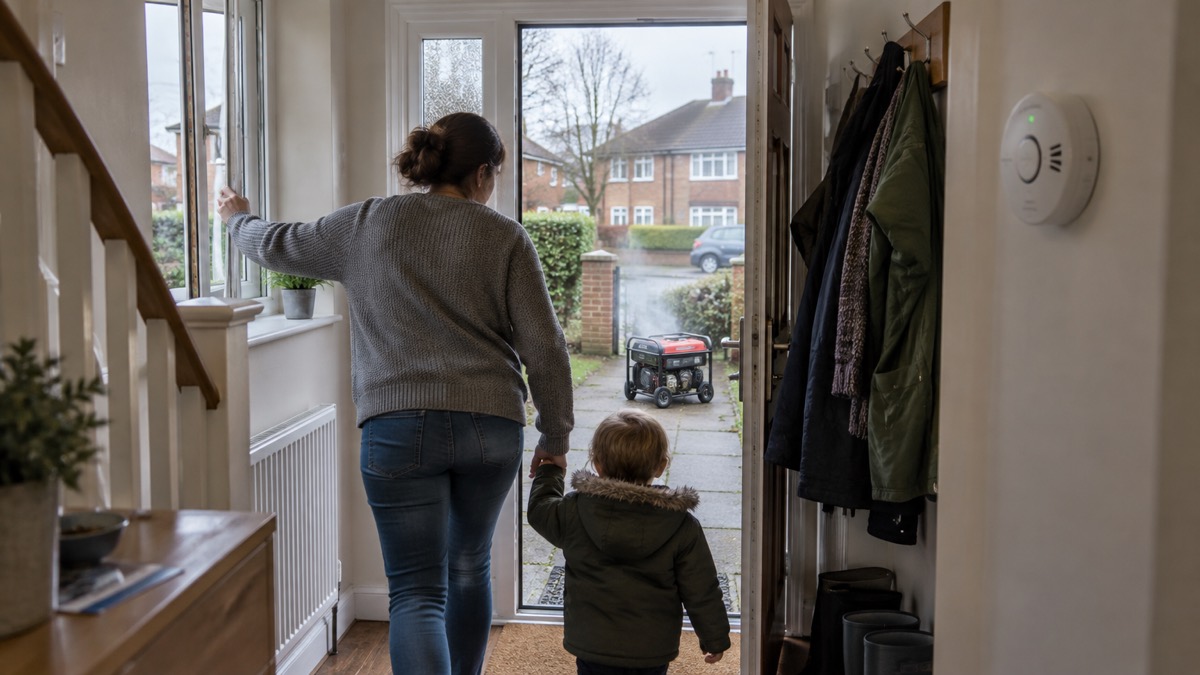
There is a legal floor in England: all landlords of private residential rental properties are required by law to install a carbon monoxide alarm in any room that contains a solid fuel burning appliance13. If you rent, check that one is fitted and working. If you sleep in a room where a conventional coal or gas fire, a log burner, a cooker or a back burner is left on overnight, there is a risk of carbon monoxide poisoning27.
Alarms are not all equal. CO-Gas Safety supports alarms made to the EN 50291 standard19. Test your alarm regularly, replace the batteries, and replace the unit at the end of its stated life.
Winter, ventilation and the risk of closing everything up
The risk of carbon monoxide rises in the colder months. Scottish Government guidance notes that using gas heaters and boilers more in winter can raise the risk of carbon monoxide poisoning, and recommends regular gas safety checks and a carbon monoxide alarm28. The temptation to seal a room and bring a heat source inside is exactly the behaviour the warnings are written to prevent.
Ventilation matters, but it is not a substitute for siting equipment correctly. The Health and Safety Executive advises using safer alternatives such as electrical tools where you can, and notes that specially selected mechanical extraction venting to the outside will almost always be needed for petrol equipment used indoors1. For a household, the practical version is simpler: keep fuel-burning equipment outside, and keep the alarm working.
Long-term exposure deserves its own mention. Carbon monoxide poisoning can cause long-term health problems if you are exposed to low doses over a long period11, and long-term exposure to lower levels can cause ongoing health problems that may be difficult to recognise29. In extreme cases, paralysis and brain damage can be caused as a result of prolonged exposure9. A generator run in a garage "just for an hour" is exactly the kind of repeated low-level exposure that is hard to spot and easy to prevent.
Sources (29)
- Carbon monoxide in construction, Health and Safety Executive, 2026
- Petrol generator case study, CO-Gas Safety, 2018
- Keeping your home warm in winter, Met Office, 2026
- Flooding and health: safely cleaning your home, Wiltshire and Swindon Prepared, 2026
- Fire prevention, gas safety and electric safety, Age UK, 2026
- Carbon monoxide information, Sheffield Yorkshire Smokefree, 2026
- After a flood, London Fire Brigade, 2026
- Strong winds and heavy rain: warning information and advice, nidirect, 2026
- Gas safety: frequently asked questions, Health and Safety Executive, 2026
- Carbon monoxide poisoning, NHS 111 Wales, 2025
- Gas safety and carbon monoxide, nidirect, 2025
- Power cuts advice, Northern Ireland Electricity Networks, 2026
- Carbon monoxide: the silent killer, Wiltshire and Swindon Prepared, 2026
- Stay warm safely in winter, Devon and Somerset Fire and Rescue Service, 2026
- Camping and caravanning safety, Devon and Somerset Fire and Rescue Service, 2026
- Carbon monoxide poisoning, NHS, 2025
- Child safety hub: poisoning, RoSPA, 2026
- Public Health Wales carbon monoxide algorithm, Public Health Wales, 2016
- Statement of support for CO alarms to EN 50291, CO-Gas Safety, 2022
- Preventing exposure to carbon monoxide, NHS England Learning Hub, 2026
- Carbon monoxide information, Wakefield Yorkshire Smokefree, 2026
- Carbon monoxide | Health and Safety Executive for Northern Ireland, controlling risk together, Health and Safety Executive for Northern Ireland (HSENI)
- Which? carbon monoxide alarm review, Which?, 2026
- Smoke and carbon monoxide alarms, North Yorkshire Fire and Rescue Service, 2026
- Fire safety for carers, Devon and Somerset Fire and Rescue Service, 2026
- Carbon monoxide, Devon and Somerset Fire and Rescue Service, 2026
- Sleeping in a room with a gas appliance, coal or log fire, Doncaster and Bassetlaw Teaching Hospitals NHS Foundation Trust, 2026
- Cold, snow and ice, Scottish Government Ready Scotland, 2026
- Carbon monoxide, North Wales Fire and Rescue Service, 2026
 Power Cut Backup Power Checklist
 Backup Power Before Winter
 Safe Battery Charging at Home
 Running a Generator Indoors
 Generator Sizing for a Power Cut
 Generator Run Time on a Tank
 Storing Petrol at Home
 Diesel Storage at Home
 Storing a Generator
 Generators in Cold Weather
 Generator Noise and Neighbours
 Power Station Capacity Sizing
 Power Station Run Time
 Power Station for a Gas Boiler
 Power Station UPS Mode