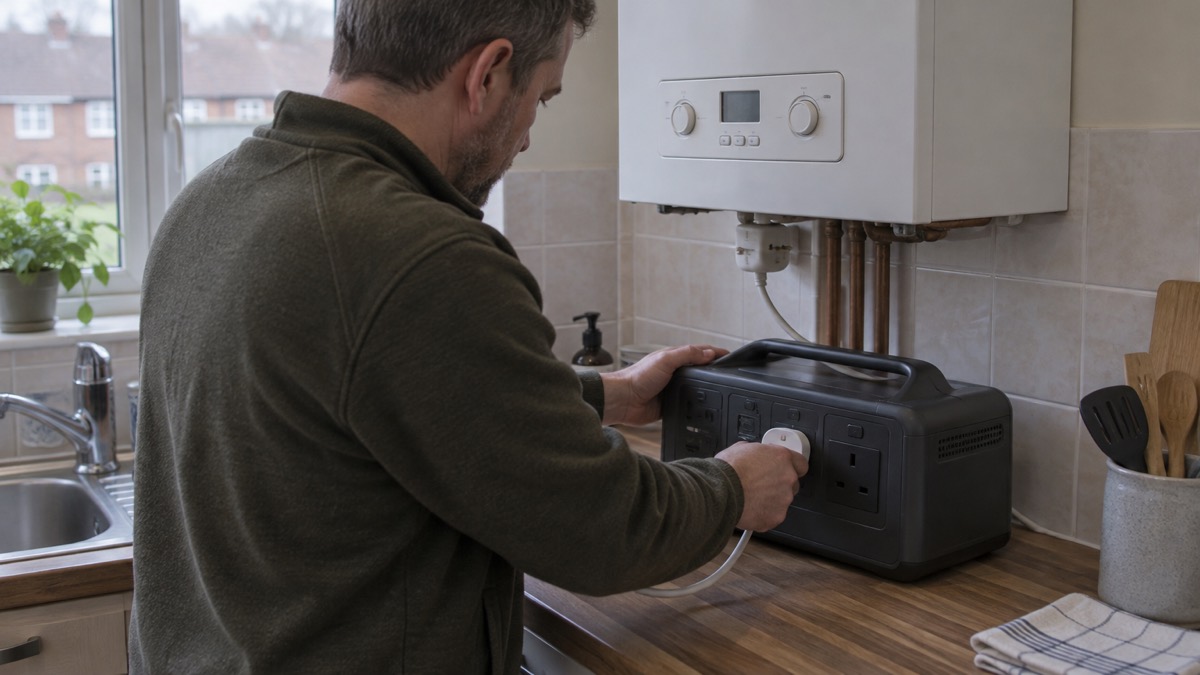
For most households the short answer is no: a portable power station will not run a gas boiler through a power cut. The gas supply is usually still there, but most gas boilers need electricity to start, and gas and oil central heating boilers generally will not work without electricity to power their pumps1. That is why the heating goes off even though the hob may still light.
What a power station can do is keep the rest of the household going: phones, lights, a laptop, the router, a cordless tool charger. A unit with a 2,000W AC output can run appliances up to that rating, and smaller units suit phones, laptops and lights3. The limit is not the gas, it is the electricity the boiler needs and the way it is wired in.
So plan for warmth without the boiler, and plan to keep the things that need a small amount of power running. Charge the power station before winter, know what it can and cannot carry, and never bring a fuel-burning heater or stove indoors to fill the gap.
What a portable power station is and what it can power
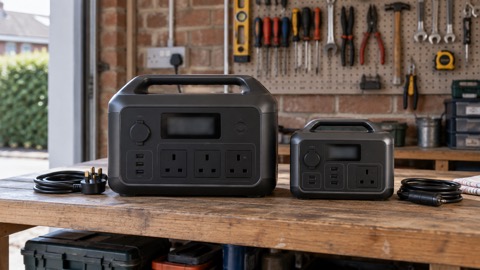
A portable power station is a battery in a box with mains sockets on the front. You charge it from the mains, from a solar panel or from a car, and it then supplies ordinary 230V appliances through its AC output, plus phones and small devices through USB and 12V outlets. Makers describe them for home backup, off-grid systems, campervans and workshops, and one maker states that when used responsibly, portable power stations are completely safe6.
What it can power comes down to two numbers: the continuous AC output in watts, and the battery capacity in watt-hours. The output decides whether an appliance will run at all; the capacity decides for how long. A unit rated at 2,000W with a 1,024Wh capacity can run several devices at once, but a 2,000W appliance will flatten a battery of that size quickly3. If the sums are unfamiliar, the guide to watts, watt-hours and surge explains how to work out what your own appliances draw.
For a boiler the answer is almost always no, for two reasons. First, a central heating boiler is not a plug-in appliance: it is wired into the home's heating controls and needs its pump running, and gas and oil central heating boilers generally will not work without electricity to power their pumps8. Second, even a boiler that could be plugged in would need to be connected safely, and connecting a battery to a home's fixed wiring is a job for a qualified electrician, not a plug and a lead. The page on connecting a generator or battery to your home's wiring covers what that involves.
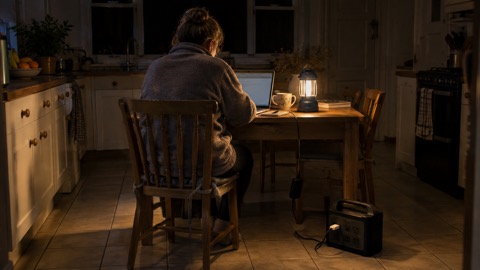
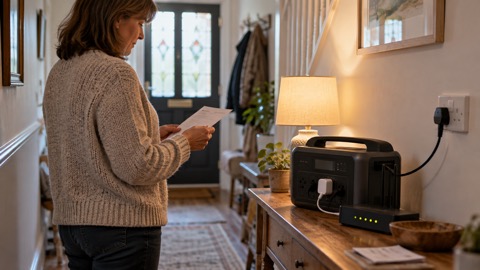
Where a power station earns its place is everything else. It keeps the fridge ticking over in short outages, runs lamps in the evening, charges phones so you can follow updates, and keeps a laptop or router alive if your connection survives. Decide in advance what matters most to your household with the guide to deciding what to keep running when the mains fails.
AC output: better models give 1000W or more
The AC output is the figure to check first. A model with a 2,000W output and a 3,000W peak can power up to nine devices at once, according to its maker3. Another maker's 1,000-class unit is described as able to run devices requiring less than 1,000W9. The peak figure matters for anything with a motor or a heating element, which draws a surge at switch-on before settling to its running load.
| What you might want to run | Typical demand | What it means for the power station |
|---|---|---|
| Phones, tablets, router, lamps | Low | Any size of unit copes |
| Laptop, cordless tool charger | Moderate | A mid-sized unit runs these comfortably |
| Kettle, heater, hairdryer | High | Needs a large unit, and drains it fast |
| Gas boiler and central heating pump | Wired in, not plug-in | Not a job for a power station |
Two cautions follow from the output rating. The first is that a high-wattage appliance can be within the output rating and still empty the battery in minutes, so match the appliance to the capacity as well as the output. The second is that the AC output is a limit, not a target: plugging in more than the unit is rated for will trip it or, worse, overload it. The guide to extension leads and overloading with backup kit explains how to spread the load safely.
If you are choosing between a power station and a petrol generator, the comparison page on portable power station or petrol generator for a power cut sets out the trade-offs. For most flats and terraced houses, a power station is the simpler option because it produces no exhaust fumes, which is the decisive point for indoor use.
Smaller 200 to 500Wh units suit phones, laptops and lights
Not every household needs a large unit. A small power station is enough for the things people actually miss in a power cut: a charged phone, a light in the room, a radio, a laptop. Portable power banks can hold enough power to charge a mobile several times and are well worth having to hand to stay connected in a blackout1. If charging a smartphone is all you need, a power bank is the better buy than a generator10.
The trade-off with small units is output. Portable generators are small enough to carry and have labelled inputs, but their limited output capacity means some models will not power all appliances, and one maker's unit is only compatible with items that operate at less than 200W10. That is fine for electronics and hopeless for anything that heats.
| Size of unit | Suits | Will not manage |
|---|---|---|
| Power bank | Phones, a radio, small USB devices1 | Anything with a mains plug |
| Small power station (a few hundred Wh) | Phones, laptops, lights, a router | Kettles, heaters, large appliances |
| Mid-sized power station (around 1kWh, 1,000W or more) | Several devices at once, a cordless tool charger, a short fridge run3 | Central heating, ovens, anything wired in |
A compact unit can be genuinely portable: one maker describes its model as 15% smaller than similar power stations, with a strap sold separately for carrying11. That matters if you might move it between rooms or take it to a relative's house. The guide to power banks: keeping phones charged in an emergency covers the smallest end of the range, and what capacity power station do I need helps size a larger one.
Charging a power station before and during a power cut
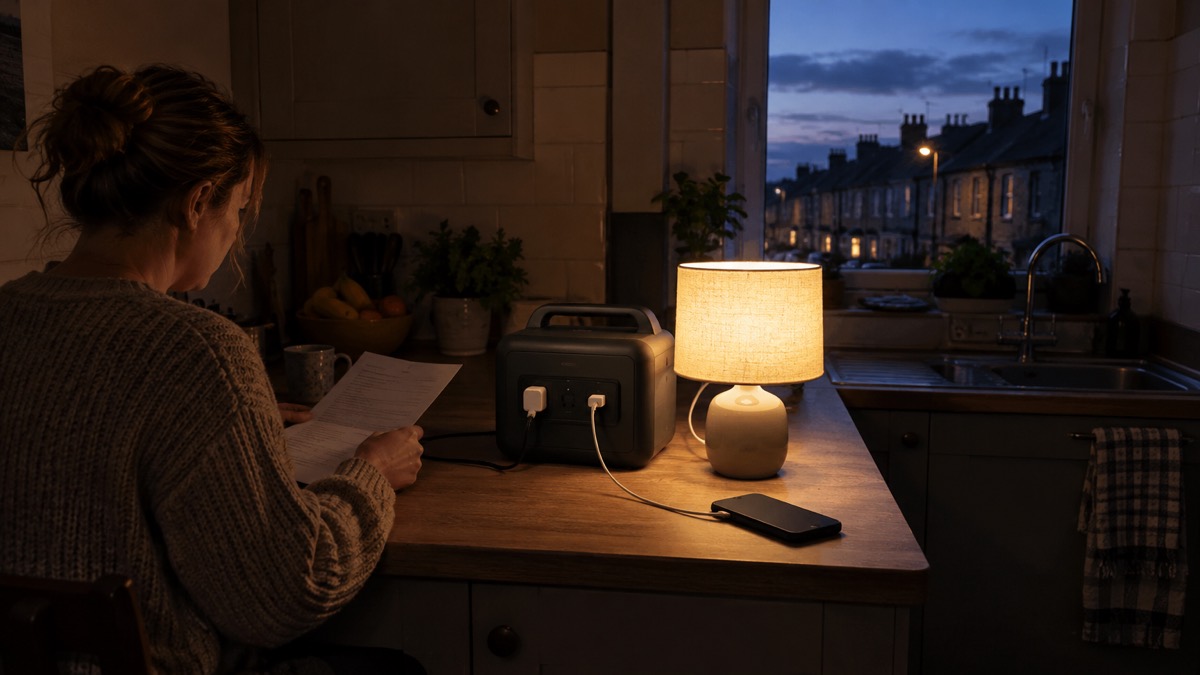
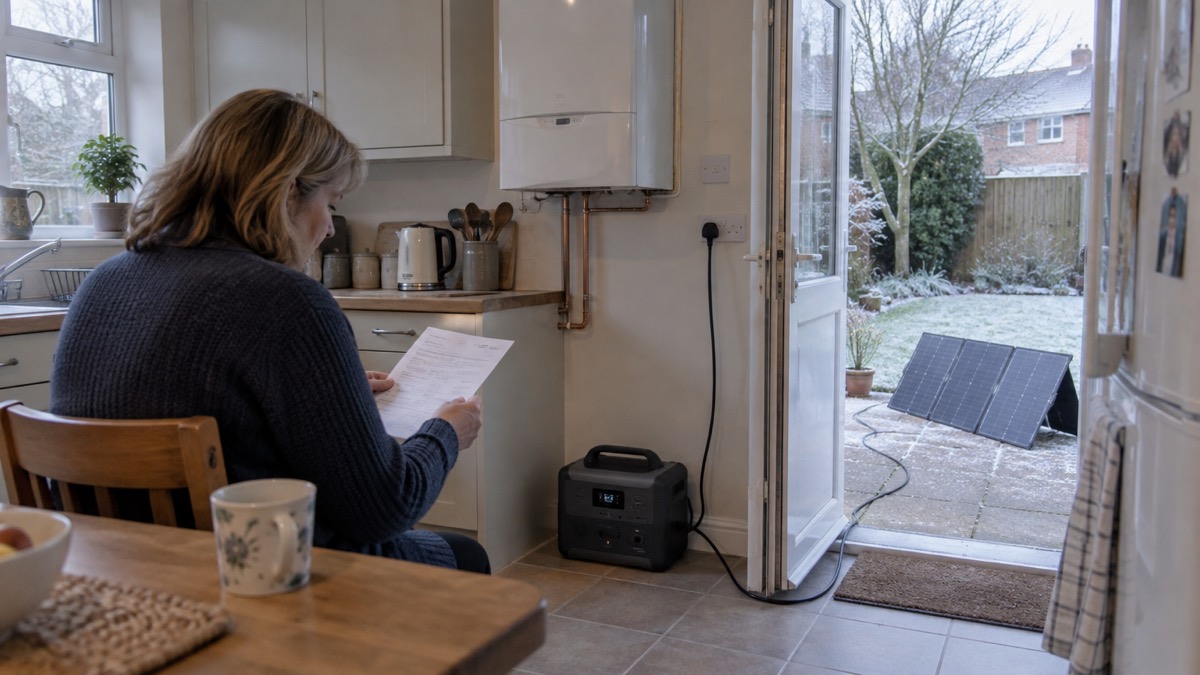
The single most useful thing you can do is charge the unit before the power goes off. A power station sitting at half charge when the lights go out is half a power station. Top it up from the mains as winter approaches, and again whenever a storm forecast is issued, so it is full when you need it.
During an outage you have three ways to put charge back in, and they are not equal.
- Solar panels. Power stations can be charged with a solar charger, and some makers sell folding panels to match their units10. Be realistic: a power station charged from solar will take a while to fill5, and a UK winter gives little to work with. Treat solar as a top-up during a long outage, not a rescue.
- A car socket. Many units can be charged from a car, but check what is in the box. One maker's manual lists the car charging cable as not included13, and another states that the car charging and solar charging cables can be purchased separately14. A car socket charges slowly, so plan it as a top-up.
- A second battery or a bigger unit. Some makers recommend pairing a power station with a solar generator for longer-lasting power16. That is a way to extend run time, not to run a boiler.
The guide to portable solar panels for charging in a power cut covers panel choice, and can you charge a power station from your car explains the cable and rate questions. If you are charging indoors, follow the maker's instructions and keep the unit on a hard, ventilated surface away from soft furnishings; the safe battery charging at home checklist sets out the routine.
Where a power station is not meant to be used
A power station is safe when used as intended, but it is not a substitute for every other piece of kit, and some of the obvious workarounds for a cold house are dangerous.
The risks are carbon monoxide and fire. Gas appliances should have an annual safety check, including boilers, gas cookers and gas fires18, and spare gas cylinders should be stored outside where possible19. If you use any fuel-burning appliance, make sure you have a carbon monoxide alarm and know the warning signs; the page on carbon monoxide from generators covers what to look for, and generator safety covers the wider rules.
A power station itself has limits on where it belongs. Keep it dry and out of bathrooms and shower rooms, do not leave it in a hot car or direct sun, and do not use it to feed the home's fixed wiring unless a qualified electrician has set that up properly. If a unit is damaged, swollen or overheating, stop using it and follow the maker's advice; the guide to warning signs a lithium battery is dangerous explains what to look for.
Keeping warm and fed without the boiler
Since the boiler will not run, plan for warmth and hot food by other means. The gas hob is the bright spot: gas cookers are more likely to function during a power cut, while electric cookers will not work20. Gas ovens, boilers, heat pumps and home internet will not work without power21. So a gas hob can boil a kettle and heat soup, provided you light it safely and never leave it unattended.
For warmth, layers, blankets and a hot water bottle do more than most people expect, and they carry no risk. If you use any portable heater, follow the manufacturer's instructions and the fire service guidance on placement and ventilation17. Do not bring a barbecue or camping stove inside, and do not run a generator indoors or in a garage; the page on whether you can run a generator indoors explains why.
Food safety matters if the outage is long. Keep fridge and freezer doors closed. The power cut backup power checklist lists what to have ready before an outage, and the backup power checks before winter checklist is worth working through each autumn.
Getting help and reporting the outage
Report the outage and get information from your network operator. In Great Britain, call 105, the free national power cut number, and check the operator's live map and updates22. Northern Ireland has its own arrangements through NIE Networks8. Keep a phone charged so you can report the fault and receive updates, which is one of the best reasons to own a power bank or small power station.
If anyone in the household depends on electricity for medical equipment or has other additional needs, ask your network operator about the Priority Services Register. It lets them know in advance who needs extra support during an outage. The guide to powering CPAP, oxygen and other medical devices from a battery covers the equipment side, and the power cuts household guide covers the wider picture.
Sources (22)
- What to do in a power cut, Which?, 2026-06-04
- Prepare for a power cut, Citizens Advice, 2023-11-14
- Anker SOLIX C1000 Gen 2 Portable Power Station, Anker SOLIX, 2026-10-25
- Be prepared, Northern Powergrid, 2026-10-26
- Emergency kit packing list, Which?, 2026-09-30
- Fogstar 2.2kWh Portable Power Station, Fogstar, 2026-10-25
- Portable power stations, EcoFlow, 2026-10-25
- Emergency power cuts, NIE Networks, 2026-10-25
- Jackery Explorer 1000 Pro, Jackery, 2026-10-25
- How to buy the best generator, Which?, 2026-01-20
- Anker SOLIX C300 DC, Anker SOLIX, 2026-10-25
- Anker SOLIX C1000 Gen 2 with PS100 bifacial solar panel, Anker SOLIX, 2026-10-25
- Anker SOLIX F3800 Portable Power Station user guide, Anker, 2026-10-26
- Anker SOLIX C300 with 100W solar panel, Anker SOLIX, 2026-10-25
- Anker SOLIX C300 with 2 x 100W solar panel, Anker SOLIX, 2026-10-25
- Choose a portable power station, Anker SOLIX, 2026-10-25
- Heating your home, North Yorkshire Fire and Rescue Service, 2026-03-09
- Gas safety, RoSPA, 2026-10-26
- Heating and gas, Scottish Fire and Rescue Service, 2024-11-21
- Power cuts, Food Standards Scotland, 2026-10-25
- Be informed about hazards: power cuts, UK Government, 2026-10-21
- Storm, Energy Networks Association, 2026-10-26
 Power Cut Backup Power Checklist
 Backup Power Before Winter
 Safe Battery Charging at Home
 Running a Generator Indoors
 Carbon Monoxide from Generators
 Generator Sizing for a Power Cut
 Generator Run Time on a Tank
 Storing Petrol at Home
 Diesel Storage at Home
 Storing a Generator
 Generators in Cold Weather
 Generator Noise and Neighbours
 Power Station Capacity Sizing
 Power Station Run Time
 Power Station UPS Mode