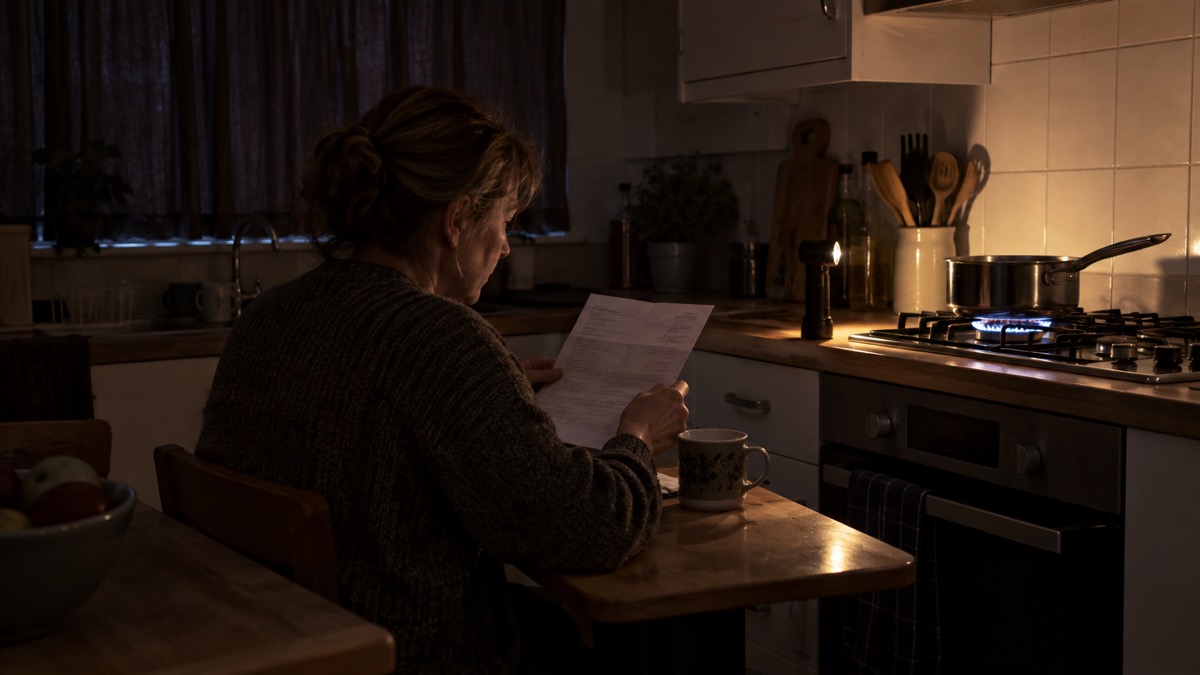
In most power cuts, a gas hob keeps working. Food Standards Scotland puts it plainly: "Electric cookers will not work during a power cut, but gas cookers are more likely to function"1. The same advice appears in the UK government's consumer guidance on food safety in a power cut, which says electric and induction cookers will not work, but gas cookers may continue to function2. So if your hob burns gas, the answer to the question most people type into a search box is yes, with two catches.
The first catch is the ignition. Most gas hobs light with an electric spark, and that spark needs mains electricity. When the power is off you may need to light the burner another way, and how you do that depends on your cooker, so the maker's instructions are the authority to follow. The second catch is that some cookers, particularly modern ones with electronic timers, displays or safety cut-outs, will not allow gas through at all without power. If your oven has a digital clock and electronic controls, treat it as dead until the electricity returns, and check the handbook before the next outage so you are not finding this out in the dark.
This page covers what works and what does not, how to light a burner safely, the particular dangers of frying when the kitchen is dim, what to check before using a portable stove, and where to turn if something goes wrong. For the wider picture of keeping warm and fed without mains power, see Heating and Cooking Without Mains Power or Gas.
Which cookers work without electricity, and which do not
The split is simple. A gas hob with a flame that burns from the burner can usually be lit and used when the mains is off. Anything that needs mains electricity to run is not an option until the power comes back. Whatever you cook on, the standing rule from the cooker safety guidance is simple: "Never leave your cooking unattended"1.
Within gas cookers there is a further distinction that matters in an outage. Hobs on older and simpler gas cookers generally have a mechanical gas tap: you push and turn the knob, gas flows to the burner, and you light it. Many newer cookers add electronics on top. An electronic timer or clock display, an oven controlled by a circuit board, or a hob whose knobs are really electronic controls can all stop the cooker working without power, even though the hob itself burns gas. The government's power cut guidance for consumers notes only that gas cookers "may continue to function"2, which is a fair summary: most do, but not every model does.
The only way to know for certain how your own cooker behaves is to check the manufacturer's instructions before you need to. Look up whether the hob can be lit by hand, and whether the oven and grill work without electricity. Do this now, while the lights are on, and note the answer somewhere you can find it in the dark. If you have the handbook, keep it with your torch; if not, most makers publish manuals online and you can download one in advance.
If you rely entirely on an electric or induction cooker, a power cut removes your cooking entirely. In that case a backup such as a camping stove used outdoors, or a stock of food that needs no cooking, is the practical answer, and both are covered below.
Lighting a burner when the igniter is dead
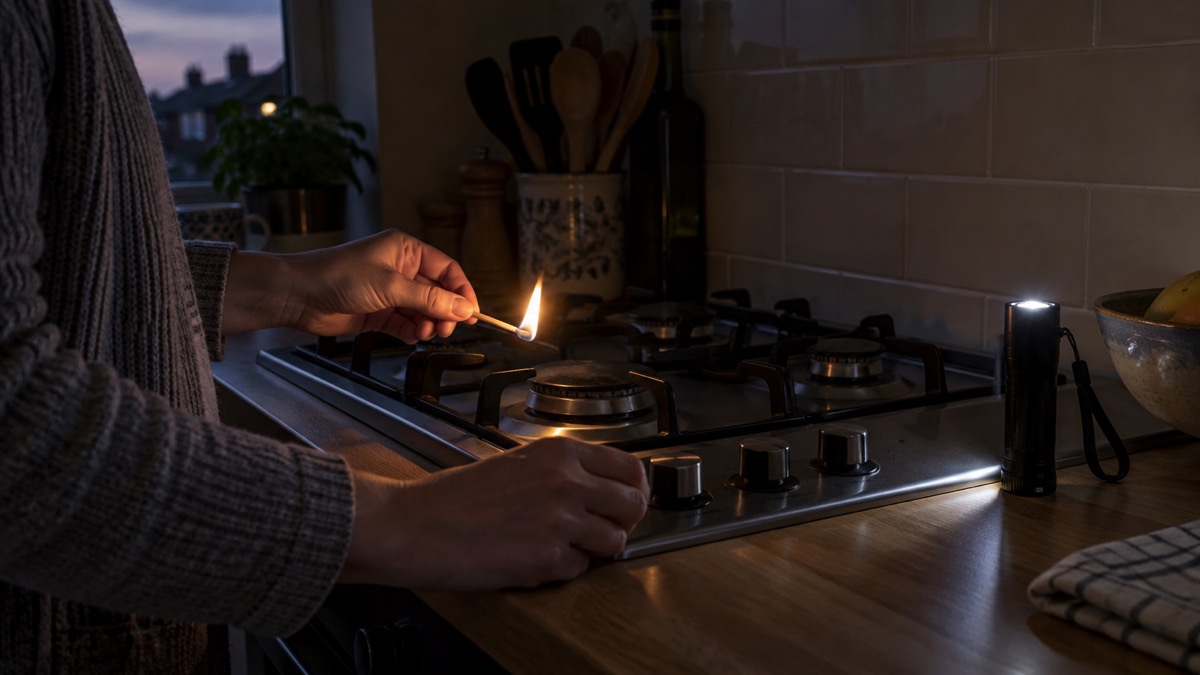
The electric spark that lights most gas hobs is powered by mains electricity, or in some cookers by a battery that may also be flat. When the power is off, the knob may still release gas even though nothing sparks. Check how your own cooker is lit before you need to know, and follow the manufacturer's instructions for lighting a burner by hand, because the method differs between cookers. Never leave your cooking unattended1.
On many gas hobs the safe method is this: turn the knob to the high setting, hold a lit match or a gas lighter to the edge of the burner, and only then let the gas flow, so the flame catches as the gas arrives rather than gas pooling first. But whether that is right for your hob, and whether your hob allows it at all, is set by the maker. Some cookers have a flame safety device that must be held down until the burner warms; some will not release gas without an electrical signal. Read the instructions for your model and follow them exactly.
A few practical points make hand lighting safer in a dark kitchen:
- Keep a torch handy, as community guidance for adverse weather in Wales advises, rather than feeling your way to the hob7. A torch you can stand up, or a head torch, leaves both hands free.
- Light the match or lighter before you turn on the gas, so gas never has time to build up around an unlit burner.
- If the burner does not light within a few seconds, turn the knob off, wait for the gas to clear, and try again. Never keep feeding gas to a burner that will not catch.
- If you smell gas at any point, stop, turn off the gas supply at the meter8, open doors and windows, and follow the advice in the last section of this page.
One device worth knowing about is a stove guard, a cut-out that Manchester Fire and Rescue Service describes as detecting a dangerous situation on the hob and instructing a power control unit, fitted between the power output and the hob, to cut the power and prevent a fire9. A stove guard depends on electricity to do its job, so in a power cut it may not protect you. That is a reason to be more careful, not less: with the igniter dead, the room dark and any automatic protection possibly inactive, your own attention is the main safety system.
For anyone with impaired mobility or a health condition, the Northern Ireland Fire and Rescue Service advises considering an electric hob or microwave instead of a gas hob, because of the risk of a naked flame10. That advice assumes the power is on; in a power cut the choice disappears, and a household in that situation should plan for no-cook foods rather than hand lighting a gas burner.
Never leave the hob unattended during a power cut
Manchester Fire and Rescue Service's rule for cookers is blunt: "Never leave your cooking unattended"4. In a power cut that rule matters more than usual, for a reason specific to outages: you do not know when the power will come back on. North Yorkshire Fire and Rescue Service advises turning off any appliances which should not be left unattended when switched on, such as cookers and microwaves, precisely because the return of power is unpredictable11.
For a gas hob the risk runs the other way. A pan left simmering on a lit gas burner in a dark house is a hazard in itself: a draught can blow the flame out while gas keeps flowing, a tea towel can drift across a burner, or a pan can boil dry. If you must leave the kitchen, even for a moment, turn the burner off. If the power cut is caused by a storm and you may need to evacuate or move to another room, turn the hob off at the knob before you go.
Scottish Fire and Rescue Service notes that during a power cut its firefighters can be called to fires started by candles or portable heaters12. The kitchen adds its own version of that risk. Before an outage arrives, it is worth clearing the hob area of anything that burns: paper, packaging, curtains and pan handles all belong well away from a flame. Community guidance also advises avoiding candles and paraffin heaters during power cuts7, and if you do keep candles for lighting, keep them well away from anything that could catch fire12. Torches are the safer choice around a cooker.
Frying in the dark: hot oil and fat catch fire easily
Frying is the one cooking method that deserves its own warning in a power cut, because it combines the highest fire risk in the kitchen with the worst visibility. Devon and Somerset Fire and Rescue Service identifies deep fat frying with chip pans as among the highest fire risks when it comes to cooking13. Manchester Fire and Rescue Service warns: "Take care when frying - hot oil or fat can easily catch fire"4. Cheshire Fire and Rescue Service says the same: take care when cooking with hot oil, as it can easily catch fire14.
The reason oil is so dangerous is that it can reach temperatures far above the point at which it ignites, and it does so silently. A pan of oil left a minute too long on a burner, in a kitchen lit only by a torch, can catch fire before you notice. Manchester Fire and Rescue Service adds that any type of pan can catch fire, including a wok, kadai, grill, chip pan or frying pan15. There is no safe pan for deep frying on a hob.
The fire services' advice is consistent and worth following exactly:
- Use less oil, or better still use the oven instead, because oil catches fire easily, so use as little as possible5.
- If you are deep-frying, use an electric thermostat-controlled deep-fat fryer rather than deep frying on the hob16. In a power cut that option is unavailable, which is itself the argument for not deep frying at all during an outage.
- Warwickshire's fire safety advice adds that a thermostat-controlled deep-fat fryer makes sure the fat does not get too hot17, which is exactly the control a pan on a gas hob lacks.
- Keep the oven, hob and grill clean, because a build-up of fat or grease can catch fire when hot18.
In practical terms, a power cut is the time to boil, simmer and warm, not to fry. A pan of soup, a pot of rice or pasta, and a kettle of water on the hob are all low-risk. A chip pan is the opposite. If you want hot food that feels like a treat, tinned food warmed through in a pan, or bread toasted under a grill if your grill works without power, carries a fraction of the risk of a pan of oil.
Portable gas stoves: check for recalls before you use one
Many households reach for a portable gas stove when the cooker will not work. Before you do, check whether the stove has been recalled, because at least one model sold in the UK was withdrawn over a gas leak fire hazard.
The Office for Product Safety and Standards issued a recall in September 2022 for the Optimus Gemini Portable 2-Burner Gas Stove19. The product does not meet the requirements of the Gas Appliances (Enforcement) and Miscellaneous Amendments Regulations 2018, and owners were told to stop using their stove immediately and return it to the place of purchase for a refund20. The affected stoves are black metal with silver top burner surfaces, measuring 12in (20cm) long and 4in (9cm) wide, can be used with isobutane-propane fuels, and have Optimus printed on the side19. The serial numbers affected are RG000001 to RG006788 and RG023004 to RG02332320. The recall covers model number 8020872, barcode 0604375208728, with country of origin Romania19.
| What to check | Detail |
|---|---|
| Model | Optimus Gemini Portable 2-Burner Gas Stove, model 802087219 |
| Serial numbers | RG000001 to RG006788, and RG023004 to RG02332320 |
| Appearance | Black metal, silver burner surfaces, 20cm long, 9cm wide, Optimus printed on the side19 |
| What to do | Stop using it immediately and return it to the place of purchase for a refund20 |
If you own one of these, do not light it to test it. The recall notice is unambiguous, and the hazard is a gas leak that can cause fire. The successor model is covered separately on our Optimus Gemini II page.
Beyond recalls, give any portable stove a check before each use. Oxfordshire's guidance for caravan, mobile home and campsite visitors advises checking gas and electrical equipment, including hobs, heaters and gas bottles, before use, and making sure connections are secure and undamaged21. Cheshire Fire and Rescue Service's camping safety advice says fuel-burning equipment should never be used inside a tent, camper or other enclosed shelter, and cooking appliances should never be used inside small tents22. The government's power cut guidance for consumers adds the general rule: check the manufacturer's instructions for safe use of these appliances, as most are designed for outdoor use only2.
If your stove runs on a refillable or clip-on cylinder rather than a small cartridge, the cylinder change is its own moment of risk. Cheshire Fire and Rescue Service advises checking the empty cylinder valve is closed before disconnecting, and only opening the new cylinder valve once it is securely connected23. Our page on changing an LPG cylinder safely covers this in full.
Where a camping stove must never be used
This is the one rule on this page with no exceptions. Devon and Somerset Fire and Rescue Service states it directly: "Never use a camping stove, portable barbecue, lit charcoal or generator in an enclosed space, as they are designed for outdoor use only and can produce poisonous carbon monoxide"6. The NHS says the same: do not use a barbecue or camping stove indoors or inside a tent24. Devon and Somerset Fire and Rescue Service adds never to use BBQs, camping stoves or patio heaters for heat indoors25.
Carbon monoxide has no smell and no taste, and it kills. Public Health Wales reminds households that portable barbecues, stoves, heaters and generators can all produce carbon monoxide26. nidirect's advice for camping, caravanning and boating is never to take a gas stove, light or heater into a tent, caravan or cabin unless it is a permanent fixture, installed and maintained correctly27, and Cumbria Fire and Rescue Service repeats the same warning28. nidirect also warns never to take a smouldering or lit barbecue into a tent, caravan or cabin, even after you have finished cooking27.
A related warning applies to a different appliance: Scottish Fire and Rescue Service advises never using portable gas cylinder heaters in high rise flats12. If you are considering any portable heater during an outage, read our guides to portable heater types and using a portable heater safely first.
If you suspect a gas leak alongside a power cut, Devon and Somerset Fire and Rescue Service advises turning off all appliances and the main cylinder valve, opening all doors and windows, and not smoking or turning on any electrical switches or appliances until given the all-clear6. For mains gas, nidirect advises turning off the gas supply at the meter8.
Cooking without the microwave or electric oven
When the power is off, the microwave and any electric oven are simply unavailable, so the shape of your cooking changes. The government's consumer guidance on food safety in a power cut stresses that if a power cut has affected your home and you have no electricity supply, it is important you continue to store and prepare food safely2. Storm guidance from nidirect makes the same point: keep storing and preparing food safely while the supply is off29.
Two habits matter most. First, keep fridge and freezer doors shut so the cold stays in; the details of how long food stays safe are covered in our emergency food guide. Second, when you do cook, cook only what you will eat, because reheating and re-cooling food in an outage raises the risk of food poisoning. A gas hob suits one-pan meals: everything in a single saucepan, warmed through thoroughly, eaten at once.
When the power returns, resist the urge to celebrate with the microwave straight away. Manchester Fire and Rescue Service warns never to put anything metallic, such as cutlery or tin cans, inside the microwave4. In the confusion after an outage, with food moved into odd containers, that is an easy mistake to make. Check every container is microwave-safe before it goes in.
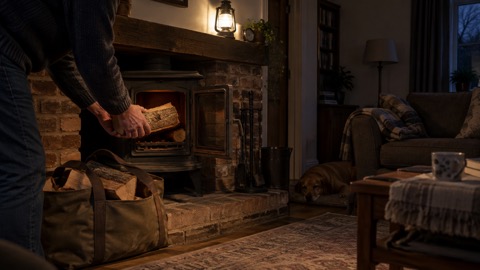
If you have an open fire or wood burner, it can warm food as well as people, with conditions. Devon and Somerset Fire and Rescue Service advises having your chimney swept, using the correct fuel for your appliance, such as seasoned wood, and keeping combustibles away from the flames30. A fire that has not been used for a long time should be treated with particular care; our pages on open fires, wood burners in a power cut and chimney sweeping cover the checks involved.
Meals that need little or no fuel
The best fuel saving is the fuel you do not burn. Food Standards Scotland gives a clear order for using food during a power cut, designed to keep food safe and reduce waste1:
- Chilled fridge foods first, while they are still cold.
- Then defrosted frozen food that does not need cooking.
- Then room-temperature perishable food such as bread.
- Then room-temperature tinned, bottled and dried food1.
That order tells you what to shop for and what to reach for first. A store of tinned and dried food, bread, and foods that can be eaten cold gets a household through a short outage with the hob untouched. Our emergency food guide covers what to keep and how much.
When you do use the hob, choose meals that need one pan and a short boil rather than long simmering. Warming a tin of soup or beans, boiling pasta or rice, and making hot drinks are all quick and low-risk. Anything that needs a hot oven for an hour, or a pan of oil, is the wrong choice in an outage. If you are trying to make a small gas supply or a small camping stove cartridge last, plan the day's hot meal as a single cooking session rather than several.
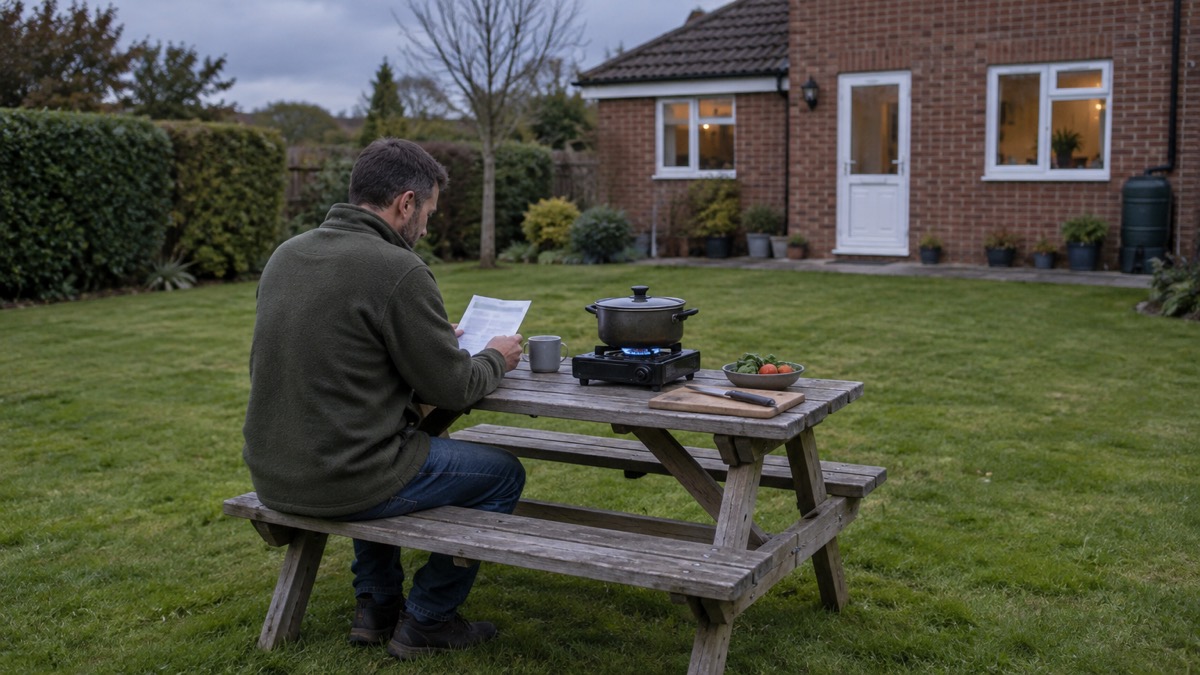
For households with no working cooker at all, the no-cook route is the only safe one indoors. A camping stove used outdoors on a step or a garden table can boil a kettle or heat a pan, and the stove can then be brought back in only when it is cold and disconnected. Never move a lit stove, and never bring it in to finish cooking.
Where to get help after a fire or gas problem
For the power cut itself, call 105 from your mobile or landline3. That is the free power cut number across Great Britain, and community guidance in Wales repeats it: "Please call 105"7. It connects you to your network operator, who can tell you how long the outage is expected to last.
For anything involving fire, call 999 and get out. Do not go back inside for anything.
For gas, the sequence depends on the supply:
- Mains gas: turn off the gas supply at the meter8, open doors and windows, do not operate electrical switches, and get help before re-lighting anything.
- Bottled gas: turn off all appliances and the main cylinder valve, open all doors and windows, and do not smoke or turn on any electrical switches or appliances until given the all-clear6.
If you smell gas after a power cut, treat it as serious even if the smell is faint. Appliances can be disturbed by the outage, and a burner left slightly on when the lights failed is a common cause. Turn off at the meter or cylinder, ventilate, and leave the room. Our home emergencies guide covers gas leaks, carbon monoxide and fire in more detail, and the power cuts guide covers the outage itself.
Households that need extra support, including older, disabled or medically dependent people, can register in advance for priority services with their energy supplier and network operator; our extra help in an emergency page explains how. If a power cut leaves you without heating as well as cooking, our guides to keeping one room warm and warm spaces near you set out the options.
Sources (30)
- Food safety in the kitchen: power cuts, Food Standards Scotland, 2026-10-25
- Food safety in a power cut: advice for consumers, Food Standards Agency, 2023-07-26
- Protect yourself and your family, Dorset Prepared, 2026-04-21
- Cookers, microwaves and electrics, Manchester Fire and Rescue Service, 2026-10-29
- Cooking safety, Devon and Somerset Fire and Rescue Service, 2026
- Power cuts, Devon and Somerset Fire and Rescue Service, 2023-11-30
- Adverse weather events, Llangattock Community Council, 2026-10-25
- Energy, power supply and utilities, nidirect, 2025-10-23
- Cooking fire safety devices, Manchester Fire and Rescue Service, 2026-10-29
- Home fire safety, Northern Ireland Fire and Rescue Service, 2026-10-14
- Staying safe in the snow, North Yorkshire Fire and Rescue Service, 2023-03-09
- Power cuts, Scottish Fire and Rescue Service, 2026-10-25
- Top ways to reduce your risk of having a fire at home, Devon and Somerset Fire and Rescue Service, 2026
- Kitchen fire safety, Cheshire Fire and Rescue Service, 2026-05-20
- Deep frying with oil, Manchester Fire and Rescue Service, 2026-10-29
- Fire safety checklist, Devon and Somerset Fire and Rescue Service, 2026
- Christmas safety tips, Warwickshire County Council, 2026-10-29
- Kitchen safety, Devon and Somerset Fire and Rescue Service, 2024-08-06
- Product recall: Optimus Gemini Portable 2-Burner Gas Stove 2209-0256, Office for Product Safety and Standards, 2022-09-29
- Optimus Gemini Portable 2-Burner Gas Stove recall notice, London Borough of Bromley, 2022-09-30
- Help prevent wildfires, Oxfordshire County Council, 2026
- Camping safety, Cheshire Fire and Rescue Service, 2025-07-26
- Portable heaters, Cheshire Fire and Rescue Service, 2026-05-26
- Carbon monoxide poisoning, NHS, 2025-12-16
- Stay warm safely this winter, Devon and Somerset Fire and Rescue Service, 2026
- Carbon monoxide (CO), Public Health Wales, 2025-12-08
- Carbon monoxide dangers if camping, caravanning or boating, nidirect, 2026-04-02
- Safety outdoors, Cumbria Fire and Rescue Service, 2026-10-29
- Strong winds weather warning: information and advice, nidirect, 2026-10-24
- Staying safe this season, Devon and Somerset Fire and Rescue Service, 2025-12-01
 Before-Winter Heating Checks
 Backup Stove Kit Checklist
 Wood Burner Lighting Kit
 Keeping One Room Warm
 Clothing and Bedding for Cold
 Stopping Draughts
 Hot Water Bottle Safety
 Wheat Bags and Fire Risk
 Electric Blanket Safety
 Portable Heater Types
 Portable Heater Safety
 Wood Burners in a Power Cut
 Using a Wood Burner Safely
 Open Fires and Fire Guards
 Firewood and Seasoning Logs