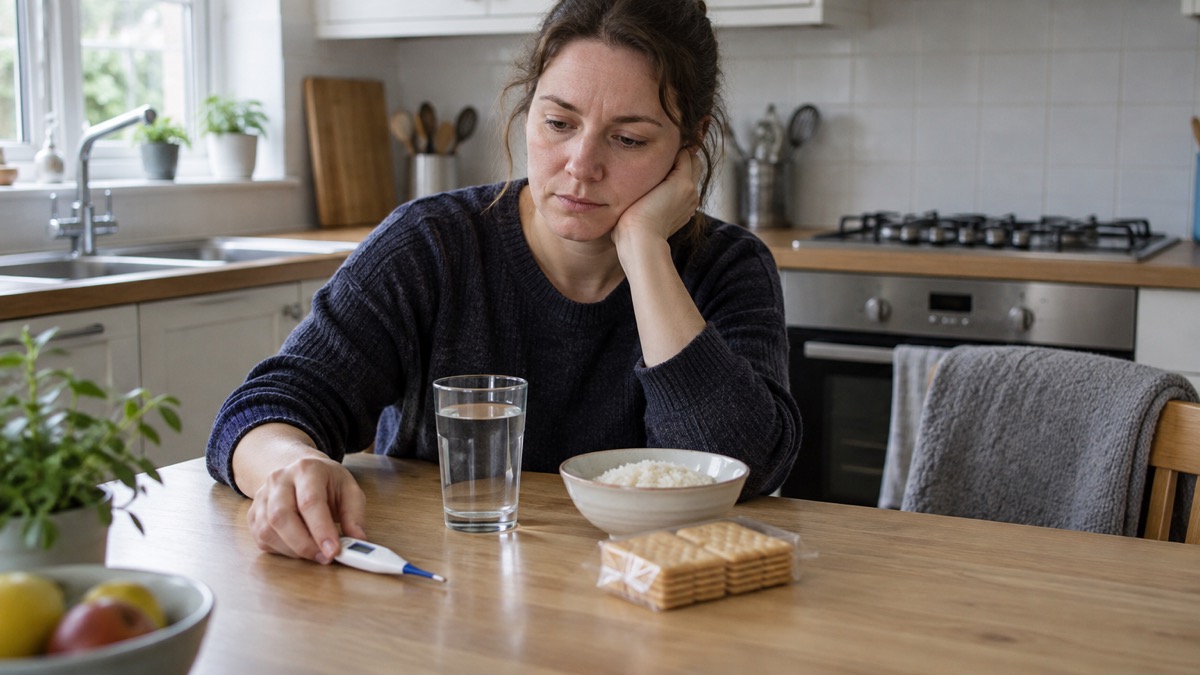
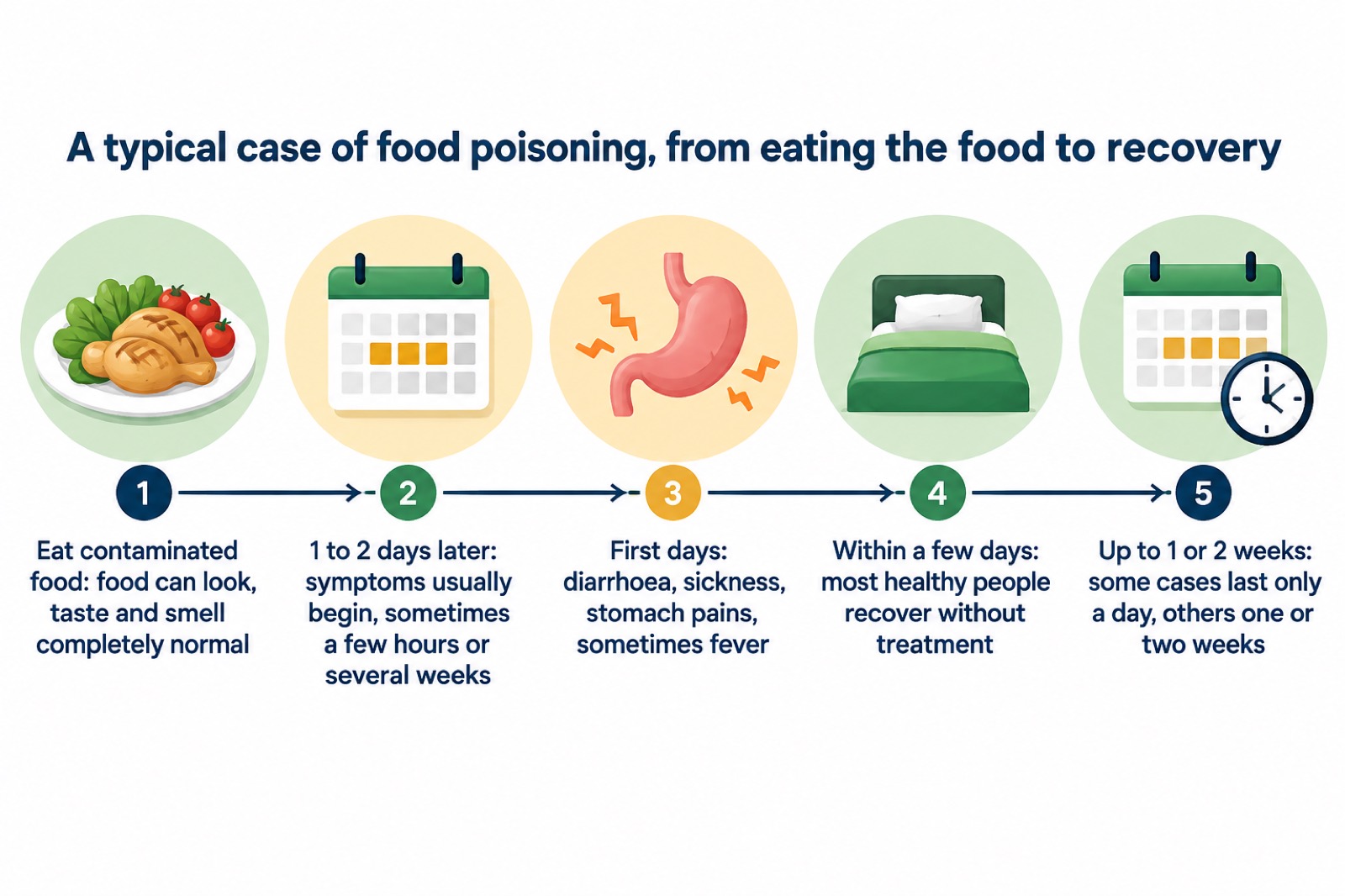
Food poisoning is an illness caused by eating contaminated food, and it is not usually serious: most people get better within a few days without treatment1. The usual symptoms are diarrhoea, sickness, stomach pains and sometimes a high temperature, and they normally begin within 1 to 2 days of eating the contaminated food, though they can start a few hours later or several weeks later2.
For most healthy people the right response is to stay at home, rest, and keep drinking fluids regularly to avoid dehydration3. You do not usually need to see a doctor, but some groups, including babies, young children, older people, pregnant women and anyone with a weakened immune system, can become seriously ill quickly and should contact their GP if badly affected3. This page sets out the symptoms to expect, how long they last, what to avoid while you recover, how to stop the illness spreading through your household, and the warning signs that mean you should call NHS 111, see your GP or call 999.
The symptoms: diarrhoea, sickness, stomach pains and fever
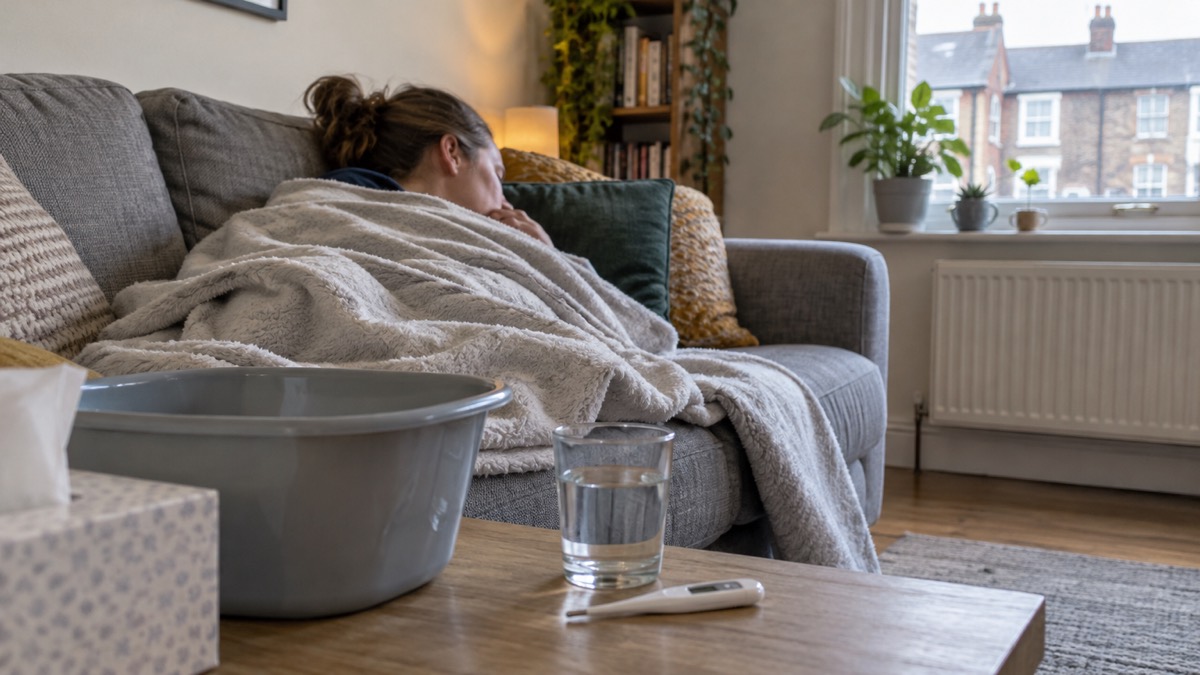
The most common symptoms of food poisoning are diarrhoea, sickness, stomach pains and sometimes a high temperature3. Council environmental health teams list the main symptoms of foodborne illness more fully as diarrhoea, stomach cramps, vomiting, fever, nausea, headache and dizziness5. NHS inform in Scotland adds that diarrhoea may contain blood or mucus, and that you may also feel a lack of energy and weakness, lose your appetite, have a fever of 38C or above, aching muscles and chills2.
Symptoms vary because many different bacteria and other germs cause foodborne illness, and each behaves differently in the gut1. Campylobacter, the most common cause in the UK, tends to produce stomach cramps and severe diarrhoea but rarely vomiting6. Staphylococcus aureus, by contrast, tends to cause stomach pains and vomiting rather than diarrhoea6. So two people who ate the same contaminated food can have quite different experiences, and a case with vomiting but no diarrhoea can still be food poisoning.
If diarrhoea or vomit contains blood, that is a warning sign and you should seek medical help rather than wait it out. NHS inform advises calling 999 or going to A&E if you vomit blood or have vomit that looks like ground coffee, or have yellow-green or green vomit2. Those signs are covered in full later in this page.
How long after eating bad food do symptoms start?
Symptoms of food poisoning usually begin within 1 to 2 days of eating contaminated food, but they can also start a few hours later or several weeks later2. The gap between eating the food and feeling unwell, called the incubation period, varies with each type of organism, and in some cases can be up to 10 to 15 days after consumption of the food7. That long gap is one reason people so often fail to connect their illness with a particular meal: by the time you are ill, the food that caused it may be long gone.
Some organisms are faster than others. Staphylococcus aureus produces symptoms within 1 to 6 hours of eating, and those symptoms usually take 12 to 24 hours to subside6. Campylobacter is much slower: symptoms can begin 2 to 10 days after eating contaminated food, but usually within 2 to 5 days6. NHS Borders notes that symptoms of one type of illness usually start 1 to 36 hours after eating spoilt food and can last for up to one week8.
| Cause | Time from eating to symptoms | Typical symptoms |
|---|---|---|
| Staphylococcus aureus | 1 to 6 hours6 | Stomach pains and vomiting; usually subsides in 12 to 24 hours6 |
| Campylobacter | Usually 2 to 5 days, can be 2 to 10 days6 | Stomach cramps and severe diarrhoea, rarely vomiting6 |
| General food poisoning | Usually 1 to 2 days, sometimes a few hours or several weeks2 | Diarrhoea, sickness, stomach pains, sometimes fever3 |
| Some organisms | Up to 10 to 15 days7 | Varies with the organism7 |
This matters in two practical ways. First, do not assume the last meal you ate is the culprit: if you are trying to work out what made you ill, think back over everything you ate in the previous few days. Second, if you later report the illness to your council, you may be asked to give a food history of up to 5 days before becoming ill to assist with any investigation6.
Most people get better at home within a few days
Food poisoning is not usually serious, and most people get better within a few days without treatment1. Most healthy individuals will recover after a short period of illness9. Symptoms may last for only a day or continue for one or two weeks3, so do not be alarmed if you are not back to normal within 48 hours, but do seek advice if you are getting worse rather than better.
The main thing you can do for yourself is keep drinking. Shropshire Council's environmental health team advises that in most cases of food poisoning your GP will not prescribe medication, as it will not help you recover from the illness any faster; instead, keep drinking regularly to avoid dehydration3. Food poisoning caused by food that has not been prepared or stored properly can be treated at home, according to NHS guidance10.
What not to eat, drink or take while you recover
While you are recovering, NHS inform in Scotland advises2:
- Do not have alcohol, caffeine, fruit juice or fizzy drinks.
- Do not make baby formula weaker.
- Do not give children under 12 medicine to stop diarrhoea.
- Do not give aspirin to children under 16.
Northumberland Council adds a firm warning about antidiarrhoeal medicines: do not take antidiarrhoeals, like Imodium, as this stops the digestive tract getting rid of what is causing the symptoms and can increase the severity of the illness and prolong it4. Antibiotics are not usually part of the picture either: in most cases your GP will not prescribe medication because it will not speed your recovery3, although in some types of food poisoning infection antibiotics can be used, which is a decision for your doctor3.
For more on how long to keep away from work, school or nursery, see our page on how long to stay off work or school with food poisoning.
Staying at home and stopping it spreading in the household
If you have food poisoning, stay at home while you have symptoms. The same principle applies to any infectious illness: Derbyshire County Council advises that if you have flu symptoms you should stay at home if you can, to help avoid spreading germs to others11, and food poisoning spreads in the same household settings, through hands, surfaces and shared items.
Germs are passed on easily. NHS Borders notes that germs passed on by other people, pets or farm animals cause more than half the cases of food poisoning, transferred via hands and surfaces, through the air if someone is vomiting, or via the toilet8. Cornwall Council gives a practical checklist for limiting spread when someone in the house is ill6:
- Wash your hands after contact with the sick person, and before handling food.
- Do not share towels or face cloths.
- Disinfect the toilet handle and seat.
- Do not share bathwater.
- Put the toilet lid down when flushing, and ventilate the house.
- The person who is ill should avoid preparing food for others.
That last point deserves emphasis. Shropshire Council advises that anyone with diarrhoea, vomiting or nausea must not prepare food for other people3. This applies to family cooking and to larger events alike: for parties and gatherings, the same guidance says not to prepare food too far in advance, and to keep food either piping hot or refrigerated until it is served3.
If your household is coping with several illnesses at once, or you want broader advice on managing illness during a wider emergency, see our guide to health emergencies.
Who is most at risk from food poisoning
Food poisoning is mild for most healthy adults, but foodborne diseases can cause serious illness in some groups of people and in extreme circumstances even cause death9. The groups most at risk are consistent across official guidance3:
- Babies and young children, who can very quickly become very ill5
- Older people, who can also become very ill quickly5
- Pregnant women, who can be seriously affected5
- People with a pre-existing illness or a weakened immune system5
Shropshire Council is direct about what these groups should do: babies, young children, people with a weak immune system, pregnant women and the elderly should contact their GP if badly affected by food poisoning3. Northumberland Council adds that these groups can quickly become very ill when infected12.
Pregnant women must also take particular care with what they eat and drink, and follow the advice given to them by their doctor or midwife9. Government advice for people at increased risk, which includes young children, pregnant women, older people and people with an underlying health condition, is to take extra caution: wash hands, surfaces and utensils often; be cautious with high-risk foods like deli meats and smoked fish; make sure food is steaming hot; and do not consume expired or spoiled food, checking use by dates13.
Listeria deserves a special mention here. Cornwall Council warns that prevention of food poisoning from Listeria is more difficult than for other organisms, because it can multiply rapidly at refrigeration temperatures6. Chilling food properly, which normally stops bacteria, is not enough on its own against listeria, which is why the caution about deli meats and smoked fish matters for these groups. Our page on salmonella, E. coli, listeria and other causes of illness covers the organisms in more detail.
When to call 111, see your GP or call 999
Most cases need no medical contact at all, but there are clear thresholds for getting help. NHS inform in Scotland says to phone 999 or go to A&E if you2:
- vomit blood or have vomit that looks like ground coffee
- have yellow-green or green vomit
- may have swallowed something poisonous
- have a stiff neck and pain when looking at bright lights
- have a sudden severe headache or stomach ache
- have blue, grey, pale or blotchy skin, lips or tongue
- have severe difficulty breathing
- are confused or not responding as usual
For less severe but still worrying symptoms, contact your GP or call NHS 111. In Scotland, NHS 24 provides the same service on 1118. NHS guidance on poisoning generally is that symptoms may take a few hours or days to start, so it is important to get medical advice quickly if there is a chance you have swallowed something harmful10. If the person has no symptoms and appears well, nidirect advises calling your GP or the GP out of hours service for advice14.
For children, the NHS Healthier Together services use a red and amber system. Red features in a child mean going to the nearest hospital emergency department or calling 999, and include choking, breathing very fast or being too breathless to talk, eat or drink, being pale, blue, mottled or unusually cold, being difficult to wake or very confused, having a fit (seizure), or having severe tummy pain15. Amber features mean you should urgently see your GP, or call NHS 111 if your surgery is closed, and include a rash or skin irritation, vomiting or mild stomach pain, headache, breathing a bit faster than normal, dry skin, lips or tongue, not having had a wee or wet nappy in the last 8 hours, or simply getting worse when you are worried16. If you call about a child who has swallowed something, have the substance with you16.
Signs of being seriously ill from poisoning include vomiting, loss of consciousness, drowsiness and seizures (fits), and nidirect advises calling 999 for an ambulance or taking the person to your local emergency department if these appear14. After getting medical advice or leaving hospital, keep an eye on yourself or your child for the next 1 to 2 days, eat and drink as normal, follow any advice given by doctors, and seek medical help again if you feel worse17.
How food gets contaminated, and why it can look and smell fine
Food poisoning is an illness that occurs after eating or drinking anything that is contaminated3. Contamination can occur at any stage of the food production, delivery, storage or consumption chain, from pollution in water, soil or air, and from unsafe food storage and processing8. In the home, the common causes are food that is not cooked or reheated thoroughly, not stored correctly, left out for too long, handled by someone who is ill or who has not washed their hands, or eaten after its use by date2.
The uncomfortable truth is that you usually cannot tell contaminated food from safe food. Shropshire Council's answer to whether you can spot it is blunt: "You can't - even food which looks and tastes good can cause food poisoning."3 NHS Borders explains why: with some bacteria, chemicals (toxins) are produced which are not destroyed by cooking, and a food does not have to look, smell or taste off to be dangerous8. The same warning applies to home preserved food: preserved foods that have not been prepared correctly may not look, smell or taste unusual, so do not rely on appearance, smell or taste to decide whether food is safe to eat12.
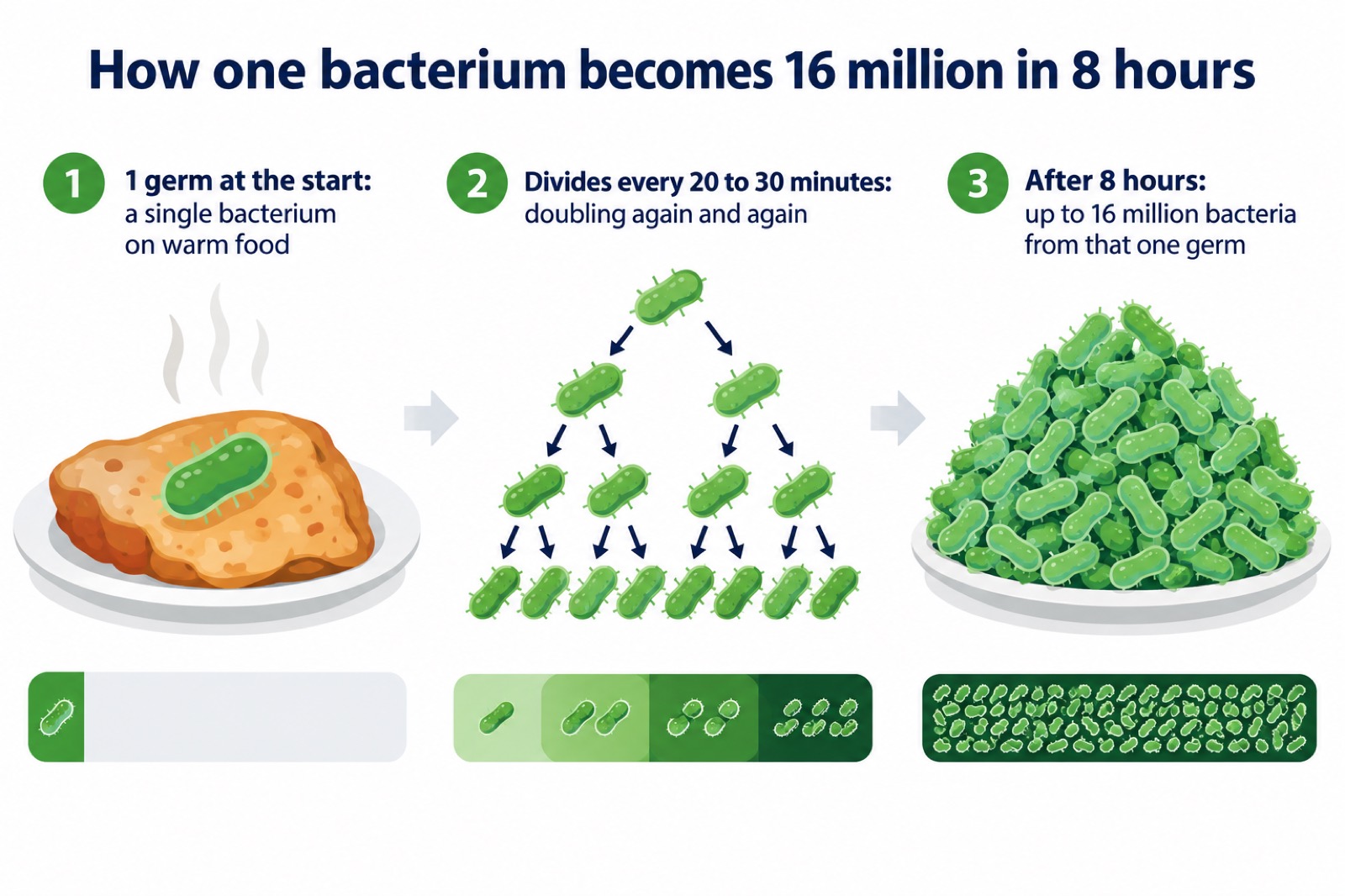
Bacteria multiply at astonishing speed when conditions suit them. Some bacteria can divide in two every 20 to 30 minutes, so that one germ produces up to 16 million others within 8 hours8. When food is kept warm, bacteria can grow rapidly and reach dangerous levels within hours5, which is why the number of cases of foodborne illness rises particularly during the summer months18. Bacillus cereus is a good example of the problem: it produces spores that survive heat processing, and grows rapidly at room temperature, producing toxins both in the food and after ingestion8.
Preventing food poisoning at home
The good news is that the same handful of habits prevents almost all of this. Thorough cooking kills food poisoning bacteria: make sure food, especially meat, is cooked right through and piping hot in the middle, and do not reheat food more than once3. Keep perishable foods at a temperature below 5°C, keep to the use by date of wrapped foods, and eat foods within 3 or 4 days of opening8. Food Standards Scotland adds a simple rule for leftovers: eat leftovers within 2 days9, and our page on how long you can keep leftovers in the fridge goes into this in detail.
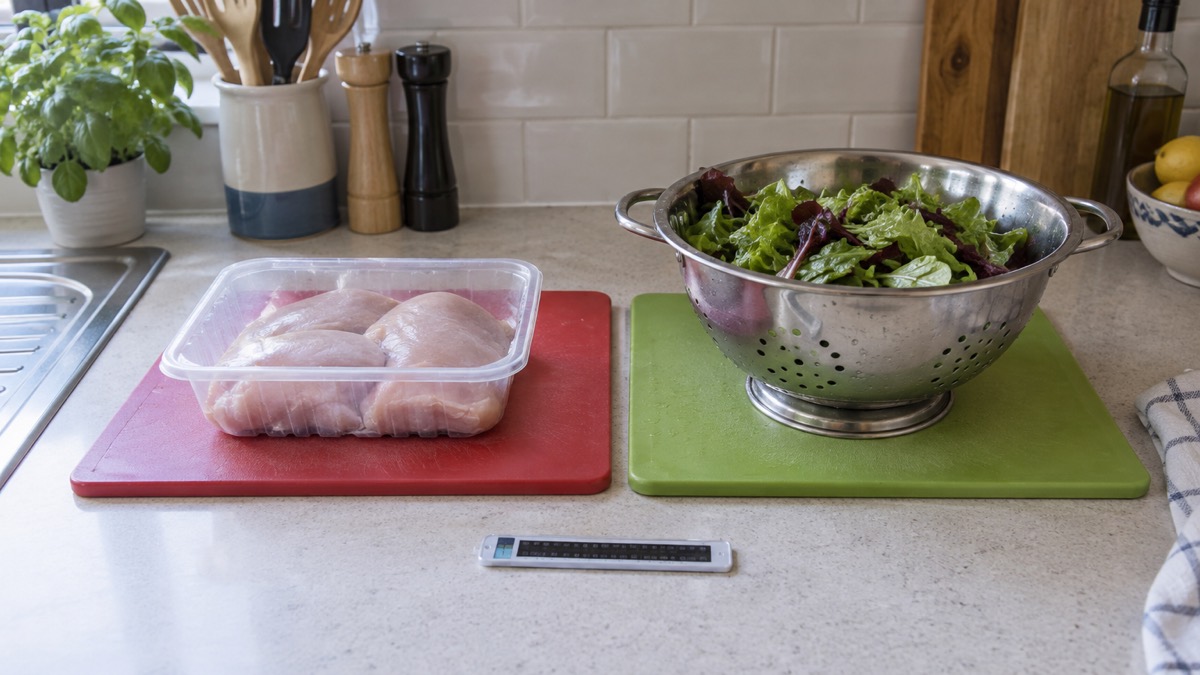
To stop bacteria spreading around the kitchen, always clean surfaces, utensils, plates and hands thoroughly after they have touched raw or thawing meat9. Shropshire Council's cross-contamination advice is to store raw meat in sealed containers at the bottom of the fridge, use different boards for raw and ready to eat foods, and keep raw and ready to eat foods apart3. Northumberland Council adds a point that is easy to overlook: keep pets away from food and food preparation surfaces5.
A prevention checklist for the kitchen:
- Wash hands with anti-bacterial soap, and keep work surfaces and utensils clean, disinfecting them with anti-bacterial spray3
- Store raw meat in sealed containers at the bottom of the fridge3
- Use different chopping boards for raw and ready to eat foods3
- Cook food right through until piping hot in the middle, especially meat3
- Do not reheat food more than once3
- Keep perishable food below 5°C and eat leftovers within 2 days8
- Keep pets away from food and preparation surfaces5
- Anyone with diarrhoea, vomiting or nausea must not prepare food3
If you preserve food at home, follow reputable instructions exactly, including temperatures and processing times, wash hands thoroughly before, during and after preparing food, clean and sanitise work surfaces and equipment, check jars, lids and containers for damage and discard damaged ones, sterilise containers when instructed, label and date preserved foods, and use them within the recommended shelf life12. Our guides to preserving at home safely and how to tell if preserved food has gone off cover this in depth.
Testing and reporting food poisoning
If you think you have food poisoning, visit your doctor as soon as possible: they might ask you to submit a sample for examination, or you can request to submit one5. Where food poisoning is caused by a bacteria or a parasite, it will normally be diagnosed once a patient has provided a faecal sample (stool) to their doctor or at a hospital, which is then tested at a laboratory3. This is why seeing a GP matters even when you are recovering: a confirmed diagnosis is what triggers the public health follow-up.
Food poisoning is a notifiable illness, and your council's environmental health team will act on notifications. Belfast City Council, for example, explains that on receiving a food poisoning notification it contacts the person with symptoms and asks what and where they ate, the symptom details, whether they were abroad, whether the GP took a faecal sample, and whether others who ate with them had symptoms1. Somerset Council lets you report an incident of food poisoning online by completing a form on its website9. Our page on reporting food poisoning or a food problem to your council explains the process step by step.
Reporting matters even when your own illness was mild, because it is how contaminated food sold to the public gets identified. Campylobacter is the most common food poisoning bacteria in the United Kingdom3, salmonella is the second most common form of food poisoning6, and cases have grown particularly in the summer months18. Each report adds to the picture that environmental health teams use to trace outbreaks.
Sources (18)
- Food poisoning, Belfast City Council, Belfast City Council, 2026-10-29
- Food poisoning, NHS inform, NHS inform, 2026-08-17
- Food poisoning and waterborne infections, Shropshire Council, Shropshire Council, 2026-10-29
- Infectious diseases, Northumberland Council, Northumberland Council, 2026-10-28
- Infectious diseases, Cornwall Council, Cornwall Council, 2026-10-29
- Food poisoning advice, Northumberland Council, Northumberland Council, 2026-08-11
- Food poisoning, NHS Borders, NHS Borders, 2014-06
- Food poisoning, Somerset Council, Somerset Council, 2026-07-09
- Chilling, Food Standards Scotland, Food Standards Scotland, 2026-10-25
- Poisoning, NHS, NHS, 2025-06-12
- Flu, Derbyshire County Council, Derbyshire County Council, 2026-10-29
- Consumer advice for food preservation at home, GOV.UK, GOV.UK, 2026-10-26
- Poisoning, nidirect, nidirect, 2021-06-27
- Poisoning / accidental swallowing, Healthier Together, Healthier Together, 2026-10-29
- Poisoning (accidental swallowing in children), ABB Healthier Together, ABB Healthier Together, 2026-10-29
- Poisoning, Frimley Healthier Together, Frimley Healthier Together, 2026-10-29
- Health protection, Cornwall Council, Cornwall Council, 2025-09-29
- Food safety in a power cut: advice for consumers, GOV.UK, GOV.UK, 2023-07-26
 Long-Term Storage Kit Checklist
 Store Cupboard Checklist
 30-Day Household Checklist
 How Much Emergency Food to Store
 What to Store in an Emergency
 Starting a Store Cupboard
 Shelf Life and Date Labels
 Rotating Your Food Store
 Long-Term Storage Conditions
 Meals Without Power
 Self-Heating Meals
 Tinned Food Guide
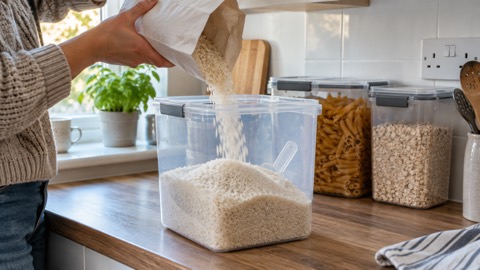 Rice, Pasta and Pulses Storage
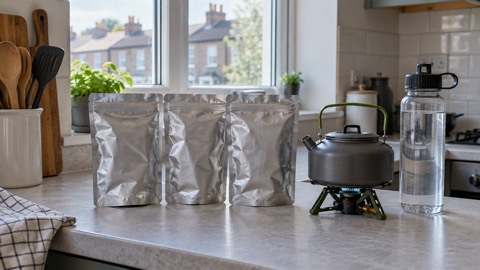 Freeze-Dried Meals
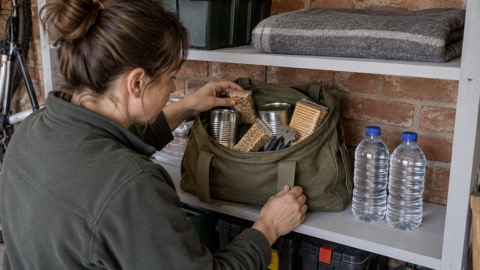 Emergency Ration Packs