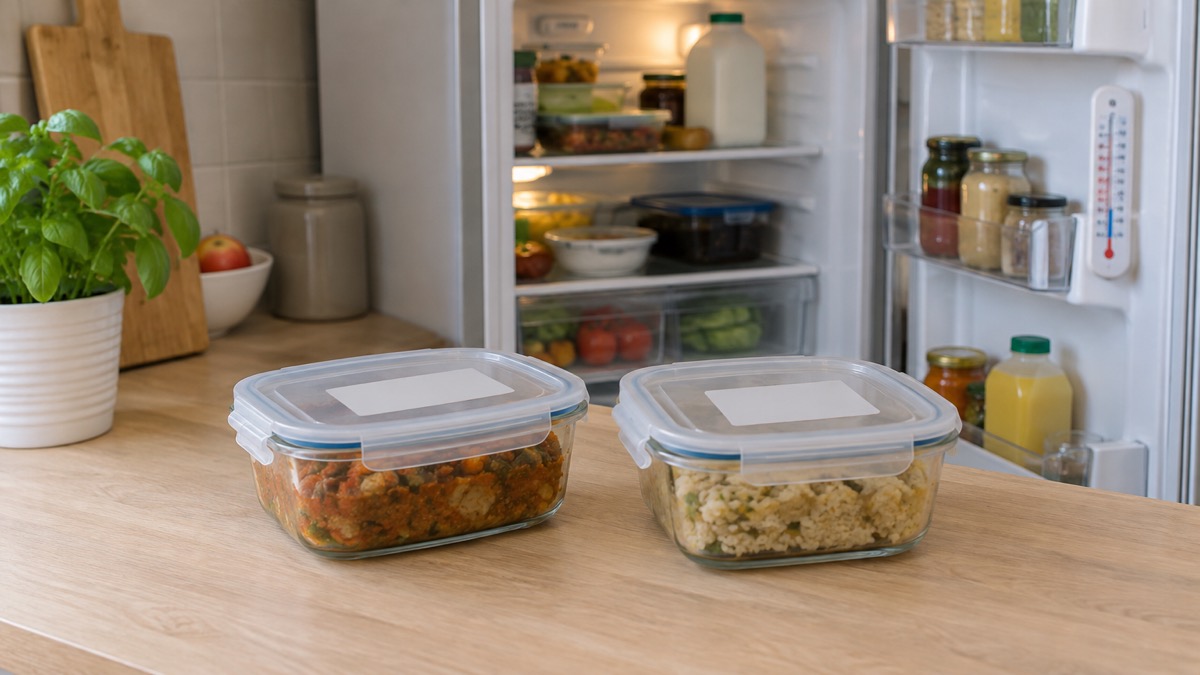
Cooked food left over from a meal is safe in the fridge for two days, and no longer. Cool it quickly, get it into the fridge within one and a half hours, and eat it within two days1. That is the short answer, and it holds for most cooked dishes, including meat, fish, sauces and casseroles.
The two days are counted from cooking, not from when you remember to put the food away. Leaving a pan on the hob overnight, or a plate on the worktop through the evening, uses up the safe window before the food has even reached the fridge. Never let cooked food sit at room temperature for more than four hours3.
Some foods are stricter than the two-day rule. Cooked rice should be eaten within 24 hours5, and anything that has been cooked, frozen and then defrosted should be reheated and eaten within 24 hours6. If the label on a packet gives storage instructions, follow those instead of the general rule5.
Eat leftovers within two days
The two-day limit is the figure to remember. Official guidance is to eat leftovers within two days, and to cool any leftover food quickly and put it in the fridge within one and a half hours1. The same two-day rule applies to food that goes off quickly when the label gives no storage instructions: put it in the fridge and eat it within two days5.
Why two days and not longer? Cooked food is a good home for the bacteria that cause food poisoning, and refrigeration slows them rather than stopping them. The clock starts when the food is cooked, so a dish cooked on Sunday evening should be eaten by Tuesday evening. If you cooked it on Sunday lunchtime, Monday and Tuesday lunch are your two days.
The cooling step matters as much as the storage. Food should be cooled immediately after cooking and never left at room temperature for more than four hours4. The Food Standards Scotland advice is not to let food sit at room temperature for longer than one to two hours before it goes in the fridge1. In practice, decant leftovers into a shallow container, leave them on the side only until they stop steaming, then refrigerate.
A few cooked foods have their own rules:
- Hard-boiled eggs: keep for up to two days in the fridge, with or without the shell5.
- Dishes containing eggs: cool quickly, keep in the fridge and eat within two days5.
- Cooked rice: safe to eat cold if cooled down quickly, stored in the fridge and eaten within 24 hours5.
- Defrosted food: use within one to two days after defrosting, as it will go off in the same way as if it were fresh1.
How long food keeps once it is cooked
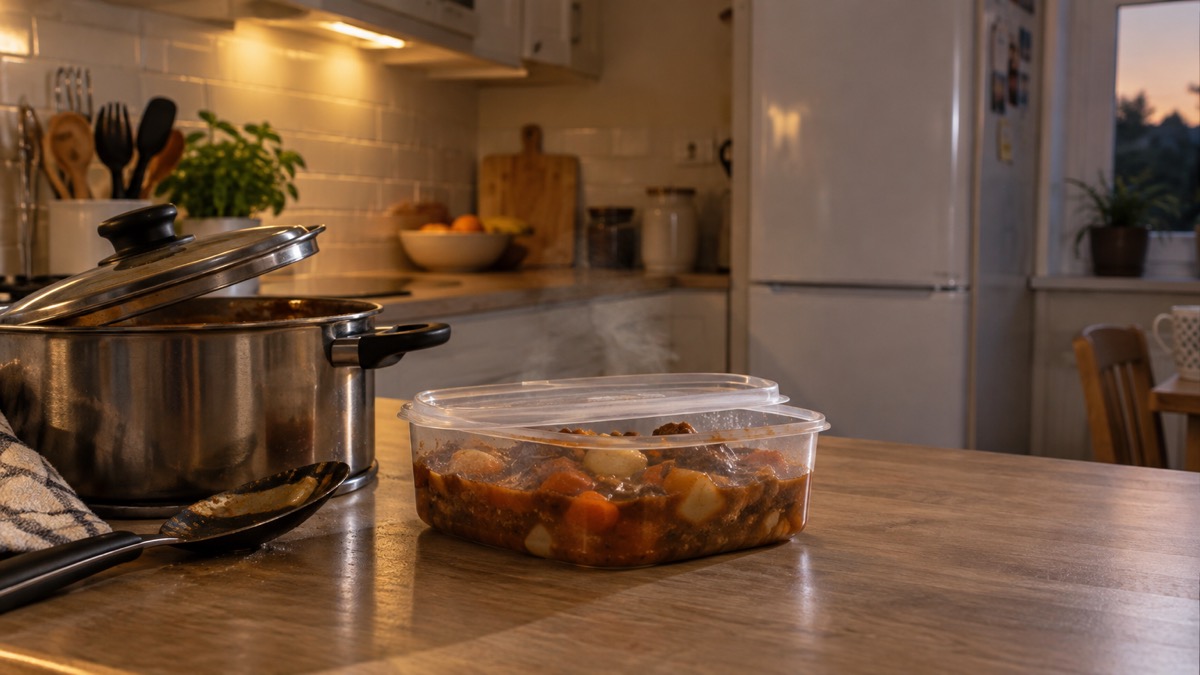
Once food is cooked, its safe life in the fridge is measured in days, and the two-day rule covers most of it. The variables that shorten it are heat, time at room temperature and how the food is handled.
The four-hour rule is the one people break without noticing. Never let cooked food be at room temperature for more than four hours3. That includes the time it takes to cool, the time it sits out while people help themselves to seconds, and the time between serving and clearing up. If a dish has been out for a long lunch, the fridge clock has already started.
Cross-contamination is the other way cooked food spoils early. Store raw meat in sealed containers at the bottom of the fridge, use different boards for raw and ready-to-eat foods, and keep raw and ready-to-eat foods apart2. A covered container of leftovers on the shelf above an uncovered joint of raw meat is a food poisoning risk even if the leftovers are only a day old.
Opened foods have their own clock. Follow the storage instructions on the label and use opened foods within two days unless the packaging says otherwise8. That applies to jars, tubs and packets as much as to home-cooked food.
| Food | How long in the fridge | Source |
|---|---|---|
| Most cooked leftovers | 2 days | 1 |
| Cooked rice | 24 hours | 5 |
| Hard-boiled eggs | up to 2 days | 5 |
| Egg dishes | 2 days | 5 |
| Defrosted food | 1 to 2 days | 1 |
| Opened foods | 2 days unless the label says otherwise | 8 |
Leftovers past two days: when to throw them out
After two days, throw leftovers out. The guidance is not to keep leftovers for longer than two days6. This is not a margin you can stretch by sniffing the food: the bacteria that cause illness do not always change the smell or look of a dish.
There are times when food should go sooner than two days. Throw out meat, fish and dairy products if they have been above 4°C for more than a couple of hours9. If a dish has been left in a warm kitchen, in a car or in a heatwave, treat it as spoiled whatever the calendar says.
The same caution applies to food that has been through a flood or a fire. After a flood, double bag and throw away any food that was frozen but has now been at room temperature for more than an hour10. After a fire, food in a fridge or freezer will remain safe for a short period if kept closed, but anything that may have become warm or wet should be disposed of11.
If you are ever unsure, the rule is simple: when in doubt, throw it out13. The cost of a wasted portion is small next to a bout of food poisoning.
Keeping track of leftovers in the fridge
The easiest way to keep to two days is to label food when it goes in. Write the date on a strip of tape or the lid of the container, and put the oldest items at the front. A fridge where you can see what is in it is a fridge where leftovers get eaten rather than forgotten.
A few habits make the two-day rule easy to keep:
- Cool in shallow containers. Food cools faster and reaches the fridge sooner.
- Portion before storing. Freeze or refrigerate what you will not eat in the next two days, so nothing is wasted.
- Keep raw meat below cooked food. Store raw meat in sealed containers at the bottom of the fridge2.
- Check the temperature. A fridge thermometer tells you the fridge is doing its job; see our guide to fridge and freezer temperatures and thermometers.
- Use the oldest first. Rotate containers so the earliest date is at the front.
If you are cooking for a household and regularly have leftovers, it helps to plan portions so that what is left is what you intend to eat within two days. Our guide to rotating your store covers the same first-in, first-out habit for longer-life food.
Leftovers after a power cut
A power cut turns the two-day rule into an hours-long one. Keep the fridge and freezer doors closed, and the fridge should keep food at a safe temperature for up to four hours14. The freezer is more forgiving: food should stay frozen for up to 48 hours if it is full, or about 24 hours if it is half full14.
The official advice after the event is blunt. Throw away food from a fridge if the electricity has been off for more than four hours, and from a freezer if it has been off for more than 24 hours7. If the temperature in the fridge has risen to 8°C or more, eat food that normally needs refrigeration within four hours14.
Different network operators give slightly different figures for how long a closed fridge or freezer holds its temperature. Northern Powergrid says most fridges keep food fresh for up to 12 hours and chest freezers for up to 24 hours15. NIE Networks says food should keep for between 4 and 6 hours in the fridge and 15 to 24 hours in the freezer if you can avoid opening it16. National Grid advises keeping the freezer closed, as depending on the type it could remain cold if unopened for up to 12 hours17.
If you have to use up food during a long outage, eat refrigerated food first, frozen food next within two days, and food from the cupboard last19. Keep the freezer shut, and if food has defrosted by the time the power comes back on, throw it away20. For more on planning for an outage, see our guide to power cuts.
Freezing leftovers instead
Freezing is the better option when you know you will not eat something within two days. Freeze food up until its use-by date1, and cool it before it goes in.
The rules for what happens after freezing are stricter than for fresh leftovers. If food has been cooked, frozen and then defrosted, reheat and eat it within 24 hours6. Once defrosted, meat and fish need to be cooked and eaten within 24 hours6. You can freeze food again once cooked, but you will only be able to reheat it once after that1. Cooked meat, fish and poultry can be frozen as long as they have been cooled, and should only be refrozen once after cooking6.
That means the freezer is not a way to extend the two-day rule indefinitely. It pauses the clock, but the defrosted dish still has a short life. Portion leftovers into single servings before freezing so you only defrost what you will eat. Our guide to refreezing defrosted meat covers the detail.
Rice and leftover rice
Cooked rice is the exception to the two-day rule. It is safe to eat cold if it is cooled down quickly, stored in the fridge and eaten within 24 hours5. That is half the time allowed for most leftovers, so rice should be the first thing you use up.
The reason is that rice can carry spores that survive cooking and multiply if the rice is left warm. Cooling it quickly and getting it into the fridge promptly is what keeps it safe. Do not leave rice in the pan on the hob to cool overnight.
If you have cooked more rice than you need, cool it quickly, refrigerate it, and plan to eat it the next day. Our guide to rice, pasta, oats and pulses covers storing the dry versions.
Reheating leftovers more than once
Reheat a portion once, and eat it. Do not reheat the same dish twice. The guidance is that you can freeze food again once cooked, but you will only be able to reheat it once after that1. If food has been cooked, frozen and then defrosted, reheat and eat it within 24 hours6.
The practical way to stay within this is to portion before storing. Put what you will eat tomorrow in one container and what you will freeze in another, so nothing is reheated, cooled and reheated again. Reheat until the food is piping hot throughout, and do not leave it standing at room temperature afterwards.
Official food safety advice in summary
The official advice on leftovers comes from the Food Standards Agency in Scotland, NHS Inform and local council environmental health teams, and it is consistent across the UK. The core points are:
- Eat leftovers within two days1.
- Cool food quickly and refrigerate within one and a half hours2.
- Never leave cooked food at room temperature for more than four hours3.
- Follow the label and use opened foods within two days unless the packaging says otherwise8.
- Store raw meat in sealed containers at the bottom of the fridge2.
- Throw away fridge food after a power cut of more than four hours7.
If you become ill after eating leftovers, our guide to food poisoning explains the symptoms and when to get help. To report a food problem, see reporting food poisoning or a food problem to your council. For the wider picture on keeping food safe at home, start with our emergency food guide.
Sources (20)
- Chilling, Food Standards Scotland, 2026-10-25
- Food poisoning and waterborne infections, Shropshire Council, 2026-10-29
- Infectious diseases, Northumberland County Council, 2026-10-28
- Infectious diseases, Cornwall Council, 2026-10-29
- Food storage, Food Standards Scotland, 2026-10-25
- Preparing and cooking food safely, NHS Inform, 2025-02-21
- After a flood, GOV.UK, 2026-10-25
- Listeria, Food Standards Scotland, 2026-10-25
- What to do in a power cut, Which?, 2026-06-04
- Further support | Nottinghamshire County Council, Nottinghamshire County Council
- Steps after a fire, North Yorkshire Fire and Rescue Service, 2026-06-17
- Heatwave, Lancashire Prepared, 2026-10-29
- Power cut, British Red Cross, 2026-10-25
- Power cuts, Food Standards Scotland, 2026-10-25
- What to do in a power cut, Northern Powergrid, 2026-10-26
- Will food in my fridge or freezer be ok?, NIE Networks, 2026-10-25
- Emergency power cuts, NIE Networks, 2026-10-25
- What to do in a power cut | Northern Powergrid, Northern Powergrid
- The-Pillowcase-Project-Thunderstorms-practise.pdf, British Red Cross
- Weather and health - Public Health Wales, Public Health Wales
 Long-Term Storage Kit Checklist
 Store Cupboard Checklist
 30-Day Household Checklist
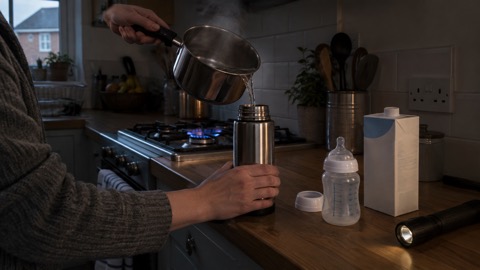 Baby Formula in a Power Cut
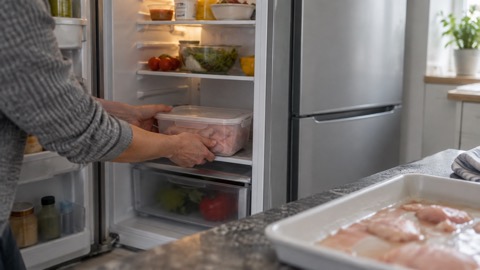 Refreezing Defrosted Meat
 Reducing Botulism Risk
 Sterilising Jars
 Spotting Spoiled Preserved Food
 Boiling Water in Glass Jars
 Mylar Bag Food Shelf Life
 Mylar Bag Sizes
 Are Mylar Bags Food Safe
 Oxygen Absorber Activation
 Silica Gel With Stored Food
 Freeze-Dried Meal Shelf Life