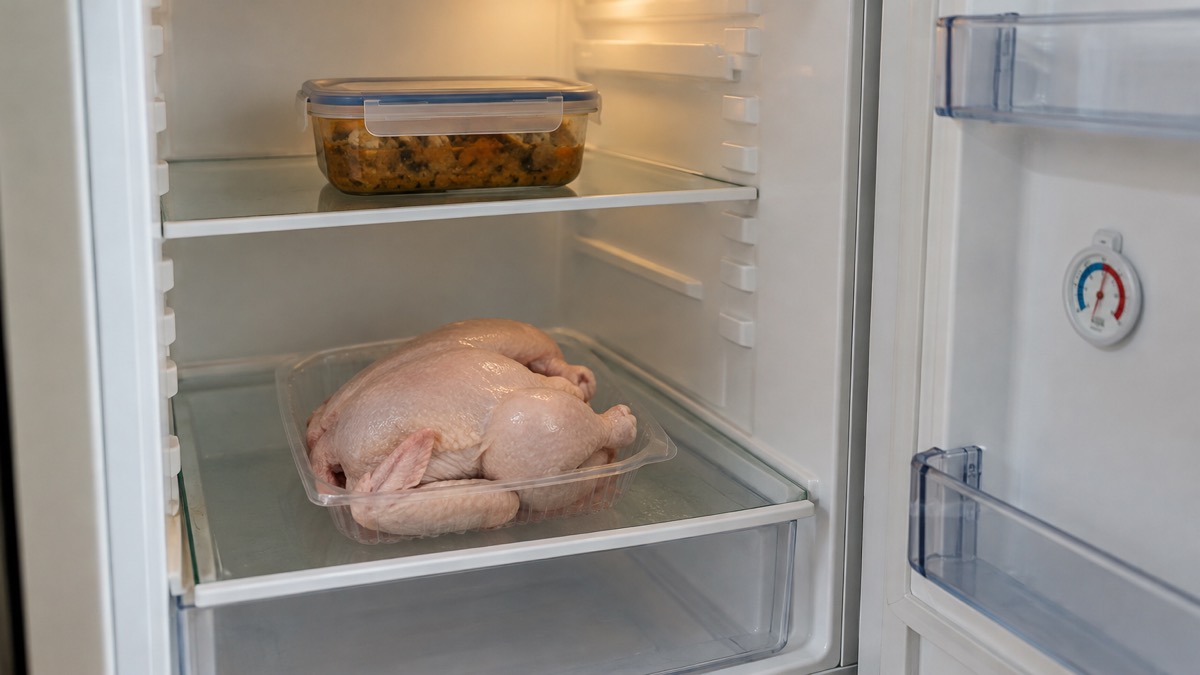
No, you should not wash raw chicken, or any other raw meat or poultry. Washing does not get rid of harmful bacteria, and it splashes them onto your hands, worktops and utensils, where they can spread to food that will be eaten without further cooking. Thorough cooking kills the bacteria that washing cannot reach1. That single rule, and a food thermometer, cover most of what separates a safe kitchen from a risky one.
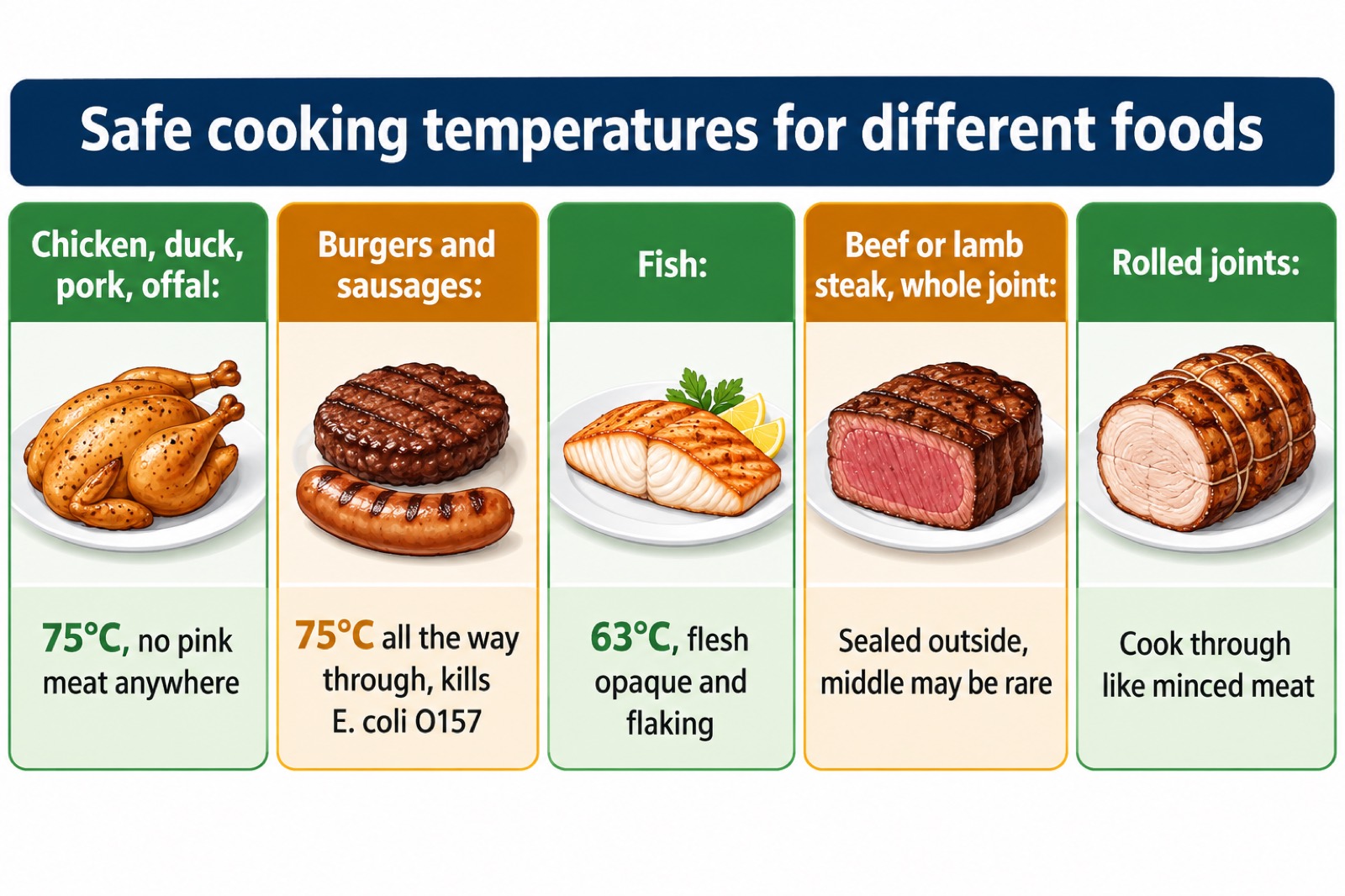
The numbers to hold on to are simple. Chicken, duck, pork, offal, and anything made from minced meat, including burgers and sausages, should be cooked through until the core reaches 75°C, with no pink meat left1. Whole cuts of beef and lamb are the exception: a steak or a whole joint (not a rolled joint) can be served rare as long as the outside has been properly sealed by cooking1. Fish is done at 63°C1. Eggs belong in the fridge, and their best-before date is set no more than 28 days after they were laid2.
This page sets out how to store, handle and cook each of these foods, why the rules differ between a steak and a burger, and what to do if someone in the household does fall ill.
Why washing raw chicken does more harm than good
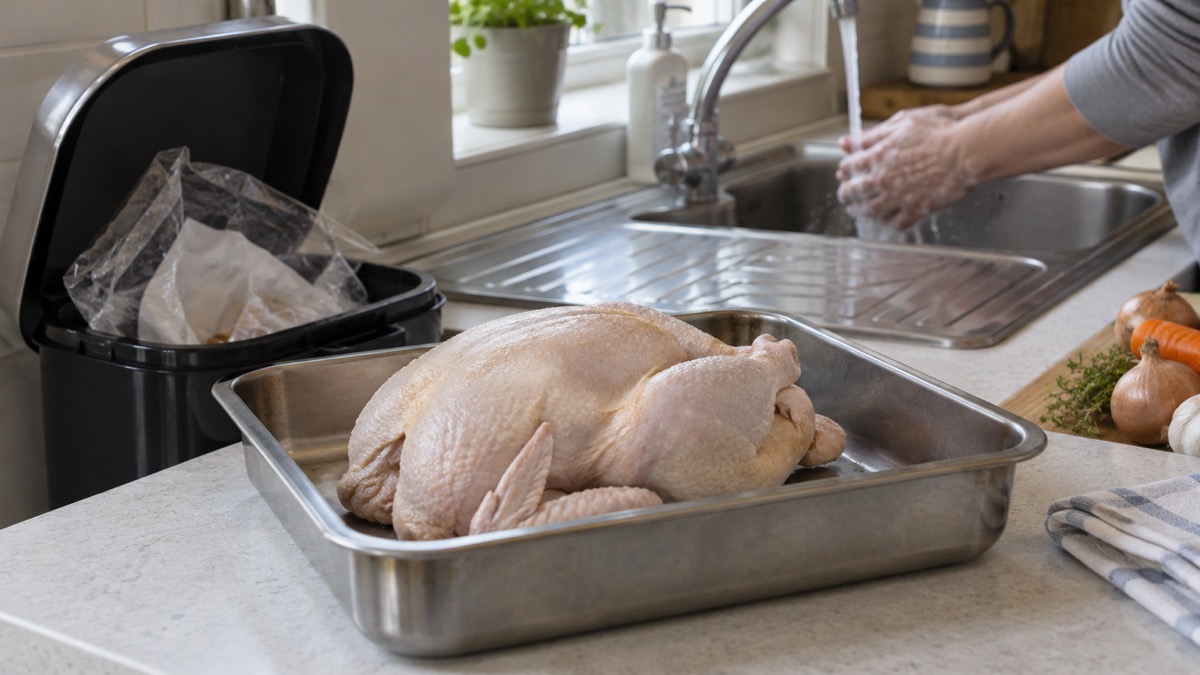
The instinct is understandable: chicken looks slippery, and rinsing feels like cleaning. But the bacteria that matter, above all campylobacter, sit on the surface and inside the bird, and a tap does nothing to them except move them. NHS inform's guidance is unambiguous: "You should never wash raw meat or poultry before cooking as this can spread bacteria around your sink, work surfaces and utensils"1. Cornwall Council's barbecue advice says the same: "never wash raw chicken or any other meat - you risk splashing germs onto your hands, utensils and worktops"4.
The reason cooking works where washing fails is temperature. As NHS inform puts it, "Washing doesn't get rid of harmful bacteria, but thoroughly cooking will kill any bacteria present"1. Water from a tap cannot reach the temperatures needed, and the splashing it creates sends invisible droplets onto surfaces, tea towels and ready-to-eat food such as bread and salad, all of which will never be cooked again to destroy what has landed on them.
The same logic applies to the rest of the washing-up routine. Wash fruit and vegetables before eating them to remove surface dirt or bacteria, but do it in a bowl of fresh water, rubbing them rather than holding them under a running tap, to reduce splashing1. Wash dishcloths and tea towels regularly, let them dry before use, and use the hot cycle of your washing machine, because dirty and damp cloths are a perfect place for bacteria to breed1. After raw or thawing meat has touched anything, clean surfaces, utensils, plates and hands thoroughly to stop bacteria spreading around the kitchen5.
Campylobacter: the bug behind most UK food poisoning
Campylobacter is the most common cause of food poisoning in the UK6. Cornwall Council's infectious disease guidance calls it "the most common cause of acute diarrhoea in adults"3, and NHS Borders notes it is found in the gut of animals and birds, with poultry the commonest meat source8. Its main sources are undercooked chicken and other meats, handling pets, cross-contamination to other foods, raw milk and contaminated water3.
Two features of campylobacter shape how you should respond if someone falls ill. First, the symptoms, stomach cramps and severe diarrhoea but rarely vomiting, can begin 2 to 10 days after eating contaminated food, though usually within 2 to 5 days3. NHS Borders gives the usual window as 2 to 7 days8. That delay means the meal people blame is often not the one that made them ill, so do not rule out a food just because it was eaten recently. Second, because germs passed on by other people, pets or farm animals cause more than half of food poisoning cases, transferred via hands and surfaces8, hand washing matters as much as cooking does.
Salmonella follows a similar pattern. The most commonly reported foods causing salmonellosis are raw meat, undercooked poultry, eggs and unpasteurised milk9. Both bacteria are killed by the same measures: thorough cooking, clean hands, and keeping raw and ready-to-eat food apart. More detail on the bugs themselves is on Salmonella, E. coli, Listeria and Other Causes of Illness.
Chicken, duck, pork and offal: 75°C, all the way through
Poultry, pork and offal share one rule: cook them through until the core temperature reaches 75°C, and never eat them pink or rare1. This is not a matter of preference. Bacteria on these meats are not confined to the surface, so searing the outside is not enough, and a food thermometer is the reliable way to check. If you do not have one, the practical checks are that the meat is steaming hot throughout, there is no pink meat visible when you cut into the thickest part, and the juices run clear10.
The 75°C figure also covers a less obvious risk in pork. Food Standards Scotland advises that whole cuts of pork, pork products and offal should be thoroughly cooked until the thickest part of the meat reaches at least 75°C with a food thermometer, because of the risk of hepatitis E12. So the same number that protects you from campylobacter and salmonella in chicken protects you from a virus in pork.
Barbecues are where this most often goes wrong, because char and heat are not the same thing. Never cook food over flames: the outside will burn while the inside stays raw and unsafe to eat1. Cook over the embers instead, and move meat around so it heats evenly. Keep hot foods hot and cold foods cold until you are ready to eat them13, and check every piece before serving: steaming hot throughout, no pink in the thickest part, clear juices10.
Beef and lamb: when rare is safe
A steak is different from a chicken breast because of where the bacteria live. On a whole cut of beef or lamb, harmful bacteria are on the outside surface, so searing that surface cooks them off even while the middle stays pink. NHS inform's rule is: "Beef and lamb steaks and whole joints (not rolled joints) can be served rare as long as the outside has been properly cooked (sealed)"1.
The exception is in the brackets. A rolled joint has had the outer surface folded inside, where the heat of a pan or oven cannot reliably reach it, so it must be treated like minced meat and cooked through. The same applies to any meat that has been pierced, skewered or tenderised in a way that could push surface bacteria into the middle. When reheating any cooked food, make sure it is steaming hot and heated all the way through1.
Burgers and sausages: minced meat must be cooked through
Mincing takes the bacteria from the surface of the meat and spreads them throughout, so a burger's pink middle is not a sealed middle. NHS inform is direct: "Always cook burgers and sausages made from these meats all the way through. This will kill harmful bacteria, including E. coli O157"1. E. coli O157 matters because it is one of the causes of serious illness from undercooked minced beef, and a small number of bacteria is enough to cause infection.
The practical standard is the same as for chicken: if possible, use a thermometer to ensure the internal temperature reaches 75°C, and make sure there is no pink meat1. At a barbecue, the Wales Ambulance Service's advice is that meat "must be cooked until it's piping hot all the way through, none of the meat is pink and the juices run clear"11, and South East Coast Ambulance's summer advice says the same13. Pre-cooking chicken in the oven and finishing it on the barbecue is a common way to combine flavour with safety, provided the final checks are still made.
Fish and shellfish: 63°C and the signs of done
Fish is cooked when it reaches 63°C, measured with a food thermometer1. If you do not have a thermometer, the signs are reliable: fish flesh turns opaque, losing its transparency, and flakes easily with a fork; prawns turn from blue-grey to pink; scallops, crab and lobster flesh becomes firm and opaque; and the shells of clams, mussels, whelks and oysters open during cooking1.
Shellfish have one further rule that decides whether they should be cooked at all. Raw shellfish should always be cooked alive, and you should never cook any shellfish if the shell does not close when handled before cooking: a shell that will not close means the animal is already dead1. After cooking, never eat any shellfish whose shell remains closed1. A closed shell after cooking means the animal was dead before it went in the pan, and dead shellfish spoil in a way heat cannot make safe.
Two cautions sit alongside this. If you choose to eat raw fish, make sure it has been frozen first, as the cold temperature will kill any parasites present1. And cold-smoked or cured fish, such as that added to cooked pasta or scrambled eggs, should be cooked first, because warming it through while preparing the meal will not heat it to a high enough temperature to kill listeria15. Because the risk of serious illness from listeriosis increases with age, older adults should eat such products by their use-by dates, keep them refrigerated below 5°C, and consider safer alternatives15.
Storing raw meat and eggs: where each belongs
Raw meat goes at the bottom of the fridge, in a sealed container, below everything else, so that nothing can drip onto ready-to-eat food3. Prepare and store raw meat and ready-to-eat food separately, and use separate shopping bags for the two on the way home1. Defrost meat and fish thoroughly before cooking, because partially defrosted food may not cook evenly and harmful bacteria may survive1. Once raw meat, fish or poultry has been defrosted, it cannot be frozen again1; more detail is on Can You Refreeze Defrosted Meat.
Eggs are best stored in the fridge, where they are kept at a constant temperature1, and Cornwall Council's advice is simply to always store eggs in the refrigerator3. Their best-before date is set at no more than 28 days after they are laid2. A best-before date is about quality: after it, the egg will still be safe to eat but its flavour, colour or texture might not be as good2. However, after this date the quality declines, and if any salmonella bacteria are present they could multiply to high levels and could make you ill2. Never eat any food past its use-by date, which is a safety deadline rather than a quality one16.
| Food | Where to store | How long |
|---|---|---|
| Raw and defrosting meat | Base of the fridge, sealed, below all other food3 | By its use-by date16 |
| Eggs | In the fridge, constant temperature1 | Best before is no more than 28 days after laying2 |
| Hard-boiled eggs | In the fridge, with or without the shell16 | Up to 2 days16 |
| Dishes containing eggs | Cooled quickly, then fridge16 | Eat within 2 days16 |
| Leftovers | Fridge1 | No longer than two days1 |
| Food with no storage instructions that goes off quickly | Fridge16 | Eat within 2 days16 |
Freezing and keeping eggs
Eggs can be frozen, but not in their shells. You can freeze boiled eggs, and raw eggs that have been removed from their shells1. To freeze whole eggs, beat them until blended and pour them into freezer containers that can be sealed tightly16. Frozen egg, like defrosted meat, should be used in fully cooked dishes rather than anything lightly cooked.
Freezers themselves hold safety in a power cut. Food in your freezer should stay frozen for up to 48 hours in a full freezer, or 24 hours if it is half full, as long as the door stays closed17. Chilled food is more vulnerable: if the fridge temperature has reached 8°C or above, foods needing refrigeration should be discarded after 4 hours unless power is restored within that time17. The two sources in the pack give slightly different figures for how long food keeps in the fridge during a cut, 4 to 6 hours if you avoid opening the door, so treat that as an outside limit and rely on the 8°C and 4-hour rule for deciding what to throw away17. Fridge and freezer thermometers are covered on Fridge and Freezer Temperatures and Thermometers.
Keeping raw and ready-to-eat food apart
Cross-contamination is how bacteria travel from raw food to food that will be eaten without cooking, and every measure in this section exists to break that path. NHS inform's list of what to do covers storage, preparation and shopping1:
- Keep raw meat and unwashed vegetables separate from ready-to-eat foods during storage and preparation1
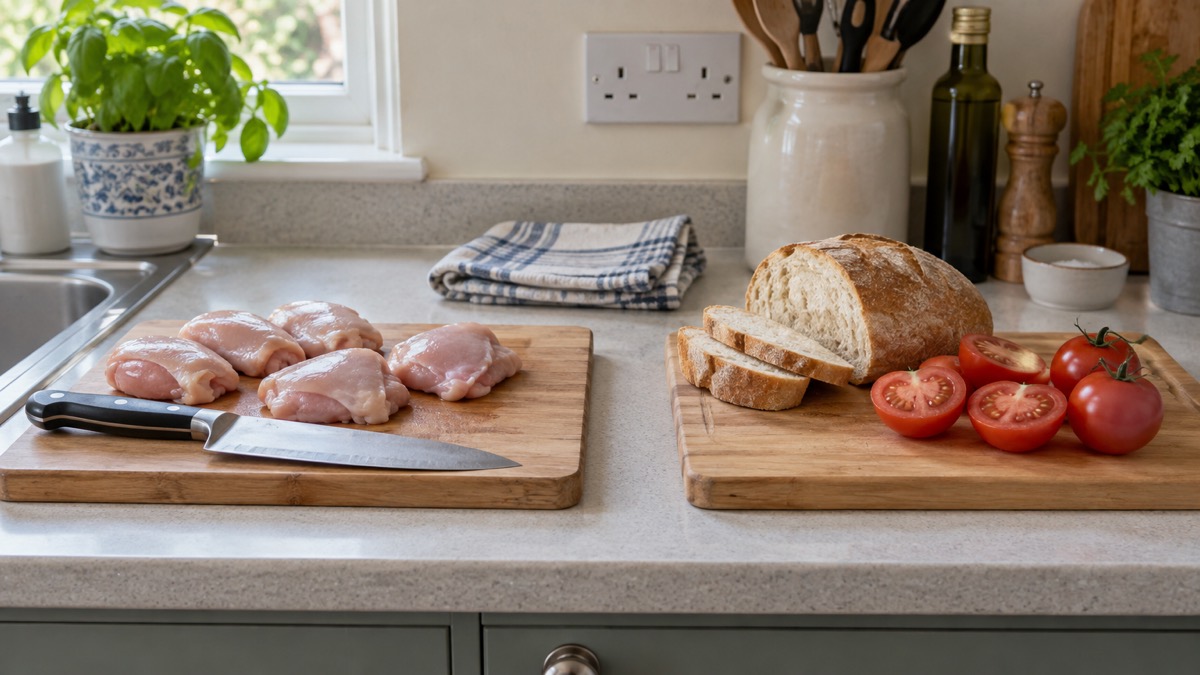
- Use different chopping boards, plates and utensils for raw and cooked food, or wash them thoroughly between uses1
- Wash hands, worktops and utensils thoroughly after touching raw meat, poultry, fish and eggs1
- Keep raw meat in a sealed container at the bottom of the fridge1
- Never wash raw meat1
- Use separate shopping bags for raw and ready-to-eat foods1
Wash your hands before you prepare, cook or eat food; after handling raw food such as raw meat, uncooked eggs and unwashed fruit and vegetables; and after touching the bin, going to the toilet, blowing your nose or touching your pets1. Northumberland Council's guidance adds the same rule in its own words: wash hands well before handling food and always after handling raw meat, going to the toilet, blowing your nose or handling animals including pets18. During a 2023 rise in salmonella cases linked to poultry products imported from Poland, Food Standards Scotland repeated the core advice: never wash raw poultry products, and clean all surfaces and utensils with hot, soapy water after contact with raw poultry9.
Pets are part of this picture, not a separate one. Handling pets is a main source of campylobacter3, and germs passed on by other people, pets or farm animals cause more than half of food poisoning cases8. Raw pet food deserves the same treatment as raw meat for humans: in 2020, Benyfit Natural recalled several types of frozen raw dog food containing beef because the products might contain salmonella, and the advice issued with that recall was to wash hands thoroughly after handling raw pet food, bowls, utensils or after contact with the faeces of animals19. Food is recalled for contamination with pathogens like listeria or salmonella, or because of manufacturing faults such as plastic or metal being found in the product20, so it is worth checking recall notices if you feed raw pet food.
Food poisoning: symptoms, timing and when to get help
Food poisoning is an illness caused by eating contaminated food6. Symptoms usually begin within 1 to 2 days of eating contaminated food, but they can also start a few hours later or several weeks later6. The symptoms include nausea, diarrhoea which may contain blood or mucus, lack of energy and weakness, loss of appetite, a fever of 38C or above, aching muscles and chills6. Shropshire Council's summary of the most common ones is diarrhoea, sickness, stomach pains and sometimes high temperature or fever7, and Cornwall Council adds stomach cramps, vomiting, fever, nausea, headache and dizziness3. Symptoms may last for only a day or continue for one or two weeks7.
Most cases pass with rest and fluids, but some need medical attention. NHS inform says to seek help if there are symptoms of severe dehydration, if the person is vomiting constantly and unable to keep down fluids, if there is bloody diarrhoea, if diarrhoea lasts more than 7 days or vomiting more than 2 days, if the person has returned from a part of the world with poor sanitation in the past few weeks, or if they have kidney disease, inflammatory bowel disease or a weak immune system and develop diarrhoea and vomiting6. Full detail is on Food Poisoning: Symptoms, Who Is at Risk and When to Get Help.
If you think you have food poisoning, visit your doctor as soon as possible; they might ask you to submit a sample for examination, or you can request to submit one18. Where a bacteria or parasite is responsible, food poisoning is normally diagnosed once a patient has provided a faecal sample to their doctor or at a hospital, which is then tested at a laboratory7. Reporting the illness helps environmental health teams trace outbreaks; see Reporting Food Poisoning or a Food Problem to Your Council.
Eggs, vulnerable groups and a note on imported eggs
Thoroughly cooked eggs, handled hygienically, should not present a food safety risk21. The caution applies to raw or lightly cooked eggs, such as in homemade mayonnaise or soft mousse, and it is strongest for vulnerable groups. Infants, young children, pregnant people and older adults should only eat raw or lightly cooked eggs if they are produced in the UK and are part of a recognised assurance scheme21. Cornwall Council's advice is to exercise caution with food containing raw egg, particularly for vulnerable groups or those who are immunocompromised3.
Imported eggs have been the subject of specific warnings. In 2026, Food Standards Scotland and the Food Standards Agency warned consumers and businesses not to eat or sell certain eggs imported from Ukraine, with the notice covering all best-before dates21. The lesson for an ordinary household is to check where eggs come from and to watch for food alerts, which are published when a product is withdrawn or recalled20. How long stored food keeps in general is covered on Shelf Life, Use By and Best Before Dates Explained.
Sources (21)
- Preparing and cooking food safely, NHS inform, 2025-02-21
- Use by and best before dates, Food Standards Scotland, 2026-10-25
- Infectious diseases, Cornwall Council, 2026-10-29
- Stay safe this summer, Cornwall Council, 2026-08-07
- Chilling, Food Standards Scotland, 2026-10-25
- Food poisoning, NHS inform, 2026-08-17
- Food poisoning and waterborne infections, Shropshire Council, 2026-10-29
- Food poisoning, NHS Borders, 2014-06
- Salmonella linked to poultry products imported from Poland, Food Standards Scotland, 2023-12-06
- Hot weather advice, NHS Central and East London Integrated Care Board, 2026-08-04
- BBQ and food safety, Welsh Ambulance Service, 2026-10-29
- Foodborne viruses, Food Standards Scotland, 2026-10-25
- Stay safe and cool in the sun, South East Coast Ambulance Service, 2021-07-14
- Summer health campaign, NHS inform, 2026-08-06
- Listeria, Food Standards Scotland, 2026-10-25
- Food storage, Food Standards Scotland, 2026-10-25
- Food safety in a power cut: advice for consumers, GOV.UK, 2023-07-26
- Infectious diseases control, Northumberland Council, 2026-10-28
- Benyfit Natural Pet Food recall of frozen raw dog food, Food Standards Agency, 2020-07-13
- Recalls and alerts, GOV.UK, 2026-07-07
- FSS and FSA warning on certain eggs imported from Ukraine, Food Standards Scotland, 2026-10-10
 Long-Term Storage Kit Checklist
 Store Cupboard Checklist
 30-Day Household Checklist
 How Much Emergency Food to Store
 What to Store in an Emergency
 Starting a Store Cupboard
 Shelf Life and Date Labels
 Rotating Your Food Store
 Long-Term Storage Conditions
 Meals Without Power
 Self-Heating Meals
 Tinned Food Guide
 Rice, Pasta and Pulses Storage
 Freeze-Dried Meals
 Emergency Ration Packs