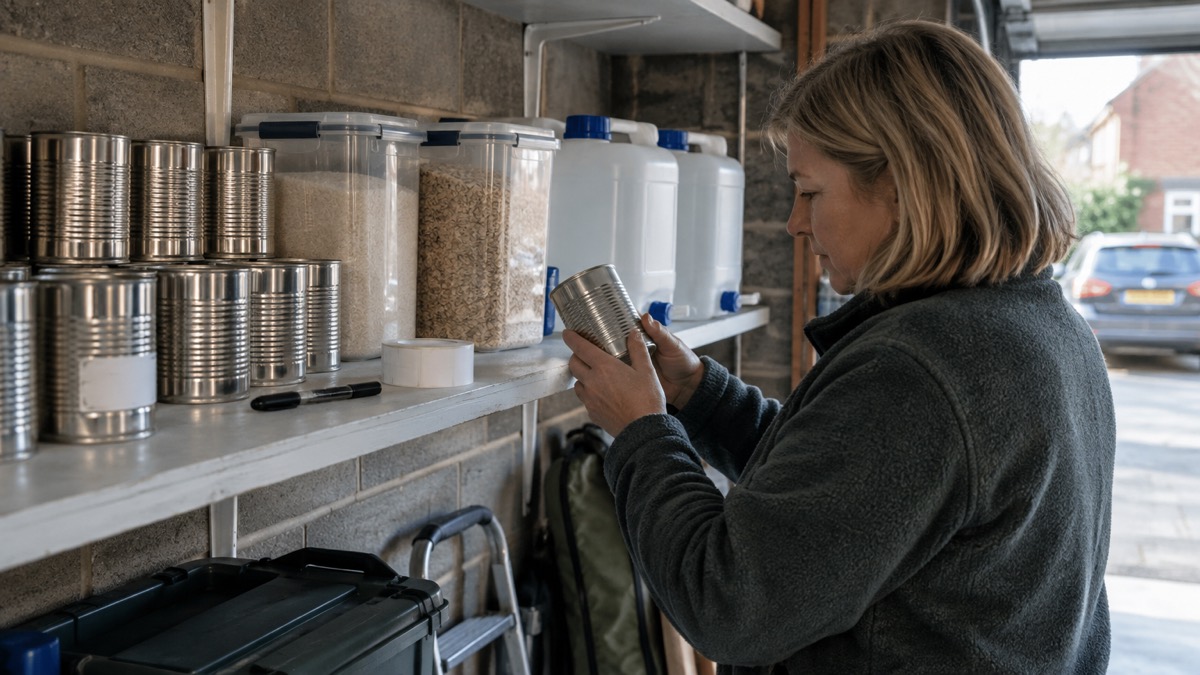
A long-term food store is not a single purchase. It is a small working system: food that keeps, containers that protect it, water to go with it, and a habit of checking dates so nothing sits forgotten at the back of a cupboard. The government's Be Ready campaign keeps the baseline modest: non-perishable food for 3 days, with a long shelf life and no need for refrigeration or cooking, and it is best to buy food you would usually eat1.
Build outwards from that. Store at least a three-day supply of non-perishable food, choose foods that need no refrigeration, preparation or cooking and little or no water, and keep them compact and lightweight2. Add at least 3 days' worth of bottled water at 3 litres per person per day3. Then add the things that make the store usable: a manual tin opener, containers and bags, labels, and food for anyone in the house with particular needs.
The checklist below is the kit itself. The sections after it explain why each item earns its place, how to store food so it stays safe, and how to rotate the store so it feeds you rather than going to waste.
The long-term food storage kit checklist
Work through this list once, then keep it as the reference for what goes into the store and what gets replaced. Each line says what the item does for the household.
Why each item on the list matters
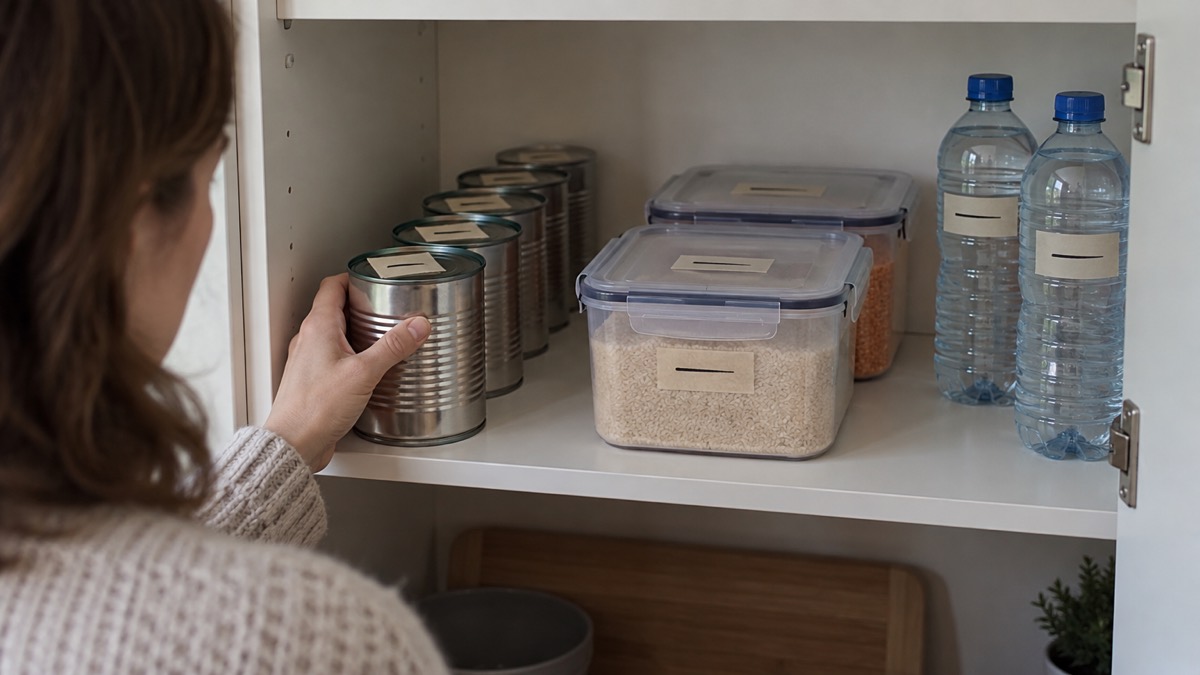
The list looks modest because it is designed to be. Official guidance is consistent that a household needs days, not months, of food set aside, and that the store should be made of things you would eat anyway. The Be Ready campaign asks for non-perishable food for 3 days, food with a long shelf life that does not need refrigeration or cooking, and says it is best to buy food you would usually eat1. A Scottish Borders council checklist puts the same idea in practical terms: have a store of three days food you can eat in a power cut, such as tins whose contents you can heat on a gas stove13.
Each category on the checklist does a different job:
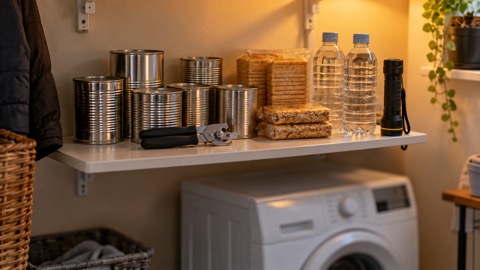
- Tins and dry staples carry the bulk of the calories and keep for a long time without power. Tinned food can be eaten without heating through, which is why official power-cut guidance says to eat perishable food first and save tinned food for later5.
- No-cook food covers the case where you cannot heat anything at all. Official advice is to make sure there is something available to eat that does not require electricity or heat preparation14.
- Water is stored separately from food because it has its own replacement cycle and its own quantity rule3.
- Containers and labels are what stop the store degrading. Sealed bags and containers keep food fresh and keep contaminants out8.
- Food for babies, pets and special diets is on the list because a store that does not feed everyone in the house is not a store. Official guidance names ready-made baby formula and pet food as part of a power-cut kit3.
The reason to buy food you already eat is rotation. A store of unfamiliar food gets ignored until it is out of date; a store of food you cook with gets used and replaced without effort. If you are starting from nothing, the step-by-step approach on starting a store cupboard supply and the emergency store cupboard checklist take the same list in a different order.
Storing food so it stays safe to eat
Where and how you keep the food decides how long it lasts. Tinned foods should be kept in a dry place where the temperature is fairly cool, and boxed food should go into tightly closed plastic or metal containers to protect it from pests4. Cupboard and pantry food is best kept in sealed bags or containers, which keeps it fresh and stops anything falling into the food by accident8. Frozen food needs the same care in reverse: always store frozen foods in airtight containers or freezer bags, because the cold air will cause food to dry out9.
Read the label before you store anything. Storage instructions on the label should be followed to keep the food safe, for example "store in a refrigerator"7. That matters most for food that is meant to be chilled, which should not be moved into a cupboard store.
Flooding is the main way a well-built store is lost. Food in water-resistant packaging such as metal cans, sealed pouches and tetra packs can be kept if it is not damaged, but the outside of the packaging will need to be cleaned and sanitised first to avoid cross-contamination15. Anything that has been in contact with floodwater and is not in water-resistant packaging should go. If your area floods, the guidance on where to keep an emergency store if your area floods is worth reading before you choose a shelf.
Keeping the store ready: checking and rotating
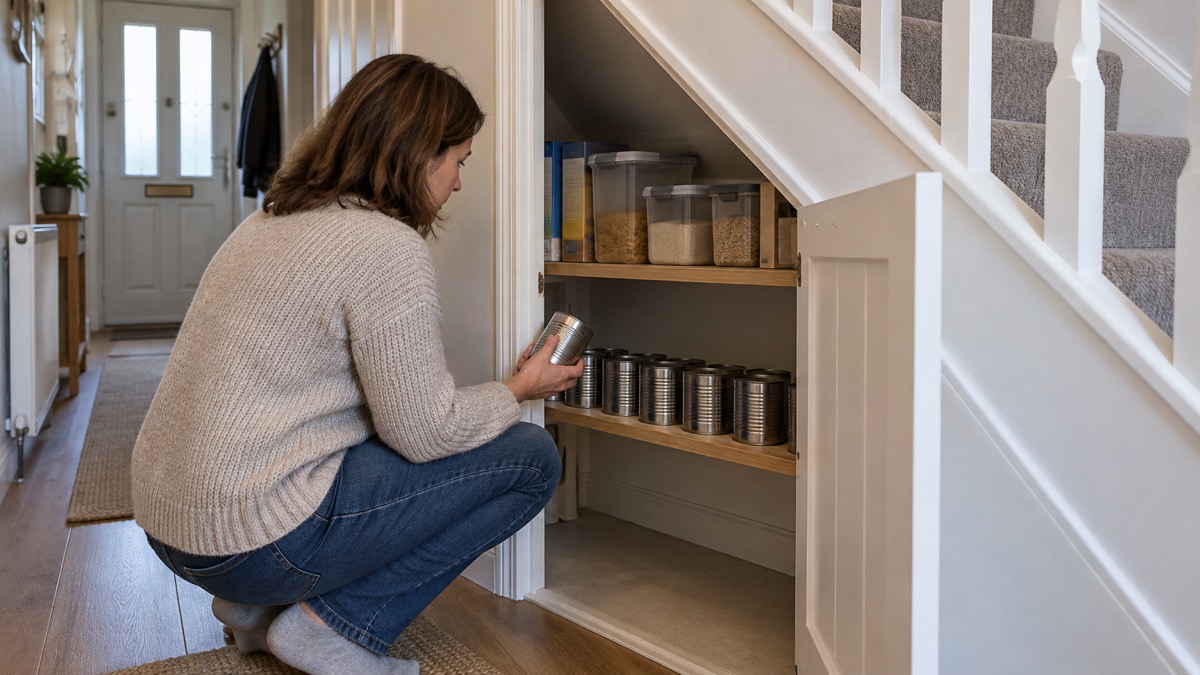
A store is only useful if you know what is in it and when it needs replacing. The simplest system is to date everything as it goes in and to eat from the front. Bottled water is the clearest example: it must be replaced every six months4. Write the month on each bottle and swap it out when you do the household shop.
Some dates are about safety and some are about quality, and the difference decides what you can keep. A use-by date is about safety: even if food looks and smells fine, it should not be eaten past its use-by date, because it might contain harmful bugs that could make you sick7. A best-before date is about quality: after this date the food will be safe to eat but its flavour, colour or texture might not be as good7. Food that is normally stored at room temperature will continue to be safe to eat as you usually would, even if the best-before date has passed5. The full explanation is on shelf life, use by and best before dates.
A rotation routine that takes minutes:
- Check the dates on tins, packets and bottles each time you shop, and move anything close to its date to the front of the cupboard.
- Replace bottled water every six months4.
- Use the store in ordinary cooking so that food cycles through rather than sitting.
- Check on others. If you have neighbours or relatives who are older or vulnerable, check they have stocks of food and medicine so they do not need to go out during very cold weather12.
- Keep the store small enough to see. A small supply of long-life food, drinking water, toiletries and prescription medicines is what official guidance suggests; you do not need to stockpile food or medicines16.
Food safety when the power goes
The store exists partly for the day the power fails, and that is when food safety rules tighten. If a power cut has affected your home and you have no electricity supply, it is important to continue to store and prepare food safely17. The good news is that a short outage is manageable: a power outage of less than 4 hours is unlikely to impact the safety of food in chilled or frozen storage5. Your fridge should keep food at a safe temperature for up to four hours, provided you keep the door closed5.
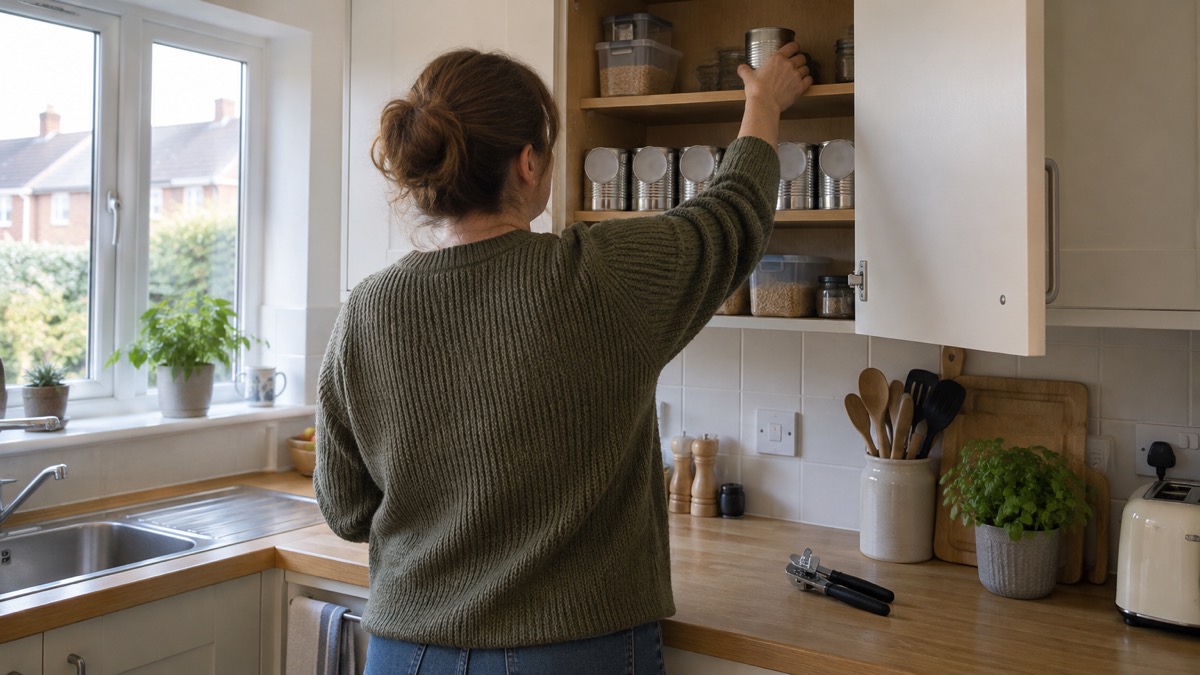
Eat in the right order so the most perishable food is used first. Official guidance is to use foods in this order: foods that need refrigeration, then defrosted frozen food that does not need cooking, then room-temperature perishable food, then room-temperature canned, bottled and dried food5. Food normally stored at ambient temperature will continue to be safe to eat, and some foods such as tinned foods will be safe to eat without heating through; eat these after perishable foods that require chilled storage5.
If the weather is cold, below 8°C, you can store food outside, in clean dry conditions, out of direct sunlight, protected from animals, in a sealed box to prevent contamination and tampering5. Do not put food outside in milder weather.
For meals that need no power at all, see meals without power. For the wider household picture during an outage, the power cuts guide covers lighting, heating and staying in touch.
Water, babies, pets and special diets
The store has to feed everyone in the house, and that means planning beyond the standard list.
Water. Keep at least 3 days' worth of bottled water at 3 litres per person per day3. Children, nursing mothers and people who are unwell will need more2. If you ever need to boil water, it needs only to be brought to the boil, and it can then be stored in a covered container in the fridge for up to 48 hours18. The water section covers storage and treatment in more detail.
Babies. Include ready-made baby formula in the kit3. Prepare a flask of hot water to heat bottles and baby food; it is always safer to make up a fresh feed, and when this is not possible, feeds should never be stored for longer than 24 hours10. The narrow guide to making up baby formula in a power cut takes this further.
Pets. Keep pet food and bottled water for pets1. Official guidance on how much varies: some councils suggest a couple of days' supply of food, ideally tinned or long lasting19, others a week's worth of food, water, medication and cat litter20, and Birmingham City Council suggests at least 3 days' supply of pet food and water stored in waterproof containers11. Storing a week covers all of these. The pets and animals section covers the wider kit.
Special diets. Include food for infants and for people on special diets in the emergency kit4. If someone in the house has a medical, religious or allergy-related diet, build the store around the food they already eat and can safely eat, and check dates on those items as carefully as any other. The guide to emergency food for medical, religious and allergy diets sets out the detail.
Where to get help and what to do next
Start with what you already have. Look in the cupboard, pick out the tins and dry goods you would eat anyway, and put them together in one place with their dates facing out. Add bottled water at 3 litres per person per day for three days3, a manual tin opener, and a few sealed containers8. That is the core of the store, and it can be built over a few shopping trips rather than in one.
If money or access is tight, help exists. The getting emergency food help page covers food banks, councils and local support, and how to get a food bank voucher referral explains the referral route. Households with young children may qualify for the Healthy Start scheme, covered on the Healthy Start scheme.
For the wider household kit that the food store sits inside, see the emergency kit section and getting started. For how much to store per person, the how much emergency food to store page takes the three-day baseline and scales it. And for the detail on containers, absorbers and bags for dry staples, see mylar bags and oxygen absorbers.
Sources (20)
- Be ready for emergencies, UK Government, 2026
- Create a flood pack, Bradford Council, 2026
- Power cuts, UK Government, 2026
- Emergency supplies kit, Denbighshire County Council, 2020
- Food safety in a power cut, Food Standards Scotland, 2023
- Stay warm and nourished, NHS Norfolk and Suffolk ICB, 2026
- Use-by and best-before dates, Food Standards Scotland, 2026
- Food storage, Food Standards Scotland, 2026
- Preparing and cooking food safely, NHS Inform, 2025
- Strong winds and heavy rain warning, nidirect, 2026
- Are you ready, Birmingham City Council, 2026
- Keeping warm and well during winter, Lancashire County Council, 2026
- Prepared personal resilience, Scottish Borders Council, 2026
- 12 tips to prepare for a power cut, Horsted Keynes Parish Council, 2026
- Flooding, Food Standards Scotland, 2026
- Be prepared for winter emergencies, NHS Norfolk and Suffolk ICB, 2026
- Strong winds weather warning, nidirect, 2026
- Private water supplies, Argyll and Bute Council, 2026
- Your pets, Wiltshire and Swindon Prepared, 2026
- Your pets, Slough Borough Council, 2026
 Store Cupboard Checklist
 30-Day Household Checklist
 Emergency Plan Template