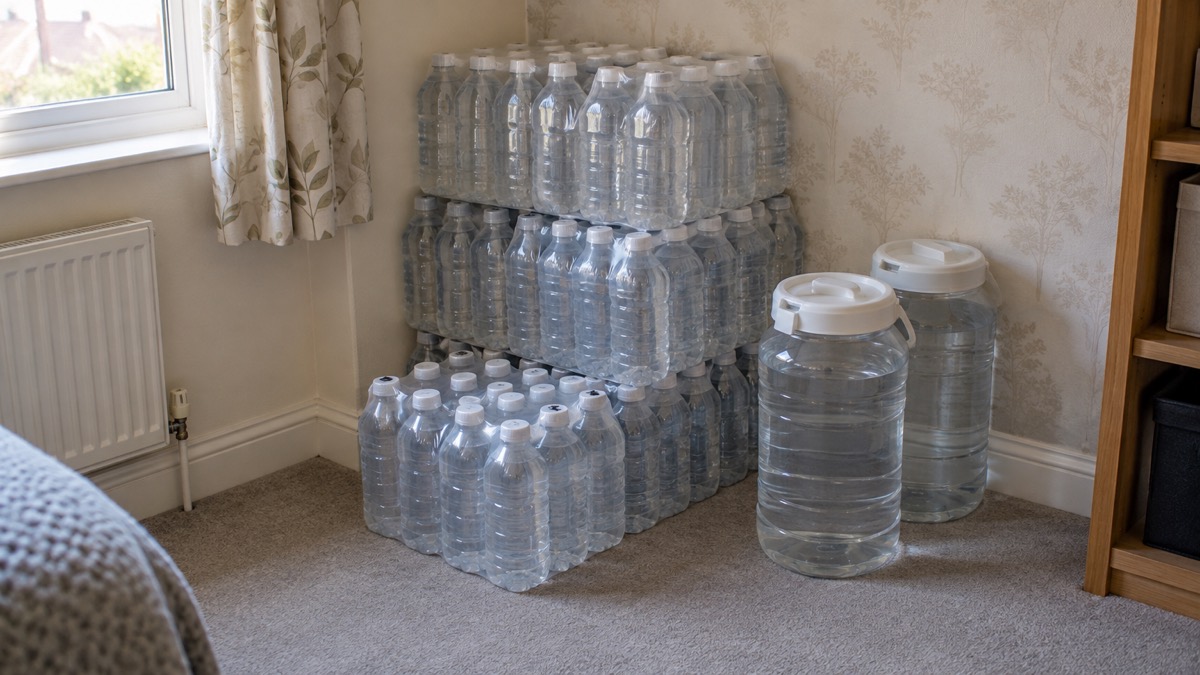
If the taps stop, the first question is how much water your household needs to get through. The UK government's Be Ready household plan says to keep bottled water at 3 litres per person per day for at least 3 days1. That figure is for drinking; the same guidance says more would be needed for other tasks such as cooking and washing2. Work out your household's daily drinking need from that 3 litres per person, then add extra for cooking and washing.
The second question is whether that water will still be safe when you reach for it. Bottled water has a best before date and should be replaced regularly, and the Be Ready checklist asks households to set a reminder every six months to check expiry dates and swap out items that need replacing3. Store bottles in plastic, keep them out of sunlight, and treat your store as something you rotate rather than something you fill once and forget.
The third question is what happens if the outage runs longer than your store. Your water company may bring bottled water or tankers, and if you are on the Priority Services Register they will arrange alternative supplies for you during an interruption4. But they cannot always do so, so the store at home is the part you control. This checklist sets out what to keep, how to keep it fit to drink, and what to do when the supply fails.
The emergency water checklist
Work through this list once, then diarise the six-month check. Each item says why it earns its place.
How much water to store, and why the figures differ
The headline figure of 3 litres per person per day for at least 3 days appears in the Be Ready household plan and in the power cuts guidance, which asks for 3 days' worth of bottled water at 3 litres per person per day1. Lancashire's emergency pack guidance simply says enough food and bottled drinking water to last three days11. Nottinghamshire's advice is to keep bottled water and change it regularly as noted on best before dates12.
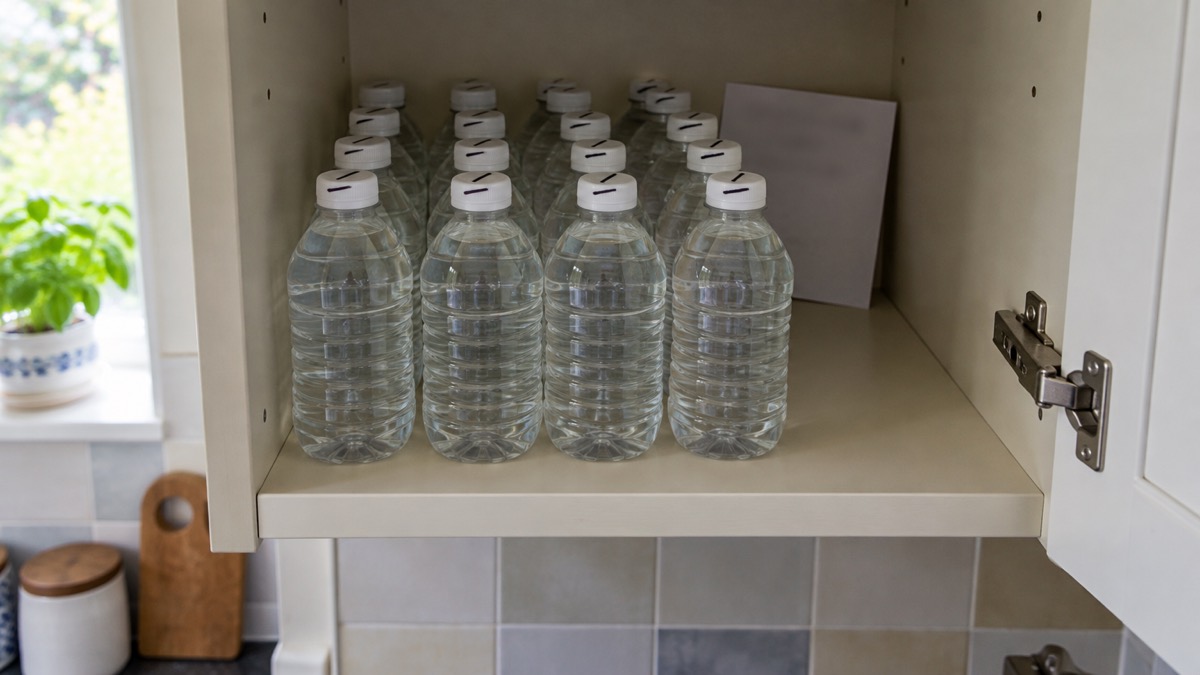
Other official documents give slightly different numbers, and it is worth knowing why. North Devon's guidance cites the World Health Organisation's minimum of 2.5 to 3 litres of drinking water per person per day for survival, and adds that 10 litres per person per day will make you more comfortable by also providing for basic cooking and hygiene needs5. Greater Manchester's resilience advice gives the same 2.5 to 3 litre survival range and the 10 litre comfort figure7. Dumfries and Galloway's household plan asks for 2.5 litres of bottled water per person for each day13. Birmingham's guidance splits it: at least 2 litres per person per day for drinking, and at least 3 litres per person per day for cooking and washing14.
The documents do not contradict each other so much as answer different questions. The 2.5 to 3 litre range is the survival minimum; 3 litres is the figure the national campaign asks households to store; 10 litres is what comfort looks like once cooking and hygiene are included. For a household plan, store to the national figure of 3 litres per person per day for three days, then add the extra you would want for cooking, washing, pets and any medical need. If you want the arithmetic worked through for your own household size, see how much drinking water to store per person.
| Source | Drinking water per person per day | Period or note |
|---|---|---|
| Be Ready household plan | 3 litres | At least 3 days1 |
| Be Ready power cuts guidance | 3 litres | At least 3 days10 |
| North Devon and Greater Manchester | 2.5 to 3 litres | Survival minimum5 |
| North Devon and Greater Manchester | 10 litres | Comfort, including cooking and hygiene5 |
| Dumfries and Galloway | 2.5 litres | Per day13 |
| Birmingham | 2 litres drinking, 3 litres cooking and washing | Per day14 |
Bottled water must be replaced every six months
Bottled water is a foodstuff with a date on it, and official guidance treats it that way. Denbighshire's emergency supplies guidance says bottled water will have to be replaced every six months13. The Be Ready checklist asks households to set a reminder every six months to check expiry dates and swap out items that need replacing, or update the kit if circumstances change3. Nottinghamshire's advice is to change bottled water regularly as noted on best before dates12.
Six months is also the rhythm the Drinking Water Inspectorate recommends for inspecting a private supply storage tank, at least annually and preferably every six months15. The two checks belong together: one afternoon, twice a year, you look at the bottles and the tank.
What goes wrong if you skip it is not dramatic, but it matters. Water past its date is not automatically unsafe, but you have lost the assurance the date gave you, and you may be relying on it in the worst week of the year. Opened bottles are a different matter: once a bottle has been opened and drunk from, it is no longer a sealed store.
Bottled water and baby formula: use tap water where you can
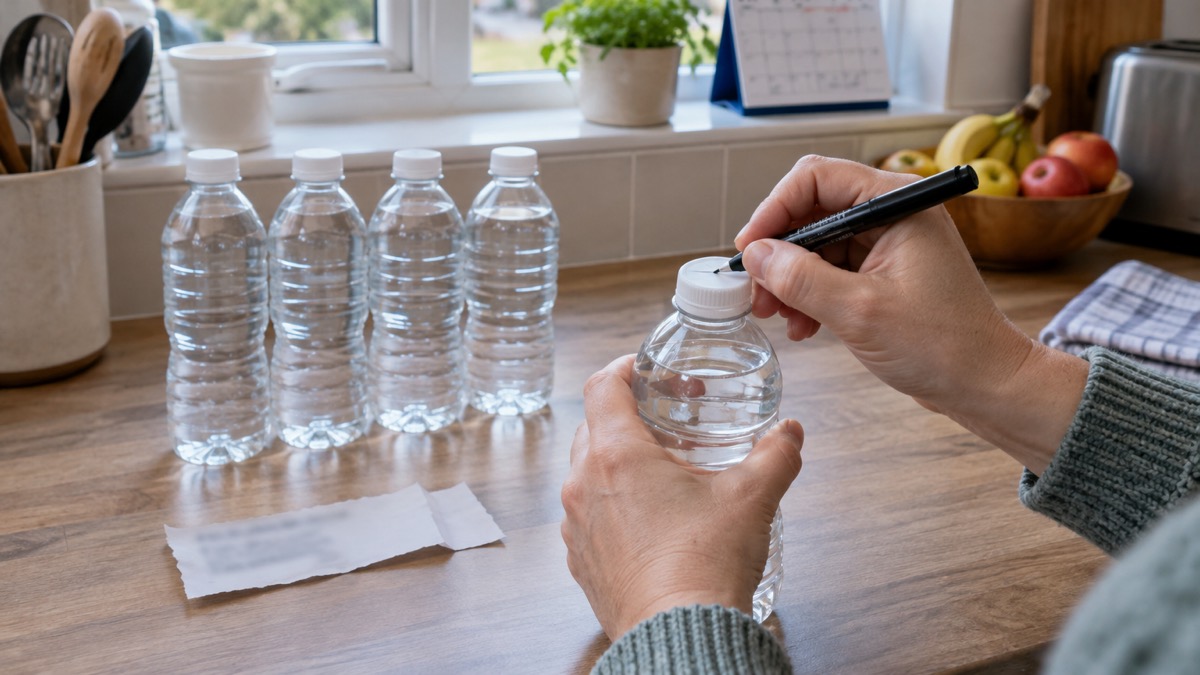
Baby formula is the part of water storage where the official advice is most specific, and it is easy to get wrong. The NHS recommends that you do not use bottled water for making formula feed for babies, because it is not sterile and may contain too much salt (sodium) or sulphate16. The Prepare campaign says the same: bottled water is not usually recommended for making up formula milk feeds, but in rare circumstances, such as when drinking water is unavailable or has been contaminated, you can use still bottled water8.
So the order of preference is clear. Use tap water where you can, and only use the cold tap for drinking, cooking and making infant formula17. If you have no tap water, ready-made or ready-to-feed formula is the safest option10. If you cannot boil water to prepare formula safely, try to use ready-to-use baby formula7. The Be Ready checklist lists ready-made or ready-to-feed formula as best, as you may not be able to boil water to make up powdered formula safely2.
If you have no gas or electricity to allow boiling, official flood guidance says you can use unboiled bottled water (table, spring or mineral water) to make a baby feed, but you must give the feed to the baby immediately18. Runnymede's flooding aftercare advice adds that if boiling is not possible and ready-to-feed liquid formula is not available, bottled water can be used without boiling, but the prepared feed should then be used immediately19.
For households with a baby, the practical checklist item is a stock of ready-to-feed formula, not a stock of bottled water for mixing. Wiltshire and Swindon's guidance makes the point that keeping some water readily available is essential for families feeding a baby formula milk21. More detail on feeds during an interruption is in babies and formula feeds when the supply is off or unsafe.
Larger home storage: what makes a tank safe for drinking water
Bottles are the simple store. A tank is the larger one, and it has its own rules. The Drinking Water Inspectorate's consumer guidance says that if your tank is storage for drinking water, it is recommended that you check annually for the condition of the tank and the quality of the water22. It also says a tank should not be too large, so the water in it is frequently replenished with fresh water, and that 250 litres is quite sufficient for most homes22.
Size is a safety question, not just a convenience one. The Inspectorate's guidance on private supply networks says the tank or reservoir should hold a volume sufficient to accommodate peak demand and the maximum period of interruption of supply, but must not be so large that water is allowed to remain static for lengthy periods15. Water that sits still for months is water you have to think about.
The physical requirements are straightforward. Storage tanks should have watertight walls and lids23. Periodic visual checks should make sure there has not been a build-up of scale or deposits on the tank floor and that the lid and screens are securely in place22. Tanks should be covered to reduce evaporation, which also reduces the risk of contamination of your supply24. Modern tanks are constructed of plastic (polyethylene) and are unlikely to cause problems provided they are designed for drinking water purposes and have a close-fitting cover22. Check the instructions supplied with the tank, as they should contain details of how to maintain and clean it22.
| What to check | Why it matters |
|---|---|
| Designed for drinking water | General purpose tanks are not made to the same standard22 |
| Watertight walls and close-fitting lid | Keeps contamination and animals out23 |
| Not oversized | Water should be replenished, not left static25 |
| Annual condition and water quality check | The Inspectorate's recommended frequency22 |
| No scale or deposits on the floor | A sign the tank needs cleaning22 |
| Covered | Reduces evaporation and contamination risk24 |
If you are weighing up a tank against bottles, the comparison is set out in storage tank or bottled supplies, and the tank subject has its own guide at household storage tanks for drinking supplies.
Mains-connected tanks, landlords and WRAS approval
A tank fed from the mains is plumbing, and plumbing that carries drinking water is regulated. The Drinking Water Inspectorate says the requirements for landlords are set out in BSEN 806-5, "Specification for installations inside buildings conveying water for human consumption: operation and maintenance", and BS 8558, the associated guidance document22. If you rent, that is the standard your landlord is working to; if you own, it is the standard a competent plumber should be working to.
WRAS approval is the phrase you will see on fittings and materials. The Inspectorate's guidance on rainwater harvesting says approved materials, WRAS or permitted under regulation 5, should be used to prevent contamination of rainwater during runoff and collection26. In plain terms, it is a mark that a material is accepted for contact with drinking water. It is not a guarantee that a whole system has been installed or maintained correctly, which is why the inspection and cleaning routine still matters.
For private supplies, wells, boreholes and springs, the rules and the checks are different again, and they are covered in private supplies: wells, boreholes and springs.
When the supply fails: bottled water from your water company
When the taps go off, your first move is to follow advice from the water company, keep bottled water available, check your water supplier's website for information and updates, follow the instructions of the emergency services and your local authority, and make yourself known to your local authority if you are vulnerable or have additional needs for water28. That single piece of local authority guidance covers most of what a household needs to do in the first hours.
The Priority Services Register is the mechanism for households that need extra help. If you are eligible, sign up to your water supplier's Priority Service Register to let them know that you need additional support, including when there is an interruption to your supply4. If you are on the register, your water company will arrange alternative supplies for you during an outage4. To join, find out who your water supplier is and ring them; they will add you to the register21.
Do not assume a delivery is guaranteed. The Inspectorate warns that water companies may not always be able to provide an emergency supply of water in bowsers or in bottles, for example if they have their own ongoing emergency such as a burst main25. That is the reason for keeping your own store: it covers the gap between the supply failing and alternative supplies arriving.
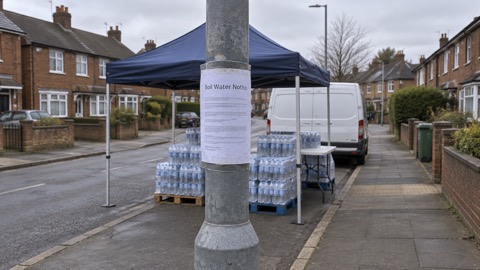
Outages can run longer than a day. In December 2022 a freeze-thaw event caused widespread water supply interruptions in Wales and Herefordshire, with over 15,000 customers losing supply and over 10,000 off for two days or more29. In 2022 some Blackburn and Darwen customers were left without water for over 24 hours, and bottled water collection points were set up with the local council at football clubs, supermarkets and other locations30. The practical lesson is to know where your nearest bottled water station would be, and to check on neighbours who might need help collecting water27.
Keeping the store ready: rotation, records and the six-month check
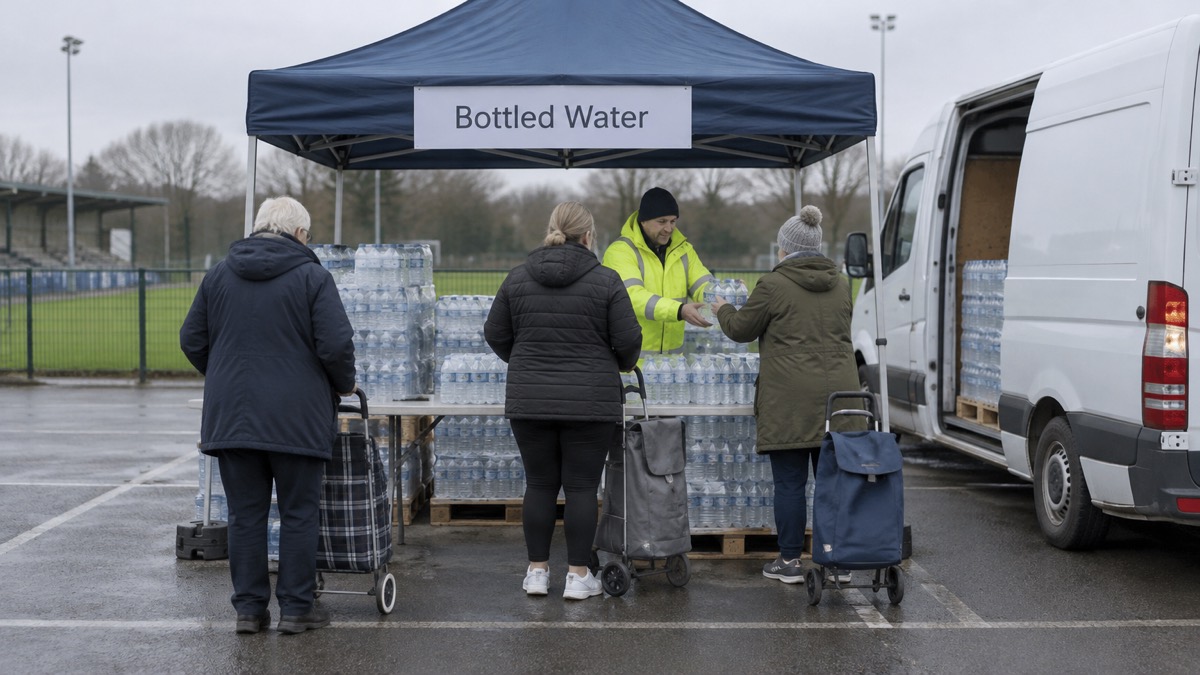
A store is only useful if you can find it, carry it and trust it. Keep the bottles somewhere cool and out of direct sunlight, in plastic containers such as soft drink bottles rather than glass or milk cartons, which the official guidance warns against because they decompose or break6. Keep a note of what you have and when it was bought, so the six-month check is a five-minute job rather than an excavation.
The wider household plan matters too. The Be Ready household plan asks you to record the utility shut off locations: the water stop cock, gas isolation valve and electricity isolation switch1. Knowing where the stop cock is means you can act quickly if a pipe bursts during an outage, and it is the kind of detail that is useless if you have to look it up in the dark.
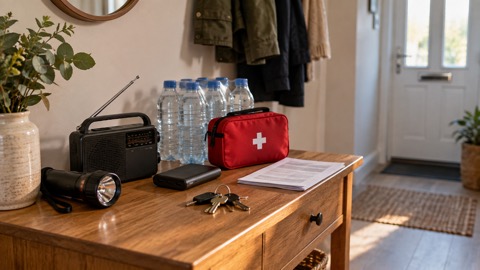
Finally, treat the water store as part of the household's wider emergency kit rather than a standalone project. The emergency kit guide covers food, lighting and power, and the supply interruption checklist walks through what to do on the day. The water section has the full set of guides, from storing tap water safely at home to how to make water safe to drink in an emergency.
Sources (30)
- Be Ready Household Emergency Plan, Be Ready campaign, 2026
- Be Ready Checklist, Be Ready campaign, 2026
- Be Ready for Emergencies, Be Ready campaign, 2026
- Water Supply Interruptions or Outages, Prepare campaign, 2026
- Be Prepared for Emergencies, North Devon Council, 2026
- Create a flood pack | Bradford Council, Bradford Council
- Loss of Essential Services, Greater Manchester Combined Authority, 2026
- Water Supply Interruptions or Outages, Be Ready campaign, 2026
- Get Help and Advice in an Emergency, Lincolnshire County Council, 2026
- Power Cuts, Prepare campaign, 2026
- Emergency Pack, Lancashire Prepared, 2026
- Preparing for an Emergency, Nottinghamshire County Council, 2026
- Emergency Supplies Kit, Denbighshire County Council, 2026
- Are You Ready, Birmingham City Council, 2026
- Water Storage, Drinking Water Inspectorate, 2025
- Weather and Health, Public Health Wales, 2026
- Lead Poisoning, NHS Inform, 2026
- Keeping Children Safe During Flood, nidirect, 2025
- Flooding, Runnymede Borough Council, 2026
- How to Recover from Flooding, UK Government, 2026
- Failure of Water Infrastructure or Loss of Drinking Water, Wiltshire and Swindon Prepared, 2026
- Water Storage Tanks and Cisterns, Drinking Water Inspectorate, 2026
- Private Water Supplies, Scottish Borders Council, 2026
- Loss of Supply, Argyll and Bute Council, 2026
- Managing Insufficiency of Private Water Supplies, Drinking Water Inspectorate, 2026
- Protecting Your Private Water Supply, Drinking Water Inspectorate, 2026
- 45,000 Litre Vertical Rainwater Harvesting Tank, Enduramaxx, 2026
- Loss of Essential Services, Lancashire Prepared, 2026
- Freeze-Thaw Response, Ofwat, 2023
- How We Manage Incidents, United Utilities, 2022
 Supply Interruption Checklist
 Boil Notice Checklist
 30-Day Household Checklist