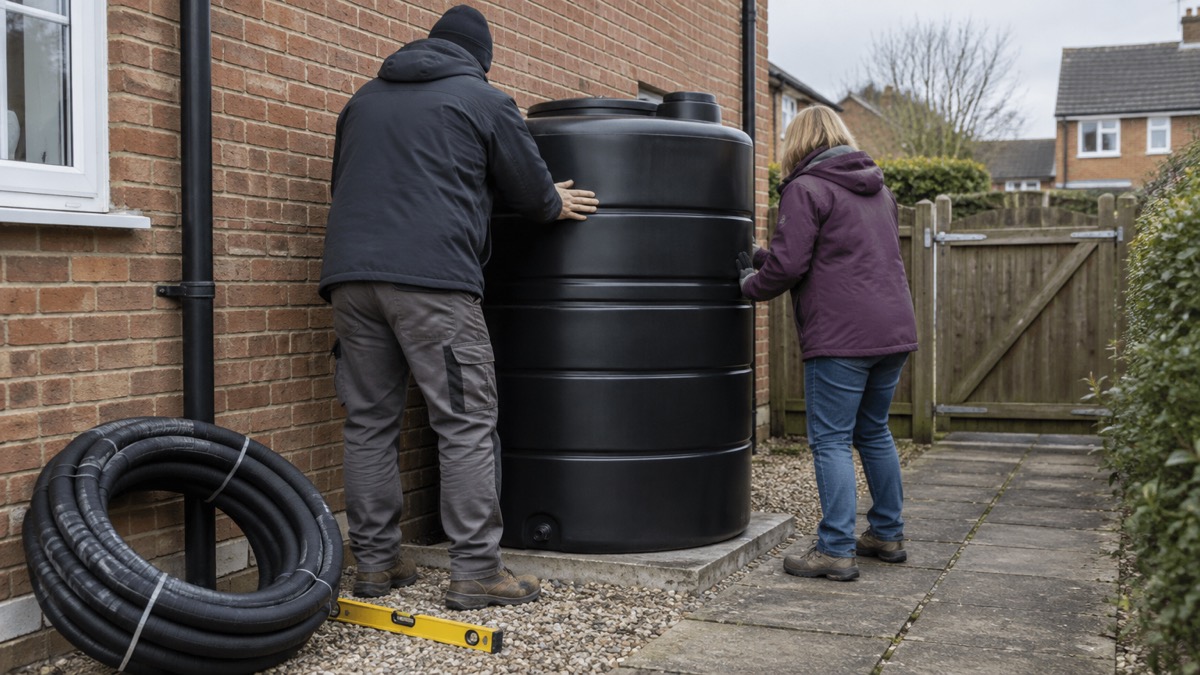
If your water goes off, the first thing to know is which taps in your house are fed directly from the mains. The Drinking Water Inspectorate advises that you should ideally only use a tap connected to the mains water supply for drinking, food preparation or teeth cleaning1. The main water supply normally enters your home at the cold kitchen or utility room tap, so if water comes out of that tap but nowhere else, the problem is with your internal plumbing rather than the supply in the street2. Taps fed from a storage tank, such as the bathroom cold tap in many older houses, draw on water that has been sitting in a cistern, and that water is not the water you should be drinking.
A storage tank in a home is therefore a mixed blessing. It gives you a reserve when the mains fails: some houses have a cold water tank in the loft which allows some water for a short period in an outage, and you should use it only for critical purposes such as flushing the toilet3. But standing water deteriorates, can grow bacteria, and in older homes may sit in a rusting or lead-contaminated system. This page explains what a safe drinking water tank is, what sizes suit a household, how the regulations work when you connect a tank to the mains or run a private supply, and how to keep stored water clean. For how much water to store per person, see How Much Drinking Water to Store per Person; for smaller containers, see Containers and Jerrycans for Drinking Supplies.
Potable or non-potable: what the label means
Tank sellers divide their products into two families, and the distinction matters for anyone thinking of drinking what comes out of the tap. Non-potable tanks are designed for the storage of non-drinking water, for everyday uses across many different applications7. Makers list their typical uses as industrial and commercial applications, including toilet flushing, horticultural and market garden applications, agricultural irrigation, or situations where mains water is not available7. A non-potable tank has no approval for materials in contact with drinking water, and you should not drink from one or use it for cooking.
Potable tanks are the ones made for drinking water. They are built from approved polymer, carry a WRAS approval, and are intended to store water that people will swallow. The difference is not just labelling: the material of a non-potable tank may taint the water or leach into it, and it has not been through the approval process that drinking water materials require.
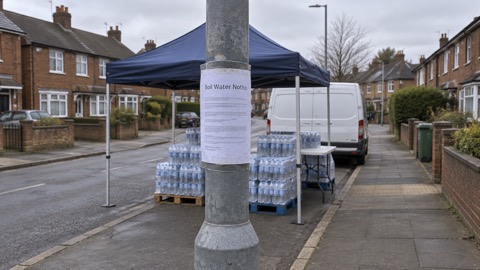
The same distinction appears in emergencies. If your water company issues a Do Not Drink Notice, it means your tap water may contain harmful contaminants that cannot be removed by boiling8. In that situation, no tank of stored tap water drawn before the notice is affected, but water in the system after the contamination event is off limits until the notice is lifted. See Do Not Drink and Do Not Use Notices for what those notices require of you.
| Tank type | What it stores | Typical uses | Safe to drink? |
|---|---|---|---|
| Potable (drinking water) tank | Water intended for drinking | Household drinking reserve, private supply storage | Yes, if WRAS-approved and maintained9 |
| Non-potable tank | Non-drinking water | Toilet flushing, irrigation, horticulture, agricultural uses | No7 |
| Rainwater harvesting tank | Collected rainwater | Toilet flushing, irrigation, landscape watering, pool backwash | No, unless treated7 |
What makes a tank safe for drinking water
The Drinking Water Inspectorate is blunt about materials: nowadays tanks are constructed of plastic (polyethylene) and are unlikely to cause problems, provided they are designed for drinking water purposes and have a close-fitting cover1. Two things therefore decide whether a tank is safe for drinking water: it must be designed and made for that purpose, and it must have a lid that fits closely. A tank that fails either test can taint the water or let contamination in, however clean the water was when it went in.
The approval to look for is WRAS, the Water Regulations Advisory Scheme. Makers of drinking water tanks state that all their drinking water tanks are manufactured from WRAS approved polymer9. That approval covers the material in contact with the water, which is what stops the plastic tainting the taste or leaching into what you drink. It is not a general seal of quality on the whole tank, so the lid, the insulation and the fittings still need your attention.
The material itself is usually MDPE, medium density polyethene. Makers state their tanks are manufactured from MDPE and UV stabilised for many years of outside use9, and that they are 100 per cent rust proof6. That rust-proofing is the practical difference from the older metal tanks found in many lofts, which corrode over time. Modern plastic tanks avoid that problem entirely, which is one reason a replacement loft cistern is usually plastic.
Tank sizes: from a household cistern to 80,000 litres
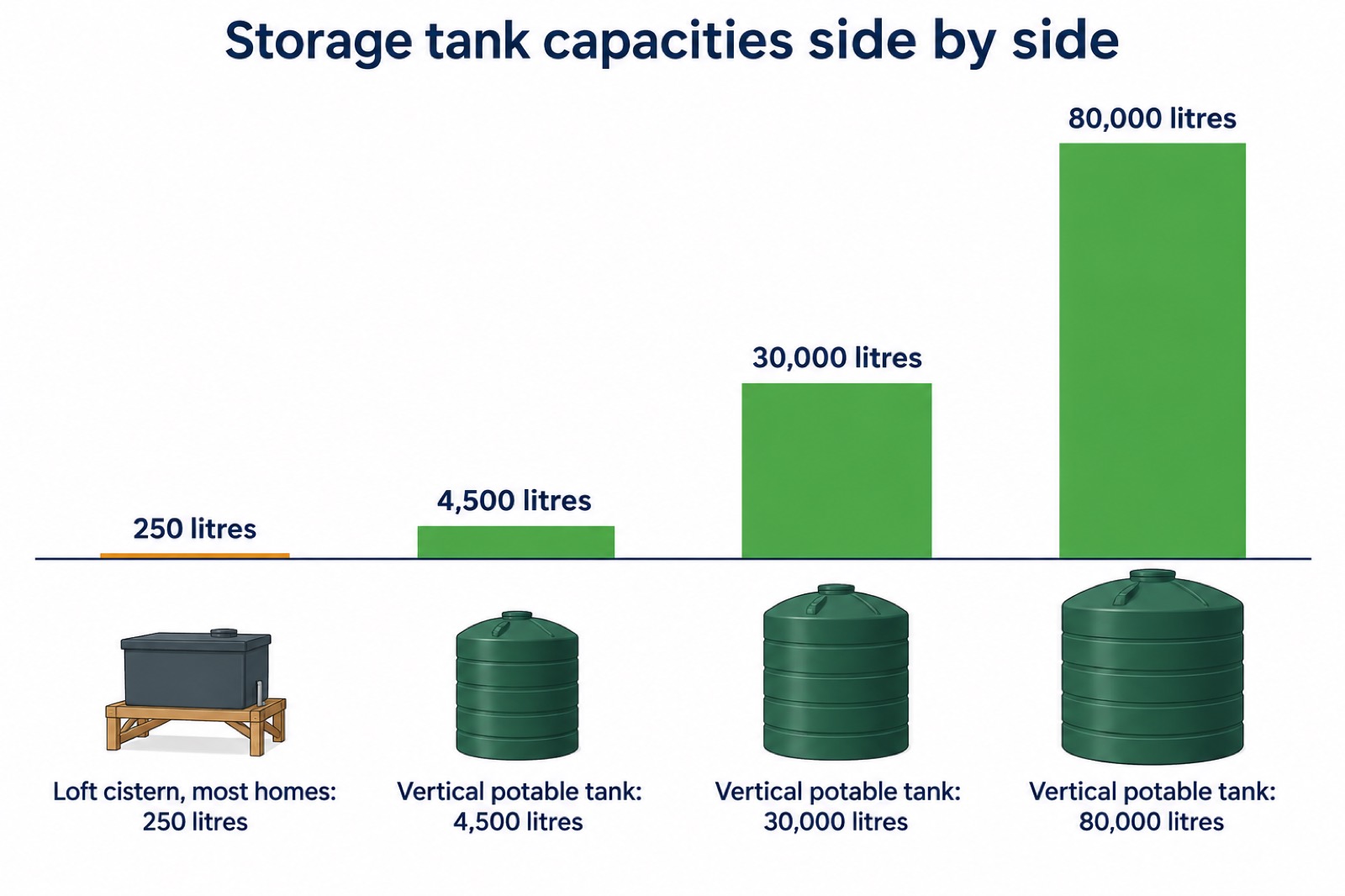
Size is a trade-off between having enough water and keeping it fresh. The Drinking Water Inspectorate advises that a tank should not be too large, so the water in it is frequently replenished with fresh water, and notes that 250 litres is quite sufficient for most homes1. A tank that is too big for the household's use holds water for so long that it stagnates, which is the opposite of what you want from a drinking reserve.
For most homes, the sizes that matter are these:
- Loft cold water cistern: typically around 250 litres, sufficient for most homes, and refilled constantly from the mains1
- 4,500 litre vertical potable tank: a UK-manufactured WRAS-approved tank for households or small private supplies needing a larger reserve10
- 30,000 litre potable tank: a vertical WRAS-approved tank for larger premises or shared supplies6
- 80,000 litre potable tank: a vertical tank for commercial-scale or community storage9
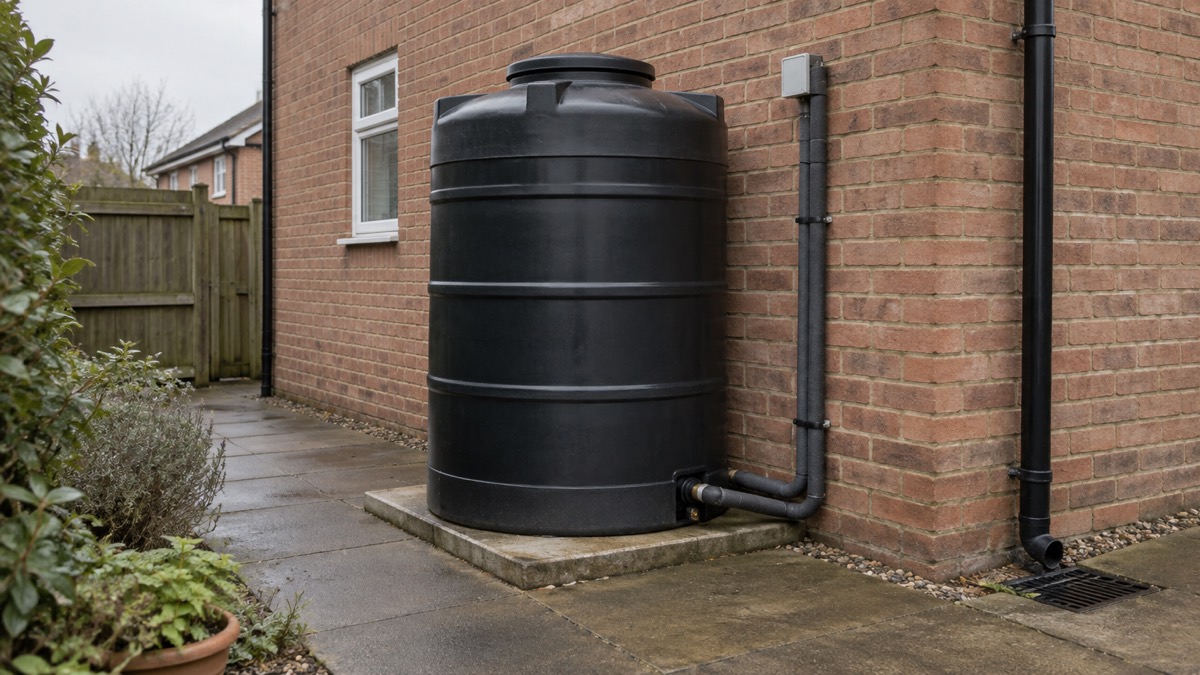
Makers quote a size tolerance: tank sizes are subject to a plus or minus 3 per cent variation6, so a nominally 30,000 litre tank may hold slightly more or less than the name suggests. Large tanks can also be customised at manufacture with liquid level sensor assemblies, fill pipes, PN16 and ANSI flanged connections, welded BSP outlets and sockets, and a bolt down lid and side access hatch for access for cleaning, installation and maintenance of water pumps6. Those options matter for private supplies, where a tank may feed a pump and a whole network of pipes.
For planning how much a household actually needs to get through an interruption, work from the guidance on How Much Drinking Water to Store per Person rather than buying the biggest tank you can fit. A comparison of the practical differences is in Storage Tank or Bottled Supplies?.
The loft cold water tank: what it holds and why older ones rust
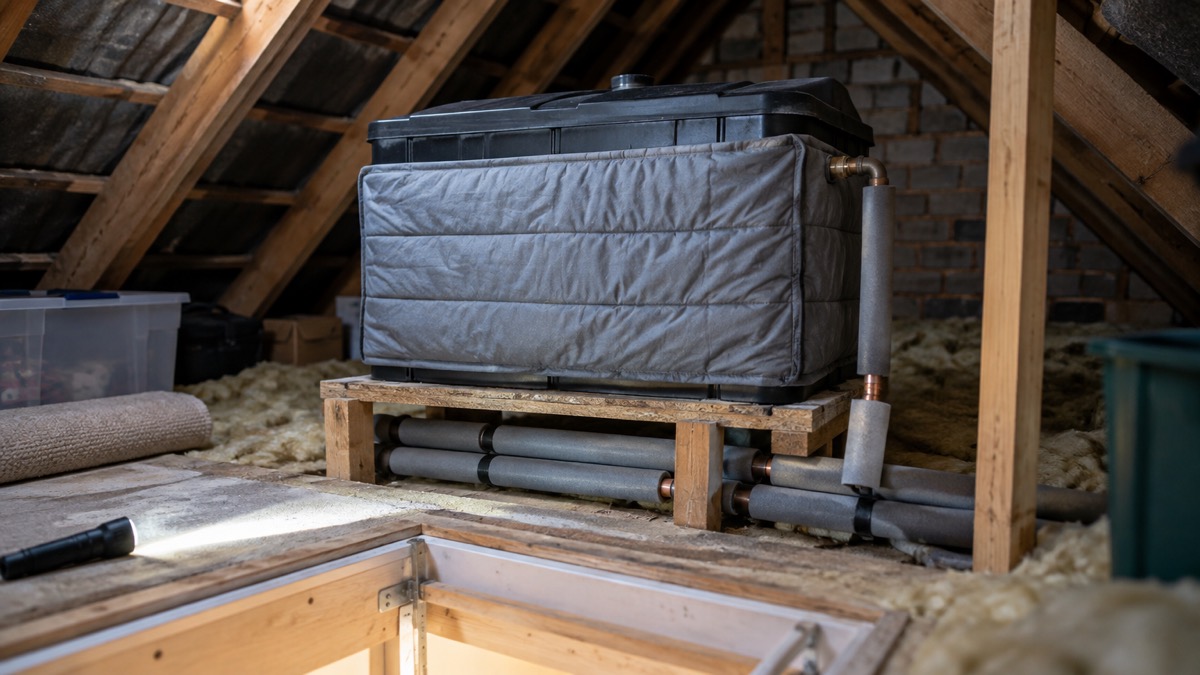
Many British homes, particularly older ones, have a cold water storage cistern in the loft feeding the bathroom cold taps and often the hot water cylinder. In an outage this is a genuine reserve: it will allow you some water for a short period of time, and you should use it only for critical purposes3. It is not drinking water. Ideally you should only use a tap connected to the mains water supply for drinking, food preparation or teeth cleaning1, and water held in a tank or pipes for longer than 24 hours deteriorates and becomes stagnant2.
The Inspectorate sets out clearly how stored water goes wrong. Water in a tank will deteriorate if there is no lid on the storage tank, if the water becomes warm, if too much water is stored and turnover is low, if the tank is made from or lined with an unsuitable material, or if work on the tank is carried out by an unqualified person1. Every one of those failure modes is common in an old loft cistern: missing or cracked lids, warm loft air in summer, and a tank far larger than the household's draw-off.
Older tanks bring two further problems. Rust is one: most of the older water mains in this country are cast iron, originally unlined, and they corrode over time, giving rise to iron particles that lodge in areas of low flow11. The same corrosion logic applies to old metal tanks and pipework in the home. Lead is the other: NHS inform warns that older homes may have lead pipes or lead solder which could affect drinking water, and advises you to use only the cold tap water for drinking, cooking and making infant formula12. If your home has lead pipes between the tank and the taps, the tank water is the last thing you want in a kettle.
Insulation is the maintenance job that matters most. The Met Office advises making sure water pipes and water tanks in the loft are insulated with good quality lagging, which protects from freezing, helps insulate your hot water system and saves you money13. North Wales Fire and Rescue Service go further for winter: insulate your loft and the sides of your water tanks14. A frozen tank that splits can cause serious water damage when it thaws, so this is a job worth doing before the first hard frost. The Drinking Water Inspectorate's guidance for private supply storage states the requirement in full: all storage tanks must be insulated to guard against freezing during the winter and excessive warming during the summer months5. A local preparedness booklet gives the same advice at household level: ensure you have enough insulation around your water tanks, loft and external water pipes15.
Connecting a tank to the mains: the Water Fittings Regulations
Any new plumbing system, and any alteration or addition to an older system, must comply with the Water Fittings Regulations 19991. That includes fitting a storage tank and connecting it to the mains. The regulations exist to protect the public supply: a tank of stored water connected to the mains is a possible route for that stored water to flow back into the network, so the installation has to prevent it.
The key concept is fluid category 5, the highest level of backflow risk. Makers of large potable tanks state that in many installations, potable drinking water tanks which are connected to the mains water supply will need to be fluid category 5 approved6, and the same note appears on their 4,500 litre10 and 80,000 litre tanks9. In practice this means the tank cannot simply be plumbed into the mains pipe: it needs an air gap or other approved arrangement so stored water can never siphon back into the public supply. This is a job for a qualified plumber, not a weekend project.
The rules also bite when a tank leaks or fails. Domestic oil storage tank leaks can pollute drinking water supplies and cause structural damage16, which is why the government requires that home oil storage containers that can hold 3,501 litres or more must follow the regulations for businesses17. The same principle of containment and protection runs through all the storage regulations. Petrol storage at home is licensed under the Petroleum (Consolidation) Regulations 2014, which have provisions for licensing domestic and non-workplace premises for private use18. None of these regimes is about drinking water tanks directly, but they show the pattern: large volumes of liquid stored at home are regulated, and the water fittings rules are the ones that apply to yours.
Before connecting any tank to the mains, notify your water company and use a WaterSafe registered plumber. Ideally you should only use a tap connected to the mains water supply for drinking, food preparation or teeth cleaning1, and all plumbing fittings and materials that come into contact with tap water should comply with the Water Supply (Water Fittings) Regulations 19992.
Private supplies and when the Regulations apply
Around a million people in the UK get their water from a private supply: a well, borehole, spring or stream, often with a storage tank in the system. The rules differ from the mains in ways that matter to anyone buying a house or installing a tank.
In Wales, Dwr Cymru explains the boundary plainly. If your premises only has a private water supply and does not receive any clean water supply from Welsh Water, then the Water Regulations do not apply to you or the premises. If your private supply is completely and physically separate from your mains system, then the Regulations only apply to your clean water system. But if both plumbing systems are directly or indirectly connected, then you and your plumbing system must comply19. So a household with both a mains connection and a private supply feeding the same pipework is fully within the Water Fittings Regulations.
Testing duties depend on how many people the supply serves. Any private water supply used for domestic purposes that supplies two or more dwellings or other properties must be risk assessed every 5 years and regularly tested in accordance with the regulatory requirements by the local authority20. Cornwall Council applies the same framework: supplies used for domestic purposes serving two or more properties and up to 50 people need to be sampled every five years21. If a supply provides water for domestic purposes to only a single dwelling, the regulations do not require a risk assessment or testing unless requested by the owner or occupier, unless the dwelling is in Wales and rented to tenants, unless it is in England, rented and meets the criteria in the guidance on regulation 9, or unless the local authority believes there to be a risk to health20. Local authorities must carry out sampling at all supplies except those which serve only one domestic property which is owner occupied21.
Scotland has its own structure. Larger private supplies, or those with a commercial activity, are defined as Regulated supplies; smaller supplies that only serve domestic properties are Exempt supplies22. Regulated supplies are those serving 50 or more persons in total, or supplies to commercial or public activities irrespective of size, and are regulated by the Water Intended for Human Consumption (Private Supplies) (Scotland) 201723. Exempt supplies serve only domestic premises with fewer than 50 persons in total supplied, and are regulated by the Private Water Supplies (Scotland) Regulations 200623. Supplies serving the public or commercial operations include self catering properties, food businesses, factories, sports centres, hotels, B&Bs, schools and campsites24. In England, Somerset Council provides its statutory sampling and risk assessment service in accordance with the Private Water Supplies Regulations 2016 and the Private Water Supplies (Amendment) Regulations 201825.
Whatever nation you are in, the tank itself must be right. The Drinking Water Inspectorate advises owners of private supplies to ensure that materials and products in contact with the water conform to regulation 5 of The Private Water Supplies Regulations26. Local authorities test private water supplies for bacteria, chemicals and metals27. Lead is a specific concern: the local authority must inform, offer advice and act in accordance with the current Private Water Supplies Regulations and section 80 of the Water Industry Act 1991 where lead is found28. See Private Supplies: Wells, Boreholes and Springs for the full picture.
| Nation | Single-owner-occupied dwelling | Two or more dwellings, or commercial |
|---|---|---|
| England | No routine sampling required unless requested, rented under regulation 9 criteria, or a health risk20 | Risk assessment every 5 years and testing by the local authority20 |
| Wales | As England, but rented dwellings are always tested20 | Risk assessment every 5 years and testing20 |
| Scotland | Exempt supply under the 2006 Regulations if fewer than 50 persons23 | Regulated supply under the 2017 Regulations if 50 or more persons or any commercial activity23 |
Keeping stored water clean: disinfection and Legionella checks
Stored water is not inert. Water held in your water tank or pipes for any longer than 24 hours deteriorates due to loss of chlorine residual, warming, and interaction with the plumbing system materials4. Stagnation creates the right environment for bacteriological growth, most commonly Legionella colonisation, and can also cause taste and odours, discolouration and increased levels of dissolved metals4. The fittings most at risk are water tanks, hot water storage vessels, hot water circulating systems, showers, thermostatic mixer taps and valves, expansion vessels, and the design of the water system and pipework itself4.
The maintenance routine for a household drinking water tank is straightforward. The Drinking Water Inspectorate recommends that if your tank is storage for drinking water, you should be checking annually for the condition of the tank and quality of the water1. Check the instructions supplied with the tank, as these should contain details of how to maintain and clean the tank1. In public buildings, workplaces, health care premises and social housing, all water tanks are checked and cleaned as part of the arrangements that must be in place for Legionella control purposes1, which shows how seriously standing water is treated where many people are exposed.
For a private supply system being commissioned or disinfected, the Drinking Water Inspectorate's guidance is specific: fill the system with a 20 mg/L solution of chlorine and leave it to stand for several hours, preferably overnight, then drain it off and rinse it thoroughly using treated water5. That is a job for someone who knows what they are doing with chlorine dosing.
After a period away, the recovery is manageable. If you have been flushing outlets at least once per week and water quality seems normal, flush hot and cold outlets one more time and, if quality seems ok, it is probably fine; arrange a Legionella Risk Assessment if you have not got one4. More detail is in How to Stay Safe from Legionella at Home and What to Do If Water Tastes Odd After a Holiday.
Discolouration is a diagnostic clue. If discoloured or dirty water is only present at taps other than the mains-fed kitchen tap, a storage tank in the house may be the cause29. That single test tells you whether the problem is in the street main or in your own cistern. See Brown or Discoloured Tap Water. And if illness does strike a household, hygiene around the affected person matters: disinfect door and toilet handles, taps and the toilet seat after use, and disinfect the toilet bowl frequently30.
Tanks for harvested rainwater
A rainwater tank is the one large tank most households can genuinely use, and it is a non-potable tank. Makers list a 10,000 litre non-potable tank as a rainwater harvesting tank to store water for rainwater harvesting systems, with uses including toilet flushing, irrigation, landscape watering, agricultural and crop sprayer tank use, seawater storage, swimming pool backwash, and civil engineering where mains water is unavailable7. None of that water is drinking water, and none of it should be, unless it has been properly treated, which is a separate discipline covered in How to Make Water Safe to Drink in an Emergency.
Rainwater storage earns its place in dry summers rather than outages. During a drought, official advice is to use a watering can instead of a hosepipe in the garden and install a water butt if you can to capture rain31. A covered tank also protects the supply: ensuring all water tanks are covered reduces evaporation and also reduces the risk of contamination of your supply32. For private supply users, storage tanks should have watertight walls and lids24.
Floods are the hazard that turns a rainwater or private supply tank into a risk. Do not use the water supply if the tank or connecting pipework has been damaged, or where flood water has been in contact with taps or connections within or outside the home33. After flood water recedes, a tank that has been submerged or damaged needs inspection and disinfection before anyone drinks from it again. See Flooding: A Household Guide and Self-Reliance at Home: Rainwater, Off-Grid Power and Living Without Mains.
Water shortages, hosepipe bans and what a tank lets you do
A storage tank does not exempt you from restrictions on the mains, but it does give you options. Water companies may choose to enforce Temporary Usage Bans, or hosepipe bans, to help conserve water31. If a hosepipe ban is in place where you live, you cannot use a hosepipe connected to your mains water supply for things like watering your garden, filling a paddling pool or washing your car31. Westminster Council describes the same measure: a ban declared by your water company to help conserve water, during which you should avoid filling a paddling pool, washing your car and watering your garden34. Water companies can bring in hosepipe bans when water is in short supply, usually after a long dry or hot spell35.
The ban is on the hosepipe connected to the mains, not on water you have already stored. Rainwater in a butt or tank, used with a watering can, is within the rules and is exactly what official drought advice recommends31. Everyday conservation still matters alongside any storage: fix dripping taps, keep drinking water in the fridge instead of running the tap until it becomes cold, and reuse leftover washing-up water and cooled cooking water on garden plants where safe. For a full picture of dry spells and what they mean for households, see Heatwaves and Drought: A Household Guide.
Frequently asked questions
Does the colour of a water tank matter? For drinking water tanks, colour is mostly practical. Makers offer potable tanks in colours such as black and blue9. What matters far more is that the tank is made from WRAS-approved material, has a close-fitting cover1, and is insulated against freezing and warming5.
What is fluid category 5 protection and do I need it? Fluid category 5 is the highest level of backflow protection in the Water Fittings Regulations. Makers note that in many installations, potable drinking water tanks connected to the mains supply need to be fluid category 5 approved6. Ask a WaterSafe registered plumber or your water company before connecting any storage tank to the mains.
What happens if I breach the Water Fittings Regulations? The Water Fittings Regulations 1999 apply to new plumbing systems and alterations and additions to older systems1. A breach can put your supply at risk, and water companies hold enforcement powers to protect the public network. Related storage rules show the stakes: domestic oil tank leaks can pollute drinking water supplies and cause structural damage16, and home oil containers of 3,501 litres or more must follow business regulations17.
Could my water supply be disconnected over a tank? Disconnection is the extreme end of enforcement, but the power exists to protect the mains network from contamination. The more common consequence is being required to bring a non-compliant installation up to standard. Notify your water company and use a qualified plumber so the installation complies from the start1.
What is a bladder tank? A bladder tank stores water inside a flexible liner within a rigid outer shell. For household drinking storage, the same rules apply as to any tank: materials in contact with the water must be suitable for drinking water26, and a tank connected to the mains may need fluid category 5 approval6. Check the maker's specifications before buying.
What are MDPE tanks? MDPE is medium density polyethene, the plastic most large water tanks are made from. Makers state their tanks are manufactured from MDPE and UV stabilised for many years of outside use9, and are 100 per cent rust proof6. For drinking water, the polymer must be WRAS approved9, so check the approval rather than just the material.
Do water shortages and hosepipe bans affect stored water? A hosepipe ban stops you using a hosepipe connected to the mains for watering the garden, filling a paddling pool or washing the car31. It does not stop you using water you have already stored. Installing a water butt to capture rain is official advice during droughts31.
Sources (35)
- Water storage tanks and cisterns, Drinking Water Inspectorate, 2026-06-09
- Utilities failure: what to do, Richmond Council, 2026-05-22
- Failure of water infrastructure or loss of drinking water, Wiltshire and Swindon Prepared, 2026-10-25
- Stagnant water advice, Southern Water, 2026-10-28
- Water storage in private supply networks, Drinking Water Inspectorate, 2025-11-05
- 30,000 Litre WRAS Approved Potable Water Tank, Enduramaxx, 2026-09-04
- 10,000 Litre Water Tank, Non-Potable, Enduramaxx, 2026-09-24
- Our promise to you if your water supply is interrupted, South East Water, 2026-10-28
- 80,000 Litre Potable Drinking Water Tank, WRAS Approved, Enduramaxx, 2026-03-09
- 4,500 Litre Vertical Potable Water Tank, WRAS Approved, Enduramaxx, 2026-06-16
- Brown, black or orange water, Drinking Water Inspectorate, 2026-10-28
- Lead poisoning, NHS inform Scotland, 2026-09-07
- Protecting your property from winter weather, Met Office, 2026-10-25
- Ice and burst pipes, North Wales Fire and Rescue Service, 2026-10-29
- Are You Ready booklet, Culham Parish Council, 2025-09
- Oil tank leaks, Somerset Council, 2025-07-29
- Storing oil at your home, GOV.UK, 2026-10-29
- Domestic and non-workplace petrol storage, Manchester Fire and Rescue Service, 2026-10-29
- Private water supplies and the water regulations, Dwr Cymru Welsh Water, 2026-10-28
- Buying a dwelling with a private water supply, Drinking Water Inspectorate, 2026-10-28
- Private water supplies in Cornwall, Cornwall Council, 2026-10-29
- Private water supplies, Drinking Water Quality Regulator for Scotland, 2026-10-28
- Private water supplies, Argyll and Bute Council, 2026
- Private water supplies: regulation and testing, Scottish Borders Council, 2026-10-29
- Private water supplies, Somerset Council, 2026-08-12
- Protecting your private water supply, Drinking Water Inspectorate, 2026-10-28
- Types of private water supply, Cumberland Council, 2026
- Lead in private water supplies, Drinking Water Inspectorate, 2026-10-28
- Discoloured or dirty water, Drinking Water Quality Regulator for Scotland, 2026-10-28
- Food poisoning advice, Northumberland County Council, 2026-08-11
- Droughts: be informed about hazards, Prepare Campaign, 2026-10-19
- Loss of supply: private water supply users, Argyll and Bute Council, 2026
- Private water supplies after floods or storms, Argyll and Bute Council, 2026
- Drought advice, Westminster City Council, 2026-08-06
- Stay safe during hot weather, London Borough of Bexley, 2026
 Supply Interruption Checklist
 Boil Notice Checklist
 Drinking Supply Checklist
 How Much Water to Store
 Storing Tap Water Safely
 Containers and Jerrycans
 Water Already in Your Pipes
 Making Water Safe to Drink
 Boiling Water to Kill Germs
 Purification Tablets
 Emergency Filter Types
 What Water Filters Remove
 Gravity Filters Explained
 Hand Pump Filters
 Filter Bottles and Straw Filters