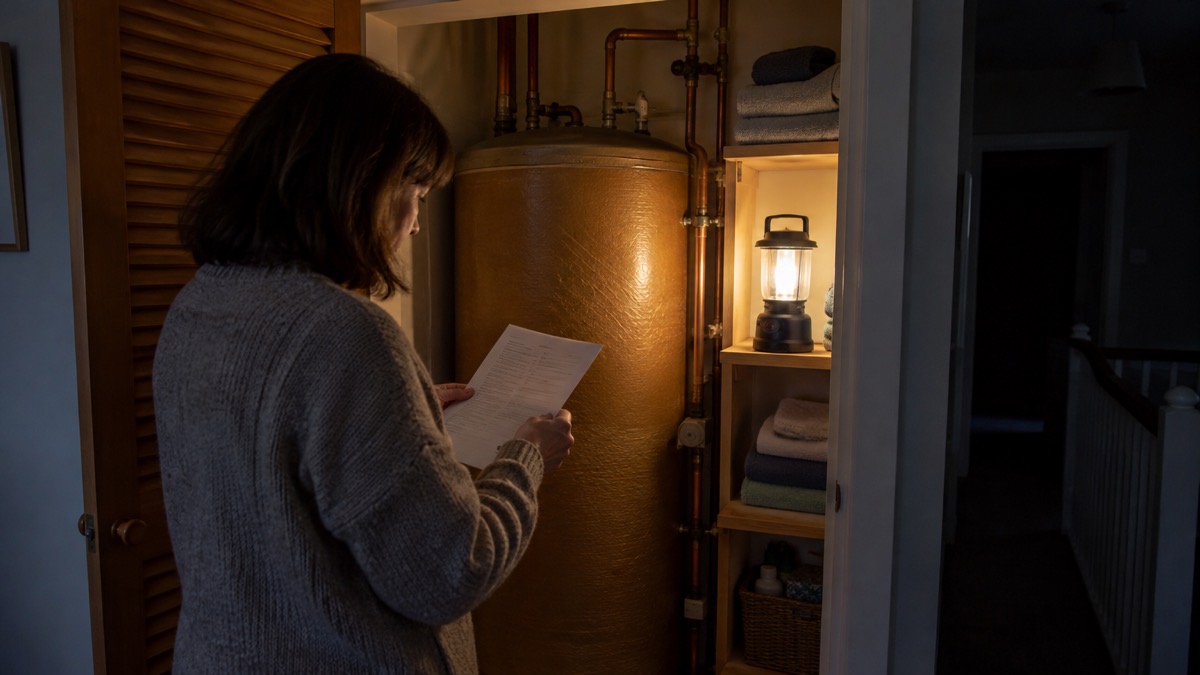
If the power goes off, neither a combi nor a system boiler will make new hot water, because most boilers need electricity to run1. The difference is what is already stored. A combi heats water on demand and keeps no reserve, so the hot water stops as soon as the power or the mains water does. A system boiler heats a cylinder of water, and that cylinder holds a tankful that stays warm for a while after the boiler stops.
That stored water is the practical reason a household might choose a system boiler if hot water in an outage matters to them. A combi is compact, needs no cylinder, and supplies hot water at mains pressure, which is why it suits many homes2. But it depends on two things arriving at once: electricity and mains water. When the water is off, a combi stops giving hot water, though the heating side can keep working if the power is on.
Whichever boiler you have, the useful work is the same: know how to turn the water and gas off, know what your pressure gauge should read, and know who to call. This page sets out how each type behaves when the power or water fails, what to check when it comes back, and when the job needs a Gas Safe registered engineer.
Neither boiler makes hot water in a power cut, but a cylinder holds some
The first thing to understand is that a power cut stops the boiler, not the gas. Gas and water supplies will typically be unaffected in a power cut, but most boilers need electricity to function1. The Be Ready campaign is blunt about it: gas ovens, boilers, heat pumps and home internet will not work without power, and the mains water supply could also be disrupted during and after power cuts6.
So the question is not which boiler keeps running, because neither does. It is which one has hot water already made when the power stops.
A combi provides on-demand hot water with no hot water cylinder, supplying it at mains pressure, and it is often more compact and can be more cost effective to install than other boiler types2. The trade-off is that there is no reserve: when the power or the water stops, the hot water stops with it.
A sealed system boiler is a closed system that needs only a boiler and a cylinder, with no separate water tanks in the loft unless it is an open vented cylinder, but it needs space for the cylinder and can cost more to install than a combi2. In return, the cylinder is a store. It will not stay hot indefinitely, and it will not refill without power, but it gives a household a period of hot water after the boiler has stopped.
If hot water in an outage is a priority for your household, that stored cylinder is the deciding feature. If space is tight and you have never run out of hot water in a power cut, a combi's compactness and mains-pressure supply may matter more. Neither is wrong; they suit different homes.
How each boiler behaves when the power or water goes off
The two types fail in different ways, and knowing which you have tells you what to expect and what to do first.
| Situation | Combi boiler | System boiler with cylinder |
|---|---|---|
| Power cut | Boiler or heat pump will not work unless supported by backup power, because these are typically powered by electricity1 | Boiler or heat pump will not work unless supported by backup power, because these are typically powered by electricity1 |
| Mains water off | Hot water stops; heating can keep working if power is on2 | Heating system can be used as normal, as this will not require any top up of water3 |
| More than one tap running | Hot water can weaken if the system is poorly designed2 | Stored supply is less affected by a second tap2 |
| Space needed | Compact, no cylinder2 | Needs space for a hot water cylinder2 |
| Installation | Often more cost effective to install2 | Can be more expensive than a combi2 |
For a combi household, the practical point is that a power cut and a water cut hit the same way: the hot tap runs cold. For a system boiler household, the cylinder buys time, so the sensible move in an outage is to use hot water sparingly and keep the cylinder's heat for washing rather than for long showers.
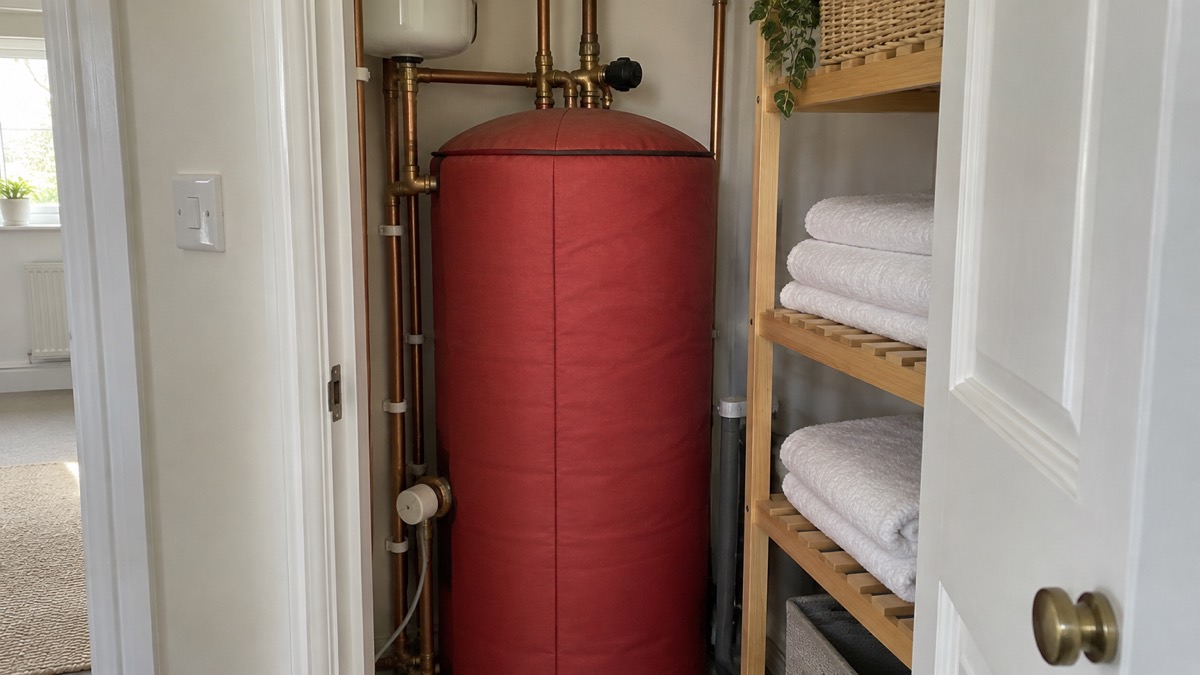
If you are unsure which type you have, look for a cylinder: a tall insulated tank, usually in an airing cupboard, means a system or conventional set-up. No cylinder and a single wall-mounted box means a combi.
When the mains water is off, a combi stops giving hot water but the heating still works
This is the case that surprises people. A combi makes hot water by heating water straight from the mains as it flows through the boiler. If the mains water stops, there is nothing to heat, so the hot taps run dry or cold even though the boiler and the power are fine.
The heating side is separate. Turning off the mains water supply will stop the boiler from supplying hot water, but the heating function will still work as long as there is no issue with the central heating circuit1. Scottish Water gives the same advice for combi, system and conventional boilers: the heating system can be used as normal during an interruption, as this will not require any top up of water2. That matters in a winter outage: you may have no hot water but still have a warm home.
A system boiler behaves differently. Its cylinder holds water already heated, so the hot taps can keep running for a while after the mains stops, until the stored water is used. The cylinder will not refill until the supply returns.
If the water is off, water companies and councils advise knowing how to turn off your gas, electricity and water, because you will need to turn these off if you have to leave your home due to flooding or a leak7. The same knowledge helps when a pipe bursts: turn off the water supply coming into your property at the stop tap and switch off your boiler8.
If you cannot find your inside stop valve, or it is broken, there are other ways to turn your water off, listed by your water company9. Find them before you need them.
An immersion heater gives a system boiler home a back-up
A system boiler's cylinder often has an immersion heater fitted: an electric element that heats the water directly, independent of the boiler. In a power cut it is no help, because it needs electricity too. But it is useful when the boiler itself has failed while the power is on, giving a way to heat water while you wait for an engineer.
The same principle applies to other essential equipment in an outage: if you rely on something that needs power, consider a battery-powered backup or insulation methods1. For a cylinder, insulation is already built in, which is why the stored water stays warm for a while.
If your boiler has failed and you are relying on the immersion, keep an eye on the cylinder thermostat and do not run the immersion continuously for days without checking. If you are unsure how your immersion is controlled, ask a Gas Safe registered engineer or electrician when they next visit.
Checks to make when the power comes back
When the power returns, do not assume everything has restarted correctly. Work through these checks in order.
- Look at the fuse box. If a circuit has tripped, find out why before resetting it. If water has leaked near your electrics, do not touch them and switch them off at the fuse box8.
- Check for water in the fuse box. Switch off the electricity supply at the fuse box if it is safe to do so; if there is evidence of water inside the fuse box or signs of arcing or overheating, seek professional advice10.
- Check wet appliances. If electrical appliances have been wet, turn off the electricity at the fuse box, allow them to dry out and have a qualified professional check them before turning them on11.
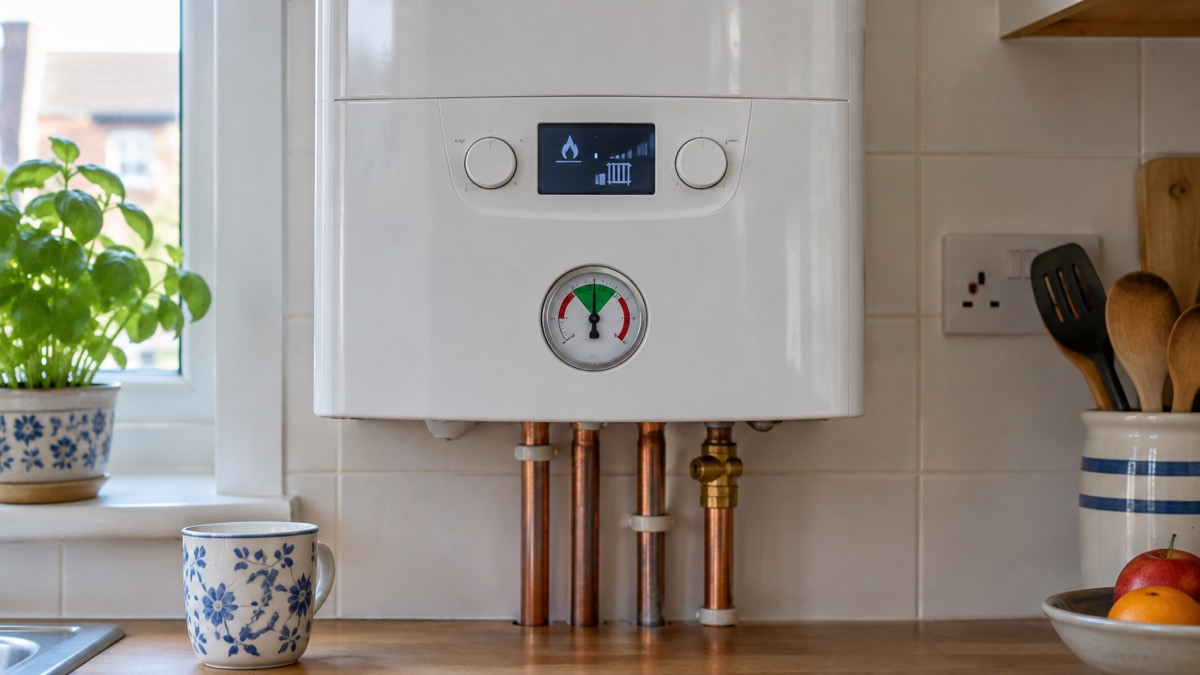
- Check the boiler pressure. The pressure gauge should be at one bar on a sealed system3.
- Check the boiler has restarted. If it has locked out, reset it once and see whether it holds.
- Check the programmer and thermostat. A power cut can reset timers, so heating may not come on when you expect.
If water has come into contact with electrical wiring or appliances, isolate the electricity supply and have the circuit checked by a registered electrician12. After a flood, turn off any electricity until a qualified electrician or utility company has checked all switches, sockets and appliances, then use a circuit breaker with any electrical equipment used in or to clean and repair the property13.
If you had to leave your home during an outage, the advice is to stay with friends or relatives until your power is back on, leave a light on so you know when it returns, and switch off appliances that could pose a hazard14. That last point matters for boilers and immersion heaters: switching them off before you leave avoids a surge or a dry start when power returns.
Boiler pressure: 1 to 1.5 bar on a sealed system
Pressure is the check most households can make themselves, and the one most often got wrong. Independent guidance is to check the boiler power supply first, and the pressure gauge should be at one bar3. Maker guidance differs slightly: one maker says the gauge should be around 1.5 bar and topped up if too low, while another says the pressure should be between 1 and 2 bar. Most makers put the working range at 1 to 1.5 bar, so check your own boiler's manual.
| Reading | What it means | What to do |
|---|---|---|
| Around 1 bar | Normal on a sealed system1 | Nothing |
| Around 1.5 bar | Normal per maker guidance | Nothing |
| Below 1 bar | Too low; system needs topping up | Repressurise following the maker's instructions |
| Above 2 bar | Too high | Stop and seek advice from a Gas Safe registered engineer |
Pressure drops for a reason: a small leak, a recently bled radiator, or a faulty pressure relief valve. Topping up without finding the cause only postpones the problem. If the pressure keeps falling, book an engineer rather than topping up repeatedly.
If your boiler has lost pressure and you are not confident topping it up, our guide to boiler pressure walks through the gauge and the filling loop, and how to repressurise a combi boiler covers the step-by-step.
Why a combi gives weaker hot water when more than one tap runs
A combi heats water as it passes through, so its hot water output is limited by how much water can flow through it and how much heat it can add. If incorrectly designed, on-demand hot water means there can be a problem with hot water supply to taps if more than one is running, reduced water flow filling a bath, and lack of mains water pressure or flow affecting hot-water performance2.
Water pressure itself falls when demand rises: your water pressure will reduce if you have multiple taps or appliances, like dishwashers and washing machines, running at the same time3. So a combi in a busy household can struggle at the very moment everyone wants water.
A system boiler with a cylinder avoids this because the stored water is already hot and is fed at pressure from the cylinder, not heated on the spot. That is why larger households, or homes with more than one bathroom, often suit a cylinder better.
If your combi's hot water is weak even with one tap running, the cause may be the mains supply rather than the boiler. Our guide to no hot water sets out the checks for combi and cylinder systems, and low supply pressure covers who to call about the supply itself.
When to call a Gas Safe registered engineer
Some jobs are for you; some are not. Any work on appliances such as cookers, boilers or fires has to be carried out by a Gas Safe Registered engineer15. You should only ever use a qualified and competent Gas Safe registered engineer to service your boiler2.
Call an engineer if:
- The boiler locks out repeatedly after a reset.
- The pressure will not hold after topping up.
- You smell gas, or the boiler makes a loud banging noise that could mean a pipe is freezing: turn off the system and call a plumber immediately16.
- Water has got into the electrics or the boiler.
- The boiler has been flooded: do not turn on gas or gas appliances until your system has been checked by a Gas Safe registered engineer17.
The Gas Safe helpline is free on 0800 408 55004. If you suspect carbon monoxide, get fresh air and call the gas emergency service; the fire and rescue service advises getting a Gas Safe registered engineer to inspect your gas appliances and flues to see if there is a dangerous problem4.
For a boiler that has broken down in cold weather, our guide to boiler breakdowns covers the checks before you call, and finding a Gas Safe registered engineer explains how to check an engineer's card.
The Ideal Logic 2 recall: check your model
On 22 February 2024 the Office for Product Safety and Standards published a recall of the Ideal Heating Logic 2 Combi and System Boiler Range, a white domestic combi boiler, covering 30 listed part numbers21. Ideal has launched a modification programme to address the safety risk21.
If you have an Ideal Logic 2, check the model and part number against the recall notice. The affected models include 228307 IDEAL LOGIC COMBI2 C24 BOILER through 229983 I MINI2 C35 BOILER21. Do not wait for a fault: contact Ideal about the modification. Our page on the Ideal Logic Combi2 covers fault codes and breakdown steps for the model.
Where to get help in an outage
If the power is off, dial 105, the power cut line5. If you have a vulnerable neighbour or family member, check on them: the advice is to check on vulnerable neighbours or family14. Households that need extra support can ask their network operator about the Priority Services Register, which our guide to extra support explains.
If your boiler has failed and you need to know what to do next, start with our section on gas and heating failures, which covers breakdowns, fault codes, pressure and finding an engineer.
Sources (22)
- What to do in a power cut, Northern Powergrid, 2026
- Boiler and appliance guide, Gas Safe Register, 2026
- Water pressure, Yorkshire Water, 2026
- Carbon monoxide, Greater Manchester Fire and Rescue Service, 2026
- Emergency, Basingstoke and Deane Borough Council, 2026
- Be informed about hazards: power cuts, Be Ready campaign, 2026
- Be ready for emergencies, Be Ready campaign, 2026
- Frozen or burst pipes, Met Office, 2026
- Know your water supply, Wiltshire and Swindon Prepared, 2026
- Flooding, Runnymede Borough Council, 2026
- Prepare yourself, Greater Manchester Combined Authority, 2026
- Steps after a fire, North Yorkshire Fire and Rescue Service, 2026
- After flooding, Surrey County Council, 2026
- Power cuts, West Yorkshire Prepared, 2026
- What you might need in a gas outage, Wiltshire and Swindon Prepared, 2026
- Adverse weather events, Llangattock Community Council, 2026
- Flooding advice, Belfast City Council, 2026
- Flooding advice, Belfast City Council, 2026
- Carbon monoxide, Greater Manchester Fire and Rescue Service, 2026
- Carbon monoxide, Cheshire Fire and Rescue Service, 2026
- Product recall: Ideal Heating Logic 2 Combi and System Boiler Range, Office for Product Safety and Standards, 2024
- Prepare: emergency plan, Ready Scotland, 2026