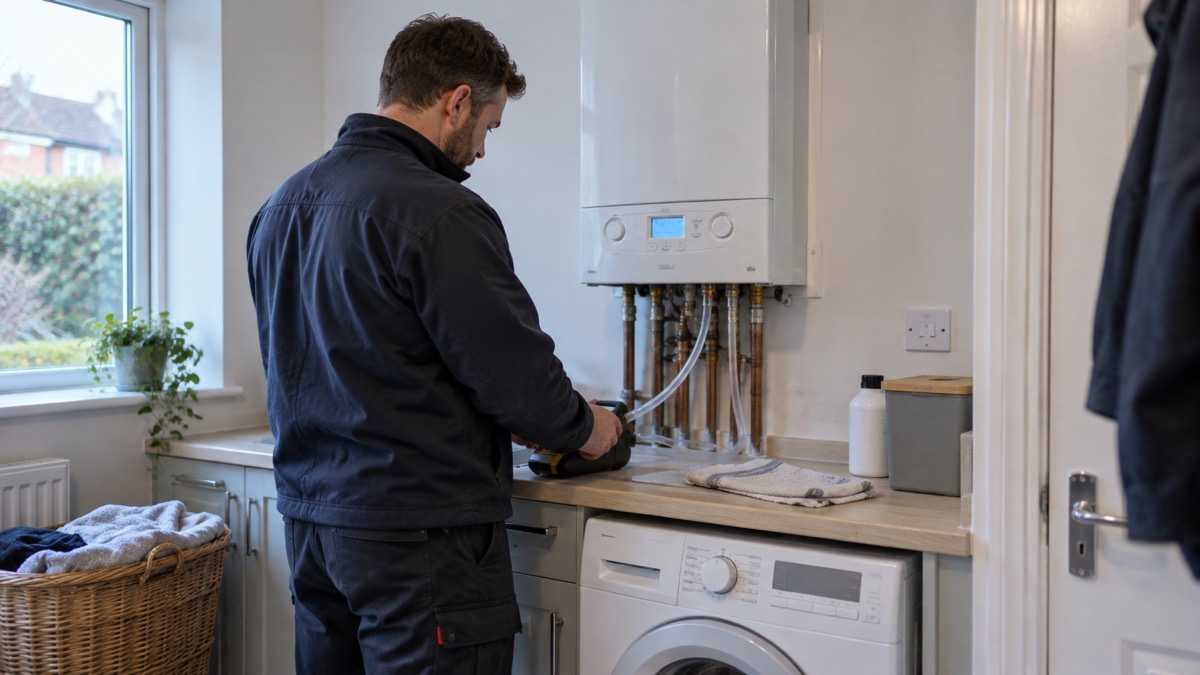
Every UK fire and rescue service, the Health and Safety Executive and the NHS give the same answer to the question "how often should a boiler be serviced?": once a year, by a qualified and registered engineer. The Scottish Fire and Rescue Service puts it plainly: "Gas boilers and appliances should be serviced once a year by a Gas Safe registered engineer"1. Public Health Wales says the same of every fuel-burning appliance in the home, from boilers to wood burners2, and the Health and Safety Executive requires that gas appliances, flues and pipework are "installed, regularly maintained and serviced at least annually by a Gas Safe registered engineer"3.
The reason is simple. A boiler that is burning fuel badly can produce carbon monoxide, a gas you cannot see or smell, and an appliance that has not been safety checked and serviced annually is a recognised risk factor for carbon monoxide poisoning4. Yearly servicing also keeps the boiler running efficiently and reliably through the winter, when a breakdown matters most. The Met Office's winter readiness checklist puts "boiler serviced" among the jobs to complete before cold weather arrives5.
If you rent, none of this is your job to arrange: your landlord must have the gas appliances they own maintained by a Gas Safe registered engineer and must give you a copy of the gas safety record after the annual check6. This page sets out the annual rule, who can do the work, what servicing protects you from, what landlords must do, and the signs that mean you should not wait for the next booked service.
Once a year: the rule every authority gives
There is no ambiguity and no regional variation in the frequency. Lincolnshire's home fire safety advice is to "have your boiler serviced annually"8. London Fire Brigade says to have your boiler and other fuel-burning appliances "serviced by a qualified professional at least once a year"9. Public Health Wales advises having heating and cooking appliances serviced at least once a year by a professional engineer10, and the NHS says to make sure boilers, heaters and cookers are "serviced regularly by a qualified and registered engineer"11. Warwickshire's safe heating guidance says to have a qualified technician inspect and service fuel-burning appliances annually to ensure they are functioning properly12.
The timing within the year is up to you, but the practical choice is to book the service in late summer or early autumn, before the first cold snap. Engineers are busiest when boilers fail in winter, and a fault found in September can be fixed at leisure rather than during a freeze. The Met Office has repeated the same advice for years: it is "worth getting your boiler serviced yearly, and ensuring your pipes are insulated"13, and its current winter checklist carries "boiler serviced" as a standing item5. Derbyshire's snow and cold weather guidance likewise stresses ensuring central heating boilers are serviced regularly14.
A service is not the same as a repair call-out. The point of the annual visit is to catch problems before they become breakdowns or safety faults, and to confirm the appliance is burning cleanly. Northern Ireland's Fire and Rescue Service makes the underlying reason explicit: all boilers and fuel-burning appliances have the potential to produce carbon monoxide, "therefore it is important they are serviced annually by a qualified engineer"15. If your boiler missed a year, book one now rather than waiting for the anniversary to come round again.
Who can service a boiler: a Gas Safe registered engineer
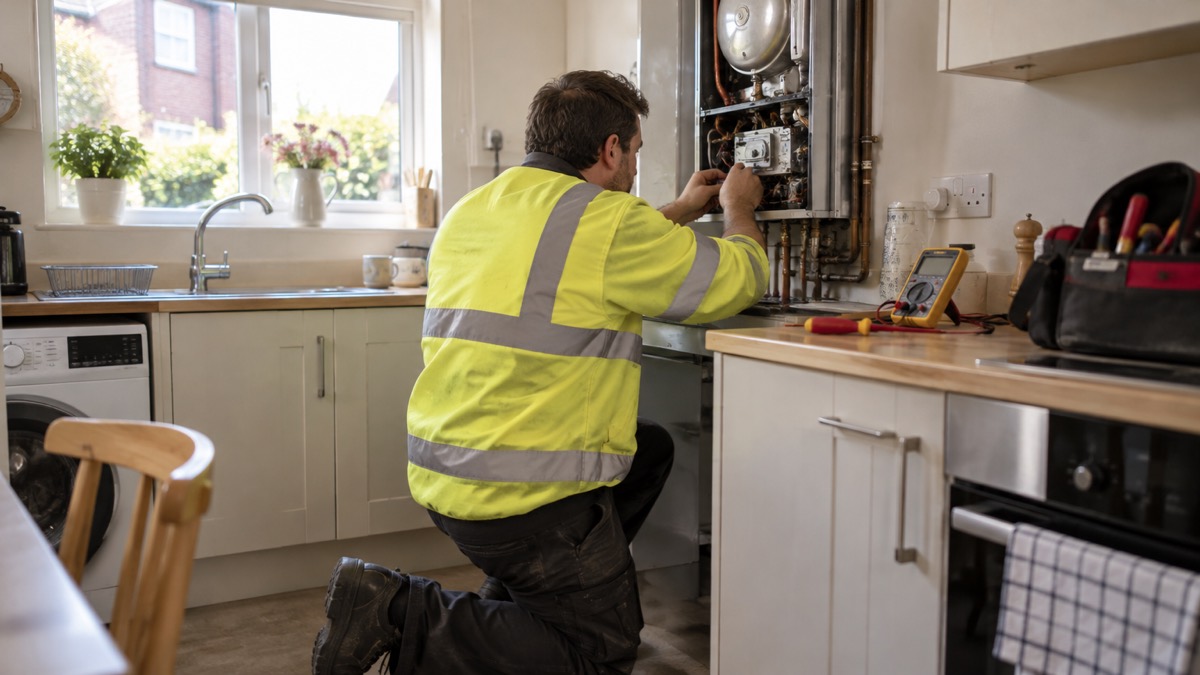
For gas appliances, the law and every official body are clear about who does the work. The Health and Safety Executive requires gas appliances, flues and pipework to be installed, maintained and serviced at least annually by a Gas Safe registered engineer3. The Scottish Fire and Rescue Service1, Surrey's fire and rescue guidance17 and the government's Fire Kills campaign18 all repeat that gas appliances should be serviced once a year by a Gas Safe registered engineer. Never attempt DIY repairs on gas appliances: the Fire Kills campaign states this directly, noting that annual servicing by a Gas Safe registered engineer is a legal requirement for landlords18.
Before the visit, check the engineer's registration. Our guide to finding a Gas Safe registered engineer and checking their card explains how to verify an engineer on the register and what to look for on their card, including that they are qualified for the type of work you are booking. WaterSafe, the UK plumbing register, adds a further suggestion for households: have your boiler serviced regularly by a Gas Safe and WaterSafe Register-approved engineer to keep it in good condition19.
Different fuels need different qualifications. A gas engineer is not automatically qualified for oil or solid fuel, and official guidance on wood pellet systems says the boiler must be cleaned and serviced by a competent person at the frequency required by the manufacturer's instructions20. If you have an LPG boiler or a bulk tank, see our page on LPG homes; for oil, see oil boiler breakdowns. Book the right engineer for the fuel you have.
What the service is protecting you from: carbon monoxide
The most important reason for the annual service is carbon monoxide. Carbon monoxide is produced when fuel does not burn completely, and Warwickshire's fire and rescue guidance lists a heating appliance that is "not maintained or serviced" among the causes of carbon monoxide build-up in a home21. The gas has no smell and no taste, and an appliance can be producing it while appearing to work normally.
That last point matters after floods. Public Health Wales advises: "Have your heating and cooking appliances serviced by a Gas Safe engineer, even if they seem to be working normally. There is a risk of carbon monoxide poisoning if they are not working properly"22. If floodwater has reached a boiler, flue or gas pipework, do not assume that because it fires up it is safe: book a Gas Safe service before relying on it.
British Gas describes the annual service as "a bit like an MOT for your boiler"23. The London Fire Brigade's easy-read fire safety booklet notes of gas boilers, wood burning stoves and open fires that "it is important that they are checked and serviced regularly"24.
A serviced boiler is the first line of defence; an alarm is the second. Our page on unsafe appliances covers the warning signs that an appliance is burning badly, and home emergencies covers what to do in the moment.
Renting: your landlord must arrange the service and give you the record
If you rent, the annual service and safety check are your landlord's legal responsibility, not yours. The Health and Safety Executive's guidance for tenants and students states that your landlord has to have any gas appliance they own regularly maintained by a Gas Safe registered engineer and must issue you a copy of the gas safety record following the annual gas safety check6. The Greater London Authority confirms that landlords must make sure gas appliances and flues in rented homes are safety checked every 12 months, covering your gas boiler, gas cooker and gas fire25.
What this means in practice:
- Your landlord should arrange the annual gas safety check for any fixed gas appliances26.
- Your landlord must show you safety certificates so you can see when gas and electrical appliances were last checked27.
- Ask whether all gas appliances are being checked and serviced every year by a Gas Safe fitter28.
- If your landlord fails to provide the annual gas safety check, report them to your local authority26.
- Ensure your landlord has completed the annual Gas Safety check, as the NHS trust in Doncaster advises tenants29.
The same rules extend to LPG. The Health and Safety Executive says landlords must arrange maintenance by a Gas Safe registered engineer for all LPG appliances they own and provide, with a safety check at least once every 12 months3. Dorset and Wiltshire Fire and Rescue summarise the rented-sector duties: gas appliances must be checked by a Gas Safe registered gas fitter every year27.
Keep your copy of the gas safety record. It is your proof of the check, and it shows the date the next one is due. Our page on broken boilers in rented homes covers what to do when the heating actually fails, and appliance safety checks explains how often checks are needed and who can get them free.
Carbon monoxide alarms in rented homes
Servicing and alarms go together, and in rented homes the alarm is a legal requirement. In England, from 1 October 2022 all private and social landlords must ensure that in all of their rented properties there are smoke alarms on every storey where there is a room used wholly or partly as living accommodation, and carbon monoxide alarms in any room used wholly or partly as living accommodation where a fixed combustion appliance is present, excluding gas cookers7. The law also requires landlords to check the alarms are working at the start of the tenancy18.
Cornwall's fire and rescue guidance describes the landlord's duty as supplying a carbon monoxide detector and alarm in any room used wholly or partly as living accommodation which contains a solid fuel burning combustion appliance28, and Cheshire's safe and well booklet tells renters simply: "Your landlord must provide one if you rent your home"30. Greater Manchester's cost of living advice leaflet confirms that a landlord must make sure a carbon monoxide alarm is equipped in any room used as living accommodation that contains a fixed combustion appliance, excluding gas cookers31.
On the type of alarm, Cherwell District Council's housing standards advice recommends that carbon monoxide alarms in rental properties are mains-powered with integral battery back-up, installed by a competent electrician, and compliant with the relevant British Standards7. Test the alarm regularly: Dorset and Wiltshire Fire and Rescue note that alarms fitted by landlords should then be tested regularly27.
Boiler cover, warranties and keeping the record
Several practical questions sit around the annual service, and the answers are worth knowing before you book.
Is a service included with boiler cover? Some policies include one and some do not, so read the terms. British Gas states that with its own cover, a boiler service is included at no extra cost with any level of boiler cover, and that it gets in touch with HomeCare customers when the next annual check is due23. Whether or not you have cover, the annual service still needs to happen.
What about the warranty? The Met Office's winter checklist treats "boiler serviced" as a standing annual job5, and the Northern Ireland Fire and Rescue Service's New Year safety message is blunt: "Don't skip servicing boilers and gas appliances and remember to test all alarms regularly"32. A missed service is the most common reason a warranty claim runs into trouble, so keep every service record with the boiler's paperwork. If the engineer leaves no paper record, ask for one: it is your evidence of the service date and what was done.
Booking through the manufacturer. You can book with a local engineer or through the manufacturer's own service scheme. What matters is that the engineer is Gas Safe registered and follows the maker's servicing schedule. If your boiler is within its warranty period, check whether the manufacturer requires evidence of annual servicing by their approved engineers.
Recalls. Boilers are occasionally recalled, and a service visit is a good moment to check. Have your model and serial number to hand and check the government's product safety alerts and recalls pages. If you have an Ideal Logic boiler, our page on Ideal Logic Combi2 faults may help.
Signs your boiler needs attention before its next service
Do not wait for the annual visit if something is clearly wrong. A boiler that locks out, drops pressure, leaks water, makes unfamiliar noises or leaves radiators cold needs looking at now, and each of these has its own guide on this site:
- Boiler fault codes, flashing lights and lockouts for error displays and repeated lockouts.
- Boiler pressure if the gauge has fallen or climbed out of its normal range.
- What to do if your boiler is leaking water for water around the unit.
- Frozen condensate pipes when the boiler stops in a cold snap.
- Cold radiators and noisy radiators for heating that is uneven or loud.
- Checks to make before calling a boiler engineer for the quick things to rule out first.
Some symptoms point at safety rather than comfort. Sooty marks around the appliance, a yellow or orange flame on a gas burner that should burn blue, extra condensation in the room, or a boiler that runs hot and shuts down repeatedly all warrant a Gas Safe engineer's attention promptly, because they can indicate poor combustion. The London Fire Brigade warns that all appliances that burn wood or fossil fuels, such as natural gas, could produce poisonous carbon monoxide if they are not working properly24, so treat these signs as a reason to book a check, not just a service. If you smell gas at any time, that is the National Gas Emergency Service, not a service booking: see when to ring and what happens.
For the wider picture of heating failures in cold weather, start at gas and heating failures: a household guide, and for the broader set of winter jobs, the Met Office's WeatherReady checklist is the reference most authorities point to5.
Sources (32)
- Your guide to fire safety, Scottish Fire and Rescue Service, 2023-11-03
- Carbon monoxide (CO), Public Health Wales, 2025-12-08
- Domestic gas FAQs, Health and Safety Executive, 2026
- Carbon monoxide safety in your home, TANCGC, 2026-10-29
- WeatherReady winter checklist poster, Met Office, 2026
- Gas safety for students and tenants, Health and Safety Executive, 2026
- Housing standards: smoke and carbon monoxide alarms, Cherwell District Council, 2026-10-29
- Heaters and electric blankets, home fire safety, Lincolnshire County Council, 2026
- Carbon monoxide safety at home, London Fire Brigade, 2026-10-25
- Cold weather advice, Public Health Wales, 2026-06-16
- Carbon monoxide poisoning, NHS, 2025-12-16
- Safe home heating, Warwickshire County Council, 2026-10-29
- WeatherReady 2018, Met Office, 2018-11-20
- Snow buddies and cold weather, Derbyshire County Council, 2026-10-29
- Home fire safety, Northern Ireland Fire and Rescue Service, 2026-10-14
- Carbon monoxide detectors, Scottish Fire and Rescue Service, 2024-04-16
- Fire safety at home, Surrey County Council, 2026-10-15
- Fire Kills prevention advice, Fire Kills campaign, 2026-03-25
- Winter plumbing advice, WaterSafe, 2026-10-29
- Wood pellet fuels safety, Health and Safety Executive, 2026
- Carbon monoxide awareness, Warwickshire County Council, 2026-10-29
- Flooding and health, Public Health Wales, 2026-07-31
- Carbon monoxide: the silent killer, Wiltshire and Swindon Prepared, 2026-10-25
- Easy read fire safety booklet, London Fire Brigade, 2026
- Gas safety for tenants, Greater London Authority, 2026-10-25
- Stay fire safe, Manchester Fire and Rescue Service, 2026-10-29
- Shared and rented accommodation, Dorset and Wiltshire Fire and Rescue Service, 2025-06-24
- Fire safety in rented accommodation, Cornwall Council, 2026-03-25
- Sleeping in a room with a gas appliance, Doncaster and Bassetlaw Teaching Hospitals NHS Trust, 2026-03-06
- Safe and well booklet, Cheshire Fire and Rescue Service, 2026-04
- Cost of living leaflet, Manchester Fire and Rescue Service, 2022
- New Year fire prevention tips, Northern Ireland Fire and Rescue Service, 2025-01-02
 Checks Before Calling Engineer
 Boiler Checks When Moving In
 Power Cut Kit Checklist
 National Gas Emergency Service
 When the Mains Supply Goes Off
 Getting Supply Back After Outage
 Compensation for Supply Cuts
 Planned Pipe Works
 Help During a Long Outage
 Prepayment Meters
 LPG Homes in Winter
 Oil Boiler Breakdowns
 Boiler Breakdown in Cold Weather
 Boiler Fault Codes
 Boiler Pressure Gauge