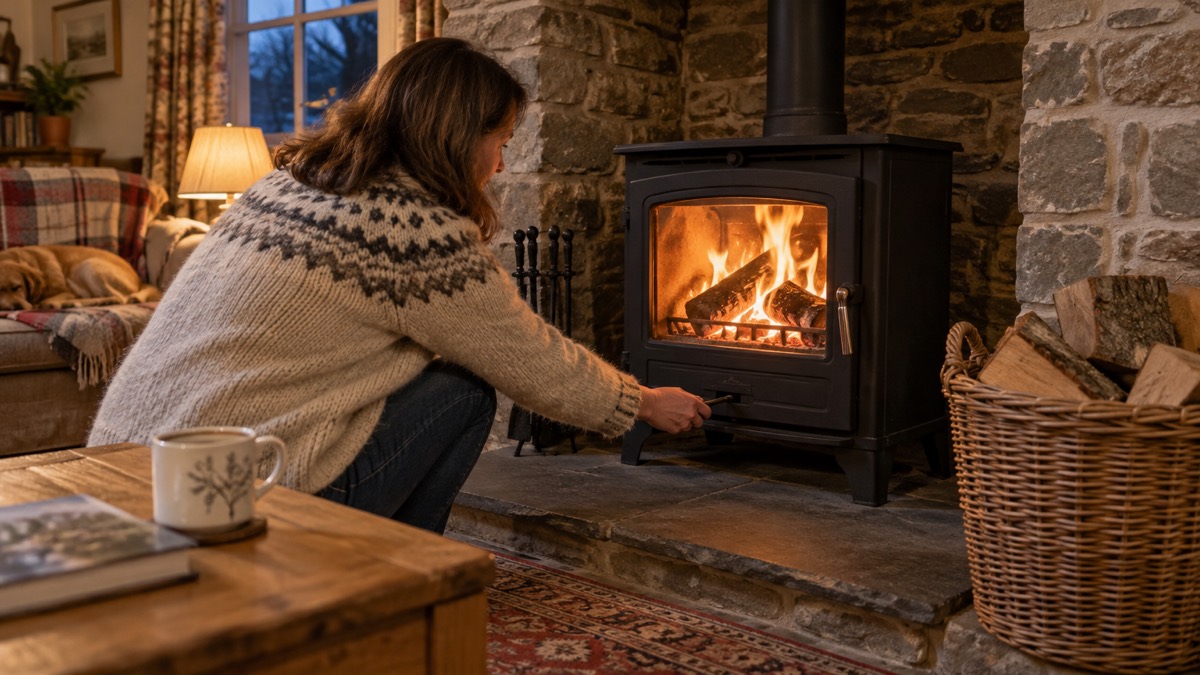
A wood burner is one of the safest ways to heat a room in a power cut, but only if it is used safely and within the rules that apply to it. The one requirement the research states firmly is the alarm rule: building regulations require that whenever a new or replacement fixed solid fuel or wood/biomass appliance is installed in a dwelling, a carbon monoxide alarm must be fitted in the same room as the appliance1. Everything else on this page builds on that requirement and on the wider safety advice from the fire and rescue services and the NHS.
Mid and West Wales Fire and Rescue Service puts the reason plainly: enough air coming into the room and a clean chimney assist the burning process, and particles that escape into the room are hazardous to health, especially for anyone with a pre-existing respiratory illness1. Smoke in the room is not just a nuisance, it is a warning that something in the system is wrong, and the right response is to stop and find the cause rather than to carry on and hope it clears.
This page covers the practical safety of running a stove: what to do when smoke spills back, how air controls and flue draught interact, which fuel to burn, the carbon monoxide alarm rules for owners and renters, what the NHS says about sleeping near a stove left on, and why the "stove guard" devices you may have heard of are for electric hobs, not wood burners. For choosing a stove in the first place, see Wood Burners and Multi-Fuel Stoves in a Power Cut; for keeping the flue in order, see How Often a Chimney Should Be Swept and Checked.
If smoke comes back into the room, stop and find the cause
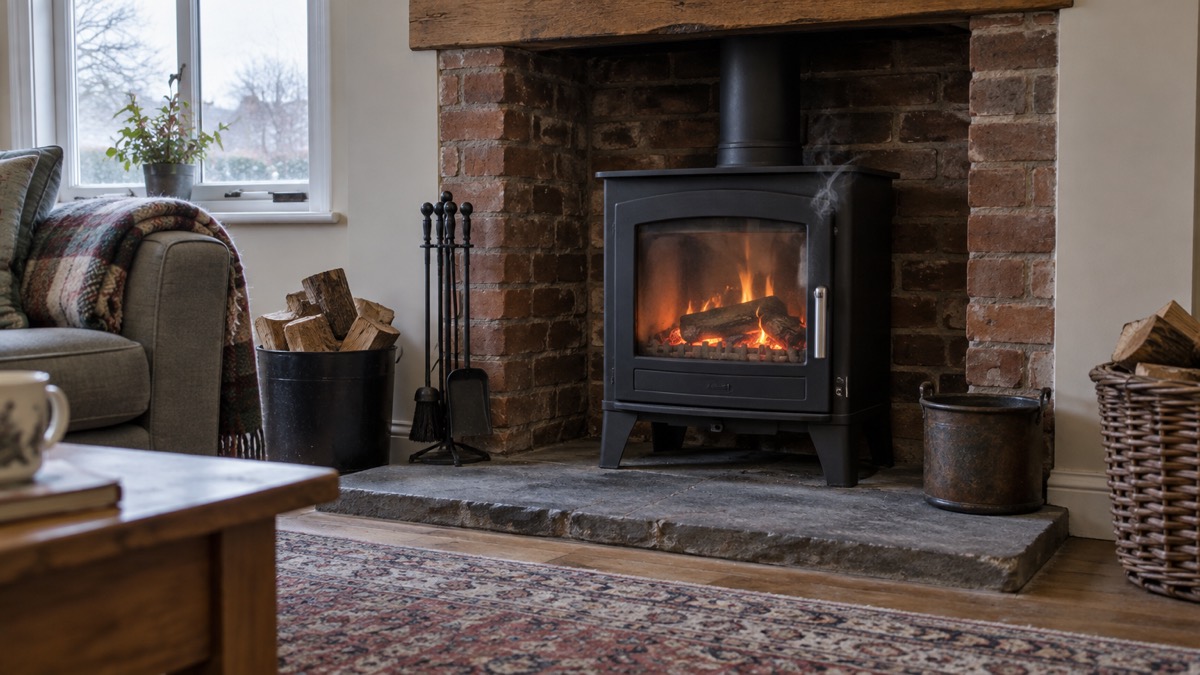
Smoke escaping from a stove door or vents into the living room is the single clearest sign that the stove is not working as it should. North Yorkshire Fire and Rescue Service lists "smoke is coming back into the room when the appliance is in use" as a reason to stop using the appliance and book a chimney sweep2. That instruction is worth following literally: do not keep feeding the fire to try to push the smoke back up, and do not open the door wide to "let it clear", because both add more smoke to the room.
The health reason is set out by Mid and West Wales Fire and Rescue Service. Particulate within the room has the potential to be hazardous to health, more so for those with a pre-existing respiratory illness, and the two things that keep it out of the room are enough air coming in and a clean chimney1. The Welsh-language version of the same guidance repeats it: plenty of air at all times and a clean chimney help the burning process and reduce airborne particles in the room8. If anyone in the household has asthma or another lung condition, treat any smoke spillage seriously and air the room before they spend time in it.
The usual causes sit in two groups: a blocked or dirty flue, and a fire that is not hot enough to drive a proper draught. A flue blocked with soot or deposits, or a chimney that has not been swept recently, gives the smoke nowhere to go. A fire that has been damped down for hours, or one burning wet wood, produces cooler, lazier smoke that can drift back into the room instead of rising. Oxford City Council's fuel campaign adds a specific check: make sure the ventilation system of your wood stove is clean and has no blockages, to prevent carbon monoxide build-up9.
What to do, in order:
- Stop using the appliance and book a chimney sweep if smoke comes back into the room when the appliance is in use2
- Make sure there is always enough air coming into the room and that the chimney is clean; airborne particles in the room can be hazardous to health, especially for people with a pre-existing respiratory illness1
- Check what you were burning: wet or unsuitable fuel is a common cause (see below)9
If smoke ever fills the room to the point that you need to escape, the London Fire Brigade's easy-read advice applies: smoke is poisonous, so keep low where the air is cleaner, get out, and stay out10. A chimney fire is a separate and more dangerous development; see Chimney Fires: Causes, Warning Signs and What to Do for the signs and the response.
Flue draught, air controls and why you should not shut everything down
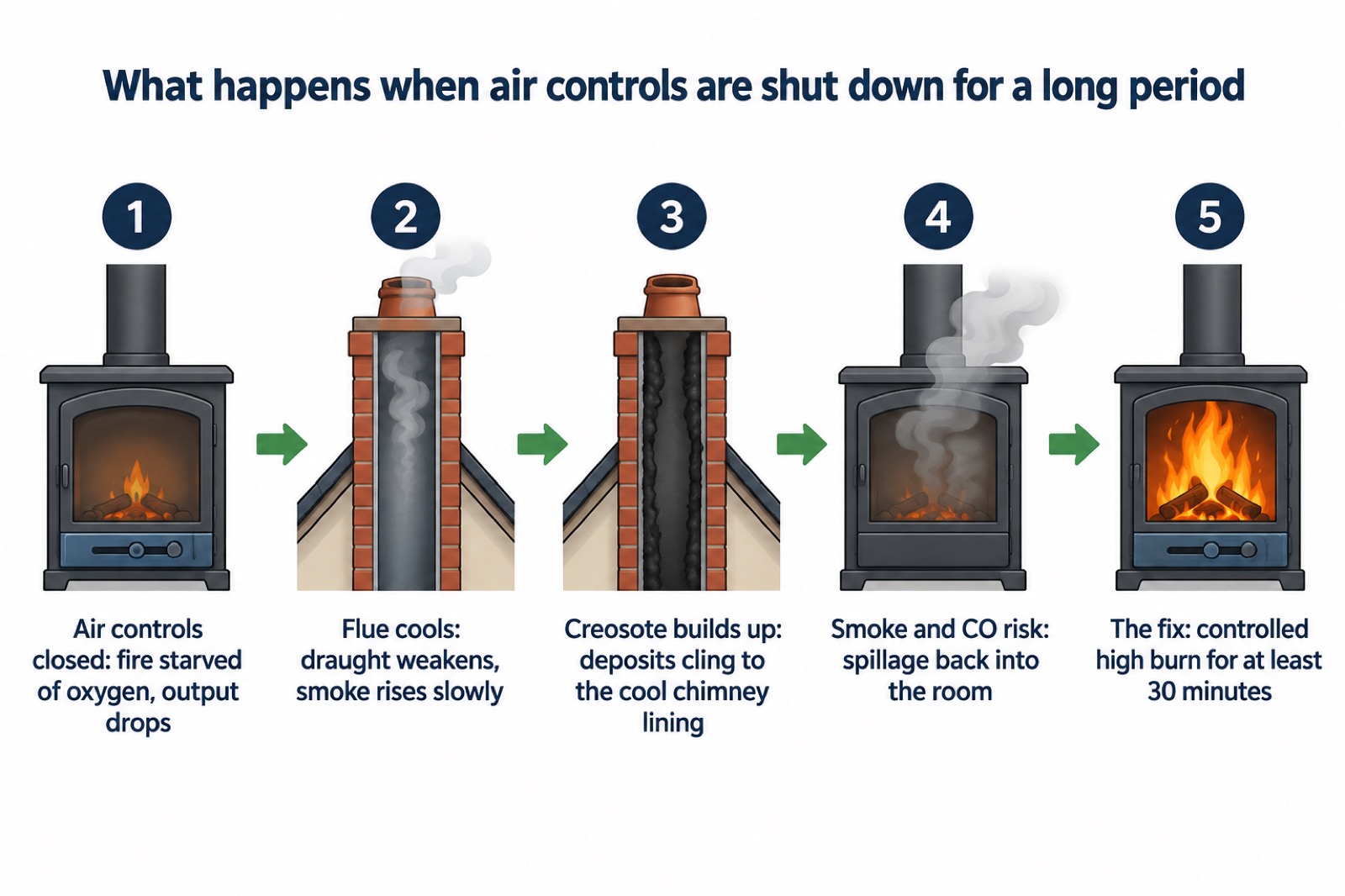
A stove works by pulling air through the fire and up the flue. The air controls are how you manage that flow, and the common mistake is treating them as an off switch. Shutting the controls fully for a long period starves the fire of oxygen, drops the flue temperature, weakens the draught and moves the fire towards exactly the cool, smoky, smouldering condition that pushes smoke and carbon monoxide back towards the room. The Scottish Fire and Rescue Service's chimney safety leaflet gives the practical correction: if the wood burner has been used at a low output for a long period, this should be followed by a controlled high burn for at least 30 minutes to dry out any creosote and to warm up the chimney again3.
That 30-minute high burn matters because a long low burn leaves deposits in the flue. Creosote and soot cling to the cool chimney lining, and those deposits are both a chimney fire risk and a restriction on the draught. A controlled high burn, with the air opened up and dry wood on the fire, dries them out and restores the pull. "Controlled" is the operative word: this is a hot, attended burn with the door closed, not a blaze left to itself.
The other half of the draught equation is the room itself. Mid and West Wales Fire and Rescue Service is explicit that there must always be enough air coming into the room1. A modern, well-sealed house with trickle vents closed and extractor fans running can starve a stove of air, and a starving stove is one that spills smoke and carbon monoxide. If your stove smokes when a kitchen extractor or bathroom fan is running, or when certain doors are closed, you have found the problem: the fan is pulling air out of the house faster than the stove can draw it in. Run the stove with the vents open, and if the problem persists, ask a registered installer whether the room needs additional ventilation.
The fuel side of draught is moisture. Wet wood burns cool, produces far more smoke and deposits, and undermines everything above. The UK government's Burn Better campaign sets the standard: wood sold in volumes of less than 2 cubic metres must have a moisture content of 20% or less, and if you source or buy wood in larger volumes you should use a moisture meter to check that moisture levels are 20% or less before burning4. Full detail on seasoning and testing is in Firewood: How Dry It Should Be and How to Season Logs.
Burn only the fuel your stove maker recommends
The fuel rules come from several official bodies and they all point the same way. Manchester Fire and Rescue Service: "Ensure you burn the correct fuel in open fires and wood burning stoves. Burning other materials can cause toxic fumes in the home, chimney fires and carbon monoxide poisoning"11. The Scottish Fire and Rescue Service adds a flat prohibition: household refuse must not be burnt3. Oxford City Council's fuel campaign says to use fuels from the certified list of manufactured solid fuels or dry untreated wood, and not to burn wet or treated, painted or glued wood9.
The reasons are concrete. Treated, painted or glued wood releases toxic fumes as it burns. Household rubbish burns unevenly, can flare, and leaves deposits that feed chimney fires. Wet wood wastes most of its energy boiling off water, cools the flue and produces the smoky, sluggish burn that causes spillage. Every one of these makes the stove less safe rather than more warm, and none of them saves money once you count the sweep's bill.
"Ensure you burn the correct fuel in open fires and wood burning stoves. Burning other materials can cause toxic fumes in the home, chimney fires and carbon monoxide poisoning."
A practical fuel checklist:
- Dry untreated wood, moisture content 20% or less, checked with a meter if you buy in bulk or season your own4
- Manufactured solid fuels from the certified list, which the government's Burn Better campaign recommends for less smoke and better heat efficiency4
- Nothing else: no household refuse, no painted, glued or treated wood, no random combustibles3
The same discipline applies to other heaters in the house. Warwickshire County Council notes for bio-ethanol burners that only the fuel specifically designed for them should be used, because alternative fuels can cause excessive smoke or heightened fire risk12. If you live in a smoke control area, the rules on what you may legally burn are stricter still; see Smoke Control Areas: What You Can Burn and Where, and for the full list of problem materials, What Wood and Rubbish You Should Never Burn.
A carbon monoxide alarm belongs in the same room as the stove
Carbon monoxide is the hazard that ties this whole page together. It has no smell, and a stove running short of air, on the wrong fuel, or with a blocked flue can produce it. The NHS warns that there is a risk of carbon monoxide poisoning when you sleep in a room where a conventional coal or gas fire, a log burner, a cooker, or a back burner is left on overnight13. The alarm is the only thing in the house that will tell you it is there.
The placement rule is consistent across the fire and rescue services. Lincolnshire Fire and Rescue: fit a CO alarm in all rooms containing fuel burning appliances, ensuring the alarm is able to be heard throughout your home, and consider keeping one in the bedroom14. Devon and Somerset Fire and Rescue Service: you should have an alarm in every room containing boilers, cookers, ovens, open fires or wood burners15. For a household with a wood burner, that means one alarm in the stove room as a minimum, and Warwickshire County Council recommends additional units for each floor, near sleeping areas, and in proximity to potential CO sources such as wood-burning stoves16.
The cross-government group on carbon monoxide reported in April 2026 that over 15 million households in England have CO alarms installed, and that dwellings with a solid fuel burning appliance, such as a coal fire or wood burning stove, were more likely, at 66 per cent, to have one in 202417. That figure cuts both ways: most stove-owning homes have an alarm, but a substantial minority still do not.
| Where | Who says it | The rule |
|---|---|---|
| Every room with a fuel-burning appliance | Lincolnshire Fire and Rescue5 | Fit a CO alarm; make sure it can be heard throughout the home |
| Every room with a boiler, cooker, oven, open fire or wood burner | Devon and Somerset Fire and Rescue15 | An alarm in every such room |
| Each floor, near sleeping areas, near CO sources | Warwickshire County Council16 | At least one, additional units recommended |
| Rented homes: rooms used as living accommodation with a fixed combustion appliance | Cherwell District Council18 | Positioned at head height, on a wall or shelf, roughly 1 to 3 metres from the potential source |
Choosing and testing carbon monoxide alarms
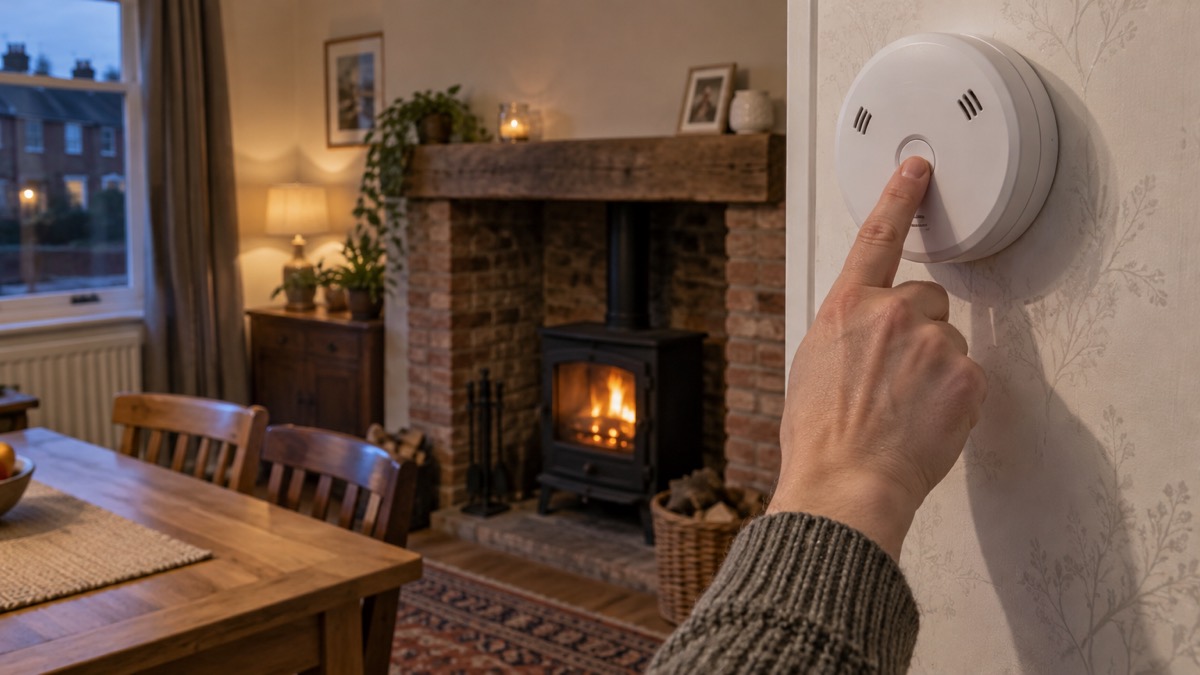
Buy on standard, not on price or design. North Yorkshire Fire and Rescue Service advises making sure the alarm complies with the British Standard EN 50291 and carries a British or European approval mark, such as a Kitemark6. Warwickshire County Council recommends battery-powered CO alarms that meet British Standard BS EN 50291, again looking for the BSI Kitemark12. Humberside Fire and Rescue Service, writing for caravans and boats, refers to alarms tested to BS EN50291-2 and kitemarked, which is the part of the standard covering those settings19. Lincolnshire Fire and Rescue also points buyers to the British Standard Kitemark and the Loss Prevention Certification Board (LPCB) symbols, which show the alarm is approved and safe5. Manchester Fire and Rescue Service gives the same Kitemark advice for smoke alarms, which are worth checking at the same time20.
A CO alarm is not a fit-and-forget item. Humberside Fire and Rescue Service's advice for caravans and motor homes applies equally at home: ensure there is a smoke and carbon monoxide alarm in place and that they are tested regularly19. Warwickshire County Council goes further on household readiness: ensure that all household members, including children, are aware of the sound and meaning of a CO alarm, respond promptly and evacuate safely, and regularly discuss CO safety and develop an emergency plan16. Everyone in the house should know what the alarm sounds like and what to do, in the same way they should know the smoke alarm drill.
A short buying and testing checklist:
- Standard: BS EN 50291 compliance, with a BSI Kitemark or equivalent British or European approval mark6
- Type: battery-powered alarms meeting BS EN 50291 are the usual household choice12
- Placement: head height, on a wall or shelf, roughly 1 to 3 metres from the stove18
- Testing: test regularly, and make sure everyone in the household knows the sound16
What to do if the CO alarm sounds
Warwickshire County Council gives the response in one line: leave your home, call 999, and seek medical attention, and do not re-enter until the property has been deemed safe by professionals16. This is not a "open a window and see how you feel" situation. Carbon monoxide displaces oxygen in the blood, and the NHS lists headaches, dizziness and nausea among the symptoms of exposure13. If the alarm sounds, or if anyone has those symptoms and you suspect CO, the order of actions is fixed:
- Get everyone out of the house16
- Call 99916
- Seek medical attention for anyone with symptoms16
- Do not go back in until professionals say it is safe16
Before the alarm ever sounds, the prevention is everything else on this page: the right fuel, enough air, a swept chimney, and a correctly installed stove. The NHS's specific warning about sleeping near an appliance left on overnight is covered next. For the wider picture of gas, CO and fire emergencies in the home, see Home Emergencies: Fire, Carbon Monoxide, Gas Leaks and Burst Pipes.
Sleeping with a log burner on: what the sources support
This is the question households most want answered, and the honest answer is that the official sources advise against sleeping in a room with the stove left on. The NHS states that there is a risk of carbon monoxide poisoning when you sleep in a room where a conventional coal or gas fire, a log burner, a cooker, or a back burner is left on overnight13. The risk is not theoretical: asleep, you cannot smell smoke, notice spillage, or respond to early symptoms.
Ventilation and instruction-following are the two safeguards most likely to be skipped at bedtime, when the temptation is to bank the fire down, shut the air off and leave it. That is precisely the combination the NHS warning is about: a fire left burning overnight, a closed-up room, and someone asleep in it who cannot notice the early signs.
What the fire and rescue services do advise for bedtime is a controlled shut-down. London Fire Brigade: before you go to bed, make sure fires or hot embers are under control and guarded21. In practice that means letting the fire burn down, closing the stove door, and fitting a guard if embers could escape. North Yorkshire Fire and Rescue Service's chimney safety campaign makes the CO alarm the bedtime companion of that routine: install a carbon monoxide alarm in every room which has appliances that burn fossil fuels22, and Warwickshire County Council suggests keeping alarms near sleeping areas16.
If your reason for wanting the stove on overnight is staying warm during a power cut, the safer pattern is to warm the room and the bed before you sleep, then let the stove die down. Our pages on Keeping One Room Warm When the Heating Fails and Clothing and Bedding to Stay Warm in a Cold Home cover the rest of that approach.
Landlords and carbon monoxide alarms in rented homes
If you rent, the law does most of this for you. The Fire Kills campaign states the duty plainly: the law requires landlords to ensure there are carbon monoxide alarms in any room used as living accommodation which contains a fixed combustion appliance, excluding gas cookers, and to check they are working at the start of the tenancy23. Manchester Fire and Rescue Service gives tenants the same account under the Smoke and Carbon Monoxide Alarm (Amendment) Regulations 2022: your landlord must ensure a carbon monoxide alarm is equipped in any room used as living accommodation which contains a fixed combustion appliance, excluding gas cookers24. Devon and Somerset Fire and Rescue Service confirms that landlords are required by law to install working smoke and carbon monoxide alarms in their properties25.
A wood burner is a fixed combustion appliance, so a rented living room with a stove in it needs a CO alarm by law. Lincolnshire Fire and Rescue spells out the England-wide position: all landlords of private residential rental properties in England are required by law to install a carbon monoxide alarm in any room that contains a solid fuel burning appliance, such as coal or wood burning fires and stoves5. Wiltshire and Swindon Prepared gives the same England-specific rule26. The cross-government group records that this duty for solid fuel appliances dates from October 201517.
The detail on positioning comes from Cherwell District Council's housing standards guidance: carbon monoxide alarms should be installed in every room which is used as living accommodation containing a fixed combustion appliance (excluding gas cookers), positioned at head height, either on a wall or shelf, approximately 1 to 3 metres away from a potential source of carbon monoxide18. Cherwell also advises landlords to choose alarms compliant with British Standards BS 50291, and notes that landlords of houses in multiple occupation have additional fire safety responsibilities and should select and maintain their alarm systems in accordance with their fire risk assessment18.
Two things stay with the tenant. First, the start-of-tenancy check: North Yorkshire Fire and Rescue Service advises landlords to check the alarms are in working order at the start of any new tenancy27, and the Fire Kills campaign adds that landlords must provide smoke alarms but you, the tenant, are personally responsible for making sure they continue to work after the initial test23. Second, the smoke alarm baseline: your landlord must ensure at least one smoke alarm on each level of the home where there is a room used as living accommodation24, and North Yorkshire Fire and Rescue Service reminds tenants in private rented accommodation that smoke alarms should be fitted by the landlord on each level, which may differ in a block of flats and should be outlined in your tenancy agreement27.
| Duty | Who holds it | Source |
|---|---|---|
| Provide a CO alarm in each living-accommodation room with a fixed combustion appliance (excluding gas cookers) | Landlord, by law | 23 |
| Check alarms work at the start of each tenancy | Landlord | 23 |
| Keep alarms working after the initial test | Tenant | 23 |
| Provide at least one smoke alarm on each level | Landlord, by law | 24 |
| Additional alarm duties in HMOs | Landlord, per fire risk assessment | 18 |
Installation and repairs: use a HETAS-registered engineer
A stove that is safe in one room can be dangerous in another, because safety depends on the flue, the hearth and the ventilation as installed. Devon and Somerset Fire and Rescue Service's carbon monoxide guidance is blunt: never attempt to install or service appliances yourself, and use a reputable, registered engineer25. For solid fuel appliances, the registration scheme it names is the Heating Equipment Testing and Approval Scheme, HETAS: anyone carrying out work on installations and appliances in your home must be registered with HETAS25. London Fire Brigade also directs households to HETAS for solid fuel appliances21.
The government's Burn Better campaign widens the list slightly for installation: get your stove installed by an installer registered on a competent person scheme certified by one of the following organisations: HETAS, APHC, BESCA, Certsure, NAPIT or OFTEC4. A registered installer's work meets the building regulations without you needing a separate building control application, and the installer takes responsibility for the safety-critical parts: the flue, its lining, the hearth and the air supply. The same logic applies to repairs. If the stove smokes, if the door seal fails, or if the flue needs attention, that is work for a registered engineer, not a weekend job.
For a household building resilience before winter, the sequence is: registered installation, an annual service by the same standard, a chimney swept at the recommended interval, and a CO alarm fitted in the stove room. Our Before-Winter Checklist for Your Heating and Stove pulls those steps together.
Stove guards are for electric hobs, not wood burners
The word "stove guard" causes real confusion, because the devices sold under that name have nothing to do with wood burners. Manchester Fire and Rescue Service describes them precisely: stove guards use a heat sensor to cut the power to the cooker to prevent a fire, and they can be installed to any electric hob or cooker28. A sensor is mounted on the wall behind the hob or cooker, or on the cooker hood, or on the ceiling; it monitors the hob, sensing heat, the rise in heat, smoke, steam and human presence; and if it detects a dangerous situation it instructs the power control unit, fitted between the power output and the hob, to cut the power28. A wood burner has no power supply to cut, so none of this applies to it.
Stove guards do have a real place in the wider safety of a household, particularly where someone's circumstances make cooking risky. Manchester Fire and Rescue Service notes they can be particularly useful in homes where using the hob becomes high risk due to conditions such as Alzheimer's and dementia, disabilities or learning difficulties28. North Wales Fire and Rescue Service describes the Stoveguard Cooker Isolator as a smart device for electric hobs and cookers whereby the hob is scanned by a sensor and the power isolated before a fire breaks out if unattended oil or hot cooking is detected29. The guard cuts power if food has started to burn or a pan has boiled dry, if the temperature is becoming dangerously high or rising too quickly, if the hob has been left unattended, or if it is inadvertently left on after cooking has finished28. Manchester Fire and Rescue Service advises anyone considering one to investigate the different options and ensure it is fitted by a qualified specialist28.
| Feature | Stove guard (electric hobs) | Fire guard (wood burners) |
|---|---|---|
| What it is | A heat sensor plus power control unit28 | A physical barrier around the stove3 |
| What it fits | Any electric hob or cooker28 | Guards suited to the stove's design3 |
| What it does | Cuts power before a cooking fire starts28 | Stops hot embers and children reaching hot surfaces3 |
| Who it suits | Households where hob use is high risk28 | Any household with children, or with embers at bedtime22 |
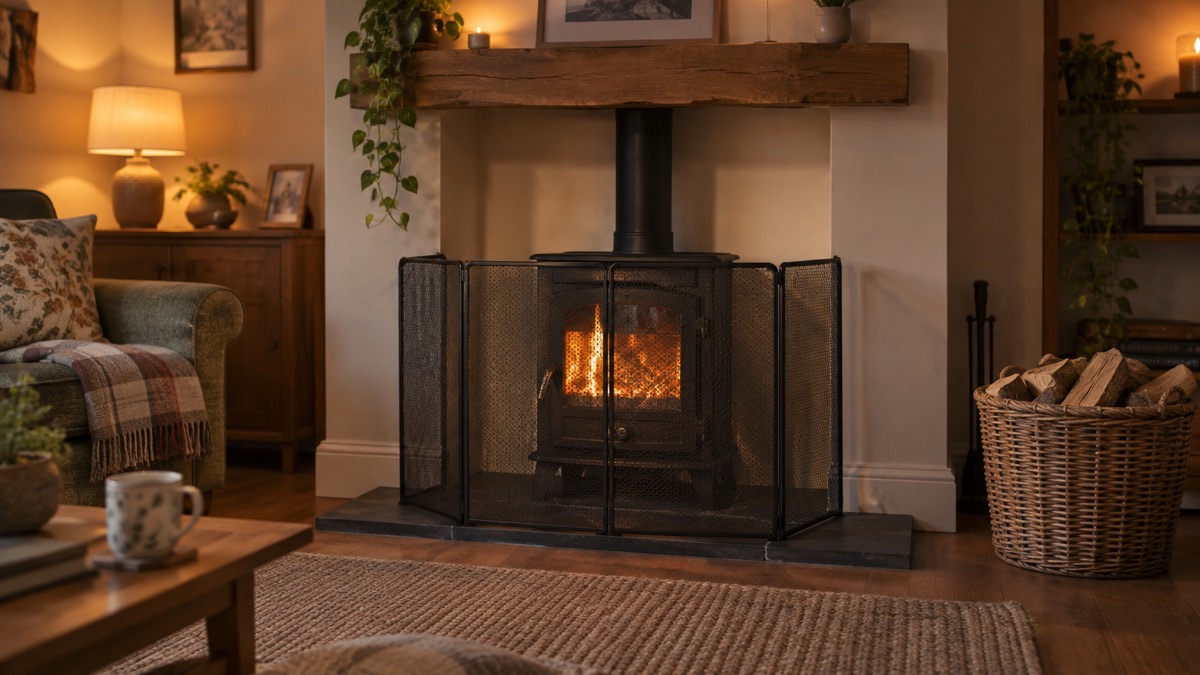
For a wood burner, the equivalent protection is a fire guard, and the sources are clear about when it is needed. The Scottish Fire and Rescue Service advises that children should be educated about the dangers of fire and should not be permitted near hot surfaces, and that you should use a protective fire guard suited to the design of the stove within your property3. Mid and West Wales Fire and Rescue Service says the same: children should be taught about fire dangers and not allowed near hot surfaces or the stove door, with a protective guard that suits the stove's design8. North Yorkshire Fire and Rescue Service's chimney safety campaign adds the ember argument: a fireguard helps prevent hot embers from escaping and igniting carpets or furnishings22.
One related rule belongs here because it involves children and combustibles. Mid and West Wales Fire and Rescue Service warns: do not stack logs or place any other combustible materials immediately adjacent to the stove or boiler, because the service has been called to fires caused as a result of logs being stored against the hot external surface of wood burners1. The basket of logs beside the stove is a familiar picture and a real hazard; keep the fuel store well back from the hot surfaces.
Stove guards and telecare
Where a household receives telecare support, the two systems can work together. Manchester Fire and Rescue Service notes that stove guards can connect to telecare, enabling staff to be alerted when the power has been cut to protect the resident28. The London Fire Brigade makes the broader case for linking alarms to telecare: by linking fire alarms to telecare as standard, delays in calling the Brigade are limited, reducing the likelihood of injury or death occurring as a result of a fire30. The Brigade also cautions that the standard "box and button approach" to telecare, where one lifeline and one pendant are provided to vulnerable people, is ineffective when it comes to life protection, according to fatal fire reviews30. If you or someone you support uses telecare, ask the provider about linking alarms, and remember that the telecare-linked stove guard protects the electric hob, not the wood burner.
Where to get help
Northern Ireland Fire and Rescue Service publishes home fire safety guidance covering alarms and the main causes of fire31. If you need extra help during an emergency, see Extra Help in an Emergency: Older, Disabled and Medically Dependent Households.
A chimney sweep booked at the recommended interval keeps the flue working; see How Often a Chimney Should Be Swept and Checked. And in any emergency involving fire or suspected carbon monoxide, the instruction is the same one that runs through this page: get out, call 999, and stay out until professionals say it is safe16.
Sources (31)
- Chimneys, open fires and wood burning stoves, Mid and West Wales Fire and Rescue Service
- Chimney fire safety, North Yorkshire Fire and Rescue Service
- Chimney safety leaflet, Scottish Fire and Rescue Service, January 2024
- Burn Better, UK Air, Defra
- Fire alarms and carbon monoxide detectors, Lincolnshire County Council
- Smoke and carbon monoxide alarms, North Yorkshire Fire and Rescue Service, 20 February 2026
- Safe home heating, Warwickshire County Council
- Simneiau, tanau agored a stofiau llosgi pren, Mid and West Wales Fire and Rescue Service
- Fuel Good campaign, Oxford City Council
- Easy read fire safety booklet, London Fire Brigade
- Stay fire safe, Manchester Fire and Rescue Service
- Safe home heating, Warwickshire County Council
- Carbon monoxide, Doncaster and Bassetlaw Teaching Hospitals NHS Foundation Trust
- Carbon monoxide safety | London Fire Brigade, London Fire Brigade
- Stay warm safely this winter, Devon and Somerset Fire and Rescue Service
- Smoke alarms and CO detectors, Warwickshire County Council
- Cross-government group on carbon monoxide safety report, Health and Safety Executive, April 2026
- Housing standards, Cherwell District Council
- Caravan, motor home and campervan safety, Humberside Fire and Rescue Service
- Smoke and heat alarms, Manchester Fire and Rescue Service
- Portable heaters, gas fires and open fires, London Fire Brigade
- Chimney fire safety week, North Yorkshire Fire and Rescue Service, 8 September 2026
- Fire Kills prevention advice, Fire Kills campaign, 25 March 2026
- Additional advice for tenants, Manchester Fire and Rescue Service
- Carbon monoxide, Devon and Somerset Fire and Rescue Service
- Carbon monoxide: the silent killer, Wiltshire and Swindon Prepared
- Student and rented accommodation, North Yorkshire Fire and Rescue Service, 21 September 2026
- Cooking fire safety devices, Manchester Fire and Rescue Service
- Support for vulnerable people: interventions, North Wales Fire and Rescue Service
- Alarms for carers and support workers, London Fire Brigade
- Home fire safety, Northern Ireland Fire and Rescue Service
 Before-Winter Heating Checks
 Backup Stove Kit Checklist
 Wood Burner Lighting Kit
 Keeping One Room Warm
 Clothing and Bedding for Cold
 Stopping Draughts
 Hot Water Bottle Safety
 Wheat Bags and Fire Risk
 Electric Blanket Safety
 Portable Heater Types
 Portable Heater Safety
 Wood Burners in a Power Cut
 Open Fires and Fire Guards
 Firewood and Seasoning Logs
 Smoke Control Areas