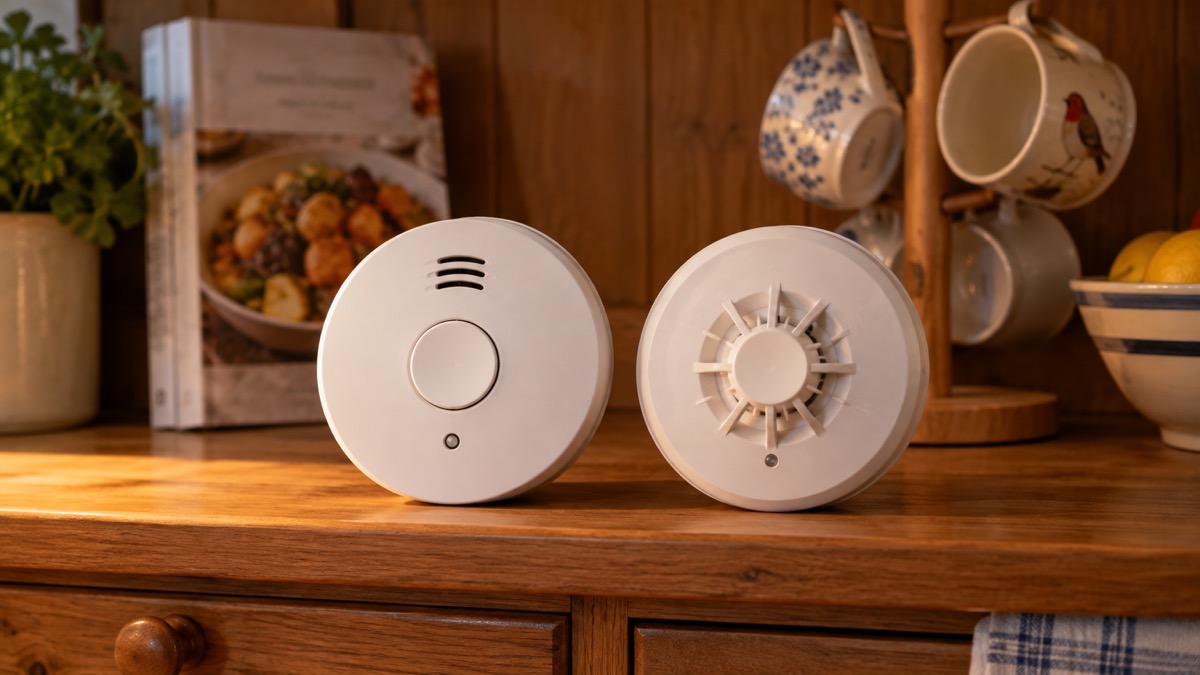
A smoke alarm is the single most important piece of fire safety kit in your home, and the standard every fire and rescue service repeats is simple: at least one working smoke alarm on every floor, and a heat alarm in the kitchen1. You are around 10 times more likely to die in a fire if you do not have a working smoke alarm, according to Cheshire Fire and Rescue Service2. Devon and Somerset Fire and Rescue Service recommend alarms in the hallway, at the top of the stairs, and in bedrooms or other sleeping areas3.
Choosing one comes down to three decisions: the sensor type (optical, ionisation, heat or a combination), the power source (a sealed 10-year battery or mains power), and whether the alarms interlink so they all sound together. This page walks through each choice in turn, then covers where alarms should and should not go, the safety marks to look for, how to test and maintain them, and the specialist alarms available for people who are deaf, hard of hearing or have limited mobility.
How many alarms, and where they belong
Every home should have a minimum of one working smoke alarm per floor, and a heat alarm in the kitchen1. That is the floor of the advice, not the ceiling. Devon and Somerset Fire and Rescue Service recommend a smoke alarm in the hallway and one at the top of the stairs, and suggest you could also have them in bedrooms and other rooms where people sleep3. nidirect's home fire safety advice goes further still: think about extra alarms in the most used rooms, such as living rooms and bedrooms8.
The reason for the kitchen rule is practical. Smoke alarms react to smoke and steam, and a kitchen produces both every day, so a smoke alarm there will sound when nothing is wrong. A heat alarm senses the rapid rise in temperature of a real fire instead, which is why it is the recommended alarm for the kitchen4. Our page on heat alarms covers how they work in more detail, and how many smoke alarms a house or flat needs works through the count for different homes.
North Wales Fire and Rescue Service's guidance for people with dementia makes a point worth holding on to in any home: smoke alarms are not needed in every room, and are best fitted in hallways and at the top of stairs9. The aim is coverage of the escape routes and the places where a fire is most likely to start or where you sleep, not an alarm on every ceiling.
The four sensor types, and which rooms they suit
Warwickshire County Council identifies four main types of smoke alarm on the market: ionisation, optical (also described as photoelectronic), heat, and combined units that pair optical smoke and heat sensing, or smoke and carbon monoxide detection10. They are not interchangeable, and matching the type to the room is what stops false alarms without losing protection.
| Type | What it senses | Best at detecting | Recommended rooms |
|---|---|---|---|
| Ionisation | Smoke particles | Fast, flaming fires that burn fiercely11 | Landings10 |
| Optical (photoelectronic) | Smoke scattering a light beam | Smouldering, smoky fires | Bedrooms, living rooms, hallway10 |
| Heat | Rise in temperature | Fire heat, not smoke or steam | Kitchen1 |
| Combined optical and heat | Both smoke and heat | Fire faster, with fewer false alarms | Any room needing both7 |
Ionisation alarms are widely stocked and very sensitive to fires that burn fiercely11. Manchester Fire and Rescue Service notes that ionisation sensor technology is typically more effective at detecting fast, flaming fires12. Optical alarms suit the rooms you live and sleep in: Warwickshire recommends optical smoke alarms, or combined optical smoke and heat alarms, for bedrooms, living rooms and the hallway, with ionisation or combined alarms for landings10.
Combined optical smoke and heat alarms put both sensors in one unit, which Cornwall Fire and Rescue Service describes as reducing false alarms while increasing the speed of detection7. There are also combined smoke and carbon monoxide alarms10, which we cover below. If you are weighing the two smoke sensor types against each other, our optical or ionisation comparison sets them out side by side.
Staffordshire Fire and Rescue Service give a single recommendation that compresses most of this into one purchase: if possible, fit an optical multi-sensor smoke alarm with a ten-year life span, a sealed battery compartment and a British Standard Kitemark6.
Sealed 10-year battery or mains power
Once you have chosen the sensor type, the next decision is how it is powered. There are two main options, and both are endorsed by fire and rescue services.
A sealed 10-year battery alarm carries its own long-life battery, which cannot be removed and is designed to last the life of the alarm. Lincolnshire Fire and Rescue's advice is blunt: ten-year sealed battery smoke alarms are the best option, slightly more expensive to buy but saving the cost of replacing batteries4. Staffordshire Fire and Rescue Service agree, noting you can buy alarms fitted with sealed 10-year batteries6, and the Northern Ireland Fire and Rescue Service advises that if you are purchasing a battery alarm, you should consider one with a sealed long life (10yr) battery13. North Yorkshire Fire and Rescue Service, which supplies alarms to households, fits exactly this kind: alarms with 10-year batteries that cannot be removed14.
Mains-powered alarms are wired into your home's electricity supply and have a back-up battery in case of a power cut. Suffolk Fire and Rescue Service's guidance notes they need to be installed by a qualified electrician5. nidirect adds that mains-linked smoke alarms contain a nine-volt back-up battery that needs to be changed according to the manufacturer's instructions15.
| Sealed 10-year battery | Mains-powered | |
|---|---|---|
| Installation | Screw to the ceiling yourself | Qualified electrician5 |
| Battery | Sealed, lasts the life of the alarm6 | Nine-volt back-up, changed per the maker's instructions15 |
| In a power cut | Unaffected | Back-up battery keeps it working5 |
| Lifespan | Replace the whole alarm after 10 years7 | Replace after 10 years7 |
The older style, basic alarms running off nine-volt replaceable batteries, still exists. Dorset and Wiltshire Fire and Rescue Service note these should be replaced on a regular basis11, and North Yorkshire Fire and Rescue Service advises replacing the batteries every year in alarms with removable batteries14. If you are choosing between the battery approaches, our sealed or replaceable battery comparison goes deeper, and battery or mains smoke alarms weighs the power sources.
What happens in a power cut
A mains-powered alarm does not go silent when the lights go out: it switches to its back-up battery, which is the whole point of the design5. That back-up battery is a nine-volt unit that needs changing according to the manufacturer's instructions15, so a mains alarm is only as reliable as its back-up. If you want an alarm with nothing to depend on but itself, a sealed 10-year battery alarm is unaffected by any power cut. Our power cuts guide covers the wider household picture when the supply fails.
Interlinked alarms: why they all sound together
Interlinking is the feature that turns a set of individual alarms into one system. Some battery or mains alarms can be interlinked so that when one alarm detects a fire, they all go off together, giving a warning wherever you are in the home16. Cornwall Fire and Rescue Service describe it simply: some alarms connect to each other so that, when one senses smoke, all the alarms sound7.
Devon and Somerset Fire and Rescue Service recommend considering an interlinked alarm system to ensure smoke alarms are heard in all rooms of the house17, and Dorset and Wiltshire Fire and Rescue Service note that interconnecting or linking alarms are useful in larger properties and for people who are D/deaf or hard of hearing11. For people with mobility issues that may prevent or delay escape, interlinked alarms give the earliest possible warning wherever the fire starts18.
In Scotland the expectation is firmer. The Scottish Fire and Rescue Service's guide states that the requirement is to have all smoke and heat alarms interlinked19, and the Northern Ireland Fire and Rescue Service notes that ideally alarms should be hardwired and interlinked, which is a legislative requirement for rented accommodation13. Our page on interlinked alarms explains how linking works, and wireless or wired interlinked alarms compares the two ways of doing it.
Where to fit an alarm, and where it must not go
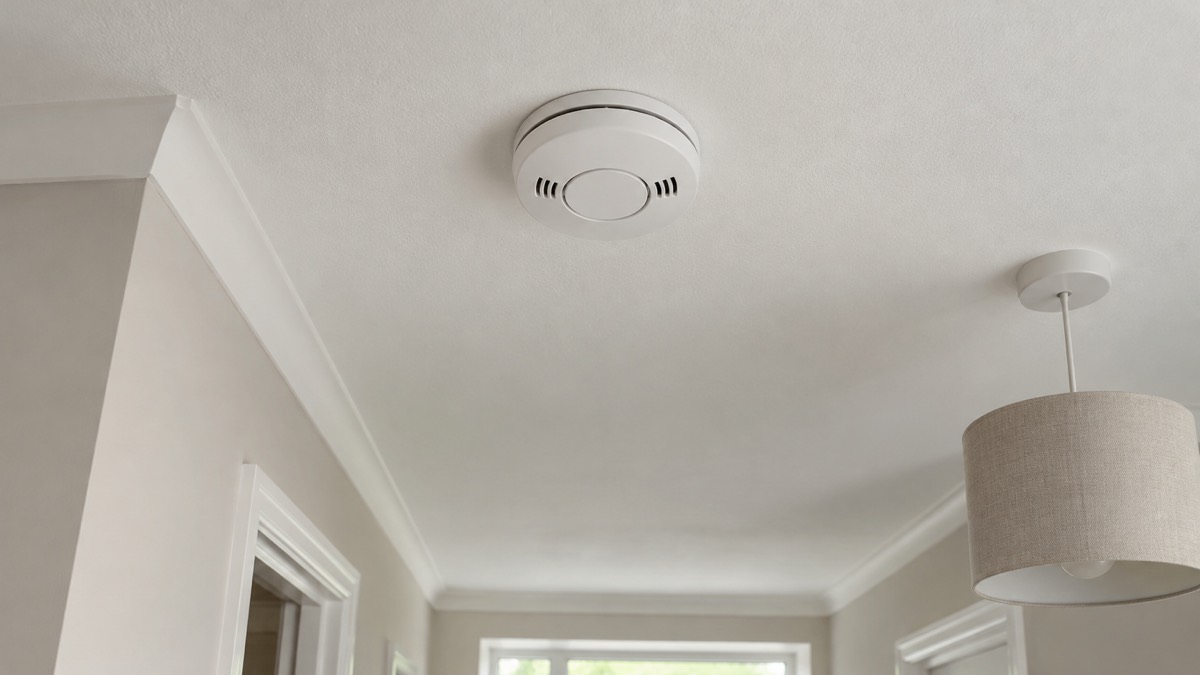
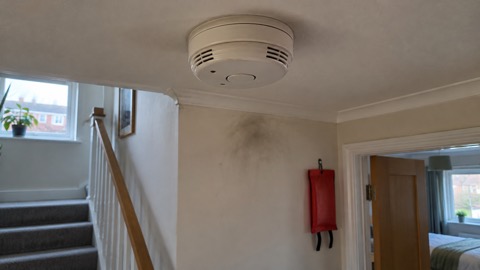
Position matters as much as type. The rule repeated across fire and rescue services is consistent: smoke alarms should always be mounted on the ceiling, near the middle of the room or hall, and at least 30cm (one foot) away from a wall or light fitting3. Staffordshire Fire and Rescue Service add that the alarm should be fitted as close to the centre of the room as possible6, and Suffolk Fire and Rescue Service's factsheet says alarms should be screwed into the ceiling, at least 30cm (12 inches) from any wall or light fitting, as close to the centre of the room, hallway or landing ceiling as possible20.
For rented homes, Cherwell District Council's housing standards follow the same pattern: at least one smoke alarm on every storey used as living accommodation, fixed to the ceiling in a circulation space, meaning a hall or a landing21.
On a sloped ceiling, sit the alarm at the highest point. North Wales Fire and Rescue Service's alarm siting guidance states that alarms in rooms with sloping ceilings should be sited at the highest point of the ceiling22.
Rooms where a smoke alarm does not belong
Do not fit smoke alarms in kitchens or bathrooms, where smoke or steam could set them off accidentally; install a heat alarm in the kitchen instead3. North Wales Fire and Rescue Service's dementia fire safety guidance gives the same reason in plainer terms: heat and vapour from cooking and bathing can set smoke alarms off unnecessarily9. A nuisance alarm is not just annoying; it is the start of a habit of ignoring or disabling the alarm, which is the danger. Our page on stopping smoke alarm false alarms deals with the problem directly.
Safety marks to look for
When you buy, look for certification marks on the alarm and its packaging. Lincolnshire Fire and Rescue Service advise looking out for the British Standard Kitemark and the Loss Prevention Certification Board (LPCB) symbols, which show the alarm is approved and safe4. Manchester Fire and Rescue Service put it more shortly: whichever model you choose, look out for one which has a British Standard Kitemark symbol12.
Suffolk Fire and Rescue Service's factsheet specifies the standard behind the mark: smoke alarms should meet the British Standard BS 5446 Part 1 and carry the Kitemark20. For rented homes, Cherwell District Council expects alarms compliant with British Standards BS 5839-621. Our page on alarm standards explains what these standards mean and how they differ.
The same discipline applies to carbon monoxide alarms: Devon and Somerset Fire and Rescue Service say to make sure the alarm meets British Standard EN50291 and ideally carries the British Standard Kitemark23, and North Yorkshire Fire and Rescue Service advise checking it complies with British Standard EN 50291 and carries a British or European approval mark, such as a Kitemark14.
Testing, cleaning and replacing your alarms
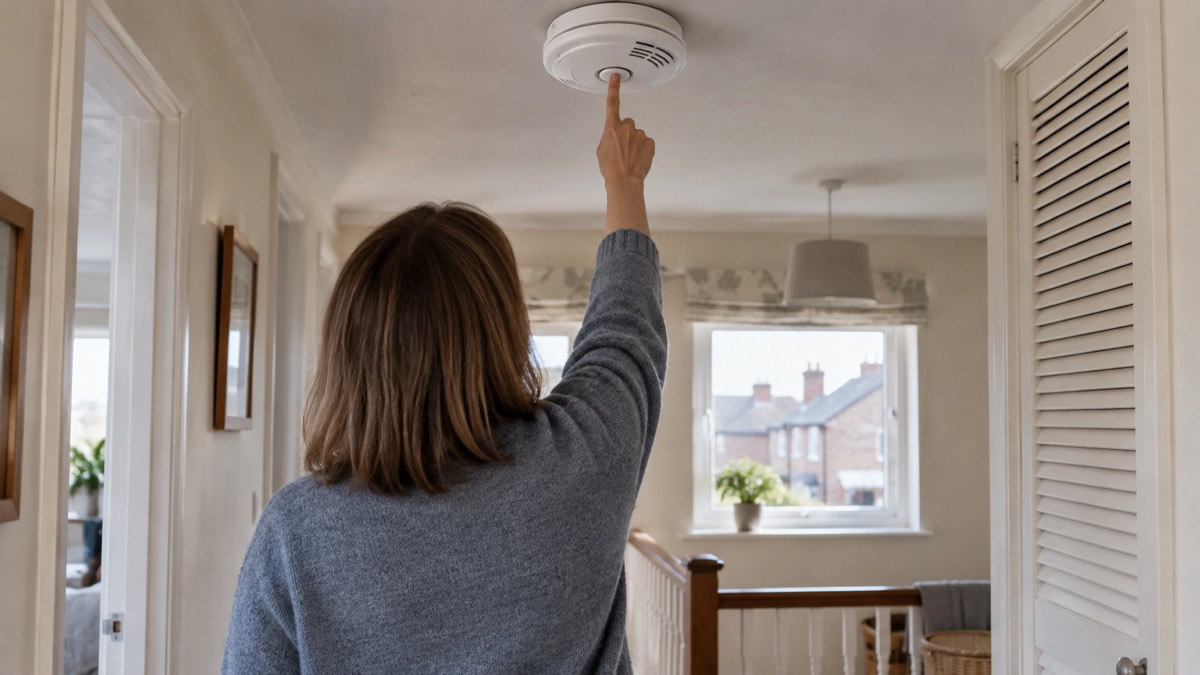
An alarm is only protection if it works, and the maintenance routine is short. Staffordshire Fire and Rescue Service's instruction is: test your smoke alarm every week, change the battery once a year unless it is a ten-year alarm, and after 10 years get a whole new alarm6. South Wales Fire and Rescue Service's reminder is the same on the first point: test your alarm weekly24.
If a smoke alarm starts to beep on a regular basis, replace the battery immediately5. In a hard-wired, mains-powered alarm, frequent little beeps are a sign that the back-up battery is failing2. If a mains alarm still beeps after the battery is changed, South Wales Fire and Rescue Service advise contacting a qualified electrician for advice and to check your electrical supply24.
Replacement is on a fixed clock: most smoke alarms need replacing after 10 years. Devon and Somerset Fire and Rescue Service add: check your warranty and replace your alarm every 10 years16. North Yorkshire Fire and Rescue Service supply alarms with a 10-year warranty, and give contact numbers for replacements during that period14.
Our pages on how often to test alarms, why a smoke alarm keeps chirping and when to replace an alarm cover each of these jobs in detail.
Alarms for deaf, hard of hearing and limited mobility households
A conventional smoke alarm works by emitting a loud noise when smoke is detected25, and a loud noise is no use to someone who cannot hear it. Surrey County Council's guidance is direct: people who are deaf or hard of hearing need additional ways of being made aware the alarm has been activated, including vibrating pads and flashing strobe lights25.
These specialist alarms exist and are available. Devon and Somerset Fire and Rescue Service explain that smoke alarms are available that use a strobe light and vibrating pads for people who are D/deaf or hard of hearing, following an assessment26. For anyone who is deaf or hard of hearing and lives alone, or with others who are also deaf or hard of hearing, Devon and Somerset Fire and Rescue Service say you can get a smoke alarm that uses a strobe light and vibrating pads placed under your pillow at night27. Cheshire Fire and Rescue Service's Safe and Well booklet confirms that strobe lights and vibrating pad alarms are available for people who are deaf or hearing impaired28. The Northern Ireland Fire and Rescue Service advise contacting your GP to arrange an assessment for sensory alarms with a vibrating pad and flashing light29.
For residents who are hard of hearing but not deaf, Oxfordshire's guidance suggests a simpler step: choose an alarm with an emergency light that comes on when the alarm is triggered30.
For people with limited mobility, the Northern Ireland Fire and Rescue Service advise fitting an alarm where they sleep29. Devon and Somerset Fire and Rescue Service note there are special smoke alarms for people who have conditions that may make escape difficult or who are vulnerable31. Our page on smoke and CO alarms for deaf and hard of hearing people goes through the options in full.
Devon and Somerset Fire and Rescue Service also advise talking it through with children: if you accidentally set off the alarm through cooking, talk calmly about what you are doing to silence it, and explain that if the sound was from smoke for another reason, you would get out in case there was a fire32.
Smoke alarms and carbon monoxide
A smoke alarm detects smoke. Carbon monoxide is a different danger entirely: an invisible gas with no smell and no smoke, so a smoke alarm will not detect it. nidirect's advice is to make sure that as well as smoke alarms, you also have a working carbon monoxide alarm8.
Devon and Somerset Fire and Rescue Service advise that carbon monoxide alarms should be fitted in all rooms containing solid fuel appliances, any gas appliances or paraffin heaters17, and note that carbon monoxide alarms are available from DIY and hardware stores23. Buy one that meets British Standard EN50291 and ideally carries the British Standard Kitemark23. Our carbon monoxide alarms guide covers choosing and siting them, and what to do if your CO alarm sounds covers the emergency itself.
If you rent: your landlord's duties
If you rent, the advice on this page still applies to your home. Where alarms are missing or faulty, raise it with your landlord or letting agent in the first instance. For questions about alarms in rented housing, contact your local council for more information.
Cornwall Fire and Rescue Service set out the same duties: smoke detectors on each floor of the premises, and a carbon monoxide detector in any room used wholly or partly as living accommodation which contains a solid fuel burning combustion appliance33. Lincolnshire Fire and Rescue Service state it plainly for tenants: it is your landlord's responsibility to ensure working smoke alarms are fitted on every level of the property4. Landlords of houses in multiple occupation have additional fire safety responsibilities and should select and maintain their alarm systems in accordance with their fire risk assessment21.
If you are a tenant and an alarm is not working, tell your landlord: their duty to repair or replace is triggered once they are informed34. Our fire safety checklist for flats and the page on alarm rules in Wales and Northern Ireland cover the differences between the nations.
A free home fire safety check, and where to get help
You do not have to work all of this out alone. Fire and rescue services across the UK offer free home fire safety visits, and Manchester Fire and Rescue Service's Home Fire Safety Assessment is typical: if you are eligible for a visit, they may fit free smoke and heat alarms during it, depending on the fire risk1. Cheshire Fire and Rescue Service's advice to landlords and households alike is to install at least one smoke alarm on every floor where there is living accommodation2, and a visit is the easiest way to have that assessed by professionals.
If you care for someone who is vulnerable, our fire risk checks for a vulnerable person's home can help you prepare.
Once the alarms are up, the rest of your fire readiness follows the same pattern: a fire escape plan everyone knows, a bedtime routine of fire safety checks, and a clear idea of what to do if a fire starts. The alarm is the warning; the plan is what you do with it.
Sources (34)
- Home Fire Safety Assessment, Manchester Fire and Rescue Service
- Smoke alarms, Cheshire Fire and Rescue Service
- Advice for parents and guardians, Devon and Somerset Fire and Rescue Service
- Fire alarms and carbon monoxide detectors, Lincolnshire Fire and Rescue
- Fire safety in the home, Suffolk Fire and Rescue Service
- Smoke alarms, Staffordshire Fire and Rescue Service
- Smoke alarms, Cornwall Fire and Rescue Service
- Avoiding accidental fires in the home, nidirect
- Dementia fire safety, North Wales Fire and Rescue Service
- Alarms and sprinklers, Warwickshire County Council
- Smoke alarms, Dorset and Wiltshire Fire and Rescue Service
- Smoke and heat alarms, Manchester Fire and Rescue Service
- Other safety, Northern Ireland Fire and Rescue Service
- Smoke and carbon monoxide alarms, North Yorkshire Fire and Rescue Service
- Fire safety and prevention, nidirect
- Smoke alarms for vulnerable people, Devon and Somerset Fire and Rescue Service
- Fire safety for carers, Devon and Somerset Fire and Rescue Service
- Smoke alarms and heat alarms -Fire safety at home | London Fire Brigade, London Fire Brigade
- Your guide to fire safety, Scottish Fire and Rescue Service
- Smoke alarms factsheet, Suffolk Fire and Rescue Service
- Housing standards, Cherwell District Council
- Alarm advice sheet, North Wales Fire and Rescue Service
- Carbon monoxide, Devon and Somerset Fire and Rescue Service
- Smoke alarms, South Wales Fire and Rescue Service
- Smoke alarms, Surrey County Council
- Hearing and sight difficulties, Dorset and Wiltshire Fire and Rescue Service
- Fire safety for people with hearing difficulties, Devon and Somerset Fire and Rescue Service
- Safe and Well booklet, Cheshire Fire and Rescue Service
- Home fire safety, Northern Ireland Fire and Rescue Service
- Smoke alarms, Oxfordshire County Council
- Smoke alarms, Devon and Somerset Fire and Rescue Service
- Talk to your children about fire safety, Devon and Somerset Fire and Rescue Service
- Fire safety in rented accommodation, Cornwall Fire and Rescue Service
- Additional advice for tenants, Manchester Fire and Rescue Service
 Home Fire Safety Checklist
 Bedtime Fire Safety Checks
 Fire Risk Checks for Carers
 What to Do If Fire Starts
 How to Make a Fire Escape Plan
 Fire in a Block of Flats
 Kitchen Fires and Cooking Safety
 Electrical Fires and Sockets
 Smoking, Matches and Lighters
 E-bike Charging Safety
 Hoarding and Fire Risk
 Thatched Properties Fire Risk
 Fireworks and Bonfire Safety
 What to Do After a House Fire
 How Fire Services Respond